Home Blog Page 56

Angler Story of the Week: A Redfish & Rainbow Trout Road Trip

A note from Bentley Faulkner:

An out of the box idea that started months prior, came together at the beginning of 2023. One of my best friends Benny Gregg and I had been kicking around the idea of a multi-state road trip and put our respective home waters to the test.


Our trip started on the eastern coastline of North Carolina stalking redfish in gin clear water. We took advantage of the warm, windless days and got on some schooling redfish early. Benny was able to knock sight fishing a red off his bucket list. From there we teamed up with my buddy Timmy and really dialed the fish in. Over the next 6 days we landed 15+ Reds in schools as big as 100.

Flash forward, a few days later we stalked massive rainbows in the spring creeks coming out of the Shenandoah Valley, VA. Water levels were up and a winter warm front pushed into the Shenandoah providing a window into some serious streamer fishing.


Our good friend Drew Sorrells had a feeling all week that the streamer bite would be on. Benny who swears by nymph fishing, respectively put down the euro set up, and started chucking streamers. Not to say nymphs weren’t also doing their thing, we were also convinced these bigger migrational trout were going to be looking for a big fly with the current water levels and the weather patterns. All in all, it seemed to pay off. With the two largest trout of the week being caught on olive and copper streamers, a male rainbow at 24” and a female rainbow at 22 inches.”

Angler Story of the Week from Bentley Faulkner. Check out Bentley and his fishing endeavors on Instagram @bentley_faulkner, and his buddies Drew and Benny. If you’re going on a rad fly fishing trip and want to pitch us an article for the Angler Story of the Week segment, send us an email at nelson@theflylords.com and content@theflylords.com. 

Check out the articles below:

Flylords Original Series: Fly Shop Tour – ALL EPISODES NOW LIVE!

Reel of the Week: Monster Spring Creek Trout Hammers Cicada

Protections Reinstated for Alaska’s Tongass National Forest, America’s Salmon Forest

Wednesday, January 25th–Today, the U.S. Forest Service announced the reinstatement of the Roadless Rule in Tongass National Forest, protecting some 9.3 million acres of salmon habitat and old-growth forest from industrial activities. This news comes after a years-long effort to restore the Roadless Rule protections after they were rolled-back in 2020. The Tongass Roadless Rule prevents industrial clear-cut logging in North America’s largest remaining intact temperate rainforest and provides salmon, steelhead, and other wildlife with high-quality habitats.

“The Tongass’ wild and scenic landscapes are timeless, but its management practices were stuck in the past for far too long,” said Chris Wood, president and CEO of Trout Unlimited. “Today’s news brings hope for the future. A future where the national forest that produces more salmon than all others combined is conserved for the incredibly valuable and lasting resource that it is, and a carbon sink that slows the effects of climate change is left standing.”

This decision seeks to preserve the remarkable ecosystems of Southeast Alaska and maintain the sustainable tourism industry that is in large part built on the Tongass’ powerhouse ability to create strong runs of salmon and steelhead.

“This decision has been a long time coming,” said Austin Williams, Alaska legal and policy director for Trout Unlimited. “It’s so great to see the Forest Service move beyond unsustainable and damaging clear cut logging of old-growth forest and chart a path forward for the Tongass that recognizes roadless areas are critical to our local communities and economies, and to helping fight the effects of climate change.

In addition to restoring protections, the U.S. Forest Service will employ local Southeast Alaskans to cary out habitat restoration work. The people, communities, and tribes that rely on the Tongass can celebrate the restored stability in the region through the reinstatement of the Roadless Rule.

Picture by TU’s Josh Duplechian

The Lost Salmon, An Interview with Filmmaker Shane Anderson

We recently sat down with film-maker, Shane Anderson, to talk about his film “The Lost Salmon” and issues facing the incredible Spring Chinook. Shane’s film tells the story of Spring Chinook and how we are on the verge of losing them. Follow along to learn more about Shane Anderson, “The Lost Salmon,” and ways to save these incredible fish.


Flylords: Shane before we dive into the film, tell us a little bit about you, your background, etc.. 

Shane: I grew up in Olympia, Washington and was raised in a fishing family, my uncle is Kerry Burkheimer of CF Burkheimer Fly Rods, so fish and fishing have been a central part of my life and excitement.

I moved to Tahoe out of high school and became a professional skier at the beginning of the whole free skiing movement and didn’t fish for awhile until I broke my back at the 2000 X games. I then had two consecutive knee surgeries and ultimately ended up losing that career. The rivers called to me as a form a therapy and excitement in my life when I really needed it. I began making the annual pilgrimage to the Trinity and Klamath Rivers and caught the steelhead fever which eventually led to me going back to school at Humboldt State to study fisheries and then starting my film career with Wild Reverence: The Wild Steelheads Last Stand.  

Shane on the Klamath River, @JasonHartwick

Flylords: How did “The Lost Salmon” come to be? Was there one moment, when you thought “I’m going to make a film about springers?”

Shane: I’ve always been fascinated with the genetic side of salmon and steelhead and the importance of preserving wild genetics that have evolved to specific landscapes. I didnt grow up fishing for springers like a lot of people here in the PNW but when I moved back to Washington State I started to re-explore the rivers on the Olympic Peninsula by snorkeling in the summer. I was shocked with how few springers and summer steelhead were left in these rivers despite pristine habitats. Fast forward about 10 years and Dr. Mike Miller was staying at my house during a symposium for a proposed dam on the Chehalis River, and he was presenting his research with his wife Dr. Tasha Thompson. After staying up late talking salmon genetics, I wanted to make a short film about it. I had no intention then of making a feature film over two years.

Flylords: What makes these spring Chinook so prolific and special? 

Shane: Their evolutionary story and their incredible life histories and migration make them the king of all salmon. Sure, they are the best tasting salmon on earth  due to their high fat content, but it’s their story and relationship to place that give them a special place in my heart. Most salmon return in the fall and can all overlap with each other with often very short migratory windows. The fact that springers spend up to six months in freshwater can really bring a river to life.

These natural waterfall features are now understood to be essential for maintaining salmon genetics, @JasonHartwick

Flylords: Based on the film, it seemed like some of these populations are in a bit of a catch-22: genetic diversity will improve their resilience to climate change, but it is also causing fish to run at different times of the year with some devastating results. Care to expand on that?

Shane: Yeah, a prime example of anthropogenic effects changing genetic diversity and not in a good way. The way we have changed and re-engineered river systems has had devastating impacts genetically that we are just starting to learn more about with the discovery of the GREB 1L gene and how hybridization between spring and fall chinook is encouraging migrations in the summer which is the worst possible time for a salmon. The interbreeding of spring and fall-run fish is caused by changes in habitat which can include damming a river with no fish passage, changing hydrologic cycles of a river, changes in water temperatures from dams and the fish and wildlife agencies assault on waterfalls across salmon country. In the 1960’s Fish and Wildlife agencies in Washington, Oregon, California and other states had entire programs dedicated to the removal of waterfalls because they thought they blocked fish habitat, not knowing they were changing a very important separation barrier between fall and spring chinook. The fish evolved with waterfalls and ignorant good intentions altered millions of years of evolution. This is going to be hard and expensive to fix.

A springer making the jump, @JasonHartwick

Flylords: You covered many different river systems/distinct populations–were there any that really stuck with you?

Shane: I think what stuck out was the diversity of challenges facing all these diverse populations. The issues were so different everywhere we went. Spending a few days with Russ Thurow in the headwaters of the Salmon River in Idaho was amazing. It was super powerful to see those fish they call “The Mariners and Mountaineers” that swim over 900 miles and climb 6,500 ft past eight dams two different times in their lives. Those fish have so many odds stacked against them, and yet they are still here and not extinct. The reason they are not extinct and have survived is because of their genetic diversity. If genetics are the instruction manual for a species, written over millions of years, then these fish have developed an encyclopedia of information which has kept them alive. But time is running out, and it was sobering to hear that they could be extirpated in four generations, if we don’t get those four lower Snake River dams breached. 

Shane on the hunt, @JasonHartwick

Flylords: If you could sum it down to a sentence or two, how would you describe “The Lost Salmon?” 

Shane: A cautionary tale of how tinkering with nature can have indirect effects even with the best of intentions. 

All smiles, @JohnMcMillan

Flylords: This is a topic that I’ve been thinking more and more about, but can you describe (briefly, because I know how complex it is) the impact of certain offshore fisheries on salmon and steelhead populations?

Shane: It’s a very complex topic and something that needs to be addressed immediately–especially mix-stock fisheries, where endangered stocks are swimming with non-endangered stocks. This is what is happening off the entire west coast but especially in SE Alaska, which is like a nursery ground for salmon and steelhead. This is where they go and do laps to forage and mature. These mixed stock fisheries are not only having impacts on numbers but also on the size of salmon by harvesting fish that are not fully mature. The result after a nearly a century of mixed sock fisheries is our salmon, on average, have shrunk, and we have literally lost entire age classes. The only path forward for sustainable commercial fisheries for species with locally adapted genetics like salmon, is to return to place-based fisheries like Indigenous people did for thousands of years.  

An amazing tool for this type of sustainable fishing was developed by The Wild Fish Conservancy called a fish trap or pound net. They were able to create a 100% passive fishing tool that can release non-targeted species unharmed and harvest targeted species.  Here is a video I did last year about it: 

Once you loose that connection to place you loose that connection to protecting the species. I don’t see any of the commercial fleets advocating for dam removals, hatchery reform, or habitat restoration on our local rivers. They catch these fish far from home and have no connection to the place where the fish are from. 98% of the chinook harvested in SE Alaska are not from Alaska. Why don’t we have protected marine sanctuary nurseries for salmon? There are many freshwater rivers and creeks closed to fishing to protect the fish, but out in the open ocean they get no refuge. In some cases it could be as simple as the changing of a fishing season like the winter troll fishery in SE Alaska that intercepts a lof of our endangered stocks.  Then there is the trawler bycatch issue which is the most maddening of all. NOAA allows chinook bycatch in the the neighborhood of 50k kings a year in each one of the fishery zones while these factory ships are targeting your pollock (aka your fillet-o fish sandwich or fish stick or imitation crab), while our most cherished species are allowed to be killed by the thousands and thrown overboard wasted. 

Flylords: How can people watch the film and advocate for spring Chinook?

Shane: As far as the advocacy part goes, in general just watch out for public comment periods surrounding new Endangered Species Act listings. The Feds really need to incorporate this genetic information into policy and come up with a formal recovery plan. Another practical thing is to know where your salmon comes from that you consume, especially chinook and especially if that chinook is caught in the ocean and marketed wild. Until the commercial industry gets a better understanding of what it is catching and selling, I only eat chinook that I catch or I know where it came from. There’s plenty of hatchery chinook out there that need to be consumed and kept off the spawning grounds, so go eat them. Unfortunately they are branded as wild and thrown into the same category as our endangered wild stocks.

The film is now broadcasting on PBS across the country and streaming on the PBS passport app. If you want to watch it on the big screen, the film will continue to be screened at festivals this year including Wild and Scenic film fest. I will update on my IG @shaneandersonfilm and my website swiftwaterfilms.com.

A Beginner’s Ode to Surfperch

The waves lapping up against my leg while I was trying to cast were spinning me into a dimension of frustration I haven’t been in since I first picked up a fly rod. The coastal wind was howling, the sea spray was covering me with moisture, and the waves were deafening, silencing any positive emotion or sight, despite being on a beach. 

I put on my waders and wading boots, just like I would if I were in the mountains chasing trout, swinging flies for steelhead, or crawling into a drift boat to float the local river. I put on a top layer to keep warm. A hat to prevent sunburn, and polarized sunglasses to help with the glare. The two only differences from my usual daily fishing pattern were the waves continuing to pelt me, doing their best to erode my ego, and the stripping basket that I have been relentlessly peeling line into with nothing but seaweed and sand to show for it. 

I don’t know what I am doing, I don’t know what the tide is doing, and I don’t know why I am putting all this effort into trying to catch a fish the size of my palm. But the allure to add yet another species under my belt was too tempting, and the beach that I grew up at has had these fish my entire life. Not once in the 23 years since picking up a fly rod, have I even tried a cast into their waters. 

Researching these fish, they can be caught all year along the coast from Mexico to Canada. Anywhere a sandy beach resides, these fish swim and feed off of the crashing waves and moving tides spilling anything from its shores and into their tiny voracious mouths. From minnows and shrimp, to their favorite, sand crabs. As a kid I have caught these fish with spinners and live sand crabs in the gullies in between low and high tide. Now at the age of 34, at the local beach I grew up surfing and catching those early surf perch, imitating the live specimen with a tied fly from a local fly shop, my luck isn’t like my childhood memories.

Surprisingly, with more research, I found many anglers target these fish with extremely heavy rod, reel, and line setups. For a fish that some trout could arguably bully in a local lake or river because of their size, require a rod a full third larger. Anywhere from 6 to 8 weight rods with sinking lines are the norm for both the hectic winds that can ravage the west coast, and most importantly, the crashing waves that come from both the North and South Pacific. 

Being a fly fisherman, despite growing up in cookie cutter Southern California, I didn’t come from the money that the TV shows inaccurately painted for most of the residents that call the area home. So my semi-retired spey setup from steelheading this past winter has been the chosen weapon for the battle. Two handed rods have become increasingly popular by coastal anglers for their sheer ease of casting both for over head and two handed casts, and with the extra rod length to get the distance or stealth needed given the conditions. 

So with the waves stewing me into a pot of sand, salt, and seaweed, my surfperch patience has worn for the day, and I return to hit the internet hard to find answers for my frustrations. 

Turns out, perch are very similar to trout in the regard that fishing mid day during bright sunlight hardly brings the success of the early morning or late afternoon hours. Also, unlike trout but similar, the flow of water is very important. During spring, trout anglers deal with high and discolored water making fishing possible but more difficult than late summer when the water has receded. The same to be said for perch when the waves are large, the bite and cast, more importantly, your safety in large surf, is hardly worth it. While contrarily, the smaller the surf the more likely your health and bite situation. 

Tide also plays a role depending on your beach steepness and depth. Beaches south of Point Conception in Southern California typically have a more shallow beach and smaller waves making for easier casting for low tide conditions. Where north of Point Conception up to British Columbia, the beaches are much deeper with far more consistency to larger ocean waves for a higher to medium tide success rate. 

The weather can also dictate your day as mentioned with the lower light conditions being favorable, but also with rainy or overcast days perhaps producing more fish than sunny and bright days. 

All of this I am reading while still stewing from my unsuccessful day on the water, but now armed with hopefully the knowledge to hit the waves early with a lower tide and small surf to see what I can come up with. 

With an early morning fog, I stumbled down the bluff and onto one of the many state beaches that riddle the California Coast. The swell is small with a buoy reading just offshore at 1.4 feet @ 7 seconds. The tide is slowly going out and the coffee is giving me a pep in my step to start flying that sand crab and hoping my luck changes from sand and seaweed to something more lively.

I started to find rhythm in the waves for the first time since attempting to cast in surf. I grew up as a surfer and thought I was fairly good at reading the ocean. But it is a very different perspective sitting on your belly as a surfer opposed to standing on the beach just taking the crashing waves on your legs. But figuring out the slowly crashing waves towards me, I found that if I timed my cast to shortly after the wave broke, the fly would sit in the green water for a little longer and the wave wouldn’t bring my line towards me without stripping. A few times the day before and during this session, I did cast directly into the crashing wave and found no tension on my line from the momentum of the wave bringing the fly towards me. But during a lull in the waves, it was the best opportunity to get the fly out there with the recession of the latest wave crashing on shore and momentum heading back out to sea. 

With the water moving away from me, the tension on the line was good and I was able to put my rod under my arm pit and do the quick two handed retrieve. I am still very much a novice with this type of stripping and practicing in crashing waves is very difficult. But a few casts like this, timed with the receding water in between waves, the first strike occurred. 

I was blown away. It felt like a fish of much larger scale smacked my fly. But upon reeling in the little barred surfperch, it sat gently in my palm with water washing over it in the crashing waves. The name is appropriate with the bars of yellow going down its side and a sharp dorsal fin should you hold it the wring way. The tiny sand crab would have barely fit in its mouth but it struck it anyway and the two-day effort of curse words, the sunrise, and some internet research guided me to my first surf perch. 

The rest of the morning, that drum beat continued of casting between the waves and timing them to always focus on maintaining tension with your line. I reeled in a few more perch then called it a day to sit on the beach and reflect on another specie to add to my list. I noticed on the beach that if you pay attention, there are eddies in between certain beaches with deeper water that these fish congregate in. There is timing in the waves and like trout and steelhead anglers that watch depth gauges on a river, coastal anglers too, pay attention to buoy readings and swell charts. 

I did a few more trips up and down the coast and found success up at different beaches in southern California and even a few in the Pacific Northwest. With varying conditions and more focus than I thought it required, more perch came to hand with a few showing potential to break the palm scale. 

Simply put, unless this is the fish of your dreams, it is hardly a species to fly all over the west coast to target. What I think is great about surf perch is that it’s always there. For the steelheader in the PNW, if the rivers are blown out or if it’s the off season, perch are a great option to go and get your line wet and try for a few. If it is a family day at the beach and the kids are occupied throwing sand at each other, perhaps you could sneak away form your loved one and cast for a few. Or if you’re like me, a die hard surfer that knows that the waves don’t always come up, it is another fun way to get out into the water, while also itching that scratch for another specie on the list.

The beaches are beautiful, the sunrises are unreal. The sunsets are worth it to watch for the green flash, and yes, the perch are small. But the effort is worth it to spend the day at the beach and admire another surreal location that a fly angler can partake in. And quite possibly the best part about targeting surf perch, is that perch aren’t always what you get on the end of your line. It’s the ocean, and perch aren’t the only specie targeting the sand crabs, shrimp, and minnows. And trust me, the two handed, heavier weighted rod and reel, will be worth it once you set the hook.

Article written by Sean Jansen @jansen_journals. Sean Jansen is a freelance writer for Flylords Magazine, and spends his time in Bozeman, Montana where he guides tours through Yellowstone National Park.

Check out the articles below:

Flavor on the Fly: Beer Battered Fish & Chips

Stand Up Paddle Boarding Yellowstone Lake

How to Tie: Nyman’s Shop Vac

0

Disclosure: The article may contain affiliate links that may result in a commission at no additional cost to the reader.

In this week’s “How to Tie” video feature, Cheech from Fly Fish Food ties a staple pattern for winter fishing, Nyman’s Shop Vac.

Learn About This Fly:

Difficulty: Easy

Winter fishing may be some of the most technical and challenging fishing of the year. Trout will become more lethargic and tend to spend more time in deeper pockets, but these fish still have to eat! Smaller food items, such as midges and mayflies, are going to be your best friend this time of year. One pattern to get you through the grueling months of winter is Nyman’s Shop Vac, a fly that imitates a variety of smaller insects drifting in the current.

This is a very simple pattern that can be easily mastered by tyers of all levels. Wrapping pheasant tail can be frustrating at times, such as when it slips from your fingers or pliers, but taking your time will solve that. For the most part, midge patterns are extremely simple and tied in smaller sizes. Using a smaller thread will make sure you do not crowd the hook eye when whip finishing, which can ruin a perfectly tied fly.

Trout will consistently feed on midges year round, so fishing Nyman’s Shop Vac at any point in the season will produce fish. For technical fishing, using 5x, 6x, or even 7x may be necessary to hook into more fish. Although trout will become lazier in the winter, much like us, you will still be able to find feeding fish to keep you entertained. On your next outing, tie on Nyman’s Shop Vac and watch your winter blues disappear.

Ingredients:

Different Fish, Different Places: California Surf

On the latest episode of Different Fish, Different Places presented by Loon. We head to the California Coast. *cue “California Love”* The folks at Lost Coast Outfitters and Stokeventures Fly Fishing are hitting the coast in search of one of America’s favorite fish, striped bass, among some other fun species to catch on the fly. We got to chat with George Revel from Lost Coast Outfitters and Evan Praskin from Stokeventures Fly Fishing about this unique fishery. 

Flylords: Not many people think about fly fishing when you talk about San Francisco, what is it like having a fly shop in the city? 

George Revel (Lost Coast Outfitters): I mean, we are surrounded by water, why would you not think of fly fishing? I would argue, fishing opportunities are more accessible, diverse, and less crowded in San Francisco than say, Bozeman Montana, or many of your other famous trout towns. You won’t find trout in SF but a couple of hours from here you will find some of the finest trout fishing in the world. In city limits, we target Striper, Halibut, Surf perch, and Dungeness Crab (via pots) and with less successfully King Salmon, Ling Cod, and White Sea Bass. Aside from our local saltwater, delta fisheries, and one nearby trout stream, everything else is equally far away, with SFO providing frequent, cheap, and direct flights anywhere in the world. It’s easy to escape anywhere you can imagine with ease.

San Francisco is an incredible city, and our shop is in the best part at the confluence of North Beach (little Italy), Chinatown, Jackson Square (the old part of town), and the Financial District. There is a large fishing culture and storied history in San Francisco. R.L. Winston Fly Rods, Scott Fly Rods, and Ross Reels all got their start in the San Francisco Bay Area, the Golden Gate Angling and Casting club is where the ideas for many modern innovations used today in fly fishing like shooting heads and the AFFTA line standards.

San Francisco is an international city, We get visitors from all over the world. It’s amazing to interface with and learn from such a diverse pool of people. We’ve had Bosnian fly fishing guides and Mongolian competitive anglers walk through our doors. In one week we might have people going to Seychelles, Bolivia, Mexico, New Zealand, and places I’ve never even heard of. The diversity of people that walk through our doors is incredible and we are dedicated to providing a friendly and welcoming space for all people.

I grew up in the country in Northern California outside of Redding, CA. I moved to San Francisco in 2006 to attend college. 17 years later I am still working on my street smarts. Cities are harsh, and my country folk sensibilities often have me at odds with the city. It’s not all sunshine and roses in the sunshine state. The high cost of living, vandalism, theft, and homelessness all make running a small business in the city incredibly difficult. Once, I spent three weeks sleeping in my shop with my dog and a 12 gauge after a bout of break-ins as I awaited shutters to be installed. It’s wild, challenging, and incredibly rewarding. I love San Francisco and like many other small businesses, Lost Coast Outfitters is doing its part to make San Francisco a better place. Our customers have rewarded our commitment to the community, conservation, and keeping a well-stocked and friendly fly shop environment with tremendous loyalty. I wouldn’t trade or betray it for anything.

Evan Praskin (Stokeventures Fly Fishing): Having a fly shop in the city is absolutely crucial in my opinion. You can gain so much more from actually stepping foot into a shop as opposed to shopping online. Being able to ask questions and build a relationship with the staff can lead you to have more success out on the water.

Flylords: What led you to throw flies in the surf rather than conventional tackle? How long have you been doing it? 

George: It’s varsity. A true test of fortitude, casting ability, line management, and reading the water. I am a fly fisherman. I have spent the past 27 years learning the art and science of fly fishing. Everything I have learned and experienced is put to the test in the surf. My skills have and continue to improve from the frequency of outings and the challenge of the fishery. It is the thought of hooking a 30lb striper, salmon or something I can not even conceive of that lurks in the back of my mind with every strip and every cast that makes the challenge worth it. I don’t want to make it seem unattainable or too hardcore because there are many beaches and days where fishing can be quite easy. I have taken people out who have never touched a fly rod before in their lives and put them on fish.

My first experience fishing the surf was in August of 2006, I was 17 and just moved to San Francisco. I went to Ocean Beach and saw all the gear guys out there throwing plugs for Striper. I converted some steelhead gear I had and promptly had my ass handed to me. The ocean chewed me up and spit me out. It wasn’t until I sold everything I owned to open Lost Coast Outfitters in 2013 that I started fishing the local surf and bay in earnest. I was 25 years old, broke, and needed fish so that I didn’t explode under the stress of my new venture. I started in the bay and caught some striper. Chasing striper in the salt quickly became one of my favorite pastimes. I learned about their migration and where I could find them throughout the year. 8 months a year Stripers can be found in and around San Francisco. It didn’t take me long to realize that my best product was selling people local fishing, something that makes my customers’ lives better. The local fishery has cemented the bay area as my home.

Evan: Growing up I was introduced to fly fishing at a very young age by my father. As a family, we also spent many weekends conventionally fishing the Santa Cruz coastline. As a young kid, I quickly realized how much more joyous it was to catch a fish on my fly rod, how personal and exciting it was. One day when I was about 12 I noticed a gentleman fly fishing the surf. Once I saw that it was all over for me and it became my mission/obsession to learn how to successfully throw chicken feathers into crashing waves.

Flylords: I saw you throwing two-handed rods, what is the advantage of that?

George: Ahh, not just any two-handed rods but two-handed rods designed to cast overhead. Most two-handed rods are designed to spey, cast, and perform very poorly in the surf. In one cast I can deliver my fly back out into the zone with much less effort than with a single-handed rod. We couldn’t find rods that did what we wanted in the surf so we set out to design our own. We have two models, one is good for flies up to 1/0 and the other is for larger flies 2/0 and of course large fish. The lines these rods are designed to cast are heavier and make delivering larger more wind resistant flies much easier. The longer length helps you manage the line over waves much easier.

Evan: Line control, line control, line control! Also the ability to save your arms and back from straining. Fly fishing the surf requires many casts to be made repeatedly sometimes for hours, having the two hander allows you to strain less and utilize more of your body instead of just your one casting arm.  The length of the rod gives you the ability to control the line in the crashing waves, thus allowing you to maintain a tight connection to the fly. Slack is the kiss of death in the surf as fish can bite and release your fly without you even noticing if you have any slack in your line.

Flylords: What are 5 things you always have with you on a mission to fish the California Surf? 

George: One of the beautiful things about fishing the surf is you don’t need a lot of gear, you can travel pretty light.

Evan:

  • A good waterproof pack whether it’s a backpack, Fanny pack, or sling pack. It’s a wet sport and it is important to keep your gear dry if possible.
  • A good pair of pliers
  • A good pair of clippers
  • Extra flies! One time I walked a few miles and got into a good school of fish, made a desperate cast, and snapped the only fly I had off on a big ball of kelp. I had to leave a nice school of fish that were busting the surface right in front of me. Lots of foul language was said on the walk back to the truck.

Flylords: How have you seen the fishery change? 

George: More people are getting out there and doing it. It’s awesome to see people get out and enjoy what makes San Francisco incredible, its geography.

Evan: Unfortunately for the worse. It seems that every year the migration of Striped bass has declined drastically, at least in the surf zone. The migration patterns differ every year and the fish can sometimes be very hard to locate or pinpoint during the season. Many factors come into play for these reasons, climate, clean water and water temperature.

Flylords: Can you share with us your favorite fly recipe? 

George: Adachi Clouser, the best color is surf brown. I have a very successful variation, but am still working out the kinks. The colorway is bright pink over white, incorporating bright blue lite brite and uv white polar chenille, with hackle tips on top. Been crushing with this. It’s a mix-up between my favorite steelhead fly, the burnt chicken by Dave Hughes, and the Adachi Clouser. I call it something borrowed 😉

Evan: I have two flies I always have in my box. First is the Adachi Clouser, and the second is my tie, the Trench Bomb!

Flylords: What does “Different fish, Different places” mean to you? 

George: Fly fishing is a vehicle that can take you to some of the most amazing places in the world and if you think beyond trout, the world gets even bigger and less crowded.

Evan: To me, different fish, different places means finding opportunities to find fish that might not be a main target by anglers or even thought possible. To search for fish in waters that might seem unconventional or unheard of. In pursuing other areas and fish, you are giving the over-pressured species and waters a chance to breathe and recover, you may also surprise yourself by finding a new/better opportunity to catch fish.

Thank you to George and Evan for taking us behind the scenes! If you want to check out the rest of the Different Fish in Different Places series head over to LOON’s Youtube channel.

Different Fish, Different Places: The Deep South

Different Fish, Different Places: Canals in the Desert

A Cast & Blast Adventure in the Famed Laguna Madre

When my phone rang back in mid October I answered and was greeted by my good friend Bryant Patterson. He asked what I was doing the week before Christmas and asked if I’d be up for a cast & blast trip on the Texas coast. Fly fishing for redfish and hunting ducks in the Laguna Madre of Texas. I immediately cleared my calendar for December 19-22.

Zach Landry who grew up fishing in Port Aransas with his dad, put the trip together. Zach is an experienced boat captain and an excellent fisherman. Both Bryant and Zach had a lot of redfish under their belts, but I was completely new to it. I would be responsible for the “blast” portion of the trip, which helped me not to feel completely useless. I would be supplying the duck decoys and means of retrieving whatever birds we shot by way of my three year old Drahthaar Jäger. 

The morning after our arrival we woke up to rain and fifteen mile per hour winds. We weathered the rain in the local Mexican food joint and were comforted with bad coffee and greasy breakfast tacos. The rain broke around midday and we headed to the boat ramp to launch and make our way south towards Baffin Bay where the floating cabin we rented was located. 

The wind still howled and the open water was choppy. We were doused with sea spray as we painfully made the forty-five minute trip to the floating cabin. After reaching the cabin we quickly unloaded and organized our gear, rigging rods and assembling shotguns.

We got to test out a cast & blast case from Negrini/Sea Run Cases that will be available later this year. This thing is bomb proof and kept our guns, rods and reels dry and secure.

When the work was done we downed a celebratory cocktail that also helped get our mind off the fact that the cabin smelled like damp cigarettes. 

Our alarms rang out early on the first full day of the trip. We scrambled around to make some coffee and ate warmish oatmeal out of the package. Jäger stood by the door eagerly, knowing it was his time to work. Shooting light rolled around and we could finally see well enough to identify birds as three pintail drakes made their measured descent into the decoys.

We had the first birds of the trip in the bag and Jäger made quick work of the short retrieves. We ended the morning with our limit of pintails, a handful of green-winged teal and a bonus mottled duck. 

We guzzled down a quick breakfast of bacon and eggs and rewarmed the morning pot of coffee. The rods were loaded into the boat and we struck out on the water to get after some fish. The wind still blew at fifteen miles per hour and the sun had still not graced us with its presence. Bryant and Zach were kind enough to let me have the first shot, because I was the new guy.

I stood on the bow of the 18 foot skiff, full of anticipation and pulled the fresh Airflo Ridge 2.0 Flats Universal Taper from the Ross Evolution R creating that subtle outgoing click sound that’ll put a smile on any fly anglers face. Zach polled and polled but we were not able to locate any fish on our first full day.

The next morning started in much the same way. We had an excellent duck hunt, then eagerly got on the water in search of fish. Another day full of clouds, wind, and temps under fifty degrees was upon us. We found a few fish, but with the conditions we had almost hit them with the boat before we saw them, sending them off the flat in a trail of mud. 

We ate our lunch in a state of despair, the only comfort for our souls being Epic Western cocktails, friendship, and the hope that maybe at some point we would get our hands on the fish we so desired. The sun set again on the Texas coast without a redfish to the boat. 

Our last morning was here. The weather called for a break around noon. We had to leave at 2pm. The skiff eased onto the flat, the wind was low but the sun still hid behind the clouds casting a gray hue across the landscape. Bryant and Zach polled me around for a couple of hours but we still weren’t able to make a good shot on a fish.

The sun finally broke through the clouds and I asked Zach or Bryant to get on the bow. They insisted I stay, but with the break in the weather I wanted someone capable on the deck so that if a shot presented itself we would have a good chance of connecting with the fish we had come so far to catch. 

It was a real learning experience seeing how Bryant and Zach communicated with one another on the bow and poling platform. Fish were working now that the sun had beat its way through the clouds and for the first time I could see from the middle of the boat, the dark copper outlines of redfish patrolling the flat. 

Zach made a bomb of a cast at a fish and pulled the fly delicately across his nose, the fish turned and followed the measured strips of the fly twenty or so feet back towards the boat. We all knew it was finally about to happen… but it didn’t. The fish slid off the fly as if to say “maybe next time fellas.” 

It was time to head home. The fish had won and that is ok. I didn’t catch a redfish, hell none of us did, but it was still a success. I learned a valuable lesson: surround yourself with people who are just stoked to be out there enjoying the experience, people that don’t complain or want to call it quits when things get tough. The fish get a say and sometimes the wind blows and the sun hides its warming glow but it still beats being at home. It is always better to go, always better to be there! 

Photos & Article by Sam Wells, check out more of Sam’s work on Instagram at @sam.wells_

Fly Fishing Torres Del Paine, Patagonia

Airflo And Terracycle Invite Fly Fishers To Get Hooked On Recycling With New Program

Fat Tire is Reimagining its Iconic Beer & Brand to Inspire the Next Generation of Beer Drinkers

1

Fat Tire might look and taste a bit different than you’re used to after an exciting re-brand that we’ve been eager to share for months!

From Fat Tire & New Belgium Brewing:

For more than 30 years, Fat Tire has introduced an entire generation to craft beer, with a strong commitment to environmental sustainability since the start. As the climate crisis has worsened, we’ve doubled down on climate action and advocacy investments using every tool we have, including becoming America’s first certified carbon-neutral beer. But craft beer has come a long way since Fat Tire first helped put it on the map, while the need to enlist every single person we can in protecting the things we love – including beer itself – has never been greater. 

Today, Fat Tire is announcing a wholesale reimagining of our 32-year-old recipe and our iconic brand to inspire the next generation around better beer and a better planet. This includes changing our beer with the goal of making a crisper, brighter, and even better Fat Tire, and debuting a bold new look designed to highlight our deep ongoing investments in climate solutions – all designed to inspire the next generation of beer drinkers to join us in a growing movement around climate action. 

“Fat Tire has spent three decades at the center of the craft beer movement. Now, it’s time to widen the circle and inspire the next generation, too,” said New Belgium Brewing CEO Steve Fechheimer. “We’ve made Fat Tire even better at what it’s always done best – taste delicious, bring people together, and spark our customers to engage in the climate movement. It’s our sincere hope that beer fans – whether  they love the planet, simply love great beer, or both – will embrace the chance to change along with us.” 

With a reimagined recipe, the new Fat Tire Ale is easy to drink, with a medium body, crisp finish, and deep gold color. The bright flavor profile offers subtle caramel and floral aromas and light bitterness.  

“Longtime Fat Tire drinkers will clearly recognize the original Fat Tire flavor when tasting the new recipe,” said New Belgium Brewmaster Christian Holbrook, who developed the new recipe. “So far,  many are telling us they prefer the crisper, brighter version and feel excited about the change.”  

Since New Belgium’s founders first brought Belgian-style beer to the United States in the early 1990s,  Fat Tire – the flagship brand of New Belgium Brewing – has been out front on climate action and  advocacy through a 360-degree approach that’s unique among consumer brands. Our actions include: 

  • Investing in aggressive carbon reduction initiatives toward our science-based targets to  continually lower Fat Tire’s footprint – from solar, biogas, and solar thermal generation at our breweries, to funding climate-friendly barley breeding research, to supporting our packaging and malt suppliers in reducing their own climate impacts;
  • Becoming certified as America’s first carbon-neutral beer and giving our blueprint away to  competitors for free; 
  • Brewing innovative beers like Torched Earth Ale made only with ingredients that would be  available in a climate-ravaged future and designed to kick-start a new consciousness about climate threats to things we love, including beer; 
  • Donating more than $17 million to frontline climate organizations through our $1 per barrel  philanthropy commitment; 
  • Holding big corporations responsible for the majority of global emissions accountable with  innovative tools that enable customers to take direct action; 
  • Providing leadership as part of climate policy coalitions working at the federal, state, and local  level, with recent successes like the Inflation Reduction Act and Colorado’s Producer Responsibility for Recycling bill; 
  • And much more. 

“We’ve always believed that businesses and brands can play a powerful and unique role in supporting climate solutions – not only by reducing emissions, which is paramount but by mobilizing our customers to join the movement,” said Fechheimer. “Three decades into our journey to cut down Fat Tire’s impact on the planet, we know there are no quick fixes. But even the most incremental progress is worth our hard work and investment. We will continue to find new ways to use our resources – and engage our  community – to help save our planet, which happens to be the only one with beer.” 

While the craft beer industry has evolved dramatically since Fat Tire helped put it on the map, Fat Tire has displayed enduring appeal. In 2022, Fat Tire was the #16 best-selling craft brand in the United States – and, if Fat Tire was a standalone brewery, it would be the nation’s 18th largest.

Video of the Week: “The Denver South Platte Slush Slam” with Tom Rosenbauer

In this Video of the Week, we catch up with Tom Rosenbauer and Rick Mikesell of Trouts Fly Fishing in their Ultimate Fly Fishing test of catching a Rainbow trout, a carp, and a white sucker in the local Denver area. Rick is a seasoned DSP fisherman but with Tom, in tow, their goal is to get Tom on some local urban fish. “The Grand Slam is one of the most challenging scenarios that a fly angler can achieve. Traditionally, in the world of flats fishing, to pull off a Grand Slam requires that the angler catches a tarpon, permit, and bonefish all over the course of one day on the water. Anyone who has spent time in the front of a flats skiff knows that accomplishing the Grand Slam is no small feat but walking around Denver in the sleet chasing warm water species, now that’s a challenge.

“We were able to schedule a day on the water with the legend himself. An honor to say the least. Here was the catch – Tom only had a couple of hours to get out with a speaking engagement later in the day. Mr. Rosenbauer – who is no stranger to fly fishing for carp – wanted to check a Denver South Platte carp off his list. Luckily, our own Rick Mikesell is a certified DSP junkie and knows the ways of the common carp even in the winter.”

Check out these other articles as well!

Video of the Week: “Trouts on the Water” – Episode 2 – Michigan Smallmouth

Video of the Week: Project Isuzu with Blue Line Co.

Video of the Week: Golden Dorado “The Treasure of the Parana” by Fly Fish Food

Costa Behind the Guides: Paula Shearer

In this installment of our “Costa Behind the Guides” feature, we’ll be headed Northward to the pinnacle of the Rocky Mountain Range: Calgary, Alberta. There, we’ll be sitting down with our friend, and distinguished fly-fishing guide, Paula Shearer, to talk about all goings-on that have to do with managing one’s own outfitting company, as well as what it takes to control the fishing fate of eager anglers on snowy Canadian mornings.

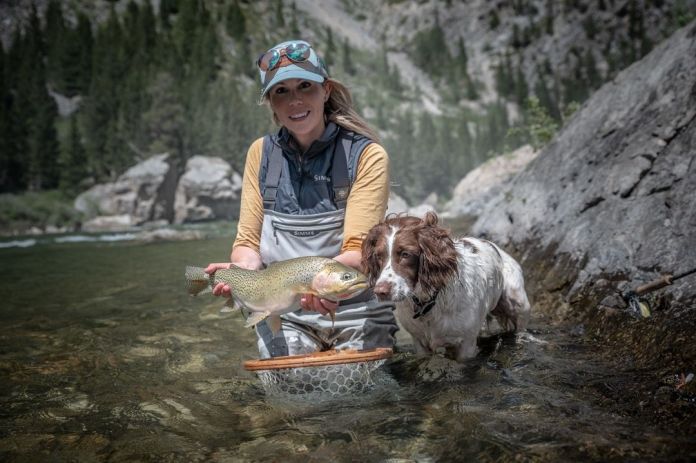
paula with a fish
Image courtesy of Nick Trehearne

FLYORDS: Who IS Paula Shearer?

Paula: I am a full-time guide and angler who is located in Calgary Alberta Canada, which is located on the East Side of the Canadian Rockies. I’m also the owner of PS On The Fly Outfitters which focuses mainly on the Bow River.

paula getting ready for a day of guiding

FLYORDS: What was your childhood like? 

Paula: From a young age, I was encouraged to be active and outdoors, which is where I spent most of my childhood. During the summer months, my family spent a lot of time camping around lakes while the other months were spent playing a number of sports including hockey, lacrosse, and skeleton.

Paula and her dog enjoying a game of fetch between pools.

FLYORDS: When was the first time you picked up a fly rod?

Paula: I can’t recall the exact first moment I held a fly rod in my hand as I was very young, but it was around the age of 8 that I was casting a fly rod in many of the lakes that my family would camp at. As with anything when you first start, it wasn’t pretty, but I became better at untangling line before anything else.

paula casting

FLYORDS: What first attracted you to guiding?

Paula: A lot of my fishing friends were guides, so it was something I had been thinking about for quite some time as I had always enjoyed teaching my non-fishing friends how to cast. One day in particular, I took one of my old teammates from skeleton to the river to fish. We both had retired from the sport due to injury and she wanted to try fly fishing as a new hobby. I met her at the river, put her in a pair of my waders, and taught her the basics of casting a fly rod. It wasn’t long before she was hooking into fish and we grew busy celebrating. Seeing how happy she was and how much she enjoyed the experience cemented my love for teaching others and made me pursue a career in guiding. I found enjoyment in being a part of other people’s happiness in fishing.

paula guiding a friend

FLYORDS: Can you describe the fishery that you guide in? What makes it special?

paula in alberta

Paula: The Bow River is a renowned quality trout fishery of wild rainbows and browns, and runs throughout Alberta. What makes this river unique is that it flows through a major city of over a million people, which is listed as one of the cleanest cities in the world. This, in turn, keeps the river clean and healthy as well. Our river system not only runs through Calgary but also through Banff National Park which is only about an hour and a half away from the city.

FLYORDS: What element of being a fly-fishing guide do you enjoy the most? What element do you enjoy the least?

Paula: One of the things I love most about being a fishing guide is the privilege of being a part of some people’s happiest memories. It is one of the best experiences to see clients excited about something I also enjoy so much. The element I enjoy the least is not having much of a social life during the guiding months, as the days are long and can be physically exhausting. Oftentimes, you’re preparing for the next day on the water the moment you get home.

FLYORDS: For someone who doesn’t know what it likes to be a guide, what is one consistent hardship that you wish you could show them?

Paula: Being a guide is very physically demanding, and rowing a drift boat in all weather conditions (wind being one of the worst!) can be exhausting. Even more than the physical demands would be having to be the mentally challenging component of the job. As with most guides, we put a lot of pressure on ourselves to give 100% in order to try and give our clients the best day possible. This can be more fatiguing than rowing! One thing I’m grateful for was being able to openly chat with my other guide friends to get through the first couple of years of guiding.

picking a fly

FLYORDS: When did your involvement with Costa start?

Paula: I first started with Costa in 2016.  Since then, I have been increasingly involved and supportive of their missions such as; Kick Plastic, One Coast, and all of their numerous conservation efforts. It is one thing to put out amazing quality products, but to do so while being so environmentally proactive is something that plenty of brands claim to do, but few actually follow through with. That’s really what separates Costa from the rest.

Check out Costa Women’s Frames, HERE.

FLYORDS: What are some fly-fishing destinations that you find yourself wanting to visit/ revisit?

Paula: At the top of my list is the Seychelles. Not just because of its incredibly beautiful location, but for its rich fishery that is home to many fish on my bucket list. Other locations that I would love the opportunity to fish in would be the jungles of Bolivia and Iceland. I’d also like to revisit Baja, Mexico for Marlin and Roosters; as well as continue my travels to Cuba. This is however an ever-expanding list that continues to grow and evolve.

FLYORDS: What advice would you give someone who’s looking to get into guiding?

Paula: The advice I would give is to always continue to learn and grow through both your experience and knowledge. Learn from those you look up to. What I love about being part of a large fishing community is the ability to learn from those around you. Don’t be afraid to admit you don’t know something and always be open to learning.

paula wading

FLYORDS: On the days that you’re not guiding, what do you like to do?

Paula: Fish, rest, recuperate, and spend time on the water with good friends.

Image courtesy of Amber Toner

FLYORDS: What’s next for Paula Shearer?

Paula: I’m just looking forward to 2023 with big plans to travel, host fishing trips, and guide my nearly booked-up season.

Ps on the fly

Thank you to Paula Shearer for taking the time out of her busy schedule to sit down with us for this interview. If you’re looking to learn more about Paula and ‘PS on the Fly’, you can find her on Instagram, or at her website, HERE. Also, thank you to Costa for making this series possible, as well as keeping our eyes protected, and our vision acute on and off the water. To learn more about Costa Sunglasses, and their conservation initiatives, visit their website, HERE. Lastly, remember to stay tuned for future iterations of “Costa Behind the Guides”, coming soon.

Header Image and additional media courtesy of: Nick Trehearne.

Costa Behind the Guides: Jeff Currier

Costa Behind the Guides: Jeff Feczko