Home Blog Page 55

YETI Introduces Two New GoBox Sizes

We’ve been testing the original YETI GoBox since they were first released a few years ago, and they’ve become constant companions on many of our content shoots. This week, the Austin brand released two new sizes of the GoBox to fit and protect your gear wherever you’re adventuring!

From YETI Coolers: 

Now available in two additional sizes (GoBox 15 & GoBox 60), the YETI GoBox is the ultimate waterproof, dust-proof, ultra-durable cargo box. Having your gear accessible and protected is nonnegotiable for almost any pursuit –and yet typical gear cases lack organizational capabilities, or don’t stand up to the demands of the outdoors. Built to be nearly indestructible, the LoudOut GoBox family can endure seasons in the sun, negative temps, and repeated abuse being lugged in and out of the truck, boat, and the blind.

Key Features

  • 100% WATERPROOF: gasket, latches, and vent work together to ensure the gear inside stays dry – even when your case is fully submerged in water
  • STACKABLE: nesting design and non-slip feet to keep your setup high and tight.
  • DEFENDER MATERIAL: this cargo box can withstand serious impact, even in the most extreme conditions.
  • EASYFINDTM DESIGN: wide design and versatile compartments keep gear and tools in their place and still accessible.
  • MULTMISSION SYSTEM: portable builds and versatile gear configuration free you to pack this up for any pursuit.

GoBox 15

This slideshow requires JavaScript.

Check them out, here!

GoBox 30

Check them out, here!

GoBox 60

Check them out, here!

Heading to the Fly Fishing Show? Recycle Your Old Fly Lines at the Airflo Booth!

Heading to your local Fly Fishing Show this year and have some ratty old fly lines laying around? Well, if you bring them along and drop them in an Airflo Zero Waste Boxâ„¢ you can be entered to win a brand-new line from our friends at Airflo!

From AirFlo:

Airflo is not only looking for ways to make the best fly lines but also reduce our impact on the environment. And now, to help our customers recycle any plastic fly fishing line…even if you didn’t previously buy Airflo.

Airflo has teamed up with The Fly Fishing Show to launch this new recycling program. At each show, look for the Airflo Zero Waste Boxesâ„¢ at the front entrance or at the Abel, Ross, and Airflo booth and drop in your old fly lines, tippet, plastic packaging, and spools, or even regular old fishing line.

We will also be offering a chance to win a free Airflo fly line when you recycle your old line at the Airflo booth and enter to win. See below for contest entry steps:

How to enter the giveaway:

1. Drop off your old lines with us at our booth in our recycle box

2. Fill out show giveaway form at the booth located on our tablet

You will then be entered into the show giveaway. After each show, we will select 5 winners who will receive a free fly line*.

*Giveaway fly lines will be selected by Airflo.

To learn more about how we are using recycled lines, go to AirfloUSA.com!

So You Want to Float the Smith River?

Here’s what you need to know… Presented by Hatch Adventures

AE3A9837

Montana’s Smith River is one of the state’s most valuable resources and is home to some of the most unique scenery in the west. It’s deep canyon walls and picturesque views make for a float trip experience that you won’t find anywhere else in the world. Additionally, the Smith River is the only river in Montana that you must draw a permit to float. Each year thousands of applicants put their name in the hat in hopes of drawing a coveted float permit. In this blog post, I’ll share a few tips and tactics to help you make the most of your Smith River permit (If you’re one of the lucky ones that draws, that is!)

AE3A3029

What gear do I need to bring for the Smith River?

If you find yourself planning a Smith River float in 2020, you’ll want to make sure you are well equipped with the best gear possible. The weather can be very unpredictable and you’ll want to be prepared for anything. I’ve personally had days on the Smith that are 90 degrees and sunny, followed by days that are 50 degrees and raining. Check out the gear list below to get a good idea of what you’ll need. 

AE3A4053

Raft – A good raft is the most important piece of gear you’ll need for the Smith. Keep in mind that you will be at least two days of floating away from civilization at the very minimum, so bringing a high-quality reliable raft is a must. I have rented rafts from Hatch Adventures in Bozeman, MT for the past two years and have been very impressed with the quality and customer service. 

AE3A4100

Bear Proof Storage – The smith river is home to a large population of black bears depending on the time of year that you float, and bear-proof food storage is required by Montana State Parks throughout the duration of your float. I’d recommend bringing multiple YETI coolers, along with a few dry boxes. If you do choose to rent from Hatch Adventures, all boats are equipped with YETI coolers and dry boxes. Just be sure to put a padlock on them at night before you hit the hay. 

AE3A7822

Proper Clothing – Montana is known for it’s unpredictable weather, and you’ll want to be prepared for the worst. I’d recommend keeping an eye on the forecast the week prior to your float, and planning accordingly from there. Packing a good layering system is key for an enjoyable and safe float down the Smith. Below is a list of specific clothing items to bring along with your everyday wear / swim trunks & sandals.

  • Base layers (merino wool, tee shirts, athletic shirts.)
  • Insulation (fleece pullover, sweatshirt X2, fleece pants, wool socks X5.)
  • Midlayers (Down Jacket or vest, light jacket, gloves, beanie.)
  • Rain Gear (BRING YOUR RAIN GEAR.)
  • Sun Protection (straw hat, sunglasses, UV shirts, etc.)

Camp Gear – Some of my best memories on the Smith River have taken place in one of the many designated campsites along the river. On most Smith River trips you will be camping a total of four or five nights depending on how many miles you plan to float each day. Good camping equipment is key for a comfortable float. Below is a list of specific gear items to make your trip more enjoyable. 

  • Sleep System (Three or four season tent, treated down sleeping bag, sleeping pad, camp pillow, dry bag for storage.)
  • Cooking (Coleman camp stove X2, Jetboil, extra fuel for stoves, utensils, paper plates, drinking mug – for coffee or whiskey, collapsible camp table, helinox lightweight camp chairs.)
  • Fire (waterproof matches, lighter X5, fire starting log, kindling, fire wood – wood can be very hard to find along the Smith River and in it’s campsites.)

Download the onWater App to check out the interactive map of the Smith River. The app can be useful for pre-planning to when you are on the water. With a detailed map of all the campsites, and a mileage tracker to make sure you don’t miss your favorite camp. Download the app HERE.

What is the fishing like on the Smith River?

AE3A3265

Depending on the time of year, weather, and water levels / clarity the fishing can be very good or very slow. I have floated the Smith in early June and experienced phenomenal fishing, and also floated it in mid-May and experienced very slow fishing. I would recommend bringing a wide range of flies from nymphs, dries, and streamers. If timed correctly, the salmon fly hatch on the Smith River can be out of this world. In general, I would focus on using prince nymphs, Sanjuan worms, pats rubber legs, wooly buggers, leech imitations, chubby chernobyls, hoppers, and a handful of midge patterns. I like to bring a 5 & 6 wt rod on the Smith and have one set up as a streamer rod, and the other as a nymping or dry fly setup. The Smith River is home to rainbow, cutthroat, and brown trout, along with the occasional whitefish. For the best fishing on the Smith River, I’d recommend putting in for a float in either June or July. One of the Smith River’s most prized fishing gems is it’s numerous tributaries. While you’re on your float, be sure to keep an eye out for them as they can produce some of the best fishing of the trip. With that being said, be sure to obey high watermark laws as many of these tributaries flow through private property on their way to the Smith. 

AE3A2949

What are the logistics of floating the smith river?

For a first time floater, sorting through the logistics for a successful float can be a daunting task. I’ve outlined some general information below that will give you a good place to start when planning your trip. Check out this free resource map of the Smith River from the onWater App HERE.

AE3A3243

Arrival at Camp Baker –  Your trip will start at Camp Baker State Park, located about 35 minutes outside of White Sulphur Springs, Montana. This is where you will stage gear, get rafts ready, and ultimately launch your rafts. Launching order is based on a first come first serve basis as there will be other groups launching on the same day as you. You are able to put your name on the list the day before your float, so I’d recommend having someone in your party head up to Camp Baker around 24 hours prior to your float to secure a prime spot for the following day. When the rest of your party arrives at Camp Baker, you will spend the night at the campground there before launching the following morning. 

AE3A4215

Registration – On the morning of your float you will be briefed on the rules and regulations by a park ranger inside of the Ranger Station located at Camp Baker State Park. Do note that each member of your party MUST HAVE A PHOTO ID to be able to float as they will take down each person’s information. In addition to this, each floater is required to pay a launch fee before floating. The fee is $25 for Montana residents and $75 for nonresidents. Be sure to have the exact amount needed in cash on the morning of your float as they do not accept card payments. Additionally, this is when you will pick your designated campsites along the river. 

AE3A2569

How long is the Smith River Float? – The duration of your float depends on how many miles you intend to float each day. The stretch of river you will be floating is 56 miles long and will take two-three days at the very minimum. I personally prefer to float the river in five days, allowing for roughly ten-mile floats every day, and plenty of time to fish, take in the views, and get the full experience. 

AE3A2562

What kind of experience can I expect on the Smith River?

Floating Montana’s Smith River will give you an appreciation for wild places and the fish and wildlife that inhabit them. It’s important to be a steward of the land while on your float and practice “leave no trace” policies when cleaning up camp, disposing of trash, and disposing of human waste. Each campsite has its own designated latrine within a short walking distance of camp. While fishing can be an incredibly fun and exciting aspect of floating the Smith River, it’s also about so much more than that. The views, river, and camaraderie of the trip have always been some of my favorite aspects of the Smith River, and good fishing is just icing on the cake. Montana’s Smith River is currently in the crosshairs of a large proposed copper mine that if approved, would be located just above the headwaters of the precious river, landscape, and ecosystem. I would encourage anyone who has floated the Smith River to share their experience with others, and oppose this mining project while advocating for this incredible resource. Rain or shine, your trip down the Smith River will be a memory and experience that you will cherish for years to come. 

AE3A4553

In Conclusion
Montana’s Smith River has provided me with some of the greatest outdoor experiences of my life in the three times that I’ve been lucky enough to float it, and I would encourage anyone and everyone to see it for themselves. Put in for a permit, cross your fingers, knock on wood, and you just might draw!


This article was written by flylords contributor Calvin Connor – check out his work on IG!
The article and trip were made possible by the generous support of Hatch Adventures – Give them a shout if you are planning your Smith River trip!

Reel of the Week: A Solo Mission For Tarpon

A note from Captain Willy Le:

“I was just checking in on some fish in South Florida solo, once I found them, I decided to try to get an eat on film with the drone. I happened to get it the first try which I still can’t believe it happened. These fish were feeding in very shallow water which everything had to be perfect to even get a look. I was very surprised everything came together, and I was able to document this catch completely solo! Check out the full YouTube video below.”

Reel of the Week from Captain Willy Le, find him on Instagram @nativefishcharters. To check out the full video on YouTube, click here. 

Check out the articles below:

Reel of the Week: Laid up Tarpon in Gabon, Africa

Best Streamer Fly Boxes

Finally, Protections Realized for Bristol Bay–EPA Rejects Pebble Mine

Tuesday, January 31st–The Environmental Protection Agency just announced its final rejection of key permits for Pebble Mine–an end-all outcome for this widely-opposed copper mine in the headwaters of Alaska’s famed Bristol Bay. The announcement effectively kills the Pebble Mine project and future mining projects in the region through Clean Water Act authorities. Finally, after so many years, so many emails and action alerts from all of our conservation partners, and so much back and forth, Pebble is dead once and for all. This is an incredible victory for the fishing communities and Tribes of Bristol Bay, all the fish and wildlife that depend on these healthy ecosystems, and the entire outdoor recreation community that stood up and banded together to say “NO Pebble Mine.” It was a long, winding road, but Bristol Bay is finally protected from Pebble Mine.

“What a day for wild salmon! This is a victory for a whole ecosystem and one of the most important salmon strongholds left on the planet,” says Wild Salmon Center President & CEO Guido Rahr. “It’s a victory for clean water, for the tens of millions of salmon that return to Bristol Bay’s watersheds every year, for the thousands of people in communities built around these fish, and for the 137 species that depend on that returning salmon, including orcas, grizzly bears, caddis flies and everything in between.”

Bristol Bay’s healthy rivers, steams, and other habitats support some of the most prolific salmon runs in the world today–Pebble Mine threatened that and all the communities depending on the healthy Bristol Bay watershed.

A record 66 million sockeye salmon returned to Bristol Bay last year, Colin Arisman

“EPA and the Biden Administration deserve a huge thank you for listening to Alaska Native Tribes, residents, and fishermen, and stepping up to protect this American treasure,” Rahr says. “If we had lost Bristol Bay—and this mine was a very real threat—wild salmon would have taken a definitive turn for the worse. But now we can take this momentum and build a more hopeful future for wild salmon everywhere, along with the communities who cherish them and the life-sustaining rivers we all call home.”

The EPA is relying on its authorities under the Clean Water Act to regulate industrial discharges in rejecting the Pebble Mine permit. According to EPA’s decision, the Agency based its decision on the fact that the Pebble Mine discharges would have “unacceptable adverse effects” the Bristol Bay watershed and its fisheries.

“Clean Water Act 404(c) protections have always been a common-sense safeguard for Bristol Bay. Today, the people and businesses in Alaska and across the country who stood up for Bristol Bay should take a bow, because their efforts have protected the world’s most important wild salmon runs and the communities that depend on them,” said Chris Wood, president and CEO of Trout Unlimited. “It’s long past time for Pebble to recognize that it will never have community or legal standing to develop this mine. Now, it’s time for us to work for lasting protections for the entire Bristol Bay watershed that match the scope of the threat to this special place.”

Good on all of you that participated in this long, grassroots-driven fight to affirm a sustainable future for Bristol Bay and protect the regions remarkable and abundant fisheries and wildlife.

How to Tie: The Shark Bait Fly

2

Disclosure: The article may contain affiliate links that may result in a commission at no additional cost to the reader.

In this week’s “How to Tie” video feature, Mike P. from the Ole Florida Fly Shop ties a shark fly that will entice those apex predators, the Shark Bait Fly.

Learn About This Fly:

Difficulty: Intermediate

Sharks are notorious for being some of the most frightening and interesting animals that swim. Growing up with Jaws set the fear factor for sharks at a young age. Now, instead of hiding from the water, anglers are chasing these apex predators with flies. The opportunity to hook a shark on the fly is one that every saltwater angler should experience. Often, shark flies are bright and essentially a chicken tied onto a hook, and the Shark Bait Fly is no exception to this trend.

Although not employing much, this fly offers just enough to entice those predators. Red and orange are a common color for shark flies, and a spun deer hair body will ensure it rides on top. Take your time when spinning deer hair, as it can be messy and very tedious to work with. The Shark Bait Fly is not one that requires perfect proportions or accuracy, rather just the right presentation in front of a hungry fish.

Blue water fly fishing is an up and coming niche in the industry and offers some of the most exciting fishing today. Targeting sharks on a fly, especially Makos and blue sharks, can be the thrill of a lifetime and only add to the addiction of the sport. Depending on the size of the sharks you’ll be targeting and flies you’ll be using, you may be throwing a 14wt all day and it may be wise to get a good stretch in before. The Shark Bait Fly is one that will allow you to hook these apex predators and give you the fight of your life!

Ingredients:

Now you know how to tie The Shark Bait Fly!

Video and ingredients courtesy of the Ole Florida Fly Shop.

Fishing Tips: Jigging Streamers

0

Sit back and listen to George Daniel’s approach to jigging streamers. If you haven’t tried approaching streamer this approach to streamer fishing, you’re missing out.

Artist Spotlight: Abby Wynia

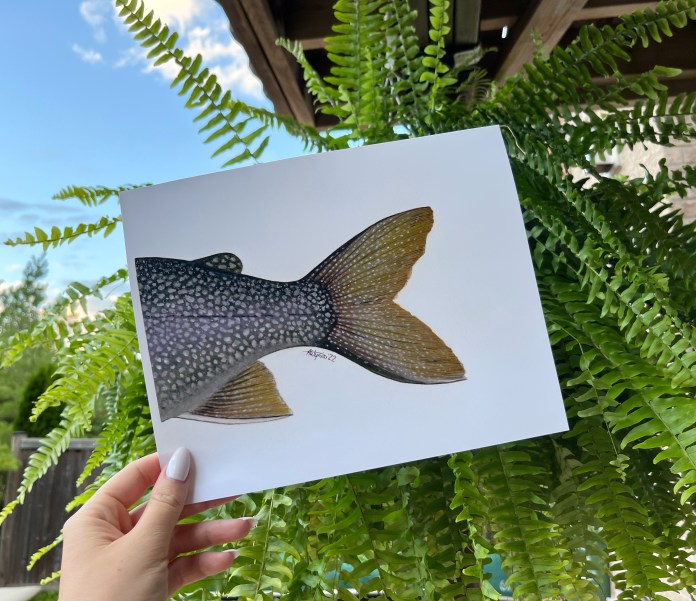
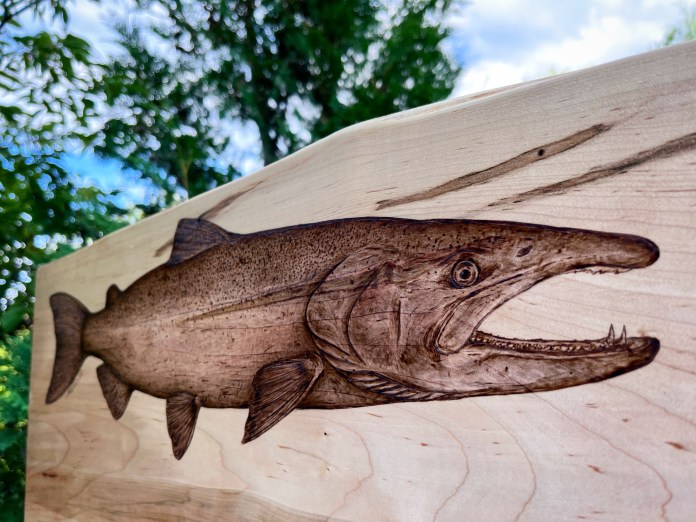
We sat down with artist Abby Wynia, an artist and fish ecologist from Ontario, Canada. Alongside her important scientific work in Canada’s fisheries, Abby creates incredible wood burnings and paintings of the fish species she interacts with. Read below to learn more about Abby’s background in the outdoors, their passion for fish and conservation, and her amazing artwork.

Flylords: How did you first experience the outdoors?

Abby: I spent the majority of my shaping years around the rural areas of southern Ontario, Canada near the Saugeen River and its tributaries and an hour-long drive from Lake Huron’s Georgian Bay. My family moved from a small bungalow in the city to a 100-acre farm north of Mount Forest, Ontario when I was about six. The house barely had heating and we had to install indoor plumbing, but the access to hunting, fishing, and other recreational activities in our own backyard made the move one of the best decisions my family ever made. 

Photo Courtesy of Abby Wynia

Growing up I was surrounded by people who had a deep connection and respect for the outdoors. My grandfather on my dad’s side spent his first few years in Canada as a prospector touring around the boreal forests of northern Ontario. He shared what he learned with my dad and his siblings and they passed it onto my cousins, my sister and me. We often spent our summers camping in Ontario’s provincial parks or up at our family hunt camp in the Parry Sound area of central Ontario. I had a great deal of exposure to the hunting and fishing community at a young age, though female mentors were hard to find. Recreational activities like camping have always been a large part of my life, but fishing and hunting came into my life in a significant way in my early 20’s. 

Flylords: What inspired you to pursue fish ecology?

Abby: In 2012 I departed for Trent University in Peterborough, Ontario for both my Bachelor’s degree in Environmental Science/Studies and my Master of Science in Ecology and Conservation Biology. 

Photo Courtesy of Abby Wynia

Late in my undergraduate degree, I scored a summer job as a fisheries technician through a federal student employment initiative. Learning about the complexities of fish habitat and the implications of invasive species for delicate yet resilient ecosystems around the Great Lakes helped me decide that fish ecology was the career path I wanted to journey down. I am now a member of a five-person ecotoxicology lab based in Ontario. We research and monitor the impact of aquatic contaminants on wild fish populations in Canada. 

Flylords: What do you think people should know about Ontario’s fisheries?

Abby: Ontario has bountiful opportunities for every angler. The province borders four of the five Great Lakes, each offering a unique angling experience. The smaller, inland lakes are also full of opportunity for everyone from the brook trout angler to the smallmouth bass, walleye or muskie enthusiast. Ice fishing is a huge recreational activity here, and if you haven’t had the chance to chase perch or trout through the ice I totally recommend giving it a shot.

Photo Courtesy of Abby Wynia

Flylords: When did you first learn to fish? 

Abby: I remember my parents taking my sister and me to a kids’ fishing derby at a local conservation area when I was about 12 years old. From that time on I recall occasionally picking up the rod and reel when there was an opportunity for it, but I’d say I became more serious about fishing when I started working as a student fisheries technician. My crew leads would spend their evenings fishing for walleye or perch during our field trips. I eventually got involved in fishing salmon tournaments on the Great Lakes (Huron and Ontario) and running downriggers and spoons bigger than anything I initially had in my tackle box.

Photo Courtesy of Abby Wynia

Since then, I’ve dabbled in spring steelhead fishing on the Saugeen River and trolling for brook trout and smallmouth bass out of canoes in Algonquin Provincial Park. In the winter months I get my fishing fix on the frozen lakes of Ontario like Lake Simcoe, in the Muskoka’s, or the lakes bordering Algonquin Park. As for fly fishing, I am still learning. I received my first fly rod as a birthday gift this year and had grand plans to take it out to Alberta with me to pass the slow time during spring fieldwork. But mother nature had other plans and we were required to overhaul our entire field program, resulting in minimal opportunities to get some practice in on the fly rod. 

Flylords: What does fishing mean to you?

Abby: Fish and fishing have made an incredible impact on my life. Prior to working with fish, I intended to pursue a career in the field of water science. This changed immediately after I spent a summer working as a fisheries technician in the coastal marshes of the Great Lakes, and I haven’t looked back. Beyond my career as a biologist, fishing sparked an ecological awakening for me. I’d say that fishing is like opening a door in your house you’ve never looked behind before. Each waterbody, access point, and cast holds the potential for surprise. It provides us with a glimpse into this parallel, aquatic world that hosts an incredible diversity of plants and critters we may overlook due to lack of recreational opportunities, perceived nuisance, or simple disinterest. Fishing has opened my eyes to the value of conservation and protection and propelled me beyond the idea that under that glistening, rippled surface are just some fish and some weeds. 

Photo Courtesy of Abby Wynia

Flylords: When did you first develop an interest in art?

Abby: For as far back as I can recall I have always been creative. I remember thoroughly enjoying art class in elementary school and continued to take art as an elective in high school. However, my interests were very broad and I would bounce from hobby to hobby. Apart from some high school art classes, I am a self taught artist.

Photo Courtesy of Abby Wynia

Flylords: How did you narrow your work down to pyrography and painting?

Abby: I’ve always had an interest in watercolor. There’s something about blending colors and control over pigmentation that I find comforting in painting. Pyrography came to me a bit later and was inspired by the need to procrastinate on my thesis in grad school. In October of 2019 I agreed to do a piece for a friend. With my wood burner out of storage, I started experimenting more and began to like the slow, sometimes grueling process of taking a blank piece of wood and creating something with permanence and beauty. The improvement in my skill over the last two years has been a huge motivation to continue with the medium, though I do enjoy making time for painting too as a break from burning.

Photo Courtesy of Abby Wynia

Flylords: What is your process for creating a wood burning?

Abby: Many of my pieces start with inspiration like the opening of a fishing season, the species found in a local water body, or a species I catch myself. I love to work with trout, and often need to remind myself there are other species out there. I proceed with a trip to my local wood supply shop and find a unique live-edge or bias-cut piece of maple, cherry, pine, or birch. I put each piece through three rounds of sanding, finishing with a fine-grain hand-sanding sponge. I sketch my initial draft out and I use my small knife-tip pen (for the wood burner) to throw down an outline. Next, I begin an initial shade of the body and start filling in fine details. I usually finish by working on the fins and adding a final layer of shading. I use a tung oil finish on all of my pieces, which offers great water resistance and is food safe, so it’s perfect for coasters and serving boards.

Photo Courtesy of Abby Wynia

Flylords: How does your work as a biologist impact your art?

Abby: Working in the discipline of fish ecology has greatly opened my eyes to minute differences in species and habitats, and that has transferred well into my artwork. With each new piece, I remind myself that I have brought into this world because it brings me joy, and if that creation also happens to bring joy to someone else that is more than any artist could hope for.

Photo Courtesy of Abby Wynia

Flylords: Where can we find your artwork?

Abby: If you’re interested in some unique, original artwork please visit the custom order application on my website, or contact me through my email address abby@fishfulthinkingart.com. 

My current, available pieces can be found on my website www.fishfulthinkingart.com. My Instagram page showcases all of the pieces I have worked on and am working on. I have a few shows in Ontario this year, which I will be posting about through Instagram and the website. If you’re in town swing by and say hello!

Video of the Week: Freshwater Jungle Tarpon

In this Video of the Week, we catch up with Federico Hampl and Tom Enderlin from the Tropical Fly Collective in the first episode of their new series the “Tropical Freshwater Diaries”. Caymans, monkeys, jaguars the list goes on. 200 km away from the ocean we follow the journey of the migrant king, or jungle tarpon, deep into a river system surrounded by rainforest. Wildlife abounds, as do really massive tarpon brought here by huge concentrations of baitfish. Prepare yourself for a visual ride to this amazing freshwater tarpon fishery.

Tropical Fly Collective is a Costa Rica-based story-telling and media production company focused on adventure fly fishing films and documentaries around the world.

Check out these epic articles as well! 

Video of the Week: The Legend of Casa Mar

Video of the Week: Golden Dorado “The Treasure of the Parana” by Fly Fish Food

Flylords Original Series: Fly Shop Tour – ALL EPISODES NOW LIVE!

Reel of the Week: Fly Fishing for Magdalena Bay Marlin

A note from Alec Lucas:

“Our season here at Los Locos had just ended and I went out on the boat with one of our captains Tacone for one last day to pull on some marlin. With the winds down and the conditions lining up to be perfect, why wouldn’t we!

As we got to the zone sure enough it was epic chaos. Birds on top of bait balls and a large number of Marlin crashing underneath. It was go time, we cranked some music and began working the bait balls. It was Tacone’s first time fly fishing and he had wanted to hook a marlin on the fly all season. 

@flylords

Catching Marlin on the fly with Alec Lucas, @fish_a_day at @loslocosmagbay. #flylords #flyfishing #saltwater #fyp #saltwaterflyfishing

♬ 2am – Slightly Stoopid

Watching the joy across his face when he hooked his first one was the best part. We continued switching off driving the boat and casting to fish jumping and shouting with excitement. It really is something that never gets old. Pulling on these fish with a fly is something I hope every angler gets to experience.”

Reel of the Week from Alec Lucas, find him on Instagram @fish_a_day. Check out Los Logos Mag Bay Adventures @loslocosmagbay. 

Check out the articles below:

The Best Saltwater Fly Reels, and How to Find Yours

Urban Fly Fishing & The World’s 9 Best Cities to Fly Fish