In this week’s “How to Tie†video feature, Matt Grobert with Tightlinevideo ties his Cinder Worm fly pattern that should be in every striper angler box during the spring.
Learn About This Fly:
Difficulty: Intermediate
When targeting striped bass, one of the most exciting opportunities is during the cinder worm hatch. This begins when water temps in estuaries and salt ponds warm to around 60 degrees. Much like hatches in rivers, striped bass will eat these worms on the surface like a dry fly. In saltwater fishing, this is extremely unique situation you always want to be prepared for and Grobert’s Cinder Worm is a exactly that fly for the job.
Although this fly looks simple to tie, it requires quite a bit of skill and technique. If you are a beginner tyer, take your time and do not rush the body or the head. I personally think the dubbing loop tail gives the fly amazing action and profile, but it can be substituted by another red tail material, such as chenille. Changing the size and color of Grobert’s Cinder Worm can help “match the hatch” in your specific waters and spend your time on the water efficiently.
For striped bass, an 8, 9, or 10 weight rod will do. These flies will be smaller, so don’t be afraid to bring out the 8wt and feel the tug of these powerful fish. When the temperatures are on the rise, be on the lookout for these hatches and stop into your local fly shop to figure out what is working in your area! Grobert’s Cinder Worm should be a staple in your fly box this spring and fill the time between that on the vise.
Ingredients:
Hook: Standard saltwater hook (here a Mustad 34007), sizes 2-6.
When developing their new saltwater rod the SALT R8, Sage sent their senior rod designers to the birthplace of the discipline in South Florida. During their lengthy saltwater immersion, they listened carefully to the shops, guides, scientists, stories, and legends to truly understand what was happening on the water and what was really required to shape and hone a more perfect tool for saltwater sight fishing.
We were lucky enough to go behind the scenes with Joe Dahut, one of the best when it comes to targeting Bonefish on the flats. We got to ask Joe a couple of questions to give you some more background to why he picks up the SALT R8 on the flats.
Flylords: Tell us about yourself… Who are you?
Joe Dahut: While I struggle with the concept of who I am sometimes, I know that I am someone who tries, more than anyone else in the room, to soak in my surroundings – to observe, listen, note, and simply exist in a state of compassion and understanding. Above all else, I try to be conscious, intentional, and unapologetic in my approach every day. I am a teacher, writer, insatiable reader, and a manic flats fisherman. Perhaps that’s all anyone who doesn’t know me needs to know.
FL: Why are you picking up the SALT R8 when you’re targeting bonefish?
Joe: The SALT R8 is a reliable and trustworthy fly rod because it has been proven on sacred ground with the Keys stamp of authenticity. To be a guide in the Florida Keys, you have to be willing to think critically about chasing pressured, intelligent fish. The fact that Peter and the folks at Sage trusted the guides/anglers I look up to, admire, and even have the privilege to fish with from time to time means a lot. I like talking to Peter about his process – he takes the long way home creatively, because he knows it will produce a superior product. Go to a local shop and ask the kid behind the counter to throw it in the parking lot, you will know what I mean.
FL: You can only throw one fly all day, what are you pulling out of your box?
Joe: A professor of mine once told me that when a poet writes, they are not trying “to describe the thing, but the essence of the thing” in their descriptions, their observations, and musings. When I’m picking out a bonefish fly, it should not look exactly like something in nature. It should posit some asymmetry or inconsistency, and mimic the movement of something in the wild. I’d like to convince a fish on my terms, so the fly has to have some sentimental value I guess – a loved one tied it, the material was hunted by a friend, etc. It’s probably the most inefficient way to fish, but it’s my way.
FL: What is your favorite part about your local fishing community?
Joe: I think what I like about the fly fishing community in the Keys is that on some level, we are all insane. We are process-oriented, sentimental, and masochistic. The people that really live this life care, above anything else, about the preservation of the resource. As much as it might appear to be this vast, chasmic void of tough fish and hearty ecosystems, the Keys is quite delicate. I love being a piece to a bigger picture, one small star in a galaxy of constellations that, when pieced together, makes something spectacular and profoundly unique.
FL: If someone is visiting South Florida, where is the best place to start?
Joe: Jamaica Kincaid, about her home of Antigua, says that a tourist is an ugly, ugly thing. There are ways of avoiding this reality here in the Keys. Tread lightly, and support a local business, whether it be a guide, fly shop, restaurant, or state park (whatever is within your means). If you come to South Florida with the mentality that your actions have consequences, you will likely leave it a better place than you found it. The unfortunate truth is that very few people approach vacation time this way, so the best place to start actually happens before you get on the plane with the appropriate mindfulness that while what you are about to do is amazing, it also happens to be finite. Take care of what you care about.
Thank you Joe for taking the time to sit down with us an answer a few questions. If you are going on a flats trip soon, you can check out the Sage SALT R8 HEREor at your Local Sage Dealer.
“My sons first GT on fly – As a 12 weight was too heavy for the arms of an 11 year old, we opted for a 9 weight Thomas & Thomas Sextant, 40 pound monofilament and a smaller fly pattern. After hooked it was a case of hold tight as the fish left the flat and headed for the surf zone. Pano has fought piles of fish in the past both hooked by him and I so it wasn’t a new experience. After 25 minutes we had a beautiful 95cm GT in hand. A happy father and a happy angler all be it with a worn out arm.”
In this exceptional Video of the Week, we are graced with the phenomenal storytelling and videography of Captain David Magnum and Patrick Rhea. With the help of Gordy & Sons Outfitters and Seaholm watches we get a closer look at the legendary guide Steve Huff’s life in fly fishing. His insatiable curiosity and passion for fly fishing has led him down a path you can only dream about. Steve says it best; ” I’ve been a fishing guide for 54 years, I’m 76 years old and I’m the luckiest guy that ever set foot on this planet.”
“Captain Steve Huff’s illustrious career and dedication to conserving Florida’s Everglades is showcased in a powerful new film directed by Captain David Mangum and Patrick Rhea and produced by SEAHOLM and Gordy & Sons Outfitters with support from Bonefish & Tarpon Trust (BTT), Patagonia, YETI, Captains for Clean Water, and the International Game Fish Association (IGFA). In 2010, he became the first full-time professional fishing guide ever inducted into the IGFA Fishing Hall of Fame. “He is without question the top fly-fishing guide on the planet,†says angler Sandy Moret, owner of Florida Keys Outfitters and a member of BTT’s Board of Directors.”
In this installment of our “Behind the Brand” series, we’ll be checking out onWater. For this feature, we sat down with onWater founder, Scott Carver, as well as Senior Product Specialist, Josh Eaton, for a peak behind the curtains of the fishing-focused app which seems to be taking the outdoor community by storm. Here, we’ll be looking to get a glimpse into the background of the app, as well as what actually sets it apart from the others.
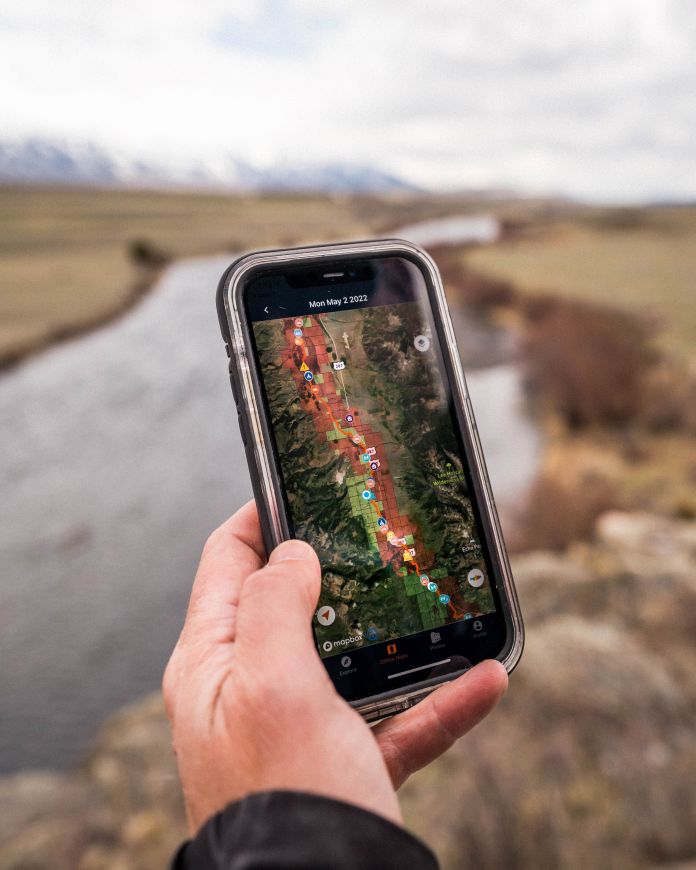
The onWater App in use: Finding alternate routes around private land.
In the rapidly evolving technological age, it seems that more and more outdoor-focused apps are hitting the market, providing solutions for recreators to push their outdoor pursuits to the next level. The ever-encroaching shadow of digital advancement has received mixed reception amongst anglers and outdoor enthusiasts alike. While some suggest hurling your digital device into your nearest reservoir so as to never be bothered by the ‘bings’ and ‘pings’ which we strive to escape from, there is a separate proportion of the community that has embraced technological advancements as just another tool in the box which can be used to further push the boundaries of what is possible out of doors.
Over the last few years, there have been a few notable apps that have entered the fly fishing stratosphere – plenty of which have been quickly labeled as detrimental to the very nature of our sport. However, there do seem to be a select few that serve to give more than they gain: focusing their effort on constructing a smarter and safer way for anglers to approach the waters (as opposed to their neighbor’s secret spot). An app that fits this bill well, and has drawn the attention of our team over the last 6 months, has been: onWater.
An interview with onWater Founder: Scott Carver:
Flylords: Who are you?Â
Scott: I’m the Founder and CEO of onWater. I live full-time in Boulder, CO, and part-time in Ennis, MT. I’m a passionate outdoorsman and serial entrepreneur.   I love starting things from scratch…especially businesses. With onWater, I was able to combine my passion and experience in the fly fishing industry with my career experience in building technology companies. Kind of an unusual combination.
Flylords: How and when did you start fly fishing?Â
Scott: I’ve been an angler my whole life but really became immersed in fly fishing in my early twenties, when I discovered how therapeutic standing in a cold stream was on my knees. I had had my knees reconstructed 13 times from my college football days. Adrenaline outdoor sports were more challenging for me, so when I discovered fly fishing, it became all-consuming.  I spent every waking moment either fly fishing or thinking about fly fishing. I became so consumed with it, I built a fly fishing lodge on the Madison River.
Flylords: In your words, what is onWater?
Scott: onWater is an outdoor recreation technology platform designed to enhance the angler’s experience, connect our community, and protect our resources. Handheld devices now are a ubiquitous part of our everyday lives. GPS, satellite imagery, and technological advancements have allowed outdoor recreation enthusiast to pursue their activities with more confidence and relevant information. At its core, fly angling embodies adventure, so it only makes sense to provide tools to anglers to help them explore more, safely, and with confidence.
Flylords: What was the mission for onWater?Â
Scott: The idea for onWater was born out of a fishing trip to Montana with several buddies and after spending a day on the Madison River, we began wondering where we might fish the next several days. As we began searching for options it became an incredibly tedious process. We had to research what rivers were in that area, how far away, how we access them, what were the flows, where could we access and how much of the property was private. We had to figure out what fly shops served those rivers and call them to get fishing reports and recommendations.  It dawned on us that this was crazy… â€there has to be an app for this rightâ€. So we started looking and found nothing that brought all that together for the fly angler. Given my background in building technology companies and being an owner of a fly fishing lodge, I said…†we could build thisâ€. At that point, we started onWater.
As we started to develop our Product Roadmap, we drew on our own personal experiences as anglers to decide what functions and features we wanted to build into the app. One of our most powerful features is a GPS navigation tool that tracks your position and movement on the river. It also allows you to determine distances from your location to any point on the river, in river miles. You can also set a notification when you are approaching a designated point like a boat ramp, campsite, or hazard. This feature was conceived based on my own personal experience when my young son was floating a river and unknowingly missed the take out just before dusk. He floated several miles past in pitch-black darkness and was not aware there was a very dangerous diversion dam ahead downstream. Thankfully, he had the good sense to pull off the river and try to find someone to call for help. But if he had kept floating he would have easily gone over that diversion dam and certainly died. That experience shook me to the core and I said we could build a feature in our app to prevent that from happening to anyone.
To learn more about onWater’s story, check out the video below:Â
Flylords: In the first year, what did onWater look like?Â
Scott: Like most start-ups, it was exciting and chaotic. The first year we were mostly focused on building the platform, so everything was all about creativity…how will it look, what are the features and performance, what areas of the country should we focus on, and so on. It was all about the platform…the user’s experience would come later.  Unfortunately, we made a tactical error at the very beginning…we outsourced the original platform development to an outside software development agency. This proved to be a huge and costly mistake. The agency we used had little angling domain experience and was more interested in billing hours than building quality software. We quickly concluded that we needed to pivot and bring all of our engineering in-house. So we hired an incredible team of software engineers and completely transformed the platform and process. It was a defining moment for us. Every start-up has those moments…fortunately we experienced ours early enough to avoid a catastrophe.
Flylords: What were some of the hurdles of the initial development of the app/ company?
Scott: The biggest hurdle we faced was transitioning our software engineering from an agency model to an in-house model as I mentioned above. But once we got through that our two most significant hurdles were how we could scale the process of curating our digital maps across the entire country and figuring out the Customer Acquisition model. What makes onWater unique is the precision and detail of our maps for positioning and navigation. Other mapping apps simply overlay public data, primarily from government sources, to create their maps.  This can lead to incorrect geo coordinates, misplaced points on the map, and just plain outdated information. onWater, on the other hand, has a team of experienced anglers hand curating our maps to ensure accuracy and current information. With the number of waterbodies in the US and across the world, this can be a daunting task. So one of our biggest hurdles is figuring out how to scale that part of our app without sacrificing the detail and accuracy of our maps. We’ve made amazing progress and in 2023 we’ll improve more than 10X.
The other hurdle we face is understanding the Customer Acquisition model. Fly anglers, in particular, are a challenging audience. We are very secretive about our angling activities and generally distrustful of any technology entering our sport. I find it very it very interesting that anglers have no problem posting and sharing their fishing adventures and prize catches all over social media, but yet may be hesitant to embrace a tool that would enhance their angling experience and be completely private to them. The days of paper maps and spiral-bound fishing journals are gone, so we must reinforce to our customers that this technology does not diminish our sport, but is really value add on so many levels. For that reason, we are constantly tweaking our messaging and methodologies to connect with customers. If we continue to bring features that anglers value, I know this audience will embrace onWater just as many outdoor enthusiasts have embraced other apps like Alltrails, onX, or Strava.
Flylords: Since the idea was translated to fruition, how have you seen onWater evolve?
Scott: onWater is evolving so rapidly it blows my mind on some days. Right now I would characterize where we are as “the tip of the icebergâ€. We have a very robust long-term product roadmap, but we made the decision we were going to be really good and solid at just a few high-value things before we moved on to the next phase.  Our mantra is we want to be “an inch wide and a mile deep†rather than “a mile wide and an inch deepâ€. We’ve stuck by this principle in how we’ve rolled out features and evolved our product. Thus far our focus has been primarily on enhancing the experience for the individual angler, so the features we’ve introduced around map precision, navigation, property data, tracking, journaling, and local resources are second to none.
However, as we all know the fishing ecosystem is quite large and there are many different stakeholders. We view conservation organizations, fly shops, outfitters, lodges, product manufacturers, fisheries managers, product manufacturers, authors, bloggers, and many others as part of our community. The evolution of onWater will involve connecting this entire community and developing elements of our product that drive value for each one of them. A prime example of this is some of the work we’re doing with conservation partners and non-profits promoting fly fishing within disadvantaged groups. We are currently rolling out several new programs and features that we believe will not only promote the proper stewardship of our resources but raise awareness of and participation in our conservation partner’s initiatives. We are mission-driven and giving back to our sport is one of our key missions.
Flylords: How has the creation of onWater affected your personal relationship with fly fishing and the fly fishing community?
Scott: Creating onWater has given me an appreciation of the abundance of angling opportunities we have in this country and how critical it is to protect it and preserve access to it. We are so blessed in this country to have access to so many diverse waters and landscapes. It’s unfortunate that so many anglers concentrate on such a small percentage high profile water bodies when there is so much more out there to explore and experience. My hope is that onWater will help people gain the confidence to venture a little further, try something new and explore more. In doing so, I think that translates to more people having a vested interest in preserving what we have.
Q: Who do YOU believe the onWater app is for?Â
Scott: As I stated earlier our vision is to create a platform that would connect our entire angling ecosystem and drive value for every one of its stakeholders. But, of course, we are only in the early stages of that journey. For now, onWater is for anglers who want to spend more time fishing and less time researching and planning to go fishing. It’s for anglers who want to explore new waters and do so with the confidence of fishing conditions, where to access, and not venture into areas where you shouldn’t. It’s for anglers who want more real-time, relevant information at their fingertips. Anglers who enjoy journaling their days on the water, tracking their journey, and reliving their experiences.
Many people ask me is onWater for beginning anglers or experienced anglers. My answer is certainly both. I have fished all over this country and all over the world. I’d love to boast that I know it all, but I don’t. Prior to onWater, I carried hundreds of paper fishing maps with me and when I went to a new location, I bought another one…for 20 bucks. I love fishing new places and for an experienced angler like me, I find onWater to be an incredible tool.
Likewise, people new to the sport or just learning will find just as much value. Whether it learning the character of a water body, where the fly shops are, what the regulations might be, purchasing a license, or just where to go…there’s something there for everyone, no matter where you are on the experience spectrum.
Flylords: Where do you see this app going in the future? Â Â
Scott: In the near future we will be focused on expanding our geographic footprint. We expect to have the entire country covered in the next few months. We have a full suite of new features that will be released shortly that will dramatically enhance the overall user experience. There are too many to name here, but they include things you can’t find anywhere else. In the coming months, we will also be expanding into the conventional angling and paddle sports segments. Those are natural extensions of our core platform and we have some exciting news that we’ll announce in the very near future.
Long term, our goal is to expand the reach of our platform to all stakeholders and global geographies. In doing so, we can create a community that is aligned, informed and vested in protecting our sport and its resources. As I said earlier, this is a journey and we are just now leaving the driveway.
We also had the chance to sit down with onWater Senior Product Specialist, Josh Eaton, for a more “boots on the ground” perspective:
Flylords: Who are you?Â
Josh: My name is Josh Eaton – I am the GIS/ Senior Product Specialist for the onWater App. I was born along the banks of the Madison River in Ennis, Montana. I grew up surrounded by fishing guides, my mom Julie Eaton was one of the first female fishing outfitters in the Madison Valley and started our family outfitting service, Eaton Outfitters, in 1994. Living in the mountains I developed an understanding and love for paper maps which were crucial for success and safety during hunting season. This connection to maps and information was a major influence on my decision to study GIS mapping and City Planning at Montana State University. My passion for fishing and mapping was a natural fit for joining onWater at its inception in 2020. When I am not working or rowing down the rivers of Southwest Montana, I’m likely skiing moguls up at the local mountain!
Flylords: What is your position at onWater? What are the roles and responsibilities that come with that role?
Josh: As the GIS/Senior Product Specialist I use my knowledge from a lifetime of fishing and nearly a decade of guiding to help bridge the gap between data and angler. Using a GIS system, we are able to create and query data that applies to anglers and showcase it in a POI (Point of Interest) format on our maps. Accordingly, I also carry the responsibility in making sure we stay on the ethical side of information sharing.
Secrecy is natural a part of fishing; there is an important aspect to fishing that involves being out in nature and “figuring it out†– and I keep this close to heart when doing my work. OnWater’s mission statement follows the spirit of the sport – we are not a fish-catching app, but an app to help anglers tap into to the information and knowledge they need to wade, float, and plan with confidence. Speaking from experience, having confidence in where you are going and being comfortable out on the water allows you to enjoy everything the outdoors has to offer!
Flylords: When did you get started with onWater?
Josh: I started with onWater at the company’s inception in 2020; my passion for fishing and mapping along with my degree from Montana State University proved a natural fit for joining onWater.
Flylords: What role does fly-fishing play in your life?
Josh: As a third-generation fly-fishing guide in Southwest Montana, fishing plays an important role in my life. I was super fortunate as a youngster to fish with family members who had vast knowledge of the local rivers including entomology and structure of the river systems, but it wasn’t until I was older that I gained more appreciation for the underlying principles of the sport. As I got older, I began venturing out to the rivers on my own and no longer only fished with friends and family that floated the local rivers almost every day. As a result, I was able to welcome the reality that fishing is not all about catching fish: which has given fly fishing a much larger role in my life.
Flylords: What are some developments you’ve seen with the app/ company that have been impactful since you started at onWater?
Josh: As an app, there have been a vast number of developments since the founding of the company. However, my favorite is still in the works (here’s a little sneak peek). We are currently working on a user-discovered information update, which would allow users to share important information with other users. This could include hazards such as newly falling trees – to site closures but would NOT include fishing spots. It will allow user interaction to benefit the community with updates that do not hinge on catching fish, but rather create a safer experience for everyone.
Learn more about some of onWater’s features, HERE.
Flylords: What are some of the projects you’ve worked on/ lead/ been a part of that you’ve felt have been helpful in getting the app to where it is today?
Josh: I have been a part of the curation team/effort since the app’s founding. The river maps are one of the main pillars of onWater, and it’s rewarding to use the app and open up a map that I worked on/crafted that helps inform our users while following our company’s vision.
Flylords: In your opinion, what is one of the most important features that the app has to offer users?
Josh: Growing up on a drift boat means that I absolutely love floating rivers. Accordingly, my favorite feature is the ‘Notify When Near’ feature which allows users to mark a POI such as a boat ramp, and have their phone notify them when they are within a certain distance of said boat ramp. This feature comes in handy when floating new streams, I get to spend less time worrying about where a boat ramp is and more time fishing!
Flylords: How do you draw from your personal experiences (on and off the water) and work them into the app?
Josh: I draw off my personal experiences to help bridge the gap of maps and anglers. Most people associate maps with discovering spots, a sort of a Pirate’s treasure map mentality. Yet, the onWater maps offer a different type of interactive experience. If you have been in the fishing and particularly fly-fishing industry, you may know that the sharing of spots is frowned upon. Accordingly, using our backgrounds as fishermen and a deeper knowledge of maps, our app provides information that does not exactly revolve around spots, but instead focuses on helping users be more comfortable and in turn discover “fishing spots†on their own!
Flylords: What part of your job do you feel is most fulfilling?
Josh: The most fulfilling aspect of the job revolves around helping anglers of all backgrounds feel more comfortable out on the water. I relish reading every new review or customer email that tells us how our product and my work helped someone have a better fishing experience. When users can spend less time planning/worrying and more time exploring their rivers, they will start to paint a bigger picture of the importance and diversity of our water bodies and the need to protect them for the future. This is turn will hopefully spawn more and more activist that get out and vote in the name of conservation and volunteer their time to defend our waterbodies!
Flylords: What are you working on now that we can expect to see in 2023?
Josh: National coverage is on schedule and expected to be available by late spring. Because our rivers are hand-curated by employees including myself, they take some time. We don’t just copy+paste information. We want to make sure that each river or lake is crafted so that if we were going to go fish it, even though we might get skunked, we would have the resources at our fingertips to get on the water in a safe and legal fashion. As a company, we continue to constantly improve the user experience from both an angling community and usability standpoint. There’s a vast amount of new developments that we are excited to share with the community in 2023!
Thank you to the onWater team for dedicating some of their time to chat with us. If you’re looking to learn more about onWater, you can check out their website, HERE. You can also download the app on the Apple App Store or Google Play.
Disclosure: The article may contain affiliate links that may result in a commission at no additional cost to the reader.
Meet Charlie, an avid fly fisherman, fly tier, fly shop owner, and author. Fly tying for Charlie started when he was 8 years old, and his fly tying passion continued when opening Charlie’s Fly Box, selling retail, and putting fly tying clinics together. We had the chance to catch up with Charlie, learn more about who he is, talk about some of his favorite flies, materials, and his endeavors in writing books about fly tying. Check out the full interview below.Â
Flylords: Who is Charlie Craven?
Charlie:Honestly, just a guy who loves to fly fish and tie flies. These days the world may have some sort of differing impression, but it really all boils down to something I started when I was really young and became good over time. I still tie flies everyday and really look forward to having a whole day without other plans where I can sit down and really get creative.Â
Flylords: Tell us a little more about Charlie’s Fly Box.
Charlie: I started Charlie’s back in 2004 after years spent guiding and working in and for other fly shops. I had always had the plan to open a shop of my own at some point and everything just kind of lined up right and we were able to make it happen. It was a little scary at first, but by then, I had enough experience in the business to make it through. These days, we’re a pretty well known shop, not just for having a good inventory of everything you might need, but, I like to think, for having a smart inventory and acting as a kind of litmus test for all the things that come to market. I see a lot of shops these days just ordering everything from every vendor and while that probably does result in more sales overall, I think it can lead to unhappy customers because there’s no inherently expert advice on what to use or how to use it. I probably didn’t explain that as well as I could have, but I really feel like the main service that fly shops can offer is experienced, expert advice on specific products that fill an actual need and do what they are supposed to do. I think we do that really well here.
Flylords: How long have you been in the fly tying game, and what has inspired you to start tying?
Charlie:I have been tying since I was eight years old, and I just turned fifty-f******-two, so that’s a pretty long time now. I remember having gone on a family camping and fishing trip and losing all of my dad’s lures. On the drive home my Pops mentioned that if I learned to tie flies, I wouldn’t have to worry about losing his lures. He was really cool about it and for my birthday that year, my folks gave me a fly tying kit that I was immediately enamored with. I played around with tying for several years and just loved the creativity and detail of it. When I was about twelve my Dad, again, saw an ad in the newspaper for a local company looking for fly tiers and casually mentioned that if I got paid to tie flies I might save up enough money to buy a car, so I applied and got hired on with that first outfit. I tied lots and lots of flies and got lots of practice and eventually I actually did buy a car with that money.
Flylords: Do you have a particular fly that you enjoy to tie to most, or more importantly, a favorite fly?Â
Charlie:I like tying anything I haven’t tied a million of before, so new patterns are at the forefront. I do a lot of experimenting and pattern development these days, much more so than production tying. I seem to gravitate towards flies that are more complicated and compelling, I guess. I couldn’t really say I have a favorite fly to tie as they all have some aspect I really enjoy, especially if they’re a little tricky. That being said, I hate Bead Head Prince Nymphs from tying too many of them back in the day; however, I still love Humpies. As for my favorite fly to fish with, that’s a dumb question and you know it. My favorite fly is the one that’s working (unless it’s a Bead Head Prince Nymph). I don’t leave home without Two Bit Hookers, Fat Angies, Parachute Adams, the Mole Fly and a Jujubaetis though.
Flylords: Would you say you are more of a euro nymphing junkie, meat thrower, or dry fly purist?
Charlie:I’m definitely not a euro nympher… I’ll just leave it at that. I love throwing streamers when appropriate and I even more so love throwing dries. I can get heavily behind a good day of sight nymphing too, and I probably fish dry-dropper as much as anything. I think a good angler has to have all those tools on his belt and be ready to use them any time. If I could design a perfect day, it’d be fishing dry flies, just a single dry cast to targets. That’s heaven for me.
Flylords: Out of all fly tying tools and materials, what is one tool and material you couldn’t live without?
Charlie:I am both a tool and material whore so even the idea of having to exclude some things gives me anxiety, but as for what I really, really like, it’d have to be a Tiemco Midge Whip Finish tool. I use a lot of different bobbins and hair stackers and even scissors but the Tiemco Midge Whip Finish tool is just the right size to be accurate and precise. Materials-wise I don’t know that I can narrow it down too much as I like all of them, but I would say good quality CDC, Polypropylene Macrame Yarn and Whiting Hackle would be tough to get away from.
Flylords: What draws you to fly tying and design?
Charlie: I have always loved the puzzle aspect of fly fishing, so tying is just sort of one more rung down that rabbit hole. At first it maybe just started as a way to get a little creative, but I find these days I always feel like I can do better than what’s out there, very often including my own patterns. Being able to solve a problem, and even more so, figure out that there IS a problem in a fly pattern is a huge pull for me. I love that thought process and the idea of figuring things out on my own and solving issues on the water.
Flylords: What is your process while designing and testing a new pattern?
Charlie: All of my flies generally start as trying to solve a problem on the water. Flies that don’t float very well, are hard to see, don’t sink fast enough, or are hard to cast can all be improved on. I try to go about things in a different way than what everyone else is doing, on purpose. That’s not hubris, but I really feel like I can usually come up with a better version that is purpose driven and does exactly what it is supposed to do. I love the problem solving aspect of this game both at the bench and on the water, and being able to combine the two is just endlessly compelling to me.
Flylords: You are an author of four different books, what was your inspiration behind writing these and do you find yourself producing another book in the future?
Charlie: I wrote my first book, Basic Fly Tying, because the books that were out when I was a kid were frankly just terrible from a teaching aspect. Four pictures and six sentences of directions does not help anyone who is just starting to tie flies. I wanted to do a more thorough, clear job of the details of fly tying and stress a pedagogical approach building techniques on themselves and learning things in a more useful order. I think that’s why that book is still around and so popular. That all came from me being a young kid and being frustrated with “Step 2, Tie in the wings.†My other books kind of just branched out from there, but stay true to the technique-first approach. Be sure to check out Charlie’s YouTube page for step by step instructions by clicking HERE.
Fly tying is really just building and mastering a collection of techniques, and once that’s done, exact patterns can change and you’re still comfortable with tying them because you have a solid foundation to work from. As of right now, I have the Basic Fly Tying book, Charlie’s Fly Box, which is a collection of my signature patterns, Tying Nymphs and Tying Streamers which are obviously focused on each of those genres. I do have plans to write a Dry Fly book this winter, with several others in the big picture from there on out. I enjoy writing and photographing the flies and learning a bit more about their history and background has always been something that interests me. And to be honest, signing a book for someone is one of the coolest things in the world.
Flylords: Where is your bucket-list or dream place to fly fish?
Charlie:I am really not picky when it comes to places to fish. I do a fair bit of saltwater fishing and have been to Mexico, Belize and the Bahamas several times and I have traveled all over the Rocky Mountain West fishing for trout. I really think it’s more about who you are fishing with than where as far as a bucket list kind of thing. I love fishing in Wyoming with my wife, Lisa and our dear friend Blake Clark, I’d give anything to fish one more day with my youngest son Jonathan, with him sitting in my lap on the bank while we picked off sippers, or spend a day “guiding†my Dad, or I could spend the rest of my days fishing a big, white flat in the Bahamas with my buddy Brandon at my side, floating the Colorado with my best friend Matt or I could be perfectly happy fishing to a big pod of risers with my oldest son down on the South Platte.
I wouldn’t go to the most exotic destination in the world with the best fishing you could imagine with a bunch of strangers, fly fishing is far too precious for that. I honestly don’t remember specific “epic†fish at all these days but I do remember the cast, the people I was with and the laughs we had. That’s my bucket list right there.
If you’re in the front range of Colorado and haven’t stopped in to meet Charlie, stop by Charlie’s Fly Box in Arvada. If you’re just getting into the fly tying game, check out Charlie’s YouTube channel here to get full fly recipes and tutorials. Check out their website and follow Charlie on Instagram @charliesflybox.
Expanded distribution to enhance the iconic event’s dedication to conservation and inclusion.
Outside Interactive, Inc. and Adventure Entertainment, today announced the completion of a new partnership to grow the Fly Fishing Film Tour (F3T)Â in the USA and internationally. This annual tour is a traveling roadshow of the best fly fishing films from passionate anglers and cinematographers around the world. Through a competitive submission process, films are selected to bring great angling stories to the big screen in more than 150 locations. More than just a film tour, F3T kicks off the annual fly fishing season, celebrates new faces and places in the sport, and highlights conservation efforts.
In the new partnership, Adventure Entertainment will acquire the Fly Fishing Film Tour from Outside and take over full management of the tour, which premieres in Salt Lake City on March 2, 2023. Outside continues as a major sponsor and the exclusive distributor of the films via its streaming service, Outside Watch. Following the completion of in-person events, Outside Watch will air the films across its linear, CTV,
and web channels, which together reach 58 million viewers in North America.
“We’re delighted to extend our existing partnership with Adventure Entertainment, who has been a terrific ally as our international tour licensee for a number of years for both the F3T and the Warren Miller Film Tour,†said Robin Thurston, CEO of Outside. “The Adventure Entertainment team delivers best-in-class client service and customer experiences, and its focus on growing these events will enable Outside to lean harder
into our own core mission, which is delivering content that inspires and enables everyone to get outside. We’re excited to partner with Adventure Entertainment to welcome new enthusiasts into this passionate audience.â€
“The Fly Fishing Film Tour is an iconic brand with 17 years of rich history, and we’re stoked to work with the community to build on that legacy,†said Toby Ryston-Pratt, CEO of Adventure Entertainment. “We have met many wonderful people in the industry, and we have so much respect for the roots of fly fishing and the conservation ethic that knits together the guides, outfitters, and associations. This acquisition represents a significant step forward for Adventure Entertainment that will fuel the growth of our existing film and advertising business in the USA across our suite of tours and digital assets, including the Women’s Adventure Film Tour and Kendal Mountain Tour.â€
The 2023 Fly Fishing Film Tour is presented by Costa, YETI, and Simms Fishing, and it will be supported by a host of national partners along with local outfitters and independent promoters.
Disclosure: The article may contain affiliate links that may result in a commission at no additional cost to the reader.
After the release of “Damnation” nearly 10 years ago, Patagonia is once again focusing its sights and publications on the issue of dams, their impacts on wildlife, and how advocates can make progress toward the destruction of useless dams on our favorite waterways.
Throughout history, mankind has dammed rivers at the cost of wild fish, Indigenous peoples, forested land, and healthy watersheds. Adding to the havoc of today’s climate-change-induced weather extremes and water shortages, science says there’s no future for the business of dam-building. A new book from Patagonia offers hope for the dam removal movement and how it will contribute to the mitigation of the climate crisis: when we free the rivers, watersheds are restored and Earth heals itself.
In Cracked: The Future of Dams in a Hot, Chaotic World (Patagonia, OUT May 2, 2023, hardcover) author Steven Hawley, an Oregon-based environmental journalist and documentary filmmaker, delivers the full, ugly truth about dams and offers a pathway toward freeing our rivers.
Over the past 20 years, the mess made by America’s dam-building binge of the 20th century has come to light. Hawley highlights that what started out as arguably a good government project – to turn rivers into revenue streams – has drifted oceans away from that original intent. As a result, water control projects’ main legacy is needless ecological destruction and a host of unnecessary cultural injustices.
Cracked is a speed date with the history of water control — its dams, diversions, and canals, and just as importantly, the politics and power that evolved with them. Examples from the American West reveal that the costs of building and maintaining a sprawling water storage and delivery complex in an arid world — growing increasingly dry under the ravages of climate chaos — are well beyond the benefits. Success stories from Patagonia and the Blue Heart of Europe point to a possible future where rivers run free. There are currently over 90,000 dams fifteen feet tall or higher in the United States, according to the US Army Corps of Engineers. In a report by the World Wildlife Fund, freshwater species in North America have declined by 83% since 1970. The estimated 800,000 dams in the world can’t be blamed for destroying the earth’s entire biological inheritance, but they play an outsized role in that destruction.
The chapter “Dam Removal 101†equips activists with tools, resources, and success stories for cleaning up these man-made messes, ensuring future generations don’t live with the mistakes of the past. Hawley walks readers through the process of campaign organizing, goal-setting, financing, permitting, and the final step of site restoration and monitoring.
“Dam removal is not purely an engineering game, nor strictly an exercise in ecological improvement,†says Hawley. “It’s a grassroots organizing project, an endeavor in door-to-door diplomacy, a revival of the practice of community-level democracy to which politicians are always vaguely alluding, and which the vast majority can’t quite seem to remember how to perform.â€
Publishing nearly 10 years after Patagonia’s groundbreaking documentary “DamNation,†the release of Cracked underlines the company’s long-standing commitment to freeing rivers and saving wild fish.
About the Author: Steven Hawley is a writer and filmmaker from Hood River, OR. He is the writer and co-producer of an award-winning documentary “Dammed to Extinction†(2019), and the author of Recovering a Lost River (Beacon Press, 2011.) He was among the first to write about the historic agreement to tear out Edwards Dam on the Kennebec River in Maine. Since then, his work has appeared in High Country News, OnEarth, The Oregonian, Missoula Independent, and other publications. He’s also a contributor at The Drake, Outlaw, and the Columbia Insight.
One of our favorite fly fishing podcasts is back for its third season, and they have an incredible story for their Third Season, focusing on the disappearance of 5 men off of Andros Island in the Bahamas in 1995.
From Down the Path Podcast:
Down the Path Season Three examines the unsolved disappearance of fly fishing lodge owner Stanley Bain, his brother, and three crew members who went missing on – or after – August 5th, 1995. They left Andros Island, Bahamas in a 36-foot cabin cruiser with two additional skiffs. From all accounts, their mission was to go on an extended lobster fishing trip to support the Cargill Creek fly fishing lodge and help feed clients for the upcoming fishing season.
The five men… the three boats… were never seen again.
After conducting hours of interviews and research three questions continued to surface about the disappearance:
Was it some type of accident at sea – perhaps mechanical – weather related, or a combination of both?
Was Stanley Bain robbed, killed, and his boat hijacked by pirates while lobstering – perhaps somewhere near the island of Cuba?
Or… was it something else?
Down the Path is an original podcast and writing project created by Freelance Journalist Will Rice. The six-episode series is edited by Rick Mikesell and co-produced by Jason Rolfe.
Will has written about fly fishing and his travels for 15+ years.  His work has been included in The Denver Post, The Drake Magazine, The Flyfish Journal, Fly Rod & Reel, Saltwater Fly Fishing, OutsideMagazine.com, and Angling Trade, among others.
The introductory episode of Down the Path Season Three was released online on January 13th, 2023 – over 27 years after Bain and his crew went missing.   All six episodes of Down the Path Season Three will be available at downthpathpodcast.com, Apple Music, and Stitcher on January 20th, 2023.
For more information or questions about this new podcast, please visit downthepathpodcast.com!
“Early July brings to life epic damsel fly hatches on the spring fed ponds and lakes of the Laramie Range in Southeast Wyoming. Trout turn their full focus to the surface and edges of these waters. For about a week, stalking fish with adult Damsel patterns becomes an all day adventure.
The eats range from subtle gulps to acrobatic attacks. It’s non stop fun that’ll have even the most serious anglers giggling and smiling. On this particular day I was working the edge of one of those still waters while my friend Ivan Orsic (@yukongoesfishing) filmed with the drone.”
Reel of the Week from Bob Reece (@thin_air_angler), be sure to check out Thin Air Anglers at Horse Creek Ranch if you’re in Wyoming or looking to book a guided trip. Camera and drone footage from @troutsflyfishing Ivan Orsic (@yukongoesfishing).Â