A fish like this amazing fluvial brown is special no matter what, but having my wife @kristina_h_parkinson with me made it even more memorable.Â
I actually caught a glimpse of this fish the day before. It swiped at my streamer and I spent the rest of the day trying to get him to show himself to no avail. That night my wife could see how excited I was to have the encounter, it was literally all I could think about. The next morning that fish was still consuming my thoughts and she offered to go with me to try and find him again. My initial thought was that it wasn’t likely but I couldn’t turn down the invitation so we headed out.
As luck would have it, he hadn’t moved far and he must have been more hungry than the day before. He fully committed this time and I think Kristina yelled as loud as I did when she realized I had hooked the exact fish we came for. We got him netted, took some pics and sent him on his way. I couldn’t believe it, I didn’t make another cast and we headed home. Moral of the story? If you’re wife says let’s go fishing, you better go!
Angler Story of the Week brought to you by Sam Parkinson, find and follow him on Instagram @cutbow25.
In this week’s “How to Tie†video feature, McFly Angler ties a tried and true shrimp/crab imitation that will work on nearly and shallow saltwater predator, the Kwan fly.
Learn About This Fly:
Difficulty: Intermediate
Most inshore saltwater species eat crabs and shrimp regularly. For fly anglers, these species offer some incredible opportunities to target sizeable fish. Whether in the Northeast for Striped Bass or down south for Redfish, these predators will gorge themselves on crustaceans and allow for some extremely exciting fishing. Sight fishing is a situation where you may often need a crab or shrimp pattern to interest that fish, and the Kwan fly is the perfect combination of both to get the job done.
Tying this fly is relatively simple, with the only challenge coming from the body. Tying in materials using cross wraps or “x-wraps” is difficult to begin with, but going slow will allow you to improve without ruining a fly. Proportions when it comes to the body are extremely important for the Kwan fly, so it is imperative not to rush the body step. In trimming the body, remember that less is more and once it is cut it can never go back on.
Fishing this pattern is effective on the flats and other shallow water feeding situations. Depending on the depth or current, you may decide to use a floating, intermediate, or even a sinking line. Like many aspects of fly fishing, this is very situational and often times using a floating line and changing the weight of this pattern is all you need to be in the right zone. Many shallow water saltwater predators indulge themselves heavily on crabs and shrimp, which is why having a couple different variations of the Kwan fly in your box is so important for this new year.
So what’s the big deal with fishing caddis in the first place? Isn’t this just another hatch that allows for some fun dry fly fishing?
This a loaded question for sure, but to answer, I dare say that fish eat caddis adults with more ferocity and aggression than any other insect. The reason for this is simple, caddis adults are constantly spazzing out. They never hold still! Fish watch them escape over and over again, and they’ve learned that in order to capture them they have to match or even surpass the aggression of the insect. The fish get all wound up like a kid devouring his Halloween candy the night of trick-or-treating.
This results in super splashy rises, and oftentimes fish jumping way out of the water to eat their prey. There are no casual sippers, only pure adrenalized eats! And as an angler, this can present some of the most exciting fishing of the year.
Most of us have heard of, or even experienced, skating a caddis dry fly right before dusk and well into the night. This is a super fun way to entice aggressive trout looking to feed on hyperactive summertime caddis. However, would you believe me if I told you there was a more realistic way to present a caddis dry fly? It might sound a little strange at first, but allow me to introduce you to “bouncing†your caddis dry fly to better imitate the way ovipositing female caddis behave when returning to the water’s surface.
Let me give you some quick reasoning as to why this is a more realistic approach when fishing caddis dries. First and foremost, the majority of adult caddis that are consumed by fish occurs when female caddis return to the river and begin dancing and dipping above and on the water’s surface.
During a thick hatch event, there will be thousands of caddis performing this same action. On the flip side, every now and again you’ll see a caddis adult motoring across the water’s surface which is what skating a caddis imitates. If I had to make a guess I’d say the ratio of actual caddis adults bouncing vs skating is probably 1000:1. This isn’t good science, just mere observations from years of fishing this hatch.
Before diving head first into this technique, I’d like to mention that this was taught to me by my friends and fellow anglers Devin Olsen and Lance Egan. After watching them rail on fish with this technique while filming our instructional film “Modern Nymphing Elevated†I knew I needed to master it myself. Needless to say, for the past three or four years, this has been my go-to technique for targeting fish when caddis adults are abundant.
The Bouncing Caddis Technique:
Now let’s jump into what it takes to bounce a caddis dry. This can be done with any dry dropper setup, but when fished on a Euro nymphing leader with a long Euro rod (10’ – 10’6â€) the results are far better. The long rod gives us greater reach, and the long, light Euro leader allows our flies to stay in the drift longer. We also fish our dry fly on a dropper tag which helps it move and dance more freely. The weighted nymph down below is heavy enough to help cast the Euro leader, but not too heavy that it continually drowns the dry fly. After that, the purpose of the nymph is to give us something to pull against.
Drawing courtesy of Garrison Doctor of Rep Your Water.
As we slightly wiggle our rod tip it pulls against the weighted nymph back and forth. This allows us to slightly raise and lower our dry fly creating the “bouncing†motion while still keeping our flies out in the river.
Tips for Bouncing Caddis:
A couple of additional tips, you’ll need to wade close to your target area since keeping your entire leader off the water is a must. The Max distance is probably 30 feet. Make your cast directly across from you, or perpendicular to the opposite bank. You’ll need to be in contact with your flies to bounce them as they drift. This is more easily achieved when your flies are down and across from you with the water tension helping to keep them tight.
Lastly, try not to raise your dry fly more than 3-4 inches off the water’s surface. Any more than this and they either won’t see it, or if they try to eat your fly, it will likely be out of their reach and they will miss.
This is such a fun way to fish, and the visual takes are second to none. It’s hard to beat watching trout of all sizes leap out of the river to catch your fly mid-air above the water’s surface. Give it a shot this Summer when the banks are lined with caddis adults. It’s sure to startle, surprise, and even excite you when it all comes together and fish are literally leaving the water to eat your fly.
To see this technique in practice, check out the award-winning short film “Caddis Magic†by Gilbert Rowley and Phil Tuttle below.
Article, videos, and photos by Gilbert Rowley, follow his YouTube channel HERE. Additional photos and videos by Phil Tuttle.Â
We met Southern California native Robin McCormack, owner, and artist for Thunderbird Design Studio in Los Angeles. Inspired by natural wonders, Robin creates phenomenal digital artwork and pledges his time and profits to support conservation initiatives. Read more about Robin, his artistic philosophy, and his conservation-minded business below.
Flylords: What were your first experiences in the outdoors?
Robin: I was born and raised in the San Fernando Valley in Southern California and my parents took our family on many camping trips over the years. My first really memorable camping trip was to Sequoia National Park. For a kid from the suburbs, the Sierra Nevada Mountains became a magical place where you could wrangle garter snakes, catch wild trout, and see black bears. These were the kind of exciting experiences you could only get by spending time in the forest and I was hooked.
Photo Courtesy of Robin McCormack
Flylords: When did you first learn to fish and what does fishing mean to you?
Robin: I can relate to those of you who also suffer from last cast syndrome and from the compulsive disorder that forces you to look down at the water every time you cross a bridge. I enjoy all types of fishing but the most exciting fishing for me is sight fishing on the fly.
My first experience fishing was on those family camping trips. I remember using pieces of marshmallow on a huge bait hook and waiting impatiently for a fish to strike. We never caught anything but it resulted in dad taking me to the closest fishing shop where I asked questions and flipped through pages of Fly Fisherman Magazine. That started my fly fishing journey because whatever those guys in the magazine were doing seemed to be working.
Photo Courtesy of Robin McCormack
There’s a popular Thoreau quote that goes “Many go fishing all their lives without knowing that it is not fish they are after.â€
Fishing has become about the moments of clarity that come with peaceful solitude. It’s also about laughing to tears with friends after a few too many drinks. For me, the most memorable parts of a trip often happen off the water. I realized that catching a fish was just an excuse to have all the other parts of the trip. I really appreciate those moments when life feels like the water and just flows easily, free, and unrehearsed.
Image Courtesy of https://thunderbird-design.com/collections/graphic-prints?page=1
Flylords: Where does your interest in art come from?
Robin: I was lucky to have a lot of creative people in my family. My older brother Kevin was a big influence early on and I copied everything he drew. My grandfather was a photographer, my father was an art major, and my mother did pastels.
Image Courtesy of Robin McCormack
In college “street art†was the big scene and artists like Shepard Fairey, Banksy, Dalek and Jeremy Fish were among my favorites.  When I started my work as a graphic designer my first Creative Director, Marco, taught me tons about design but also introduced me to Filipino Martial arts, philosophy, and how your life experiences and interests translate over to your work. Over the years I’ve been lucky to work with so many talented people and the majority of my learning has been through them.
Flylords: When did you first consider art as a career path?
Robin: Before I knew what career path I was going to take, I knew I didn’t want to work in business and sit behind a desk all day.  A friend of mine was taking design classes and that sounded interesting to me. In those art classes, I rediscovered the fun I had created as a kid. I graduated and got a job at a little design shop in town. Just so you know, I did end up working long hours behind a desk in an office and I also wish I took some more business classes.
Photo Courtesy of Robin McCormack
I’ve been creating digital art for over a decade now and it’s now second nature.  With that being said I’m interested in the idea of revisiting painting and experimenting with some new materials.  There will be some exciting projects planned for 2023.
Fylords: What sparked your passion for conservation work?
Robin: There’s a place called Stoney Point. It’s a 400-foot-tall stack of giant sandstone boulders that is popular with hikers and rock climbers.  As a kid, I remember scrambling my way up to the top looking for lizards and hawks. A few years back I revisited Stoney point and was disappointed to see its sad condition. Boulders were covered in graffiti and trash littered the trail. At the top, there were broken bottles and bullet casings scattered all around. It’s such a bummer to see people flock to places that we all agree are great and then fail to see that their inconsideration is destroying the thing that drew them there in the first place. This was the first time I saw the condition of a place drastically decline firsthand.
Image Courtesy of https://thunderbird-design.com/collections/graphic-prints?page=1
Flylords: What led you to start Thunderbird Design Studio?
Robin: The seed for Thunderbird Design Studio was planted in 2016 when I struck up a conversation with a grey-bearded Park Ranger at the base of a 900-year-old cliff dwelling site near Sedona, Arizona. Sensing that my trip was a soul-searching one, the ranger asked me about work. I told him I was a graphic designer working in advertising, but fishing and being outdoors were what I loved to do. He challenged me to find a way to combine the two, and the idea kept bouncing around in my head.
Image Courtesy of https://thunderbird-design.com/collections/graphic-prints?page=1
Then, in 2020, the pandemic shut everything down and, suddenly, I had all this extra time. I started to make artwork for myself and I posted my illustrations on social media. The more illustrations I did, the more people seemed interested and that’s what really gave me the traction to start the business. It took six years and a long string of events starting with a broken engagement, changing jobs, and a failed side business to get to the point where Thunderbird Design Studio came to life in April 2020.
Image Courtesy of https://thunderbird-design.com/collections/graphic-prints?page=1
I knew I wanted TDS to be a vehicle for good and it just made sense to focus on giving back to the wild places and animals that inspired me to begin with. That’s how “Conservation by Design†became the motto for the art.
Flylords: Where does your artistic inspiration come from?
Robin: The inspiration comes from a fishing and upland hunting obsession. When I think about why fishing is so captivating, it’s easy to believe that it tugs on a deeply ingrained relationship that is important to the survival story of humans. The excitement of landing a fish must be some ancient reward system that’s hard-coded into our DNA. I don’t recall making a conscious choice to make fish art but it kind of just happened.
Image Courtesy of https://thunderbird-design.com/collections/graphic-prints?page=1
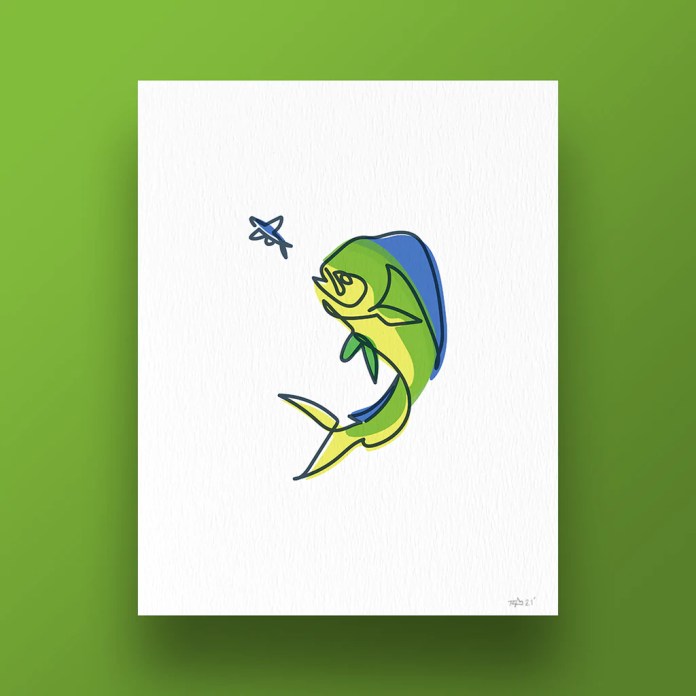
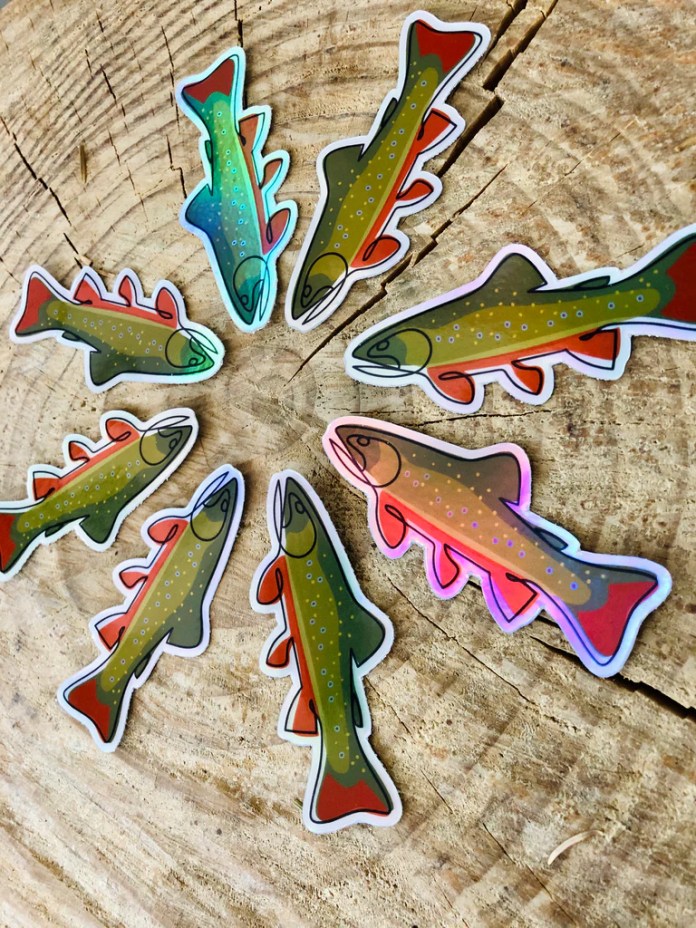
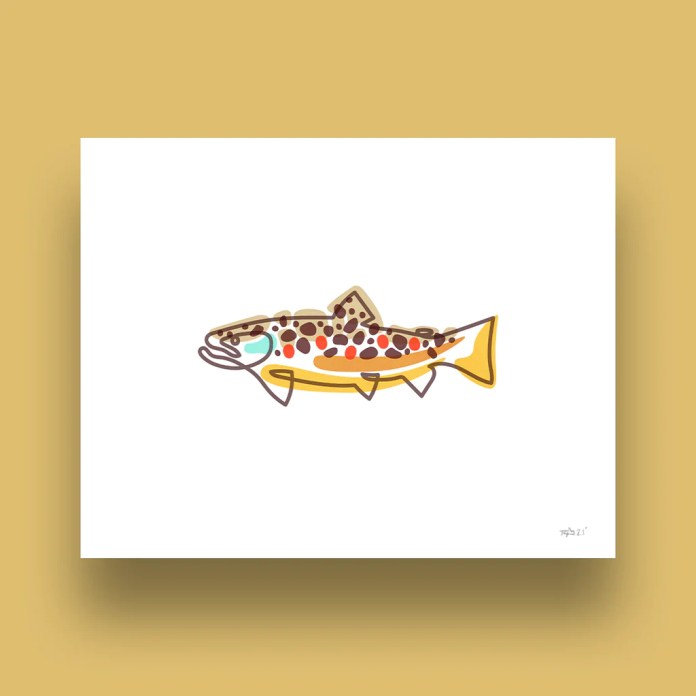
I feel that the single-line illustration is a great match of style because it resembles a fly line so well. The free and loose feeling of the line work also represents the flow of the river—always changing in expressions and form. I aim for the artwork to be minimal and tell the story with as few words as possible.
Bruce Lee said, “It is not daily increase but daily decrease, hack away the unessential.†I subscribe to this philosophy and try to apply this lesson in art and in life. That idea of finding the kernel of truth in each subject is such a fun way to approach art, and I feel like it leaves you with a unique interpretation of the subject. I enjoy the challenge of portraying something we’ve all seen in a new and unique way.
Image Courtesy of https://thunderbird-design.com/collections/graphic-prints?page=1
Flylords: Tell us about TDS’s 2% For Conservation certification.
Robin: 2% For Conservation means 1% of your Time + 1% of Money goes to conservation. Being involved in 2% has been great in connecting with businesses and other like-minded people who share the same values when it comes to conservation and the outdoors. I think the certification is important because it builds community, shows what we feel is important, and spreads the word so that more people get involved and more resources go toward conservation. Shout out to Jared Frasier for starting the 2% movement.
Image Courtesy of https://thunderbird-design.com/collections/graphic-prints?page=1
Flylords: Which organizations does TDS donate to?
Robin: TDS has made contributions to Theodore Roosevelt Conservation Partnership, BackCountry Hunters & Anglers, Trout Unlimited, and The Ocean Cleanup. These organizations stood out because they are run by passionate people who are actively and effectively making a difference in the world today. From legislation to boots on the ground, these organizations are fighting the good fight and doing the much-needed work to preserve and improve what we have for future generations.
Image Courtesy of https://thunderbird-design.com/collections/graphic-prints?page=1
Flylords: What challenges and successes have you experienced in starting your own business?
Robin: Running your own business means you wear a lot of hats. For an artist, some hats just don’t fit very well. Another challenge is finding quality manufacturers in the U.S. That’s a big one. I want TDS to transition to all U.S.-made goods. While some of our products are already made in the U.S., fully transitioning is taking a lot longer than I want.
Successes have come in many forms. My first was a snowboard design for Gilson. It was an awesome project because designing a board was always a bucket list item for me. The cherry on top was that proceeds from each board sold went to Trout Unlimited. A more recent project I really enjoyed was designing the poster art for “Pheonix,†a Fly Fishing Short Film by the Braker Brothers—shout out to the force of nature that is Eric and Andrew. I’m constantly surprised by the support that comes from the fishing and hunting communities.
Photo Courtesy of Robin McCormack
People have reached out about how the art makes them think about personal memories of lost loved ones and some have gotten tattoos because it reminds them of their time on the water. Having people share with me the personal experiences they’ve had because of the artwork is something I never imagined. It’s definitely fuel in the tank for me. It’s such a bonus to be able to connect with people over the art and it makes me happy to think it’s bringing people a little happiness in some way.
Happy Holidays and Happy New Year! We cannot wait to jump into 2023. We’ve got some amazing trips and plans that we can’t wait to share with all of you. To round out our last Video of the Week of 2022 we catch up with Niklaus Bauer & Jonathan Ã…hström of Fly Maniacs as they explore one of the largest rivers in northern Sweden. They share the same passion for exploring new water and chasing big pike. In this episode, they are testing out their new Pike Maniac rod in the 9 weight. Sit down and enjoy as the guys put on a clinic chasing some monster Swedish esox.
Vision Fly Fishing is a Finnish fly fishing brand focused on the European fly fishing market. They started in 1997 and now have customers and team members in over 40 countries. From Rods, Reels, Lines, Waders and more Vision has it all. If you liked the first episode of Flymaniacs make sure to check out their youtube here: Vision Fly Fishing
Make sure to check out these killer articles as well!
The strange fish are the ones that keep me super engaged and challenged as an angler, and strange we found. Our day started with the intent of camping on one of our favorite islands in the bay and targeting snapper species and whatever else we could find.
When fishing rocky shorelines, the biggest thing I like to focus on is canvassing the area. The biggest tactic I’ve learned is to put a few casts in one spot and then move to the next. I was jumping from rock to rock, blind casting fishy water. Suddenly, I retrieved my fly to my feet and this Giant Hawkfish made his move. As my fly dropped, the fish shot out from under the rock I was standing on and crushed my fly. Less than a few seconds, the Giant Hawkfish buried himself in volcanic rocks. Without hesitation, I jumped into the water, rod in one hand, the leader in the other. I dove down to pull this fish out not only from one rock but a few sharp volcanic rocks while getting smashed by waves.
After pulling him out of the volcanic rocks and landing him on the beach, I began shouting in awe as my good friend Jefe Feczko was in full sprint and excitement, making his way over to assist. We could hardly keep it together. This is the largest Giant Hawkfish we had ever seen and was on par with the world record. The aggression and fight of this alien-looking fish was unmatched. The biggest take away from this is to keep the fly in the water and keep exploring and pushing to try new things.
Angler Story of the Week from Alec Lucas, find him on Instagram @fish_a_day.Â
Flylords: What do you look forward to the most about tarpon season?
David Mangum: You know, the beginning of it’s really awesome, and by the end of tarpon season, you’re actually like, what else is going on? But in the beginning, I’m super fired up. It’s still like a little way out, but it’s all I’m thinking about. Having this weather warm-up and that feeling of seeing the first one.
The cool thing about tarpon is it’s always changing. There are spots that the tarpon live and you fish them in. They change here and there, but you know they’ll swim over those spots on parts of the tide, there are all sorts of other aspects of the fish that are always changing. It’s a puzzle and if it were exactly the same every day, it would bore the shit out of you. You have to keep engaged…
Read on below for the full Interview with Capt. David Mangum presented by Costa Sunglasses.
New Zealand is a dream country for all trout bums. I was lucky enough to spend more than a year there on working, holiday, and tourist visas. During my stay, I saw a few giant eels following the trout I hooked. I also landed a couple of trout with apparent marks of eel jaws. COVID stopped all traveling for a while; however, in November 2022, I finally returned to the North Island for some fishing.
Returning to this river, it’s just like I remembered. I had a short walk to the river, prepared my nymphing setup, and started working water in the upstream direction. After approximately 2 hours of fishing, I landed five nice rainbows and reached some hefty rapids. Only a few people fish through these rapids, so there was an excellent opportunity to get into some bigger fish. After a few casts, I hooked another beautiful rainbow.
The fight took a few minutes, and I was able to get it in the net! After successfully landing, I decided to take some pictures. I prepared a tripod with my phone, and when I put my hand into the net to grab the trout, I almost shit my waders. A long black shape came quickly from the side and tried to catch my rainbow. Not one but two eels together were chasing this fish while I had it in the net. I moved toward the Eels trying to scare them away. The Eels moved a bit back but started to chase again. I’ve never seen Eels so aggressive before. Suddenly I lifted the net from the water, but the Eels continued to pursue, with one of them biting the trout in my net.
I finally tried kicking the Eels away to try and get them to stop harassing my nice rainbow. The Eels were crazy-it seemed as if they wanted a good meal from the trout I landed.
I didn’t want to torture the trout more with photo shooting, so I released him, hoping he would escape the jaws of the Eels. By the end of the day, I saw three more eels, something I had never seen nor experienced when fishing this majestic river.
Fish: Native vs. “Invasive”
It’s pretty well known that trout are not the native fish of New Zealand. On the other hand, Eels are native, so let’s look closer.
Longfin Eel (Anguilla dieffenbachii) are locally known as “tuna.” Endemic to New Zealand, the longfin eel, so named because its dorsal (top) fin is longer than its bottom fin, is one of the most giant Eels in the world. Some females can reach up to 2 meters long and weigh up to 40kg.
During the day, Eels are secretive, hiding under logs and boulders or undercut riverbanks. They hunt primarily at night, using their excellent sense of smell. Juvenile Longfin Eels feed on insect larvae, worms, and water snails. As they get bigger, they begin to feed on fish. They will also eat freshwater crayfish and even small birds like ducklings.
When Eels begin life, they are microscopic, only reaching one millimeter in length. Eels are slow growing compared to many other fish – a longfin may grow only between 15-25mm a year. They can also live for many years. Large longfins have been estimated to be at least 60 years old.
Longfin Eels have a unique life cycle. They live in rivers, lakes, and wetlands for most of their lives. Then, after 25-80 years, they travel 5000km to the South Pacific near Tonga to breed. After laying their eggs, they die. The tiny fertilized eggs float on ocean currents for about 15 months until they reach New Zealand. They then journey inland, swimming up rivers and waterfalls and even crawling over dams! They transform into glass eels and then elvers before becoming adults. However, Longfin Eels are now considered at risk, and their numbers are still declining.
Angler Story of the Week from Martin DvorÌŒaÌk, be sure to follow his fly fishing adventures on Instagram @mdx_flyfishing.
How much do you think about fishing angles? One topic seldom talked about is the is angler positioning relative to the sun. Check out this video from Troutbitten to improve your approach when you’re hitting the river.
In this week’s “How to Tie†video feature, Charlie Craven ties Grillos Low Rider, created by Andrew Grillos that will produce when those big stones are hatching.
Learn About This Fly:
Difficulty: Intermediate
With winter in full effect, it’s time to reminisce on warmer days throwing dry flies to aggressive trout. Some of the most exciting fishing happens between June and October, and it’s best to prepare now so you can spend those days on the water instead of behind the vise. A personal favorite time for me is the salmonfly hatch, where trout gorge themselves on freakishly large stoneflies. Grillos Low Rider is a hopper style pattern that will produce trout during those warmer months when their eyes turn upward with aggression.
Patterns that use foam and naturals can be difficult for novice tyers, but practice is key. Working with deer hair, or in this case elk hair, is not as simple as it may look and requires patience and precision. For the first few, go slow and make sure your profile is consistent with the video’s. Taking your time when tying Grillos Low Rider is beneficial for overall product and increasing your skills on the vise.
Summer is the best time to bring this pattern out of your box. Whether fished as a single fly or in a dry dropper rig, both are effective methods. Hot days are best spent on the water, and this pattern will entice those hungry trout that begin to key in on bigger terrestrial food items. Fish Grillos Low Rider with confidence during the warmer months and spend your time behind the vise now!