Home Blog Page 49

2023 F3T Behind the Lens: The Belt Buckle

The 2023 F3T is underway – click here to find a local showing and purchase tickets.

For this installment of F3T Behind the Lens, we sat down with filmmakers Cale Berry and Elsa Caruso to discuss their latest film “The Belt Buckle”. The film takes us to the wild, wild, south of Australia, where four competitors fight for a champion position to gain the elusive, Belt Buckle. Cale and Elsa both run @fosh_au, an Australian Fly Fishing page on Instagram.

FLYLORDS: So, who are you?

ELSA: During the day, I am an advertising creative. But outside of work, I’m an avid fly fisher, outdoors lover, writer, filmmaker, and partner at FOSH. I grew up with a dad who loved fly fishing and a mum who loved horse riding. So, I got a taste of that world from a young age and loved every part of it. Still do. Through my content, I aim to inspire and encourage more women to get into the sport and out on the water.

CALE: I’m an advertising creative five days a week, and a nature lover, fly fishing obsessed filmmaker the other two (oh, and as many sick days I can turn into days on the water too). I began fly fishing in the North East regions of Victoria, Australia. FOSH was born when I started bringing my camera with me on every trip to begin documenting the incredible places and great fish we were catching.

FLYLORDS: How did this film turn from an idea into reality?

ELSA: With the Belt Buckle, we wanted to branch away from the more traditional fishing films you see and focus on a story-based narrative rather than a documentary about one trip. We wanted to blur the genre lines, melding together Australian sarcasm, epic westerns, and of course, fly fishing. 

However, due to the utterly unpredictable nature of the sport, following a script word for word was impossible; no one could predict who would catch what. In truth, we wrote the script in sections and filmed as we wrote, starting with the things we could control; the legend of the Belt Buckle, the rivalries, and the characters. As the season went on, we documented each trip and every great fish, filming constantly, working each notable moment into the story, and dropping it all into our editing software. It was a fascinating exercise in creativity, patience, and adaptability.

FLYLORDS: Were there any difficulties around filming when fishing was slow, there was bad lighting, or, etc.?

CALE: The filming of this project had its ups and down. Our main difficulty was that this entire film had to be shot over one full fishing season. It wasn’t just one trip’s worth of footage and content to sort through. This was 4-5 months of footage shot across Victoria and Tasmania. And just like every fisherman knows, you can never really tell when something amazing might happen on the water, so we had to try and film as much as possible. The second most significant difficulty would have been the ever-changing story that developed over the season. We had storyboarded and planned out the entire film, characters, and backstory, but we couldn’t predict who would catch what. But thanks to long-life batteries and being vigilantly behind the camera at all times, it came together in the end and was well worth it. 

FLYLORDS: We’re there any stressful moments for the crew with the fear of not getting to take the prize home: the belt buckle?

CALE: The season was truly a wild ride! The one thing we needed was a big fish to round off the season and to win The Belt Buckle. This isn’t exactly the easiest thing to plan. No matter how many trips you go on, a big monstrous brown or rainbow trout isn’t a given. However, it wasn’t long into the season when two of us out of the four had caught some stunning fish, and that fear soon disappeared. 

ELSA: Unlike my character in the film, I’m not a particularly competitive fly fisher. Don’t get me wrong, I love catching great fish and showing these boys what’s what, but I have other goals on the water, like enjoying myself. It was more stressful ensuring that the whole cast caught some good fish to really raise the tension of the film.

FLYLORDS: Do you have a favorite shot from the film, can you give us a backstory on it?

ELSA: I have two. My first one has to be Max fighting that sea run smelter. Everything about that sequence is perfect. Max’s performative fighting style, with the slow but dramatic music and the fish flipping out of the water… You can’t get a better shot than that. The second is Riley’s title card shot. His eyebrow raises just at the perfect moment, casting a fierce and hilarious air around the character. It sets him up perfectly. 

CALE: It’s hard for me to pick a favorite shot. It might have to be the same as Elsa’s favorite, the shot of Riley walking through some prehistoric tree stumps in the water, the scenery in that location is next level, and Riley’s hair illuminates the shot.

FLYLORDS: What equipment were you using to shoot the film?

CALE: As any fisherman knows, there’s nothing like packing light while spending long days on the water, so I try and help myself the best I can with a small, nimble, but very powerful camera. We use the Canon R5, a fantastic all-around camera that covers all our stills and video while fishing. The camera has great slow-motion capabilities, too, and excellent Clog RAW functionality, which is super important when it comes to grading your own film. The Canon 24-70 f2.8 is my go-to lens on the river, and when I feel up for it, I’ll bring along the very heavy 70-200 lens for those beautiful long shots.

FLYLORDS: It seems like there was a lot of competition–and a lot on the line. So, who talked the most trash on the water?

ELSA: I think everyone will agree with me on this one… Cale… definitely Cale. No question about it.

FLYLORDS: Was there any instance of “the one that got away” that could have changed the champion on the belt buckle?

ELSA: I am already getting annoyed thinking about losing this fish. So, Cale and I got up early on the last day of one of our trips to the high plains to get some good drone footage of both of us fishing. Cale had only had this drone for a week or so, and he was still figuring it all out, so he wasn’t the speediest with getting it up in the air or back down. I was standing in the middle of a stunning, wide stretch of water. It would have been roughly twenty meters across, and I was standing directly in the middle. Cale was downstream on the left bank, controlling the drone hovering above me. It had been very slow, with little activity, but the sun and some bugs were coming out. Long story short, I cast across to the right bank and hooked onto an absolute monster. I didn’t have a net because it looked messy in the shot. I began screaming to Cale to come over with the net as I fought this fish. Getting to the bank was impossible, so I got it right in front of me. I could see it in the water. Cale was still trying to land the drone, and taking forever, I might add. The fish popped off just as he landed the drone and started to leg it over to me. I was devastated. It could have been the winning fish… It’s still a sore spot for us. We don’t really talk about it.

FLYLORDS: What’s next for the Fosh team?

Not even we know! And that’s what we love about it. But we’re hoping to move further away from the documentary style regularly seen in the fishing world and push our storytelling further into another short film, potentially in the horror genre. We are always looking for ways to create more, do more, and be more innovative with what we make. It’s what we love to do.

FLYLORDS: Is there anyone you want to thank for helping this film come to life?

Huge thanks to the rest of the cast, Riley Berry and Max Caruso. The film wouldn’t have been possible without them and the amazing characters they portrayed in the film. Also, a special thanks to both of our sponsors Manic Tackle Project and Smith Optics Au. We use their products religiously; they make our time fishing on the water the most enjoyable it can be.

Special thanks to Cale & Elsa for taking the time for an interview, be sure to follow along for more content on their page, @fosh_au. To check out the full film, click here to see The Belt Buckle. Stay tuned for more iterations of the Fly Fishing Film Tour, F3T Behind the Lens segment by clicking here. 

To see the full film attend a 2023 F3T Premiere, click here to find a local showing and purchase tickets.

Check out the articles below:

The 2023 F3T Stoke Reel has Arrived!

Reel of the Week: Finding The Right Drift

The Rundown: An All Encompassing Look at Simms’ 2023 Freestone Waders

Welcome to: “The Rundown”. In our newest editorial series, we’ll provide an all-encompassing look at the latest and greatest products from your favorite brands in the fly fishing and outdoor space. Here, we’ll run over high-level info, tech specs, and our opinions – all paired with a behind-the-scenes interview with product designers who have poured their hearts into bringing these creations from blueprints to the showroom floor.

In this Rundown Feature, we will be providing an all-encompassing look at the newest iteration of the Freestone Waders from the Simms Freestone Collection

Background: 

If you’ve ever picked up a fly rod, hopped into a Bass-Boat, or stepped foot in pretty much any store that sells fishing tackle, there’s a good chance you’ve become well antiquated with the brand: Simms.

Simms Fishing Products is a Montana-based company, located in Bozeman (or Bozeangeles, as some of us know it at this point), and since its founding in Jackson, WY in 1980, Simms has been a producer of quality fishing products for anglers of all pursuits. In 1992, Simms traded hands (before being acquired by Vista Outdoors just last year) and was moved to Bozeman, where the HQ and production floor currently reside. Nowadays, Simms is one of the most well-known names in the greater Fishing industry, with their products covering a wide variety of needs ranging from fly to conventional.

An accolade Simms proudly boasts is their dedication to manufacturing their fishing waders in Montana. As we all know, being a domestically self-sustaining company has become more and more of a rarity over the years, and certainly comes with a price tag. However, Simms stays strong and shows no sign of reallocating their production efforts any time soon.

If you were to walk into Simms HQ in Bozeman today, one of the items you might see being meticulously stitched together would be the NEW, 2023 Freestone Waders.

The Freestone collection has been a staple to Simms’ wader offering for the last 20 years and has been marketed as their most “Accessible” pair of waders. Sitting at the lowest price point within Simms’ full catalog, the Freestone has been serving as a break-in point to new anglers for years and offer a high-quality, long-lasting wader option at an extremely affordable rate.

What’s New: 

When it comes to the new Simms Freestone Waders, no one was trying to reinvent the wheel. However, that’s kind of the point of the Freestones in the first place. That being said, there are a few key differences we’d care to highlight.

  • The New Midnight Colorway

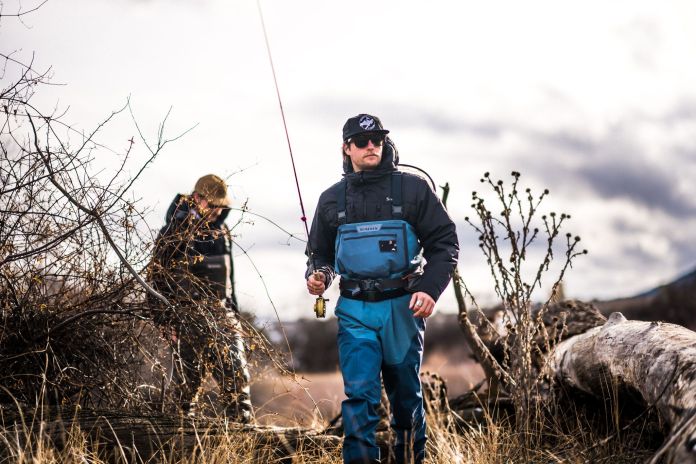
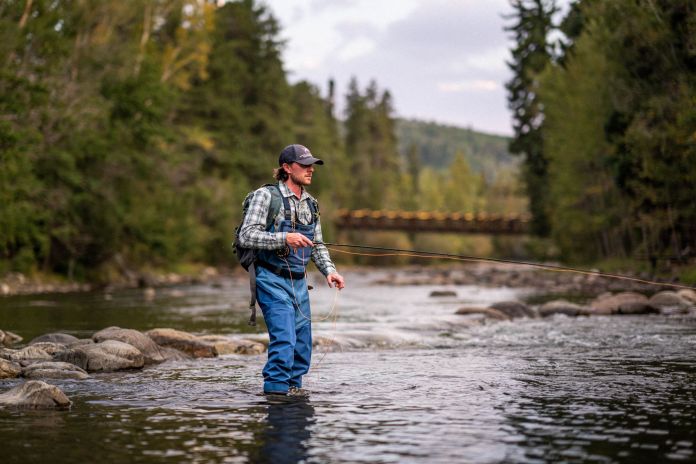
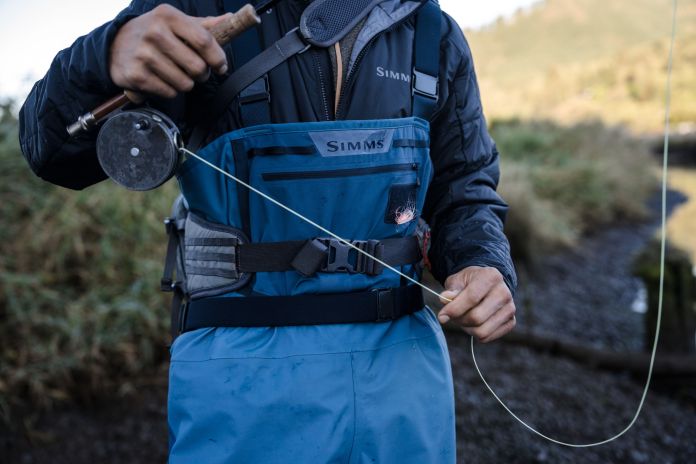
First and foremost, let’s address the most notable difference that has certainly caught all of our attention – one way or another. No, you there is nothing wrong with your computer or phone screen, those are in fact BLUE waders with a Simms logo stamped on the front.

While most of us associate Simms waders with the “Space-Grey” color that has seemed to have metastasized throughout the fly-fishing industry within just a few years, this isn’t the first non-grey wader we’ve seen out of the Freestone collection over the last few years. Many might remember, and some might still be using the Freestone Toray waders that came out a number of years ago. These waders departed from the usual “gunmetal” grey and offered anglers a green colorway offering. However, green waders weren’t anything too new, as you could as easily find an old pair of green waders laying around your grandfather’s basement as you could a pair of khakis in his closet.

Now, we return to the newest and bluest. Simms’ intention of releasing the newest iteration of the Freestone Wader collection in blue, particularly this shade, was to make them stand out. And that they do. Built for the non-typical angler, the Freestone’s don’t offer all the bells and whistles that higher-end waders such as the G3’s and the G4’s do, but they certainly aim to highlight unique personalities who might live their life on the outskirts of the core-fishing community. And that much, they definitely do.

Rest assured: if blue just isn’t your color, the 2023 Freestone waders are still also available in the signature “smoke” colorway.

  • Incorporation of the G3 Fit Block 

(From Simms Senior Product Line Manager: Matt Carara): “The first, and one of the most important steps in developing the new Freestone collection was for Simms to incorporate their G3 fit block on both the Men’s and Women Freestones (respectively). This improved fit not only enhances mobility and comfort — by eliminating bunching, creasing, and abrasion areas, it also dramatically increases the longevity of the wader itself.

  • Updated Front and Back Leg Seams

“Another new development that bolsters comfort, mobility, and durability even further is
the incorporation of their patented front and back leg seams. While Simms has utilized
front and back leg seams for many years in wader styles such as G3 and G4, this is the
first time this innovation has found its way into the Freestone collection.”

  • Neoprene Gravel Guards

“After dialing in the beloved mobility and fit found in G3, the next priority to address was
the gravel guard. While its predecessor utilized a self-fabric gravel guard, which is
essentially a continuation of the lower portion of the wader’s fabric, the new Men’s and
Women’s Freestone features a built-in neoprene gravel guard/stockingfoot construction.
Not only is this a major upgrade towards comfort, performance, and durability —
aesthetically, it gives the wader that iconic and unmistakable Simms look.”

Check out the new Freestone Wading Boot, HERE.

Tech Specs: 

Here is a high-level tech-spec breakdown of the new Freestone Waders from Simms’ Website: 

  • Durable and breathable Toray QuadraLam 4-layer upper & lower
  • Stretch elastic suspenders with Simms custom opposing male and female buckles for easy waist-high conversion
  • Upper chest pocket array features a top access stretch woven storage pocket, micro-fleece lined hand-warmer pockets and integrated loop fly patch

  • Patented front and back leg seams deliver articulated fit, improved mobility, and increased durability
  • Dual rear belt loops; 38mm stretch elastic wading belt included
  • Built-in Tippet Tender Pocket

FABRIC TECH:

4-layer Toray QuadraLam Upper & Lower

Our Experience: 

Our team was lucky enough to have heard about the upcoming release of the new Freestone waders around this time last year and were able to get our hands on a pair to play with in the Fall of ’22. Since then, here’s what we’ve gathered:

We would describe the new Freestone waders as a minimalist’s delight. They’re an incredibly versatile pair of waders, without feeling the need to be anything more than just that: waders. These are a pair of water pants you won’t feel bad shoving in your duffel and tossing in the back of the truck when headed out for a weekend trip on some new water. They’re good for just about anything, which is just about what we put them through.

Something we really admire about these waders is their focus on maneuverability. Whether you’re camping on the banks of a Northwestern river well before sunrise, watching your breath dissipate beneath the spotlight of your headlamp, or trudging through the pouring rain of canyonous landscapes in search of Colorado Cutthroat, these waders will do two things: 1. keep you dry 2. keep you going.

No, the blue is not some sort of new patented river camouflage (while that is something Simms is well known for) that is guaranteed to catch you more fish. It is, however, a new and exciting way to show off your snazzy new pair of waders on the water without having to awkwardly jam it into conversations with passer-byers. (We’re all guilty of it. It’s okay to be excited.) All jokes aside, if you’re looking for something just a little different from every other river rat on your side of the Mississippi, it’s nice to know an option like the Freestone waders is out there.

In summation: We feel that the new Freestone waders are for those who may not be ready to break the bank on a pair of waders, but respect good, American-made gear that’s going to last. In an age of rapidly advancing technology within the sport of fly fishing, the Freestone Waders serve as a no-BS, accessible option for any angler who just needs a good pair of waders – plain and simple.

An Interview with Simms’ Product Marketing Manager: Connor Flanagan: 

In this portion of, “The Rundown”, we had a chance to sit down with Simms Product Marketing Manager, Connor Flanagan, who has been working diligently with the Simms design team over the last year in bringing the new Freestone Collection to life.

Flylords: Why did Simms feel the Freestone collection was next in line to receive an upgrade?

Connor: When it came to revamping the Freestone collection, our goal was to create a high-quality product that was accessible to any and all anglers. The thought process behind Freestone is really “everything you need, nothing you don’t”. Throughout the Freestone collection, there is trickle-down tech and DNA from our top-of-the-line wader offerings. We are especially excited about the improved fit and comfort we achieved in the newly updated Freestones. These improvements came directly from the design lines of our multi-award-winning G3 Stockingfoot Waders.

Flylords: What kind of angler are these waders made for? Who do you see best fitting into them…

Connor: Our slogan for the new Freestone’s is: “From first cast to lasting obsession.” Whether you are new to the sport or an avid angler, the new Freestone collection caters to individuals looking for a reliable, performance-driven wader at an accessible price point… I’d say that sums it up pretty well.

Flylords: What are some of the new design updates and improvements anglers can expect to find in the new Freestones?

Connor: As I mentioned previously, we are really pleased with the Freestones’ new and improved fit profile. When you dial in the fit of a wader, you’re not only enhancing comfort, you’re also creating a wader that’s built to last for the long haul.  The new fit profile is derived from our multi-award-winning G3. We are also really excited about the Freestone’s 4-layer, waterproof/breathable Toray Quadralam fabric package. It’s extremely performative in terms of breathability and durability, but it also offers anglers a completely unhindered range of motion. Another aspect of the Women’s Freestone that makes a huge difference is the inclusion of stretch side panels on the upper portion of the wader. Once again, that’s really going to increase mobility and comfort, but also provide female anglers with a flattering fit.

Flylords: What was the thought process behind deviating from the iconic grey color and releasing a blue [Midnight] wader?

Connor: Keep in mind, in addition to the Midnight wader, the Men’s Freestone is also available in Smoke which is certainly more “traditional” for Simms. But to answer your question, in truth, we just wanted to try something a little different. We recognize that a lot of anglers gravitate towards more traditional colors, but considering this is one of our largest and most diverse consumer groups, we wanted to offer something a little different, something that would appeal to those anglers that want to stand out from the herd.

Flylords: When can consumers expect to see the new Freestone Collection Available?

Connor: The new Freestone collection is available NOW on our website and at a Simms Dealer near you.

Thank you to the Simms team for allowing us to be a part of this project over the last year. To learn more about the new Freestone Collection, Click HERE. To find a local fly shop and Simms dealer, you can do so HERE!

Check out the new Freestone Waders, HERE.

This article was published as part of a paid campaign between Flylords LLC and Simms Fishing Products. All opinions presented in this article are genuine and solely reflect the opinions of Flylords LLC. 

The Rundown: An All Encompassing Look at the New NRS Slipstream Raft

Simms New Watershed Waders are Now Available for Purchase

Reel of the Week: 40″ Redfish Caught on a 7 Weight

A note from Chase Smith:

“We were deep in the Louisiana marshes using Google Maps to navigate when we found a bay system that had redfish stacked in the shallow lakes. Robby could see this forty inch redfish tailing before we even came around the bend. Robby and I had plenty of time to get the drone overhead; my dad was poling a skiff for the first time ever so he eased us towards the fish in a slow zig zag pattern.

The seven weight rod in Robby’s hand seemed woefully underpowered once we could see the wide shoulders on the feeding redfish; however, Robby laid his cast out nonetheless. On the second cast, the redfish engulfed the fly just as we thought it would be spooked by the boat. A few minutes into the fight, Robby vowed never to use a seven weigh for these fish again. Thanks to some heavy tippet and a tight drag, we landed the fish a short while later and watched it swim away with memories.”

Reel of the Week from Chase Smith, be sure to follow him on Instagram at @fishchaseflies. 

Check out the articles below:

Ole Red: A Redfish Angler Story

Flavor on the Fly: Grilled Redfish Collars & Lowcountry Grits

Fishing Tips: How to Set Up the Perfect Leader

Check out this video from Mad River Outfitters all about how to set up the perfect leader. Brian Flechsig and Flip Pallot are sure to bring up some tips that you’ve never considered.

How to Tie: The Parawulff

0

Disclosure: The article may contain affiliate links that may result in a commission at no additional cost to the reader.

In this week’s “How to Tie” video feature, Charlie Craven with Charlie’s Fly Box ties a dry fly that every angler should be tying this winter, the Parawulff.

Learn About This Fly:

Difficulty: Intermediate

Moving into the spring, two things are constantly on my mind: warm weather and dry flies. After a brutally cold winter, I think I can speak for many when I say spring is needed. Tying flies throughout the winter is a fantastic way to pass the time, but nothing beats time on the water. When I think of summer dry fly fishing, the flies that come to mind are the Parachute Adams and the Parawulff, and both should always be in your box.

The Parawulff is similar to the Parachute Adams, but the post is split into two parts similar to all Wulff dry flies. This pattern can be tied in a variety of sizes and colors, especially to imitate a mayfly hatch in your area. In general, this is a great surveying fly and is perfect for tricking those finicky trout to come up to the surface. Once those water temps rise and larger insect hatches become more prevalent, do not leave the house without this pattern.

Whether on small blue lines on a map or larger rivers, this is a fantastic fly. Small stream fishing often calls for dry dropper setups, and this pattern is perfect in those technical environments. For larger rivers during the summer, fishing this pattern in a double dry rig is extremely effective. The Parawulff is the perfect dry pattern to master before those warm temps hit, and you’ll only be wishing you learned to tie it earlier!

Ingredients:

Now you know how to tie the Parawulff!

Video and ingredients courtesy of Charlie Craven.

Behind the Scenes: “SALT R8 Applications | The Silver King”

When developing their new saltwater rod the SALT R8, Sage sent their senior rod designers to the birthplace of the discipline in South Florida. During their lengthy saltwater immersion, they listened carefully to the shops, guides, scientists, stories, and legends to truly understand what was happening on the water and what was really required to shape and hone a more perfect tool for saltwater sight fishing.

We were lucky enough to go behind the scenes with Captain Camp Walker, one of the best when it comes to targeting Tarpon in the Keys. Camp has been Guide to six IGFA world records on fly including three for tarpon. He is three-time Guide to Grand Champion of the Ladies Tarpon Fly Tournament. He is Guide to Grand Champion 12lbs Division of the 40th Annual Don Hawley Invitational Tarpon Fly Tournament. We got to ask Camp a couple of questions to give you some more background to why he picks up the SALT R8 on the flats.

Flylords: Tell us about yourself… Who are you?

Camp: I spend most of his days on saltwater flats looking for tarpon, snook, bonefish, permit and redfish. Most of my guiding is throughout the Florida Keys and Everglades National Park. I love brining clients into a wilderness of mangrove islands, marl and seagrass flats.

Fishing has been a part of my life since I was was young. Born and raised in Vero Beach, Florida, I used to tote a wagon full of tackle through neighbors’ yards to get to the Indian River Lagoon’s tarpon and snook. I did know I wanted to move to the Keys. It is the epicenter of saltwater fishing and also where I could learn to hone my craft into being a great fishing guide. Two decades later, I am still guiding down here in the keys, loving every moment of it.

I am lucky to be married to my amazing wife, Michelle Nicole Lowe, an incredible marine life artist. We enjoy living in Islamorada and teaching our two sons a love for the ocean through fishing, snorkeling, and exploring all the Keys have to offer.

Flylords: Do you have any fun stories from filming with the Sage crew? 

Camp: When filming, my angler John Wilson and I caught a tarpon that did not miss out on many meals. I remember it like it was yesterday. It was a chilly February morning in Everglades National Park, as most mornings are that time of year, or at least chilly for my Floridian blood. We first noticed the fish upon it rolling. The fish laid up and was clearly awaiting a meal because when John delivered the fly in front of the fish, she did not hesitate to engulf the fly comprised solely of chicken feathers.

SALT R8 fy rod casting.

The fight ensued with a series of picturesque acrobatics. The light reflecting on the fish in an exquisite fashion. The hues of the tannic water absorbed into her scales shined golden.

RC is an incredibly talented and hard working videographer, a true master of his craft. He captured all the amazing aspects of this fish from start to finish. He truly gave this fish all the respect and glory that sea creature deserved.

I will forever hold onto the memory of catching that special fish with my great friend John. Even more so since RC captured it all on film.

Flylords: What is your favorite aspect of Tarpon fishing? 

Camp: To make it clear, I love all aspects of tarpon fishing. My absolute favorite part of tarpon fishing is when they “lay up.” I love fishing for laid up tarpon for a variety of reasons. One thing is you have to go find or hunt them. You do not just sit on an edge of a bank or in front of a white sand hole and wait for the fish to swim to you. Also, tarpon lay up in the Florida Keys and Everglades National Park at all times of the year, not just during the migration, making them accessible on just about any day the water temperature is warm enough. Lastly, the most vicious bites/eats I have witnessed have occurred from fish that were laid up.

Flylords: Why are you picking up the SALT R8 when you’re targeting Tarpon? 

Camp: I am grateful and honored to have been part of the R&D of the SALT R8 rod, so I may have a slight bias towards the rod. I feel the SALT R8 does a lot of things really well, all of which you need from a tarpon rod. My favorite aspect is the cast ability of the rod. Anglers of all skill levels can enjoy casting this rod because they can feel the rod when making casts of all lengths. The rod’s softer tip no longer makes the short shots difficult. While the mid-section allows the angler to carry the line necessary to make a longer cast into our trade wind while fishing migrating tarpon on the oceanside of the Florida Keys.

SALT R8 bending with a fish on.

Since the rod helps anglers cast better, more tarpon are fed the fly, resulting in more hooked fish. The materials these rods are constructed with are 25% stronger per weight then rods of prior generations. Therefore, the SALT R8 is an incredible fish fighting tool!

Flylords: What is your favorite part about your local fishing community?

Camp: Although I am still young, as a native Floridian, I have been around long enough to see things change through out the state. The camaraderie shared by guides and anglers in South Florida’s fishing community enable us to take action for the water and gamefish that live here. We have a genuine love for the area and know together we can make a difference. I am thankful for the numerous wonderful conservation organizations that work tirelessly to conserve all the unique wetland, estuarine, and marine ecosystems of Florida. As a guide, I benefit greatly from these folks hard work.

Flylords: Why is it so important to pull hard when fighting a tarpon? 

Camp: The first and foremost reason it is important to pull hard when fighting a tarpon is solely for stewardship and conservation. It is imperative to catch these fish as quickly as possible to ensure they withstand a chance to avoid predation after being released.

Secondly, it is important to pull hard when fighting a tarpon because the longer the fight wains on, the advantage leans in favor of the tarpon.

Thank you Camp for taking the time to sit down with us an answer a few questions. If you are going on a flats trip soon, you can check out the Sage SALT R8 HERE or at your Local Sage Dealer.

Behind the Scenes: The Ghost of the Flats | SALT R8 Applications

Behind the Scenes: Salt R8 Applications | “The Final Boss”


YETI Issues Voluntary Recall of Hopper M20, M30 1.0 and Sidekick Dry Bags

YETI has issued a voluntary recall of 1.9 million Hopper M20, Hopper M30 1.0 and 2.0, and SideKick Dry products citing issues raised by the U.S. Consumer Product Safety Commission (CPSC). The concerns related to the magnet closures featured on the above products. In some cases, these magnet closures can fail, releasing the strong magnets found inside.

According to the CPSC,  “When two or more high-powered magnets are swallowed, the ingested magnets can attract to each other, or to another metal object, and become lodged in the digestive system. This can result in perforations, twisting and/or blockage of the intestines, infection, blood poisoning, and death.”

The CPSC and YETI have both stated that consumers should immediately stop using the recalled products and contact Yeti for refund information.

Click here to navigate to YETI’s recall page.

From YETI Coolers:

“In cooperation with the U.S. Consumer Product Safety Commission, we are voluntarily recalling the Hopper M20, Hopper M30 1.0 and 2.0, and SideKick Dry products sold between March 2018 and January 2023. The magnet-lined closures on these products can fail and release the magnets, which poses a risk of serious injury or death if ingested. We ask all customers currently in possession of the Hopper M20, Hopper M30, and SideKick Dry to immediately stop use of these products.

Please fill out the form on this site to receive your choice of either a suggested replacement product of equal or greater value than the recalled product or a full refund in the form of a YETI gift card with an additional value depending on the product and market. Upon submission, we will provide you with a prepaid shipping label and packaging material for you to return your product. Refunds (in the form of YETI gift cards) and/or replacement products will be sent only after YETI’s receipt and validation of recalled products.

Please contact YETI toll-free at 1-833-444-3151 (7 a.m. to 7 p.m. CT) or email ProductRecall@yeti.com for more information.”

To learn more about the recalled products and the replacement products YETI will give to customers who return the recalled products, please go to this link.

Featured image courtesy of YETI Coolers.

Are Olympic Peninsula Steelhead Heading to an Endangered Species Designation?

In unfortunate, yet hopeful, news, the National Oceans and Atmospheric Administration’s Fisheries Service announced a review of Olympic Peninsula steelhead to determine if the species warrants Endangered Species Act protections. Frankly, this is a sad development for wild steelhead, because OP steelhead were often looked at as one of the remaining bright spots. On the other hand, however, a possible ESA listing would ensure strong federal oversight and resources dedicated for their recovery. But the truth is bleak–the steelhead runs in OP, like the rest of region, are failing.

The ESA is a foundational conservation law in the United States, with a long history of successfully preventing species becoming extinct and putting them on the road towards recovery. As it relates to salmon and steelhead, there are nine genetically distinct populations of Chinook Salmon, two populations of chum salmon, four populations of coho salmon, two populations of sockeye, and 11 populations of steelhead listed under the ESA. Because of the strong protections afforded by the ESA, these species have a chance for recovery. However, many of these listed species have not exhibited substantial progress towards recovery due to a multitude of challenges: climate change, ocean conditions, harvest, incidental catch, and habitat degradation being some of them. For example, how can one expect Snake River Chinook, sockeye, or steelhead to recover when the four lower Snake River dams continue to impede migrations, disrupt juvenile out-migration, and promote invasive species?

Back to the Olympic Peninsula steelhead designation–apologies for the digression. This potential ESA listing was initiated by the Conservation Angler and Wild Fish Conservancy in an official petition–the formal process requesting NOAA Fisheries to look into ESA designation. In it these organizations argue, “Olympic Peninsula steelhead are at risk of becoming an endangered species within the foreseeable future. The summer-run component is nearly extinct, and the winter-run component is declining and losing its life history diversity…The remnants of these runs that historically numbered in the tens of thousands face declining freshwater and marine habitat conditions, increasing recreational fishing pressure, and ongoing commercial harvest…Olympic Peninsula steelhead warrant protection under the [ESA].”

It just goes to show you that steelhead just about everywhere are struggling due to a myriad of factors and need intentional and strong protections to get them on the road towards recovery. Again, it’s sad, because while maybe not avoidable, proactive management decisions years ago could have improved this current situation, but, broadly speaking, Washington state managers’ inaction leaves OP steelhead with few options other than the ESA route.

“The Conservation Angler and Wild Fish Conservancy filed the petition because Olympic Peninsula steelhead merit protection under the Endangered Species Act,” John McMillan from the Conservation Angler added. “As demonstrated by the petition, the best available science demonstrates that Olympic Peninsula steelhead face demographic and other threats that put them at risk of extinction. For example, wild summer steelhead, which were once so abundant that they supported recreational fisheries, are nearly extirpated. Wild winter steelhead, which used to return in the tens of thousands, are mere shadows of their former abundance, with multiple populations failing to meet minimum abundance targets. Despite these trends, these fish are subjected to the highest harvest rates in Washington State. Hatcheries and harvest have reduced their life history diversity, putting the species at further risk of climate change impacts, which include lower summer flows, higher peak flows, and warmer summer water temperatures. Despite improved forestry practices and restoration efforts, these fish still suffer the consequences of historic and ongoing habitat destruction. For these and other reasons, The Conservation Angler and Wild Fish Conservancy felt compelled to file this petition as a critical step to ensuring these iconic fish receive the protections they deserve.”

NOAA Fisheries opened a 90-day petition (comment period) to determine if the agency will pursue an ESA designation. Head on over to this NOAA Fisheries link to learn more and share your input–comments close April 11th, 2023. If ESA designation be deemed warranted, and ultimately OP steelhead be listed, there will undoubtedly be harm felt throughout the PNW, particularly by guides and outfitters. But we all need to ask ourselves this question–Are you willing to swallow a hard pill and make sacrifices today, if it means future generations may have the opportunity to experience the magic and power of wild steelhead in the future?
Cover picture by John McMillan.

Video of the Week: Ibera the Golden Marsh with Fly Fish Food

In this Week’s Video of the Week, we circle back on the fantastic Argentinian adventure the crew from Fly Fish Food had. From fishing the Parana, one of the world’s biggest rivers, and catching a monster Golden Dorado. The crew head 3 hours north into one of the world’s largest wetland systems. The Ibera Wetlands. Home to caiman, anacondas, capybaras, and a plethora of Golden Dorados. At twice the size of the Everglades the Ibera has so many channels, canals, coves, and everything in between for the Dorado to hide and live in. So sit down and enjoy as Cheech, Curtis, & Brig explore this amazing wetland system and catch a few Golden Dorados as well.

“Fly Fish Food has one of the most comprehensive fly-tying material selections in the country, but it came from much humbler means. Curtis and Cheech have been fishing buddies since the early 2000s and would spend long drives to great fishing locations talking about “you know what would be cool” types of scenarios.  They never could have imagined opening the shop as it is and pretty much-becoming shop rats as a career… Well, they definitely could imagine it, but it would have been a tough sell for their wives…”

This summer we visited the shop in Orem, Utah, and when they say they have “the most comprehensive fly-tying material selection in the country” they aren’t kidding. Do yourself a favor and check out their website here: flyfishfood.com and follow along for the newest fly patterns and adventures. @flyfishfood

Check out these epic articles as well!

Video of the Week: The Legend of Casa Mar

Video of the Week: Patagonia Spring Creek with Jensen Fly Fishing.

Video of the Week: Golden Dorado “The Treasure of the Parana” by Fly Fish Food

Reel of the Week: The Foam Is Home

A note from @trippin_on_trout:

“I watched this rainbow trout for ages as he fed in his foam line. Swinging side to side eating nymphs and occasionally eating off the top, super relaxed and doing his thing. 
Although I didn’t see any on the water, the Cicadas were deafening and so it seemed like the obvious first choice for me to tie on. There is nothing better than watching a big dry fly get eaten, one cast under the overhanging tree and it was job done!”
This week’s Reel of the Week from @trippin_on_trout, be sure to follow on Instagram. To watch the full video on YouTube click here. 

Check out the articles below:

17-Year Cicadas: The Periodical Hatch Explained

Reel of the Week: Monster Spring Creek Trout Hammers Cicada