Flylords caught up with Monte Burke, author of the new book Lords of The Fly. The book follows an untold story of the quest for the world record tarpon on a fly rod—a tale that reveals as much about man as it does about the fish. Given the similar name we were intrigued to hear about the new book and what went into it, check out the full interview below with Monte.
Monte hooked up.
Flylords: Tell us about the name Lords of The Fly, and what it means to you?
Monte Burke: It’s a fun and great name, as you well know (ha!). I think it works for the book because, in a sense, the characters within were/are the best fly anglers of their time—Lefty Kreh, Stu Apte, Tom Evans, Billy Pate, Flip Pallot, Ted Williams, and on up the present day, with Andy Mill, David Mangum, and Nathaniel Linville. I also love the allusion to William Golding’s book, Lord of the Flies, about the children trapped on an island. In a sense, these men after the world record tarpon on a fly were very much like those children—competitive, collaborative, and forming their own sort of “society.†I guess the famous conch shell in the novel could be seen as the world record tarpon in my book. Whoever owned it was the boss for a time.
Nathaniel Linville (left) and Steve Huff in 2020. Courtesy of Chad Huff
Flylords: How long have you been working on this book? Was there a particular moment when you decided you were going to commit to bringing this book to life?
Monte Burke: The book took about two years to report and write. It originated out of conversations I had with Steve Huff and Andy Mill. Both men kept mentioning this magical time in the late 1970s and early 1980s when all of these great fly anglers were in Homosassa, all after the record at the same time, and all of the crazy things—both on and off the water—that took place during that time. Andy pushed me to do a book about that time, and then put me in touch with Tom Evans, who is sort of the narrative thread holding together the book. When I interviewed Evans and heard just a few of the stories, I knew it was going to be a book.
Flylords: What was the most challenging part of writing this story? What about the most rewarding?
Monte Burke: The challenge with all books—and all types of writing—remain the same: it’s always daunting to start, to stare at that blinking cursor on your screen and think of how you’re going to pull this off. As for the rewarding part, this may sound untrue, but the whole thing was rewarding. The reporting, as you might imagine, was super fun. I got to interview Stu Apte, Steve Huff, Flip Pallot, Chico Fernandez, Tom McGuane and many, many more people who were my angling and literary heroes. And the actual writing—after getting past the start—was an absolute joy.
Photo: Ian Wilson / Flylords
Flylords: What makes the tarpon such a great species to focus on?
Monte Burke: I think they are the coolest fish to pursue with a fly rod. They are massive. The bite and the tug are unforgettable. They come into shallow water. They are beautiful and prehistoric. And the big ones are equal parts beauty and terror.
Photo: Ian Wilson / Flylords
Flylords: Tell us about your fondest memory chasing tarpon.Â
Monte Burke: You always remember your first. I actually recount my first tarpon in the book. It was caught with Steve Huff. I had blown countless shots at laid-up fish all morning and then, finally, got one to take in the afternoon. The fish, which was around 140 pounds, nearly did me in. During the fight, I sweated through my clothes, got so dehydrated I thought I was going to puke, couldn’t feel my fighting hand, rubbed my knees raw on the casting platform, and nearly passed out when she was finally landed. And I couldn’t wait to do it all over again.
Andy Mill Ready to Rock
Flylords: Who did you write the book for?
Monte Burke: Well, in a certain way—not to be selfish—it was for me. The story was one that, as I learned about it, I was dying to tell, that I thought needed to be told. I got really, really into it. But in another very significant way, it was written as a tribute to these incredible pioneers—both past and present—in our sport, and for the general angling public to get this glimpse of them. And perhaps the sheer madness of it all will attract even those outside of the angling world.
Flylords: When does this book launch, where can people pick up their own copy?
Monte Burke: September 1st! You can pick it up on Amazon here.
Monte Burke is the author of the New York Times bestseller, Saban: The Making of a Coach, a biography of Alabama head coach, Nick Saban. After a 14-year stint as a reporter, staff writer and editor at Forbes, he is now a contributing editor at the magazine. He lives in Brooklyn with his wife and daughters.
Billy Pate Courtesy of the Intervational Game Fish Association
This is why you wear close-toed shoes when you’re wet wading…
Zach Reynolds was fishing in a kayak bass tournament and cooling his toes off the side of his kayak when he felt something hit his left foot. Initially, he didn’t feel anything while fighting in a bass about 30 yds off the bank but out of curiosity he lifted his foot. It was covered in blood and bleeding profusely.
“Oh my gosh. A muskie just bit my foot!” Zach thought to himself.
Zach’s buddy was fishing nearby when he heard his friend yell upon discovering his freshly flayed foot.
This muskie encounter was a first in Missouri waters, and bites like these are exceedingly rare. Typically, most muskie and pike bites/cuts happen while anglers are removing hooks prior to release.
Incidences like these are exactly why you should always carry a waterproof first aid kit with a fast-acting, blood-clotting agent when your sights are set on aggressive, toothy predators. Pike and Muskie’s teeth are razor-sharp, and it doesn’t take much for an Esox to flay your skin while you’re attempting a release.
Carp. A rather peculiar freshwater fish known for living in large ponds or warm water lakes. They are famous for having a large somewhat “sucker” or “suction cup” type mouth that acts as a vacuum cleaner if you will. Carp tend to be large and heavy species and if you aren’t careful, your rod wont stand a chance! Carp are rather spooky due to their sensitive lateral line and their small feeding window. They are known for their monocular vision meaning they are very good at focusing downward toward their prey and food. Carp are unique in that they can actually “hear” sounds while other fish can only feel vibrations. Because of all of these tricky senses, your fly needs to be placed perfectly and with precision to ensure hooking and landing these mud rockets. In this tips and tricks video of the week, Rick Mikesell of Trouts Fly Fishing demonstrates how to execute the Drag & Drop casting technique for carp.
How to Execute the Drag and Drop Cast:
Start in the ready position with the fly in hand and plenty of fly line un-spooled from the reel.
Avoid making a lot of false casts as this can spook the fish.
Quickly load your rod, cast 4 to 5 feet past the fish.
Lift your rod to keep the fly high in the water column and then drop your rod tip. The fly will then gently drop into the zone.
At this point the fish will either eat or spook.
At shoot distances, a trout set is perfect for hooking carp.
Sometimes twitching the fly slightly can also entice and eat.
Now that you have the Drag and Drop cast mastered, its time to hit the pond! Tight lines!
I really do think one of the greatest things about fly fishing is getting to share it with the people you love. So, when my girlfriend, Anna, asked me for some casting counsel, I was eager to help. She was standing fifty feet or so to my right, perched along the edge of a large rockslide that fed into the alpine lake we had just started fishing. After a couple of hours of tough hiking, I could tell she was eager to get to the fish. I had actually just hooked my first fish of the day, a bright red 10†cutthroat that ate my size 16 Purple Haze. The cutties in this particular lake have never been much in terms of size (rarely ever see one over 14â€), but with the right set up, they can certainly make for a fun fight.
I was mid-fight with this one when Anna called to me. She asked if I thought there was anything wrong with the way her flies were landing, and how come so many fish were coming out of seemingly nowhere on a beeline for her flies, only to turn away at the very last second like these picky lake fish so often do. I watched her cast, watched a refusal, then told her to work her way over to me so we could change her flies out for something smaller. When I finally turned back to the little guy I had on my own line, he had taken advantage of my lapse in attention and made a run down into the dark blue drop off. My eyes were following the line down into the deep when I noticed what looked almost like a big piece of wood circling around in the dark water below the edge. I can’t perfectly recall what went through my head at that moment, other than a couple of short expletives and a small sliver of hope, but I do vividly remember mumbling to myself “there’s no way that’s a fish.â€
Aside from their beautiful patterns and coloration, I think cutthroat trout appeal to most fishermen for their location and generally aggressive (hungry) nature. Hiking up into a beautiful alpine basin in the heat of summer and throwing double dry rigs at eager fish is about as good as it gets, and on top of that, it’s generally a numbers game. During the right time of year, it’s not uncommon to hear of 50 to 100 fish days from some anglers in the right spot. But even with the great scenery and high quantity of willing fish, an angler can often wonder if there’s any size to be had. If there are so many healthy fish in some of these alpine lakes, odds are there has to be a big one somewhere, right?
The honest answer is yes, there are big ones out there, but the even more honest answer is that they are very few and far between. Signing yourself up for a day of fishing high alpine lakes for cutthroat trout should not bring thoughts of consistently netting monster fish. If it does, you might be setting yourself up for disappointment. More often than not, big cutthroats are just happenstance. A byproduct of luck, timing, and more luck.
For the angler who has caught their fair share of small cutties and might be willing to sacrifice a day of numbers for a slight chance at some size, there are some things you can focus on to better your odds at running into that random beast. I’ve narrowed my personal focus down to three.
1. Focus on Drop-Offs and Shelves:
I like to think of big cutties as celebrities (and I think they do too). They usually like to keep to themselves and try to have their privacy, but they also don’t like being too far from the public. Drop-offs and shelves provide just that. While most fish you’ll find feeding in these alpine lakes are cruising the flats and rocky structures along the edges, the big boys are usually down below, hiding away from the crowds. When summer spawning comes around, you might find some of these bigger fish up in shallower water with the rest of the fish, just like you might see a big-time celebrity come out of hiding for the right party. But you can’t always count on it. Drop-offs and shelves are a welcoming structure to all trout as they provide a variety of depth, temperature, and bug life, but they are particularly appealing to these large lake fish as they provide an easy escape from predators and pressure (and eager fishermen).
2. Use Bigger Flies:
Most people seem to think that as a cutthroat gets bigger and older, it loses its aggressive, predatory nature in exchange for more patience and intelligence. While this thought does add some romanticism to the allure of a big cutty, it’s just not the case. Big cutties are still just as aggressive and hungry as little cutties, they’re just a pickier with what they eat. Think of your local gym. Some of the biggest and baddest guys and gals you’ll find in there are also likely to be on some of the strictest diets you could imagine. That doesn’t mean they don’t eat, it just means they eat with a purpose. Big cutties are no different than big bodybuilders. When it comes to food, they know what they want, and it usually isn’t just your average snack. While summer fishing on mountain lakes is generally synonymous with small dry flies, I’d challenge any alpine angler to consider switching things up and throwing some bigger, more intimidating stuff.
A cutty with an appetite!
Big dries are the first obvious route to take. I’ve seen several small cutties inhale purple and black chubbies half the size of their body, so don’t be afraid of going too big or too flashy. In fact, it’s often the “splat†of the fly on the water that gets some of these bigger fish to come up out of the deep. In the streamer department, I’ve found that there’s something special about a little flash and some eyes. I’ve tried dark and natural, I’ve tried bright and super flashy, but my personal favorites all share the common thread of eyes and just a touch of flash. Most of the time your big streamers will only generate follows and a handful of eats from willing fish, but if/when you run into that monster, I can promise you’ll be glad you tied on something big and meaty. If you’re wanting a do-it-all fly that can keep you ready for the big fish but also keep the numbers coming in the meantime, I’ve found stripping leech patterns to be extremely effective (sometimes even more so than dries). Stripping a dark (I prefer black) leech with some weight to it, just like you would a streamer, can drive cutties wild. In the photo above you’ll see a cutty I caught with a leech pattern that ended up partially regurgitating a mouse as I brought him in (remember what I said about cutties and big meals?). All that being said, I have caught a handful of larger cutties by throwing your conventional small dry patterns (Elk Hair Caddis, Parachute Adams, etc.), so don’t leave those at home if you’re going hunting for big fish. Every lake is different and will require different approaches.
Timing Can Be Everything:
If there were an equation for catching a monster cutthroat, time would be a multiplier. That may not be the sexy thing everyone wants to hear or read in an article, but time (unfortunately) is the biggest factor in catching any big fish, and it’s worth reiterating even though everyone has heard it before. Most lakes aren’t just crawling with monster cutties, and most days you may cast to hundreds of fish without seeing one that’s much bigger than the rest. The biggest piece of advice I can give in regard to time is to just enjoy yourself, and know that every day you spend in a lake full of cutthroat is a day you’re at least giving yourself a chance at a big one. This is also where I might suggest bringing two rods or fishing alongside a friend. Stay in the small fish game and enjoy it for what it is (because it’s honestly a blast) but also stay ready for when you get your shot. The outcome of the story I’ll continue below was a product of nearly 8 years of fishing this particular basin, with roughly 10 separate trips to this particular lake, all without ever knowing anything of this size ever existed in these mountains. Time is everything.
So, if you’ve been following along up to this point, I’ll repeat myself briefly in saying that the equation for a big cutty (for me at least) looks a lot like this:
(Drop-Offs + Big Flies) X Time = Big Cutthroat (eventually)Â
Now here’s what happened to that big chunk of firewood.
When I finally came to terms with the idea that what I was staring at might actually be a fish, I yelled across the lake to my friend, Max Westheimer, and told him I had a monster in front of me. Max and I have done a lot of fishing together over the years, and he knows just as well as I do that when I say “monster†I could mean anything within the 16†ballpark, especially in this lake (again, still a pretty big fish as far as cutthroat are concerned). “Yeah, I’m sure there’s a couple in here,†he unenthusiastically responded as he kept fishing. At the same time, Anna had finally crawled her way through the rocks between us and stood at my side. “See a big one?†she asked. Without another word, I immediately handed her my rod (with the fish still on it), clipped off the rig she had on, and tied on a pretty large (about the size of my hand) rainbow streamer. By that time I assumed the fish would be long gone, likely somewhere down deeper than I could imagine and well out into the middle of the lake. And I was right. When I looked back up from my pack, Anna was back to casting my rod to the rising 10†fish in front of us, and the fish of my dreams was nowhere in sight.
For the next hour or so I stood by Anna’s side and watched her fish. That alone is something I always enjoy, but I’d be lying if I said my eyes weren’t glued to that deep drop-off every time she hooked a fish. Now and then I’d cast to some cruising fish, but every cast was met with either a discouraging refusal or a spooked fish as soon as the big streamer smacked the water. Doubt began to sink in, and I started to consider switching back to my beloved dries. I climbed back to the top of the rock where I had seen the big guy. I remember telling myself that if that fish came back by and I had anything smaller than a size 10 hopper to offer, I would undoubtedly miss my shot. He was just too deep. Deciding that was a chance I couldn’t live with taking, I held tight with my streamer and kept watching Anna from a distance. Clouds came over, things got quiet, then chaotic all at once. He showed back up.
This time he was cruising from the edge of the drop-off to my right and down into the crazy deep stuff to my left. One false cast and I had the streamer about 20 feet in front of him along the path he appeared to be taking. Even though I had an obnoxious amount of split shot on my line, my biggest fear was that the fly wouldn’t get down deep enough before he was down and out of sight. I let it sink for three seconds, then gave it two quick twitches. He turned briefly, gave it a quick look from a distance, then got back on his path and kept on sinking down into the deep again. “Well,†I thought, “that’s usually the way it goes with these kinds of fish. At least I got to see him.†I let the fly continue to sink as his tan hue slowly disappeared into the dark blue water. Then, just as he was about to leave my sight entirely, I saw his shape turn. The fly was now even with his depth. His shape began to grow as he swam closer and closer to me. I gave the fly a few more light twitches, pulling it up and away from him in the water column. As he gave it a pretty somber approach, I let it drop again. When he was finally just about face to face with the fly, I gave it one last twitch, and he gulped it. The fight was on.
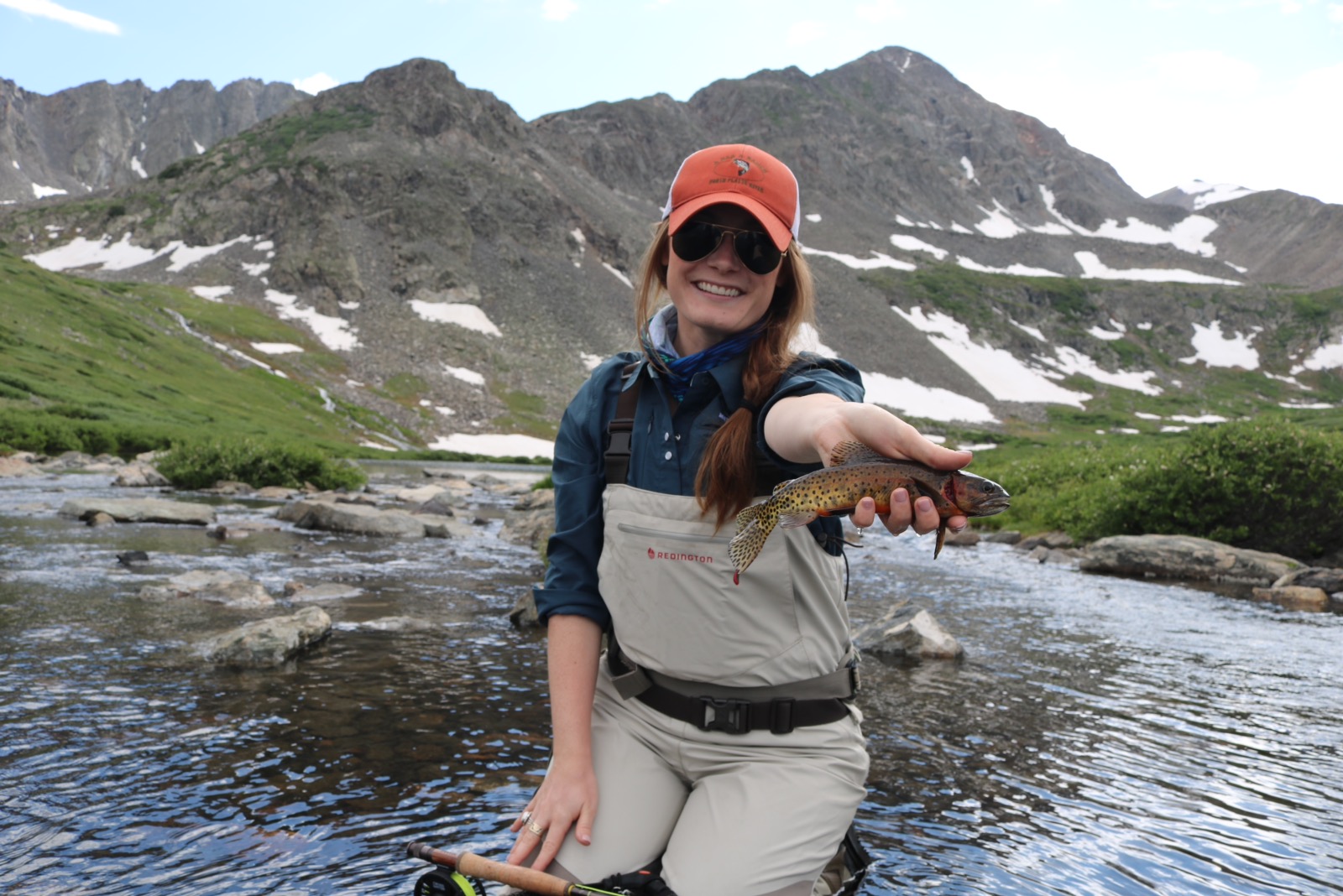
The biggest cutthroat I could have ever imagined seeing face to face matched up against me and my girlfriend’s Redington Crosswater setup. To say I was on edge would be an understatement. After a tense five-minute fight, we got him in (thankfully Max made a long run around the lake to meet me for the net job). All I can say about getting my hands on that fish is that moments like that one don’t come often in fly fishing (at least for me), and I’m incredibly grateful that God allowed those stars to align on a day when I was in good company. Sharing that moment in that place with those friends is certainly something I won’t ever forget.
Article and photos from Garrison Kinsel, an avid angler based down in Austin Texas. Check out his fishy feed at @garrison_kinsel.
Many people get a bit uncertain about trying to cook fish. Some are worried about making the house smell like the dumpster at a seafood restaurant. Others are fearful that they will dry out their prized catch. Fair enough, but if the fish is freshly caught, aroma isn’t an issue. As for dryness, with the right recipe, it’s not that hard to hit the sweet spot in cooking a fish. Cooking fish is actually a lot less complicated than grilling a steak, for example, or roasting a leg of lamb. With a piece of meat, you can have it rare, medium, or well done. With fish, once the flesh turns opaque…it’s done. End of story. All you can do after it reaches that point is to dry it out. I’ve had the good fortune to have written cookbooks with some terrific chefs and I’ve learned a lot from them.
I am mostly a catch-and-release fisherman because I know that if we kill every fish we catch, pretty soon there won’t be anything worth catching. Remember, many of the fish that we enjoy fishing for are top predators. That means that there are relatively few compared to baitfish. Think about it this way: out on the African plains, there are far fewer lions than impalas. Likewise, in a stream, the trout-to-minnow ratio is low, so it doesn’t take a lot of fishing pressure to turn a blue ribbon trout stream into “don’t bother unpacking your rod.†Still, I recognize that one of the reasons we take pleasure in catching fish is that fish are food and humans get great satisfaction in gathering food. For that reason, I think that keeping and cooking the occasional fish deepens our appreciation of these creatures that we snatch from their watery home and deliver to the dinner plate. I guess it all comes down to what a veteran fisherman once told me “Limit your kill. Don’t Kill your limit.â€
My pal, Ned Baldwin is a fish-a-holic chef, originally from Seattle and now New York City. His restaurant is about a nice hike over the Brooklyn Bridge from my home. When he’s not cooking, he’s fishing out on the North Fork of Long Island. He and I bonded over our mutual love of fishing and cooking and spent two years writing a cookbook “How To Dress An Egg.†It’s about a lot more than eggs. Case in point: this grilled fish recipe
Grilled Whole Fish Recipe:
Many people shy away from this method because they think they’ve failed if a little skin sticks to the grill. No big deal. Not everything in life looks like it does on Top Chef. And if a bit of skin sticks, more of the flavor of woodsmoke will infuse the flesh of the fish. I’ve done this with small bluefish, mackerel, snapper, porgies, bream and crappie. If you clean the grill with a wire brush and then oil it, you’ll be fine.
Photo: Will Hereford
Note: When Ned and I made this for Food & Wine magazine, he added a topping of grilled fresh cherries and sweet bell peppers that he threw on the grill. If you like that idea, a grill basket or wire mesh will keep the fruit and vegetables from falling through the grate.
Serves 4
2-4    fish ¾ lb 1 to 2 pounds each
2 to 3Â Â tablespoons oil
1Â Â Â Â Â teaspoon kosher salt
Photo: Will Hereford
Rub the fish evenly all over with oil (don’t drench it). Sprinkle the salt all over.
Give the grill bars a good scrub with a metal brush, then wipe them down with an oiled rag. (A grill with a thicker grate works better than the classic Weber, but you can work with whatever you have. Fire up the grill; you want medium heat (meaning you can hold your hand about 4†above the grill for a count of 4-Mississippi before it feels uncomfortably hot). I like to grill a piece of bread before I cook the fish so I can see what kind of heat I’m dealing with. Ideally, the bread browns evenly and at a reasonable pace, not too slow and not too fast—although given the choice, I’d choose slower every time. You’ll need a pair of tongs as well as a metal spatula.
Photo: Will Hereford
Grill the fish, find a spot on the grill with fairly even heat and gently lay the fish down there. The heads should go over the hotter part of the grill so the thickest meat gets the most heat. Once you put fish on the grill, leave it, even if it’s not exactly in the prime spot. After 3-4 minutes, use your fish spatula to gently lift up part of each fish to see if the skin is sticking and if you’ve established a crust.
Photo: Will Hereford
If there’s no crust yet, leave it for another minute or two. The, if the fish isn’t sticking, reach over and put your spatula in the organ cavity of each fish and roll it over. If you are not sure about this maneuver or the fish sticks a little, gently insert the spatula under the fish while pulling it up by the head with a pair of tongs. Even if it sticks a little, turn the fish over to finish cooking.
Photo: Will Hereford
After another 2 -5 minutes, use a metal skewer, cake tester or a meat thermometer to pierce the meat at its thickest point. When you remove the skewer, it should feel quite warm above your upper lip.
Photo: Will Hereford
If it is, you can remove the fish from the grill. If you’re really not sure, fleck a bit off the part that you will serve yourself and taste.
Photo: Will Hereford
With your tongs in one hand and the spatula in the other, use the tongs to lift the head, slide the spatula under the body, and lift the fish off the grill and onto a serving plate. Drizzle some oil all over and garnish with lemon or lime.
This recipe as well as many more are featured in the cookbook “How To Dress An Egg.†To purchase this cookbook click the link here.
Peter Kaminsky is a long time fly fisherman and author. His Outdoors column appeared in the New York Times for more than 30 years. He was a contributing editor to Field & Stream. Among his fishing books, the classic “The Moon Pulled Up An Acre of Bass.  He is also the author of 17 Cookbooks including 7 Fires with Francis Mallmannn. He fishes New York Harbor a lot.â€
For this installment of “Organization of the Month,” we highlighted American Rivers, an organization that works to protect wild rivers, restore damaged rivers and conserve clean water for people and nature. In its more than 50 year life, American Rivers has protected thousands of river miles, improving fishing all over the country. Follow along for the whole interview!
Flylords: What is American Rivers’ ‘story’? When and why was American Rivers formed?
American Rivers: Congress passed the Clean Water Act in 1972 and the Wild and Scenic Rivers Act in the late 1960s when rivers were so polluted that they were literally catching on fire and massive dams were being built that would ultimately destroy salmon runs and other ecosystems. A few years later, since there weren’t any organizations using these legislative tools to help protect our water and rivers, a group of river enthusiasts got together in Denver to brainstorm. One person put a $20 bill on the table, saying, “I’m in.â€Â Then another and another, and American Rivers was formed.
Since then we have grown into one of the nation’s leading river conservation groups – helping to protect thousands of miles of river with “Wild and Scenic†designations, building a nation-wide movement to remove dams, leading water conservation efforts in cities and basins across the country, working to make sure that all communities and ecosystems have access to clean water and healthy rivers, and supporting efforts for environmental justice.
Legacy, an American Rivers film taking place in the headwaters of Wyoming’s Snake River
Flylords: Can you speak to American Rivers’ core functions today, and how you all achieve those victories for our rivers?
American Rivers:Â Our core functions are protecting wild rivers, restoring damaged ones, and conserving water for people and nature.
Our best tool for permanently protecting rivers is the Wild and Scenic Rivers System. Designating a river as Wild and Scenic, either through Congress or through its managing agency, means that it must be kept pristine and can’t be dammed, diverted, developed, or polluted. Think of rivers like Montana’s Flathead River, Michigan’s Au Sable, or Georgia’s Chattooga which have beautiful stretches that are part of the program – they will be as pristine for our grandkids as they are for us.
For restoring rivers, our main focus is removing outdated dams that have outlived their purpose. There are more than 90,000 dams in the U.S., and the best thing you can do for a dammed river is to take out the dam.
For conservation, the goal is to make sure enough water stays in the river for all uses — human and environmental — and we do that by getting groups to sit down together to first listen and then work towards common goals. The process is called Integrated Water Management, which is a wonky way of saying that we all care about the river. It’s working in places like Washington’s Yakima basin, Georgia’s Flint River, and North Carolina’s Cape Fear basin, and we’re seeing progress in other places like the upper Colorado.
Michigan’s Au Sable River–courtesy of Bubba Miller
Flylords: Clean, free flowing rivers and fly fishing are inextricably connected. Just how important is a river’s health for strong populations of wild, native fish?
American Rivers: You can see how important clean, free-flowing rivers are to fish by what happens when you take them away. The dams in the Northeast basically destroyed our Atlantic salmon populations, and it’s happening out west now on the lower Snake River and others. One of our supporters put it very simply: “No fish; no fishing.â€
On the other hand, when you take care of a river, the fish can thrive. We saw the trout population in one Pennsylvania stream increase ten-fold after removing a dam. And on the Penobscot, where we removed two dams with the Penobscot Nation, Atlantic Salmon Federation, and Trout Unlimited, it’s been less than a decade later and record-breaking numbers of fish are returning. Literally millions of fish. Nature can take care of itself if we give it a chance. At the end of the day, most anglers understand that healthy fish need healthy rivers.
Westslope Cutthroat, Pat Clayton
Flylords: Every spring, I keep an eye out for you all to publish the annual “Most Endangered River Report.†What goes into that document and how has it positively impacted river systems across the United States?
American Rivers: Our America’s Most Endangered Rivers® report puts a national spotlight on ten rivers each year that face a serious threat and have a major decision coming up that will likely determine the fate of that river. It’s not necessarily the most polluted river, but one where public input can help save the river.
A good example is the Harpeth River in TN, where the river was seeing increased pollution coming from Nashville’s growing development. Listing the river pulled communities together in a way that led to a collaborative solution that is now being shared across the state. Another example of the public making a difference is the Hoback River in Wyoming, where a gas company was planning a major drilling project that would have threatened this beautiful river. We listed it several times and the public response against the drilling was fantastic. Showing how unpopular it was helped open the door to our partners (especially Trust for Public Lands) and river supporters to buy out the drilling rights. America’s Most Endangered Rivers® provides a great way for people to help save their river.
Flylords:Â When I think of damaged and unproductive rivers, one of the first things I think about are dams. Just how harmful are dams to river systems?
American Rivers: People often don’t realize how detrimental dams are to rivers and the ecosystems that depend upon them. First, in most cases the dam has changed a single, connected, cold-water, free-flowing river that can support trout and other cold-water species, into a warm-water impoundment/lake with warm water spilling into the stream below. Those species that need cold water can’t survive. A clear example is how the seven dams build on Alabama’s Coosa River are attributed with killing off 30 species – one of the largest mass extinctions on record. A second impact is that they block species’ ability to move and migrate. In the most visible examples, they prevent both Atlantic and Pacific salmon, as well as other migrating species, from reaching their spawning grounds – which is effectively a death sentence.
But the important thing to remember is that if you take the dam out in time, the river will come back. We’ve seen it countless times and continue to see it each year.
Flylords: I saw that dam removal projects are a huge point of emphasis for American Rivers’ agenda–are there any ongoing projects you’d like to highlight?
American Rivers: Yes, there are a lot of important dams coming out this summer. One example is on Washington’s Nooksack River, where removing a diversion dam will restore sixteen miles of pristine spawning habitat for the first time in almost 60 years, starting with the first of two explosions (click here to watch video). A second is on New Hampshire’s South Branch Gale River, where taking out the dam will connect over 30 miles of native brook trout habitat. There are other examples from states ranging from Pennsylvania to North Carolina and more.
We also have some longer-term projects that will have tremendous impact if/when successful. The first is to remove the four dams on the Klamath River that have blocked access to hundreds of miles of productive salmon and steelhead habitat for 100 years. Also, there are new economic, political, and environmental factors that we hope will move forward the discussion on removing the four lower Snake River dams, which we have been fighting for over more than 15 years.
Elwha Dam before (left) and after (right; taken in March 2012) removal | Photos by National Park Service
Flylords:Â What about past dam removal successes?
American Rivers: A great example is the Kennebec River in Maine. We helped remove that dam 20 years ago, and now there are more than 5 million herring that come back to spawn each year! On Washington’s Elwha River, five years after removing two dams, there are thousands of chinook salmon that come back to spawn each year. Those are huge success stories.
And there are countless smaller dam successes, where we’ve had trout so eager to move upstream that they leap through the breach as soon as it’s made. What’s great to see is that, as a nation, we’re taking out more dams each year.
The “Wild and Scenic†Gros Ventre River, courtesy of Steve White
Flylords:Â Next to dams, pollution and development pose the greatest threats to rivers right? Care to tell us a little about the importance for laws such as the Clean Water Act and Wild and Scenic Rivers Act?
American Rivers: These are bedrock laws for river conservation. The Clean Water Act is under attack by the current administration, which recently proposed repealing protection for all ephemeral streams and roughly half of the country’s wetlands. We know that waters are connected and that water moves. When you pollute in a stream or wetland, it will move downstream and pollute your neighbor’s drinking water. That makes no sense, and with our partners we have filed suit to block that change.
As for the Wild and Scenic Rivers Act, it is a great example of Congress giving our nation the tools needed to protect the environment. Less than 1 percent of our rivers are protected, but that number is growing. Working with our partners, we’ve protected an additional 2,000 miles in the past couple years and are working to protect 3,000 more in the near term.
See American Rivers’ recent report on the economic importance of healthy rivers!
Flylords:Â How can fly fishermen and women learn more about American Rivers and get involved?
American Rivers: We hope that people who care about rivers will want to be a part of protecting and restoring them. For starters, you can go to americanrivers.org to learn more about our work and hopefully join as a member (click here). If you are looking to have an even bigger impact, we would love for you to look into joining The Anglers Fund, our national fishing program. I’ll leave you with a quote from Tom McGuane, former American Rivers Board member:
“We are beyond having to put back what we have taken out. We must put back more than we take out.â€
Thanks for the chance to share this information about our work and our organization, and please remember: healthy fish need healthy rivers.
The cover picture, which features the “Wild and Scenic†Flathead River, is  courtesy of Pat Clayton
It looks like this New Zealand Rainbow doubled down on its ability to eat. We’re not sure what caused this fish to develop what looks like two mouths, injury or mutation, but it must’ve been a shock when it came into the net with a Glo-bug in its bottom jaw.
“Well, there’s something you don’t see every day, a big rainbow with two mouths!!!
This big jack had no issues eating a little glow-big (I suppose it had twice the chances!) and put up an epic scrap, certainly not what I was expecting when I had a spare hour after work earlier in the week!”
In this week’s Video of the Week, we join the Hooke team on their most recent journey down to Patagonia in search of some of the largest brown, rainbow, and brook trout in the world. From swinging flies to Sea Run Brown trout to stripping streamers for overweight rainbows the team enjoys what Patagonia has to offer and more. So turn those Subtitles on and enjoy the scenery and wild rivers of Patagonia.
Image Courtesy: Hooke.com
So sit down and enjoy the unique landscapes of the Rio Grande and the surrounding Andes range as the team catches your dream fish in one of the world’s most amazing backdrops.
In this installment of “Flylords Behind the Brand” we sat down with the great folks at Twelve Weight to chat about how they have grown in the fly fishing apparel space and why their gear is built to perform on the water, in the mountains and all along the way!
Flylords: Let’s start with the name, where did Twelve Weight story begin?
The goal has always been to build a unique brand with high quality products. We also positioned sun protection at our core. Regarding the name, the 12WT rod seemed like the perfect analogy (a specialized piece of equipment) for our concept. The tarpon naturally emerged as an iconic symbol for the brand. There is more to the story but that’s the abridged version.
Flylords: What was your motive around building a niche apparel company in the fly fishing space?
The founders and key team members are all avid fly fishermen–always have been. At this point, the brand is propped up by a group that loves being on the water. I think the motive was simple. We love to fish and fly fishing is somewhat underserved from an apparel perspective. For most larger brands it’s a small off-shoot department. We thought, let’s make it our focus and give it everything we’ve got.
Flylords: Tell us about the time that goes into each collection? Where do your product ideas come from?
We’re big on utilitarianism and bold simplicity, probably because the team is very design heavy. Function before aesthetics is important to and helps guide our decisions. At its core fly fishing is very simple actively, people may over complicate it with gadgets, but at the end of the day, you’re throwing hair on a hook and fighting fish on light tackle. It’s pure sport and we want our clothing to feel the same way. Easy and natural but details are important. We pull our inspiration from nature and the outdoors. The team is made up of surfers, skateboarders, artists, designers, and all-around adventurous spirits so I’d say we pull a good amount of inspo from those activities as well.
Flylords: How has the brand evolved over the last decade?
Honestly, the evolution doesn’t seem all that dramatic. The team has grown. We’re a lot like a family. We are not focused on growth so much as having fun and loving what we do. We hope our products can bring that same joy to people who wear them. The collection continues to evolve as we add new products, but it’s definitely a slow and steady game. We just released the cotton collection and a full set of hats. That’s a little unconventional. We figured rather than blitz all at once with all the products we wanted, we should take them one at a time and build them right. We don’t add things to the collection thinking they will be a one and done. Once something is in the line we expect it will stay and we stay diligent to improve things as needed.
Flylords: This year’s lineup is killer – and we’ve had the privilege of shooting/testing some of these products. Can you tell us a little about the lineup – maybe some of your favorite items?
When we won the Gray’s Best Award for our hats, we knew we were on top something. So we wanted to make more of those and broaden the styles. That whole line is something we’re very proud of. Fishermen always need hats and we think ours are as comfortable as they come. The optic black under brim to reduce glare is also a really nice feature.
The Cotton Collectionwas a labor of love. When we first launched the brand we did what most small brands do. We screen printed on blank tees. Something about that just didn’t feel right to us, so we set out to build our own. In the end, that meant sourcing fabric, custom dying and going through a lot of rounds of prototypes but as always the more challenging path taken is usually the most rewarding.
We’re also super stoked on the SUNWT Collection. We’d been sketching on full-bleed patterning for a long time. We pulled inspo from old rugby jerseys and some photos we’d found of Heminway in the Keys. It’s been a lot of fun seeing those designs transform into modern technical apparel. Keep in mind that our latest developments all follow heritage styles like the WORKWT Glove, FREEWT Shirt, OCEANWT Hoodie and 7 Mile Button-Down Shirt (all award winning within the fly fishing industry). Those styles paved our way and reinforced our optimism.
Flylords: Are there any specific influences that inspire your most recent designs?
We try to stay true to ourselves, but I’d say recent inspiration is coming more from surf/skate culture. It’s interesting because surf/skate is super progressive and fly fishing quite frankly is largely not. Smashing those two together is a fun challenge. We also spend a lot of time looking at the history of the sport. Our logic is if it worked in the beginning it probably will still work now. We are comfortable blending old school and new school to get the performance results desired.
Flylords: In a saturated apparel market, 12 weight seems to be doing things a little bit differently. What do you think your special sauce is?
Our small motivated team is very eclectic and I think that shows through in our products. Some of our crew have an extensive product background, while others do not. Some are art directors and typographers while others studied fine art and color theory. When you start mixing together these different perspectives and a wide range of industry knowledge–with everyone free to speak their minds and ask questions–it makes for a quirky environment to work in and the result is a product line that feels a little bit different.
Flylords: What’s one of the coolest adventures you’ve seen your brand be a part of?
Will Benson (World Angling) and one of our co-founders (Frank Smith) fished Seychelles over the winter. It’s a little cliche right now because it seems like every brand is doing it, but that was pretty cool to see. Honestly, though, we have cool right here in our backyard. When you can get up before work, hike out on the rocks of the Maine coast on a low tide, maybe swim to some outer rocks, land a 35″ striper on the fly, shower in the beach parking lot and make the short drive into downtown Portland it feels like an adventure, but it also feels like normal everyday life.
Flylords: Are you allowed to fish a 5 weight wearing 12 weight apparel?
Of course, if you’re fishing in our gear, and your happy doing it–then we’re happy for you!
Flylords: What’s the best way for people to get their hands on some product?!
Order online–and reach out to us if you have any questions on sizing, product performance, or whatever. We are a small enough brand that when you call you to get to talk to a member of the team. Also, don’t be bashful about joining our newsletter. We’re always sending out promos to our clique that follow along.
To check out the full 12 WT apparel line click here and be sure to follow them at @twelveweightapparel.
You never know how much that antique fishing gear granddad left you might be worth. Recently, collectible antique fishing gear has been selling high at auctions, some fetching bids well into the six-figure range. Buyers for auction houses like Lang’s Auction, a fishing-specific auction house, are putting bounties out for select old fishing equipment that they know collectors are hunting for.
According to the New York Times, “in an effort to uncover some of these forgotten gems, Lang’s Auction worked with Fishbrain, an app for avid fisherman, to encourage people to go treasure hunting in their own homes, using a catalog-style listing of rare items as inspiration.”
In their article about the phenomenon, the New York Times lists several antique items that are expected to sell for well over $100,000.