Home Blog Page 196

Save the Horny Fish: An Inside Look at BTT’s Permit Initiative

Recently, Flylords had the chance to catch up with Dr. Ross Boucek, to talk more on Bonefish Tarpon Trust’s efforts to help preserve Permit populations, and protect them during their spawning season. Ross earned his Masters and Doctoral degrees at Florida International University, studying how weather events, such as hurricanes, droughts, and extreme cold events, impact sport fisheries in Florida Bay and Everglades National Park. Now, Ross spends most of his time in the Keys, either conducting BTT science, or working with anglers, and management agencies to turn BTT science into meaningful management and regulatory changes that improve Keys fishery.

ross looking off into the distance
Images courtesy of Ian Wilson-Navarro

Flylords: How long has BTT been fighting for saltwater game species?

ross coming up in the boat

Ross: We have been fighting for saltwater gamefish species for more than twenty years. Many of our valuable flats fishes, like bonefish, permit, and tarpon, have not been closely tracked by fisheries managers because no one harvested them. BTT was founded because bonefish in the Keys started declining and no one was doing anything about it. We brought attention to these valuable gamefish, as well as tarpon and permit.

releasing a bonefish underwater

At our beginning, we didn’t know much about these fish, so any type of restoration work to improve the fishery would have been like trying to hit a bullseye in the dark. For this reason, we focused on learning about the species and doing the science needed to figure out how we can keep the flats fishery going. This science is what guides our conservation work, done through habitat restoration, habitat protection, improved regulations, and other conservation measures.

Flylords: What do you think has been your organization’s biggest accomplishment to date?

flats trails

Ross: We have done a lot of seemingly impossible things to get these fisheries protected across the Caribbean. In the Bahamas, we worked in partnership with the Bahamas National Trust, and the guide and angling community to develop six national parks on iconic bonefish flats and spawning sites. These national parks protect those valuable areas from becoming a hotel or cruise ship dock. It is pretty cool to be a part of a small group that can make big things like this happen.

Flylords: Tell us about the recent permit initiative?

fish tailing

Ross: Project Permit is a decade-long initiative to identify and protect permit habitats and minimize unsustainable fishing practices that threaten the Florida Keys trophy permit fishery. Sadly, over the last 20 years, the permit fishery in the Keys has been declining. If we look at the permit fishery like a doctor would look at a sick patient, the symptoms of the declining fishery seem to suggest that too many fish are dying at their spawning aggregations.

To try and fix this problem, we worked with Florida Fish and Wildlife Conservation Commission (FWC), our state fisheries agency, to establish a harvest closure during spawning season. A catch and release fishery occurs at the spawning sites because fishing is easy for them—you can hook 10 permit a day. But, because there are so many sharks around those spawning aggregations looking for easy meals, about 2 in 5 of those hooked fish are eaten by sharks prior to being landed. That is not sustainable. So, we are working with the state to make one of their most important spawning sites, a place called Western Dry Rocks, a seasonal no fish zone to keep these fish safe, and rebuild our permit fishery.

permit fish in the water

Flylords: How can anglers make a positive impact on that fishery?

Ross: It is pretty crazy that we don’t have the same respect of spawning fish in the ocean as you do with freshwater fish. If you kill fish when they are spawning, a fishery will always be in trouble, whether it is a trout on a redd or permit spawning on a coral reef.

For permit in the Keys, we are fighting to make one of their critical spawning sites a seasonal no fish zone to stop those spawning fish from being fed to sharks. The science is there, it’s now a policy decision. We 100% need anglers and guides who care about protecting spawning fish, permit, and fly fishing, to take two minutes to make their voices heard on the topic. If you go to www.btt.org/protectpermit, we have the information and link to write FWC. Permit will 100% appreciate you for doing this.

Flylords: How important are permit to the Florida Keys?

permit
Image courtesy of BBFL

Ross: Permit in the Lower Keys are a lifestyle, obsession, and an addiction for many. Probably 50% of the Key West flats guides have permit tattoos. Permit are also extremely economically valuable. They are a part of a half a billion-dollar a year flats fishery in the Florida Keys. And, a thriving permit fishery is essential to businesses of 180 full-time Lower Keys fishing guides.

Because they are so hard to catch, each fish is extremely valuable on its own. For instance, the best permit guides in the Keys catch about 30 – 40 permit a year on fly. That is spread across about 180 trips targeting them. So, each permit that is caught on fly is worth about $5,000 dollars just in guide fees alone. Chasing permit on the flats is a crucial part of our economy.

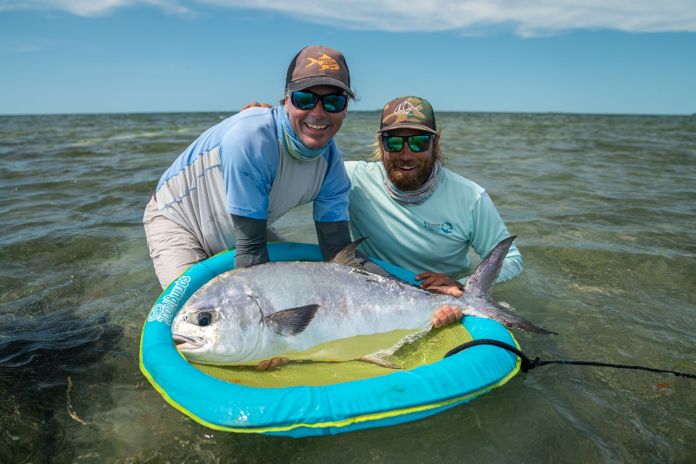
Flylords: We had a chance to spend a day with you and Captain Will Benson, and you ended up landing a monster permit. What did this fish mean to you?
permit in the net

Ross: The experience was really special for a couple of reasons. First, we surgically implanted a transmitter in the permit and will get movement data on the fish for five years. Second, it was one of the largest fish we tagged in Project Permit. Third, we caught it on one of the most iconic permit flats in Key West. Finally, we caught it with Captain Benson. He has been on the front line of the permit conservation fight at Western Dry Rocks. Being able to catch and tag it with Will was really special!

permit tagging device

We lined up a tagging trip in April. I live on a sailboat, and during the quarantine, I sailed to the best permit flats in Key West. We had been living in the permit grounds for about a month before we met up with Will. The morning we planned to fish, the weather sucked, it was cold, super cloudy, and rainy. Not looking promising to catch a permit and get a tag out. Will picked us up anyways, and we decided to go. We checked a few spots, but all of the permit we saw that day were tiny and too small to tag. Finally, we stopped by The Flat. We saw a school of smaller fish, I threw a crab to them, and out of nowhere the monster pushed the small fish out of the way, stuck his head out of the water, and inhaled the live crab we were using. Thirty minutes later, we landed the fish, tagged it and we sent it on its way. It was a day I won’t forget anytime soon.

Flylords: Are you working on anything interesting right now you would like to mention?

bonefish after release

Ross: We are on the hunt for bonefish pre-spawning aggregations in the Florida Keys. Bonefish aggregations are elusive in the Keys, and no one has never discovered one. Bonefish likely form these pre-spawning aggregations in the same places jetskis, sunset cruise boats, and booze cruisers like to go. All of these activities will disrupt their spawning behaviors, and how successful their spawn is.

Right now, we are tagging and tracking bonefish and following these tagged fish to their spawning sites. Once we find where they spawn, we will work with different agencies to make sure that noisy boaters don’t mess with horny fish trying to get it on!

some noisy boaters

We also had a chance to sit down with Costa Guide, Captain Will Benson to discuss his involvement with BTT’s initiatives

Flylords: Who is Captain Will Benson? will benson

Will: I am a Florida Keys native husband and father of two.  Ione World ANGLING and pay my bills by guiding clients to the big three Tarpon Bonefish permit.  My specialty is permit on Fly I have one for major grand championships.  I have involved myself with conservation both as a leader of the lower keys guides association and a leader of the Florida Keys National Marine Sanctuary Advisory Council.  I would like to see my passion and livelihood sustained for generations to come and I hope to leave the fishery in a better condition than when I found it.

Flylords: How big of a part do Permit play in your life? 

will benson with a permit

Will: Permit play an important role in my life not only has dave been a tremendous source of pleasure and pain over the years but they are the financial background for the Benson family.  Permit are virtually a year-round fish in the Florida Keys and therefore are the most sought after target for visiting Anglers coming to fish with me.  Permit are virtually a year-round fish in the Florida Keys and therefore are the most sought after target for visiting Anglers coming to fish with me. Permit is my bread and butter!
Over the years I have witnessed a significant decrease in the general size of the permit that we fish for.  When I was a kid first starting to fish the Florida Keys in the early 90s the average size permit that we would catch would be over 20 pounds.  They were extraordinary amounts of large permit some in the 40 to 50-pound range.  I no longer see those fish and it is a real trophy to catch a permit over 20 pounds with the vast majority of the fish that we catch been just under sexually mature size at about 20 to 22 inches.  In other words, our permit fishery is a juvenile permit fishery for the most part.

Flylords: What has been your involvement with BTT?

Will: My involvement with BBT has been for the majority of my professional career.  I have been both a recipient of the scientific knowledge and an active participant in the gathering of data and spreading the overall message.  I think BBT is a wonderful organization filled with people that really believe and care about our fishery and I am proud to be associated with them!

Thank you to Dr. Boucek, Capt. Will Benson, and BTT for all they do in working to preserve and protect the fisheries we know and love so much. To learn more about BTT’s efforts, CLICK HERE and support the and cause.

Also thank you to organizations like Costa, who’s continuous support fuels these initiatives.

“Working with and supporting great conservation organizations like BTT has always been of the utmost importance to Costa. We are glad to sponsor and promote the great work they do protect the fish and the fisheries that our so near and dear to us, our pros, and the fishing community at large.” — Costa Community Manager, Joe Gugino

Help BTT Save Florida’s Fish Habitat

Costa Behind the Guides: Brandon Cyr

BTT Announces New Strategies in Belize & Mexico


False Albacore Vs Bonito – Everything You Need To Know

1

As the summer rolls on, anglers around New England start to get antsy. When the inshore waters warm, and baitfish begin to pile up, the clock starts ticking. Ticking down until inevitably, they show up. “They” in this case are False Albacore and Bonito, two of the fastest, most action-packed fish that fly rodders have a chance to encounter. Through all this craziness, the two can be very similar, so here’s our rundown on the differences and similarities of False Albacore and Bonito, and of course our tips on catching them.

False Albacore release
Photo: Ben Scott @tashmooflats

What is a False Albacore?

False Albacore (Euthynnus alletteratus), also known as Little Tunny, Albies, Bonita, and Fat Alberts, are members of the Scombridae family, in the Euthynnus genus; somewhere in between true Tuna and Mackerel. Albies are often picky with anglers and can be difficult to get a fly in front of, causing the obsession known as “Albie Fever”. Once an angler catches “the Fever”, it is impossible to cure and can only be treated with more Albie fishing. Essentially being a “party-sized” tuna, Albies give fly anglers a taste of bluewater fishing, close to home. Pound for pound, Albies are one of the hardest fighting fish I’ve ever encountered and would have no problem towing most fish their size across the Atlantic.

Atlantic Bontio
Photo: Ben Scott @tashmooflats

What is a Bonito?

Atlantic Bonito (Sarda sarda) are an often confused fish. According to Google, Bonito are in the same family as Albies, but the main photo google uses for bonito is undoubtedly a False Albacore. I’m not going to get into a scientific war with the largest source of information in the world, so I’ll just go off of what I know. Bonito, not Bonita, are also members of the Scombridae family, but in the Sarda genus. Bones do run a bit smaller than Albies and give up a little quicker, which makes them an awesome 7-8wt fish. A school of Bonito slashing at a large baitball is most definitely a sight that gets the adrenaline going.

Little Tunny on Fly
Photo: Ben Scott @tashmooflats

What Does A False Albacore Look Like?

Alberts have a bright silver body with a green back. Along their back, they have a unique, black, squiggly pattern, different from any other fish. In the water, they look like missiles (they essentially are), with their pectoral fins jetting out of their sides acting as stabilizers. Even though they technically are not, every part of them screams tuna. Albies are also bigger on average than Bonito.

Bontio
Prepare for blastoff! @nateholmes_wild

What Does A Bonito Look Like?

Bonito resemble species of mackerel much more than Albies. They are generally smaller than albies and are much skinnier. Bones have a silver body with a blue or green back. Along their flank, bones have black stripes, kind of similar to Striped Bass. Running with the Mackerel theme, Bonito have a nearly rectangular dorsal fin compared to Albies, and noticeable teeth.

Bonito on fly
Photo: Ben Scott @tashmooflats

False Albacore Vs Bonito Diet:

This category is where the differences cease. Albies and Bonito feed on the same kinds of bait while cruising the waters of the Eastern US. Some of their favorites are Silversides, Peanut Bunker, Anchovies, and Sand Eels. To feed on these baitfish, Albies and Bonito work in schools of anywhere from two to hundreds of fish. These schools of pelagic fish work together to corral large amounts of bait into tight bait balls and then proceed to annihilate them, causing a serious commotion on the surface. 

False Albacore pattern
Photo: Alex Blackwell @xblackwell

Fly Fishing for False Albacore:

At a glance, one would think that a fish moving at crazy speeds through a sea of food would hit any fly put anywhere near it. False Albacore proves that assumption wrong with a passion. One of the hardest parts about targeting False Albacore is getting a fly in front of one. Not only are the fish moving super fast, but they are often spooky and are easily put down by boats. Add some wind and other anglers to the mix, and you have a challenge set out for you. Your best bet for getting a shot at them is to anticipate where the school is moving next. If you are able to get in front of a moving school of Alberts, you have a much better chance at getting a much better shot. When you do get your shot, make a cast into the school towards the front of the pack, and start stripping. Sometimes they like it as fast as humanly possible, and other times they like it slow, you’ll have to figure that out yourself. No matter what you do, keep your line tangle and snag-free, and you should be just fine.

False Albacore
Tuna Eyes @nateholmes_wild

Fly Fishing for Bonito:

Everything said above about fly fishing for Albies applies for Bonito, but there are some things that should be added on. For the most part, Bonito like flies moving a bit slower than Albies, but again it is all situational. Also, Bones do have teeth, so I’d recommend checking your tippet every chance you get and using flies with synthetic materials for durability. Also as I mentioned before, I like a 7 or 8wt rod for Bonito opposed to an 8-10 for Albies.

Tuna head
Hydrodynamics at its finest @nateholmes_wild

False Albacore Vs Bonito Range / Geography:

Both False Albacore and Bonito are found all around the North Atlantic ocean. Both of these species can be found from Nova Scotia to South America, and across the Atlantic to the Mediterranean and Africa. While they are both so spread out, the northeast coast of the US seems to be a hotspot for anglers targeting these fish.

#FliesForFireRelief – Fly Fishing Community Rallies to Support Fire Relief

Josh Mills and the #FliesFor community are back making their impact on those affected by the devastating fires that have struck the Pacific Northwest, Rocky Mountains, and California in the past weeks. Entire communities, businesses, and homes have burnt, and they need all the help they can get while attempting to recover in the days of COVID-19.

The fires in Oregon have hit the region’s fly fishing and outdoors businesses hard, but thanks to the infectious altruism of Josh Mills and his fundraising campaigns, help is on the way in the form of donations and circulating dozens of flies. The concept is simple, find items up for auction via #FliesForFireRelief, make a bid in the comments, and then the proceeds from your bid will be donated to one of the many relief funds being set up in the affected regions.

Check out these #FliesForFireRelief items that are up for auction!

A 14″x20″ Metal Print of Deadline Falls from Joseph O’Brien


View this post on Instagram


A post shared by Josh Mills (@millsfly) on

This Custom Abel Super Series donated by Patagonia Fly Fish


View this post on Instagram


A post shared by Josh Mills (@millsfly) on

Scaly’s Designs Custom Skate Deck Art


View this post on Instagram


A post shared by John Noble (@scalydesigns) on

Dozen Swinging Flies from Josh Mills


View this post on Instagram


A post shared by Josh Mills (@millsfly) on

These are just a few of the offerings found by searching #FliesForFireRelief and there are dozens more, please check them out and consider supporting their important work!

If you’re looking for funds to directly donate to, please consider supporting this fund by our friends Sawyer Paddles & Oars, dedicated to helping those affected by the fire in Talent, Oregon.

New York Times Highlights The Art of Custom Rod Building

0

In their latest feature on fly fishing, the New York Times shares a photo essay and the story of Tom Morgan Fly Rods. The company was founded and ran by Tom Morgan, a legendary fly rod builder who started his rod building career in the 1970s when he owned RL Winston Rods. The NYT photo essay and article dive deep into the poetry, craftsmanship, and attention to detail (down to cork custom trimmed for each buyer’s hands) required to build some of the finest, custom graphite rods available.

Discover the full Tom Morgan experience in the NYT article, here!

Warm Waters in Kodiak, Alaska Caused Hundreds of Salmon to Die

Hundreds of pink salmon were found dead in the Buskin River of Kodiak, Alaska. The Kodiak Fish & Game also discovered dead silver salmon, rainbow trout, and dolly varden. The cause is thought to be warmer water temperatures, as this is affecting other waters in the area. Salmon dying before spawning is negative for salmon populations as well as future sportfishing.

Warmer Water Temperatures

Kodiak sportfish biologist, Tyler Pollum said about the dead salmon, “It looks really consistent with what’s happened the last couple of years in various rivers around here and other places in the state.” The Buskin River has been around 60-65 degrees, which is warmer than usual. Warmer water is unable to hold as much oxygen as colder water, and that combined with low water levels is a deadly situation. “It’s pretty likely that the dissolved oxygen in the water just got so low that they died of suffocation basically,” Polum said. Rivers across Kodiak have been low and warm, causing salmon deaths over the last couple of years.

Hundreds of dead pink salmon and other fish species were found in the Buskin River.

Even the Yukon is Being Affected

The Koyukuk River is a large tributary of the Yukon River. Last year at least 1,364 chum salmon were found dead. University of Alaska Fairbanks professor, Peter Westley, studied the salmon deaths in relation to the 2019 heatwave. “All of these signs point to these types of events becoming more frequent and potentially of greater magnitude as things warm up,” Westley said. “So in some ways, it’s surprising when it happens, but I think we’re going to get to the point where we are not surprised.”

Local biologists believe the salmon died of suffocation after warming temperatures reduced oxygen levels.

Future Effects of Warming Waters

How will heat stress affect salmon in the future? The answer to this question is uncertain… but salmon dying before spawning is never a good thing. Tyler Polum said it could impact future sport fishing opportunity in the Buskin River for years to come. More and more research is being done on salmon deaths in order to truly understand what is happening. Peter Westley said, “What we do have the control of is the protection of these habitats and allowing fish to find places in rivers, as much as possible, that might be refuge.”

Check out the original article on this topic at Alaska’s News Source.

Faces of Fly Fishing: Riverhorse Nakadate

In this feature of the ongoing Flylords Faces of Fly Fishing series, we had the pleasure of catching up with Riverhorse Nakadate. Riverhorse is a Patagonia fly fishing ambassador, environmentalist, musician, explorer, and talented writer. His work has been featured in various fly fishing, surfing, and guitar magazines and publications around the globe. Riverhorse resides in the Lone Star State where he can be found drinking french pressed coffee sitting in his cherished canoe, chasing bass, and redfish on the fly. Follow along as we interview Riverhorse to learn more about how he got into fly fishing, writing, and his role in Patagonia’s recent film It’s All Home Water | A Northern Light.

Flylords: Who is Riverhorse? Where did your name originate from?

Riverhorse: What? You don’t have ten other friends named Riverhorse? Awoooohoooooo! Yes, it is one of a kind and I have had it from the beginning. Nakadate stands for center of the chest, which is the heart. Although I rarely step inside corporate coffee shops, you can imagine the holy heck it unleashes at a Starbucks when they ask for your name, let alone when passing through foreign customs at airports, or a border crossing in other countries while on the road.

Tony Czech @tczech
Photo: Tony Czech @tczech

Flylords: How did you begin your fly fishing journey?

Riverhorse: I had the most soulful & beautiful earthy mother in the world. She made her way to Austin, Texas to chase dreams and go to college, which is where I was born. We had cheap government housing and were living on food stamps, but there was a river in the backyard, so I was free to run wild, swim, and fish day in and day out. I started out with a Snoopy Zebco rod and would use hoppers to catch bass. I’ll admit it, loud and proud.

She fell in a love with a steelhead and salmon fisherman from Oregon when I was in Kindergarten. He was there at the University of Texas teaching literature, after graduating from Stanford. He became my father, and so each summer we’d drive from Texas to the Oregon coast and stay there for months to fish. It changed everything. That’s where I found the sea, and surfing, too, which became an integral part of my life, since I am a surfer and have chased waves all over the planet, as well as fish.

Photo: Jono Winnel @jono_winnel

Flylords: What was your first piece of fly fishing literature that was published?

Riverhorse: I was a staff assignment writer for SURFING Magazine for a decade and a few guitar magazines, but during all of those years I refused to write about fly fishing. I wanted to keep it close to my chest, for everything seemed so deeply personal. Eventually, I turned in a story called A Checkout Line to the Flyfish Journal and it was published right away. I think I’ve had some 20 pieces for them now, along with the Writers on the Fly tours we have done to various cities across the country and a few wild trips with them to islands, etc. There is something about our fly fishing community, how we pull together. The peeps at The Flyfish Journal became my closest friends in life, how can you beat that?

Photo: Becca Skinner @beccaskinner

Flylords: How many years have you been professionally writing for?

Riverhorse: Sheesh, I guess it has been twenty years now. Just getting started? Ahahaha!

Photo: Tony Czech @tczech

Flylords: When did you realize that you wanted to pursue a career in writing?

Riverhorse: I was always that kid who couldn’t stop reading when I wasn’t out in the water. Still am. There are five books by my feet that I’m reading now, as I write this to you. I was always writing in journals, using words to help me make sense of this life and why we are here, what matters to me. I wrote a couple poems in high school that got published and haven’t stopped since.

Boots in the water and paddle on the bow seat, Nathaniel Riverhorse Nakadate navigates a tight, soggy portage.
Photo: Tony Czech @tczech

Flylords: Can you tell us a little bit about your connection to your canoe?

Riverhorse: There is nothing more intimate and personal than being intertwined to the hips of a canoe on some lonely body of water with nothing but days ahead. I’m a fan of absolute solitude, the sounds of nature, and using my own body to rely on going where I dream. The Merrimack canoes I own are everything to me. I’ve even slept in them under the night stars all over the country. Just seeing them on the roof of the truck lets me know I am free to go anywhere, far from land. Is it ok to confess that I’ve got three of them inside the 1910 bungalow here with me, or will you guys have an intervention?

Flylords: What makes bass fishing so special to you?

Riverhorse:  I’m a fan of big topwater eats and predator fish, let alone the fact that bass are everywhere. So if we are talking pike, musky, barracudas, jacks, and rowdy fish like that, I am all in! I think it’s hilarious how so many focus on trout, which are beautiful, of course, but there are people who have no idea how much immeasurable joy one can have chasing big ol’ freight train bucketmouths on peaceful lakes and rivers.  Smallmouth bass are definitely true to form, everything they say about their pound for pound strength is true.

 The Flyfish Journal and Patagonia teamed up to do a film following me through Texas fishing for bass and running wild.

Love & Water: Riding Shotgun with Riverhorse (Full Video)

Flylords: Any memorable fishing moments you want to elaborate on in the past year?

Riverhorse: For some reason, I have found so many hawg bass this year. But the most memorable fish for me was actually a four-pound Brook trout. I was alone in Northern Minnesota and had taken the canoe all the way to Canada. I found myself on a 500-foot cliff overlooking the last body of water between our countries. There was a three-tiered waterfall that made its way down the cliff. I hiked the canoe down to the lake, and using a homemade crayfish pattern, caught the fish below the waterfall. On the five weight, it took a couple of minutes of brawling to even get a glimpse of it. That said, to me, every fish is beautiful.

Flylords: What draws you to the gulf coast of Texas?

Riverhorse: Home!! Texas is bigger than Spain. We have over 300 miles of barrier islands and salt marshes, emerald Hill Country Rivers, piney woods lakes, and amazing food, culture, music, and people. There are lifetimes of memories here in Texas, and this life is so fragile and fleeting that there will never be enough time to explore them all.

Photo: Jono Winnel @jono_winnel

Flylords: What are some parallels between fly fishing, surfing, music, and poetry?

Riverhorse: All of these endeavors are about finding the Zen of flow. And, if you really spend time contemplating them, they are one and the same, aren’t they? For Flylords people reading this, can you even imagine life without any of these? No. Why would you? They are all so deeply personal, with infinite ranges of style and approaches. Endless flavors. Endless hues of color to paint with.

Photo: Jono Winnel @jono_winnel

Flylords: Any tips you would give for the aspiring outdoor writer?

Riverhorse: You betya. Less is always more. Go for poetry, not novels. Find ways to tell stories that actually break free from the same boring themes which keep getting recycled in flyfishing, such as the: “me and a buddy went fishing and this is what happened” riff. I’ve written stories in the Flyfish Journal about yoga, rowdy brawls, a pitcher’s mound, baby squirrels, crash and burns in life, and yes, fish. Find your own voice, groove, and moments. And never forget that the smallest moments can be everything in life, they can shine a light on the answers you seek as a human.

Photo: Tony Czech @tczech

Flylords: It’s our understanding you are working on a new film with Patagonia, what is this film about?

Riverhorse: It’s out now! It is called “A Northern Light,” and is about a proposed mine in the Boundary Waters. It was filmed by Tony Czech. There are so many formulaic documentaries out there, so our goal was to show the absolute raw, mesmerizing, breathtaking beauty of that wilderness, and let the viewers decide for themselves if this is a wilderness worth fighting for to keep sacred for all of us to enjoy forever. Here is the free film, hop on and enjoy the ride!

And here is a link to the Patagonia Action Works page photo essay I wrote so you can help save it, so you can be a person who stands up for our fish and wilderness.

Flylords: Can you talk about the behind the scenes of this film? Was it just you and Tony out there? What went into the production of the film?

Riverhorse: The film was just the two of us, out there going in deep, making it happen. It may have been a crazy way to go about it, but we both knew what our creative dream and vision was and wanted to keep things just to us. There is a cool story about how we met. I had just done 82 miles alone up there in the canoe and was back out of the wilderness in a small town drying out my clothes in trees and from the windows of the truck, having coffee. Tony and his wife happened to walk by and saw me from across the street. They wondered if I was homeless, but Tony knew he should come over and say hey, said he had a feeling I was an amusing character he needed to talk to… ahaha!

He realized he had read my work for years, and I knew of him from many of the films he had done–projects with North Face, Red Bull, Lonely Planet, and so on. Within a week of phone conversations, we agreed we were going to go for it. Three years later….after dreaming it, writing it, hundreds of meetings together, adventures where we would work on the vision, and even down to the challenges of getting legal permits for the film and drones–there were so many details, let alone the path we took with the canoe and our gear. We shot film three times. Twice in summer, once in late winter.

There were some heavy moments, as there can be when you are out there on the fringes far from civilization. Perhaps the rowdiest were the two serious bear encounters. One was a standoff in the dark for a couple hours in the middle of nowhere with baby cubs involved, too. Another day on the side of a river, a massive whopper of a bear charged from out of the forest, loud as can be and not happy. That was exciting. Let alone paddling the sheets of ice and snow through the winter scenes, knowing if I fell through them into the water, that’d most likely be all she wrote, since we were miles from medical care. So be it, it was all worth it, because life asks us to have the heart to chase our dreams, and saving a wilderness is forever a dream worth fighting for.

I was hoping the home team at Patagonia would help me out with some sort of support, but never expected them to go all in and fully fund the entire film. You can bet that was an amazing phone call to get. How cool is it to have their unconditional support and wisdom for the release and the Cleanest Line essays we did? That’s the power of having family as a team. Our budget was tiny and we didn’t make a single penny from three years of work, slept in the dirt, etc. But whatever it takes do right by Mother Earth, is fine by me.

Photo: Tony Czech @tczech

Flylords: In the movie you state, “This water is a membrane holding everything aloft.” What is the meaning behind this phrase?

Riverhorse: Water has held my heart aloft through everything in this life. There have been some crash and burns, some beautiful times, and some absolute heartbreak, which is par for the course. Water has given me endless hope and desire, the unbridled passion to seek and explore, as well as the steadfast understanding that we must do everything we can to protect it. If I’m not on water, I am somewhere on my way to it, no matter what day it is.

Flylords: Mark Twain once said “Whiskey is for drinking, water is for fighting,” do you agree with this?

Riverhorse: I prefer Shiner Bock or small-batch mezcal from Mexico, with some fresh organic limes carved up on the rosewood cutting board. And yes, I am a believer in French press coffee made over a campfire or on tailgates, mountaintops, alongside rivers, seas, and forests. As for Twain, he was something else. I have read him since I was a boy. He once said, “Always do what is right. It will gratify half of mankind and astound the other.” Times like these are what he was talking about. I would add that both water & love, are the reasons we are here. This world needs us to take care of each other now, more than ever.

Photo: Tony Czech @tczech

Flylords: Conservation seems to be very important to you, why should anglers care about conservation and what can we do?

Riverhorse: To be deeply candid, I feel that fighting for the Mother Earth and wilderness is the reason I am here. This is the work I am meant to be doing, and what matters most to me. My time in nature has given me everything I have ever dreamed, and I hope to write stories, make films, share my words in community get-togethers, and even see all of you along the path to share some laughter and water.

Flylords: Every year it seems the world is getting smaller and it’s harder to find solitude. Where do you find your solitude?

Riverhorse: There are many who feel this, but I’d disagree. There is so much solitude and open earth out there in this miracle of a spinning dustball. Those who want it deeply enough will find those untapped places of mesmerizing beauty. You can find me anywhere there is wilderness, be it in the Arctic Circle of Lapland north of Sweden, a Texas salt marsh, a cliff along a river, or some faraway land–I am forever game to be out there delving in.

Photo: Tony Czech @tczech

Flylords: Last words?

Riverhorse: This life has been so beautiful that sometimes I wonder if the cops are going to show up and say, “Riverhorse, the jig is up, you’ve been having too much fun in life, throw the fly rods out the front door and come out with your hands up, it’s over!” They can try to catch me if they can. I’d simply bail out the back door and leave them a note on the counter that says, “KISS MY BASS! AWOOOOHOOOOOOOOOO!

Be sure to check out Riverhorse on Instagram at @riverhorse_nakadate and check out the full photo essay from Patagonia’s It’s All Home Water: Paddling Past the Graveyard.

Cover photo from Tony Czech @tczech.

Faces of Fly Fishing – Jasper Pääkkönen

Faces of Fly Fishing: Ruth Sims

Faces of Fly Fishing: Joe Humphreys

9 Underrated Gear Essentials for Every Angler

There are some essentials when it comes to fly fishing like a fly rod, reel, and fly line however there are some other items hat can really make or break your day. Below you’ll find 9 different items that can enhance your angling experience day in and day out.

1. Strike Indicators 

This may seem like a real no-brainer but having the correct size and type of indicator to use in a day or even a given run can make a huge difference in the way that your fly is presented. A large, heavy indicator in calm water can easily spook trout so downsizing and going to a smaller, lighter profile can be advantageous. Other times, such as high water or choppy riffles, you may want an indicator that floats higher and can support a heavy nymph rig with 2 or 3 weighted flies. Some of the major industry offerings have been outlined below.

The new Air-Lock indicators are biodegradable and won’t kink your leader.

Airlock

 The new for 2020 biodegradable Airlock Strike Indicators are my choice when fishing subsurface. Air Lock indicators are designed to prevent kinking your line (one of the biggest downsides of Thingamabobbers) and can easily be adjusted as you navigate varying water depths. These come in ½” and ¾” but I prefer the smaller ½” for most of my trout fishing. 

Wool

Many anglers turn to wool strike indicators when dealing with wary trout. They can be trimmed to your desired size making them the most versatile option. Choppy water? No problem simply cut a larger piece of wool for the day. A popular choice is the New Zealand Strike Indicator Kit.

Thingamabobber

No introduction required, Thingamabobbers float all day and are relatively cheap. I have found that this style of indicator will kink leaders, break often, and can be difficult to adjust up and down your leader. Lastly, if lost, these indicators will pollute rivers and streams for generations to come. Not my first choice as there are better options out there but I certainly have a few in my pack.

Variety is key when it comes to indicators.

Palsa

The Pinch-On-Float Strike Indicators from Palsa are just about the cheapest, smallest, and lightest indicators available and are perfect for extra spooky trout. Some of the downsides are that they don’t support a ton of weight  (maybe a bead-head or two), are single-use, and tend to leave residue on your leader if you need to adjust your depth.

2. Flotant/Dry Shake

This may seem like another easy one, but many anglers are unsure of the way to properly apply floatant and dry shake or misunderstand the need for both products. When you are dry fly fishing, liberally apply your choice of floatant before you ever get your fly wet. I’d recommend Loon Aquel or George Gehrke’s Gink however there are a number of different options available.

George Gerhke’s Gink and Shimazaki Dry-Shake are my Go-Tos.

Floatant will get you started but your flies will inevitably sink after several drifts. When this happens, you can blow it dry or use an Amadou Patch to quickly draw the water from your fly. Lastly, apply dry shake or your choice of powdered desiccant, like Loon Top Ride or Tiemco Shimazaki Dry Shake, to the fly and you’ll be ready to fish again. You can repeat the process of drying your fly and applying dry shake/desiccant until you can no longer revive the floating properties, at which point you should change out flies. Summer may be fading but there are plenty of dry fly fishing opportunities out there so be sure to put your best effort forward by properly applying floatant and dry shake.

3. Leader Straightener

Nearly all commercially available tapered leaders come tightly wound in convenient packaging. This is great until you’re trying to deliver a size 26 Trico to a picky trout with a leader full of coils. Enter leader straighteners. Once you have unwound your leader from the packaging, simply pull the leader through the straightener (butt end first) while applying pressure to both sides and you’ll quickly see the coils fade. This will leave you ready to make the perfect presentation to that rising lunker.  Sure you can stretch a leader out by hand, but leader straighteners will give you the best result.

4. Thermometer

Thermometers, while not necessary, are a valuable tool to any angler, particularly if you pursue cold water species. Thermometers are critical for trout anglers in warmer months when water temperatures rise. As cold water species, trout thrive in water below 65 degrees, and fishing in any warmer water can be lethal for the fish. Check out our Water Temperature Guide to Trout for more detailed information.

In addition to letting anglers know when to give fish a break, thermometers can also help identify where fish will be feeding in a given body of water. Optimal feeding temperatures for trout range from 52 to 64 degrees and fish will be found distributed throughout the entire river or stream. When water temperatures take a turn south, look to target fish in shallow areas like sand bars and in slower currents as they try to preserve energy. When water temps rise, look to target fish in deep pools and in shade covered water. The Fishpond Swift Current Thermometer is a durable choice.

5. Forceps/Pliers

Having the proper tools for the job is crucial. If you often find yourself fishing from the bow of a skiff or wading salt flats, you’ll want a pair of pliers that are rated for saltwater and capable of grabbing larger gauge hooks. Any study pliers will do but why not splurge a pair of premium, heirloom-quality Abel Pliers?

The Umpqua River Grip Hemo/Forcep and Locking Forceps are my current choices.

If trout and other smaller fish are your common target, a pair of cheap needle-nose forceps should do the trick. I’ve used $3 no-name brands that work well (though they tend to disappear) and recently have relied upon the moderately priced Umpqua River Grip Hemo/Forceps with built-in scissors. The key here is to have a fine enough point to grab any small flies.

6. Sunproof Clothing

Grab yourself an exclusive Flylords X Grateful Dead BUFF

No matter the species of fish you choose to pursue, the sun will always be a factor that you must battle.  It’s important to minimize direct exposure to sunlight for extended periods of time to reduce the risks of skin cancer. Sunscreen is a must but can wear off with exposure to water and be bothersome to constantly reapply all over. Sun-proof clothing like the Flylords Sun Hoodie and an exclusive Flylords X Grateful Dead BUFF will help keep you protected all day, in and out of the water. 

The NEW Flylords Sun Hoodie will keep you protected from the sun all day.

7. Nippers

Nippers:  If you have them, you’ll probably use your teeth, but leave home without them and you’ll be sorry. I was a long-time user of dollar store nail clippers and they all served me well however about a year ago I picked up a pair of the moderately priced Orvis Flow Nippers and have enjoyed a higher quality product. These nippers are sharp, not too heavy, and have a slim profile. 

The Orvis Flow Nippers are my personal choice.

If $30 for the Orvis Flow Nippers seems like a lot for glorified nail clippers, Rising’s Nippa line clipper is a cheaper option that is still a significant step up over dollar store nail clippers. Coated in rubber, they’re easy to grip and squeeze. Like the Orvis Flow Nippers, the Rising Nippas come with a hook eye cleaner. 

Quite possibly the industry standard, Abel Nippers are one part tool, one part mechanical masterpiece, and another part art. While they come with a higher price tag, the Abel Nippers have a 2-year warranty and have replaceable blades so you can use them until you lose them. Consider picking up a pair of higher quality nippers next time you need to replace those rusty nail clippers and you might just be surprised by the improved performance.

8. Tippet Tender/Holder

Managing your tippet effectively can help save time changing out flies and rigs. Tippet Ts and tenders help neatly organize multiple spools and sizes of tippet so you can easily cut the correct test and length. Often equipped with a clip, they can be attached to the exterior of any pack, bag, or vest for easy access. My choice is the Fishpond Headgate Tippet Holder however other manufacturers like Orvis both make great products as well.

9. First Aid Kit

First Aid Kit Fly Fishing

Whether you frequently fish from the banks, a drift boat, or even a skiff, you don’t want to get caught in a pinch without medical supplies. A basic first-aid kit is a must as you never know when you’ll need it. Having a few bandaids, a topical antibiotic, gauze, and even some duct tape can save the day. 

Many anglers will already have these items in their pack or vest however we wanted to share some of our gear essentials

Article by Evan Garda, he is on the Content Team here at Fly Lords. He can be found chasing trout throughout the west with his trusty fly rod. Check out his adventures at @evangarda.

Wading Safely: A Wading Gear Guide [2020]

Backcountry Fly Fishing Gear Guide


Video of The Week: Double Haul Media’s “The Bob”

Image Courtesy: Double Haul Media

Some trips on paper look better than how they turn out. Well, this wasn’t the case for Conner Grimes and Double Haul Media and their pack trip out to the remote interior of the Bob Marshall Wilderness. 60 miles in on horseback helping the guys from Cheff Outfitters get prepared for the upcoming elk season. Plenty of wood was prepped and chopped but the monotony of chopping wood was happily intervened by the plentiful cutthroat willing to take a dry fly.

A chance to disembark from everyday life and disconnect was a major factor for this trip. The opportunity to get away from it all and live in the moment where you can watch a beautiful cuttie rise from the bottom of the creek to eat your dry fly and then play cat and mouse with a bull trout is not your everyday scene. But for Conner and the boys, this was life for 8 days. 8 days of horses, cutties, and splitting wood. Nothing better.

Image Courtesy: Double Haul Media


Video of the Week: Wild Fly Productions: Idaho Series Episode 1

Backcountry Fly Fishing Gear Guide

Scared to Poop – An Alaskan Backcountry Story

Election 2020: Your Vote Matters–Especially to Fly Fishing

0

What a year 2020 has been—the tragic death of Kobe Bryant, impeachment, the largest protests in American history, Tiger King, Murder Hornets, COVID-19 and the thousands of lives it has claimed. It’s been a weird, frustrating, and eye-opening year on all fronts. And now, the country will hold an election in less than 60 days. Americans will vote to either reaffirm President Trump or install former Vice President Joe Biden. They will also vote for their respective United States Congresspeople and make important decisions for their local governments.

Before you completely discount this article with “leave the politics out of fly fishing,” understand the fact that fly fishing is inextricably connected to politics–everything is. What happens in Washington, DC can directly benefit or harm the quality of your fishing all throughout the country. Consequently, your vote does in fact matter a great deal to your fly fishing and time spent outdoors.

Just look at instances of politics impacting your fly fishing. In the last three years, the current administration attacked bedrock environmental laws that ensured clean water, promoted responsible construction, and prevented vulnerable species from going extinct. These laws—the Clean Water Act, National Environmental Policy Act, and Endangered Species Act, respectively—safeguard clean and free-flowing waterways that support some of our favorite fish species, but they have long been the target of large corporations and environmentally-harmful industries. More public lands have been opened up to extractive industries in the Trump administration’s three and half years than by any presidency in history. The Center for American Progress quantified the sustained attack on public lands: “Put differently, President Trump has eliminated protections on 16 times more land than President Teddy Roosevelt protected as national parks and monuments.”

Bears Ear National Monument, a target of this Administration (DOI.gov)

Conversely, politics can improve your fly fishing—just look at these recent examples. The Great American Outdoor Act, which fully funds the Land and Water Conservation Fund and addresses a mounting maintenance backlog on public lands, became law because it was a great bill, but also because it gave an electoral boost to vulnerable Senators. Additionally, the lunacy of Pebble Mine broke into the national spotlight, after several high profile political figures indicated their opposition to the mine. Just a couple weeks ago, the Trump administration finally stood up and opposed Pebble Mine. And just last night (September 16th), President Trump tweeted about Pebble Mine: “Don’t worry, wonderful & beautiful Alaska, there will be NO POLITICS in the Pebble Mine Review Process. I will do what is right for Alaska and our great Country!!!” The millions of individuals who wrote letters or signed petitions are responsible for this major victory for clean water, healthy fisheries, and sustainable economies.

Ceremonial signing of the Great American Outdoors Act (White House Flickr)

This is exactly why it is important to vote. Politicians care what you think; your vote either helps or harms their chances of reelection, which is an elected official’s number one priority.

Voter preferences hold even greater influence over vulnerable politicians. Senators Cory Gardner and Steve Daines, of Colorado and Montana respectively, serve a perfect example. Both face intense elections this year, and their positions on the environment and public lands are being ridiculed by portions of their constituencies, and certainly by their opponents. Further, many link their vulnerability to the passage of the Great American Outdoors Act and the withdrawal of William Perry Pendley’s nomination to lead the Bureau of Land Management. I will not speculate too much as to whether or not these conservation victories would have transpired in a non-election year, but both Senators have dismal lifetime ratings according to the League of Conservation Voters.

If that is not enough to demonstrate the power of your vote, think of how much money goes into elections. In 2016, more than $6,511,000,000 billion was injected into the general election. The fact remains, however, the SuperPACs and corporations that seek to influences elections do not enjoy the right to vote. That is left and trusted to the American citizenry–regular folks with diverse perspectives, preferences, backgrounds, and ideologies. Further, your vote can be the difference because many elections have been won or lost with razor-thin margins.

So, regardless of your personal ideologies or party allegiances, go out and vote. Obviously, there are bigger issues than fly fishing on the ballot, such as foreign policy, health care, the economy, immigration, broader climate change policy, etc. But remember: what happens in Washington, D.C. directly impacts the quality of your fly fishing for better and worse. So, outside of directly endorsing a candidate—which we will refrain from—take heed from Backcountry Hunters & Anglers’ recent campaign: VOTE PUBLIC LANDS AND WATERS. I think that’s something ALL fly fishermen and women can agree on.


Patagonia Premiering Documentary, “Public Trust”, on September 25th

The West is on Fire

MeatEater Premieres Das Boat Season 2

0

After a successful and hilarious first season, the MeatEater crew is back at it again with a familiar cast and fresh guests eager to make their impact on this year’s boat.

“Das Boat” remains one of the craziest concepts for a fishing show we have ever heard of. The MeatEater crew buys an old boat and take it on the road, handing it off to famous eanglers to take on their favorite waters. The plan: Give the anglers one day to modify the craft as they see fit, and take it out on the water for some fishy shenanigans.

From MeatEater:

“In the first episode of Season 2, Steve introduces you to the new Das Boat—Dos Boat. After a bumpy start, Steve gets to South Haven, MI, where he recruits the help of local charter captain Grant Gulley. Steve, Grant, and a local fabricator put in 10 hours of work getting the boat ready to fish for lake trout in 100 feet of water. With good reason, Grant is somewhat skeptical about the 14 foot, 50-year-old boat’s ability to handle the big water of Lake Michigan. Luckily, the conditions are perfect allowing them to deep water troll for the native char better known as lake trout. Along the way, they discuss Jon Gary—Steve’s fishing mentor and the original captain of Dos Boat—the young anglers Jon influenced, the decline (and comeback) of the lake trout, and a whole lot more. They might even catch some fish.”

We will continue to update this page with new episodes as they are released over the coming weeks!