Home Blog Page 192

Behind the Scenes of: “This Place Sucks” – Getting Cinematic on a GoPro

It’s well known throughout the fly-fishing community that shooting on a GoPro camera is not only far from a unique filming method, but somewhat of an industry standard. However, have you ever tried to shoot on 6 of them at once?

For our latest fly-fishing adventure video, we met up with local guide, Colby Crossland, to create a cinematic experience following our adventure down the Green River. However, we told cinematographer, Preston Hoffman, to leave his expensive camera gear at home, because on this trip, we were going to capture everything on GoPro Gear. Normally, Preston would be shooting on thousands of dollars of equipment, the likes and capabilities of which would make the average anglers’ head spin. This time, however, the only camera gear he was allowed to use was what he could fit in the palm of his hand.

colby with a gopro

We followed up with Preston afterward to talk about his experience with switching up his style and deferring back to the roots of fly-fishing filmography. Here’s a behind the scenes look with Preston on filming “This Place Sucks”.

Preston Hoffman is a Director, Cinematographer, and Photographer, born and raised on a 5th generation ranch and farm on the Southeastern Plains of Colorado. His upbringing has instilled with him a deep-seated gratitude for the outdoors, and stewardship of wildlife conservation. He has worked as a cinematographer/DP for brands such as Patagonia, Toyota, and Coors Light, and has directed projects for brands such as Stetson, VSSL, Outback Trading CO, and many more. He currently resides in Colorado, documenting the West and outdoor adventures with storytelling through his filmmaking and photography.

Flylords: How was it transitioning from shooting with a cinematic camera to using just a GoPro?
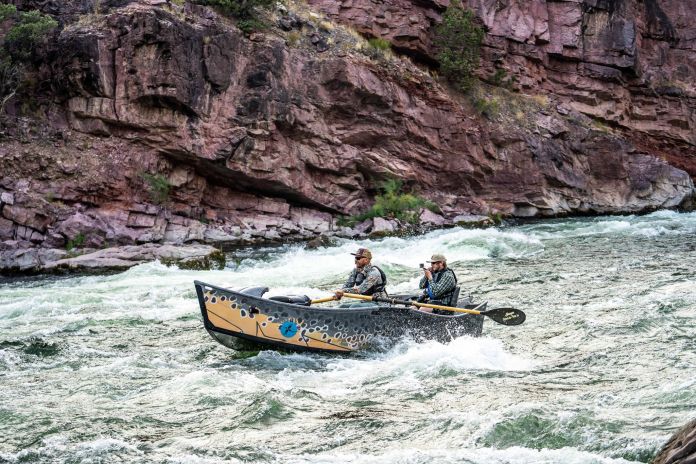
shooting on the boat

Preston: It was great. I’m selling my entire cinema setup, and going purely GoPro from here on out. It’s the way forward. Haha. You know truth be told, I was definitely feeling a little vulnerable about it in the beginning, just because I was worried about not getting the exact results that I was looking for. Luckily, because GoPro’s have come so far since I last picked one up (Hero 3+) I was blown back by how many settings were packed into this little camera, and the ease-of-use with switching settings made it fun and easy to use.

For a run and gun project like this, while being in a rugged environment, the peace of mind of not worrying about gear getting wet or dropped was awesome. Coming from a background of being in rugged environments and worrying about gear getting damaged on the road, or on set, the transition was great. I felt I was able to think a little bit more about the creative side of the project rather than stressing out about damaging the camera itself while on the boat or in the water. Also, I probably wouldn’t put my cinema lens that close to sizzling breakfast patties, but the GoPro got right in there no problem.

Flylords: What filming techniques were you able to employ while using a GoPro that you wouldn’t normally be able to accomplish with a cinematic lens?

jared on boat

Preston: The amount of mounts that GoPro offers these days allows filmmakers and creative‘s to get really diverse and think outside the box. With a normal cinema set up, on a run and gun project like this, I wouldn’t necessarily be strapping the camera to the edge of the boat, or getting these POV angles that I would be able to get with this GoPro. Don’t get me wrong, there are mounts for cinema cameras out there that allow you to do similar setups, but the amount of setup time and money that goes into them, might not always be worth it depending on the project. So the fact that I can carry all the accessories in one small bag, and mount the GoPro nearly anywhere, was allowing me to accomplish and explore new creative ideas that I might not have thought of had I just been shooting purely on a cinema set up.

Flylords: How did you utilize the Zeus Mini in creating this video?

Preston: The trail to the bathroom at night was treacherous, and after too much of Colby’s hazardous hot sauce at dinner, let’s just say I was glad the Zeus mini kept me on the right path.

Creatively, I was able to throw it into nearly every situation to help provide extra accent and key lighting when needed. Not only that, but since the Zeus Mini is compatible with all GoPro’s accessories, I was able to use the hat clips, and magnetic clips to help with lighting certain situations at night. I really wanted at least one cooking scene in this piece, and since we had to cook in the dark, the lights helped bring that idea to life without any issue. Since they’re so small, they’re easy to keep in your pocket and also just use around camp as an all-around great camp light. The

Also, GoPro ISO capabilities were a lot better than I had anticipated. Especially when working in the GoPros “low light” mode. However, just out of habit I wanted to keep my ISO as low as I possibly could and that’s where the Zeus Mini really came into play.

Flylords: When people shoot on a GoPro, they’re usually not thinking about lighting. How was having the Zeus mini advantageous to adding lighting to the video? How did the lights stack up against traditional lighting?

Preston: Typically, traditional lighting can kind of be a little bit of a thing to set up. There are a lot of small lights out on the market, and although I think that professional lights are getting more and more catered to run and gun projects, the market is still somewhat limited, so having these little lights made a huge difference. I wasn’t worried about stands, cords, batteries, or stressed about them getting damaged while getting on and off the boat or at camp. I will definitely be keeping a couple of Zeus lights in my camera bag, and pick up, from now on just to help with adding little lighting effects on future shoots.

Flylords: How did being able to film underwater affect your creative process when creating this video?

Preston: Filming underwater is something I had always wanted to try. But, with how expensive underwater housing units can be for cinema bodies, I still haven’t pulled the trigger on owning one myself. So, creatively, this was a new avenue for me and I couldn’t have been happier with the results. I think having the ability to take a peek into this underwater setting and seeing these fish interact in their natural habitat is an incredible opportunity and only helps grow my overall appreciation for these badass fish and fisheries.

The ease of being able to film on dry land and seconds later dunk the camera into the water, allows so many people to see what they might be overlooking every time they’re around a body of water. In return, I believe this can open the eyes of many others, and with how easy it is to share images and videos these days — it’s only going to help educate and spark inspiration in people to help keep these wild places, beautiful and healthy. It’s awesome to have a small, portable, easy camera that has the ability to do that!

Flylords: With the portability of the multiple cameras, do you feel you were able to get a more diverse array of shots/ capture more action?

Preston: Absolutely. To have the ability of 3-4 cameras running at one time, and having people who aren’t necessarily familiar with cameras, be able to run them, was a dream. With the click of the button you can have someone who knows nothing about cameras immediately filming in 4K 60fps, 24fps, and 1080 120fps. Even if they’re a couple hundred yards away from you. Also, with GoPro’s Bluetooth capability and app, I was able to control the cameras just from my phone as well. So having them hooked up to an angler, I was able to turn the camera on and off and also record when I saw a moment happening downriver.

Flylords: What was your favorite shot to get from the whole production?

Preston: You know, that intro shot with Colby’s mustache might be my favorite. It’s not every day you get to shoot a glorious stache like that.

But if I had to choose a second one, I think it would be a tie between the night lapse shots I was able to achieve with the Zeus Mini, or the underwater release shots. As I said, the underwater world is still pretty fresh to me as far as getting creative with it, so being able to explore that a bit more is something I’m really looking forward to and had a lot of fun trying out. Also, there was a slow push-in shot through the tall grass of Colby walking towards the boat at sunset, and the colors and dynamic range that I was able to pull from the GoPro footage was really surprising and fun to work with. Most shots were refreshing to me in some way just because it’s so different from what I’m used to, and I will definitely be pulling the GoPro out again on future projects.

To learn more about the Zues MIni Light, click HERE

Thank you to GoPro for this amazing opportunity. Make sure to go check out their line of cameras and accessories, including the new Zeus Mini LED clip light. Also, thank you to Preston Hoffman for taking on this challenge. Lastly, thanks to Colby Crossland and the anglers that call the Green River home for sharing their amazing water with us.

GoPro Presents: “This Place Sucks” – A Fly Fishing Adventure Down the Green

The Ultimate Fly Fishing Gift Guide

SOUTH PLATTE RIVER CARP SLAM XIV 2020 RECAP

Earlier this month the annual CARP SLAM took place along the banks of the South Platte River in Denver Colorado. The event is put on by the local Denver Trout Unlimited Chapter, we caught up with Rick Mikesell who sits on the board of the TU chapter to learn more about the Carp Slam event and who won the 2020 slam. Rick is an avid carp angler in the Denver area and Chief Operations Manager at Trouts Fly Fishing, a sponsor for the event.

Photo: Jake Burleson

Flylords: What is the Carp Slam?

Rick Mikesell: This was the 14th year of The Carp Slam – a fly-only carp fishing tournament celebrating the urban Denver stretch of the South Platter River. Each year, 15 pro/am teams compete to catch the most inches of carp. Teams are paired via random draw, and each team receives a randomly assigned morning & afternoon beat on the Urban Denver South Platte. Prizes are also awarded for the largest exotic species caught, like smallmouth bass, crappie, or rainbow trout. The event has become well-known in Denver.

Photo: Jake Burleson

The Carp Slam is the primary fundraising vehicle for the Denver Trout Unlimited chapter. This is a not-for-profit warm water tournament like many of the others you have seen pop up in the past few years, all proceeds go directly to our conservation efforts on the Denver South Platte. Planning a fundraiser in a global pandemic has been quite challenging, be we are confident we can use this day to continue our mission of creating a sustainable, quality urban fishery; literally out our backdoor (my new office window looks directly at the river, and I get to watch tricos creep out of their shucks on the glass every morning as I respond to emails).

Photo: Jake Burleson

Our charter is conservation first – we do not use our funds to pay fishing celebrities to speak at our chapter meetings, we do not use our funds to arrange private water fishing outings, our funds are directly applied to real initiatives in and on the Denver South Platte.

Photo: Jake Burleson

As the urban corridor undergoes stream restoration through its entirety, we have slated ourselves stakeholders in each individual project. Denver is a large city, and there are many vested interests in the river as a resource. Most projects are focused on broad outdoor recreation access, primarily boating and urban beautification, with little focus on fishing and fisheries health. Through fundraising and advocacy, we have been able to give a voice to the angling community, and to the fish inhabitants of the river, seeing that every step is executed with the health of the fish and access to anglers in mind. A link to completed and in-progress projects can be found here.

Photo: Jake Burleson

Our biggest achievement in the last few years has been in the Chatfield Reallocation Project. As a stakeholder, we have directly raised $75,000.00. These funds go directly to the purchase of Acre Feet of Storage in the Newly Expanded Chatfield Environmental Pool. With our allies; The Greenway Foundation and Denver Water, we now have access to 500-acre feet of stored water, to be released at the call of CPW to eliminate the 100+ zero flow days from Chatfield Reservoir. You can only imagine the immediate impact a constant supply of cold, clean water will have on the temperature, aquatic insects, and fish stocks of the river below. We will begin seeing these releases in 2021.

Photo: Jake Burleson

In the 20+ years, I have been fishing the Denver South Platte, I have seen an unbelievable positive charge in the health of the system, and am grateful for the work those before me have done to benefit my home river.

1st Place Winners Chris Galvin and Ryan Russel.

Flylords: Who took home the 2020 Carp Slam title?

Rick Mikesell: This year, Chris Galvin (5 Time Carp Slam Champ!!!) and Ryan Russell, a rockstar carp angler from the Phoenix Area, crushed the competition and put up some astounding numbers! Together they put up 89” of carp, including a 35.5” monster. With Chris’ Tournament Winning Pedigree, Ryan’s extensive knowledge on the uber-technical AZ Carp Game, and a beat with some happy fish in the morning, there was no stopping them!!!

2nd Place Winners.
Photo: Jake Burleson

Flylords: What were some of the highlights from this year?

Rick Mikesell: 2020 was a year of challenges to planning a charity event, but we took the challenge head-on and, from all accounts made some very tasty lemonade! The success of the event has long rested on the full-time guides who volunteer their services for the day, given the tough season our guides have faced early on, we, as a board have fundraised a $350 stipend to pay each guide for their time, ensuring that the stewards of the river are given the credit and compensation they deserve. This is independent of the tournament’s conservation net proceeds, and many Pro/Guides have chosen to waive this payment, and put the funds directly towards the river. We have also taken the fundraising first approach to an extreme this year, and cut any superfluous spending on the event, running lean and mean to maximize the end net for the river.

Photo: Jake Burleson

Last year was the largest grossing tournament in its 13-year history, and we likely beat that number in 2020. In 2019, we made a very large push for inclusivity in the event, with more female participants in 2019 than in all previous years combined. I was lucky enough to fish with the first female amateur champion, Brittany Nickolas. This year, almost half of the amateur participants are female! These amateur competitors are also responsible for the bulk of the fundraising. To date, the amateurs have raised over $18,000.00.

Photo: Jake Burleson

Flylords: How did you and your team do?

Rick Mikesell: While we fell short of the podium, all in all, it was one of my favorite carp slams! I was paired with an awesome amateur – Priscilla Dorszynski,- who has been really crushing the saltwater game and was taking the carp game head on! Coming off a 1st place finish last year, there was a lot of pressure to keep the title, we had quite the entourage of photographers, spectators, volunteers, following us around in the morning beat. Couple the pressure with extraordinarily low and clear river flows, and maybe the spookiest freshwater quarry of them all, and it was a challenge to say the least! The few happy fish we did find were well guarded by a group of sentry dink largemouth bass, who made sure to light up your fly before it got anywhere near an intermittently feeding Carp. If I don’t see another dink largemouth on the end of my line for the next 5 years, I won’t complain!! Priscilla and I caught more little bass than we would ever want to and did our best to try and get around them to the cycling super grumpy carp.

Photo: Jake Burleson

The afternoon we finally settled in and got into a groove. The spectators had thinned out, and the pressure was waning with Chris Galvin already way out ahead of all the other teams. After finally finding some truly happy fish, I went 0-2 in the very first fishing session on the afternoon. Both fish were tailing in a slough right in front of an agricultural pump. The pump was the best camouflage I had to keep them from seeing me in the extraordinarily clear water. The first fish pounced, and ran directly under the pump, wrapping around the valve; boom, hook straightened…… Carp have super gummy mouths, and with good knots, and heavy tippet, it is very rare to break fish off, unless they wrap you around something solid, like a pump valve……

Photo: Jake Burleson

Luckily, I found one more still feeding just a clip downstream. When carp spook, they release a stress pheromone, that alerts all the other fish around that something is not right, and generally, all fish in close proximity spook too, or at the very least, stop feeding. The second fish was much wary than the first, it rolled over to the fly slowly, and took a quick taste, set, and he immediately ran right into the pump. SNAP, this time at the tippet knot (should have checked after the last fish wrapped me….).

Fish in the net! Photo: Jake Burleson

Priscilla was up next, and we found some smaller fish cycling in a slot just upstream. As we were retying from a tree snag, a much nicer fish rolled into the slot, and right in the zone. We finished tying the knot; CAST, HIGH IN THE COLUMN! DRAG! DRAG! DROP! SET! BOOM! FISH ON! Priscilla did everything perfectly, and we scooped her first DSP carp, and her biggest fish ever into the net! The fish was measured, photos were snapped, and air high fives were given, and we were feeling great! Unfortunately, all the commotion of the first hour had put all the fish into a super grumpy mood, and they wouldn’t stick around to look at anything. We moved back upstream and found a few fish here and there, but all spooked before we could get a good presentation….

At the end of the day, Priscilla took home the prize for the largest fish (and only fish) caught by a female angler! It was one of the more challenging Carp Slams I have fished (My 5th year competing) and had I came through with just one of the fish I fed, we would have had a strong second-place finish, but that is part of the fun of the tournament. The random beats, the timing, conditions varying all across the drainage, it forces you to approach your fishing from a completely different light, and that is what makes it a special way to try and give back to the resource!

Abel SDF 6/7, Ross Evolution 7/8, and Abel SDS 7/8. Photo: Jake Burleson

Flylords: What gear were you using?

Rick Mikesell: Depending on conditions, a 6-8wt rod, I had all three rigged and ready just in case… Loomis NRX+ 6wt, Orvis H3D 7wt, and Loomis Asquith 8wt. I use Abel SD (S & F) reels across the board for Carp. I have used so many others over the years, and none have stood up to the absolute beating of carp fishing like the Abels have. Urban fishing is tough on gear, concrete, metal, and hard pulling fish, really push rods and reels to the limit, and I have not had an Abel Fail yet. For terminal, I have really been fond of the new Umpqua Deceiver HD Fluorocarbon. Unless I do something dumb, like wrap around a metal object, lol, fish stay stuck!

What do you think does camo make a difference? Photo: Jake Burleson

Flylords: Does camo make a difference when carp fishing?

Rick Mikesell: In the Denver South Platte, absolutely! Carp have extraordinarily keen eyesight, and unlike most other freshwater fish, true color vision. Couple that with the pressure the DSP sees (carp on the fly all began here in the 80’s with Barry Reynolds & Brad Befus!!!). It may be one of the most fished carp waters in the country, and all little advantages add up. Camo has become standard among the DSP angling community, and I have even seen some go as far as Ghille Suits in past competitions!

Barry Reynolds, a carp on the fly legend. Photo: Jake Burleson

Flylords: Why should anyone want to chase carp on the fly?

Rick Mikesell: Carp are the ultimate freshwater sport fish! They are most likely the closest angling opportunity to most American anglers. They are big! The average in the Denver South Platte is 8-9lbs, with fish caught well over 20lbs each year (A trophy trout is 5lbs, and dink carp is 5lbs). And most importantly, they are hard as hell to catch! It is a 100% sight fishing game, they can actually hear vs. just sense vibration through the lateral line, their olfactory senses are second to none in freshwater, a real challenge when you offering is animal feathers, and glue tied to a hook. It is a constant, evolving challenge, and that is why most of the hardcore carp anglers get stuck in the pursuit and never come out!

Photo: Jake Burleson

Flylords: How can somebody get involved in the Carp Slam next year?

Rick Mikesell: Go to denvertu.org and sign up for eNews & Notices. Because the Carp Slam tournament sells out every year, it’s important to get notified once registrations open up next spring. We can always use volunteers for the day of execution, and most importantly, would love to have any interested parties join Denver Trout Unlimited’s monthly meetings, to provide new voices to the conservation work that is at the heart of our organization and this event!

Be sure to check Rick out on Instagram at @rick_mikesell and follow along with @troutsflyfishing. All photos are shot by Jake Burleson (@jakobbur) unless otherwise noted.

How to Use the Drag & Drop Casting Technique for Carp

World Record Carp in the LA River

Carp on the Fly with Chris Fowler

Premiering Tonight: “Blood Run” – Payara on the Fly

0

Ross Purnell and Rodrigo Salles take on the challenge of the Payara in the latest film from Flyfisherman Magazine premiering at the link above at 7 PM EST tonight. More than just fishing the new film highlights the Kayapo Tribe’s battle against the damming of their home waters.

“On Brazil’s Xingu River, Kayapo warriors use the enormous fangs from vampire fish to cut and scar their arms. Join two adventurous fly fishers in their quest to catch these magnificent jungle fish and become the first outsiders to participate in this ancient ritual.”

The film will premiere on Youtube, Facebook, and IGTV tonight at 7 PM EST.

Read more about the Kayapos and the wild fanged fish of the Xingu River, here!

Video of the Week: Trout Hunting NZ’s Exploring New Backcountry Water

In this week’s segment of Video of The Week, we take a look at Gareth Bayliss‘ new film where he and Alex Waller walk into one of their favorite backcountry rivers in search of large New Zealand trout. This early season adventure leaves the boys with some amazing fish, a few dry fly opportunities, and some unreal New Zealand sceneries. So sit down and enjoy 20 minutes of Trout Hunting NZ’s epic backcountry fishing.

Be sure to check out these other rad videos as well!

Building the Stoke in New Zealand – an Interview with Guide Alex Waller

Fall Fishing Tips: 8 Effective Flies for Fall Trout Fishing

Video of The Week: A Journey Upstream


GoPro Presents: “This Place Sucks” – A Fly Fishing Adventure Down the Green

This September we had the chance to take a trip over to the Green River and meet up with our friend, Colby Crossland, a guide for Spinner Fall Guide Service. With us, we brought a few rods, a cooler of beer, and most importantly, our friend Preston Hoffman who was armed with an arsenal of GoPro equipment, including the new Zeus Mini Magnetic Swivel Clip Light.

gopro equipment on the table
Tools of the trade

While there, we set out to capture a 2 night, 3 day float/ fish extravaganza on one of Utah’s most incredible rivers. The catch: we wanted to document it solely with GoPro gear. With Colby and company leading the way, we set out to enjoy all the splendors float-camping had to offer, all while trying to catch a few fish along the way. For some good old wave crashing, fly tying, hook setting goodness, feel free to check out our official collaboration with GoPro appropriately titled: This Place Sucks.

The Ultimate Fly Fishing Gift Guide

Top 5 Reasons to Fly Fish Utah’s Green River

Faces of Fly Fishing: Ben Sittig (Huge Fly Fisherman)


5 Ways to be a More Sustainable Fly Fishing Consumer

As fly anglers, we care deeply about the health of fish populations and the environments that these fish live in. We know that without healthy fish populations and healthy aquatic environments, fishing becomes unproductive, and the places we cherish begin to fall apart.

As consumers, the things we choose to purchase have an effect on the greater world. When we choose to buy a new fly rod, for instance, materials are harvested from around the world, shipped to production locations, assembled by workers, shipped to secondary production sites, shipped to retailers, and ultimately shipped to your front door. The long chain of actions required to get that fly rod in your hands has an impact on the environment, people, and local economies of the greater world.

As responsible consumers, we want to make sure that we minimize our negative impact on the world. Especially when it comes to purchasing fly fishing gear! These are the five ways to be a more sustainable fly fishing consumer.

Buy less

It should go without saying that buying less is the best thing you can do to lower your negative impact. It can be difficult to restrain yourself from purchasing this year’s waders, the newest fly pack, or upgrading that old reel, but taking the time to differentiate the items that you NEED and the items that you WANT is very important before making that next purchase. Not to mention, your bank account will thank you.

Fly fishing gear layed out pre-trip
Courtesy of @ericbraker

Buy Items That Last

When you do choose to buy an item, make sure that it’s built to last. For example, if you buy a cooler, it shouldn’t give you problems for years to come. Focusing on the quality of the gear may be more expensive in the short run, but the investment is well worth it in the long run. And it will be better for the planet too!

Yeti Tundra and Cocktails
Courtesy of @moretti.media

Buy Items That Serve Multiple Purposes

The outdoor recreation industry is known for creating gear that is specifically designed for each activity you’re doing (e.g., fishing, hiking, climbing). If you have interests beyond fishing, plan ahead and purchase items that you’ll be able to use for multiple different occasions. For example, if you’re going to buy a rain jacket (one of the most environmentally destructive items you can purchase), take the time to buy a jacket that will be suitable for a number of different activities including fishing, hiking, and maybe even something you would wear to work. If you can buy one jacket instead of three, that is a more sustainable tradeoff. 

Rock Climber, outdoor gear
Courtesy of @moretti.media

Support Companies Who Care About Sustainability

When purchasing items, the company you choose to buy from is very important. If you can buy the item from a company that values sustainability and incorporates these values into their business practices, you will drastically lower your impact. If you need some help figuring out which companies to support, check out “6 Organizations and Companies Doing Great Things For Our Planet and Fly Fishing.” When these items can be purchased from a local fly shop, that is all the better!

hiking into the woods
Courtesy of @jzissu

Fixing and Re-Using Gear

The last tip for becoming a more sustainable consumer is tending to your gear. If you can extend the life of your gear, you also prolong the amount of time before you make the next purchase, and you ultimately lower your impact. For example, if you get a leaky hole in your waders, it is always beneficial to attempt to patch them up before purchasing a new pair. Some companies like Patagonia take it a step further and will help repair those waders and other gear. Check out their Worn Wear initiative, dedicated to repairing, sharing and recycling gear.

Patagonia Wading Boots
Courtesy of Flylords

As fly anglers, we purchase fly fishing gear to improve our experience in nature. Being in this position, we are a group of people that must stand for something more than constantly buying the newest and greatest— ultimately at the expense of the very environments that the gear is meant to be used to enjoy. We have a responsibility to be more sustainable consumers.

West Branch of the Delaware De-Watered for Dam Repairs

As many of you know, a tailwater is a river or stream whose flow is controlled by a dam, typically in the case of trout tailwaters, a bottom release dam. This means that if the dam needs to be repaired, like the Cannonsville Reservoir Dam on the West Branch of the Delaware River, releases trout rely on for food, water and spawning may be temporarily impeded. This is exactly what happened on last week on the Del. With less than 24 hours notice, the NYCDEP announced on October 4th that the river would receive 0 CFS of releases for several hours on the 6th, and less than 30% of its average flows on the 5th and 7th.

Drained West Branch Delaware River
Courtesy of Friends of the Delaware River

The flow events of last week were done in conjunction with 2 projects, one to repair a leak on a dam release pipe, and the other to calibrate a USGS gauge below the dam. Keep in mind that the usual constant release from the dam is around 150 CFS.

Here’s how last weeks events were supposed to go, according to the Daily Star of Oneonta, NY:

On Monday, Oct. 5, DEP will reduce the downstream flow to 40 cubic feet per second for several hours in the morning while USGS takes readings to calibrate its gage in Stilesville. The release is expected to increase to 150 cfs by noontime.

On Tuesday, Oct. 6, DEP will ramp down the release to zero flow by 5 a.m. The shutdown is necessary for DEP to safely repair a leak on one of the release pipes in the West Delaware Release Chamber, which releases water from the reservoir into the West Branch Delaware River. The shutdown is expected to last the majority of the day. During the shutdown, DEP will also work with USGS to remove debris from around its gage. DEP will ramp back up to 150 cfs when the repair is complete.

On Wednesday, Oct. 7, DEP will again reduce the downstream flow to 40 cfs in the morning while USGS takes additional readings to calibrate its gage in Stilesville. DEP will then ramp back up to 150 cfs.

West Branch, Upstream of Deposit Bridge (Pine Street) – Photo Ron Chiavacci. Courtesy of Friends of the Upper Delaware River.

The Results?

It’s important to keep in mind that the West Branch of the Delaware is a wide river and at its usual flows, a relatively shallow one. The NYCDEC said they tried their best to coincide with the repairs and dewatering with increased rains and cooler temperatures to protect the tailwater’s precious wild trout and aquatic insect populations. Despite the drastically lower flows happening for just a few hours, the impacts were felt all along the approximately 18-mile tailwater. As you can see in the image above, countless smaller fish who would have been taking shelter in the shallows lost their lives when the waters dropped out below them. But the impact on aquatic insect life is likely what will haunt the fishery for years to come.

To read more about the events, check out this release from the Friends of the Upper Delaware River!

The Waiting Game – A Shore Albie Story

2

The angle of the sun. The nip in the morning air. The slight rustle of the drying leaves in the trees. Every year, the onset of the Albie season is seen, felt, and heard. 

Wait, you’ve never caught one before? Well, get your ass out there and book any guide you can find who isn’t in the middle of a bender. Chase the Albies around Rhode Island, Montauk, Long Island Sound and catch them continually, until your triceps burn. Do this a few times if you have to—rinse it from your soul. Then try your hand at the true madness. Do some Albie fishing from the shore. 

Photo by Capt Kyle Schaefer

The shore Albie tribe is easy to spot, even from a distance. Anglers, at times, seem to come to resemble their prey. The striper dudes are usually stout, with bags under the eyes the color of cigarette stains, from the wee early hours demanded by their quarry. The albie angler is slimmer, jumpier, their eyes insatiable, flinty. Their rods are quicker. You’ll see what I mean when you get out there. 

I started my Albie season this week with the typical bang. I drove through the intemperate, early-morning traffic to a spot out east, one of my favorites. When I arrived, everything looked promising, like the Albie gods might just shine a little light down on me. The seas were animated, but not rough. The wind was blowing onshore. There had been reports of Albies showing in previous days. 

Photo by Capt Kyle Schaefer

I rigged up, climbed up onto the rocks, and stood there for five hours staring over the water. Every once in awhile, I worked out a series of casts, practicing my double haul and hastening the inevitable onset of elbow tendinitis I get every Albie season. 

Nothing. No busts. No birds. No bait. 

Photo by Capt Kyle Schaefer

In the sixth hour, I laid down on the rocks, hat pulled over my eyes, my sling pack acting as a workable pillow, and went completely out for 30 minutes or so. The snooze was almost worth the trip out and back. Naps, in some ways, accomplish the same thing we seek while fishing—that total, if fleeting, clearing of the mind. I drove back home, drowsy from the nap, and hungry for another shot. 

I will persist, of course, because that’s just what you do during shore Albie season. You try to keep an ear out, on your online and offline social networks, for where the fish might be. You input all of that information and mix it around a bit with your instincts, and hatch another plan. You inevitably experience that sinking feeling a few hours into your next trip, when you see nothing but untroubled water once more. Then you try again. And again. 

Photo by Capt Kyle Schaefer

And then it happens one day, seemingly out of nowhere. You see the pod of Albies slashing through the panicked bait. You hear the squawk of the terns, which dip in and out of the mayhem as if on invisible yo-yo strings. And you make your cast. If you’re lucky, you connect and your knots hold and your mind clears. If you’re luckier still, the Albies come in for another taste and you maybe catch another and another. Each one is earned, and each one is as sweet and as affecting and as fleeting as the fall itself.

Words by Monte Burke

Images from Capt Kyle Schaefer and Capt Zak Robinson

Patagonia Releases Shareable “We Stand for the Water We Stand In” Poster

If you’ve been on fly fishing social media lately, you’ve likely seen this graphic pop on your feed. And there is more behind the graphic than just the important voting message it carries. The message is one we easily identify with and continues to bolster the concept of “Think Globally, Act Locally” with regards to the health and sustainability of our Nation’s fisheries as we look to the 2020 election in less than 30 days.

From Patagonia:

“It’s our job to inspire, educate and support a broad-based community of fish activists,” said Ted Manning, Patagonia’s director of fly fishing. “Patagonia’s mission is to save our home planet, and for us, specifically, to fight for wild fish and wild waters. We’re constantly searching for innovative ways to get that message across. We wanted creativity and spirit, and we wanted it out before the upcoming election because the stakes are so high.”

The poster’s proclamation, “We Stand for the Waters We Stand In,” is inspired by a Wendell Berry poem titled “Below.” Berry, known for his longstanding activism and an inspiring, prolific body of work, writes:

All my dawns cross the horizon
and rise, from underfoot.
What I stand for
is what I stand on.

“We really hope that our take, ‘We Stand for the Waters We Stand In,’ will resonate and inspire anglers to activism,” added Manning. “It’s a simple message, but it’s powerful. It works hand in hand with Patagonia’s ongoing “It’s All Home Water” storytelling, emphasizing our commitment to support anglers who are fighting to ensure a future that includes wild fish and wild waters.”

The design recalls the supersaturated colors and the retro-kitsch aesthetic of midcentury modern graphic design. “There is a warmth to old fishing ephemera that everyone who worked on this responded to,” said Dan Cassaro of The Young Jerks. “Combining that with the immediacy and importance of a political poster felt like an exciting mix. It’s impossible to not feel the urge to help when you see the world on fire every day.”

If you feel so inclined you can download and share the poster, here.

Fall Fishing Tips: 8 Effective Flies for Fall Trout Fishing

Fall. The time of year where leaves begin to change, temps begin to drop, and water begins to cool. Fall is a favorite amoungst many and is also known for being a great time to fly fish for trout. With the season shift, fly fishermen also shift with the conditions throwing effective flies for this time of year. If you are primarily a trout fisherman or someone looking to dive into becoming a troutbum, it is important to know when certain flies are more effective than others. In this tips and tricks video, Orvis legend Tom Rosenbauer illustrates his 8 favorite trout patterns for the fall season.

Tom’s Top 8 Fall Trout Patterns:

Lynch’s D&D (Down & Dirty)

  • Great for large brown trout
  • When pulled, this flies dives
  • Best used with sinking or sink tip lines
  • Also great when used with a high sink rate poly-leader with heavy tippet

Cone Head Maribou Muddler Minnow

  • Makes disturbance in the water
  • Can be fished with floating or sink tip lines
  • Cone head allows for a quick sink rate

Griffith’s Knat

  • Midge emergers and dries are very active in the fall and the Griffith’s Knat is a perfect imitation.
  • Midge’s vary in size but smaller flies seem to work better
  • Also imitates small mayflies

Olive Sparkle Dun

  • Vary in size anywhere from 18-24
  • Very abundant hatch this time of year.
  • Popular around the US in multiple different states.
  • Imitates an adult and an emerger

The Killer Bug

  • Basically yarn on a hook
  • Vegetation tends to break up in the fall and scuds and sow bugs tend to move around
  • Very simple to tie and sinks well
  • Perfect for spring creeks

Zebra Midge

  • Resembles generic sources of midge larvae and pupa
  • Sinks well and is effective everywhere
  • Range in size from 14-mid to high 20’s

Hot Spot Pheasant Tail

  • Best tied on a jig barbless hook
  • Rides on the bottom and rarely snags
  • Contains a hot spot collar to key fish in on the fly
  • Usually used along with the euro-nymphing technique

Tongue Head Quill

  • Similar to the Hot Spot PT
  • Skinny profile with a slender body
  • Sinks quickly and resembles a mayfly

Once again, fall is such a great time to hit the water and enjoy what fly fishing has to offer! Fill your box with these 8 flies for trout and you will be set for just about anywhere in North America. Don’t be afraid to ask around to see what is working but large streamers, midge, and mayfly patterns are perfect! Get out and enjoy this time on the water, tight lines!