Home Blog Page 193

Community Embraces History to Restore San Miguel River

More than twelve years ago, on May 21st, 2007, the Town of Telluride made a final deposit of $50 million and secured the 570-acre parcel of land known as the Valley Floor. Over 90 days, Hilary Cooper, Jane Hickox (president of the Valley Floor Presentation Partners (VFPP)), and a small group of volunteers worked day and night to fundraise for this new acquisition. At the beginning of this endeavor, the outlook was not promising. In the words of long-time resident and editor of the Telluride Daily Planet, Suzanne Cheavens, “The monetary aspect seemed insurmountable.” Despite this, locals, second homeowners, and compassionate onlookers came together to pull off what would later be regarded as one of the most important and inspiring feats in the town’s history. Together, they were able to purchase this invaluable land, and thereby prevent the destruction of a precious local ecosystem. Under previous ownership, the recreational use of the land was not permitted, and the land was threatened by proposed residential development.                             

The History of the San Miguel

Many years before, Telluride was a bustling mining community exporting countless tons of gold, silver, lead, zinc, copper, and iron. It was originally settled in 1875 by a prosperous

A photo of Telluride taken in about 1900.<br /> Photo credits: Town of Telluride
A photo of Telluride taken in about 1900.
Photo credits: Town of Telluride

miner named John Fallon, and was named “Columbia”. Due to confusion with a town in California that shared the same name, it was renamed Telluride in reference to the chemical element tellurium. In 1881, Otto Mears built a toll road that enabled wagons to travel where only pack mules had been allowed previously. As a result, the population of the town soared. That said, it was still incredibly difficult to export the ore extracted at the numerous mines in the area. 

In response to this challenge, plans to build a railroad were put into place. A railroad would facilitate the transportation of ore, household necessities, and mail. As well as helping to connect the very isolated community with others around it, this new form of transportation would cut back on the time it took to obtain essentials by up to several months. It would

The Galloping Goose in 1952.<br /> Photo credits: Town of Telluride
The Galloping Goose in 1952.
Photo credits: Town of Telluride

connect with the existing Rio Grande Southern Railroad that transferred goods and people all throughout the remote towns in Southwestern Colorado. 

In order to carry out these plans, it was decided that the portion of the San Miguel River that runs through the Valley Floor would need to be rerouted to minimize the cost and materials needed. Rerouting the river had another side effect that was enticing to the town, it would help flush the heavy metals out of the town’s immediate vicinity, and therefore make the water significantly safer for consumption. After a long, harsh year, the railroad was completed and in use. As anticipated, the export process quickly became more efficient, and within a matter of days, mail and provisions could be transported from Denver to the secluded mountain town. 

The San Miguel River Today

Over 100 years later, the mining activity is all gone, replaced with a strong tourism economy fueled by a ski area built-in 1972. 

On a cool morning in early summer, 2016, men and women filtered out onto the Valley Floor, all dressed in construction jackets. It was that morning that the first phase of the San Miguel river restoration project began. The plan was to reroute the river to its natural channel, and subsequently restore the delicate ecosystem reliant on the water source. The river would be able to flood when needed, and “do what rivers do” as put by Gary Hickcox, former director of the San Miguel Conservation Fund and former chair of the Open Space Commission.

The most current version of a map showing the San Miguel river restoration project. Here you can see both the new and the old river channels, the tailing piles, the berms, and the construction sites/roads.<br />
The most current version of a map showing the San Miguel river restoration project. Here you can see both the new and the old river channels, the tailing piles, the berms, and the construction sites/roads.
Photo credits: Town of Telluride

Though the river was redirected many years ago, the original channel still exists, and naturally, that was where the river was restored. After a small amount of tree and brush removal, the channel was in perfect condition to fill with water. 

A major focus of the restoration plan was “to have minimal human engineering and to have the river do the engineering,” according to Hilary Cooper. The idea was to let the river carve its way through the valley, using the channel as a guide. On the whole, this was incredibly successful, and the river was able to re-establish itself as a natural component of the local ecosystem.  

This restoration happened in two similar phases. Working their way down the river, the town was able to complete this monumental change in just over four years. 

In addition to redirecting the river, there was a big push to rehabilitate the surrounding wetland. This is especially prevalent in the second phase, where the recapping of mining debris was necessary. A series of studies were conducted in order to determine the exact native plant representation in the area. Using this data, a seed mix was cultivated and later planted to encourage the growth of these species. Not only did this benefit the local wildlife, but it also helped to prevent erosion of the river banks, and to stabilize the wetland area. 

The flat green area in the background is the large tailing pile that is located on the east side of town.

Because of Telluride’s rich mining history, there are numerous tailing piles in and around the town. One of the most prominent resides on the Valley Floor. The toxic 23-acre area is located on the northwestern edge of the Valley Floor and was in desperate need of recapping. Without recapping, the heavy metals would begin to bleed into the wetlands, and consequently poison and kill both the animals and plants in the region. In addition, it would contaminate the river, killing the trout living in its cool waters. 

An agreement between the State of Colorado and the Idarado Mining Company mandated recapping and revegetation. The Remedial Action Plan enabled the Town of Telluride, as the landowners, to propose an alternative plan. They proposed that instead of importing materials to cover the tailing piles, the construction companies bring soil and other materials from the berms on the east side of the project. In effect, this would help minimize traffic through the area, as well as helping to preserve the spruce groves in the area. 

Due to the location of the river, the wetlands in the area effectively created a barrier between the tailing piles and the river. In the event that the tailing piles did start to bleed, the wetlands would contain heavy metals. This is beyond important because if they did get to the river, they would be carried far downstream, and negatively impact a much greater area, both on land and in the river.   

Directly following the completion of the first phase, brown trout were observed spawning in the new channel. This speaks to the promise of an improved fishery in a more natural river environment.

The second phase of this project is estimated to be finished in November of this year (2020), and despite COVID-19 and its repercussions, all of the funding and the timeline for the project are intact to this day. This, once again, is a great representation of the community’s dedication to its public lands, as well as its financial prioritization in times of economic unrest.   

At the end of this phase, Trout Unlimited’s Jason Willis will be working with the Forest Service to continue removing tailings and create several new river structures. Two or three years from now, there will be two more phases completed. While we don’t know exactly what these phases will consist of, it is most likely that they will center around removing tailings and creating a more natural river structure.  

The story of one community’s bond over such a remarkable natural resource is inspiring to many, and with any luck, it will live on for generations in the form of a river to SUP and fish, trails to bike and hike along, and an ecosystem protected from humans’ ever-escalating need for land and money.

If you are interested, click here to stay updated on this project.

Article by Brooke Duncan, a Flylords Content Intern that can be found waist-deep in any and all rivers in Southwestern Colorado. Born and raised in Telluride, she has been fishing since she took her first steps, and enjoys the challenge of techy dry fly rivers and lakes. From the crystal clear rivers in Patagonia to the swift streams of Colorado, she has spent many hours making casts, sharing stories, and being on the water with family and friends. Be sure to give her a follow at @brookelillian.3313.

11 Best Fly Fishing Rivers In Colorado [Pro Tips For Each]

On the Water with Ross Reels New San Miguel Reel


Chasing Mac’s – How to Catch Lake Trout on the Fly

Seemingly, little is known about chasing the mighty Mac with a fly rod. Most hardcore Lake Trout fishermen target these freshwater giants on spoons and plugs with downriggers and lead core lines. They troll deep structure where lake trout congregate to feed on baitfish and freshwater crustaceans. Catching the lake trout in deep water with a fly rod is possible, however, it is similar to trolling with spinning gear rather than casting a fly rod. Lake Trout are a cold-water fish and their range stretches throughout the providences of Canada, great lakes, and other northern US states. Although they have been introduced to other countries such as Sweden, New Zealand, and South America, all of their ancestors can be traced back to North America. Lake Trout are not actually trout, they are the largest freshwater Char species and can live up to 40 years. They have extremely slow growth rates but slow growth certainly does not mean small size. They can grow to over 100 pounds in certain lakes but they average between 5-15 pounds in most areas. 

The best times of year to target these fish on flies is early spring during Ice out or late fall prior to spawn and ice over. The fish are up shallow, feeding on spawning whitefish and other baitfish that cruise the ice shelves during spring break up and in the fall they are up shallow preparing to spawn. It is, of course, best practice to leave them be during their spawning period as loss of habitat, rising waters temperatures, and pollution threaten this cold water giant. 

My favorite time of year to target these fish is early spring during ice-out, shortly after venturing out onto a frozen lake is no longer safe. The disintegrating ice shelf provides cover for Lakers to ambush their prey. Lake Trout love to chase and more often than not, you can watch them follow your flies out from underneath the rotten ice and take your presentation right next to your feet! Finding success, like many other species, requires putting in the time to do your homework and putting yourself in the right positions to catch fish. You will want to look at bathymetric maps of the lake you plan to fish and find steep drops and points to cast off of. During the spring hunt, timing is everything. A few days to early and you will not find open water and a few days too late, the fish will have moved out to deeper water which makes catching them on a fly far more challenging. 

Oliver Ancans Lake Trout on the Fly

When targeting Lake Trout during the spring getting you fly deep is not as important, the water is still chilly from the winter months and you will most likely not be fishing in over 6-10 feet of water. A 10’ versa leader and lightly weight baitfish imitation on a floating line will be plenty to reach the depths necessary for spring and fall lake trout. Lake trout are known for their aggressive strikes and can rip line off of your reel as you hooked into a freight train. Presentation is key and if it is not quite right, they may nip at the tail of your fly rather than inhale it. I have found that it is best to experiment with your retrieval pattern. I have found that keeping your rod tip in the waters and utilizing a short fast strip retrieve works well for inducing a strike. Lakers have very hard, boney mouths so a hard strip strike is necessary and tent to not be leader shy so I use a fairly heavy tippet up to 20Lb fluorocarbon to get the job done. Oftentimes in the spring and fall, the fish are much closer to the bank than you think, I have spotted them cruising in less than a foot of water so making a long cast is not always necessary. Enticing a Lake Trout to eat a fly is not the challenge, the challenge lies within trying to find the fish. We have spent days tracking down good locations to find Lakers from shore but if you are willing to put the time in, you have a good chance of catching a few of these beautiful fish. 

Tips and Tricks

  1. Rods and Reels: A 7-10wt depending on the size of flies, as well as the size of the lake trout in the water you will be fishing in. Big lake trout pull hard, so a reel with a good smooth drag is a key in finding success. 
  2. Lines: I have targeted lake trout utilizing full sinking lines, intermediate lines and floating lines. The type of line you will need will be heavily dependent on the water you intend to fish. One of my favorite methods is to use a floating line and with a long fluorocarbon leader. This helps provide more of a jigging actions to your weighted fly and seems to induce a strike more regularly than a level presentation. To be safe I always carry a few detachable sink tips which will help me change my presentation if need be. Oliver Ancans Lake Trout on the Fly
  3. Tippet and Leader: I tend to tie my own leaders so I have exactly what I want. Depending on the depth, I use four or five sections of fluorocarbon with the heaviest section being 40 pound test which taper down to the tippet section which is 15-20 pound test. 
  4. Net: A large rubber landing net will help the fish keep most of their protective slime and allow you to keep the fish in the water while you unhook and prepare to take photos. 
  5. Wading: Your favorite pair of waders and wading boots (if fishing in the early spring or fall from shore) Waders will make your experience a little more tolerable.Oliver Ancans Lake Trout on the Fly
  6. Flies: Big flashy streamers and weighted baitfish or leech imitations work very well for lake trout. Fish them slow and strip strike at the slightest tap or loss of contact with your fly. Big lake trout can take surprisingly light for their size.
  7. Set the hook hard! Unlike steelhead or other trout species, Char have extremely hard bony mouths that can be difficult to get a hook into. So don’t hold back on your hookset. If you have the correct gear you will not break the fish off. 
  8. Time of year and Locations: Anywhere lake trout inhabit a lake, there is potential to catch them on a fly. Find steep drop-offs and cover where a lake trout’s food source can easily be ambushed.
  9. Have fun and stick with it. Lake trout can be fickle beasts which can be frustrating to an angler but hang in there and keep moving around. You will find a willing participant eventually and don’t be afraid to change your presentation. 

Oliver Ancans Lake Trout on the Fly

Ice Out Lake Trout

During the long winters of interior Alaska, I spend my time targeting Lake trout through a 10” hole in the ice. I am drawn to the individuality of their vermiculated bodies and knowing that you have the chance to tie into a true freshwater giant every time you step on the ice. This past spring, I decided that I wanted to catch a lake trout on a fly rod. I decided my best opportunity to do so was on foot during ice out. During the springtime, the ice recedes off of the lakes, and the baitfish cruise the edges of the rotten ice eating all of the insects hatching in the warm spring sun. My window to pull this off was short, so I chose a lake I know well from ice fishing and scouted it out while driving back from a different fishing trip. The ice was just beginning to creep away from the shoreline so I set my sights on the following weekend and planned to have my girlfriend Gaby meet me there, she wanted to catch one too.

We arrive the night prior to rig up fly rods and make our camp. We set our cell phone alarms for 5 am and got to bed early. We woke up, gathered our gear and started hiking through the brush and were almost immediately were faced with our first challenge of the day, crossing a deep fast-moving river outlet willed with enormous chunks of 6’ thick ice. Gaby clambered onto my back (a usual occurrence during our more mild summer fishing adventures) and we crossed safely and with only a little water in my waders, we began hiking through the high brush. As we hiked along only seeing beavers slap the water with their tails as we trudged by their lodges. We stopped to cast where the ice had receded from the bank and swapped our flies and sink tips regularly to maintain contact with the bottom but after 6 hours we had yet to make contact with a Lake Trout. We were getting annoyed with snagging the waist-high brush behind us and “post-holing” our way through the remaining snowdrifts. But our want for a Laker kept pushing us farther and farther from our camp.

Oliver Ancans Lake Trout on the Fly

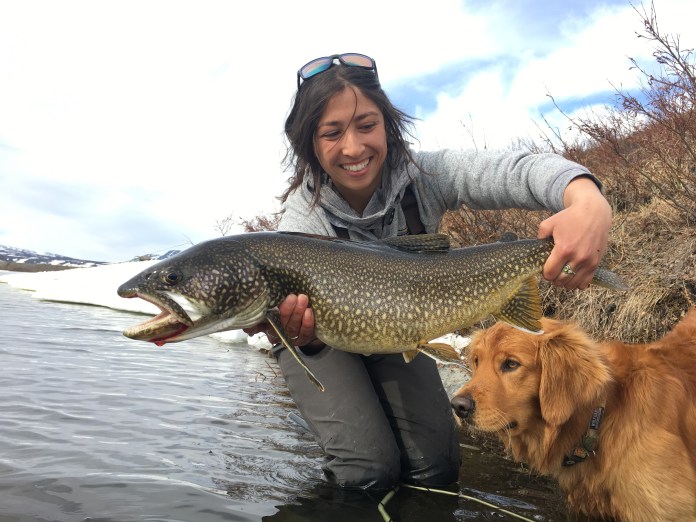
Around noon we came to an area on the lake where the sandy bottom turned to large boulders and dropped off quickly. Keeping her back cast high to avoid the brush behind us, Gaby made a cast toward the ice shelf and let her fly sink to the bottom. I glanced over at her line and as she stripped it in, then, her white wooly bugger disappeared. She hesitantly pulled up and at first, thought that she had snagged the ice underneath her feet. Then, her fly line started swimming away. After a moment of confusion to process what was happening, I yelled “set the hook!” she did and immediately her fish ran straight out to deeper water. Gaby pulled and tried to get her fly line untangled from her reel to get control of the fish. My dog Marty waiting patiently on the bank observing the chaos Eventually she turned the fish and brought it close enough to lift her fly rod high in the air allowing me to get a net under the fish.

She had done it, her first lake trout on a fly rod. We admired it and snapped a couple of photos before setting the char back into the icy water. The following hours brought a few more lake trout and lots of smiles but our day ended when my fly rod exploded into 7 pieces while trying to pull it loose from a snag in some brush behind me and with over five miles through nasty terrain between us and our camp, we decided to head back and call it a day. Since then we have been able to find and catch Lake Trout in several Lakes throughout interior Alaska. I only look forward to upcoming years as Lake Trout have made the list as a species I will catch every summer. 

5 Effective Fly Patterns for Great Lakes Steelhead

Disclosure: The article may contain affiliate links that may result in a commission at no additional cost to the reader.

Steelhead are migratory rainbow trout born in rivers but spend a large portion of their lives in the Great Lakes or the ocean for that matter. These chrome missiles are known for venturing back into creeks or streams to spawn in mid to late October. The typical spawning season lasts until early May giving anglers the chance to tango with this feisty trout for all but 8 months out of the year. Steelhead typically feed to sustain their body weight and when they enter the river systems in the winter they are considered sexually mature. They are known to eat your typical trout patterns but are also attracted to bright colored flies. In this piece, we will highlight 5 effective fly patterns for great lakes steelhead, the materials needed, and step by step instructions on how to tie these killer flies.

The How-To tying videos in this piece are brought to you by Tim Flagler of Tightline Productions.

The Nuke Egg

Materials Needed:

Jeff Blood’s Blood Dot Egg

Materials Needed:

Steelhead Woolly Bugger

Materials Needed:

Jeff Blood’s White Death

Materials Needed:

Sucker Spawn

Materials Needed:

While these few flies are known for catching steelhead, there are many patterns that do the trick. Bright colors and flash are a must with steelhead flies and if presented properly, your reel will likely be screaming! Take the tips from this article to fill your box and the Great Lakes won’t know what hit them, tight lines!

Ecological Distaster Strikes Kamchatka Coastline

Kamchatka is a perennial destination for many anglers searching for truly wid and remote pacific salmon and rainbow trout fishing. But last week something deadly started to flow from a major river, affecting the sea life and likely the fish species that previously thrived upstream.

A few weeks ago, the tight-knit surfing community of the Kamchatka Peninsula started reporting symptoms of massive pollution occurring along the coast affecting the much loved Khalaktyrsky Beach. The fish looked as though they were boiled and barnacles that would have previously torn waders and wetsuits now fall from the rocks.

The Siberian Times reports that “Doctors registered eye corneal burns. Many people who have been in with water also show symptoms such as nausea, vomiting, weakness, high fever, which may indicate phenol poisoning.”

As you can see in the satellite image from Greenpeace Russia, the plume of toxins is radiating into the sea.

According to the Siberian Times on October 3rd, “Several local residents published satellite pictures shared by Greenpeace Russia, showing a yellow-colored river flowing into the Pacific Ocean.

There is a military training ground upstream, they said.

‘We are getting new information every hour; just recently we received satellite pictures from @greenpeaceru of the river that flows into the ocean and that evidently killed everything.

‘Up the stream, there is a military training ground. Knowing how the system works and how these kinds of questions are getting hushed, we must do everything in our power to save the ocean right and to defend from a catastrophe in the future’, wrote one of the surfers under the nickname Yola_La.

‘Our beautiful underwater world is now color grey and yellow. The fish looks like it’s been boiled. Even the strongest shells that could tear a diving suit fell off the rocks. The scariest of all is that we don’t know what to do, how to help. I am looking at the stunning sunset over the Avacha Bay, knowing that its bottom is covered with dead sea animals’, another local called Kristy_Rozenberg wrote.”

To read the full story, check out the Siberian Times article, here!

How to Tie: The Duracell Jig Nymph

0

In this week’s “How to Tie” video feature, Fly Fish Food gives us a great tutorial on how to tie the Duracell Jig Nymph.

Learn About This Fly:

Difficulty: Novice

This week, we will be learning how to tie the Duracell Jig Nymph. For those of you who know of this fly, you understand it’s uncanny effectiveness when it comes to drifting flies for trout. Originally pioneered by Scottsman, Craig McDonald, the Duracell Jig Nymph has seen a meteoric rise to fame within the euro/ tight line angling community.

“No fly is stronger longer”, a slogan originally coined for the brand that the fly subsequently received its name from, perfectly encapsulates the energy of this pattern. By mixing in all the elements that make a nymph (specifically one designed for tightening) effective, this fly drifts through the current with the perfect balance of color, shine, and movement. The brown, ice dubbing body along with the red wire segmentation delivers an enticing, yet somewhat realistic color presentation, all while shining bright to grab the attention of any bedded down fish. These features, along with the CDC collar, which creates just the right amount of movement to seal the deal, make this fly an irresistible snack to any unlucky fish.

Often times, when we see a handful of tying tools in a video, we’re quick to try to figure out whether it’s all really necessary. Our conclusion for this fly: Yes…and No. While chip clips and a carefully placed index finger can take the place of a rotodubbing twister, and a Petitjean Magic Tool Set (say that 3 times fast), in the long run, you’re most likely going to be tying a few of these flies + variations. So, it may be in your best interest to just get the recommended tying gear and save yourself some frustration.

Ingredients:

  • Hook: Fulling Mill Jig Hook #12 #2 or Partridge Jig Hook #12
  • Bead: Plummeting Tungsten, 3.3mm, Nickel
  • Thread: UNI 8/0, Camel
  • Tail: Coq De Leon Tailing, Dyed Brown
  • Body & Thorax: Ice Dub, UV Brown
  • Ribbing: UTC Ultra Wire, Small, Red
  • Collar: Nature’s Spirit CDC, Brown

Now you know how to tie the Duracell Jig Nymph

Video and Ingredients courtesy of Fly Fish Food

How to Tie: The Two Bit Hooker

How to Tie: The Iron Lotus

How to Tie: The Tungsten Surveyor


Idaho Cutthroat C&R Record Broken Again

1

It wasn’t long ago (August) that we were writing about a 30.5-inch Yellowstone Cutthroat that broke Idaho’s previous record by 2 inches. On Friday, that record was topped by a further inch by Nate Burr of Rexburg, ID according to Idaho Fish and Game. His Yellowstone Cuttie taped out at 31.5 inches, after a fight that took the boat on a half-mile ride downstream. The fish was released after the fish was quickly measured.

Nate had this to say about the day he landed this beast, “It was one of those brutally slow days. Hunting big trout on streamers means a day on the water can go from zero to 100 in a split second. That was exactly the case with this fish.”

We caught up with Nate to ask him a few questions about his record-breaking catch:

Flylords: Did you see the eat? What was that like?

Nate: The eat was probably the best part. I was fishing a big white streamer across a shelf where the depth transitioned from 2 to probably 5 feet. The fish came from about 10 feet upstream charging down before my fly had crossed into the deep water. The trout’s back was out of the water as when he first slashed at it and missed. He short struck it again and then on his third pass I dropped it right as he caught up to it and watched him inhale it about ten feet off the bow of the boat.

Flylords: What was your first thought when you set the hook?

Nate: “Oh s**t” was definitely my first thought. It’s all a blur when a big fish is chasing the fly, but I had processed that this was probably the biggest trout I’d ever seen. When I picked up and realized I had him, that was all my only thought.

Flylords: What does your setup look like when you’re hunting these large trout?

Nate: Like I said the streamers I fish are big, but throwing big rods for 8-10 hours a day is rough. I caught this fish on a 6 WT Sage Igniter, but I normally fish a 7 WT with a Redington Rise Reel and floating line. This makes for a lightweight setup that is easy to cast for long periods of time. I do fish a relatively long leader for streamer standards, usually 9-10 feet and 0x (15lb) so the fly can still sink to what I consider a comfortable depth.

Flylords: You mentioned to IDFG that you’ve switched to targeting large predatory trout in the Snake River system. Is there one streamer tip you’d give to anglers looking to try streamer fishing?

Nate: One thing I enjoy is trying new things. It’s easy to get into a routine especially on “home water” and start fishing the same productive banks and runs every outing. I like to try and fish at least one new piece of water every time down the river, even if it looks inferior to a spot I prefer. This has helped me learn more about both the watershed and the fish.

The previous record was set by Sam Hix of Bellaire, Texas barely two months ago on the Snake River.

Yellowstone Cutthroat Idaho State Record Shattered!

The Biggest Rainbow Trout in the World – Tekapo Canal, New Zealand

You’ve seen ‘em on Instagram. You’ve wondered what Photoshop wizardry was involved. And then you’ve realized they’re real. Gerhard Uys looks at how nature and unique growing conditions conspire to create the 20lb-30lb rainbow trout in the hydro canals of the New Zealand South Island.

@nzyoshi letting a 24-pound rainbow go.

What and Where is the Tekapo Canal? 

The Tekapo Canal is part of the Waitaki hydro electricity scheme on New Zealand’s South Island. It is a network of lakes and canals that feed glacial water to eight power stations.

Photo from tekapotourism.co.nz

The scheme was initiated in the early 1900s when existing power generators could not provide enough for the New Zealand South Island. It now provides electricity to well over 800,000 average New Zealand households. With a population of only about 5 million people in entire New Zealand and the most staying in the North Island, this is massive.

According to a 2014/15 National Angler Survey (NAS) this network of lakes and canals is collectively the most popular freshwater sports fishery in New Zealand. The popularity of this fishery has exploded in the past 15 years, with a over a 16- fold increase in angler use measured between 1994/1995 and 2014/2015. A  study showed that between June to October 2019 there were over 4000 recorded angler days on the Tekapo Canal alone. The Tekapo Canal is where most of the monsters are caught, and it draws a quarter of all canal activity during winter season, according to the NAS survey.

The Monster Rainbow Trout:

The canals connecting the lakes sets the scene for the growth of massive fish. 

As the water is glacier fed and ultra-clean, salmon farms cages now line the canals. According to salmon.org New Zealand farmed over 14,000 tons of King salmon (Chinook) in 2018 with almost 5000 tons exported to over 20 countries. 

The primary reason for the large trout is that excess feed from salmon cages sift into the canals and large schools of wild trout simply hang around and gorge themselves on this feed.

@tom_hodge_safaris with a wide canal rainbow.

A recent report by The National Institute of Water and Atmospheric Research found that it is not just excess food that finds its way through salmon cages into the canal that leads to such large specimens, but also the prevalence of native prey fish and snails as a food source.

According to Ben Boothy, who guides almost exclusively on the canals, there are other factors that contribute to the excessive sizes of canal fish, even if they don’t feed near salmon cages.

“A client of mine caught a 23lb rainbow. Its stomach was packed full of freshwater snails. There’s a massive population of freshwater snails in the canals. One snail is about the size of half a thumb,” Ben says.

Whether it’s eating snails or excess food from the salmon farm, the trout and occasional salmon in the canal are supercharged.

“I find that anything that has a constant food source is always fully charged up. You will get a wee two to three pounder on the line and it will put up a huge fight. These fish have balls! Because of the constant food source these fish are almost in the same condition than other fish are in when they prepare for spawning. In other places, this only happens at a certain time of year, but here it is constant. ,” Ben says.

“There’s a certain population that lives around the cages and grows fat. However, there’s also a population that doesn’t live anywhere near the cages and are still really big. I believe it’s because the canal system has created a tailwater type fishery. The lakes in the area all drain into the canals. This channels a constant source of food from the lakes to the canal connections, and fish simply sit below these sections and hoover up food. There are big populations at the top of canals that never move from the tailwater and they are large. I have found pods of over 100 fish in some areas,” Ben says.

Fish feeding in different areas will vary in size and look.

“Fish that feed close to salmon cages may look like fat ‘blubberballs’, but big rainbow or browns that feed near dam inlets may be 25lb and look like a backcountry fish. 

There are also big brown trout in these canal systems. Photo: Ben Boothy. 

Fly Fishing Techiques at Tekapo Canal:

According to Ben, “As the canals can be as deep as 36ft and 196ft at its’ widest, fishing it isn’t easy. (The canals are long. With Tekapo Canal alone stretching for about 16 miles).”

“The trick is getting flies down as fish sit at the bottom of the canal to get out of the current. The water velocity is fast and a 3gm or 6mm tungsten nymph is key, there’s no way around it. I would rather use a heavy nymph than split shot,” Ben says.

Ben recommends a setup with a massive bomb on the sharp end of the line plus an egg, creeper or worm fly.

However one can also use a single egg.

“A dropper type system can create problems as some fish are so large that any second hook often attaches itself to a fishes’ body when you are fighting it. Lines and hooks then snap during a fight as angles of lines then become ‘all wrong’.

Hannah Clement @shes_on_the_fly with a beauty.

“Using one egg limits things that can go wrong,” Ben says.

Focusing on areas where lakes feed into canals is the most sure way to catch fish on the fly  as that is where fish congregate for food sources.

“Focusing on these areas meant we have had massive success. Just prospecting along the canal isn’t as efficient,” he says.

With the canal depths and speed fluctuating drastically between times of high and low electricity needs, one’s approach needs to be adjusted to conditions.

“With low flow, there is more ‘access’ to fish, but because they see so much gear (especially spin gear) they are so much harder to catch.  I like high flow, it gives fishless time to think and they just react and eat”.

Hannah Clement @shes_on_the_fly with a beauty.

The Czech Nymphing Approach: 

In deeper sections a traditional fly approach can be effective, with a long 20ft leader and a massive indicator. In rocky sections where water is 9ft deep and very fast a Czech Nymphing approach may be better.

He recommends a heavyweight rod, as a light rod will extend a fight and hampers the chances of fish surviving. 

“Because the canal is mostly uniform we cast upstream and drift/walk down.”

Ben says one of the biggest mistakes he sees when someone tries to land a fish is when they get lead feet.

“People stand still while they are trying to pull a fish. With a 25lb rainbow it’s impossible. You should fast walk down the canal while you fight. Like when chasing Tarpon or anything big, try and pull the head towards the tail and you will win.”

With the depth of the canals, sight fishing is not practical.

“If you are sight fishing it means you are catching fish off the edges, which means you are probably pulling them off their spawning redds. Such fish are already tired and need to be brought in hard and fast, and released, otherwise you will often see them drifting belly up a few seconds after being released”. 

Yoshi Nagawa’s Fly Fishing Techniques:

Yoshi Nagawa, Auckland based photographer and fly fishing guide says with talk of so many fishermen using spinning in the canals he needed to find out if fly fishing is possible there. Yoshi Czech Nymphs most of the time and believes this is also effective in the canals.

@nzyoshi showing off a beast of a canal rainbow.

“The canals are no different from normal rivers. You just have to adjust your mentality when you are there and find the right sections to fish,” Yoshi says. 

“Look for bends in the canal where you can see a current line. Target that. Any structure is also good, even a weed bed, fish will congregate there. Where lakes flow into the canals are also good. I don’t think in times of low flow it is effective to fish as you cannot get the fly moving. ” he says.

Yoshi fished edges where it isn’t too deep.

“Target areas where the canals are no deeper than 6ft – 9ft. This means you can easily stay in contact with the bottom on Czech Nymph.

He says the takes in the canal are really subtle with no real ‘bang’, and he believes Czech Nymphing is ideal as one can feel the take and stay in contact with the bottom. 

“I suggest a tap tap tap (on the bottom) and lift. If you are not hitting bottom you are not fishing.”

He suggests an eye drop sinker or split shot that will get the fly down to the bottom where fish lie. He then uses either a natural and an egg, or two eggs. 

“It is important is to get the flies away from the sinker or split shot.”

“A sinker or split shot on the bottom is actually quite noisy and fish seem to get annoyed by it. I also snapped my leader a few times when the fly was too close to the sinker. The first fly needs to be at least 3ft from the sinker/split shot, and the second fly at least 1ft away from the first fly. You could do hair and copper and an egg for example, but the water is somewhat murky and I don’t think the type of fly makes such a difference. Especially in the winter season spawning fish are very opportunistic and if they can see it they will eat it”.

Yoshi suggests a 6wt or 7wt 10ft rod. He managed to land a 24lb trout on a 5wt but says it was real ‘shitty’.

“One doesn’t have control with smaller rods. Once fish take off and go to the other side of the canal you are screwed. They just sit at the bottom and you cannot get them up. For a tippet a 6lb or maybe 8lb is fine. For an expert a 6lb tippet is fine. The water is very mirky so fish won’t see the line”

Nymphing any deeper than 10ft means line management becomes difficult, Yoshi says.

“Short to medium casts work. With too ‘long cast it’s a struggle to keep the line up.”

Spin fisherman walk down the canals with the current but Kyoshi says he would mostly stay put in one place, cast a few times, and then move on and repeat.

“The next thing I want to do is hit it in summer and sight fish with dry flies,” Yoshi says.

It’s a common misconception that the canals are for wintertime fishing only. 

Photo: @nzyoshi

When to Fish the Canals:

“The best fishing is early in January when there are warmer temperatures.” 

Ben believes early mornings are the best time to fish the canals. 

“It’s all driven by the electricity requirements. In the morning when everyone is getting out of bed you’ll find the toaster and kettle getting turned on, and at about 7:30 am the canal speeds up. The faster the water the better it is to fish. Fish have less time to think.”

Photo: Kiyoshi Nakagawa @nzyoshi

Regulations on the Tekapo Canal:

As of late the Tekapo Canal is open year-round, except for closure of spawning areas. Bag limit is 4 sportfish. Only two can be trout. All salmon must be over 11 inches long and only two salmon may be larger than 19 inches.

The scheme is not without some controversy. After the 2019 study, the CSI will close the upper half of the Tekapo Canal Fishery between 1 June to 31 August 2021. (Besides this closure the canals are open year-round). This is after concerns that fishing in the canals is not sustainable because of the large number of anglers. 

Accommodations and Travel:

When it comes to accommodation when fishing the canal you have two one-horse towns to choose from. Twizel and Lake Tekapo. Lake Tekapo is closest but may be fully booked in season. Twizel is a 40 minute drive away. Both towns offer access to backcountry fly fishing, hiking and hunting. Queenstown airport is the closest airport. Have a look at road conditions for winter as it can snow heavily. I have had the most luck with AirBnB, as opposed to motel accommodation.

Article from Gerhard Uys be sure to follow along with his adventures at @lets_hope_the_weather_holds

Photos from Kiyoshi Nakagawa who hails from Japan but resides in Auckland, New Zealand these days. He is a professional fly fishing guide and photographer. Give him a follow at @nzyoshi.

Be sure to check out Ben Booty online as well at boothysfishingschool.com and on Instagram at @boothys_fishing_school_ltd

The Biggest Brown Trout in the World – Thingvellir, Iceland

Building the Stoke in New Zealand – an Interview with Guide Alex Waller

IGFA Launches Inaugural Permit Invitational C&R Tournament

IGFA is launching a new fly fishing Permit tournament in the Lower Florida Keys to kicking off later this week. Registration is still open, and proceeds from the entries and the virtual auction will benefit IGFA’s conservation programs and initiatives.

From IGFA:

“The IGFA Permit Invitational is a premier fly fishing tournament held annually with the goal of creating a competitive atmosphere to celebrate a world-class inshore game fish, the sport of fly fishing and to promote the ethics and programs of the IGFA.

We are excited to hold this premier event out of the Stock Island Yacht Club in the Lower Florida Keys during peak permit season. All proceeds from the IGFA Permit Invitational will benefit the IGFA’s conservation programs and initiatives.”

Registration for the tournament is now open on IGFA’s website, as well as the schedule of events, rules, and the event’s virtual auction.

Some familiar faces are competing in this year’s tournament including our friends, Capt. Brandon Cyr and Capt. Will Benson!

How to Rig a New Zealand Strike Indicator

0

As long as fly fishing has been around, strike detection is something anglers always value. Although you may be able to feel a strike, often times this is not always the case. The ever popular suspension rig indication system is a tried a true technique exercised by anglers across the globe. While the typical “thingamabobber” or floating cork might do the trick, often times these could spook fish lying beneath the surface. Luckily the New Zealand Strike Indicator Company created a reusable system using yarn and tubing that casts like a dream and floats for hours on end. In this tips and tricks video of the week, Tim Flagler of Tightline Productions will demonstrate how to rig the NZ Indicator system.

How to Rig the NZ Indicator System:

NZ Indicator systems come with a pre-loaded tool with segments of indicator tubing and colored clumps of floating yarn.

  1. First, take a small segment of yarn from the clump.
  2. Roll the segment in your fingers to preen the fibers in the right direction.
  3. Double your leader over to form a loop.
  4. Using the tool included, place the hook on the doubled over loop.
  5. Then, slide a segment of tubing down over the loop.
  6. Place the rolled wool through the loop so it is spaced evenly.
  7. Slide the plastic tubing tight to the rolled yarn.
  8. Pull in opposite directions on either tag end of the leader to pull the yarn down into the tubing.

After the yarn is loaded into the tubing, it can be easily slid up and down the leader without creating kinks in the line. The indicator can also be removed and reused many times making for the perfect suspension rig! Now its time to load up your gear, set up your NZ Indicator system, and hit the river!

SWINGIN’: A Fly Fishing Road Trip Film

Most people don’t consider January to be a good “road trip” month in the Rocky Mountains. Not because the fishing is lackluster but more so because the driving conditions can vary from difficult to shit-show.
When we took off from Denver to go swingin’ in Wyoming we planned for a late-night arrival as we passed through a little snowfall. Well, as luck would have it, we never got to our destination. Tanner, Dan, Gus, and myself all slept in the cab of the Ford pickup while stranded with a flat tire and no toolset.
The F.O.R.D. acronym (Found On Roadside Dead) suddenly had a new meaning. We passed the time by taking down a case of cold snacks for dinner and as we played every Childers song available, waiting on a random passerby.
The next morning, after a couple 30-minute stints of sleep, an old man by the name of Mr. Fisher happening to be driving by and saved our ass with a lug wrench and a jack. The trip was back on.
As per usual, Gus didn’t seem phased whatsoever and by the end of our time on the water, we managed to lasso in a few fine specimens despite the sour start.
Honestly, the drone only came out on one occasion and it happened to be the last swing and grab of the trip. I can’t lie, the drive back was a little tense.
Every turn we took on the backcountry dirt roads reminded us that we no longer had a spare tire and there were a few hundred miles of pothole-ridden roads between us and home base.
Words and film from David James, be sure to check out his YouTube channel here and on Instagram at @davisjamesoutdoors.

When the Stars Align – Giant Kyped Brown Trout