Home Blog Page 64

Costa Behind the Guides: Jeff Currier

Jeff Currier is someone who needs little introduction. As a guide with well over 3 decades of experience under his wading belt, Jeff has made a name for himself as an instructor, adventurer, author, and fly-fishing guru. Currently based out of Wisconsin, Jeff spends much of his time in the cabin of an airplane, traveling to exotic fishing locations such as Belize, New Zealand, Baja, and many many more. When he’s not on the move, Jeff is either teaching, writing, or working on any other number of projects surrounding fly-fishing. This Fall, we had the chance to spend a few days on the water with Jeff to see him in action. While Jeff is out of the guiding game now, he still spends the majority of his time with rod and reel in hand, further exploring the ultimate meaning of it all.

In this activation of, “Behind the Guides”, presented by Costa Sunglasses, we had the chance to sit down with him and look back on some defining moments of his career, and look forward to see what the future holds.

jeff currier

Flylords: Who is Jeff Currier?

Jeff: An extremely lucky guy that has managed to make a life of fly fishing.  I entered the industry nearly 40 years ago working at a fly shop in Jackson Hole, Wyoming.  I started at the bottom stocking flies and tippet and moved up the ranks becoming a fly fishing instructor, guide, an international fly fishing trip host and then circled back and managed the fishing operations for 20 years.

Behind the counter in Jackson Hole you meet all kinds of folks and aid them with their fishing.  Many appreciated this and helped me jumpstart my career.  They supported and encouraged my art, writing and world travels.  These days you can read about my adventures on my blog and catch me giving presentations at Fly Fishing Shows and Clubs throughout the US and Canada.  I’m also an artist, author of two books and I’m fortunate to be an ambassador for some of the top fly fishing companies in the industry.

casting currier

Flylords: What is one of your earliest fishing memories from childhood? When did you first pick up a fly-rod?

Jeff: Hands down, my first opening day on the Ipswich River in Topsfield, Massachusetts.  It was about five years old and my dad woke me at the crack of dawn and off we went.  It may have been my first sunrise ever.  I will never forget the birds.  Their spring songs were (and still are) one of the most beautiful and mesmerizing sounds of all.

We had an Old Town Canoe and off we went upstream a few turns.  Dad set me up with a nightcrawler on a spin rod.  He proceeded to fly fish.  My lousy set up produced two fish.  Dad worked his fly like magic and caught more than a dozen rainbows, brookies and browns.  He was handing me the rod to reel them in.  After I handled a few I was sort of ticked off.  How could he set me up with this boring nightcrawler then start casting a fly and catch more fish than me?  What he was doing looked way more fun.  My dad was an incredible fly fisherman.

I was a bit young to take on the fly at age five, but that Christmas Santa brought me a telescoping fly rod and that’s all she wrote.  I may not have caught many fish on that rod the next opening day, but it was a start.  And thanks to bluegill and pumpkinseeds, by the end of the next summer I was better than some of the anglers that took the bow of my boat when I was guiding – Ha!

getting ready to fish

Flylords: Growing up in New England – what was your life like? What was the fishing scene like there?

Jeff: My childhood was amazing.  I was raised in the country.  I went to school in Massachusetts and spent much of the summer at our cottage in Wolfeboro, New Hampshire on Lake Winnipesaukee.   It was an era where kids could run wild all day on their own and that’s what we did.  Whether with friends and or cousins we were outside all the time.  We fished a ton.  Though we trout fished on the Ipswich River all spring, NH was about chasing warmwater game fish.  As I got older that Old Town Canoe became mine and I chased smallmouth bass almost every single day with poppers.  I became a fanatic for them.  I also had a passion for chain pickerel.  They are truly gorgeous fish and as a kid, I loved their teeth.

When we weren’t fishing – we played whiffle ball.  I still love to play whiffle ball!

currier walking

Flylords: What eventually brought you to Wyoming?

Though I was raised in the East, I had the good fortune of fishing Montana, Idaho and Wyoming with my dad when I was 16.  We drove the family van from MA to Yellowstone.  That trip did it for me.  I wanted to become a trout bum.  I needed a life with excellent trout fishing, big fast moving rivers and towering mountains teaming with wildlife.  Either of the three states would have worked fine so when in college I sent resumes to numerous fly shops.  While I received plenty of interest, most only offered summer work.  The Jack Dennis Outdoor Shop in Jackson Hole offered me year-round employment.  That was the deciding factor.

Flylords: What drew you to guiding? What is one of your fondest memories of your guiding career?

Jeff: On that trip out west with dad when I was 16 we fished mostly on our own.  However, dad splurged for a guided trip with Dave Lambroughton on the Madison River in MT.  I learned so much from Dave that day and enjoyed his company.  I could see his lifestyle was unique and fun.  I needed to work my way to that existence.

Eight years later I’d reach the point where I began guiding.  I’d worked my way up the ladder at the fly shop.  But it’s funny, I didn’t enjoy guiding as much as I thought I would and I’ll get to this in one of your upcoming questions.  This being said, I had many fond memories of guiding and met some of the neatest people of my life.  It’s hard to choose a favorite, but I was lucky to guide the late and great American Sportscaster Curt Gowdy many times.  Curt and I had more than fishing in common. We were diehard Red Sox fans.  Not only did we catch numerous oversized Snake River Cutthroats together on private spring creeks, but we talked baseball.  Curt had amazing stories and occasionally would do one of his play by plays from the past.  His voice is legendary and I got to hear it face to face.  He gave me chills when he did the famous Carlton Fisk homerun in Game 6 of the 1975 World Series as we were driving to the river.  I watched that WS game on TV with dad.  Trust me, there’s not many folks that could talk baseball like Curt!

Jeff Currier Standing With Lee Curt and friend.

Flylords: How did you get involved with the shop you ended up managing in Wyoming? What steps did you take to get to that management position? 

Jeff: I sort of mentioned how I got the job at the fly shop a couple questions ago.  But I’ll add something funny.  I started that job in May and business was slow.  My boss would often look for a volunteer to go home early or skip a day altogether.  I was always first to raise my hand.  I fished more than most people worked and worked less than most people fish.  As long as I could pay my rent and keep a few foods and beers around I was good.  I became the trout bum I was meant to be.

Despite my desire to work less rather than more, the shop kept me around because I was a hard worker when there.  My boss appreciated my burning desire to fish all the time.   Our regular customers did also and they started shopping on the days I worked so they could visit with me.   I became “the” source for local fishing.  The boss was wise to see that all my freedom to fish was paying off for both of us.

What I took the greatest pride in was helping every single person that came in the shop looking for fishing assistance and information.  It didn’t matter who they were.  If they didn’t know which end of the rod to cast from, fine.  I showed them.  If they needed places to go, I broke out the map.  And when “authorities of everything” came in bragging (folks the veteran fly shop guys despised), I could handle them too.  It was important to me that everyone got the help they needed to enjoy their trip.  I’ve always loved helping folks and sharing my knowledge.

Like most that work in a fly shop, that’s their first step working to become a guide.  And I was no different and eventually became a guide.  But after a couple years of guiding, I realized it wasn’t for me after all.  I enjoyed working with folks in the shop.  In a single day of guiding you might help two people learn to be better fly fishers but in the shop you might aid a dozen or more in a day.  Eventually I managed the shop, including the retail, the fly fishing school and our guide service.

Flylords: How would you say your professional career affected your ability to get on the water and fish yourself? Was there a separation of church and state?

Jeff: I believe twice now I’ve indicated guiding wasn’t for me.  I know, this sounds crazy to most.  But for me I wasn’t separating my work from pleasure when I was a guide.  The guiding season in Jackson Hole is short – like three months.  So if you’re a guide in Jackson you make hay when the sun shines.  This means instead of going fishing yourself during the best time, you’re guiding during the best time.  At that age and period in my life, not getting to fish myself was difficult.

My dad came out and visited every year he could.  The years when I worked only in the shop, dad and I fished from sunrise to sunset on my days off.  But when I was a guide, we couldn’t fish during guide season because there were no days off so he came after prime time.  Not only was that bummer, but he noticed I was burned out.  Rather than fight it, I faced it.  I eased out of guiding and back into the shop.  By then I’d worked every position in our fishing operation so I knew how things worked at every level.  It wasn’t long after I was given the shop manager job.  I got two to three days off a week and huge lumps of time off during offseason to travel the world.  Fishing was entirely 100% super fun again and easily separated from work!

Flylords: What was one of the first trips you took that caused you to fall in love with traveling for fishing?

Jeff: My first big one was to Belize in 1989.  It was right when Belize was starting to hit the map.  I didn’t have the money to go but I had to find a way.  Luckily, our fly shop gave us ski passes for Jackson Hole Ski Area each winter as sort of a bonus for working hard.  I was ice fishing more than skiing and was wasting my pass.   So I asked my boss if I could have the pass money instead because I wanted to go to Belize.  He thought it was a great idea and also fronted me the extra money I needed.  I essentially ended up charging a trip to Belize River Lodge and Turneffe Flats to my store account.  My boss didn’t realize at the time I charged two trips and he was pissed.  But he didn’t figure it out till I was back.  The only way to get his money back was for me to keep working.  And I would for another 20 years.

That trip changed my life.  The flats of Belize are great now – you can’t imagine them back then.  Soon after I was hosting my trout clients to Belize every fall and spring.  As of today I’ve been to Belize more than 20 times.  And of course the travel bug expanded far beyond Belize the next 30 plus years.

Jeff in Belize (1991)

Flylords: what are some of your favorite destinations you’ve visited and fished?

Jeff: When you’ve fished in more than 60 countries there are a lot of favorites and when I’m interviewed this question always comes about.  I knew this was coming.  For the records, I have different answers because favorites change.  Today I’ll narrow it down to a continent not a country.

I am hooked on Africa.  The first trip there, my wife and I hitched across from Botswana to Malawi over three months.  Since that eye-opening adventure I’ve been numerous times to more than a dozen African countries.  All are different and all exhilarate me in their own way.  The fish species (not only the tigerfish) are amazing.  The landscape, the people, wildlife and the wildness of it all have grown on me like you can’t believe.  I also have numerous fishy friends over there.  Africa trips are always superb.

But I’d be crazy if I didn’t mention other tremendous places such as my Himalayan adventures to India, Nepal and Bhutan.  They were life changers.  The Amazon is unreal.  All three of my trips to Iceland were unforgettable.  New Zealand.  Seychelles.  There are plenty more.  There’s a lot of good stuff out there.  You didn’t ask but I’ll toss out some advice – don’t waste time balancing the checkbook.  Just go.  Figure out a way!

Flylords: When and how did you get into fly-fishing writing?

Jeff: Believe it or not, I guided Lee and Joan Wulff back in 1990.  Everyone comes through Jackson Hole!  Obviously Lee and Joan don’t need to be guided but it so happened I guided on private spring creeks in Jackson Hole.  That set me up with a few big time folks over the years.  They were well worthy of special fishing access and I took them.  We had a lot of fun together.

We went to lunch after an outstanding morning PMD hatch on Spring Creek.  Around the lunch table gave me an opportunity to ask Lee how he became such a legend.  He simply said, “You need to write”.

I was quick to say something like “Ugh, I can’t write” and he looked me dead in the eye and said “Neither could I.  Just like fishing, it takes practice.”

Lee was in his early 80’s that day and crashed his plane and died less than a year later.  I started writing.  It was hard.  First I could barely write for our shop newsletter.  Next an occasional article in the magazines.  Then I wrote my Saltwater Fly Fishing book.  Then a Warmwater Fly Fishing book.  These days, most fly fishers are familiar with my blog in which I’ve written about EVERY SINGLE DAY OF FISHING since October 2009.  It’s even unbelievable to me.  But Lee was right.  I practiced enough that now writing comes easy.

Flylords: When did you begin to compete in competitions such as “Best in the West”? Did this new endeavor have a noticeable effect on the life path you were on?

Jeff: This question could be a book but I’ll do my best to cover it in short fashion.  Yes, I participated in the “Best of the West” casting comps.  That was only because our fly shop had a booth on the ISE Sport Show casting pond where the competitions were held.  It didn’t cost me anything so I got up there and made my long casts.  I did pretty well. That must have been the late 90’s early 2000’s.

The Jackson Hole One Fly was a big competition I was involved in mainly as a worker for all my Jackson Hole years.  But I got  few chances to fish on various teams.  I loved it when every fish really meant something.  I’ve had lots of success in the One Fly the times I fished it.  This year I was on Team Yellow Dog Flyfishing and as a team we got 2nd place.

Jeff recieving 3rd place in fishing competition in Spain (2003)

In 1997 the World Championships of Fly Fishing were held in Jackson Hole.  I didn’t know such an event existed.  I was asked if I would be willing to help run the event.  I said yes.  32 countries participated.  It was an eyeopener meeting foreign contestants and seeing them try their methods on our water.

Turns out the Europeans dominated the event.  Team USA got 30th place.  30th!  I was dumbfounded as was every other fly shop employee and guide in Jackson Hole.  Could the they really be better than us on our own water?

The truth to be learned was – yes.  Yes they “were” better anglers.

The Team USA that competed for us in the 90’s were five older gents that could fish ok but more importantly, sponsor themselves.  They were no match for the true best competitors from other countries.

The year after Jackson hosted the Worlds, it was held in Poland.  I, along with friends Jay Buchner and Gary Willmott (all from Jackson Hole) were invited to be part of Team USA – fully sponsored (It should be known that all three of us donated a ton of our time to help pull off the event when in Jackson).  It’s always a five man team so it was us three along with two of the older gent regulars.  Well, while we still weren’t a match for most the Europeans, we did well enough to prove that with practice we could be.  It was the start of a newer, younger generation of competitors.

I got to compete five times in the Worlds which gave me the amazing privilege to fish throughout Europe for trout and grayling.  I became friends with some of the best of the best trout anglers on earth including Vladi Trzebunia and made further trips to Europe simply to visit friends.  This kind of fishing was never on my radar.  During this stretch in my life I learned the ways and tricks of the Euros.  I went from being a good fly angler for trout to one of the best and in 2003 I was the first American ever to win an individual medal on the world stage (bronze in Jaca, Spain).  I’m happy to say Team USA (all three – Youth, Seniors and Masters) have won more medals since 2003.  This year I fished for the Masters Team in Italy and we took home the first Team Gold Medal ever and my teammate Brett Bishop won the individual Gold.

Flylords: When did you move to Wisconsin? What prompted the move?

Jeff: I moved to Northern Wisconsin this year despite many friends thinking I was crazy leaving the Jackson Hole area.  But what they don’t know is that I spent 1983-87 studying at Northland College in Ashland, WI.  Right on Lake Superior.  So I know the place and have missed the great WI fishing since the day I left.  In fact, I always planned to return.

The last five years or so the return plan developed.  My wife and I lived in the Jackson Hole area for over 30 years.  It was a great run and I wouldn’t trade a minute of our time there.  But the area has become far more popular than we ever expected.  There were a ton of changes starting with the numerous apartment buildings and businesses built around our house.  My favorite rivers are pretty busy these days too. Jackson Hole and Teton Valley (where we lived) are still paradise, don’t get me wrong.  But it just seemed like coming back to WI would be refreshing.

The true deciding factor was we could sell our house high and go to WI and buy low.  I probably don’t need to explain the housing market the last two years.  We listed and sold on nearly the same day.  Things happened so fast that we unloaded most of our belongings accept for our fishing and camping stuff.  We officially moved out October 31, 2021 and bought a sweet van a week later.  We lived and did my winter speaking tour from the van all the time searching the internet for a new house in WI.  We found a fixer-upper in Hayward, WI and closed on it on May 9th.  The change has been invigorating.

Flylords: Now that you are no longer guiding, what is your favorite element of fly-fishing that you still pursue?

Jeff: Anything new to me in fly fishing is exciting.  I could be traveling to an unexplored country, region, or even a US state.  I love the surprises that new water delivers every time you meet some.  And I cherish the pursuit of adding to my species list.  It’s getting more difficult these days because I’ve nailed quite a few, but the ones that I haven’t caught are thought-provoking.  I guess the true answer to your question is I’m driven by fly fishing challenges.  The tougher the better.

Flylords: How did you become involved with Costa? Why did you choose them?

Jeff: Managing a successful fly shop for many years kept me familiar with fly fishing products and decades of development.  I had representatives through the shops often and we were always dissecting the new goods adding additional thoughts and adjustments over time.  It was really fun to be involved.

We sold Costa in our shop and over time they grew and continued to impress me.  New frames, lens colors, they were always getting better.  Eventually Costa’s were the sunglasses I relied on for all my fishing needs.  I could see fish clearly; the lens colors handle the numerous light conditions like no other and they protected my eyes best.  I’m proud to be part of the Costa Team, the glasses are still tops.

Shop Costa fFishing Frames, HERE.

Flylords: What is some advice you would give to young guides and anglers who want to make a living in the fly-fishing industry?

Jeff: Have patience. Be prepared for some lean periods in the beginning.  I think that comes with everything.  Don’t get too bummed during the low times when you’re short on dollars or weren’t noticed when you accomplished something significant.  These things are part of the journey as they should be.  If your goals are high enough they shouldn’t come easy.  Expect to earn your recognition.  But most of all, fish hard, fish the best you can, be open to learn no matter how successful you are and most of all, be kind to others and share your knowledge with everyone.

Flylords: What is next for Jeff Currier?

Jeff: First and foremost will be to enjoy my new home waters in Northern WI.  Because my wife and I devoted so much time on our fixer-upper house this year, we barely turned the page on the new life and location.  And what little we have done has been enthralling.  I can’t wait for more.  And while gaining knowledge and skills to catch the big name fish like musky and walleye better with the fly, my first task next summer is to be able to consistently nymph up the mighty redhorse sucker.

Expect plenty more international travel.  Last I looked there are nearly 200 countries meaning I’m only a 3rd of the way.  Expect to see more unusual kinds of fish added to my species list.  I’m presently at 430 something but I intend to reach 500 – maybe more before this ride is over.

Last but not least, I want to write more – perhaps a few world traveling story books.  And I want to spend more time doing my art.  The last decade I’ve been so busy fishing that I’m behind on painting species I’ve caught.  I’d also like to learn some new mediums, in particular, I can’t wait to play with oils.  Looks like I’m going to remain very busy in years to come!

Thank you so much to Jeff Currier for taking the time out of his incredibly busy schedule to sit down with us. To learn more about Jeff and where in the world he’s headed next, check out his website, HERE. Also, thank you to Costa for keeping the “Behind the Guides” series running, and for making opportunities like this possible. To learn more about what’s new at Costa, check them out, HERE. As always, stay tuned for more installments of, “Behind the Guides” coming soon.

Costa Behind the Guides: Jeff Feczko

Costa Behind the Guides: Lael Paul Johnson


Riversmith Debuts New Product – The “ShortCut River Quiver”

0

From Riversmith:

The ShortCut River Quiver is a great option for anyone looking to conserve space on their vehicle while still getting to the river faster. Simply split your rod in half and the ShortCut RQ safely stores your rods while maximizing real estate on your vehicle.

With its compact and sleek design, the ShortCut is a perfect option for small, commuter vehicles. Also useful on Overland Vehicles due to the fact it can be mounted on any roof rack crossbar, inside truck cabs, on UTVS, Pop-Up Campers, Trailers, and more.

Get to the water faster while taking up a minimum amount of space on your vehicle with the ShortCut River Quiver.

Riversmith Rod Chairs included with every ShortCut River Quiver purchase.

  • T-Track on both sides of extrusion.
  • Fits 10’4″ rods broken down in half.
  • Versatile mounting options.
  • 12 seconds to break down and store a rod.
  • 15 seconds to reassemble and ready to fish!

Learn more about the Shortcut River Quiver HERE! 

Behind the Brand: Riversmith

Gear Review: Riversmith River Quiver

DIY Fly Fishing Alaska: Gear Guide & Travel Tips

The day had finally come. I boarded the plane with my Sea Run Norfork Expedition Fly Fishing Travel Case and headed north! All that mumbo jumbo you’ve heard about Alaska being The Last Frontier… well, I’m here to tell you – it’s the truth. The snowcapped mountains are literally jaw-dropping, and the glacial rivers exhibit a shade of blue I’ve yet to see elsewhere. On top of that, the salmon and trout runs are straight out of an angler’s dream and I’m not being overly romantic. Oh yeah, and there’s also the chance of running into a 500lb set of jaws around the next corner. Uncharted and unpredictable, the 49th State is a place deserving of the hype.

Alaska, mountain, lake, swan
One of many impressive Alaskan landscapes. Photo Credit: Kirk Marks (@kirkymarks)

Northbound

Through some connections here at Flylords, I was fortunate to travel north and officially check Alaska off my bucket list. I won’t bore you with stories of swinging for steelhead or sizzling coho fillets over the woodstove, but rest assured – we enjoyed ourselves. That isn’t to say we didn’t have to work, though. We grinded through tough and sometimes uncomfortable conditions, and eventually, we were rewarded. Look, Alaska is breathtaking, but she doesn’t give a damn about you or your well-being – that’s where having the right gear comes into play. Trust me, you’ll want it.

fish, grayling, fly fishing
Arctic grayling (Thymallus arcticus)

Good Gear = Good Times

There are a ton of ways to approach packing for a DIY Alaskan adventure. Most of it depends on the species you’re targeting and the time of year you’ll be in town. Keep in mind, my trip was in late October and we covered some ground. We fished from Fairbanks to Homer and targeted steelhead, rainbow trout, coho salmon, and arctic grayling. The following items were essential for my trip, and in my opinion, they’re great items to have any time in Alaska. Obviously, clothing requirements will vary depending on the season, but the importance of durable gear constructed of quality materials remains constant. To me, packing gear only builds the anticipation and excitement of an upcoming trip. So go ahead – put on some tunes, crack a beer, and enjoy the process.

searun, case, travel, fly fishing, rods, reels
Loaded and secure, thanks to Sea Run Cases.

Gear Guide for Fly Fishing Alaska:  

Fly Rods:

While swinging for steelhead and ‘bows in strong current, I found a two-handed rod, say 11’-11’6” or so, to be ideal. Coho salmon, on the other hand, seemed to gravitate towards slower pockets of water where a 9’6” 6wt did the trick. Any number of lightweight setups can be used to target grayling, but I had success with a 9’ 5wt. Obviously, every angler has their own rod preferences, but if you have no clue what to bring, these recommendations should get you in the ballpark. The respective models are as follows:

boat, drift boat, rods, alaska
Anchoring the drift boat at the end of the day.

Fly Reels:

When it comes down to it, all a reel needs to do is hold line and have a strong, reliable drag system. And if it’s lightweight, all the better. These days, most big fish reels utilize a sealed disc drag system. Pair that with a large arbor, and you’re ready to battle with silvers and steelhead. On the other hand, grayling don’t require quite as much fish-stopping power, so you can get away with a smaller arbor reel. On this trip I ran the 425 (for salmon & steelhead) and the 325 (for grayling & trout) from Cheeky’s Limitless Series. I always keep a couple spare spools around too, which makes changing between lines a breeze.

fly reel, fly line, truck
Tools of the trade.

Fly Lines:

Like rods and reels, everyone has their own opinion on line manufacturers too. Over the years, I have found that Airflo checks all of my boxes. The following recommendations are all Airflo lines, but these days, most reputable line manufacturers offer comparable products. Generally, I’d recommend a Skagit set-up for your two-handed rod, a power taper line, and a universal taper line. The respective lines are as follows:

line, fly line, fly fishing, airflo
A collection of Airflo Skagit lines.

Leaders and Tippet:

When swinging flies, I ran a relatively short leader (about 3′) of straight 12-15lb fluorocarbon. Generally, when using a sink tip it’s best to minimize leader length, if possible. A short leader will allow your fly to follow closely behind the sinking line, thus shrinking the time-delay between line depth and fly depth. Alternatively, when targeting grayling with floating line I used a standard 9′ tapered leader with 4X tippet.

pebble mine, drift boat, conservation
Conservation first.

Flies:

To each their own… or at least that’s how the saying goes. There’s probably no category where that sentiment rings more true than with Flies. At the end of the day, it’s about matching current conditions and throwing something you have confidence in. The following flies helped me land some bigguns, but that doesn’t mean they’re the only ones that’ll work. Don’t be afraid to throw something unorthodox – sometimes deviating from the norm can make all the difference.

Steelhead & Rainbow Trout:

  1. Red/Black Intruder
  2. White/Black & Purple/Black Dolly Llama
  3. Tan Flesh Fly
  4. Black Leech

Coho Salmon:

  1. Black/Purple Articulated Leech

Arctic Grayling:

  1. Various Subsurface Nymphs
boat, lake, mountains, alaska
The views don’t get old in Alaska.

Rod Travel Case:

I ran the Sea Run Norfork Expedition Fly Fishing Travel Case on this trip. It made things easy on the plane and in the truck. Having everything secured in one place keeps you protected, organized, and efficient. We were constantly on the move and I didn’t lose or break a single item, which admittedly, is a rarity for me. The case has three combination locks and once opened a divider wall separates the top from the bottom. Six four-piece fly rods can be stored up top and miscellaneous gear like reels, spools, fly boxes, lines, and leader can be stored underneath. Sea Run makes an incredibly durable and masterfully designed product. We all know fly fishing gear ain’t cheap. Protect it.

sea run case, travel rod case, fly fishing case
Packing gear up for a long truck ride.

Clothing:

As I mentioned earlier, having durable gear made from quality materials is crucial in Alaska. As every angler knows, the weather has a mind of its own. This is especially apparent up north. Exhibit A: when planning for my trip the extended forecast showed highs in the mid-50’s and lows in the mid-30’s. Low and behold, during the trip temperatures on both ends plummeted by 20⁰F. All of a sudden I was wishing for my 0⁰F bag and cursing my 20⁰F bag. The point being, pack a few more layers than you think you’ll need and make sure they’ll keep you warm even when wet. Merino wool is one of my favorites, but fleece, down, and synthetics all have their place in a layering system. Additionally, a waterproof fishing jacket, such as the Simms G3 Guide Gore-Tex Wading Jacket, will make life so much more enjoyable. Avoid cotton like the plague.

fish in net, rainbow trout, steelhead, salmon
Oliver Ancans admiring his catch.

Waterproof Pack:

yeti, panga, sidekick, backpack, waterproof
Built for the wild, truly.

YETI has made an indisputable name for themselves in the cooler and drinkware space. Unsurprisingly, their Panga 28 Liter Waterproof Backpack and SideKick Dry Waterproof Gear Case are quality products that are just as equally – built for the wild. I used these two in tandem to keep my valuables high & dry. There was plenty of room for my camera, camera lenses, fly boxes, rain jacket, gloves, snacks, wallet, cell phone, and all the other junk I tend to lug around while on the water.

Waders, Wading Boots, Studs:

snacks, fishing, wading, alaska
Refueling between casts.

Moving water is no joke. The rivers we fished had strong currents and were bedded with loose, slippery rocks. If your trip plan involves wade fishing, I would highly recommend wearing high-end waders and wading boots. Dryft Primo GD Waders paired with Simms G4 Pro Wading Boots is a pretty bullet-proof combo. For extra traction, I’d advise stainless steel studs to boot! However, if you end up fishing from a raft or drift boat you’ll probably want to remove them as to not damage the vessel.

Other Accessories for Fly Fishing Alaska:

Try to resist packing everything but the kitchen sink. That being said, there are still a few more items that come in very handy while out in the bush. Consider the following: polarized sunglasses, stainless steel multi-tool with pliers, headlamp, nippers, gloves/mittens, neck gaiter/buff, wool beanie, and snacks. Once you land, pick up a can of bear spray too.

foggy morning, fog, wade, fishing
Early morning fog over the river.

Fly Fishing Travel Tips:

Traveling long distances to fly fish can be intimidating to the unfamiliar. It seems after every trip I add another useful nugget of information to my arsenal. These days, I like to think, I run a fairly dialed program. Here are a few travel tips I wish someone had shared with me sooner.

moose, alaska, fishing, bush
Alaska/Yukon moose (Alces alces gigas)

1. Bring your Sea Run Case as a carry-on item.

Every time you board a plane, there is the possibility of the airline losing your baggage. To avoid a major headache, I encouraged you to carry-on the essentials like rods, reels, lines, and a few flies. Lucky for us, those items fit perfectly in the Sea Run Norfork Expedition Fly Fishing Travel Case. Most airlines allow fishing gear as a carry-on with the exception of items like pliers, wire leaders, and knives. However, it is ultimately left to the discretion of the TSA agents at the security checkpoint. While it has never happened to me, I’ve heard stories of TSA agents turning away rods and reels. As a safeguard, give yourself ample time at the airport, just in case you need to return to the baggage check due to a denied carry-on.

sea run case, rod travel case, fly fishing, truck, snow
Rods are rigged, goods are secured.

2. Pack an empty reusable water bottle and electrolyte packets in your personal item.

Travel can be exhausting. You’re often up extra early, not eating your usual diet, surrounded by strangers, and once you touch down – cue the jet lag. Needless to say, your immune system could use a little help. I always pack an empty Nalgene bottle and powdered electrolyte packets (Propel, Liquid IV, Gatorade, etc.). That way, I can get through TSA without any issues, fill my bottle on the other side, and keep my electrolyte levels up to snuff while en route. Staying hydrated will keep you kickin’ ass while Alaska tries to kick yours.

fly fishing, landing fish, trout, salmon, steelhead
Netting this large rainbow trout was a team effort.

3. Pack alcohol wipes and microfiber lens cloths in multiple places.

There’s nothing worse than looking through dirty sunglasses or trying to snap a picture through a foggy lens. Well, maybe there is, but hey – if you can avoid it – might as well. Individually packaged alcohol wipes and lens cloths are inexpensive and they take up virtually no space. I stow them in my rod case, jacket pockets, waders pockets, and fishing pack. It may seem redundant, but that’s the point. If I catch the fish of a lifetime, I know I’m going to want a crisp, clear photo to show off back home.

rainbow trout, fish, wet, alaska
Rainbow trout (Oncorhynchus mykiss)

A DIY trip to Alaska is the Holy Grail to many fly anglers. The fishing is phenomenal and the scenery is second to none, but having the proper gear can make or break a trip. Hopefully, these tips will help to make your northern adventure a successful one. Until next time, enjoy, and good luck out there!

Many thanks to Sea Run Cases for being a part of the adventure… check them out here!

Words and photos by Flylords Food Editor Kirk Marks, an angler, photographer, and culinary aficionado based in Kent Island, Maryland. Give him a follow at @kirkymarks. 

Ultimate Guide to Fly Fishing Alaska

Far From Home Episode 1: Alaska

Action Alert to Preserve Turneffe Atoll, Belize, from Development

Bonefish & Tarpon Trust is spreading the word about a potential development project in Belize that would be build on Turneffe Atoll’s largest backreef flat. Turneffe is world renowned for its flats fishing, particularly for those targeting permit. The Deadman Caye Group Resort is seeking to build over-water structures off several of the flat’s small islands. According to BTT, this project is one of several proposed in the region.

BTT, along with the local and international flats fishing community, has called on the Government of Belize to reject the proposed development. In a letter to Belize Prime Minister Juan Antonio Briceno, BTT highlights:

“In addition to its environmental importance, the Turneffe Atoll flats fishery is a significant economic driver for the country, contributing more than BZ $112 million to the Belizean economy annually and supporting 2,100 individual jobs in the country, including Belizean guides…We strongly oppose this project due to the irreversible environmental damage to water quality and habitats it would cause.”

BTT is asking for help to oppose this project. Here is a public comment form.

In your comments/message please note:

  • How special and unique the backreef flats at Turneffe are, that there are few like them in the world, and that people travel from around the world to enjoy them.
  • Because of Belize’s Catch and Release law, the Belize flats fishery is totally sustainable—unless the essential habitats are destroyed through inappropriate development.
  • The seabed is owned by the people and Government of Belize and should be used for the benefit of all Belizeans and the economy of Belize rather than the advantage of one developer.
  • Over-the-water structures are particularly harmful because they disrupt habitat continuity, causing habitat fragmentation and decreasing habitat quality for flats species like bonefish and permit.
  • Big Flat, and others like it, provide considerable economic value for Belize including jobs, foreign exchange and a significant portion of the country’s GDP.”

This is a stark reminder of how vulnerable some of the most renowned fisheries are to new development and degradation.

Cover picture: BTT, Tunich-Nah Consultants & Engineering

Forest Service & Trout Unlimited Launch Anticipated $40M Restoration Initiative

0

This is some very big news for cold water conservation around the US, Trout Unlimited has just announced a $40 million initiative with the US Forest Service benefiting restoration efforts wherever cold water flows. Check out the press release from TU below about the exciting new partnership!

From Trout Unlimited:

WASHINGTON, Nov. 16, 2022 — The Biden-Harris Administration is announcing today that the U.S. Department of Agriculture’s Forest Service will provide up to $40 million to Trout Unlimited as part of a five-year agreement to improve watersheds on national forests and grasslands – home to many of America’s most important trout and salmon species. Projects include the clean-up of abandoned mines and removing barriers to improve fish passage, as well as stream habitat improvements.

Made possible by President Biden’s Bipartisan Infrastructure Law, this five-year National Watershed and Aquatic Restoration Initiative aims to increase the pace and scale of watershed restoration on national forests and grasslands, with priority given to projects that use local employees and contractors to improve water quality in underserved communities and on Tribal lands.

“Our agreement with Trout Unlimited continues our joint success as stewards of national forests and grasslands,” said Forest Service Chief Randy Moore. “Our partnership is not just about cleaning a stream or increasing fish population. It’s life-sustaining work that is as vital to aquatic species as it is to people and communities. When our natural resources are healthy, we are healthy as a nation and as individuals.”

“It is heartening to see the Bipartisan Infrastructure Law’s resources being put to good use,” said Chris Wood, president, and CEO of Trout Unlimited. “This agreement builds on a long and productive partnership between the Forest Service and Trout Unlimited. Together over the years, we have already restored more than 400 miles of important fish habitat, reconnected more than 700 miles of habitat by removing barriers to fish migration, and improved hundreds of thousands of acres of National Forest System lands. We are excited to continue and expand on this work over the coming years.”

More than 40% of trout streams in the U.S. flow through the 193 million acres of national forests and grasslands. In recent years, Trout Unlimited leveraged $20 million in Forest Service funding to carry out $62 million worth of projects, improving forest health, and water quality, and building key partnerships while supporting hundreds of family-wage jobs in rural communities.

Wild and native trout and salmon face countless challenges, including warming fueled by climate change. Trout Unlimited is identifying a national network of priority waters based on the best fisheries science and guided by its strategic plan. Over the coming years, Trout Unlimited will use the funding from this agreement to work alongside partners to protect and restore these waters to improve fish population diversity, resilience, and productivity.

In its recent work, Trout Unlimited has worked with Tribes, agricultural landowners, mining companies, and government agencies to reconnect habitat and reduce flood risk on the Chequamegon-Nicolet National Forest in Wisconsin, restore native brook trout habitat on private lands around the Monongahela National Forest in West Virginia, restore streams in the Nez Perce-Clearwater National Forest in Idaho and clean up mines and restore streams in the Chugach National Forest in Alaska.

About the Forest Service

The Forest Service manages 193 million acres of national forests and grasslands for multiple uses. From timber and mineral resources to recreation and environmental conservation, the agency’s portfolio is diverse. Much of these lands are in the headwaters and recharge areas of the nation’s water supplies. National forests and grasslands provide sources of drinking water for people in 42 states and the Commonwealth of Puerto Rico.

About Trout Unlimited

Trout Unlimited is the nation’s oldest and largest cold-water fisheries conservation organization dedicated to caring for and recovering America’s rivers and streams so our children can experience the joy of wild and native trout and salmon. Across the country, TU brings to bear local, regional and national grassroots organizing, durable partnerships, and science-backed policy muscle.

Additional Resources: 

About USDA

USDA touches the lives of all Americans each day in so many positive ways. Under the Biden-Harris Administration, USDA is transforming America’s food system with a greater focus on more resilient local and regional food production, promoting competition and fairer markets for all producers, ensuring access to safe, healthy, and nutritious food in all communities, building new markets and streams of income for farmers and producers using climate-smart food and forestry practices, making historic investments in infrastructure and clean energy capabilities in rural America, and committing to equity across the Department by removing systemic barriers and building a workforce more representative of America. To learn more, visit www.usda.gov.

Anglers Driving Change: Dr. Ross Boucek – Bonefish & Tarpon Trust

0

In this series, BUFF and Flylords have partnered to highlight some outstanding members of the greater-angling community who are taking action to drive change, in their communities, and throughout the world. In highlighting these unique individuals through the lens of their own struggle, perseverance, and passion; we aim to share the stories of these anglers as they push to inspire activism in their communities and future generations. This is, “Anglers Driving Change”.

In this episode, we’ll be highlighting Dr. Ross Boucek, the Florida Keys Initiative Manager for the non-profit conservation group: Bonefish & Tarpon Trust (Also known as ‘BTT’).

Ross on the boat

About Ross and BTT:

(Via: BTT) “Ross is a second-generation South Floridian. He grew up fishing for tarpon and snook out of Everglades City. Ross earned his Masters and Doctoral degrees at Florida International University, studying how weather events, such as hurricanes, droughts, and extreme cold events, impact sport-fishes in Florida Bay and Everglades National Park. After his schooling, he worked for Florida Fish and Wild Conservation Commission, researching fish movements and migrations, and applying that information to conservation actions. Now based in Marathon, Ross spends most of his time in the Keys, either conducting BTT science, or working with anglers, and management agencies to turn BTT science into meaningful management and regulatory changes that improve our Keys fishery”.

prepping a tag
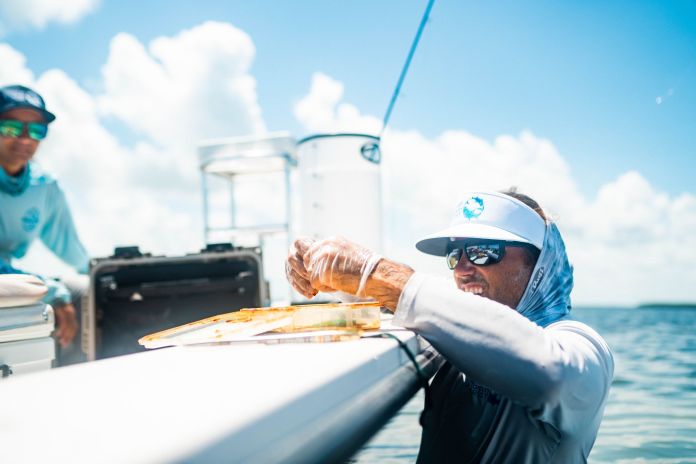
Ross prepping a tracking tag to be inserted into a bonefish.

Since Ross was just a child, he’s been on the water. In an interview with Rail Riders, he recalled his first memories of fishing, “My dad got me out on the water when I was three. The first real fish I remember catching was a Black drum in Everglades National Park”.

As Ross grew up, he spent more and more time on the water, searching for salt-water game fish like; Bonefish, Tarpon, and Snook. Once he was in high school, he had taken a job at a local tackle shop, where he spent his weekends guiding for the same fish he had become infatuated with. By the time the decision of whether or not to attend college rolled around, Ross had built up a consistent client base, and was at a crossroads of pursuing a full-time career as a Florida Keys Guide or continuing on with his formal education.

guiding on a boat

Eventually, Ross decided to continue on with school. However, this was far from the end of his fishing-focused lifestyle. Ross enrolled in Virginia Tech with a declared naval engineering major.  However, after 2 years of engineering work, he decided to change his major to fisheries science. Ross told Railriders, “After about two years of engineering classes, I realized that naval architecture is about designing oil tankers and gas platforms, not skiffs that float in 6 inches of water.  That following summer, I decided it was time for a change, I got my captain’s license and was ready to start a career guiding. By chance, my aunt came across a brochure for the school of fisheries science at Virginia Tech, she sent it to me. The program looked awesome, I switched majors, and after my first semester in fisheries science, I knew that this career was for me”.

ross fishing

Once Ross had finished his undergrad, he continued on to Graduate school at Florida Internation University, where he continued his fisheries science research. In 2016, Ross Graduated and was awarded graduate scholar of the year for the entire university.

Since then, Ross now works full-time with Bonefish & Tarpon Trust where he conducts and facilitates research on Permit, Bonefish, and Tarpon in the Florida Keys, as well as works in partnership with the angling community and management agencies, to pass regulations or put other conservation measures in place that protects and improves our fisheries. He spends the majority of his days in the field, capturing bonefish, either with traditional tackle, or a fly rod (his preferred method), tagging them, and releasing them back into the wild so that he and his agency can monitor their behavior and gain a better understanding of how these fish behave (Where they eat, where they spawn, etc). As Ross states in this film, “From that [data], we can learn so much about their environment that we can use to form conservation measures down the road.” He describes this process as, “Science, driving conservation, driving an improved fishery”. Ross has also adopted the nickname: “The Mad Fish Scientist”.

Roos planting a transmitter

Today, Ross models his lifestyle after his old man, and has taken up full-time residence on his boat, a 1977, 31 foot sea runner trimaran named, “Barbara Jean”. Over the last few years, Ross has been involved in some pivotal Bonefish and Permit protection projects, one of the most notable being the, “Save the Horny Fish” initiative, or “Project Permit”, which took place over the course of many years, and has since greatly shifted the tide of the rapidly declining Permit habitat of Western Dry Rocks. You can learn more about this project in a 2020 interview with Ross and Captain Will Benson, HERE. Over the last week, Ross has had a chance to share continued Bonefish, Tarpon, and Permit research with attendees of the 7th International Science Symposium & Flats Expo. 

ross' boat

We greatly look forward to seeing the future research and conservation initiatives to come from Dr. Boucek’s research and the folks from Bonefish & Tarpon Trust, and want to thank Ross for dedicating his time to allow us to follow along with him and capture some of his research on camera. To watch the full, “Anglers Driving Change” film on Ross and BTT, click HERE. We would also like to thank BUFF for helping make this series possible. To learn more about some of the best sun protection on the market, you can find their full fishing catalog, HERE.

Anglers Driving Change: Chad Brown

Anglers Driving Change: Chris Wittman & Daniel Andrews – Captains for Clean Water

Fishpond Releases New Nomad Net Benefitting American Rivers

Fishpond Nomad Nets have long been popular for their lightweight construction, and silicone nets that reduce fish stress and handling time. Now, they’re doubling down on that goodwill and partnering with American Rivers on a new special edition net, the proceeds of which will benefit American Rivers’ work on our nation’s waters.

From American Rivers:

For the last decade, Fishpond has joined American Rivers in our efforts to protect and restore rivers and the best fish habitat in our country. We’re excited to announce that Fishpond has now taken its passion for conservation to the next level.

Fishpond is selling a brand new, special-edition Nomad River Armor Mid-Length Net, featuring a map of the Colorado River — and the American Rivers’ logo! This year American Rivers named the Colorado River the #1 Most Endangered River in the country, highlighting the threats to fish and wildlife habitat and drinking water for 40 million people.

The headwaters of the mighty Colorado River are a source of inspiration for Colorado-based Fishpond — and protecting this one-of-a-kind resource is a responsibility the company takes seriously. So seriously, they will donate $90 to American Rivers for each of these specialty nets that are purchased.

You can purchase the new net, here!

Breaking: Federal Regulators OK Plan to Remove the Klamath Dams

On Thursday, November 17th, 2022, the Federal Energy Regulatory Commission unanimously voted to remove four dams on California’s Klamath River. In what will be the largest dam removal project in United States’ history, this decision has been a long time in the making. Klamath dam removal will open up hundreds of miles of habitat for the imperiled California salmon and other native species.

“Today is a massive day for rivers and fish in the Pacific Northwest,” said Native Fish Society’s Executive Director, Mark Sherwood. “For many, today and the days to come have been a dream on the horizon for 20+ years. Their tenacity, and that of tribal nations, NGOs, and anglers have kept this effort from falling time and time again. This is a huge step forward for the Klamath, and it is also prime fuel to keep our own fires burning for a future with wild abundance.”

“Today’s ruling is a major achievement for everyone who developed and helped advance this historic agreement over many years,” said PacificCorp President and CEO Stefan Bird. “I want to wholeheartedly thank the leadership of Yurok and Karuk tribes, Governors Newsom and Brown and their predecessors, and all of our partners who remained committed to resolving this complex and difficult issue through settlement.”

The dams that will be removed are the Iron Gate, Copco 1, Copco 2 and J.C. Boyle, which is in Oregon. These dams have lived past their useful lives, and the resources and work needed to bring them into compliance with fish mitigation measures would have bee greater than their worth. The plan is now to begin removal next summer and continue into 2024.

This is a breaking story and we will continue updating it. But rest assured, a free-flowing Klamath River is on the horizon.

Video of the Week: A Week in Alaska with Wild Fly Productions

First, we must congratulate Scottie & Wild Fly Productions on hitting 100k subscribers on Youtube. So deserved, we can’t wait to see what the future holds for you guys and what adventures await. In this piece of incredible storytelling, Scottie and Adam visit “All Alaska Outdoors” in search of the June Slam. The June Slam consists of Sockeye Salmon, Rainbow Trout, Dolly Varden, Arctic Char, Lake Trout, Grayling, & Pike. So sit back, grab your drink of choice, & maybe some popcorn for this special adventure that will leave you speechless and looking at flights to Alaska.

All Alaska Outdoors is based in Soldotna, Alaska. The lodge was built in 1996 on Longmire Lake. What started as a 1-acre plot has now turned into a 4-acre complex offering all the amenities. From bear viewing, hunting trips, and a myriad of the quintessential Alaskan Fishing adventures All Alaska Outdoors has you covered and then some. Book a trip here: allalaska.com.

Don’t forget to check out these sweet articles as well!

Fishing Ethics: Responsible Harvest

Video of the Week: Sailboat Diaries Episode 2

Video of the Week: “El Toro” A Montana Bull Trout Story


5 Tips Fly Fishing for Tanzanian Tigerfish

When a Tigerfish eats its prey, it goes as hard and fast as it gets. These fish don’t sidle up, snatch, or swallow their prey; they crash into it with their mouth open and teeth bared. They aim to inflict mortal wounds on their prey and then eat what they can. They are not shy of targeting fish up to 40% of their size, family members included. Their hard bony mouths, incredible speed on the eat, and out-of-the-water acrobatics make the tigerfish one of the most challenging fish to land.

Tigers provide some of the biggest adrenaline rushes in fly fishing. With all the odds stacked in the Tigerfish’s favor, there are a few critical elements the angler can control to help even the odds. Assuming you are fishing the correct tackle and with flies tied on the proper hooks, this is what you can do on the water: 

1. Rod tip down

Fly rods are not built to drive a hook home into a 1-inch thick, bony jaw. So, when setting a hook when fly fishing for tigers, you aim for as little fly rod in the equation as possible. A straight line from the stripping hand to the fish’s mouth is what you are after. This allows maximum transfer of stripping force to reach the crucial point where hook point and fish meet, with no energy wasted on a bending fly rod. You have all seen the meme, don’t f****** trout set! 

2. Underarm “Roly-Poly” strip

With your rod under your arm, learn to double-hand strip, better known as the Roly Poly. Although not employed all the time, it is used extensively when tiger fishing and has several benefits. One of the most significant advantages this offers is that you always have a hand actively stripping the fly in (no matter the speed or where you are in the retrieve/strip cycle).

There is no portion of the retrieve where you don’t have a stripping hand working the line. This means you can react immediately when you get a bite. Missed sets between strips when employing single-hand strips are common. By default, using an underarm Roly Poly strip means you can’t lift the rod when you get the eat. We like this. 

3. Don’t try to get loose line on the fly reel

If the fish does not run you onto the reel in the initial surge, don’t try getting it on the reel. Instead, keep fighting it in hand. The first 10 – 30 seconds of a big tigerfish eat are akin to hand-to-hand combat (when you are not a fighter) – fast, brutal, and pretty blurry. You need to react quickly to what the fish is doing. You cannot do this when trying to reel in loose line off the deck. No matter how often you have done this on your local trout stream, I promise you are not in Kansas anymore, Dorothy.

4. Keep your rod angles consistent

Unless you are fortunate to have your fly penetrate the scissors (which is not common due to the way tigerfish eat) or lodged in the tough skin in the upper pallet, you are most likely going to be tentatively connected by the hook point holding onto the inside of the tigerfish’s stiff bony jaw.

Just like when you are snagged on hard timber or rock, your fly often pops free from what seems like the most stubborn snags as you get closer and change the angle. The same happens when your fish is near, and you are preparing to land it. During this time, changing your angle on the fish, unless necessary, must be avoided at all costs. Doing everything right, seeing your fish up close and about to be landed, and then watching your fly shoot out of the fish’s mouth and back at you is heartbreaking. You can mitigate this to some degree (pun intended).   

5. Don’t lose your mojo

Even the most competent anglers will battle to convert 40% of big tigerfish eats to landed fish. That is the nature of the game. You will question your ability as a fly angler when you have a run of 5 or more for naught. Accept this and keep fishing.

We have seen countless experienced anglers broken down and reduced to shadows of their former fly-fishing selves by tigerfish. Just as the casino always wins, so do tigerfish in most cases. Enjoy the good runs, and accept the bad runs with humility. You are not more prominent than the game. Realizing this will go a long way to keeping the vibes on the boat positive, which always brings better results. 

Article from Keith Clover. If you’re interested in a fly fishing destination trip of your dreams, be sure to check out African Waters. Follow Keith and his team on Instagram @african_waters. 

Check out the articles below:

Africa Experience: Tanzania Tiger Fish

Capitaine (Nile Perch) – Fly Fishing in Cameroon – [Full Film]