One of Alaska’s largest industries is tourism, and this summer it will be hit hard by COVID-19. With people weary of travel and nervous about what the future holds, it is consequently understandable that trips are being canceled. We decided to ask some local Alaskan guides and fly-fishers how they feel about the lack of tourists amidst Coronavirus.
How do you feel about fishing in Alaska this summer during the pandemic?
Fishing and guiding this season in Alaska has been a challenging affair, to say the least. Alaska travel restrictions have put a dampener on all outfitters/guides in the state, causing most to re-write their business models and operating procedures. Local support for small businesses is more important than ever now in our industry. The one great thing that has come from all of this is the support of local anglers and clients stepping up and booking trips during times of the season they normally would not. I can’t express how much we appreciate it and encourage everyone out there to support your local fly shops and guides if you can. There will be many challenges for us this season, but I feel this is the perfect time to hone your craft as a guide and really connect with your local waters and anglers.
Due to this pandemic, I believe it’s actually made the fishing quite busier in some ways! More locals are looking to get out and do something, so they fish. On the other hand, the guiding season has been much slower. Tourists are canceling their trips to Alaska this year, resulting in fewer trips for the guides. For people to be allowed to travel to Alaska, now all they need is a negative covid-19 result. For future outlook, it seems like the guide companies will be busier come July and August.
This summer has been one for Alaska unlike any we have other seen. Generally, we discuss a multitude of “know unknowns†that could affect us in the field with our guide staff prior to the season and I can say a global pandemic wasn’t on that list, until now. Since early March we have been changing up our schedule for summer prep and planning for a multitude of different potential outcomes that involve different start dates and rivers. Many other float trip operators and lodges in our area have canceled their seasons but we have continued to delay our start dates and have held out hope to float our western Alaskan rivers for a few weeks. All of the native villages we would potentially pass through are close to any outside visitors and we had arranged alternatives to have river pickups via floatplane for a few of theses rivers.
Many hurdles have been present including a mandatory 14-day quarantine that is now in place through August 3rd for the town of Dillingham where we operate out of. The flight schedule for 2/3 airlines that provide service to the village has ceased and Alaska Airlines has not released a schedule past August 17th. At this point, even though our bush pilots are ready to fly, we may not be able to get our guests and guides in and out of the town. We operate raft based wilderness fly fishing expeditions so our ability to drop completely off the grid is unparalleled if we can get our guest into town.
As far as the fishing goes, we do think that we can operate safely but we would place travel guidelines in place for our guests to make sure everyone is traveling safely and not putting other participants at risk. We operate 50-100 miles away from the nearest paved road in the Togiak National Wildlife Refuge on fisheries that are truly world-class. While the scenario still exists that we may not be able to operate there are good things that could come from this. Sure, we will take a massive financial hit but the fisheries and especially the resident species (Rainbows, Grayling, Arctic Char, Lake Trout) could benefit greatly from a low-pressure year.
We have realized that much of this season is out of our control and all we can do is worry about the things we can control. Hopefully, we will be enjoying Alaska with our guests in August but if we cannot this year, we hope that the fisheries maintain or improve on the strength we have seen over the last decade. We completely support the continued sustainable management of the fishery but the state of Alaska for substance resident anglers and commercial anglers and the sportfishing community and hope that everyone will be able to operate in some capacity. We also have not won the fight against the Pebble Mine and we need to continue to support the opposition to the mine now more than ever to protect this wild place many of us are lucky to call home for part or all of the year.
I think this year is definitely a first for everyone being that there is a pandemic. I’ve noticed it’s been either really hit or miss with guiding & lodges. Some are still up and running, taking a shot at this season, and others had to close completely.
We’ve seen a lot of cancellations in the past few months but we remain hopeful for the rest of season as we decided to take that chance. Although, it has been nice to enjoy the river without the density of people; Cooper Landing, like the rest of Alaska, really does need its tourism to strive.
I feel like the pandemic has greatly affected the guiding community of Alaska from there being fewer tourists. Lodges all around the state were not even able to open this year because most of their clients are from out of state. Luckily Bear Trail Lodge still wanted to bring me on this year because we were able to operate and lower rates for in-state guests. Another thing lodges have been doing in my area is operating like hotels, and renting out rooms to whoever needs one. So all I can say is just support the local guides in your community and book a trip.
While the fish haven’t seemed to mind the COVID Pandemic, Guides and anglers like myself find ourselves struggling to get customers on the water. I have had lots of time to fish for fun while trying to stay prepared for potential charters but the phone just isn’t ringing.
During a tough summer for guides and other local businesses, please support your locals as much as you can!
Dams in Michigan have fared poorly this year. Back in May, two dams on the Tittabawassee River failed, threatening hundreds of local residents. Quite reasonably, these failures grasped media, political attention, and public anxiety. Unfortunately, throughout this spring, Michigan authorities neglected a different Michigan dam, resulting in an environmental disaster of its own.
The Kalamazoo River flows 130 miles throughout southern Michigan and empties into Lake Michigan. Once heavily polluted from decades of industrial activities, the Kalamazoo water quality has shown great improvements. Smallmouth bass, largemouth bass, and carp are now productive fisheries, offering anglers great recreational opportunities on the Kalamazoo River.
Today, however, fishing on the Kalamazoo is close to impossible and the future of the river is in question. Last fall, Morrow Dam, privately owned and operated by Eagle Creek Renewable Energy, needed urgent repairs. So, Eagle Creek began drawing down the water levels above the dam (Morrow Reservoir). Long story short, the drawdown operation was botched from the onset, and wildlife and vegetation on the Kalamazoo are feeling the harmful effects. And months past the original deadline, Eagle Creek’s harmful work continues.
Jon Lee, a local fishing guide, said “a private company utilizing a public resource for profit with zero accountability is unacceptable.”
The drawdown lacked the necessary oversight, which resulted in the current issue: heavy sedimentation. Large volumes of sediment–including possible remnants of a 2010 oil spill, PCBs, and heavy metals–previously trapped above the dam were released during the drawdown. Ideally, the sediment issue would have been addressed from the get-go with proper mitigation measures. That did not happen.
Now, Lee is worried about the long-term health of the river and its fisheries– not to mention his professional guiding season. The massive sedimentation occurring is altering the river’s structure and choking out juvenile fish and eggs, shellfish, and vegetation. The volume of sediment now moving through the Kalamazoo can also contribute to nutrient pollution, which can lead to harmful algal blooms.
“The high sediment load for a prolonged period of time is a serious threat to the middle reach of the Kalamazoo River. Sedimentation is known to negatively impact fish and invertebrate habitat quality, especially bottom dwelling species,” said local biologist, Devin Bloom.
Michigan authorities have been working to fix the sediment problem, but tangible progress will not be achieved until December at the earliest, according to Lee.
Pictures courtesy of Jon Lee @Kalamazoo_river_guide. Check out his page for Kalamazoo River updates!
Welcome to the first-ever installment of Flylords’ “Small Business Spotlight” series. When it comes to fly fishing, constant innovation and ingenuity are synonymous with the spirit of the sport. That being said, new products are always being released, many of which don’t really meet any actual needs of anglers. However, every now and then, something comes out of the woodwork that really catches the eye and makes one think, “Wow! Now, this is a game-changer”. In an effort to support the foundation of the industry, Flylords is looking to bring a spotlight to small businesses we believe in. Here, we’ll highlight the up-and-comers in the industry we hope to see in every angler’s pack one day.
This week, we’re taking a look at the new indicators that are really (not) making a splash in fly fishing. GHOSTech Strike Indicators.
Colors available in white, orange, yellow, and pink
Background)
Having grown up a Pennsylvania angler myself (Wills Donaldson), I was no stranger to the necessity of nymphing, especially in the colder months in between fall and late spring. While some purists may protest that idea, and there is no problem in sticking with what you love, there is no denying that the underwater food chain is far more dependable than relying on weary wings landing on the surface. However, when it came to finding my preferred style of nymphing, I found that every method seemed to fall short in one way or another.
When it came to fishing minor flows and narrow creeks, common-place indicators seemed to fall short. Splashing giant plastic bobbers into gentle currents and eddies seemed to immediately alert any trout within a 100-meter radius to the falsity of my presentation. However, on the other hand, the more “stealthy” indicators made of dubbing, putty, or even dry-dropper rigs, became engulfed by the smallest riffle and couldn’t seem to stay afloat after the 3rd or 4th drift without a heavy application of floatant. Tightlining was of-course an option, but when it came to fishing slow-moving water and clearer pools, there was always the issue of staying stealthy and getting the reach needed (maybe I’m just a crappy fisherman).
Then, I stumbled across GHOSTech strike indicators. GHOSTech presented itself as a splash-free solution to all the problems that I had experienced above. I immediately reached out to founder, Stephen Cunic, to learn more. Within a week, I had a pack of GHOSTech indicators in my pack and was ready to find out whether or not they were the real deal.
Findings)
Upon opening the pack of several indicators, I was skeptical but certainly intrigued. The small flower-shaped puck was incredibly light in my hand. On the underbelly, there were 3 small plastic bubbles encompassing the bottom of a screw. I wondered how something so light could possibly carry a fly, but continued to screw the puck onto my line. Attaching the indicator was incredibly easy, and by unscrewing the little plastic nut, I could move the indicator up and down my line with ease.
When it came to casting it took me a second to get aquainted, but within a few minutes, the indicator was landing exactly where I aimed it. Casting it was a lot like tossing a dry fly, and I was amazed as the little flower puck gently glided through the air and tenderly graced the water. It floated across the current much like a bubble, blending into its surroundings flawlessly. It didn’t take more than a few drifts before I was hooked up on a hard fighting fish, and it wasn’t soon after that that I knew these indicators were going to be a valuable addition to my arsenal.
We had a chance to chat with founder, Stephen Cunic, about GHOSTech, and how he runs his small business)
Flylords:Â What is GHOSTech?Â
Stephen: GHOSTech at the surface is simply a splash-free indicator, adaptable to an individual’s needs, designed to help anglers catch more fish by eliminating their influence on the environment….but it’s also more than that.
GHOSTech / PaduaFly is a brand for people who believe in tactical fly fishing. For those individuals that look at their craft from a tactical & scientific perspective. For those who don’t just listen and follow others’ techniques blindly; it is for those who investigate the natural world implementing their own thoughts, ideas, & techniques to find success & personal joy through the inquisitive nature of fishing.
Flylords: How did GHOSTech start?
Stephen: GHOSTech Started through Necessity and observation. While out fly fishing I would consistently splash and scare fish while using other products. Knowing this was the opposite of my intended goals, I explored other options of indicators on the market and they all lacked to fully fulfill my needs(mostly needing to add floatant to make them work [why are we adding stuff to force something to work?!? It should work right out of the packaging] or needing a backpack full of sizes to adjust to fishing conditions ~silly).
While trying to force other indicators to work for me I observed bubbles floating down the water and thought ‘how cool would it be if I could simply attach bubbles to my fly line?’. So that is what I did.
Flylords: What separates Ghostech Strike indicators from any other indicator on the market
Stephen: GHOSTech is the ONLY Splash-Free indicator on the market that is ready to work for you right out of the package (no need for adding chemicals to (floatant), cutting, or manipulating the product for the product to be put to work…). More so, they can hold more weight than traditional fiber-based products, they are adaptable to an angler’s needs for the day, and cast more naturally than other bobber style indicators. The more you use the product the more you learn about them and how they can adapt to your individual needs. PLUS, they are 100% USA MADE!
Flylords: What has been one of the most interesting lessons that has come out of starting a small business in the fly fishing industry?
Stephen: Definitely how diverse this community really is; and I love it. We all know the archetype of the folks that are in this beautiful community and that “Type” is far from reality. Which is a beautiful thing because we don’t make products for cookie-cutter citizens. We make products for individuals; those who look at things from an explorative perspective….our clients are not step and repeat/copy and paste kind of folks. They are unique and we are here to serve your unique styles and vision to push the expectations of the industry to fit the needs of all by making products designed for the few.
Flylords:How can people support GHOSTech?Â
Stephen: Obviously, as a small growing business selling some product is always a blessing; Sharing your experiences with our products is really one of the best ways you can help support our vision. Sharing with your friends, family, your local fly shop, or guide and even with us is not only the support we need but the support we love. We love hearing from you; hearing of your successes and your memories makes this whole thing worth the late nights making indicators by hand for you. The best support is sharing and spreading the word of our products and brand to others you know think differently; those who think like you who look at fishing from a tactical & inquisitive perspective.
Thank you to Stephen for taking the time to sit down and chat with us about GHOSTech. If you want to show your support, feel free toclick HEREand give them a try! Keep an eye out for more Small Business Spotlights coming soon!
Will Rice and Down the Path is back, this time with the story of an unsolved murder in Belize. After the success of their first season, Down the Path finally returns, this time with the story of the killing of Dr. Gary Swank and fishing guide Mario Graniel’s in a drive-by shooting on the flats.
Dr. Gary Swank
Currently, there are three episodes available, with new episodes premiering weekly! We’ll let Will tell the rest of the insane story:
On June 23, 2019, San Pedro, Belize, police were called to a crime scene on the waters of Ambergris Caye. After a short search, they found the body of fly fishing guide Mario Graniel slumped behind the wheel of his flats skiff, Johnnie G. Not far from the boat was his client, Dr. Gary Swank, floating face down in the warm Caribbean water. Swank was a highly regarded cardiologist from Roanoke, VA, visiting San Pedro, a bustling Central American town just south of the Mexican border, for the first time.
San Pedro local Mario Graniel, a professional flyfishing guide, had been hired by Swank for a typical flyfishing outing while he, his wife, and three children vacationed for a few days on the small tropical island. Ambergris Caye is one of the most popular destinations for saltwater anglers taking a shot at bonefish, tarpon, and permit—better known as a Saltwater Grand Slam.
It was quickly reported by police and local media that Swank and Graniel suffered multiple gunshot wounds. For the fly fishing world and the tourism industry in Belize, the news was shocking. For both families involved, it was a tragedy.  Join host Will Rice as he explores the murders of Dr. Gary Swank and his fishing guide, Mario Graniel, on the flats of Ambergris Caye, Belize, in June 2019.
Flylords got the chance to sit down with Charleston-based painter, illustrator, and business owner Paul Puckett. He shared the story of how he found his way into the fly fishing industry and how he began his career, as well as gave advice to artists hoping to break into the fly fishing space. Check out his comments and artwork below!
Could you tell us how you made your way into the fly fishing industry and fly fishing art?
Just like for any kid growing up, at my elementary school and middle school there were always art classes. Once you get to high school, you either stick with art or you don’t. I stuck with it—I just saw it as something I like doing.
Whenever I’d get with my cousins as a kid we’d always draw cartoons. We were all into comics, so we were always trying to recreate comic books. And then when I started getting into fishing, [I started incorporating it into my art]—that was in high school.
There was also an art gallery in Highland Park Village a long time ago, which then moved to Preston Center, and I don’t think it’s around anymore, called Collectors Covey*. I’d go in there and look at paintings by Eldridge Hardie, John (Jack) Cowan, and Mark Susinno. I saw this world in which I could turn what I loved doing, which was fishing at the time, into my artwork. There was a lady in there who started noticing me coming in there all the time—this thirteen- or fourteen-year-old kid. In high school, I started doing these little trout paintings and she let me sell a couple there at the gallery. I found out later my friends’ parents had bought [the paintings]. I thought total strangers bought my art, but it turned out it was a couple of cheerleaders of mine, which was still really cool.Â
Back in ‘95, after high school, I found out that an ex-Highland Park guy was starting Westbank Anglers in Dallas**, which was connected to the one in Jackson Hole. I got in touch with him to see about showing my artwork in the fly shop. They needed some emergency help to open the store, so I came in, worked for about two weeks to get the store open, and then they offered me a job. So that was my walk-in to the world of the fly fishing industry.Â
I went to University of North Texas for college and worked summers, Christmases, spring breaks, and random weekends at Westbank. When I was about to finally finish school, I wanted to try to move out to the Wyoming store and maybe be a guide and work in the shop. During the Wyoming days I didn’t really paint much, which is amazing because it’s one of the most amazing places to be an artist. But I goofed off and fished for four years here and there, and then moved to Atlanta.Â
In Atlanta I got a job in the radio industry and was stuck in a cubicle. I realized really quickly that I thought it was stupid, and that I wasn’t pursuing this thing I had—this ability to draw, paint, and do what I love: fishing.Â
I quit that job and knew I was going to give [fly fishing art] ten years. That was back in ‘05 or ‘06, so that ten years has passed, and I’m still doing it!Â
*Collectors Covey has closed its store, but maintains its website and continues to sell its remaining inventory. For more information, click on “Collectors Covey” above.
**West Bank Anglers is no longer in business in Dallas.
What inspired you to start creating your “catch and release†paintings?
That derived from working at Westbank. That was about when “catch and release†started being this continuous term you would hear working in the fly shop. It had been around a lot longer before that, but you’d have guys come in and be like, “Man, I caught this amazing trout.” [Someone else would say,] “Oh, did you stuff it or get it mounted?” [The guy would respond] “No, man, catch and release.” I was like, “Well, what if [clients] gave me photo[s] and I painted fish the exact same size, color, and shape as the ones they caught? Then [they’d] never have to worry about not keeping a trophy anymore.â€
There was a guy in Montana that I’d seen on a fly fishing show that was doing some of that [type of work], so I didn’t totally come up with that concept by any means, but I started doing [catch and release paintings] for customers at the Westbank in the mid- to late-’90s. They’re all watercolor on watercolor paper.Â
I did a couple that I remember specifically. One was for Bill Wiggins. He passed away six or seven years ago, but his family, I think, is still out there. He was so proud of this Atlantic salmon he caught. I want to say it was probably 35 inches. I was in college at the time and I’d never done one that big. I was so worried about screwing it up that it took me eight months to do. I was just sitting with it, procrastinating, because I was worried about failing. I finally did it and I was so proud of it. I saw pictures of it a couple of years ago and was like, “Oh my gosh, I can’t believe I thought that was so amazing.”
And then there was another one in 2006 for a father who took his son out to Alaska, and they caught this huge 50 pound king salmon. I think it was 50 inches as well. And just recently, [the son] got in touch with me and I did a permit painting for him. He’s going to hang it next to his salmon [I did for him] 14 years ago.
Tell us about your pop-culture-inspired, pen-and-ink drawings—how did you come up with those ideas?Â
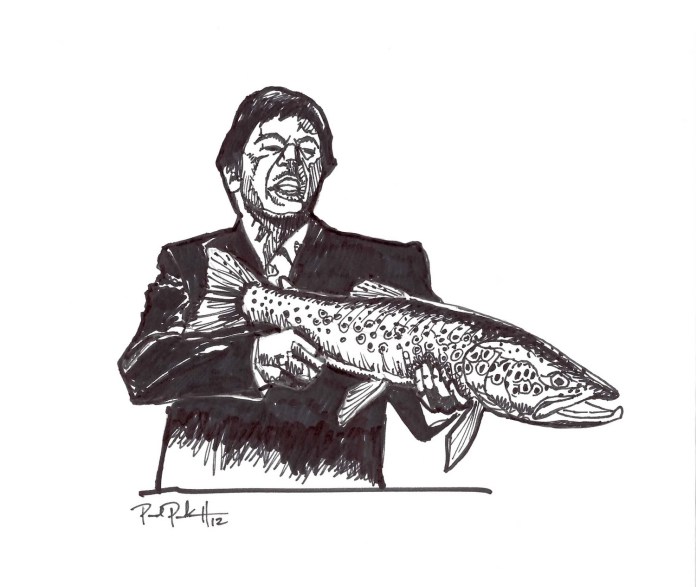
I was in Atlanta, sitting in a Starbucks. I don’t even like coffee, but I love going to coffee places because it gives me ideas sitting there. I’m a big people watcher, and I’ll just be staring at someone—right through their soul—and I don’t even realize I’m staring at them, but I’m thinking. Just looking at people, watching people, all these ideas happen. [So I was in this Starbucks] just envisioning Scarface holding that machine gun from the movie and thought how funny it would be if he had that same look on his face, but holding a big brown trout.Â
[That was the first one, and] I think the Pulp Fiction one might have been the second one, where instead of holding guns, they’re each holding a rainbow trout. And then it just kept steamrolling. I started doing those back in ‘08 maybe, and then I started getting a lot of attention. Those are definitely what put me on the map, as far as [being] a fishing artist, but what’s funny is that those were a side project. The watercolors and the paintings were really the main thing that I wanted to have people see my artwork for, but it’s funny how [my career] started with those silly drawings of Pulp Fiction and Big Lebowski, and all that kind of stuff.
I think now people know me more for doing actual fish art than someone in Big Lebowski holding a brown trout, which is fun. A lot of people do that kind of stuff now, so that’s given me a reason to move on from it to some degree. Every now and then, when an idea pops in my head, I still play around with it. I just don’t wake up and try to figure out what new character I’m going to do like I did 10 years ago.Â
What’s got your artistic interest piqued right now?
I’m inspired right now by the ‘60s and ‘70s saltwater guys with the blue-jean shorts and t-shirts. I feel like we’ve gotten so technical with everything [in fishing] and how you have to look—it’s almost like a fashion show. Those guys back in the day, they’d just wear their tucked in t-shirt, an inch- and-a-half-wide leather belt with a cool buckle, and blue jean shorts—all stringy and nasty—and just nasty old tennis shoes. That was it. That’s what they wore going out to catch 125 pound tarpon, and it wasn’t glamorous. They weren’t looking for anyone to see them do it, they just wanted to go do it.Â
Andy Mill and his son are doing the Mill’s House podcast, and they’re posting really cool vintage pictures. There’s this one of these guys in a jon boat, and the guy had an old wedding cake reel and a gaff, which is so 1973. [After seeing the picture, I thought,] “Man, what if I painted that, and they’re fighting this tarpon that’s out of frame?”Â
No one’s doing that [kind of work] in salt water [paintings]. There’s a few artists like Brett Smiththat do it in trout-type settings where it’s an old 1920s style angler with his overalls and old straw hat. I just figured I would take that idea and move it over to the salt water paintings. So I’m going to start doing more time capsule paintings like that.
What do you hope people experience when they view your work?
If it’s an illustration there’s usually some humor in it. It could be the obvious thing, like Elvis Presley holding a fly rod, but there’s usually something else to it, whether it’s from the slogan or the message that I say. With a landscape—a fishing scene or something like that—it’s more about hopefully you feel and want to be in that moment. I’m not really trying to say anything more than, “Welcome to this situation that, hopefully, you’ve been in before and you’ll be in again. Enjoy it while you’re looking at it.†[I try to invite people in] and say “Welcome to my moment.â€
What advice would you give to artists trying to break into the fly fishing industry?
You have to know it’s going to take time. You can’t rush into it, you have to experience all these things in order to make your art better. You have to hope that every painting or drawing is better than the last one. And if it’s not, you need to seriously look at that and practice, practice, practice. When I decided in 2006 that I was going to give it 10 years, I would say [things started taking off for me] at about year five. And that’s just how it goes.
Work in a company in the fly fishing industry because you go to industry shows. You need all the people [at the shows]—they are the ones that help you by word of mouth. They’re going to be the ones that think of you and say, “Oh, I got a guy that can probably do that drawing for a catalog.” And next thing you know, your phone rings. Get totally consumed with the industry, figure out a way to meet these people, and just connect with people. I haven’t done this on my own, I’ve had plenty of people who have helped me along the way. And get to know some of your favorite artists. It’s amazing how they’re just an email or phone call away.Â
The awesome thing about being in this industry and this type of art is that it’s so acute. You know that fly fishing and fishing people are going to like it. I can’t imagine being a contemporary artist where you don’t really know your market. But in this industry, you know who it is. It’s someone who likes the outdoors, and you can pinpoint for advertising—it makes it a lot easier.
Probably a Tarpon—they just have so many interesting lines in their face and body. It’s almost like they’re a knight wearing armor. They just have so many things going on that make them interesting to draw: cool plates on their gills, on their faces, and on their jaws. And they can leap 10 feet into the air.
How did you get hooked on saltwater fishing, and what’s your favorite fish to catch?
My life was all trout, trout, trout until 2004 when I moved to Atlanta. When I moved to Atlanta, I wanted to start going to the coast more. The first time I did, I got down there and saw this tailing redfish, and I was just totally mesmerized by it. Atlanta has great trout fishing—just an hour and a half north of Atlanta, you could be trout fishing in the mountains, so I never really thought I was going to become a saltwater junkie. But I found myself driving three and half hours through the Georgia coast, living around the next tide and when the next possibility of tailing redfish would be. I just got totally addicted to it. And then the bonefish came, then the tarpon came, then the permit came.
Saltwater fishing is just more of a challenge. I’m pretty sure if I went trout fishing tomorrow, I would probably catch fish—I’m not saying I’ve mastered it by any means, but I have that much confidence in my trout fishing. I cannot ever say that about saltwater fishing, and the unpredictability of it is what I love. You’ve got the weather and the tides. Nothing goes right typically, but when you get that day where everything goes right, it’s amazing. That’s what the allure of it is.
My favorite fish to catch is probably a permit. I look forward to April every year because I go to Mexico for permit fishing. When I went last year I only had two shots [to catch one] the whole week, and I didn’t catch one. The worst part about it is that you hardly ever catch them. And that’s probably why they’re my favorite to catch—honestly, it’s the mystery of it.Â
Is there anything else you’d like our audience to think about?
I think people forget about how important artists are in this industry. They’re everywhere—on packaging, emails, newsletters, products, shirts, hats. Let’s remember all the artists out there in the industry, not just me. All these other guys that are living, drawing and painting, and giving this sport that we love life when we’re not actually on the water. Everybody should check out artist Chance Yarbrough. He’s a good buddy of mine down in Victoria, Texas.
And, everyone should check out Captains for Clean Water, which is a grassroots nonprofit that advocates for clean water and healthy estuaries in Florida.
To see more of Paul’s artwork, visit his website and/or instagram.
Check out Paul’s apparel collection at the website for his company, Flood Tide Co.
If you’re like most of us, you’ve likely been locked down inside for longer than we ever thought or wanted, and some of us still are.
In certain regions, we’re in the midst of the prime fishing season, but some considerations should be taken if you want to travel to your favorite fishing zones, take it slow and pace yourself. Most of us have been enjoying time off work, spending time with family, or working from home, which means we’ve been living mostly sedentary lifestyles. Usually, by this time of year, we’ve put in miles of wading, rowing, or hiking, but the lack of exercise in the past months spent sitting tying flies, or daydreaming about getting out on the water has left our bodies less conditioned to the long days in the field.
As I prepared to escape to my local fisheries here in Ontario, Canada, I found a few things that helped me stay in fishing shape and prepare for my fishing season even while stuck indoors. I hope they’ll help you get ready for the rest of the fishing 2020 holds in store for you!
Get a practice rod. Since most of us are working from home, you can cast all day from the comfort of your office or desk. Work’s never felt so fun. Both Echo & Orvis make great practice casting rods and even have a Spey adapter. Both rods are focused on improving casting accuracy, muscle memory, refining your technique, or working on a new casting technique. One of my favorite games to play with my practice rod is to imagine my pet as my casting target. Perhaps his wagging tail is a tailing redfish or permit, or a trout holding in current sipping dries. The games you can play are endless, and you’ll improve your cast along the way!
Get Back Into Fishing Shape
Firstly, it should be noted that I’m not a personal trainer or an athlete, but getting back into fishing shape after spending the first 5 months of the year indoors will pay dividends as the season goes on. Train yourself slowly, to regain your strength & endurance. Create an easy exercise routine that resembles fishing if possible. Take a hike with your fishing kit on, or with a backpack with some weight in it.
I found a few other easy DIY workouts you can use to help whip your body back into shape. Grab an old backpack and use soup cans or laundry jugs to simulate a heavy fishing day-pack and take a long walk. Tie a rope to a weighted can, and wind it up and down while standing or sitting to help get your forearms conditioned for long casting days. Put a towel on the floor and scrunch your toes up to pulling it forward, this will help build lower leg muscle that comes in handy while wading in tricky spots or hiking through rough terrain. These are just a few ideas, but with a little Googling, you can find plenty of ideas for workouts that will benefit your fishing form.
Retrain Your Muscle Memory
When you’re able to get out on the water a few days a week or at least every weekend you build up muscle memory and reflexes. But after some time spent indoors, we may need to remind our nerves and muscles what it feels like to fish again. Take it easy while wading, you may need to get your wading feet back. Ease back into rowing your boat, it’s easy to over-commit to a long float and overexert yourself or inadvertently tweak something. Like every other outdoor activity, if we don’t do it for a while, we just need some practice. So, take it slow and enjoy the moment of being outside and doing what you love.
Local stream gem in my home waters
Start Small, Stay Local
Stay local, and rediscover your back yard. This pandemic has reminded us that change is constant, and the future seems uncertain with every passing day. This is a great opportunity to explore the fishing opportunities close to home, and you’ll be surprised what fishing is right outside of your door. Staying close to home might just be a new adventure in itself as you never know what you may catch, discover a new species or technique.
If you have to travel to fish, do your best to treat it like a camping trip, bring everything you need with you from your local area. Bring your own provisions: food, water, stove, clothing, extra gear, etc… Get gas locally, food from home, or the local store where you have been before to lessen the chance and reduce the impact on other communities. At the very least, you’re preventing yourself from getting sick or passing it on to your loved ones back at home.
Challenge yourself to learn something new (for instance, I’m learning how to Euro-nymph) or fish for a species that you may not target that often. At the end of all this, you may find yourself with a new skill that you wouldn’t have honed otherwise. When you make that first trip and hit the water, the new technique or tactic may just help to land that fish of a lifetime and create a memory that will last forever, right in your backyard.
We have partnered with 6 of our favorite flyfishing brands throughout the USA to bring you one incredible Summer Haul Giveaway. ONE lucky winner will take home the complete summer flyfishing package worth $2246 in total! This package comes with everything you need to get out on the water and wet wade with the best of them.
Yesterday, the controversial 600-mile Atlantic Coast Pipeline (ACP) project was scrapped. The pipeline would have transported natural gas from West Virginia through Virginia ending in North Carolina. Executives at Duke Energy (North Carolina) and Dominion Energy (Virginia) cut their loses on the project, $3.4 billion, indicating the heightened regulatory and judicial uncertainty involving pipeline infrastructure projects.
The ACP would have had a harmful effect on dozens of native trout streams and quality habitats. The proposed path of the ACP crossed 40 native brook trout streams and posed to impact many more. “The project would have crossed steep mountainous terrain, fragmented valuable forests, polluted streams and rivers, and threatened vulnerable communities along a 600-mile path,” said the Chesapeake Bay Foundation’s Virginia Executive Director Peggy Sanner.
Appalachian Brook Trout courtesy of Flylords’ Grant Michaels
Keith Curley, TU’s Vice President for Eastern Conservation, had this to say: “Given that ACP developers never put forward a construction plan that would protect the hundreds of sensitive wild trout streams in the pipeline’s path, we welcome the news that this project has been scrapped. We thank our many partners who worked so hard on this effort.â€
While Duke and Dominion walking away from the project is a win for environmentalists and native Appalachian species, future infrastructure development in the region is still unclear. The same day Dominion announced its departure from the project, the company announced the sale of all its other pipelines and storage assets to Warren Buffet’s Berkshire Hathaway. If you know anything about Warren Buffet, you understand he rarely gets large investments wrong.
The Southern Environmental Law Center, in a press release, wrote: “This is a victory for all communities and natural areas in the path of the pipeline—countless farms, rugged national forests, thousands of rivers and streams, and historic African-American and Native American communities.”
Courtesy of the Southern Environmental Law Center
In other pipeline news, however, the US District Court for the District of Columbia ordered the Dakota Access Pipeline to temporarily shutdown to give the US Army Corps of Engineers time to adequately correct environmental reviews–which were allegedly not up to par.
More than anything, these two pipeline developments highlight that the Executive Branch can not efficiently fast-track major energy infrastructure projects. Axios’ Amy Harder viewed the ACP’s demise in this fashion, “it also underscores hurdles facing big pipelines and other projects, despite White House efforts to speed up approvals and scale back environmental reviews.
To celebrate their move to the banks of the South Platte River in Denver, Trouts Fly Fishing recently commissioned the one and only Paul Puckett to paint the coolest mural we’ve ever seen on a fly shop. Featuring Brown Trout, Permit, Tarpon, and Carp, the piece celebrates the shop and its customer’s favorite fisheries. Check it out!
The Spey Cast, a casting technique originating in Scotland in the 1800s which is named after the river Spey. This just so happens to be one of Scotland’s highly rated salmon rivers. This intricate style of casting is best known for having little or no back cast. Essentially, this style is a more dynamic roll-cast giving anglers the ability to shoot and swing their flies in wide river systems. Typically when you think of Spey rods, you imagine long 11-22′ rods. Although these longer rods help, the Spey cast can be executed effectively with your typical 9′ 5 weight single-handed rod. There are many situations in which the Spey cast is deemed essential and is one that all anglers should apply to their bag of tricks. In this tips and tricks tutorial, Rio Brand Manager Simon Gawesworth demonstrates how to effectively Spey cast with a single-handed fly rod.
How to Perform the Single-Handed Spey Cast
To start, you need to learn how to roll cast correctly and effectively.
When loading your rod, bring your rod back further to create a larger D-Loop in your line which will allow you to shoot your line more effectively.
Make sure there is only a foot of fly line touching the water. This will avoid drag when shooting your line forward.
Three Key Takeaways:
Learn to roll-cast properly.
Have a larger D-Loop in your slack fly line.
Limit the amount of fly line touching the water.
Now that you have the Spey (switch) cast mastered, its time to hit the river! Tight Lines!