Home Blog Page 213

Fly Fishing for Snook on the Beaches of Florida

On this specific day, I had just gotten off of work and decided to hit the beach with my fly rod and my girlfriend. We got down to the sand and not even 100 ft away from all the sunbathers there was a giant pod of glass minnows. I knew it was game on so I stepped out into the water as the minnows swam through my legs. It was something a fly fisherman only dreams about and just like clockwork within minutes a pod of hungry tarpon came ripping thru the school thrashing and bashing baits, I had a few good shots at some silver but there was just to much bait to get ahead so I was unable to get an eat.
Fight the beach snook
About 5 minutes, in the crystal clear water 6 ghostly shadows begin cruising right towards me and I knew it was game time. I took the fly and made a generous cast about 3 feet in front of them and watched it sink right before they were in range. I started stripping and the shadows dispersed and all of a sudden my line went tight. I gave it a couple of good strip sets to make sure she was hooked good and it was game on!
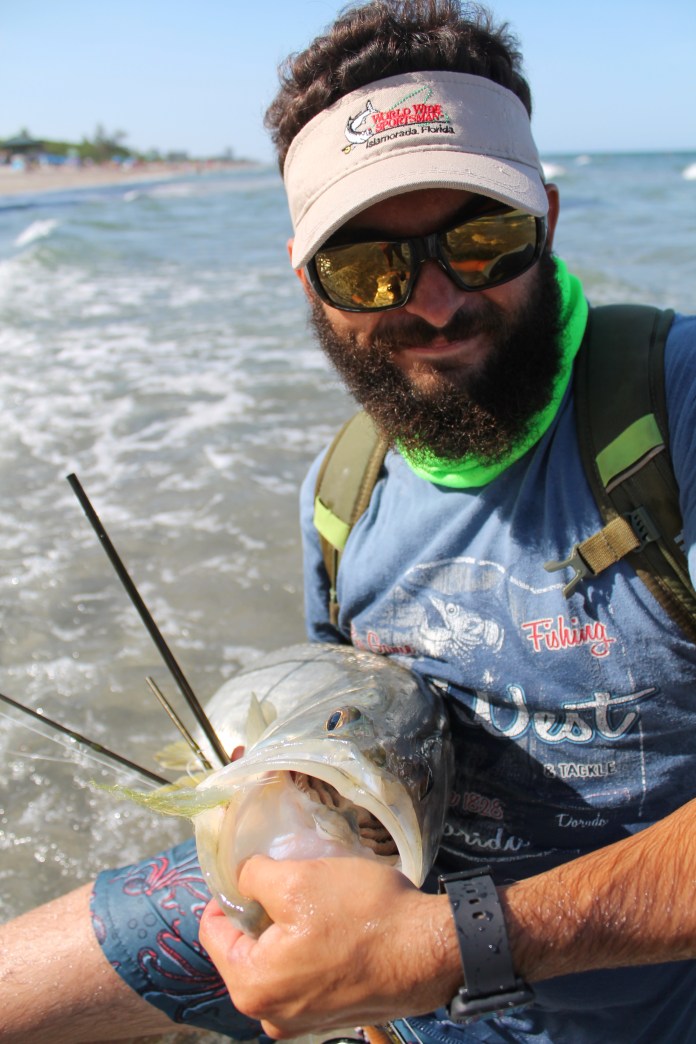
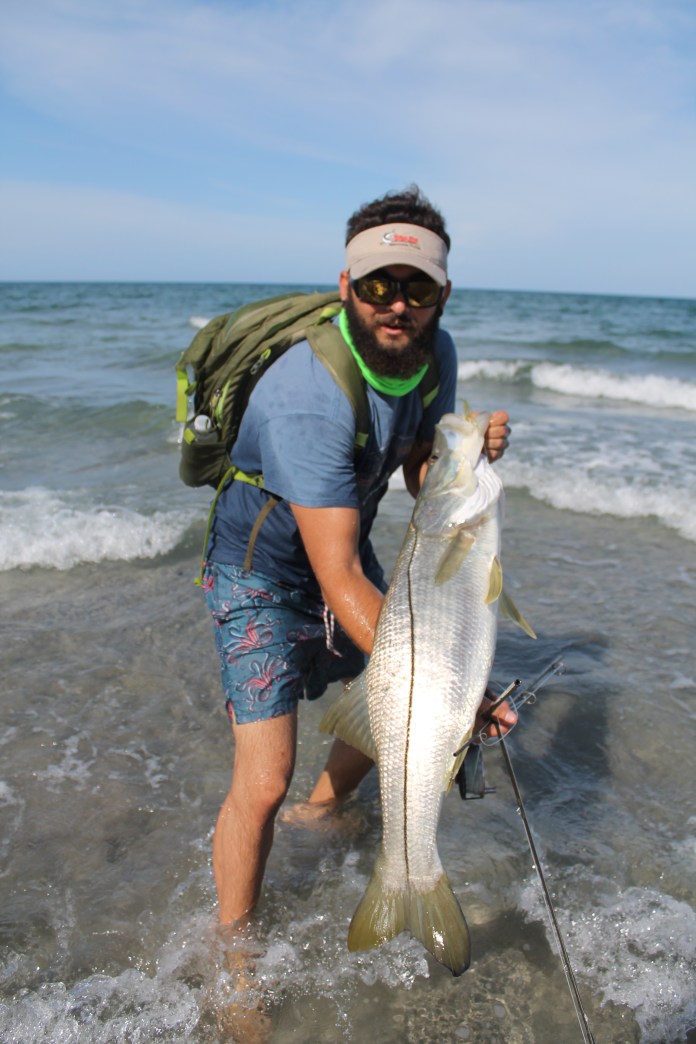
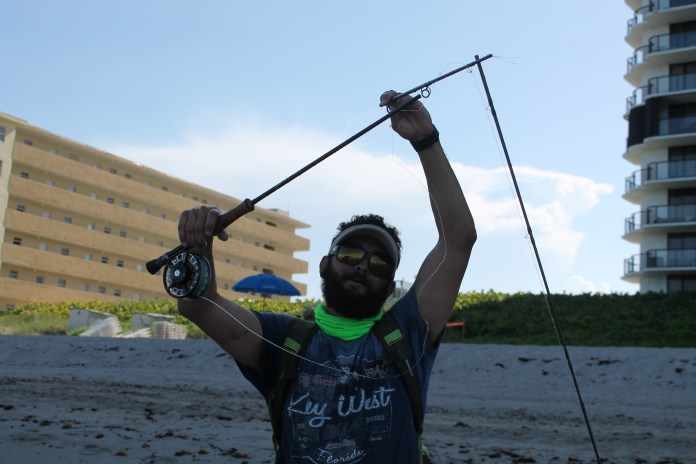
She took off down the beach peeling fly line thru my fingers, we battled she tail walked almost completely out of the water. After about 10 minutes I finally got the fish within 10 feet of me and noticed my fly line was under the gill plate and right then my rod snapped in 3 pieces so I grabbed the fly line and started pulling and by some miracle I was able to get the lip grab and after 3 years of persistence and getting skunked and broken off I finally did it a beautiful healthy snook in the surf.
Definitely the most rewarding moment of my fly fishing career to date and I’ve caught 100+lb tarpon but this catch was special all the days of walking miles in the heat finally paid off!!
Article by Peter D’Angelo, be sure to check him out on Instagram @sofloflyguy. Photos from @theseasonalgirl.

Step up your Snook Game

5 Saltwater Flies Everyone Should Know How to Tie

Fly Fishing the Striped Bass Flats

The Striped Bass is one of the most versatile saltwater fish species. You can catch stripers along rocky shorelines, down deep, in chaotic blitzes, marshes, rivers, salt ponds, and my all-time favorite, sand flats!

All around the world, shallow sand flats are highly productive ecosystems. Crabs, shrimp, and many small baitfish feast upon the algae and marine invertebrates that take advantage of the shallow, sun-baked water. Some sportfish, notably Bonefish, Permit, Tarpon, etc., have learned to take the risk of journeying into the shallow, unprotected water for the boundless food supply. Most anglers in the northeast have ignored the bare sand flats, due to the lack of structure that striped bass are known to love. This lack of interest and knowledge gives fly anglers a perfect opportunity to slide in and do what our sport allows us to do best, fool finicky fish in shallow water. Here are our tips and tricks to help you fly fish the Striped Bass flats.

Fly fishing for Striped Bass

The Gear:

When fishing the Bass flats, I recommend a 7,8, or 9wt rod, with either an intermediate or floating fly line. You can get away with a 7wt for schoolies (below 28”). Shots at 30”+ Stripers on the flats are fairly common, so an 8 or 9wt is the better tool. In all saltwater fly fishing, it is important to have a good large arbor reel with strong drag and plenty of backing, Stripers don’t mess around! I use an intermediate line for almost all of my striped bass fishing, so I would recommend those first, but you will always be running pretty close to the bottom of the flat and will hang up more than if you used a floating line. Long leaders are also necessary while flats fishing because the fish are so spooky. I’m not talking Colorado tailwater long, but a ten-foot leader down to 16-20lb fluoro gets the job done.

The Accessories:

The most important piece of gear for fishing any flat is polarized sunglasses. The majority of fishing you will be doing while on the flats is sight fishing. Striped Bass are pretty great at blending into the sandy bottom, so without polarized glasses, they can be nearly impossible to spot. The last two pieces of gear I would recommend are a waterproof backpack and some kind of water shoe. I saved these last two for the end because they aren’t necessities, but they are very useful. Since you will be wading all day, your only hope to keep your gear dry and salt-free is a waterproof bag. Although they can be quite expensive, they work amazingly well. I would be apprehensive about taking some select items, mainly my camera, on the flats without my waterproof pack. As far as footwear goes, I normally go barefoot, but more often than not I come home with a few battle wounds. If the bass are feeding on crabs, then crabs are around and if crabs are around, you are bound to step on a few. So, consider yourself warned.

Fly fishing for striped Bass
A beautiful Striper on the flats! Photo: Joe Mangiafico

Fly Selection:

The main food sources on flats are crabs, shrimp, and small baitfish. When imitating crabs and shrimp, look to bonefish and permit flies. If you carry a few EP spawning shrimp in gray and tan and a few classic Merkin crabs, you will be covered on that front. Just remember, crab and shrimp flies are not efficient in covering water, so I only use them when I know I can routinely spot and stalk the Stripers or can drift the fly over a deep trough adjacent to the flat. The most predominant forage for flat-ridden Stripers are sand eels. These long, slender baitfish dart in and out of the sand and drive Stripers crazy. Classic Striper flies like Surf Candies, Clouser minnows, and Flatwings do a great job of mimicking sand eels. Look for those flies to be about 3-5 inches long and tied in either tan and white or olive and white. I know it can be hard to remember, but Striped Bass populations are in trouble, so do your best to bend down your barbs and keep the fish in the water as much as possible.

Fly fishing the flats
Getting bent on the flats! Photo: Ben Scott @tashmooflats

Tactics:

Every flat is different, so each one has its own set of characteristics that you need to learn to be routinely successful. A lot of Striper flats are near the mouths of estuaries, which are loaded with bait. On an outgoing tide, all of that bait gets flushed out of the estuary on to and around the flat, and you best believe the fish are there waiting. Also, at the beginning of an incoming tide, as the water starts to push up on to the previously dry flat, the stripers are not far behind, staging in the deeper water outside the flat, waiting for there to be enough water to begin feeding. Either way, make sure you know what the tide is doing and don’t be too daring with your wading, because the last thing you want is to be stranded out on a sandbar. As for fly presentation, the best advice I can give is to watch how the crabs, shrimp, or sand eels move. Crabs and shrimp don’t move very fast, so keep your strips short and controlled. When fishing baitfish flies, change up your retrieve speeds until you find something that works. I always start with a medium-fast retrieve and work down from that. When you are wading the flats, you need to be stealthy. The fish aren’t comfortable in the shallow water, so walk and cast gently. According to a friend of mine, flats Bass can at times be as hard to fool as Permit (which he’s caught), so don’t get discouraged, you didn’t get into fly fishing to catch every fish, it’s the challenge that keeps us going!

Striped Bass Flat
A satellite view of a New England flat

So, with all of that said, feel free to reach out if you have any questions and get out on the water!

Staying Afloat: Kyle Schaefer

Welcome to the Staying Afloat Series, where we take an inside look into the lives of many different fly fishing guides, shops, brands, and lodges across the world in hopes of finding out how the COVID is affecting them, what they are doing to help, and how we can do our part to help them.

DSC02562-2

This week we had the chance to sit down with Kyle Schaefer, a fly-fishing guide, entrepreneur, conservationist, and owner of Soul Fly Outfitters based in Kittery, Maine. Kyle has devoted himself to the fly-fishing industry and lifestyle, and gave a few hours of his time to tell us all about this, as well as how during the COVID-19 pandemic he managed to Stay Afloat.

KyleLSchaeferBairs1.2.19-5

Flylords: How did COVID impact you and your business?

Kyle: I landed back in the US after a winter abroad just before the travel ban was set in place.  I was very thankful to reenter the country and get home to family and friends but a brand new reality was settling in for us all.  I had the best fall and winter of bookings I’ve ever had but right around mid-March calls, emails and texts completely halted.  Fast forward to today, Maine is allowing guiding and we are moving through a phased reopening of the economy.  I am restricted to fish only with clients that are Maine residents or that have quarantined in Maine for 14 days or more.  If I fish two people on my skiff, they have to be from the same household.

IMG_0244

I certainly understand and respect these requirements but 90% of my clientele comes from out of state and a number of people fly to Maine just to catch striped bass on the fly with me.  I am working hard to build a full schedule of clients that meet these new requirements but there’s going to be some serious holes in my calendar this season.  An April and May in the Bahamas hosting trips was canceled but I am thankful to be looking at future dates to reschedule.

KyleSchaefer.Bairs - 11.15.18-4

Flylords: What have you been doing with all the spare time?

Kyle: I am an optimist so I’ve stayed positive through these challenging times.  I’ve slowed down and tried to enjoy this valuable time with my family.  I’ve learned to tie new flies, got in a workout routine, got out of a workout routine, put more time into cooking than I typically would and take daily walks with my almost 14 year old Australian Shepherd. I’ve used this time to look at my business and analyze how I can be better, not just as a guide but as a citizen of this world.  We’ve got big issues right now like climate change and a striped bass stock at a 27 year low.  Being a guide gives me a unique opportunity to have a voice on these issues backed by impactful daily observations.

Bairs.Permit.May.10-3

Flylords: Are you getting clients back on the water soon?

Kyle: YES!  My guide season kicked off the first week of June and it felt damn good.  I’m rebuilding with Maine clients and meeting some great new people.  Being on the boat brings a sense of normalcy that I’ve been longing for.  I have a specific set of protocols in place to help me and my clients feel safe while getting after it on the water.

KyleSchaefer.July.3.19-2

Flylords: What made you decide to guide for striped bass?

Kyle: For me, striped bass are my ultimate home water fish. I was born on Cape Cod where striped bass summer, grew up on the Chesapeake Bay where the majority of the striped bass population spawns and I’m now lucky to live on the southern coast of Maine. Striped bass flock to the beaches, rocks and estuaries of Maine where we get resident fish from May to October. This is my home water and there is nothing more satisfying to me than getting to know a specific fishery on an intimate level. I tell my clients that one of the reasons I love striped bass is because you can fish for them however you want to. Stripers are versatile and opportunistic and can be just as much fun catching one in a foot of water on a mud flat as they can be blind casting to beautiful rocky structure on the coast.

IMG_0385

Flylords: How did your passion of conservation come about? How does it affect
how you operate as a guide?

Kyle: We are at a crossroads where if we don’t rise up and fight for our natural resources they are going to slip away. I feel as a guide and somebody who profits from this exceptional resource fighting for conservation is my duty. It’s never been a choice of whether or not to fight for these fish. It goes hand in hand with operating a business and being a recreational angler who enjoys this precious resource.

KyleSchaeferBizCardImage

Flylords: Tell us about your season in Argentina and guiding/traveling around
the world!

Kyle: As my experience in different fisheries increases, the more I feel comfortable in foreign waters facing foreign fish. I love how so many of the skills are transferable and prepare you for your next shot. Argentina was amazing. Golden dorado fully exceeded my expectations. These fish eat mice off the surface in shallow water in broad daylight; need I say more? The Bahamas have become one of my favorite places in the world and I look forward to bringing clients back there this fall, winter and spring.

KyleLSchaeferBairs-June2019--19

Flylords: Where is Kyle Schaefer’s next adventure?

Kyle: During these COVID times, it puts a spotlight on the adventures right in my own backyard. Sight fishing for big stripers and my first Maine blue fin tuna on the fly are the adventures filling my mind over the next few months. New England is a special place this time of year. I look forward to resuming more international travel as risk decreases, but I am more conscious than ever about my carbon footprint and the impact that we have as travelers on the environment. I look forward to sharing more on that soon as it relates to my business.

BairsKyleSchaefer1.27.19

Thank you Kyle for giving us the time to talk about all you do in the fly-fishing industry. For trip inquiries, Kyle is best reached by email at Kyle@soulflyoutfitters.com. Be sure to follow him on instagram @kyleschaeferflyfishing, and online at www.soulflyoutfitters.com.

Cheers to Fat Tire and New Belgium Brewing for making the “Staying Afloat Series” possible!

Staying Afloat: Chuck Ragan

Staying Afloat: Alvin Dedeaux

Staying Afloat #9: Josh Phillips of Spawn Fly Fish

Capitaine (Nile Perch) – Fly Fishing in Cameroon – [Full Film]

Imagine a fish so big that some call it the elephant of the river. Imagine it inhabited the waters of 1/4 of the African continent in vast numbers. Now imagine, that largely unseen to the developed world, a wave of humanity has reduced all the rivers and surrounding landscapes to skeletal remains. El Capitaine takes viewers to the remote rivers of Cameroon as these anglers target Nile Perch. We caught up with Johann Vorster (Vossie), the filmmaker behind this film.

Flylords: What inspired the film?

Vossie: The idea of exploring a new place in wild Africa with friends. I have collaborated with the guys from African Waters before, on a short called “Dogs of War” in the Okavango Delta in Botswana. When talks were going round of an exploratory trip to Cameroon in West Africa, I got really excited. I’ve spent allot time in Southern and Eastern Africa, so the west was all new to me. From the pictures that we’ve seen and the stories we had heard, it all sounded really exciting.

Flylords: Can you tell us a little bit about Cameroon? Did you feel safe at all times?

Vossie: Like most African countries, Cameroon is not very different. Though far from the developed world. It’s still rural, it’s still very much wild. Perfect for an adventure. The deeper you go the wilder it gets. Endless dust, the odd shade tree, and small grass and mud hut villages. When you reach the concessions, that all changes to the thick dry bush in the wintertime and you start seeing animals. Some animals I saw for the first time, like the Western Kob antelope and Red River Hog. We don’t get these in our parts of the world in South Africa. The guides from African Waters are extremely knowledgable about the bush and bushcraft and opens your nerves to new discovery. We were also fortunate to have Edward Truter as part of the team who spoke Francophone French and could translate with the locals. You are always in a big group, and whilst walking through the bush, or next to the river, it was always exciting to see new birds, the animals, crocodiles, hippos, elephants. Your very own safari, whilst fishing for giant perch. It was raw and wonderful.

Flylords: How big was the last fish Edward landed?

Vossie: What a night. It was 162cm FL, 113cm girth, 162lbs. Read more about Ed’s amazing fish on the African Waters Blog here.

Capitaine_Crew_Johann_Vorster_Vossie_BTS

Flylords: Are these kinds of trips commercially available for anglers to book?

Vossie: Yes, the African Waters team, who are responsible for the initial exploratory trips have been running commercial fly fishing trips to the Faro River since 2019. Commercial is a misnomer, as the season is short (mid-January to mid-April each year), and is limited to 2 trips per month, with a max of 4 rods per trip. This is in line with their strict fishery management protocols and ensuring as little impact on the fishery as possible. It is a fly fishing only operation, led by their team of expert guides, local trackers and game scouts. It is a true wilderness fly fishing experience, on foot in big game territory. Although Nile perch are a huge drawcard, the sight fishing to 3 species of tigerfish up to 20lbs, and yellowfish up to 15lbs is a world-class experience in its own right. You set off each day armed with a 5, 9, and 12 weight. In terms of a true multi-species African land-based destination, the Faro offers it all. Anyone interested in finding out more should contact keith@africanwaters.net or take a look at Gassa Camp.

Filmmaker

Flylords: What can viewers do to support this fishery from a conservation standpoint?

Vossie: As it stands, the best option is to go fly fishing. African Waters’ fly fishing operations support a full-time team of anti-poaching staff who’s responsibility is to monitor, report, and curb any illegal activity on the river, both in the private concession and the neighboring Faro National Park – this is predominantly subsistence gold mining, meat poaching, and fish poaching. The fly fishing camps provide added employment to local villages in all day to day camp rolls – cooks, cleaners, game scouts, etc. For some insight on how fly fishing is contributing to the conservation of the area, read this report from AW senior guide, Greg Ghaui. The combined teams of African Waters, Occidental Safaris and Xavier Vannier are in the process of setting up an NGO to raise funds for and facilitate conservation and community projects in this specific area, and the greater Faro catchment. This will soon be an avenue to further contribute to the protection of this incredible place.

Filmmaker_Johann_Vorster_Capitaine_BTS

Be sure to check out Johann Vorster (Vossie) on Vimeo and on Instagram.  

New Video: Dogs of War

F3T 2018 Behind The Lens: The African Tiger

How Blockchain Technology is Helping Source Ethical Seafood

A collective of Norwegian salmon farmers has partnered with IBM and technology provider Atea ASA to gather data on how salmon is bred, stored, and shipped. The new initiative will use Blockchain technology to ensure only ethically produced and healthy salmon make it to your plate.

According to Bloomberg this move “will help Norway’s suppliers differentiate their premium products from other exporters, curb origin fraud, and cut waste.”

“Blockchain lets us share the fish’s journey from the ocean to the dinner table,” said Alf-Goran Knutsen, chief executive officer of Kvaroy Arctic, a supplier that’s part of the initiative. “This is now more timely than ever.”

For more on how Blockchain tech is helping Norway’s salmon farmers, check out this article by Bloomberg.

Source: Bloomberg

Orvis Launches Free Virtual Summer Camp Program Aimed to Educate and Inspire Kids

From Orvis:

MANCHESTER, Vt. (July 1, 2020) — Orvis introduces a new weekly summer camp platform offering lessons and activities for kids of all ages who are homebound by the COVID-19 pandemic. Orvis Summer Kids’ Camp seeks to highlight outdoor skills and engage kids in their local ecosystems with topics covering navigation, wildlife, fly fishing, dog training, and conservation.

Beginning today, Orvis Summer Kids’ Camp will release a free weekly curriculum that challenges kids of all ages to explore their local environments. The six-part series will feature videos, skill sessions, and plans for adventure-driven activities that families can do at home, or close to home.

“Education and a love for the outdoors have been at the core of our brand for over 160 years,” says Orvis President Simon Perkins. “At a time when families are spending a lot of time at home, and many summer camps are canceled, we want to provide resources to encourage kids to get outside and explore their local environments. We hope that Orvis Kids’ Summer Camp will help to facilitate a lifelong relationship with the natural world and inspire the next generation of conservationists.”

For more information on Orvis Summer Camp, visit https://www.orvis.com/summer-kids-camp.

Additionally, Orvis is committed to sharing educational opportunities for all ages, offering virtual education options in addition to Orvis Summer Kids’ Camp, including fly-tying workshops and fly fishing how-to videos. Orvis’s full collection of video content is available on The Orvis Company YouTube channel, here.

Moreover, Orvis began offering Virtual Casting Instruction in May, providing individualized feedback on casting and technique through video analysis and one-on-one discussion with an instructor from the Orvis Fly Fishing Schools. For more information on virtual instruction opportunities, visit https://www.orvis.com/fly-fishing-schools.

About The Orvis Company: Founded in 1856, we believe the most meaningful experiences are created by sharing the love of nature and being inspired by its endless possibilities. Orvis pioneered the mail order industry in the United States, operates more than 80 retail stores in the U.S and the U.K. and maintains a network of over 400 dealers worldwide as a trusted source of discovery and adventure in the natural world. We promise to open the door to extraordinary outdoor experiences and to protect nature by committing 5% of our pretax profits each year to conservation efforts worldwide. 

Biologist Creates Insane LEGO Steelhead Sculpture

While cruising the interwebs we stumbled across this insane LEGO Wild Steelhead build by Ryan Van Duzor (a.k.a. @the.bearded.pescador on Instagram) and it was too cool not to share. Ryan’s sculpture was displayed at Bricks Cascade 2020, a LEGO convention held in Portland, Oregon every winter, and won Best Sculpture at this year’s event. We got in touch with Ryan to learn what it’s like designing such an intricate work, check out our interview with him, below.

Flylords: Tell us a little bit about yourself, Ryan. What career field are you in and how does fly fishing fit into your lifestyle?

Ryan: After years working as a government entomologist and fly shop dude (shout out to my friends at the Gorge Fly Shop!), I am now a high school/college science instructor. This new gig not only allows me to continue to share my passion for the biological world but also gives me summers off to get outside and fish! My various careers have always had some connection to my passions, and being a science instructor gives me the chance to build that passion in my students. I have been fly fishing for 25 years now, and fishing is always on my mind. This steelhead build and many of my builds are crossovers from my love of fish and fishing. 

LEGO Wild Steelhead built by Ryan Van Duzor

Flylords: What does it take to design and build such an intricate sculpture like this one?

Ryan: This build was always something I wanted to attempt. I had been thinking about the build for years before actually putting any pieces together. That is the heart of my process. I think about the design, research pieces, and conceptualize the piece. The actual building is usually the shortest portion of the work.

For this steelhead, I knew I wanted to use new pieces to show the curves, the fluidity, the scales and I wanted to try to show the chrome of wild steelhead. Lego doesn’t have a lot of chrome or shiny pieces, but I found that the flat silver color worked for the steelhead. The most difficult part of this design was to eliminate squared angles, I wanted it to look like it could swim and have plans to motorize the build at some point. The internal structure was built for this look and plan and is the key to more natural curves and shapes.

LEGO Wild Steelhead - Ryan Van Duzor
LEGO Steelhead built by Ryan Van Duzor

Flylords: How many pieces are involved? How long did it take you to build?

Ryan: This is a funny question that Lego artists/AFOLs (adult fans of Lego) get asked all the time.  Almost none of us keep track of the number of pieces we use. I literally have no idea but would guess many thousands. The design and build for this steelhead were around a year, but with many years of planning and research. The longest part of this build was the internal structure. I wanted to make sure the dimensions were accurate to a real steelhead and also displayed the fluid motion and curves of the real fish.  

To see the rest of Ryan’s creations and his living steelhead adventures, check out his Instagram page, here!

When Jacks Attack with Capt. Jako Lucas

Join us on July 1st at 9 PM ET on our Instagram as Capt. Jako Lucas joins us to chat about Jack Crevalle and his experience guiding full-time on the Gulf of Mexico!

Flylords: Now that you’re able to get back out on the water, what species have you been chasing?

Jako: You know me, I am an addict, so I will catch just about anything that swims. But as soon as I could get back on the water, I was out guiding my local waters here in Texas. Mostly targeting Redfish, Jacks, and a few other local characters.

Flylords: Tell us a little bit about the “underrated” Jack Crevalle fishery you’ve been exploring.

Jako: Man, I still don’t understand why so many people complain about not having the money to go fish for GT’s, but they have Jacks right on their doorstep. I love it when the locals ask me about my day and I tell them about catching a few Jacks.

Their response… “You mean you catch those trash fish on a fly pole?!”

The beautiful thing about Jack’s is that you can catch them all over, I have caught Jacks in Africa, South America, North America… I suppose here in Texas they are not very sought after because people can’t eat them. Amen to that, more for me and my clients.

Flylords: What strategies and techniques are you using to target them?

Jako: The whole experience is action-packed, from start to finish. We typically find the Jacks in a couple of different scenarios: deep water and on the flats, while hunting for smaller Redfish. More often than not, I find that it’s a “run and gun” situation. We’ll spot feeding activity on the surface and/or feeding birds. On the way over to the commotion, I’ll get a Jack setup in my client’s hands, and we’ll both buckle down for sickle-tailed carnage.

As we run over, I’m careful not to drive the boat over any fish on the surface to avoid putting the school down, all while getting my client ready to cast a line into the mayhem as soon as possible. Then it’s just down to the rapid strip, strip, strip retrieve. When the Jack smokes the fly (and they usually do), you’ve got to strip set as hard as possible. It might sound harsh, but in the moment I usually tell my clients to “Rip its face-off!” Just to make sure their hook is buried. After that all you can do is hold on, it’s about to get real.

Flylords: How do Jack Crevalle stack up against the Giant Trevally? Are there differences between them?

Jako: I really think pound-for-pound a Jack will stand up against a GT all day long. Their attitude, behavior, and all-around bad-ass-ness is exactly the same. Look, I’m not going to take anything away from a GT, I have built my career around GT’s and they have a very special place in my heart. And of course, GT’s can get a little bigger than Jacks growing to nearly 180 lbs. But this is how I would explain the comparison to everyone that asks me: “It is always great to have the dream to one day chase a GT, but don’t look past a Jack, you will not be disappointed. And if you are, then I don’t think we can be friends…”

Flylords: What set-ups are you using for those bruisers?

Jako: I always use 10 WT setups for them, but have changed up to 11’s now. These fish are turbocharged and it is just better for the fish to get them in quicker. My favorite rods to use are 11 WT G Loomis’, Orvis H3’s or T&T Exocetts paired with my Mako 9550 loaded with 80 lb backing, and Cortland’s 11 WT GT/Tuna line with a 40 lb fluorocarbon leader and either poppers or streamers depending on where the fish are sitting in the water column.

Flylords: What has been your favorite aspect of the Gulf fishery? How does it compare to others you have explored?

Jako: This fishery was such an amazing surprise to me. It is definitely not an easy place to guide and figure out. There is a lot of water to learn, a ton of variables…tides, winds, etc… And then it is also important to pay your respects to the local long term guides. If you are the real deal and work hard you will get respected for it. But like I said, it is a very healthy system. I was blown away by the amount of baitfish and birdlife among all the amazing wildlife. But as with many other fisheries, it is very fragile and needs to be looked after.

Flylords: What is the wildest scene you have witnessed while fishing down there?

Jako: There are a lot of special things that happen out here, but there is still something very raw about hundreds of Jacks working together and destroying everything in their path.

Flylords: What’s your next adventure?

Jako: My season is pretty packed with guiding down here on the coast till September. I still have a few pending hosted trips, to Mongolia, Brazil, and Gabon, Africa, but I don’t think there will be any international travel this year. I am not stressed about it, as I love guiding down here, plus it gives me more time to work on crazy trips for next year.

Check out all of Jako’s insane fly fishing films and content on his Youtube Channel and Instagram!

How to Tie: Steve Yewchuck’s Murder Hornet

For this week’s “how to tie”, we have a little something different planned. Last month, we partnered with Norvise Tying systems to present the #NorviseQuarantie competition. We asked all of you to use your time in quarantine to come up with the most creative fly you could think to tie for a chance to win a brand new Norvise. Needless to say, we were blown away by the submissions we received.

Once we finally narrowed it down to 10 finalists, we asked you, the fly fishing community, to vote on your favorite. With a healthy margin, the Envision Flyworks submission of the “Murder Hornet” was crowned King. Now, Steven Yewchuck, creator of the Murder Hornet fly, has set up his brand new Norvise and delivered us a step-by-step demonstration on how YOU can tie the Murder Hornet fly yourself! Note, this fly is not for the weary…

Here is how to tie Steve Yewchucks Murder Hornet:

Learn How to Tie This Fly

Difficulty: Murder

Step 1:

murder hornet step by step

Cut strips of 2mm foam 3/4″ wide of yellow, orange, and black. Out of those strips, cut 2 yellow pieces 5/8 x 3/4, 15 orange pieces 5/8 x 3/4, and 12 black pieces 5/8 x 3/4.

Step 2: 

how to tie the murder hornet

Arrange the foam pieces in an order that will be laminated to make the abdomen, thorax, and head. For this technique, I prefer loctite super glue which welds the foam pieces together in a timely manner.

Step 3:

The Laminated foam pieces should look similar to this color combo when finished

Step 4: 

I like to cut paper templates for most of the foam flies I make so there are no mistakes when cutting the foam.

Step 5: 

I then trace the templates with a fine point sharpie

Step 6:

Step 6:

Once the templates have been traced, I cut the excess bulk off with a razor

Step 7: 

Step 7:

The finished trimmed foam pieces should look like this

Step 8:

Step 8

Next, I use a disc sander to get the desired shape

Step 9:

Step 9:

The three finished body parts along with a set of mandibles for the hornet’s mouth should look like this. The mandibles are cut from 2mm light brown foam.

Step 10: 

Now it’s time to coat the abdomen with Raidzap flex UV and finish with a super thin UV resin. The abdomen can be coated after it’s glued on the shank as well. I prefer to use a bodkin when applying the UV resin for increased control.

Step 11:

The Raidzap UV resin creates a beautiful, durable seal to finish the foam abdomen. You want to end up with a smooth uniform finish.

Step 12: 

how to tie the murder hornet

The shank that will be used to connect the abdomen to the thorax is MFC offset 45mm.

Step 13:

The shank is prepared by clipping one side off at the beginning of the loop leaving a straight shank and loop that the abdomen will be glued to.

Step 14:

step 14

The shank is placed in the jaws of the vise and the thread is wrapped back towards the loop of the shank to seal it off. This also creates a secure surface to glue the abdomen onto.

Step 15:

The shank is pushed through the abdomen’s center hole that was made using the bodkin. My glue of choice is loctite super glue again. The end of the shank can be forme to a point and bent over to resemble the stinger of the hornet.

Step 16: 

Now it’s time to prepare the thorax.  I start by taking a fine point black Sharpie and coloring the orange foam black leaving 2 orange dots on the top for a realistic Murder Hornet look.

Step 17:

I like to use MFC natural flock in black for the thorax.  The way you flock is by taking the Raidzap uv flex resin and brushing it on only the black surface you want textured. Make sure you have a nice uniform coating.

Step 18:

Once you have a nice uniform coating you sprinkle the black flock over the UV resin which it will stick to. You can take your fingertip and tap the flock lightly so you get good adhesion. Tap the bodkin’s shaft with your fingertips which will knock off and loose and unneeded flock. You then hit it with a UV light curing the resin and sealing the flock in place

Step 19: 

When the UV is cured you should have a thorax that looks similar to this. When curing the Raidzap UV resin I recommend using the Raidzap UV light which will cure the resin fully with no sticky residue or mess.

Step 20:

The Hook I used is a partridge attitude extra salt in size 2/0. The hook is placed in the vise and is now ready to be connected to the abdomen.

Step 21:

I use a shank to shank connection to join the abdomen to the thorax. I’ve found this to be very durable and foul proof.  I use an MFC 20mm shank and connect it to the abdomen’s loop. The shank is then secured to the top of the hook with wraps of thread. My choice of thread for this fly is Uni Big Fly 400 denier

Step 22:

Here I secure the whole shank down with thread and then sealing with Loctite super glue for durability and keeping it in place

Step 23:

Next, slide the finished thorax over the hook and gluing it in place towards the bend of the hook. Making sure to leave enough room at the shanks loop for articulated movement. The 2 orange dots should be facing the rear. Next, using a Zuggy’s leg threader, punch a hole through the front upper part of the thorax

Step 24:

The wings are made from one 4 inch piece of Swiss Straw in Dark Brown. Take a threader and push it through the hole you just made.

Pull the Swiss Straw through leaving equal parts on both sides of the thorax.  You can back the Swiss Straw out a hair and add a drop of super glue and then pull it back into position.

This is what you should be left with.

Step 25: 

With the wing material glued into position you can now remove the Hornet from the vice to trim the wing shape

Step 26:

Put a drop of glue at the base of the wings and hold it in a backward position. Using a bodkin make 4 holes equal apart along the bottom of the thorax for the legs. To place the legs you will use the same technique as the wings by pushing a threader through the holes and pulling the legs equal through and gluing. The legs are made of Fly Tyer’s Dungeon 14-40 legs in Golden Olive.  The 4 sets of legs are pulled through the holes and glued in place. The legs are trimmed to equal length on each side. I use a Black Sharpie to mottle the legs.

Step 27:


Now it’s time to make the head of the hornet. Take the Hornet’s head and glue on the mandibles and use a black Sharpie to draw in the eyes and any details. The way the eyes are made is by building up Raidzap super-thin UV resin follow by a little thick UV over top of the drawn eyes giving them the realistic 3D effect. I add little cuts to the mandibles and some details.

Step 28: 

Next, the head is glued and placed in position over the hook

Step 29:

To make the antenna I use D’s Flyes quill body. I trim to length and bend

Step 30:

Finally, using a bodkin make 2 holes in the top of the Hornet’s head between the eyes and glue the quills in place. The quills are coated in thick UV resin to give shape and strength.  They are then colored with marker or black fingernail polish. The rest of the head is coated with Raidzap thin UV resin.

If you follow all of these steps, your final product should look something like this!

Are you still with us? Congratulations! You now know how to tie Steve Yewchuck’s murder hornet.

Thank you to Steve from Envision Flyworks for this submission, as well as sharing with us how to tie this incredible fly. Also, thank you to Norvise for making this contest and “how to tie” possible. Head over to their website to get yourself a Norvise tying system to tie up your army of murder hornets.

Is This the Most Expensive Fly Rod Ever?

Just when we thought fly fishing had hit peak opulence, Hermès (a luxury French fashion house) released a fly fishing outfit that will only cost you about as much as a brand new 4Runner. The kit comes with a bespoke fly rod, hand-made by French rob builders out of flax fibers, sycamore, and leather, a hand-woven classic creel basket, and a collection of beautiful salmon flies.

Hermes Fly Fishing Creel
Hermès Creel Basket
Hermes Fly Fishing Flies
Hermès’ collection of flies
Hermes Fly Fishing tassles
Hermès Rooster Tail Rod Ornaments? (We’re honestly not sure what these are for)

How much will all this set you back, you ask? Just a drop in the bucket at $31,210.

The bespoke fishing gear was created as a part of Hermès’ “Bespoke Objects” campaign. To learn more about the collection, check out this article from Vogue.com.au.