Fall is winding down, temperatures are dropping, and the snow is starting to fly. All three factors bode well for the Great Lakes steelhead run. Oncorhynchus mykiss or Steelhead migrate into creeks and tributaries in late October to early May for spawning purposes. Although steelhead enter creeks in October, the spawn often doesn’t occur until March. While running into creeks and tribs, steelhead are known for munching on eggs, baitfish, and various other food sources before migrating back to the lakes. That being said, egg patterns are very effective for inciting these feisty fish to eat. In this tips and tricks video of the week, Big Y Fly Company explains and demonstrates how to peg and fish beads for Great Lakes Steelhead.
Why Use a Bead?
Beads are a very lifelike imitation of eggs and are often neutral buoyant meaning they neither float or sink but ride in the water column where you want them to be. They are also translucent meaning the light shines through them and look extremely similar to natural steelhead eggs.
Choose your hook of choice and attach to the end of your tippet with a clinch knot.
Take the tag end of your tippet and thread it through the bead twice wrapping the bead with your tippet.
Thread the bead down 1 to 2 inches above the hook and pull the tag end tight.
Select the color of trout bead pegs that corresponds to the color bead you are fishing.
Thread the peg through the bead and pull the end until the peg is tight. Then cut each tag end of the peg.
Lastly, tie your tippet section to your leader and hit the water!
While this method is slightly different than your typical eggstacy egg, it is simple and proven to work! Don’t be afraid to give this a try on your next steelhead trip. Tight Lines!
We got the chance to speak with Travis Sylvester, a talented artist located in the Salt Lake City area. Travis’s portfolio boasts impressive portrait and abstract work, as well as vivd digital prints. Since discovering a love for colored pencils as a teenager, he has also created stunningly realistic drawings of trout in that medium. His pieces create the illusion of glossy, sticky trout swimming off the page—if you didn’t know better, you might just try to reach out and grab one (with wet hands of course!). Check out Travis’s thoughts and artwork below!
Photo Courtesy of Travis Sylvester
What role has fishing played in your life? How does it fit into your life now?
Fishing has played a huge role in my life, probably more than I realize. I have been fishing as long as I can remember. I have very fond memories of staying up late catching worms with my dad the night before we would go out. I recall being so excited to go that I couldn’t sleep, and honestly that still happens on occasion. I couldn’t wait for the next chance to go out—I would often spend hours organizing my tackle box, hand painting my spoon lures with my mom’s or sister’s nail polish, and doing odd jobs to earn some money so that I could ride my bike to a local fishing store and blow it all on the latest Mepps spinners. As a kid, and in my mind, there was no body of water, big or small, that didn’t have big fish in it. To this day, I still find myself looking at every creek, ditch or pond and wondering what lives in it. I can probably attribute that to my mom reading me the Dr. Seuss book, “McElligot’s Pool.” Back then, our family would eat trout more regularly than we do now, I recall going to the freezer and unwrapping the fish from the aluminum foil just to look at them again, or to show them off to friends or family that dropped by. That is kind of weird now that I think about it!
Over the last few years, my time spent on the water has been somewhat limited due to my career and other choices. However, I have recently changed things up in my life to allow for me to spend more time fishing. I look forward to getting back at it, as well as making good on some missed opportunities and offers to explore new places and meet new people. Fishing has definitely made me appreciate the outdoors and the peace of mind that comes along with walking along a stream, hiking to an alpine lake, or even just stopping by the local fishing pond.
Photo Courtesy of Travis Sylvester
Could you tell us a little more about discovering that you loved colored-pencil as a medium?
I had been drawing as long as I could remember, but it wasn’t until my junior year in high school that I discovered colored pencils. I struggled a bit in high school with some personal issues, but I still enjoyed my art classes. My art teacher, Peggy Anderson, who was, and still is, an exceptional and well-recognized watercolor painter, saw that I had an interest in art, but not so much the curriculum associated with the class. I recall her having one-on-one conversations with me about sunflowers, and that they were not just yellow, brown, and green. She stated that if you look closely enough, you can see all sorts of colors reflected in the leaves, petals, and stems. I could actually see what she was talking about, and I bought into it. She could tell that working with bright vibrant colors was more appealing to me than working with charcoal, graphite, or other mediums. Shortly after a sunflower oil pastel project, she gave me a small box of brand-new Prismacolor pencils—I believe she personally bought them for me—and told me to take them home and “have fun with them.”Â
Travis and his teacher, Peggy Anderson Photo Courtesy of Travis Sylvester
I recall having to spend some “hard time” in after school suspension, and I would spend my time drawing and getting familiar with the amazing colors and tones you could get with the pencils. I ended up working on a piece that pretty much consisted of doodles and typical high school content, but the difference was the color and the way that I found I could blend colors across the spectrum. Peggy talked me into entering my little colored pencil drawing into the Springville High School Art Competition. She personally framed and matted it for me prior to entering it. The Springville art show is a pretty big deal here locally. My piece, which I later named, “In The Beginning” ended up winning first place in its category.Â
Two years ago I had heard that Peggy was being honored locally for her accomplishments as an artist, found the location and time, and ended up meeting her at her ceremony. It was amazing and somewhat emotional to see her and talk with her after almost 30 years. She is an amazing woman, she helped countless students pursue their interests in art, and, quite frankly, played a huge role in helping not only develop my art skills, but also helped me get through some tough times in school. Ever since then, colored pencil is about the only medium I have worked with. I have dabbled with acrylics and watercolors, but I feel that I have more confidence and control with the pencils. The only drawback of working with pencils as opposed to paint is the amount of time it takes to cover a sheet of paper. It is a very time consuming process, but is fortunately one area that I do happen to have a high amount of patience with.
Travis’s high school painting “In The Beginning” Photo Courtesy of Travis Sylvester
What do you think drew you back to drawing after prioritizing other aspects of life for several years?
I recall exactly what caused me to dig out my pencils and start drawing again. My buddy had started a local fishing website and forum where guys would post where they went, what they caught, etc. The site had a pretty good following and it was starting to take off. The forum actually got me back into fishing after taking some time away from it. One of the members had an AD Maddox piece as his avatar—I don’t recall which piece it was as it was over a decade ago—but it definitely caught my attention. I looked up her website and was amazed to see the work she had done. I instantly loved her work, and it is what inspired me to find my pencils, build a drawing desk, and start drawing again. Since I had been drawing and fishing my whole life, it only seemed fitting that I merged two of my biggest interests.Â
Travis’s Piece “Desert Edge” Photo Courtesy of Travis Sylvester
What was the most challenging thing about starting up again? Did you struggle with techniques or to come up with ideas?
I would say the most challenging thing about starting up again was basically the time and space to do it. I started up using the kitchen table as my desk, which didn’t work out very well for obvious reasons. I later built a nice drawing desk and repurposed a spare bedroom in our home as my “studio,” which I am still using today. It now serves as my studio, fly tying room and home office. I didn’t really struggle with techniques because I was able to use the techniques that I taught myself when I was producing some rather abstract and surreal drawings in my mid-twenties. To this day I am still learning and figuring out how some of the different pencils interact with each other as well as the papers that I select.Â
I also dabbled with producing some digital pieces. What started out as an accident turned into some kind of cool and unique images. When I was first getting started, I attempted to create my own prints, which turned out to be a mistake. During the process of trying to get the images that I took of my work to look more like the originals, I accidentally and completely screwed one of them up; however, what I had done to it actually looked pretty cool, at least to me. I kept on tweaking the image and adding some basic effects until I thought it looked finished. A couple of these pieces ended up making their way onto some fishing products and have been popular prints. It is funny how what started out as a mistake turned out to be one of the things that I was recognized for.
An example of Travis’s digital art Photo Courtesy of Travis Sylvester
What is it about fish and outdoor spaces that fuels your creativity? Why do you choose these things as subjects?
To me, there is nothing more interesting and captivating to work on than trout, particularly shiny, wet trout. I generally work from photos and usually photos others have taken. I went out and purchased a decent DSLR camera thinking I would be able to snap my own photos. I found that capturing a great trout photo was far more difficult than I anticipated, and that I was not very good at it. I have gotten lucky on a few of my own, but I generally browse the internet and social media to find the “perfect shot†to work from—there is not a shortage of fantastic photos out there.
I have learned that the more I really stare at and focus on a great trout photo, the more I truly see. Sometimes you can see the entire reflection of the surrounding mountains and horizon in the gloss that goes down the back of the trout and sometimes you can see the reflection of the angler or photographer in the eye of the trout. The interaction of water, gill plates, reflections, tones, netting, and lighting in a good photo are what totally fuel my creativity. When I come across a photo that has those things going on in it, it is as if I have to drop everything and start working on it. Often, once I start on a piece that I am “all in” with, I get obsessed and have to work on it until it is completed.Â
Travis’s Piece “Invader” Photo Courtesy of Travis Sylvester
What keeps drawing fresh for you? What makes you wake up with new ideas and excited to create?
Since I started focusing on drawing trout, I try to make each piece better in one way or another than the previous piece. I have learned that patience is everything when it comes to my work, and although it is highly gratifying to finish out a piece, it is more gratifying to know that I took the time necessary for me to feel good about it. I can look back at some of my earlier drawings and see where I could have, or should have, taken more time in certain areas. This is one of the areas that I feel I have improved in over the last several years.Â
Photo Courtesy of Travis Sylvester
I would say what makes me wake up excited to create a new piece, or finish working on a project that I had started, is very simply the reaction that I get from the people who follow me and support what I do. What is better than having people like and appreciate what you love to do? The fact that people are willing to take the time to compliment me and my work on social media, at a local show, or spend some of their hard earned money on something that I created is extremely gratifying. I truly love the fact that something I took months in some cases to create is hanging on the wall in a total stranger’s home or office.
Since I take such a long time to complete a piece, there are usually several different factors going on in my personal life throughout the progress of each piece. I can look back at some of them and recall exactly what was going on in my life during different parts of the piece. That is something I enjoy, and most people will never have a clue about. Most of my work is done over the course of a month or several months, depending on the piece. Until recently, I worked on my drawings around a fairly demanding professional career. This included time before going to work, sometimes on my lunch hour, and then nights and weekends (where the bulk of the progress took place). I would also say that viewing other artists’ work is what fuels my desire to keep improving. It is not so much in a competitive way, but rather when I see amazing work, whether it is fish art, people, or landscapes, it inspires me to do better.
Travis’s Piece “Hands On” Photo Courtesy of Travis Sylvester
What do you hope that those who view your artwork experience when they see it? What are you trying to express with your work?
I suppose I hope that when people view my work it brings back a good feeling or memory that they had while out fishing. Whether it is a particular species, or maybe just the way the fish looked prior to releasing it, most people who like my work can relate to one piece or another in their own ways. I have learned through talking with people at shows or on social media that people are often very surprised that the work that I do is with pencils. To me, working with pencils is nothing out of the ordinary, but the reaction people have when they realize what medium I use is always fun to witness.
What I am trying to express with my work is basically my own appreciation and admiration of trout, and how amazing they really are. There is actually a bit of a stigma when it comes to colored pencil work. In some cases it is not considered “fine art.†In a way, I like trying to curve that opinion, but at the same time I find that people will like what they like, so who cares how it is made or what it is made of.
Travis’s Piece “Networking” Photo Courtesy of Travis Sylvester
Why do you think art is important?Â
Great question—although I do admire all kinds of artwork, and I do have an admiration for anything people create with their own hands or minds, I don’t consider myself as very “artsy.” Having said that, I would say that art is important on several levels. It gives people who create it a useful outlet. Oftentimes I find myself working on a piece for what feels like twenty minutes, when in reality, hours have gone by. For me, it is great to just get lost in a piece and unwind from daily stress. On the flip side, having a piece of artwork hanging on your wall that you love can be very uplifting and positive. I also believe that art inspires others to do something creative or improve their own skill sets.
Do you think everyone should have a creative hobby?Â
Absolutely. Honestly, I could not imagine not having some type of creative outlet/hobby or two, three, four, etc. I personally would go nuts. I try to be creative in everything that I can. Of course there are things that need to be done a certain way, but if you can put a creative spin on whatever you do, there is a certain feeling of gratification that comes along with it. I love creative people and I am in constant awe of people’s creativity, whether it is artwork, music, videos, software, architecture, landscaping, etc. If it weren’t for people being creative, it would be a pretty sad [world].
Travis’s Piece “Alpine Obsession” Photo Courtesy of Travis Sylvester
Why do you think so many people lose touch with their creative tendencies and talents as they go through life?
I believe people (myself included) tend to get tunnel vision with regards to their careers, their families, and just “getting by.” Being creative or having a creative idea is fairly easy; however, turning a creative idea or talent into something tangible requires a significant amount of dedication, devotion, and time. It is very easy to get caught up in day-to-day life and let talents or creativity take a back seat to things that you feel “need” to get done.
Travis’s Piece “I Call Bull” Photo Courtesy of Travis Sylvester
Could you tell us about a favorite piece you’ve created?
I think my favorite piece that I have created has to be “Tranquility.” I came across a photo that a friend of mine, Joey Guzman, posted of a Kern River rainbow. It had a lot going on with regard to lighting, ripples, and color, and it may have had some filtering done on it as well. I thought it would be a fun and challenging piece to work from. For some reason, there have been certain pieces that I work on that I love and hate multiple times throughout the project, and this was one of them. At times, I wanted to scrap it because it didn’t feel like it was working. It felt too busy, and the color scheme didn’t seem to be working out the way that I wanted. I was happy with the rainbow, which I completed first, but when I started working on the background, I started questioning it.Â
It wasn’t until it was about 90% complete when it really started to come together, and then I started to love it again. I spent a ton of time on this piece—approximately three months—and really emphasized and dramatized some of the water details. I ended up finishing the piece days before I attended a local fly fishing show where I had rented a booth to display my work. I didn’t have a chance frame or mat it, or even protect it, but I brought it to the show anyway and displayed it on an easel. Ian, the guy in the booth next to me, purchased it on the spot. It has been one of my most popular pieces to date, and has made its way onto shirts, hoodies, the side of an old teardrop trailer. Soon it will be on a large 20-foot mural that will be re-created by grade school students in Montana.
Travis’s Piece “Tranquility,” and “Tranquility” printed on Fishcognito’s trailer Photos Courtesy of Travis Sylvester
What is your greatest fishing story?
I have a lot of great fishing memories, and I guess my greatest fishing story would be based on one of my best memories. In November of 2015, my brother in law, lifelong friend, and I were camping at a small reservoir in a remote part of Utah. The little reservoir was a favorite destination of ours. It was off the grid and fairly unknown, but it was known for having large and angry rainbows in it. We had spent two days having the place virtually to ourselves, catching lots of fantastic fish, cooking great meals, eating, drinking, and playing cards in the evenings, and just having the perfect trip. Hell, I think my brother in law actually baked brownies one night, which we gave him crap for, but, admittedly, we ate every last one.
The last day of our trip started out as a gorgeous fall morning with pleasant temps, at least as far as November in the Utah mountains goes. As we were putting on our waders and cold weather gear, an old timer rode up in a side-by-side and said, “If you boys want to get off the mountain today, you’d better get your asses out of here. There’s a big storm rolling in.” Being off the grid for several days, we had no access to any weather reports through our cell phones or radio. We kind of downplayed it and made our way to the opposite side of the reservoir where we had been killing it the previous two days. Without another fisherman in sight, we got to our spot, all in a line about waist deep in the cold water, and proceeded to get into the fish again. They were hitting the chironomids as soon as they would hit the water—I had never seen anything like it. There were multiple times when all three of us had fish on, and the average fish was in the four pound range with some topping six.Â
Photo Courtesy of Travis Sylvester
Having spent a significant amount of time at this particular place, I knew how quickly the weather changed; however, due to the phenomenal fishing, I hadn’t really noticed that clouds were rapidly brewing from all sides. I probably did notice, but I didn’t care, the fishing and atmosphere was just too good to stop. We proceeded to fish until it started snowing, and kept fishing because the fishing only got better. I recall barely being able to see my buddies through the falling snow, but I could hear that familiar and awesome sound of floating fly line being zipped off the water as a hook was being set, followed by hearing the occasional, “Holy sh*t!â€
 At this point, it was apparent that the old timer may have been right, and that if we didn’t make our way back to camp, get the trailer hooked up, and get our stuff packed away in a hurry, we may not be getting out that night—or the next night. We made our way back to camp, made record time getting our stuff cleaned up and the trailer hooked up to the truck, and headed up the road. Knowing where we had to go to reach the main highway, I was a little nervous, especially with the accumulated snow and the state of the tires on my brother-in-law’s truck (no offense Brandon if you are reading this). Regardless, we ended up making it to the summit on a snow packed dirt road, down the super steep switchback side, and to the main highway while pulling a 27-foot camp trailer in the snow and in the dark. It was a bit sketchy, but a great adventure.Â
Photo Courtesy of Travis Sylvester
What else would you like our readers to know?Â
I want to thank people who have supported my work and encouraged me to keep doing it. When I first started posting my artwork on my Facebook page in 2010, the response blew me away, and it went beyond just my wife, mom, and family (they are always good for some likes and compliments). I thought my work was okay, but people really seemed to like it. As I kept producing more pieces, the number of followers and compliments kept increasing.Â
This led to a couple of huge breaks for me. I received an email from Montana Fly Company, and they were interested in using some of my work on their River Camo product line. That was truly an awesome experience and with that came a few other opportunities. I had Patagonia contact me with a request to use one of my prints on their fishing shirts, as well as Fincognito to use some of my work on their product line. I have also worked out a deal with Sportsman’s Warehouse where they are offering a few of my prints in their stores across the country. My work has also been published in several books and magazines, including American Angler, Fly Rod & Reel, H20, De Nederlandse Vliegvisser (The Dutch Fly Fisherman), and the amazing book America’s Favorite Flies.Â
Travis’s Piece “Ghost” Photo Courtesy of Travis Sylvester
I have had the opportunity to meet some of the best people in the fly fishing industry, as well as some amazing artists. One artist in particular is AD Maddox. When I was just getting started I had all kinds of questions with regards to prints, procedures, advice, etc. I figured, “You can’t be told no if you don’t ask,†so I sent her a message, told her who I was, that I had some questions, and asked her to call me if she had time. She actually called me that night and spent as much time as needed to answer all of my questions, and she gave me some invaluable advice. She couldn’t have been any more accommodating or encouraging with regard to my own artwork and things I should do and things I should avoid. I honestly wasn’t expecting a call, nor was I expecting the willingness to give me advice—I suppose I expected the opposite. I thought her willingness to help out a new artist was fantastic, and it made an impression on me. Since then, I have tried to do the same thing when I have had people contact me with questions or advice about their own artwork. I have made several friends who are great artists, as well as many people who are just getting started and had very basic questions. Had AD not been so cordial, I may not have been the same way when people approached me, so I thank her for that. I also had the opportunity to meet Bern Sundell, he is the coolest guy ever, and an amazing artist.
There are so many amazing and talented artists out there, all with different techniques, independent styles, skill levels, mediums, etc. I would like to suggest that your readers and followers take some time to find some artwork that catches their eye and support some of them through purchasing a print or original piece of work from them.
Travis’s Piece “Hopper” Photo Courtesy of Travis Sylvester
You can find more of Travis’s work on his website and Instagram.
As the long summer days start to fade and the crisp morning air ensues, we all know fall is upon us. For many fly anglers, this will be the time they find themselves going to the river less and less, or maybe they are getting ready for the hunting season that is to come. For my brother and me, it is an entirely different story.
This just might be our favorite time of year for fly fishing. The kids are back in school, the tourists are dwindling and we are left to ourselves on the water without a single soul in sight.
We can cover kilometers of a river in a day, only to be met with elk, moose, the occasional bear, and a plethora of trout. I can almost guarantee that on any given fall day, I’ll end up with more horsefly bites than vehicle sights on the FSR.Â
The only downside to fishing in the fall is the first step you take in the river, it’s cold. Sure, you could wear waders, but then you find yourself sweating to death by noon and wishing you weren’t such a baby when it came to the cold caress of the fall morning air. I have suffered through some very cold starts to the day but always found myself happy to be comfortable by the time afternoon arrived without having to carry my waders kilometers down the river. Truth be told, I will take wet wading any day. The less gear I haul on the water, the better. I try to only take 2 rods at most and the only non-essential item that makes the list is my camera.
Let’s be honest here and get this out of the way. Cutthroat aren’t the smartest fish out there and it doesn’t always take a lot of effort to fool them into eating a fly. Compound that by a hundredfold during the fall when they know they need to get fat in order to survive the winter on a pretty meager diet.
The benefit to us fly anglers is we basically get to choose our weapon of choice, whether it be the dry fly, the nymph or the wet fly and, I suppose, if you are into that type of thing, streamers.
My personal choice for a sizable river would be the wet fly on a trout spey rod. There is something about the swing from the cast to the take that gets my blood pumping. On my last fishing adventure, the river was not large enough to justify my trout spey setup so I had to settle for dry flies on my 4-weight, the travesty.Â
This leads us to fly selection and yet another special part of fall; the fish are trying to bulk up for winter. So, if you are like me and are terrible at identifying hatches, always forgetting to flip over rocks to see what might be there, you’re in luck. We have found that during the fall, the fish tend to be less picky about what they will eat. It is the best time to take out that experimental fly you tied a few weekends back when you were slightly drunk, spinning up a mess on the vise.
You never know, you might have a winner on your hands, and if you’re lucky Umpqua just might be knocking on your door come Monday morning. The point is, a well presented fly in an active feeding lane is going to garnish some fish, whether you are on the hatch exactly or not. No need to fuss over that size 18, as they will probably eat the 14 just fine.Â
Over the past couple of years, I think it is safe to say that my brother and I have spent more time together with our feet in the water than on dry land, and I am okay with that. Being out in the wilderness, away from the hustle that is normal life, lets you connect with people on a different level. When you take time to focus on fly fishing there isn’t an abundance of room for the worries of the real world. My relationship with my brother grows stronger as we grow older and I believe we have fly fishing to thank for some of that. There is also the elation of landing a fish with a good friend that truly is hard to beat.
If you manage to find a Saturday, Sunday, or better yet a Monday when the kids are in school, get out on the water during the fall. The fish are hungry, the scenery is amazing, the temperature is just right and you will probably have an entire river to yourself. Take the time to look around and enjoy the seasonal transition of colors. Appreciate the golden glow of the sun as it slowly descends into the far off hills. We don’t go out to fly fish just to find the fish, we go out to find ourselves and the beauty that is mother nature.
Article from Dana Harrison, an avid angler and photographer based in British Columbia. Check him out on Instagram at @kootenay_kid.
Just like hunting, people only see the end result when you see the pictures of success. What people don’t see are the endless nights spent on the river. Hours on hours of casting in the dark. Constantly perfecting a fly pattern that is meant to hunt these trophy fish. All the nights we fish 8+ hours and leaving empty-handed. The nights we are having to thaw our rods off in the river between casts because it’s 16 degrees. The amount of river knowledge it takes to know exactly where you are in a river in complete darkness.
Throwing flies in the dark and knowing how to work each section of river. A lot of things have to come together to make it happen. I’ve been throwing flies in the dark with @austa_pasta_47 for a couple of years now and we never cease to have a great time regardless if we get skunked or not! All that time spent on the river finally paid off with this 33” Brown Trout!
Fish and article from Cody Griffin, a guide on the Little Red River. Check him out on Instagram at @finandfeatherflyfishing.
It’s that time of year again, the 10 WT heads back into its rod tube, and I start preparing myself and my gear to start chasing Great Lakes Steelhead on the Salmon River. The Salmon holds a very special place in my heart. Cool steelheading days with my college fishing buddies are the highlights of my late fall and winter fishing seasons. The 4-hour drives begin to fly by (with the help of a few fishing podcasts), as anticipation for what the season will hold builds. It’s go-time!
Putting the wood to a salmon hell-bent on escape.
As the salmon begin to die off post-spawn, a changing of the guard occurs on the banks of the Salmon River. Gone are the fair-weather anglers looking for an easy day filled with King Salmon battles, and a different crowd enters the scene: the Steelheaders. As the days shorten, and the mercury drops, fewer and fewer anglers dip their toes into the Salmon, opening up tons of fishing opportunities for new and experienced steelhead anglers alike. Reservations at lodges, like Tailwater Lodge, are easier to come by, allowing you to pick and choose your steelhead weekends, making impromptu trips to the river a breeze. In this article, we’ll be covering how to best prepare your gear and your plans for the upcoming steelhead season!
Switching to the Steelheading Mindset
Steelhead envy is real when the first chromer of the season comes to hand
Steelhead fishing on the Salmon River looks a lot different than the “FISH ON! COMING DOWN!” chaos of the salmon run. The steelhead don’t arrive in massive waves like salmon and instead flow into the system over the course of months, as opposed to weeks. Although fewer in number, steelhead offer far more rewarding fly fishing experiences, in my opinion. They’re more selective and nuanced than the hormone-driven Kings, resulting in fewer, but exponentially more rewarding hook-ups, fights, and releases.
Fishing days become less about landing sheer numbers of fish, and more about spending time outside, and figuring out exactly what the steelhead in front of you want to eat. Selecting the right fly, amount of weight, and leader material, is imperative, but we’ll talk about that a little later.
As the season progresses and the fish fill into their overwintering hold waters, they’ll begin to become more selective. Gone are the glory days of Salmon season where you can see the holding fish, and confidently swing a fly through. Now you’ll have to work for your fish and figure out what they want to eat.
Preparing Your Fly Boxes
Although equally bright in color, steelhead diet and the flies they prefer look quite different from those you’d swing at a pod of King Salmon. For the most part, the flies are much smaller and imitate the natural food sources available to the steelhead. The game switches from trying to get a territorial eat to presenting a fly that steelhead would take for an easy snack. In the Salmon River, my box is usually filled with a mix of stoneflies, egg patterns, sucker spawns, leeches, and a few worm flies (just in case).
Another massive difference between steelhead and salmon fishing on the Salmon River is the leader and tippet you’ll choose to use. Depending on flows and water clarity during the salmon run, you’ll typically find folks using anywhere from 15lb-8lb fluorocarbon for their tippet. But for steelhead, you’re going to want to go lighter, using anywhere from 10 lb in the early season and down to 4 lb in the winter once the fish have been in the system for a while and seen their fair share of flies and lures. As you head to the water, be sure to double-check your leader and make sure it’s within the New York State regulations.
My favorite leader set up is to buy a 7.5 ft 0x leader with a micro-barrel swivel tied to the tip. The swivel not only provides a breakpoint in your leader but will also prevent leader twist and your weight from slipping too close to your fly.
Rods & Reels
After spending all fall throwing heavy rigs and 10 WT fly lines for King Salmon, your joints will rejoice at the opportunity to fish with lighter rods and tackle. 8 weights and light spey and switch rods become the norm in the hands of fly anglers. We’ll leave the choice of rod up to you, but perhaps the most important pieces of your outfit will be your reel and line. Using a reel with a fully-sealed drag like the Ross Evolution R Salt or Abel SDS will ensure that even if your reel won’t freeze up if it gets wet while you’re fishing in below-freezing weather. With regard to your choice of fly lines, we recommend a heavy, weight-forward line with a long belly to make turning over heavy rigs a breeze.
Get Ready to Layer Up
As the warm temps of fall subside and the skies of November turn gloomy, having the proper gear, both fishing and layering, is absolutely imperative if you want to come tight to steelhead all fall and winter. Layers, layers, and more layers are the best way to make sure you stay warm and dry while you’re knee-deep in the Salmon. Wool base layers, a warm mid-layer under a down jacket is my go-to layering recipe, coupled of course with a heavy GoreTex jacket stuffed into my pack. This time of year, conditions can change in an instant, and being prepared for anything is the easiest way to maximize your time on the water.
Fly boxes are often a reflection of the angler carrying them. Neat and organized by size and pattern or in disarray, randomly stuffed in a box full of countless other patterns that you haven’t sorted through for years, regardless, fly storage is a must no matter how organized you choose to be. With trout streamer season in full swing and maybe a saltwater trip on the horizon, it’s not a bad idea to take inventory and reorganize your flies for the months ahead.Â
When considering streamer storage there are two primary styles to consider, soft-sided fly wallets and “sushi roll†mats or more traditional hard-sided plastics boxes. One of the biggest advantages of the soft-sided rolls and wallets is that you can very easily carry a day’s worth of flies in a compact manner that can be comfortably stuffed in your coat pocket or waders. Traditional hard-sided boxes are great for protecting your trusty streamer patterns. Many come in waterproof versions but can tend to take up a lot of space. The options below provide great streamer storage organization solutions for both wade and float anglers.
As mentioned above, “sushi roll†and soft-sided fly wallets are great because they don’t take up a ton of space, are generally lightweight, and allow you to carry way more than enough flies for several days of fishing. There are some downside to soft-sided fly wallets to consider as using this style of fly storage will tend to smash flies as they are rolled or closed on themselves. Not only can this affect the way some patterns “swim”, it can also delay drying and lead to dull, rusty hooks.Â
Fishpond Sushi Rolls
Photo Credit: Fishpond
The Fishpond Sushi Roll has taken soft sided fly storage to the next level and achieved a design that’s lightweight, compact, and manages to avoid crushing flies. The foam notches on the edges of the Sushi Roll prevent your flies from rolling on top of themselves and also improves airflow between your flies, helping them to dry quicker. Available in 3 sizes, there’s sure to be a Fishpond Sushi Roll to meet your streamer storage needs.
Our friends over at Yakoda Supply just recently released their own Streamer Stash, a soft sided solution meant to be your one stop shop for streamer storage. The Streamer Stash can carry dozens of your favorite patterns in a highly compact design. The Streamer Stash also features a pocket where you can store spare sink tips and the like. Whether you’re chasing big browns or swinging for fall run steelhead, be sure to give the Streamer Stash some serious consideration.Â
C&F Designs are known for innovative fly fishing tools and accessories but most notably their fly storage solutions. The C&F Designs Medium Waterproof Micro Slit Foam box is my preferred style as there’s plenty of space between the two sides for larger profiled flies. An added advantage of most C&F Design boxes is that they’re waterproof. This is a particularly nice feature for anglers who stick it out regardless of weather and take pride in their patterns with a desire to maintain rust-free hooks. Note: While waterproof fly boxes are great for protecting your streamers, be sure to open them up after a day of fishing to allow your flies to dry. They’re just as good as keeping water in as they are keeping it out.Â
Fishpond Tacky
Photo Credit: Fishpond
No fly storage conversation would be complete without including Fishpond’s Tacky Fly Boxes. All of their hard sided fly boxes come with an easy open closure (typically magnetic) and feature Tacky’s original patented silicone anchoring technology to ensure that your flies stay put. Tacky released their revolutionaryFlydrophobic Fly Boxwhich features eVent Fabric that allows moisture to leave your fly box if you happen to store some flies away while wet, a must have for any streamer enthusiast. The Flydrophobic Fly Boxis quite possibly the most innovative streamer storage solution.This box has slits running the length of the product to allow you to fit as many patterns as you can squeeze.
Boat Boxes/Bulk Storage
Seasoned streamer and float anglers can all benefit from the streamer fly boxes below. . These boxes offer maximum capacity when it comes to fly storage and are also great for wade anglers who like to have their entire inventory of streamers waiting in the car or on the bank. With space being less of a consideration when storing your flies or fishing from a drift boat, these boxes are meant to carry any and every fly you could want on a trip.Â
The iconic Cliff Outdoors Bugger Beast Fly Boxescan be found on the boats and skiffs of serious freshwater and saltwater anglers and guides alike. The original non-waterproof Bugger Beast and Bugger Beast Jr. fly boxes both come with the blue slotted foam inserts. An added benefit of these boxes is that they float, ensuring you never lose your trusty streamer collection. Depending on the size of your steamers, you can easily store hundreds of flies in these boxes.Â
The Umpqua Magnum Boat Box is very similar in design to the Cliff Outdoors streamer boxes. This box has two slotted foam inserts on the interior and uniquely features an external foam sheet for quick fly management on the water.Â
Lastly, if you’re looking to store a large quantity of flies but are turned off by the size of the Magnum Boat Box or Cliff Outdoors boxes, the Umpqua Bug Locker 4624 Adjustable Fly Box may be a great storage solution for you. This box features configurable compartments where you can loosely store a large number of flies in a relatively compact manner. While your flies won’t stay quite as organized as the slotted foam boxes, you can smash multiple streamers into each section ensuring you don’t have to compromise and leave any patterns behind.Â
Finding Your Storage Solution
Whether you take this fall as an opportunity to re-organize your flies or wait until the winter when you’re at home behind the vise, you’ll eventually need a place to store all those big bugs. These streamer storage options will ensure you have your tried and true patterns at the ready no matter the species you pursue.
Article by Evan Garda, he is on the Content Team here at Fly Lords. He can be found chasing trout throughout the west with his trusty fly rod. Check out his adventures at @evangarda.
In the Land of Giants, a new adventure film is born. An unlikely team built of an American conservationist Guido Rahr, explorer-scientist Mikhail Skopets, and Russian industrial magnate Alexander Abramov converge on the river in an attempt to find the elusive fish, to unlock its mysteries, and figure out a way to protect this singular place among the harsh realities of life in the Wild West of the Russian Far East.Â
The Siberian taimen, the ancient, long-lived, oversized cousin of Pacific salmon, still reign in a remote kingdom of cold, undisturbed rivers in the Russian Far East. Roughly half of these watersheds are beyond the reach of civilization—buffered by roadless wilderness that has, for now, survived illegal logging. Journeying there is like going back in time. “River Tigers†is a new 14-minute documentary film from Wild Salmon Center, Maser Films, and Yonder Content. It focuses not only on the taimen but on the passions and unlikely friendships that drive conservation in the last frontier.Â
After years of political disputes, Congressional Hearings, sky-rocketing public opposition, and court cases, the Trump administration is officially removing protections for the world’s largest intact temperate rainforest. Southeast Alaska’s Tongass National Forest is the largest intact temperate rainforest in the world, and it has been a political football for decades. Today, President Trump exempted the Tongass National Forest from its Roadless Rule protections, opening up 9.3 million acres of undisturbed and intact temperate rainforest and streams to clear-cutting and habitat fragmentation.
Nearly 20 years ago, President Bill Clinton protected millions of acres within the National Forest System using the Roadless Rule, which prevented logging and road construction. His January rulemaking spurred numerous legal challenges. Most of the court challenges were rejected, leaving these lands intact and habitable to a plethora of fish and wildlife. Removing Roadless Rule protections from the Tongass National Forest will immediately threaten the sprawling biodiversity, one of North America’s largest carbon sinks, the region’s sustainable economy, and infringe on the lifecycles of salmon and steelhead.
Back in the summer of 2019, Tongass blinked on President Trump’s radar. Alaska’s Congressional delegation along with now-embattled Governor Dunleavy pressed the administration to exempt the Tongass from Roadless Rule protections. They claimed roads and infrastructure development were needed to jump-start logging and other industries for the region’s people and economy. However, the economic strength of logging remains to be seen. “Make no mistake, this decision is all about opening up old-growth forest to clear-cut logging in an effort to prop up an outdated and highly-subsidized logging industry,â€Â said Austin Williams, Alaska Director of Law and Policy for Trout Unlimited.
Unnamed stream in Tongass National Forest, courtesy of Trout Unlimited
Fishing and tourism, on the other hand, are both sustainable and employ 26 percent of the region, compared to logging’s 1 percent. Logging in Alaska actually costs taxpayers millions due to a federal mandate that companies must profit from any timber sale: “Since fiscal year 1980, the [US Forest Service] has lost approximately $1.7 billion, or $44 million per year on average,” according to Taxpayers for Common Sense. In contrast, “the combined economic impact of commercial, sport and subsistence salmon fishing, as well as hatchery operations, in SE Alaska, was estimated at $986 million,” in 2007 according to the US Forest Service.
“Some of the best salmon and steelhead streams in the world are in the Tongass, and many of them are in roadless areas that are completely untouched by logging and roads. When you start clear-cutting large swaths of old-growth forest and construct a spiderweb of roads along salmon streams, you create erosion that pollutes the water, cause sediment to smother spawning areas, block access to important spawning and rearing areas that are essential to young fish, and create an eye sore that ruins the wild scenery. You might not notice the impacts right away, but they’ll catch up to you over time, which is what’s happened in the Pacific Northwest where salmon and steelhead runs are a fraction of their historic numbers,” said Williams.
The Tongass is one of the world’s greatest salmon producers and, unsurprisingly, has one of the highest densities of brown bears anywhere on the planet. Thousands of streams carve through the 16.7 million acre temperate rain forest–many of which are undocumented and don’t enjoy stand-alone protections for the streams or the anadromous fish that may rely on them.
The resistance to the Trump Administration’s rollback stems from the fact that logging and development in this region will have profound effects on this vibrant ecosystem and the economically-viable fishing and tourism economies. Clear-cutting in the Tongass old-growth forests, which is well within the cards, would overnight degrade stream and habitat quality, due to rising stream temperatures, sedimentation, and erosion. Not to mention the construction of a road system, which would fracture habitat and inevitably impede migrating salmonids.
“The Tongass produces more salmon than all other national forests combined, and supports fishing and tourism industries that account for more than 26  percent of local jobs in the region.” Yet, time and time again, sustainable, productive industries are threatened by the heavily lobbied extractive projects. Alaskans do have a right to profit off their resources but removing protections for its other–and more sustainable and economically-viable–resources should not be the tradeoff.
The Department of Agriculture’s decision to remove Roadless Rule protections ignored the alternatives that took a moderate approach to timber planning in the Tongass. Instead, the Trump Administration opted to remove all roadless acres. Further, the rulemaking ignored 96 percent of the public comments opposing the rollback as well as tribal consultation. “All five Alaska Native tribal nations withdrew as cooperating agencies in the process two weeks ago, after the Forest Service published its blueprint for opening up the entire Tongass to development,” wrote The Washington Post’s Juliet Eilperin.
In recent months, the President and his surrogates have tried to improve their environmental and conservation records. Legislatively, there have been major wins for conservation, such as the bipartisan Great American Outdoors Act. But within the executive branch, where regulation can circumvent Congress, this administration has carried out a systematic and sustained attack on our public lands and waters. Millions and millions of public lands have been recently leased to the oil and gas industry, and even more acres of public lands have lost environmental protections. The President cannot claim that, “Every day of my presidency, we will fight for a cleaner environment and a better quality of life for every one of our great citizens,” while at the same time dismantling the very laws ensuring a cleaner environment and simultaneously giving oil and gas the kitchen sink.
Today, October 29th 2020, 9.3 million acres of Tongass National Forest are now effectively open to logging and road construction. This ecosystem produces a quarter of the West Coast’s salmon harvest and a billion dollar economic impact for Southeast Alaska, but this administration seeks to further threaten this fishery and our environment.
In our latest gear review, we check out GoPro’s new magnetic clip light: The Zeus Mini. Check out what we had to say below.
There’s not always a light at the end of the tunnel, but it sure as hell helps when there is. A few months ago, we got our hands on a collection of GoPro gear ranging from cameras to mounts, to other fantastic gadgets perfect for capturing adventures. To get a taste for what we were able to put together for them, check out the video below.
Out of all the gear we brought along, the one piece of equipment that intrigued us the most was the new Zeus Mini Magnetic Clip Light. At first glance, we weren’t totally sure what all we were going to even do with it. However, as the adventure unraveled, we were definitely thankful we had it handy.
Upon Opening:
As we tore through the many boxes that were laid across the floor of Colby Crossland’sguide bungalow, we made our way into the Zeus Mini. The packaging was up to the GoPro standard, and inside had the light, a charging cable, a light defuser, an adapter, and a mounting buckle. Upon first glance, the light was solid, but still lightweight, and seemed to be relatively user friendly. Immediately we tossed it onto the metal door frame to see how strong the magnet was. It connected with a resounding ‘THUD’, and we were assured that this light was sure to stick to wherever we decided to put it.
Field Testing:
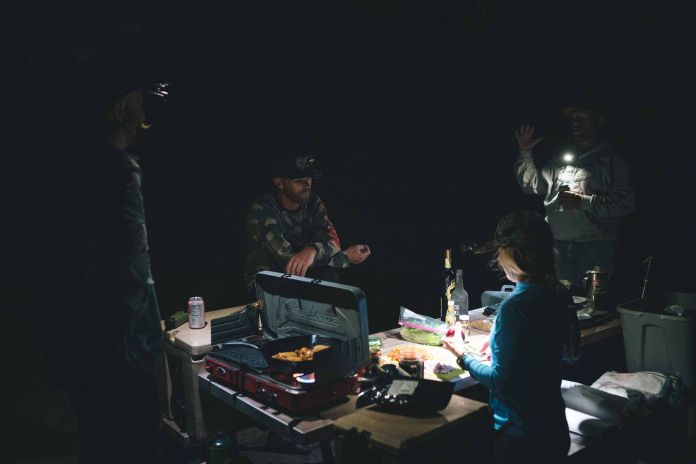
Our first interaction with the light occurred when we pulled our 3 boats up to our designated riverside campsite. The fishing had been great, and in our usual fashion, we managed to pull up to the site later than we would have preferred. As the sun dipped behind the red rock cliffs, we were thankful to have a few Zeus Minis already in hand. We strapped them onto the fronts of the metal boats and turned them to their max setting. Immediately, 200 lumens of light unveiled a clear landing, and ensured the safety of our boats and gear upon our bankside arrival.
Colby Crossland in front of some safely landed boats
It wasn’t long before we began to set up camp. Again, we were able to utilize the minis to make setting up tents in the dark as painless as possible. With one light clipped onto a baseball cap, and another clipped to a branch of an overhanging cedar, we were practically setting up our sleeping quarters in broad daylight. The lights clips were refreshingly strong and possessed a solid grip on whatever surface we placed them on.
The lights came in equally as handy when we began preparing a delicious chicken and pita dinner. Each cook was equipped with a light on their hat as they worked to prep the necessary sustenance for some late night fly tying.
As we browsed over the intel collected that day, we came to the conclusion that the heavy hitter fly that we should all be tossing would be the Chubby Chernobyl. Unfortunately, our supply was running low. Fortunately, however, Colby had his vise, and a plethora of fly tying material stowed away in his duffel bag in case of this exact incident. Quickly, we arranged a tying station for him on an old picnic table, complete with a multi-directional light fixture comprised solely of Zeus Minis. The Light defuser really came in hand for this project, as having a softened light really helped Colby focus on his task and not have to worry about being blasted by the direct LED rays.
When it was all said and done, we were well equipped for another day of excellent fishing, and ready to hit the hay. As we traced our trails back to our tents, the long-lasting battery of the Zeus mini guided our way. In all, we consider these an essential piece of gear for any camping trip.
Specs:
Compact, versatile LED illumination for projects, camping, outdoor adventures, safety and more.
Built tough and waterproof to 33ft (10m)
Clip to a baseball hat, pack strap, work bench or any fixed object
Flexible 360° swivel lets you easily adjust the lighting angle (10m)
4 levels of brightness—up to 200 lumens—for crisp detail
Final Review:
Portability:Â
User Friendliness:
Battery Life:Â
Brightness:
Price:
Conclusion:
If you’re in the market for a headlamp, that doubles as a boat headlight, that tripels as a spotlight for any task, big or small, you have in front of you, definitely consider the Zeus Mini light as an efficient alternative for your standard banded headlamp. We were thoroughly impressed with the performance of the light, not only as a practical field tool, but as a cinematic accessory. We would definitely recommend one to any filmmaker, amateur to pro, as well as anyone who regularly pulls into the boat landing long after the moon has made its way into the sky.
Earlier this month, Ross Reels released the all-new Colorado Reel. The reel is not a new version of the current Colorado LT Reel but a complete redesign of a new click and pawl reel. This past week we were lucky enough to visit the Ross Reels HQ where we caught up with Craig Baker of Ross Reels to ask him some questions about the new reel.
Flylords: What is the inspiration behind the new Colorado Reel?
Craig: The original Colorado LT Reel was a really fun project, we looked back at the history of Ross Reels, we had this original Colorado with this really cool clicking mechanism and it had this great sound. It was right at the cusp where we felt click and pawls could make a resurgence. There are some good click and pawls out there, but nothing really from Ross Reels in recent history. So we decided we’d give that old click and pawl system a chance and re-envision what a click and pawl could be with the Colorado LT. And surprisingly, we’re now going into its sixth season. So now it is time for that product to just rejuvenate a little bit, refresh.
The new Colorado represents the next generation of Ross Reels. It’s a leading indicator of where our designs are headed. The reels that we’re working on for next year and the future are incorporating some of these cool features, some of which, you can see when you just take a look at the Reel.
Flylords: What’s changed with the new Colorado Reel?Â
Craig: One of the biggest things is most of the current Ross Reels are designed with a real kind of coffee can shape. There are barrels with straight sides. And we said, what if it wasn’t that way? What if there was not a single flat on this whole reel? And that’s actually what the new Colorado is. There is not a flat on it, everything is in a radius. So, if you notice the shape of the frame from top to bottom, everything is round, and it just sort of swoops, it’s very organic looking. The new curves are also very strong, the reel has higher rigidity with less total mass.
Flylords: Tell us about the new semi-caged design?Â
Craig: Another theme of design that we wanted to accomplish was to somehow incorporate a fully caged frame. There are certain markets out there that really prefer a cage design for ultra-thin running lines, or really long, fine, fine leaders, things like that. We didn’t like the weight that the full cage adds perse, so we developed what we call our semi-caged design. It’s a unique thing for us. It performs exactly like a fully caged design, the line slips through a fully caged section.
The semi-cage design added just a tiny bit of mass to it, but we didn’t mind that because the biggest complaints we were getting about the Colorado LT was this thing is too light. “My rod feels tip heavy.” And so we actually made the 4/5 in this size bigger. It’s more of a true five weight than a four weight size. It’s got that semi cage frame that adds just … I mean, we’re talking a half an ounce or something. It’s a very, very little additional weight, but it does balance just a little bit better. That nine foot, five weight rod feels right at home on a 4/5 here.
Flylords: Why just a 2/3 and 4/5 size for the new Colorado Reel?Â
Craig: We wanted to simplify its offering for the dealers and make the choices simpler for consumers. Before we had a 0/3 size, a 3/4 size, and a 4/5 size in the Colorado LT. We found that that the 3/4 lived in no man’s land. The 3/4 was one of the biggest questions we get in customer service, which size do you recommend? And now the question is just off the table, cause if you have a two or three weight fly rod or lower you choose the small one. If you’ve got four or five weight fly rod, then you choose the 4/5 size. It’s pretty simple.
Flylords: Tell us about the new bushing material to replace the traditionally bronze bushing?Â
Craig: We’ve found another material to replace our bronze bushings, the material is called vesconite. It’s a polymer that costs more than aluminum, it even costs more than our bronze does. It is an engineered polymer designed specifically for underwater load-bearing and bushing applications. It is used in high-speed trains, oil rigs, water pumps, deep-sea drills, and that kind of thing. We have been testing it for like a year or so in all of our products and putting it in the sand and jamming it together and running. The new Colorado is the first in the Ross lineup to use the vesconite as the bushing material. We believe it is something that’s just going to last longer and perform better.
Flylords: What kind of angler is this reel focused for?
Craig: I really think it is for just about anyone that fishes for trout. I know that sounds overly generalized, but for the most, you could argue one way or another, that drags aren’t needed at all times. You get this kind of manual transmission control of the fish with the click and pawl. You get to break that fish, with your finger or your palm. Ultimately, I could see just about anybody having one of these in their arsenal.
Flylords: When is the reel going to be available?
Craig: It has already started shipping to dealers. They are available to pre-order now, most dealers should have them by early November to purchase.
For more information on the reel click here and be sure to check out Ross Reels on Instagram at @rossreels.
Our friend Ken Tenaka also dropped a pretty great unboxing and review, check it out below.