Home Blog Page 133

A Time to Care (for the Bugs)

As many of us already know, wild and native trout thrive in clean, cold water environments. One of the reasons they do so is because of the abundance of insect life that is also found in these same habitats. Diverse insect life is of significant importance to wild and native trout. As trout habitats ebb and flow from season to season, going through years of drought, extensive rains, and typical changes that occur year over year, it is important to maintain assorted biota in order to give the trout the best chance for survival. Some years, the species of abundance may be amphipods, some years may be terrestrial insects, others years could focus more on stoneflies or mayflies. It is absolutely critical to keep as wide a range of invertebrates as possible in any given aquatic ecosystem in order to avoid disaster during these yearly changes that are becoming more frequent. This is one reason why insects have always been so resilient. 

Trout feed mainly on aquatic insects, and this is a widely undisputed fact. While crustaceans, terrestrial insects, smaller fish species, and even mice can show up in stomach contents, aquatic insects still make up the bulk of it. A report released this year by Idaho Fish & Game on Idaho bull trout surprisingly discovered that this carnivorously-portrayed fish still retained an incredible amount of insects in its diet during the summer months in spawning tributaries. 87% of its stomach contents were comprised of aquatic insects and 11% were terrestrial insects. Trout are opportunists at best when it comes to feeding, but the thriving bug life underwater and hatches throughout the year are really what drives the majority of their diet, no matter what type of trout. 

While all plants and animals serve as indicators of changes in the environments, insects do so at a micro-level, which can show the change that is coming on a macro-scale. Just a few of the threats facing our aquatic insects are urbanization, habitat degradation which can be agricultural or industrial, recreational use, and environmental changes ( i.e. climate change). As the world becomes more populated and more areas see development, losses or mitigations of creeks and streams will occur. This can fragment habitat in addition to making it disappear altogether. As deforestation happens due to industrialization, or agricultural reasons like logging occur, lack of leaf litter availability and quality can reduce the number of aquatic insects present in a particular food web. Agricultural runoff can also negatively impact populations by tainting the water supply for the insects. 

In the past two years, especially, outdoor recreation has become more popular. While this can be both encouraging and discouraging, proper use of the resource and taking extra precautions to make sure you are not disrupting the ecosystem is merited. Dragging watercraft on river bottoms, removing rocks from the water, and motors used in shallow or grassy riverbeds can all cause disruptions. In even the smallest bodies of water, activities such as ORV, ATV & dirt bike use can also severely disturb the sensitive insect inhabitants. 

With more and more summers of dramatic heat, severe drought, and wildfires occurring, the trickle-down effect has potentially devastating impacts on our trout fisheries. Most aquatic insects are detritovores, meaning they shred and consume leaves in order to gain nutrients. In areas where wildfires have occurred, there is a significant decrease in the number of fallen leaves making their way into bodies of water and an increase in ash present in the water. Extreme heat also contributes to the faster breakdown of leaf matter in water by microbes which also takes away that important insect food source.  In areas where drought is occurring, sometimes insects are forced into a diapause state or are naturally driven to leave the area altogether due to genetic instinct as the environment around them is changing. We often talk about “insect drift” in angling, but it is important to understand that drift is also a biological tool used by insect populations to move when conditions change and become undesirable. In “active drift” immature insects may choose to let the currents carry them downriver to an area where there may be more water, more leaf matter, less disruption, ash, or pollution. In poor water years, agricultural impacts can also be felt by insect populations due to what is known as “passive drift” caused by increased flows from dams and diversions, causing an inadvertent sweeping of the insect population downriver to what may or may not be a suitable habitat due to substrate changes or the chance that the water source could dry up by the end of the agricultural growing season. 

One great way to keep an eye on what is happening is to use insects as biological indicators. Taking inventory of the types of insects in bodies of water on a consistent basis is an incredible tool that can indicate a disruption in the food web or sense change in a habitat. One great example of this is the South Fork Initiative, a program of the Henry’s Fork Foundation which has begun surveying the macroinvertebrates found in the South Fork of the Snake River, to see if there are regular increases or decreases in the taxa that they are monitoring, and investigate what is causing the disruption. Many state departments of environmental quality and other organizations or universities already do this and provide chances for volunteer opportunities if one is interested in getting involved. A more specific insect example that has had many eyes on it in recent years is the Western glacier stonefly. This particular stonefly has an extraordinarily narrow range of water temperatures in which it may survive, regaling its habitat to approximately 16 streams in the U.S. Stoneflies, by nature, tend to genetically disperse mainly through drift because they are poor fliers, which limits its opportunities to adapt as its unique habitat in glacial outflow water deteriorates. Snowpack increases in some winters may not be enough to counter the loss of glaciers in the stonefly’s endemic streams. The species is now listed as threatened under the Endangered Species Act. Monitoring the local fauna and gaining regulatory status such as this can help in some ways when it comes to preventing the development or avoiding detrimental agricultural or recreation impacts on certain bodies of water. 

Parallel to the types of insects that are most important to trout anglers in fishing, the same “big three” groups of insects are also the most in danger of decline due to the aforementioned factors. EPT, or Ephemeroptera (mayflies), Trichoptera (caddisflies), and Plecoptera (stoneflies) are the most vulnerable and sensitive groups of insects when it comes to change. Odontata (damselflies & dragonflies), are also highly sensitive to disturbance and have many species that are considered endangered or threatened. Diptera (true flies), Hemiptera (true bugs), and Coleoptera (beetles) are slightly more hardy, although, with insects, there is always an exception. Because insects are soft-bodied, they uptake any changes in their water sources cutaneously or through their gills as they respirate, making even the most subtle changes quickly realized.  As water temperatures warm and algae blooms become more common, we may start to see insects die off as they get trapped or lose food sources. In mayfly species, one of the biggest factors is the adult life span when it comes to their opportunities for dispersal in adverse conditions. Mayfly adults only live for about a day, but may have a staggered emergence throughout a river system based on water depth and temperatures. Due to their limited lifespan and mating opportunities, they are less likely to travel as adults to look for a more suitable habitat. This is true for most lentic species or species that come from moving water. Lotic insects are from more still or standing water environments and have to adapt more quickly because lakes and pools tend to dry up more often, although this is changing with our human manipulation of moving water.  Many of the more endangered species are considered specialists due to their ecological niche and limited temperature survival ranges or food sources. The factors that can alter aquatic insect growth, development, and reproduction are innumerable. 

Insect phenology, or their life cycle calendar, is that of being univoltine, bivoltine, or multivoltine. This translates to mean that insects emerge and complete their life cycles in one year, twice per year, or multiple times per year. One thing that may start to occur in warming water more frequently in stoneflies, mayflies, and caddisflies is a generational shift with more hatches happening in a shorter period of time. While the may sound exciting to the angler, it is not good news for the overall health of the stream. When this happens, more oxygen is required for the immature stage, which is not easy in a warming water source. They expend more energy to grow and the emerging insect may be smaller in size due to restrictions in its ability to grow. Another reason this is bad is the exact reason that was earlier mentioned in regards to trout needing a diverse food source- some years can be bad. A low water year, an oil spill or a fire can be offset in broods of insects that have a cushion of emergences behind the one that is predominantly impacted. 

Whether we realize it or not, we are currently living in the sixth mass extinction on our planet. A study by Francisco Sánchez-Bayo and Kris Wyckhuys estimates a whopping 33% of aquatic insects are threatened to become extinct if something drastic doesn’t change.  Insects are the main source of food for so many groups of vertebrates, and they are essentially the anchor in all food webs. If insects become extinct, there will be consequences on a much larger scale, not just for trout, but for all of us. To quote the former CEO of Orvis, Perk Perkins, “If we are going to benefit from our natural resources, we must be willing to take action to protect them”. It’s time to step up and start caring about the bugs as much as we care about the fish.

About the Author: Maggie Heumann is a member of the Jackson Hole Trout Unlimited and the Idaho Wildlife Federation Board. She helped found Artemis Sportswomen and is an active advocate for conservation. She currently manages the Orvis Jackson Hole store and gets out to fish and collect bugs as much as possible with her husband, Hunter, a fishing guide, and her dogs, Bug, Missy, & Cotton.

Beginners Guide to Aquatic Bug Life & How to Match the Hatch

I think one of the most intriguing aspects of trout fly fishing is the incredible range of forages (read: food sources) that they will feed on. From seemingly microscopic midges to 3-inch-long cicadas, there aren’t many bug species that trout won’t take a swipe at, given the chance. “Matching the Hatch” has long been the mantra of fly anglers everywhere, and for good reason, trout can be persnickety creatures when they’re keyed in on a very specific insect. This article is meant to serve as a cursory guide to the most common aquatic and terrestrial insects that you might encounter during your time on the water. 

Table of Contents:

How to Find and Identify Bugs on the Water

Aquatic Insects Trout Can’t Resist 

How to Find & Identify Bugs on the Water

Step 1: Find the bugs

Unless you’re seeing flies come off the water while hatching or mating, figuring out what bugs are in or on the water can seem like a daunting task. 

If the flies are in the air, simply catch one and hold it near your fly box and do your best to match the color and size of the bug. 

If there are no bugs on the water, they’re likely all below the water’s surface either embedded under rocks or in some woody structure or in the water column. The best way to capture and identify these bugs is via a seine kick-net or by simply flipping over rocks and seeing what nymphs are attached to or crawling on them. 

Step 2: Identifying the Bugs

This step can be the trickiest one if you’re interested in perfectly identifying which species of aquatic bug is in your hand or seine. There are many field guides available from State fisheries agencies that will be regionally specific to your area, like this great field guide from West Virginia’s DEP that shows many common aquatic insects with handy imagery that you can download and save on your smartphone. If you’re more interested in simply matching the bugs to the flies in your fly boxes, the process is as simple as comparing the live animals to your flies.

Pro Tip: If you find bugs in abundance that don’t match any flies in your box, snap a few pictures so you can match them while sitting at your tying desk, or in your local fly shop!

Common Insects You’ll Find While Fly Fishing

There is an infinite number of bugs that you might encounter during your time wading or floating on trout rivers, creeks, and streams, but this quick guide will help you identify those bugs and effectively match what food source the trout are keyed in on!

It’s important to note that this guide is an overview of the most common aquatic insects familiar to fly anglers, for more in-depth and regionally-specific guides, field guides for your area can typically be found with a quick and simple Google search.

Caddis

When you hear someone refer to a fly as a caddis, they’re referring to bugs that are members of the order Trichoptera. Caddis spend their early life stages in the water, and once hatched fly into the air taking on a more terrestrial lifecycle before returning to the water to mate. 

Caddis Nymphs

For the most part, the caddis nymphs you’ll come across will either be referred to as “cased” or “uncased”. These terms refer to the cases that caddis nymphs build around themselves for protection and for camouflage. Flies to match caddis nymphs!

Caddisflies

Caddisflies hatch throughout the spring, summer and fall depending on the species. They are easily identified by their long antennae and tent-shaped wings. Flies to match the caddis hatch!

Mayflies

When most people think about dry fly fishing a hatch, most think of the iconic mayfly, with its curved body, teardrop wings, and penchant for blanket hatches. They’ve become synonymous with fly fishing since the pastime was developed hundreds of years ago. There are approximately 3,000 unique species of mayfly in the world, and 300 of those are native to the United States. Flies to match the mayfly hatch!

Stoneflies

Stoneflies are a perennial favorite for both trout and the anglers pursuing them. Fish love them because they’re big sources of protein that are commonly available in abundance, and anglers love them because of the aggression they bring out in trout. The name stonefly refers to the order Plecoptera. Easily one of the largest aquatic nymphs and flies anglers will encounter. If you ever hear someone talking about the legendary skwalla and salmonfly hatches, they’re referring to a duo of insane hatches that pop off in the American west every summer, and both of them belong on any dry fly angler’s bucketlist! Flies to match stonefly adults and stonefly nymphs!

Midges

If you’ve ever been out on the water and seen a cloud of mosquito-like insects that don’t seem interested in biting you, the odds are that you saw a swarm of midges. Midges are closely related to mosquitoes and look like them, but they don’t bite. More importantly, they make up a huge percentage of a trout’s diet. This is for a few reasons. Midges are pretty universal, being found in large numbers in many bodies of water. But, one of the biggest reasons they’re so important for fly fishing is that they’re one of the few insects that can hatch year-round. This means that midges are one of the most effective flies to use. Many anglers are skeptical of tiny midge patterns since it’s hard to believe that trout can even see something so small. Yet, midges continue to be one of the deadliest flies in a box. You can learn all about these incredible insects and how to fish midge flies effectively in our in-depth guide, here! Flies to match the midge hatch!

Midge Fly Fishing – Tips to Catch Trout All Day

Isopods – Scuds, Sowbugs, Freshwater Shrimp, etc…

Scud Bug
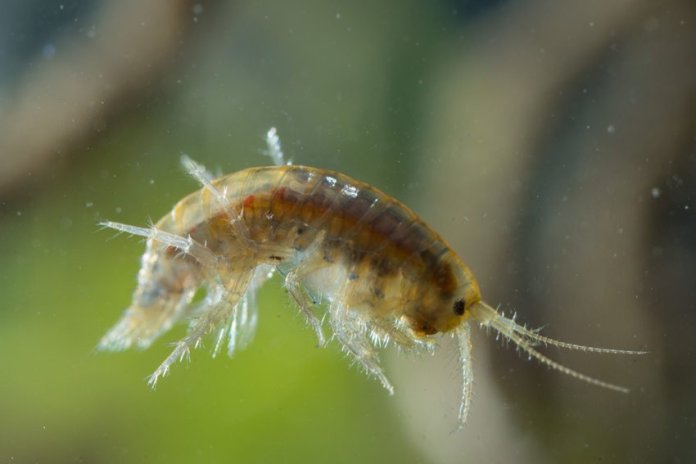
Photo by Michael Durham, via the Oregon Zoo.

When we talk about isopods like scuds, sowbugs, or freshwater shrimp, we’re referring to a class of insects that spend the entirety of their lives in the water, unlike the fly species previously mentioned in this article. These little bugs are generally herbivorous, preferring to feed on aquatic vegetation found in slow-moving spring creeks and coldwater streams. Anytime you’re fishing around plants and exposed roots, there’s a very solid chance you’ll find scuds and sowbugs hanging around. Flies to match the sowbugs and scuds!

Terrestrial Insects – Grasshoppers, Spiders, Ants, Beetles, etc…

Photo by Toby Nolan Imagery

The term terrestrial refers to insects that spend their entire lives out of the water until they accidentally find themselves on the surface of the water. Popular examples of these would be grasshoppers, cicadas, ants, and beetles. Most of the time, you’ll find these bugs splashing down during windy and stormy days. When trout encounter these struggling bugs on the surface, their response is typically violent and exciting! Flies to match the terrestrials!

5 Hatches To Fish Before You Die

There are few things more rewarding than seeing a fish take your dry fly as it skates across the surface of the water. Laying down that perfect cast and watching in anticipation as your dry fly makes its way down the stream is a feeling beyond compare. While there does not need to be any particular bug hatch going off to take a fish on top, hatches drastically improve your odds of catching that highly coveted “dry fly fish”. And just like the fish that thrive off them, not all hatches are created equally. Some insect hatches only come around once a year, and while there’s always fun to be had fishing topwater on your local creek, there are certain times in an angler’s career where an explosion of wings and casings leave you in awe of life’s sheer magnitude. These natural events draw anglers from around the world to fish them and are considered by some to be milestones in one’s fly-fishing journey. Below are five hatches you must fish before you die.

1. The Salmon Fly Hatch

Hanfuls of hatching Salmonflies on the Madison
Photo Courtesy of Sunrise Fly Shop

Few things compare to the famous Salmonfly hatch. As Montana’s most notable hatch, these bugs begin their life cycles as small nymphs which eventually rise in the water column, crawl onto the banks, and begin hatching. Salmonflies have been seen to hatch as early as the last week in May, but are most abundant from late June to early July on the Madison River. Many consider the Salmonfly hatch on the Madison to be some of the most productive fishing throughout the whole year. In fact, many anglers travel to Monatan from across the country just to fish this hatch. When you combine heavy tippets, big foam flies, and hungry Brown Trout, who wouldn’t want to visit the Madison!

2. The Green Drake Hatch

Green Drake on a rod grip
Photo Courtesy of Gregory Allen Hoover

The Green Drake hatch is one of the most prominent mayfly hatches across the entire East Coast. While the Green Drake hatches in many different states, they are typically seen in larger numbers throughout the great state of Pennsylvania from June to early July. Besides the dark and light greens found on the insect,  this mayfly differs from the rest due to their incredible size. This hatch allows the angler to use large, bushy dry flies that are easy to see even from far away. Combine this with a smaller green nymph dropped off the back, and you’ve got a presentation that even the pickiest trout can’t resist. The Green Drake typically hatches just before dusk, but can often hatch sporadically during cool afternoons. Well, what are you waiting for? Go get em!

3. The Cicada Hatch

ciccada fly
Image courtesy of Fly Fish Food

Many Easterners consider the Cicada hatch to be one of their most memorable hatches. Not only does this hatch occur every 17 years, but it also allows anglers on the East Coast to get a taste of what it is like to throw big bugs to ravenous fish, much like some of the best West Coast fishing. These bugs spend the majority of their lives living underground and emerge only when the soil reaches approximately 64 degrees. Following their emergence, the Cicadas fly to cover, mate, and eventually drop to the water’s surface where they die. It is not long before the fish pick up on this and when they do, it’s game on. So, stock up on tippet and tie up your Cicada flies, or a Chubby Chernobyls because the next emergence is set to occur this summer!

4. The Hexagenia Hatch

lots of bugs
Image courtesy of Brian Tesch on CWTU

The Hex hatch is a mayfly hatch well-known for fishing big flies to hungry fish in complete darkness. Similar to the Green Drake, these mayflies appear in large sizes and tend to emerge during the night. This hatch draws anglers from near and far to the Midwest but is seen most abundantly on Michigan’s Ausable River. Die-hard anglers consider this hatch a tradition and plan annual trips around it. The hatch begins in early June but hits its peak between late June and early July.

5. Mother’s Day Caddis Hatch

The Mothers Day Caddis Hatch is synonymous with springtime in the Rocky Mountains. Often times it is the first solid dry fly hatch of the year before the higher flows of spring runoff begin to swell. Typically these bugs start showing themselves around mid-April and the hatch can last weeks at a time as it slowly progresses upriver. This is one of those hatches that will make anglers play hooky from work or book last-minute flights to catch it at its peak. Some prefer to cash in on the subsurface chaos while others try to ride the bleeding edge to watch trout aggressively chase down a skated caddis skittering across the riffle.

Original Article by Flylords Content Team Member, Owen Rossi. Additions by Dan Zazworsky.

Costa Sunglasses Releases New “Costa Clear” Lens Technology

0

Costa has done it again with their new line of prescription lenses. The new Costa Clear is a collection of single vision and progressive lenses designed for “those who desire an accessible and reliable Costa optical lens to elite anglers and craftsmen that demand extra performance and clarity.”

From Costa:

Since 1983, Costa Sunglasses has built a reputation for creating the highest quality, best-performing sunglasses for anglers and outdoor enthusiasts – but Costa knows that not every adventure takes place in the light of day. Costa Clear, the brand’s latest collection of single vision and progressive optical lenses, answers the call for clear vision all day, every day.

The collection of three single vision (Essential, Waypoint, Waypoint Plus) and four progressive (Base, Essential, C-Scape, C-Scape Plus) lens options offer a tiered approach to suit the unique needs of everyone – from those who desire an accessible and reliable Costa optical lens to elite anglers and craftsmen that demand extra performance and clarity.

Premium options in both the single vision and progressive lens categories utilize Costa Waypoint™ digital surfacing technology, which enhances the field of view by virtually eliminating the peripheral blur found in high wrap glasses. Waypoint digital surfacing ensures superior visual clarity no matter which direction you look. Premium lenses in the progressive category feature Costa C-SCAPE® technology. Developed by top sportfishing pros and lens designers, C-SCAPE technology offers immediate adaptation and enhanced viewing fields suited for the needs of watermen and women.

“Costas are made for the anglers, soul surfers, and explorers who have inspired us since day one. Now we can provide the same optical clarity and quality that our community expects from Costa in a complete pair of optical frames,” says Jessica Bryant, Sr. Product Marketing Manager at Costa. “We’ve paired our best in lens optics with a deeper selection of Rx designs and technologies – creating the perfect pair of glasses for answering a 4 a.m. wakeup call or scrawling an entry in your journal at night. .”

Similar to Costa’s sun RX lenses, all Costa Clear lenses are etched with the C-Wave logo for authenticity and include advanced coatings, including protection from blue light. Every lens is hydrophobic [water resistant], oleophobic [smudge and oil resistant], scratch-resistant, anti-static, and made to reduce inner and outer glare to protect lens integrity on and off the water.

Costa Clear lenses are now available in all of Costa’s optical frames, as well as eight new styles for a complete pairing of high-performance lenses and frames. The sophisticated new frame styles are built with the waterman and woman in mind. Taking inspiration from the PRO series of sunglasses, additions to the Ocean Ridge collection are built from a durable, double injected Bio-Resin and feature a ventilated nose pad for increased comfort, eyewire drains to help manage sweat, Hydrolite(™) grips, and keeper-ready temples to keep your frames in place.

Costa premium lenses can be customized for your prescription by the experts at your local Costa Optical dealer. Other tiers of Costa’s authentic offering can be ordered online at CostaDelMar.com. To find an Rx dealer near you, visit https://www.costadelmar.com/en-us/stores.

Trout Week Faces of Fly Fishing: Tom Rosenbauer

Tom Rosenbauer has been a household name in the fly fishing industry for decades. With well over half a century of experience in the sport, he’s helped thousands of anglers get their start with a fly rod via his many books and instructional videos. These days, Tom hails as Orvis’ Chief Enthusiast, a title Tom shrugs off as over the top. He’s seen multiple waves of fly fishing popularity, and he’s the first person to tell anyone “Relax, it’s just fly fishing.”

We caught up with Tom as a part of our first annual Trout Week with Trout Unlimited to chat about his upbringing in the sport of fly fishing, meme pages, young people picking up fly fishing, having a sense of humor, and how Trout Unlimited helped fuel his passion for the sport of fly fishing!

Flylords: You just celebrated 45 years working with Orvis, was that your first job in the fly fishing industry?

Tom: Actually, it wasn’t. I started out tying flies commercially for a local shop when I was about 14 in Rochester, New York Carl Coleman’s Fly Shop. I think Carl’s still around in guiding. He doesn’t have a shop. But he sold some Orvis and Leonard and fly tying materials and he liked my Catskill style dries so I tied a lot of Catskills, Hendrickson’s, March Browns, and stuff like that for him as well as a bunch of nymphs. And then I went to the forestry school in Syracuse, tried to concentrate on fisheries. While I was there, I started working for a guy named Frank Vidala whose father had started a bait shop in the 1930s in the depression.

Frank was a fly fisherman. But what’s really funny is that they had the Orvis bamboo rods right next to the minnow tanks. I remember going down the basement for hours and counting worms into bait containers, then bagging minnows, and the next minute I’d be talking to a guy about a Hardy Reel or something. It was a cool place. Eventually, Frank started a mail-order fly tying material company called Hackle and Tackle. I did some stuff for him, packaging materials and stuff like that, just basic stuff. I taught some fly tying classes for him on Saturday mornings. When I got done with college, as usual when you get done with college, you don’t know what you’re going to do. I thought I might go to grad school and then I was an Orvis customer for years and I saw a help wanted ad for a clerk in the retail store. So I said, well, maybe I’ll try that for a while, that’s where I ended up.

Flylords: When you first started fly fishing and tying, when did you tie your first fly or how did you get into that side of fly fishing?

Tom: I don’t know. I was maybe 10 or 11. I just thought fly fishing looked interesting and I bought a fly tying kit and hacked my way through teaching myself how to tie flies because there were no videos, very few books and the books that were around were horrible. So, I taught myself fly fishing. I didn’t have a mentor. Carl Coleman, the guy I tied flies for later on really, really brought my fly fishing up to the next level. He’s a great nymph angler and really taught me a lot about reading water, nymphs, and dry flies.

Flylords: What do you think the largest shifts in fly tying have been since you started whipping up flies as a kid?

Tom: Well, I think that in the ’70s when Swisher and Richards first came out with “Selective Trout” and their no hackle flies, and Caucci and Nastasi came up with Comparaduns, I think that was a big step where we really started seriously thinking about imitating insects. And I think we’ve gone away from that since then.

In the ’70s and the ’80s, it was all about matching the hatch and insect hatches and identifying bugs. Remarkably, the Henry’s Fork was much more crowded than it is now because that’s just a bug factory. That was a big change when we realized we didn’t have to have an expensive hackle, which was pretty shitty in those days too. The hackle we had was, I mean it would take sometimes three hackles to dye a dry fly.

Flylords: And at that point, Metz and Whiting Farms hadn’t popped onto the scene, had they?

Tom: There were a few guys, Andy Miner and Harry Darby and a few other people were raising chickens, but you had to know somebody. They were also horribly expensive, I mean they were $100 then in 1970s dollars. I was lucky enough to get to know one of the early hackle breeders Bill Tobin, who nobody’s ever heard of, but he was in Cortland, New York and he had some beautiful duns and light gingers.

When I was in college, I got to know Bill and of course and then Mets came him along and really changed the hackle business and then later Hoffman, and Tom Whiting, and Bill Keo, another really great hackle breeder. I’ve been lucky enough to know most of those people.

I think the no hackle style or the more emerger style of dry flies was a big thing. You no longer needed a fully-hackled Catskill dry to catch fish, in fact, the other flies often worked better.

Bead heads also changed everything, I mean, the nymph game has changed so much. In those days, I mean, when I first learned how to fish nymphs it was floating lines straight upstream, not necessarily to visible fish, but you watch the tip of your floating line. Nobody had strike indicators, nobody really knew about them.

So, I’d say strike indicators and then beaded nymphs really changed the game and made it really more accessible to lots of people. I mean, nymphing then was a dark art. People didn’t know how to do it and they didn’t trust it. And you could be pretty effective, but not many people practiced it.

Flylords: What would you regard as the birthplace of American fly fishing?

Tom: Technically, Pennsylvania sounds more like the birthplace based on the history that there were people fly fishing in Pennsylvania before the Catskills, but the Catskills was mostly a bunch of wealthy New York guys. They had those private clubs and went to Harry Darby’s shop and bartered for flies. That’s really where we got a lot of our traditions from. And a lot of it was borrowed from the English, obviously.

Flylords: What contributions do you think American fly fishing has given to this sport or the pastime as a whole?

Tom: Well, certainly indicator fishing I think is a purely American thing and terrestrial fishing. I mean, they had terrestrials in England, but not it wasn’t as serious as Vince Marinaro and Charlie Fox studied it. Terrestrial fishing certainly the heavily hackled flies, Wulffs, and parachutes and things like that, I think are an American invention.

Parachutes might have been tied in England previously, but Americans really made them popular and then foam. Foam is revolutionized Hopper fishing and big stoneflies and any big fly or just attractor flies in general. I mean, you can’t fish some of those big Western rivers these days without fishing foam. So the big burly foam rubber-leg flies are really an American contribution as well.

Flylords: What about on the streamer side of things?

Tom: Tommy Lynch, Mike Schmidt, and Kelly Galloup were all originally from Michigan. I mean, streamers are particularly a brown trout phenomenon. Rainbows and cutthroats aren’t so interested in those bigger pieces of meat. I think rainbows and cutthroats eat a fair number of crayfish. But I don’t think they eat as many baitfish as brown trout do and that’s become a big American contribution: throwing meat. I mean who thought we’d be fishing six-inch flies for trout?

Flylords: What was the fly fishing culture like before A River Runs Through It, before social media? How did the folks who were already in the sport react to the wave of newcomers?

Tom: Yeah, yeah. It was very clubby, it was very white-male and I was an anomaly because I was a young kid in the ’70s and even during the ’80s. There weren’t many people my age that fly fished, and most of the anglers were much older than me. It was very clubby and snooty for the most part.

I mean, you always had your locals who really knew it better than the clubby snobby guys, but they didn’t write books, and they didn’t invent fly patterns that they would share with people. I don’t know why I kept up with it because I’m not a clubby or elitist kind of person, but I guess I just love fly fishing and I just I ignored the snotty aspects of it.

After A River Runs Through It, people complained about all the new people trashing the streams, and that they did’t have any ethics and they don’t know what they’re doing. And of course, they forgot that they, in fact, were those same people 10, 20, or 30 years ago. They didn’t know anything when they first started and there were lots of complaints. And then the film brought a lot of junk products in the fly fishing industry, you could put a trout or a fly on something and you could sell it.

The old Fly Tackle Dealer Show, which is now IFTD, was a lot of people that shouldn’t have been there, selling stupid jewelry and knick-knacks. But after a while that died off, and I think a lot of people stuck with it because of “A River Runs Through It”. They won’t admit it. But they were at first intrigued by fly fishing by “A River Runs Through It” and then I think the internet age, particularly videos really brought young people into fly fishing.

Now when I go to shows, I have lots of kids coming up and introducing their fathers to me or their mothers and telling me that they got their parents into fly fishing rather than the other way around which is really cool. And so the whole youth thing has been really exciting and fly fishing has got a lot more democratic and more people of color, a lot more women, a lot more kids. And the internet did that obviously, social media did that, the internet did that, yeah.

7 Things You Never Knew About “A River Runs Through It”

Flylords: Do you think there’s a parallel between the way the industry and hard-core anglers reacted to those new entrants post-A River Runs Through It and during this latest boom?

Tom: Sort of a parallel, I mean “A River Runs Through It” brought a lot of what you call yuppies and it became really cool on Wall Street and places like that, corporate outings “to do fly fishing” and yeah, and a lot of them were kind of posers at it, but the social media revolution and COVID really brought a lot of people out into the outdoors.

These latest entrants have embraced the culture because they really wanted to be a part of the lifestyle and really appreciate the outdoors and the ecosystem. So, it’s different, I think it’s a better stimulus to the fly fishing world and yeah, things have gotten crowded for sure. But, we have lots of places in this country where we can go and not see anybody fishing. I think it’ll settle down a little bit, but I think that we’re definitely seeing a new resurgence of people into the sport.

Flylords: You spoke about kids getting into fly fishing. It seems as though they already focus quite a bit on ethics, etiquette, and conservation. What do you think about that?

Tom: It’s almost innate with them which is the greatest thing. It’s just like they know it and we don’t have to teach about ethics either. People say, “Oh, these new people in the sport, they don’t know anything about ethics.” That statement’s total bullshit.

They’re the most considerate people I have met on particularly on trout stream because that’s where the crowds are most of the time. They’re the ones that come up to me and say, “Hey, are you working upstream or down? Do you mind if get in a couple of pools ahead of you?”

The old guys will just go and fish right in front of you. That’s why I’m so excited about the future of fly fishing because they’ve got conservation ethics, they support brands that give back to the resource and they have good ethics. 

Flylords: What’s your take on the birth of the fly fishing meme culture on social media?

Tom: Oh yeah. I love them. 

Flylords: Do you think that kind of humor existed prior to social media and the meme format?

Tom: Not really. People took fly fishing way too seriously back then. There weren’t many people making fun of various factions because there weren’t that many factions. So there was a book, a great book by a guy named, it wasn’t his real name, but he was an advertising guy and he had a pen name of Milford Poltroon. And he wrote this book called How to Fish Good. And that was making fun of the fly fishing world, but it was one of the rare instances where somebody poked fun at fly fishing. It wasn’t even big enough to poke fun at them because nobody would listen. 

Flylords: You’ve developed a cult-figure-like in the fly fishing internet community, what has that been like?

Tom: Yeah, I heard about that subreddit page Phil Mohan pointed it out to me. I’m not a big fan of social media for the most part. I mean I’ve embraced it because I’ve had to. I’ve embraced the digital world, but I don’t look at Facebook and I have an Instagram account that I post occasionally, but I don’t care for most of the social media. I mean the fishing part is fine, but all the other crap I just don’t want to deal with it. Life’s too short to spend time looking at Facebook. I’d rather be outdoors or tying flies or reading or something. So it’s fine, it’s just not something I’m really going to embrace.

Flylords: What does the title Orvis “Chief Enthusiast” entail? How did they come up with that title for you?

Tom: Well, it’s funny because it really happened right about the same time as COVID and where I had gotten to the point where people said, “Yeah, Tom’s a figurehead and we should take advantage of that because people respect him,” because I’ve always embraced newcomers.

I’ve always welcomed new people to the sport. No question is too stupid. I’ve never made fun of anybody for a dumb question. I think that’s why I have that reputation is that we were all there at one time and I know what it was like. So, in my books and podcasts and TV shows and whatever, I’ve always tried to just help people have more fun in fly fishing. That’s what I do. Orvis decided that that would be a good use of my time. Going to shows and being the public face of Orvis and then when COVID hit, a lot of it became electronic and live. I’ve even cleaned out my office at Orvis HQ. I’m not going back into the office, I’m not planning on retiring, but I don’t need it, I got everything I need at home. I got fly tying, my computer writing desk, work computer, video studio here, and my podcast studio downstairs. Why leave?

Flylords: How have you seen the conservation conversation within the fly fishing community shift since you got started in the space 45 years ago?

Tom: Oh, people never used to care much about it. There would be a few passionate, dedicated people that were Trout Unlimited life members and they joined Bonefish Tarpon Trust and whatever, and they would be really active, but most people didn’t give a shit.

For instance, take my podcast downloads when I first started 10-12 years ago. If I did a conservation podcast, it would tank. I’d have Chris Wood on my podcast and the downloads would be low, but now when I do a conservation podcast, some of them are the most popular. So, people do care about it more now than they did. They realized that there are a lot of threats to these things we love. We didn’t really know back in the ’70s what kind of things were threatening our way of life and now people you can’t get away from it. And it’s become politicized, unfortunately. And so companies and organizations have been forced to get mildly political just because you can’t get away from it. And in order to protect it, you have to so it’s not something that Orvis likes doing or I like doing personally, but you have to be there.

Flylords: When did you get first involved with Trout Unlimited?

Tom: Good question. I actually joined at Trout Unlimited chapter when I was 16. A buddy of mine and I used to go to these Trout Unlimited meetings which were all old guys. We were the youngest guys there, by the way, 20 or 30 and the guys would get us beer and we’d actually be able to drink beer when we were 16 years old. So, I had been a Trout Unlimited member since I was really young and I learned a lot there. I met these older guys who kind of took me under their wing and some of them took me fishing and taught me a lot of stuff. TU was a big part of my youth. 

Flylords: What do you think is the biggest challenge facing cold water conservation right now?

Tom: I worry most about well, climate change obviously is going to change the way our fisheries look. I worry that 50 years from now the only place we’re going to be able to fish for trout are in tailwaters, that’s the overriding concern.

The other thing is, and I don’t know how much we can do about it because it’s difficult to monitor, but one of the things that worries me most is pesticide and herbicide use. I think that I’ve seen big changes in trout populations and insect life in my lifetime, big, big changes. I’ve got to believe that these things are resistant to changes in climate to a certain degree, but they’re not resistant to chemicals in the ecosystem. Unfortunately, it’s not something we as citizens can monitor. It’s very difficult without a chromatograph and some of these organic molecules are really difficult to detect but paying attention to what golf courses put on their lawns and the highway department sprayed herbicides right in front of my house, I’m 100 feet from a trout stream. I live in an agricultural valley and I have no idea what they’re putting on those corn crops. On the one hand, it’s none of my business because farmers are trying to make a living, family farmers are trying to make a living in a tough climate. But I worry about what they’re putting into watersheds.

Five Iconic American Fly Patterns

American fly fishing has its roots from the easternmost parts of Maine to the infamous Olympic Peninsula. Many different regions of the country have their fish that are worshipped. Through our praise and devotion towards catching these fish, Americans decided to be resourceful. Flies from the chalk streams of England were modified to fish trout streams and two-handed Spey rods from Scandinavia were brought to cover big water out west. Adaption and perseverance have always been the American way, so it makes sense why some of the most infamous flies in history come from the Land of the Free. In this article, we will talk about five iconic American fly patterns and the history behind them.

Five Iconic American Fly Patterns

Royal Wulff

The Royal Wulff is a legendary dry fly tied by an equally legendary fly tying innovator and angler, Lee Wulff. This pattern was created by modifying another infamous fly, the Royal Coachman. The Royal Wulff replaced the Coachman’s flimsiness and fragileness on rougher water by implementing new materials. Through this, Wulff was able to increase the buoyancy and has proven itself to be a fantastic dry fly that trout love.

This fly is considered an attractor pattern or “searching fly” and will bring out the worst in trout looking up. The peacock herl body partitioned with red thread or silk gives the Royal Wulff natural flash and a hot spot to attract fish. Either calf tail or bucktail can be used for the wing, both offering great visibility and buoyancy. A densely packed hackle will ensure that the fly rides high to get through the choppiest currents. The Royal Wulff is not going to be the fly you tie on when trout are sipping size 20 BWOs. This is a fly that is thrown to move fish looking to find a decent-sized meal. Fished beside banks, undercuts, and under branches will produce fish by the profile and attractor properties that this fly brings to the table.

Below is a video courtesy of InTheRiffle and Charlie Craven that details how to tie this infamous dry fly pattern.

Elk Hair Caddis

The Elk Hair Caddis is one of the most well-known and efficient caddisflies to ever hit the market. Today, many variations exist, such as the X-Caddis, but Al Troth’s original has stood the test of time exceptionally. The fly first came into the public’s eye in 1978 when it was featured in an article in Fly Tyer. First tied as a wet fly for Pennsylvania streams, Troth quickly noticed it served far better as a dry fly due to its buoyancy. The Elk Hair Caddis is loved by fly fishers everywhere because of the multitude of ways it can be fished, as well as the efficiency that comes with these techniques. It can be stripped, swung, and dead drifted, all of which are extremely effective when trout are eating adult caddis on the surface during hatches.

Once proportions and density of elk hair are understood, tying the Elk Hair Caddis is simple and quick. Selecting different colored dubbing also allows several different caddis variations, such as an orange body to imitate October caddis. Selecting a properly sized hackle is also very important to profile and the effectiveness of this fly. Be sure to take your time and do not be discouraged if a few turn out looking like a toddler tied them.

Below is another video by Charlie Craven which details the importance of density and proportions to make your Elk Hair Caddis fish at optimal performance.

The Dungeon

Kelly Galloup is a name that many fly tyers know by heart. His years of innovation at the vise have brought us many patterns that hold as staples in many angler’s fly boxes. Galloup’s Dungeon is a streamer pattern that brings out the worst in big hungry trout. The versatility of this fly is second to none. Various color combinations of the dungeon allow for imitations of different food items, specifically sculpin and crawfish.

A key feature in this fly is the articulation that allows for superb movement, even when sitting in the current. The Dungeon’s ability to do this triggers a predatory and reactionary response in fish, especially when selected in brighter colors such as yellow or white. In the past eight years, this fly has changed the streamer game and has opened many anglers’ eyes to the importance of movement and profile when targeting trophy trout. Tying The Dungeon is difficult, but worth the time spent behind the vise. Through practice and working with deer hair, your overall skill will be greatly improved, and patience inevitably learned.

Below is an in-depth video of Kelly Galloup tying this iconic American streamer pattern.

Kaufmann’s Stimulator

Kaufmann’s Stimulator, more commonly referred to as The Stimulator, is a dry fly that serves as an adult stonefly or general attractor pattern. The origins of this fly are somewhat grey, as Jim Slattery claims to have tied this pattern first to fish the Musconetcong River in central New Jersey in 1980. Randall Kaufmann modified Slattery’s Stimulator but kept the name of the NYC punk-rock group. This version stuck, and for good reason. Comparably, this is similar to the Elk Hair Caddis but with an extended body providing even more buoyancy. Riding high in the water allows Kaufmann’s Stimulator to be fished in rough water and soft water, from big western rivers to small native brook trout streams in Maine.

The versatility of this fly is unmatched. Hackle and the buoyancy of a cork allow Kaufmann’s Stimulator to be dead drifted, swung, or stripped in. Twitches on the surface will imitate a stonefly struggling during a hatch, or even a distressed insect that can sense its fate. Proportions for hackle and the wing are very important for this fly to ensure it rides properly in the water but taking your time will resolve those issues. Nearly every ingredient for Kaufmann’s Stimulator promotes high buoyancy and even if a problem arises while tying, bring it onto the river and see what the trout think.

In the video below, InTheRiffle gives a great demonstration of how to tie Kaufmann’s Stimulator, one of the tops producing dry flies in history.

Woolly Bugger

There may be no single fly more infamous than the Woolly Bugger. This fly will catch anything that swims. The body of the Woolly Bugger allows it to take the appearance of nearly any small food item. Different fishing situations will show the versatility of this fly, and its productivity is a testament to why it has been a staple in guides and anglers fly boxes alike since 1984. Russell Blessing created this legendary fly to imitate the dobsonfly larvae on his home water smallmouth bass streams near Harrisburg, Pennsylvania, but it proved to also work incredibly on trout.

Today, the Woolly Bugger has remained relatively unchanged, and for good reason. This fly can be stripped, swung, dead drifted, and twitched. Any technique allows you to imitate different food items such as stoneflies, small baitfish, leeches, crawfish, and more. Tying the Woolly Bugger is easy, but it is always important to keep proportions in mind when selecting hackle and tail lengths. The versatility of this fly is the reason for it being one of the most used trout flies to exist. Anglers of any skill level can effectively fish this Woolly Bugger, only increasing with time and practice.

Below we have a video from Svend Diesel on how to tie the Woolly Bugger, one of the most infamous flies in the history of the sport.

Those are five iconic American fly patterns and some of the top-producing flies of all time. Carrying these flies in your box will undoubtedly produce more fish and will provide confidence even during the slowest days. The versatility and overall profile of these flies are what has helped them become a few of the most notorious in history. Half of the battle in fly fishing is selecting flies and techniques, and this article should have made your job a bit easier the next time you are on the water.

History of Brown Trout in the US: From Europe to North America

I caught my first brown trout in Wyoming four years ago. I didn’t know how to hold a trout, I didn’t know how to differentiate them from other species, I didn’t know where they came from, and I sure as hell didn’t know how this moment would change the course of my life. This catch triggered a passion—arguably an obsession, that would take me around the world to fish and research the incredible propagation of brown trout. Last year I settled down in Montana, a fly fishing mecca satisfying my brown trout cravings. It was here that I began researching the history of brown trout in the US.

Gloria’s First Brown Trout in Wyoming, USA.

How the Brown Trout Came to America

Brown trout, native to Europe and Western Asia, were introduced to Michigan from Germany in 1883. Eighty thousand fertilized eggs were delivered to the United States and incubated. Despite some initial propagation issues, in spring of 1884 close to five thousand fish were released in the Baldwin River in Michigan.

Since then, they have been released into most states and in some places their populations are self-sustaining (they no longer stock the rivers). Evidence shows in certain places that this aggressive trout has displaced native populations—this must be balanced with angler demand as brown trout are a highly sought-after sport fish.

Environmental and Ecological Impacts of Brown Trout in America:

Brown trout are on the top 100 invasive species list of the Invasive Species Specialist Group (ISSG) and the International Union for Conservation of Nature (IUSN). Although they hinder native populations through predation, competition, displacement, hybridization, and occasionally extinction they have indirectly benefited river ecology in most states through policy and protection. People love to fish for brown trout and because of this, people are motivated to protect their habitats. This then helps other species who rely on the river.

In some rivers, brown trout negatively impact the native fish species and in other rivers, they survive where other trout cannot. It is hard to say whether the benefits of brown trout out way the drawbacks or not. This introduced species is here in the United States and not going anywhere; for now, all we can do is monitor populations and follow Fish and Wildlife guidelines on how to handle brown trout river to river.

Economic and Social Impacts of Brown Trout in America:

As one of the most coveted sport fish, brown trout motivate anglers to buy fishing licenses. The funds from these contribute to maintaining fishing accesses and boat ramps, improving water quality, restoring fish habitat, teaching new anglers, and planning for long-term conservation.

These trout also attract anglers from around the globe to fish in rivers across the United States. Fishing tourism supports Fish and Wildlife funds to reinvest in protecting the rivers through out-of-state fishing licenses, but also the local economy through fly shop purchases, fly fishing guides, hotel bookings, and food and beverage. This adds up, and we must consider that brown trout are somewhat to thank for our clean rivers and local economies.

Conclusion: They Are Here to Stay.

I think we can all agree, there is nothing like the tug of a brown. Their aggressive takes and streamer eats combined with their pronounced jaw hooks make them a prized catch, no doubt about it. They have made both positive and negative environmental, ecological, economic, and social impacts in the United States.

They have made a home here and at the moment they are not going anywhere—but if time travel were plausible and given all that we know now, would you have chosen to release those eighty thousand eggs into the Baldwin River over a century ago?

Article and photos from Gloria Goñi, @lapescadora.

The History of Sea-Run Trout

New World Record Brown Trout Confirmed


Western Native Trout Challenge: The Adventure of a Lifetime?

You may be wondering, what exactly is the Western Native Trout Challenge? Some may say the adventure of a lifetime. The Western Native Trout Challenge was started by the Western Native Trout Initiative (WNTI) in an effort to celebrate and preserve 20 native trout species in 12 participating western United States and to celebrate the western legacy while doing so. This challenge requires catching 18 of the 20 species currently on the list and can be completed over the course of a lifetime and only has a few simple rules.

Rules of Engagement

Photo courtesy of Flylords team member @patperry

The first step is to  join the Western Native Trout Challenge via their online registration. After watching a short presentation on aquatic invasive species and submitting the $25 participation fee (free for youth 17 and under), you’ll be fully enrolled and one step closer to completing the Western Native Trout Challenge. As you plan your adventure of a lifetime, be sure to remember to purchase a fishing license for the states you plan to fish and be cognizant of local regulations. Not only will this help you avoid hefty fines, you’ll also be supporting conservation efforts throughout the participating states. 

A high quality Alaskan Arctic Char

To record each catch, simply photograph the fish in their native or historic waters and send them back on their way. Practicing proper catch and release techniques will ensure generations to come can have the same opportunity to pursue these beautiful, native species. After taking a photo of your catch, you can certify it through the  WNTI by submitting the photo along with a description of each trout or char as well as the time and place that it was caught. 

Grip and grins are welcome but the photo only needs to be of the fish. The WNTI will provide additional details on submitting your catch after completing registration. Once you’ve registered and purchased your licenses, you’ll be well on your way to earning your first certification and prize in the Western Native Trout Challenge. The best part? There’s no time limit and you can spend the rest of your life completing this challenge. A full list of rules can be found on the Western Native Trout Challenge website.

Challenge Achievement Levels

The most difficult achievement level entails catching 18 unique species across all 12 states. If you’re thinking that sounds overwhelming, there’s still plenty you can do to participate in the Western Native Trout Challenge. As you’ll see below, there are 3 levels of the challenge with increasing levels of difficulty. Whether you reach Expert, Advanced, or Master Level, finishing any of these challenges would be a notable accomplishment for any fly angler. The Western Native Trout Challenge website has detailed maps outlining where these species can be found in each of their native ranges making it a little more accessible.

Expert Caster

To achieve the first level of the Western Native Trout Challenge, anglers must catch and photograph six unique species across at least four of the twelve states. Anglers who complete this level of the challenge will be awarded with a commemorative certificate and a baseball cap. Like the next two levels, the biggest reward of the Western Native Trout Challenge is the adventure and journey throughout the west.

Advanced Caster

If you’re lucky and skilled enough to make it to the Expert Caster, you can set your sights on a new goal, the Advanced Caster. To achieve this level, anglers must catch and photograph 12 unique species across at least 8 states. Navigate this challenge and you’ll be rewarded with a commemorative certificate and a medallion. 

You can’t always be perfect.

Master Caster

If you’ve surpassed both the Expert Caster and Advanced Caster levels of achievement in the Western Native Trout Challenge, you’ve surely put some miles on the road and spent many a day pursuing these special fish. If 12 species and 8 states weren’t enough in the Advanced Caster level, anglers can achieve the highest mark in the challenge, the Master Caster, by catching and photographing 18 species across all 12 states. Similar to the Advanced Caster level, anglers will be awarded with a commemorative certificate and a medallion. Finishing this level of the challenge will surely provide any angler with countless memories of journeys taken and fish landed on top of the awards.

Species by State

Now that you know the rules and how to register, you’re likely wondering what species qualify for the challenge. The following list outlines the species that can be caught in each of the 12 states with several species that are native to multiple states. Fish that can only be caught in one state are denoted with an asterisk (*). The list currently includes 20 species and there will be 3 additional species added to the challenge in coming years including the Paiute Cutthroat Trout, Greenback Cutthroat Trout, and Kokanee Salmon as conservation progresses. 

Flylords team member @olleyeh with an Alaskan Lake Trout
Alaska
  • Alaskan Lake Trout*
  • Alaskan Rainbow Trout*
  • Arctic Char*
  • Arctic Grayling*
  • Coastal Cutthroat Trout
  • Dolly Varden*
Flylords team member @olleyeh with a colored up Dolly Varden
Arizona
  • Apache Trout*
  • Gila Trout
California
  • California Golden Trout*
  • Coastal Cutthroat Trout
  • Eagle Lake Rainbow Trout*
  • Kern River Rainbow*
  • Lahontan Cutthroat Trout
  • Little Kern Golden Trout*
  • Redband Trout
Colorado
  • Colorado River Cutthroat Trout
  • Rio Grande Cutthroat Trout
An Idaho Bull Trout. Photo courtesy of Flylords team member @Landen_Bailey.
Idaho
  • Bonneville Cutthroat Trout
  • Bull Trout
  • Redband Cutthroat Trout
  • Westslope Cutthroat Trout
  • Yellowstone Cutthroat Trout
Montana
  • Westslope Cutthroat Trout
  • Yellowstone Cutthroat Trout
Nevada
  • Bonneville Cutthroat Trout
  • Bull Trout
  • Lahontan Cutthroat
  • Redband Trout
New Mexico
  • Gila Trout
Flylords team member @patperry with an Oregan Redband Trout
Oregon
  • Bull Trout
  • Coastal Cutthroat Trout
  • Lahontan Cutthroat Trout
  • Redband Cutthroat Trout
  • Westslope Cutthroat Trout
Utah
  • Bonneville Cutthroat Trout
  • Colorado River Cutthroat Trout
  • Yellowstone Cutthroat Trout
Washington
  • Coastal Cutthroat Trout
  • Redband Trout
  • Westslope Cutthroat Trout
Wyoming
  • Bonneville Cutthroat Trout
  • Colorado River Cutthroat Trout
  • Westslope Cutthroat Trout
  • Yellowstone Cutthroat Trout

Ethical Angling

Alaskan Rainbow Trout. Is there anything better?

As fly anglers, we typically take great pleasure in the individual fish that we catch and what’s better than honoring the native species in the states above. Be sure to practice ethical angling with proper catch and release techniques including trout handling techniques and using barbless hooks. 

What level will you become?

As you can see, the Western Native Trout Challenge is truly the adventure of a lifetime for trout anglers. With opportunities to achieve various levels of the challenge in a number of different states makes it more accessible. Don’t be fooled, it’s called a challenge for a reason and the list of finishers isn’t very long.

If you think you’re up for the challenge, head over to the Western Native Trout Challenge website and register today.  If you have any additional questions about the challenge send your emails to challengeinfo@westernnativetrout.org and the Western Native Trout Initiative will be happy to help you out. So what will you become? An Expert, Advanced, or Master level caster?

5 Things You Didn’t Know About California Golden Trout

1

1. Native Waters

California golden trout are native to only two stream systems east of the Kern River: the South Fork Kern River and Golden Trout Creek. Due to continued stocking efforts and other forms of transplant over the last century, they can also be found in watersheds around the Sierra Nevada. Outside of California, these trout may be found in alpine lakes throughout Montana, Wyoming, and Utah.

2. From Coffee Can to Creek

In 1876, a baker’s dozen of golden trout were stashed in a coffee can and transported to Cottonwood Creek. Colonel Sherman Stevens traveled four miles with the fish over the Hockett Trail because he wanted the fish to be at his sawmill. Even though no fish were to be found in the creek prior to their introduction, the trout species managed to flourish.

3. Recent Record

Five-year-old Caroline May Evans recently caught a 2-pound golden trout making her the current holder of the IGFA (International Game Fish Association) Female Smallfry Record for the species. She was fishing an alpine lake in the Wind River Range of Wyoming with her parents. Photo courtesy of Evans family. World Record Golden Trout

4. What’s In the Name?

Need a bit of an explanation on why this trout’s scientific name is such a mouthful? We’ve got you covered. The name Oncorhynchus mykiss aguabonita can be broken down accordingly:

  • Oncorhynchus – ‘Onkos’ is Greek for hooked and ‘rynchos’ translates to nose. When the fish are spawning, the jaws are known to hook and overlap. Pacific salmon and true West trout share this genus.
  • Mykiss – ‘Mikizha’ is the Russian word for the Kamchatka rainbow trout, a closely related species.
  • Aguabonia – The species was first identified near Agua Bonita Falls, where Volcano Creek meshes with Golden Trout Creek before feeding into the primary fork of the Kern River.

5. State Fish

The California Golden Trout is the state freshwater fish of, you guessed it, California.


Featured photos courtesy of Dan Towsley @dtowsley

9 Native Trout Species in the United States


9 Native Trout Species in the United States

3

North America, and the United States, in particular, is home to a wide array of native trout species. From the ubiquitous rainbow to the elusive Apache, these fish inhabit equally diverse ecosystems from the east coast to the west. While some are common in nearly every freshwater stream, others have suffered at the hands of climate change and human activity. As anglers, we have a duty to understand, respect, and protect these species for future generations to admire and pursue. Thanks to groups like Trout Unlimited, we have seen innumerable conservation successes, all of which keep us happy, and the fish happier. Cheers to that. Below you will find 9 different native trout species in the United States. 

1. Rainbow Trout (Oncorhynchus mykiss) 

Voracious eaters and hard fighters, rainbow trout have earned their place as one of North America’s most prolific gamefish. Numerous subspecies exist within the rainbow trout family, including the redband and coastal species. While the species can be found throughout the United States and beyond, rainbow trout are originally native to the North Pacific. Their abundance in cold water streams is due in part to the high volume of fish raised in hatchery environments, from where they are released into watersheds nationwide. Rainbow trout thrive in cold, clear freshwater and feed actively on a variety of crustaceans, insects, and larvae. While the majority of subspecies are freshwater fish, the steelhead is a coastal rainbow trout that migrates from the sea into rivers for their annual spawn. 

Redband Rainbow Trout. Photo: Toby Nolan

Rainbow trout can most easily be identified by their red or pink lateral stripe, whiter underbelly, and black or green spots on their back, fins, and tail. Like other trout species, these distinguishing elements can vary significantly based on the fish’s diet, climate, and season.

2. Cutthroat Trout (Oncorhynchus clarkii) 

Rio Grande Cutthroat. Photo by Cameron Cushman.

Beloved by dry fly enthusiasts, cutthroat trout epitomize the western fly fishing experience. From the Snake River and Westslope to the Lahontan and Rio Grande, cutthroats have a variety of subspecies each possessing their own unique characteristics. The species, despite its variations, is native to the Pacific Ocean tributaries and the Rocky Mountain region of North America and can be found in numerous aquatic ecosystems. With more than 14 subspecies, cutthroat habitats range from high-mountain streams and western rivers to saltwater tributaries and alpine lakes throughout the American west. 

Colorado River Cutthroat Trout. Photo by Cameron Cushman.

Cutthroats can be easily identified by their unique head shape and the vibrant slash of red on the lower jaw (hence the name, cutthroat). The head of a cutthroat is slightly more blunted than other trout species, and the jaw extends past the eyes – making these fish relatively easy to identify. 

3. Golden Trout (Oncorhynchus aguabonita) 

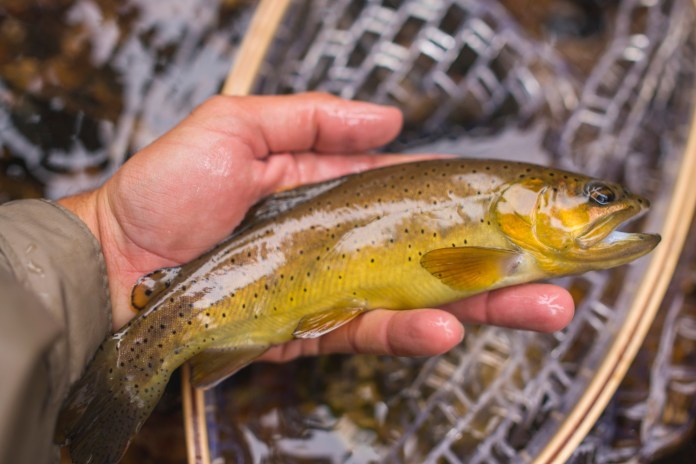
Golden Trout Photo by Cameron Cushman.

The highly sought after golden trout is the smallest of the trout species, and its limited geographical range also makes them one of the rarest. While originally native to California, the species has since been reintroduced to Idaho, Washington, and Wyoming, where they inhabit only the most pristine high-altitude water systems. Golden trout are considered an at-risk species, and have suffered greatly after decades of mismanagement, environmental exploitation, and competition from other species.

Golden Trout Photo: Dan Towsley @dtowsley.

Like the other trout species, goldens feed on an assortment of larvae, crustaceans, and surface insects. However, as the smallest member of the trout family, golden trout rarely surpass 12 inches. As the name implies, these fish truly are golden in their coloration, and can be identified by their vibrant hues. Additionally, a red lateral line highlighted by distinct “parr marks” (usually 10 vertical ovals along the sides) helps to make this trout one of the most visually stunning species on the list.

4. Lake Trout (Salvelinus namaycush) 

Lake Trout. Photo: Oliver Ancans

A member of the char genus, lake trout (or “lakers”, as they’re commonly known), reside in deep water throughout the northern part of the United States. Lake trout are a common and popular sport fish, and are the largest fish in the char family. As the largest char, many fish reach a length of 30 inches and true monsters can pass the 40 inch mark. While most lakers live an average of 20 years, the occasional 50 year old fish has been found. Due to their longer lifespan, these fish mature at a much older age. Because it takes longer for these fish to mature and spawn, lake trout populations suffer a much greater risk of being overfished. 

Lake Trout. Photo: Oliver Ancans

Like other species on this list, the lake trout has a few subspecies within it. However, despite slight variations in appearance, all can be identified by the pronounced forked tail. Similar to other char, lake trout have a dark body and spotting, ranging from dull to vibrant depending on the stage in the life cycle and time of year.

5. Brook Trout (Salvelinus fontinalis) 

Brook trout are known for their insatiable appetites, making this species a favorite among fly casters. Native to the Northeastern region of the United States, “brookies” (as they’re commonly known), have been introduced to the western states as well. A member of the char genus of the salmonidae family, brook trout inhabit a variety of highly oxygenated waters but prefer spring fed habitats lush with vegetation and gravel bottoms. In the Northeast, habitat loss and competition with brown and rainbow trout has forced these fish to higher elevation environments. Out west, the fish has been attributed to the shrinking cutthroat trout populations and is occasionally targeted for kill offs to rebalance native fish populations.

Argued by many to be the prettiest trout of them all, brook trout are unique in their appearance thanks to a unique characteristic called vermiculation. This worm-like pattern adorns the back of many brookies, and is paired with red or yellow spots encircled in a blue ring found along the sides. Lastly, the pelvic fins have a distinct white line that help to round out the stunning aesthetic of this amazing fish. 

6. Dolly Varden (Salvelinus malma) 

A close relative to both the bull trout and arctic char, Dolly Varden are originally native to the Pacific coast of the United States. These fish can be found in the coastal waterways of the North Pacific and are primarily fluvial and lacustrine (meaning they mostly live in rivers and lakes). This lifecycle differs from the Dolly Varden species found further north into Alaska, which migrates from the sea to freshwater rivers to spawn. While both species are native to North America, habitats and life cycles differ dramatically. 

While once considered an undesirable catch, Dolly Vardens now account for a sizable percentage of the fishing yield when Salmon are unavailable. Often mistaken for bull trout, the Dolly Varden’s gray or olive green coloration is often devoid of any distinct markings other than faint yellowish spots running the length of the body. 

7. Bull Trout (Salvelinus confluentus) 

Photo: Reuben Browning, @reuben.browning.

Another member of the char genus, bull trout are a rare and threatened species that exists in only the most pristine water systems of the Western United States. Currently found in Washington, Oregon, Nevada, Idaho, and Montana, these trout are often used as an indicator species for determining the health of water systems. As many bull trout are migratory and thus dependent on unobstructed waterways, the species has suffered from the results of logging, mining, and development. As such, the fish is listed as an endangered species under the U.S. Endangered Species Act. 

In its juvenile stage, bull trout feed primarily on chironomids before shifting their attention to bait fish. Their diet, spawning habits, and environmental demands allow these fish to reach sizes upwards of 41 inches long. However, while many bull trout are indeed anadromous, resident bulls are often significantly smaller. These fish, like brook trout, commonly have tailing white lines on their fins, but lack spots on their dorsal fins. Instead, bull trout often have yellow and orange spots that adorn their backs.

8. Gila Trout (Oncorhynchus gilae) 

Gila Trout. Photo: Trout Unlimited

One of the rarest trout species, the Gila is native to the Gila River tributaries in Arizona and New Mexico. While their geographic range was once wider, the species has been severely impacted by a loss of habitat. Wildfires, water diversion, development, livestock overgrazing and various other ecologically harmful activities have greatly compromised the species, but thanks to USFWS efforts the fish are coming back. Conservation efforts have allowed the Gila to be down-listed from endangered to threatened, with a provision allowing for limited sportfishing access. 

Closely related to the Apache trout, the Gila is characterized by a yellow body with black spots. As the fish primarily reside in small mountain streams, rarely do they exceed 21 inches in length. Gila trout are similar to other species in both their diet and spawning practices, feeding on subsurface insects and most often spawning in spring. 

9. Apache Trout (Oncorhynchus apache) 

Apache Trout. Photo: Cameron Cushman

The state fish of Arizona, the Apache trout is native to the upper Salt River and upper Little Colorado river watersheds of the Grand Canyon state. While it has since been reintroduced to remote Arizona streams, the species remains highly vulnerable to extinction. Federally classified as threatened under the Endangered Species Act, regional conservation groups claim the species is faring much worse. Cross breeding with cutthroat and rainbow trout has significantly weakened the gene pool, while ecological destruction continues to compromise the Apache’s limited habitat. Thankfully, conservation efforts have allowed for the fish to exist in large enough populations, so limited fishing access is permitted. 

Like the Gila, Apache trout have a yellowish gold coloration but are highlighted with a concentration of dark spots spanning the length of their body. The distinguishing feature are the two black spots that appear on either side of the pupil, giving the fish the appearance of wearing a black mask around its eyes.

Article by Jake Lebsack, an angler based in Denver, Colorado.

Beginners Guide To Trout Ethics