Mayfly Outdoors has been named an honoree of 2021 Civic 50 Colorado by CSR Solutions of Colorado and Points of Light, the world’s largest organization dedicated to volunteer service and community impact.
The award recognizes Mayfly as one of the most community-minded companies in Colorado, determined by an independently administered and scored survey. It’s the third year in a row the company is recognized, and one of only two organizations on the Western Slope of Colorado along with Vail Resorts.
The Civic 50 Colorado initiative, modeled after Points of Light’s national program, provides a standard for superior corporate citizenship and showcases how companies can use their time, talents, skills, and resources to drive social impact in their company and communities.
The report is the only evaluation that exclusively measures corporate involvement in communities. Mayfly is best known for its internationally recognized fly fishing brands Abel®, Ross Reels®, and Airflo®.
“Montrose is really important to us, and our goal is to make it a better place,†said David Dragoo, Mayfly’s founder. Mayfly is currently partnering with the Montrose community to restore and enhance nearly 1.5 miles of the Uncompahgre River. The endeavor includes the recently completed Connect Trail comprising nearly 2.25 miles of new walking trails for families and outdoor enthusiasts and preserving over 40 acres of land for open space enhancement and wildlife preservation.
Mayfly was previously recognized by both former Governor John Hickenlooper and current Governor Jared Polis for their positive impact in Montrose. “Our products are manufactured here, and we’re very proud of that,” added Dragoo. The company supports several engineering and manufacturing jobs, and recently expanded into a new, 41,000 square foot facility. The company now employees nearly 120 people worldwide.
Mayfly is also a Certified B® Corporation, a designation the company earned alongside businesses like Kleen Kanteen, Patagonia, and Ben & Jerry’s. Certified B® corporations pass more third-party analysis while committing to using business as a force for good.
The Civic 50 Colorado awards provide a standard for superior corporate citizenship and showcase how companies can use their time, skills, and resources to impact their communities. The Civic 50 Colorado honorees will be recognized during The Civic 50 Colorado Awards on November 9, 2021.
CSR Solutions, a leader in community engagement and philanthropy, is pleased to be the first in the country to bring the nationally revered Civic 50 Awards to Colorado. “Colorado companies, like Mayfly, have invested significant resources in communities to build a strong, resilient, connected, and healthy place for us all,†said CSR representatives. “The impact stories are aimed to inspire us all to support their efforts.â€
For more information about The Civic 50 Colorado and this year’s honorees, visit this link!
Paul Bruun, 77, was recently inducted into the Fly Fishing Hall of Fame at a small ceremony in the Catskills. The annual induction ceremony, put on by the Catskill Fly Fishing Center and Museum in Livingston Manor, NY. Paul Bruun is a storied journalist, fishing scholar, conservationist, and guide, now residing in Jackson Hole, where he has written for various newspapers for over half a century.
Paul is mostly known for his incredible knowledge of fishing and fly fishing. His long-time friend and fishing adventure partner, Yvonne Chouinard remarked on Paul’s knowledge, saying,
“It’s unbelievable. In his head is the entire history of fishing — not just fly-fishing. I think there’s no one else in the world who knows as much about the history of fishing,†he said, “certainly in the United States.â€
Paul has also had a lasting impact on fly fishing equipment design. He’s been one of Patagonia Fly Fishing’s product consultants since 1986 and co-founded South Fork Skiffs, which produced some of the first low-profile, fiberglass drift boats.
Paul was the only living inductee at this year’s event, however, three more names were added to the hall’s walls including, baseball great Ted Williams, Dave Brandt and William Taylor.
To learn more about the ceremony and read more about Paul’s incredible life, check out this article from the Star Herald.
On November 3rd, police in Tillamook, OR responded to a call about an angler who fell into the Wilson River after several citizens reported seeing a body floating face-down in the creek.
From Tillamook PD:
“’A 41-year-old man from Hillsboro was fishing with two friends along the Wilson River, just below Mills Bridge,’ said Deputy Barnett. ‘He decided to cross the river to fish from the other side. As he made his way across, he stumbled and fell but was able to recover and make it to the other side to fish.’
The man fished from the other side for a while and then made his way back across the river toward his friends.
‘He was crossing the river when he reached a deep point, fell over, and got sucked down the river,’ said Deputy Barnett. ‘His friends witnessed the incident and said that he was trying to get back to shore. In that part of the river, the current is actually pushing you away from shore.’
The man was wearing waders, a large backpack, but was not wearing a personal floatation device (PFD).”
The angler’s fishing buddies attempted to rescue the man, but by the time they were able to reach him and pull him from the water, it was clear the angler was dead.
This unfortunate event is a somber reminder to all anglers who like to fish on rivers and streams during the winter to always have a PFD on, or close at hand in case the worst happens. No one ever intends to fall into freezing water, but when you do, having a PFD on will likely save your life.
“Why restrict yourself with an overly bulky, motion-limiting PDF on warmer days and calmer waters? Instead, pick up the Astral Airbelt Personal Floatation Device for low-profile buoyancy and unrestricted paddling on your SUP or canoe. The Airbelt’s sleek design packs 29 pounds of buoyancy, should you take a spill off your board or boat. It quickly inflates by mouth or with the use of a 16g CO2 cartridge. The buckled hip belt securely straps in place, fitting waist sizes between 31 and 50 inches. Additionally, its zippered hip belt pocket handily stores your cash, keys, and snacks.”
“It’s time to push the limits of performance without compromise. Built on a revolutionary 3D chassis, the Mustang Survival Elite 28 Inflatable Personal Flotation Device stays put at high speeds, lets you move the way you want and need to, and provides automatic inflation powered by Hydrostatic Inflator Technology.
The 3D chassis reduces drag at speed, the wide shoulder system eliminates neck fatigue, a wicking mesh liner improves all-day comfort. Meanwhile, dual-side adjusters make it easy to dial in the perfect fit, and an exclusive sleek inflation handle prevents snags. The bright fluorescent yellow-green inflation cell provides 28lb buoyancy when inflated and improves visibility in a rescue scenario.”
“Designed to keep us paddling comfortably, the Ion PFD includes six foam panels to allow increased range of motion for long days on flat to mild water. This low-profile PFD offers a single side buckle for easy entry and features AirMesh inner panels to keep you comfortable all day long. Plus, NRS gave it reflective details to give you more visibility on cloudy days or once the sun’s set already.”
At the foot of the Bavarian Alps, embedded in the postglacial landscape, runs the cold and crystal clear river Traun.
Every year my family enjoys spending our fall vacations in the Chiemgau region with hiking and fly fishing.
Besides fishing in the river Traun, the Förchensee, which is virtually the source of the Traun, also offers a fantastic fishery for rainbows, brown trout, and char.
My son managed to catch this unspeakably beautiful male rainbow on a tiny size 18 nymph on the last day of our trip.
Generally, the fish in Traun and Förchensee are quite picky about their food offers and inspect the patterns presented to them most meticulously late in the season, a grueling affair.
But in the end, the stunning colors and perfect physical shape of these fish are worth a try.
Article and photo from Frank Steinmann, a freshwater ecologist, and photographer based in Germany, follow along with him at @franksteinmann.
The AxisGO underwater housing for iPhone from AquaTech Imaging Solutions is a completely waterproof phone casing that is designed to fit around your specific iPhone Model. It is equipped with a 6″ acrylic dome lens and an optional pistol grip for ease of shooting. The AxisGO is an easy-to-use underwater housing unit that can take your fly fishing photography to the next level.Â
We have been using these underwater housing units for a number of years and find them easy to operate with some basic knowledge. Photographing in the water can create a variety of different scenarios some of which can be problematic for the images. Below you will find a basic guide on how to operate your AxisGO to create stunning underwater imagery for your fly fishing adventures.Â
Step 1: Prepping Your AxisGo for the Water
Before taking your AxisGO out on the water we highly recommend making sure everything is watertight so you don’t soak your iPhone. As you unpackage the product be sure to put the O-Rings to complete the seal on your housing. Close the latch on the housing, making sure you hear an audible click (you have to push harder than you think). Attach the dome, then submerse for 20 seconds without your phone. Once completed, open up the housing to see if any water has penetrated the inside. Then repeat these steps with your iPhone in the case. This is also a good time to connect the Bluetooth of your Pistol grip. After you have the water tested your AxisGO, you are ready to hit the water.
Pro-Tip:Â When attaching your dome to the housing, make sure the dome is extremely tight. Ask a friend to help you to hold the housing as you tighten the dome to be 100% sure that no water or moisture will enter the unit.
Step 2: Hit the Water and Keep the Moisture Out.Â
Wet hands + iPhone = Moisture in the AxisGO.
One very important point to remember is to keep all the moisture out of the dome and the housing. This means while you are on the water store the unit in a dry area and make sure the latch and dome are tightened. It also means to make sure to dry off your iPhone prior to putting it into the unit. If you have wet hands from handling a fish, dry them off before handling your iPhone. The moisture on your phone can create just enough humidity in the unit to cause the photos to come out a little blurry (see photo above).
Step 3: On the Water Cleaning:
Prior to taking any photos, make sure that the exterior of the dome is clean of all debris. A quick microfiber cloth mixed with a cleaning solution like a lens cleaner will work best. If you are in a pinch, saliva will also do the trick. Be sure to be aware of the water drips on the dome and dip in the water if you want to clear some of the water droplets.
Step 4: Take Photos
Once your iPhone is securely placed into the housing, it is time for the magic to happen. Below you will find various different tips we have discovered when taking photos with the AxisGo.
Photo Tip #1: Dial in Your iPhone Camera Settings
We have found that setting your iPhone to “Live Photo” can work well for non-static subjects like fish. After the fact, you can go through the live photo and pick which frame you prefer. Instead of one frame, you get many.
A few settings we like include putting the iPhone to ‘Auto-Lock’ to never. This makes the screen not lock while you are trying to photograph. Another setting is to set the Display & Brightness to Auto-Lock.
Photo Tip #2: Let the Turbidity of the Water Settle
Different water will have different turbidity. Whether you are fishing a sand flat, mid flat, rocky bottom, or silty bottom it will all look a little different in photos and impact the way your image looks. Any sort of footsteps will often stir up the river or lake’s bottom causing debris to float around. When you are using your AxisGo, let the turbidity of the water settle before photographing and do your best to limit movement. If the photographer steps upstream of the angler the debris will often be swept downstream away from the subject.
Photo Tip #3: Use the Sun to Your Advantage – Change Your Shooting Angle Based on Sun Direction
The sun plays a big factor in how the water will look in a photo. If you were to go out early in the morning and evening during the golden hour and try to shoot underwater photos, they would most likely come out very dark. So strictly for AxisGO underwater photos, seek out sunlight. This light will be penetrating the water creating light in the water that will bring your photo to life.
Be aware of where the sun is and change the shooting angle based on this. Every piece of water will be different as they vary in clarity so mess around a little bit when you are out on the water and take a few photos with the sun at your back and then switch to see the difference.
Photo Tip #4: Use the Wide Angle Setting on Your iPhone
Specifically, when you are photographing fish, use the wide-angle setting on your iPhone. This will make the subject appear both wider and taller while keeping most everything in focus.
Photo Tip #5: Tap Your Focus Point
When you are taking underwater photos, one helpful tip is to tap the focus point. Whether that may mean clicking the underwater fish in the frame or clicking above water to focus on an angler or boat. Your iPhone will do a decent job at picking a focal point but to be sure you are getting the correct subject by clicking the screen.
Photo Tip #6: For Video Use the Slomo Setting
Filming a fish release with AxisGO is 100% recommended!! The AxisGO is a great tool to capture a fish release, be sure to set your video settings onto the slow-motion setting. More often than not the fish will swim away as fast as it can, so the slow motion setting of your iPhone will capture the whole sequence. After you have filmed the video, go to the settings of the video and alter the slow-motion sequence to focus on a specific part of the video.
Step 5: Storing Your AxisGO
After a day on the water with your AxisGO, you will notice a little bit of moisture may have gotten inside of the dome and housing, especially if you go from the wet and cold to the dry and warm. Open up the AxisGO in a cool dry space to let it dry out for use the next day. Do not leave it in your bag overnight especially if it was a rainy day. And if you did use it in the saltwater, a freshwater rinse is necessary.
There you have it, hopefully, these tips outlined above will help you get familiar with how to use the AxisGO. It is without a doubt a super easy tool that gives almost anyone the ability to take amazing underwater photos. If you have yet to purchase an AxisGO be sure to check out our previous Gear Review: AxisGO Waterproof Case for iPhone.
Last year we spotlighted knife maker Joe Mangiafico, who makes hand-crafted, trout-themed blades. Though Joe isn’t taking any more orders this year, you’ve still got a chance to snag one of his custom creations. Joe has contributed a special edition knife series to Science on the Fly for its annual fundraiser auction.
Photo Courtesy of Joe Mangiafico
In an Instagram post on November 4, Joe said, “Science of the Fly is an awesome organization through Woodwell Climate Research Center and Fishpond that enhances river health through their citizen-scientist program and their lab at the research center.” “If you’re passionate about conservation and the outdoors, go give them a follow and check out the fundraiser,” he said.
The auction closes on December 1, so be sure to place your bids before November is gone!
It’s that time of the year again, the browns are spawning, the temps are dropping, the rutt is on and we are left with remembering the days of the hopper-lined banks. Well luckily for us, our daydreaming can come to an end as the boys over at the Blue Line Co. have given us something we didn’t know we needed, The Trout Masters. So sit down and enjoy as we join Adam and Steve on the 18th hole staring down a doozy of a par 4 dogleg left.
Check out the rest of their stuff here: bluelineflies.com. We have to assume we probably aren’t the only ones here hoping to see the remaining 17 holes in the future so keep an eye out for those as well!
If you’ve been following environmental news over the past few years, you’ve likely heard stories of the Great Pacific Garbage Patch that circulates at sea formed from decades of plastic debris. A few years ago, an ambitious start-up, the Ocean Clean-Up Project, launched with the goal of removing 90% of the plastic waste floating in the ocean by 2040. Although the project took a few years to launch its prototype fleet of autonomous cleaning vehicles, a recent test run has proved the viability of the project as a whole, when one of their vehicles successfully removed 20-tons of waste. Those 20 tons are only a third of the total 65 tons that were removed during the prototype phase.
October 8th, 2021: the final test extraction of System 002, and the moment we knew that cleaning the Great Pacific Garbage Patch is possible. pic.twitter.com/79e1SiNz4h
The CEO of the Ocean Project tweeted this in response to the success of the final test run:
20000 lbs was just a single haul, total for test campaign is ~64000 lbs. But goal of past weeks was data collection, not plastic collection. That’ll change after next week… https://t.co/U42tBqcesj
In this week’s “How to Tie†video feature, Charlie Craven shows us how to tie a fly that should be a staple in every mayfly box, the RS2.
Difficulty: Easy
The RS2 is a versatile mayfly created by Rim Chung that can be fished as a nymph, emerger, or dryfly. This version tied by Charlie Craven employs synthetic materials over naturals that Chung originally used. These substitutes can offer better durability, availability, and cost efficiency, while not affecting the fly’s profile. Fall offers an exceptional opportunity for imitating small mayflies, which is why the RS2 is typically tied from sizes 16 to 24.
Varying sizes and colors of mayflies on your unique water should influence your time on the vise. Attempting to understand a pattern in hatches and bringing this knowledge to the vise to imitate size and color accurately will pay dividends on the water. Tying the tails into this fly may be tedious and frustrating but having them separated is very important to profile. Selecting various dubbing colors allows for a wider selection of imitation and is highly encouraged.
Pairing the RS2 with the correct weight for your desired presentation is very important. Floatant can be utilized when fishing this fly as a dry but depending on where the fish are feeding subsurface will determine the necessary splitshot. Changing leader size and length will also affect how your fly sinks and adjusting both methods as needed will inevitably produce fish. Having various sizes and colors of the RS2 in your fly box will enable you to match the hatch the next time you are on the water this fall.
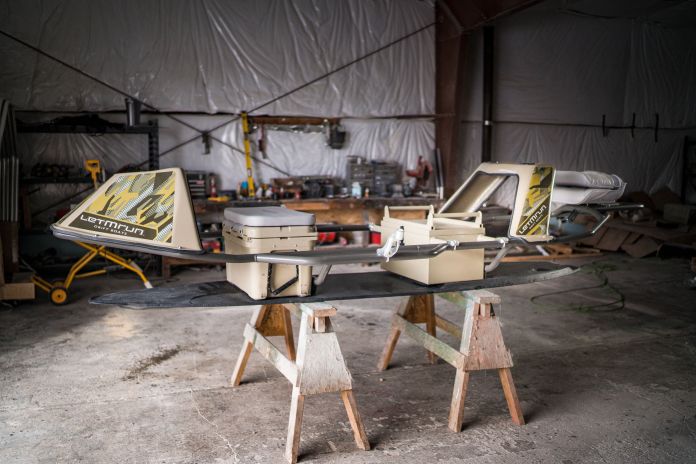
The newest advancement in fly-fishing raft technology is officially here. Derived directly from the minds and guides of Teton Valley Lodge, and designed on the lodge campus itself, comes the LETMRUN Raft. Designed for the angler who can’t be bothered with physical barriers to angling, this raft was engineered with the harsh conditions of Idaho’s waters in mind. Built by guides, for guides, the LETMRUN boat is a testament to toughness and has been a staple of TVL’s fleet for years. NOW, these rafts are available to the public – and we couldn’t be more excited.
“The LETMRUN concept began to take shape in the late 1990’s as we started to explore alternative boat options for our guides. The appeal of the modern drift boat structure was high, yet we constantly wanted to explore new sections of river that would not allow for drift boat access. The lightweight body of rafts allowed for this exploration to take place but there was one major problem.
The metal frame structure of the raft was not comfortable for our clients and thus, the fishing quality was suffering. That’s when it clicked: how can we take the lightweight, durable body of a raft and combine it with the solid, spacious structure of a drift boat? Cutting out the base of an old drift boat by hand, TVL Owner Brian Berry dropped this fiberglass base inside the body of one of his rafts. This became known as Prototype #1 of the LETMRUN boats.
Over the past 20 years, guides began to take notice of the versatility of this boat and were requesting to guide with it more and more. The TVL staff began building more of these models, perfecting one aspect of the boat during each build. Eventually, 20 years later, we have the first model ready for commercial use, and it boasts every feature you could possibly want for a day on the river.”
Inside the LetMRun Boat:
The extremely light and powerfully-durable frame allows for the ultimate transportation experience to and from the water. Take friends & clients alike to previously unreachable places with our completely overhauled design and attention to (weightless) detail. Complete with comfort-driven fiberglass knee braces, cup holders, and a firm casting platform, the LETMRUN drift boat was built to take you everywhere you’ve never fished. Clients will enjoy a spacious design base and the ability to bring everything you need for a day on the water, all while keeping your gear completely dry.​
Last April, we laced up our boots and headed West to Driggs, Idaho to visit our friends at Teton Valley Lodge. There, we met with TVL and LETMRUN founder, Brian Berry, and his team of guides turned engineers, to learn everything there is to know about the new LetMRun Rafts.
As dust and sparks flew from the sanders and drills surrounding the workshop, we watched in amazement as these boats were constructed from scratch by the very guides who would be using them for their own clients. Once we had a finalized frame, we synched it down to an NRS Super Puma and slid it onto a trailer in preparation for a chilly day on the river.
Towing a LETMRUN raft on the asphalt with a snowmobile? LETMRUN can handle it…
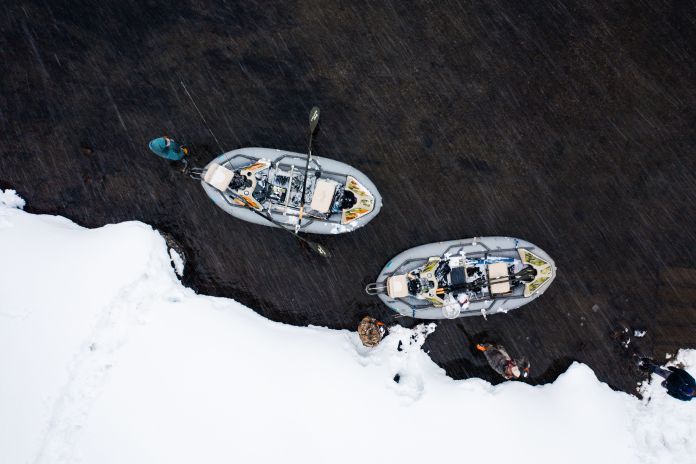
What would have traditionally been a typical day on the water, turned into an adventure like no other as we unloaded the trucks and trailers, then proceeded to strap the LetMRun Rafts to the back of snowmobiles (or if you’re from that neck of the woods: snow machines). In a relentless onslaught of wind and powder, we towed the rafts over miles of snowdrifts over 5 feet tall in order to get to the river.
From there, it was time to buck up, throw on some gloves, and say a prayer as our fleet cruised down the Henry’s Fork. Between bobbers being sucked under the riffles by fat rainbow trout, and technical boulder dodging that had one feeling like they were piloting a WWII Hellcat down the river, we were enjoying one hell of a day on the water. Finally, after pulling the boats out of the river and through semi-impenetrable walls of snow, we all loaded the boats back onto the snowmobiles and headed back to the lodge.
What we put these rafts through in just a few days of testing would have most other boats peeling apart at the keel. However, due to the ingenuity of their design and a demand for toughness, the only thing that needed repairs by the end of our trip was our expectations. Check out the full video documenting our time there, HERE.
Flylords Director of Photography, Max Erickson, braving the elements and deploying a trash bag to protect our camera.
To elarn more about how you can get your hands on one of these one-of-a-kind rafts,Click HERE or send an email to: letmruntvl@gmail.com. To learn more about Teton Valley Lodge, and where LETMRUN was inspired, Click HERE. Thank you to TVL owner Brian Berry, TVL Marketing Director, Charles Warren, and the TVL staff that made this video project possible!