Home Blog Page 92

YETI 2022 Film Tour Is Underway!

The YETI 2022 Film tour is well underway debuting a collection of seven never-before-seen YETI Presents films, showcasing inspiring tales from the wild. All proceeds from ticket sales will benefit various conservation groups dedicated to preserving the outdoors, including: –

“The wild is where we rediscover our purpose and share experiences that bring us closer together,” said Paulie Dery, CMO at YETI. “After two long years apart, we look forward to joining our communities to enjoy these films, celebrate the outdoors, and support organizations working to preserve the wild for future generations.”

The remaining 2022 YETI Film Tour stops are:

  • Friday, June 10: Denver, CO at Mission Ballroom @ 7:30pm
  • Thursday, June 16: Brooklyn, NY at Brooklyn Steel @ 8:00pm
  • Wednesday, June 22: Portland, ME at Thompson’s Point @ 8:00pm
  • Thursday, June 23: Boston, MA at The Wilbur @ 7:30pm
  • Thursday, June 30: Chicago, IL at Thalia Hall @ 7:30pm
  • Tuesday, July 12: Miami, FL at North Beach Bandshell @ 8:00pm
  • Thursday, July 14: Charleston, SC at Charleston Music Hall @ 7:30pm

The 2022 YETI Film Tour marks the brand’s third and largest multi-stop film tour yet. Each stop will feature YETI gear giveaways and special guest appearances by partners, friends of the brand, and YETI Ambassadors – those who represent the best of the best in their outdoor pursuits. Attendees will also receive a complimentary piece of customized YETI drinkware fueled by TINCUP Whiskey, the partnering sponsor for the YETI Film Tour, with each ticket purchased. Tickets are available now at www.yeti.com/filmtour and range from $25 to $40 based on tour stop locations. For more information on the YETI Film Tour, visit yeti.com.

Faces of Fly Fishing: Kayla Lockhart

Kayla Lockhart (@kayla__lockhart) is a name familiar to most fly anglers who pay any ounce of attention to the fly fishing community on Instagram. Her energy is second to none, and she has spent her entire career in the space working to promote inclusiveness, inspire future conservationists and anglers, and bring an element of transparency and optimism to the sometimes dark world of Instagram and fly fishing social media. We’re lucky to call Kayla a good friend, and were ecstatic to sit down with her and add her name to our list of “Faces of Fly Fishing“. Check out our interview with Kayla below!

Flylords: Who is Kayla Lockhart? Tell us a little bit about yourself. Where are you from? What are your home waters like?

Kayla: I was born and raised in a small town in Minnesota, and left to head west to Oregon in 2015 and Portland has been home for me ever since. My home waters range from the high desert, sage-filled terrain of the Deschutes to countless fern engulfed coastal rivers.

Flylords: What is your earliest fishing memory? Earliest fly fishing memory?

Kayla: The earliest memory that stands out was fishing with my snoopy pole in my dad’s old aluminum boat for bass, pike, and crappy (and hooking him in the back of the head) … and it wasn’t until I was 24 that I picked up my first fly rod, and caught my first midwest brown trout in a tiny stream, and never turned back.

Flylords: If you could only fish for one species for the rest of your life, what would it be?

Kayla: Bass – I effin’ love fishing for bass, it is what I grew up fishing for, it has the perfect balance of nostalgia and adrenaline and is never mundane – you can fish for them swinging, stripping flies, dry flies, poppers… it never gets old for me.

Flylords: You’ve been involved with fly fishing social media since it began changing the landscape of fly fishing with the advent of Instagram. What has it been like to see the platform and the community on it change?

Kayla: I have seen both sides of social media and fly fishing and I choose to utilize it to share my experiences on and off the water, by speaking up and advocating for our waters that need the amplified voice, great causes that are happening all around us, to get people to look at the outdoors in a different perspective and get more people to care about something that means so much to me…

The more people we have that feel as passionate about this sport as we do the better of a chance we have at protecting the resources that are such a keystone for everyone.

Flylords: Do you think the shift is for the better or worse? Why? How?

Kayla: The shift that I have followed in social media and the outdoors is for the better – I am seeing a more diverse outdoors, a more inclusive outdoors, and both of those things to me mean that we will have more knowledge and education brought into the sport to further a deeper connection and perspective of something that we all care about and with that can lead to some incredible changes for the good in this sport and within the lands and waters that need all the support and voices it can get.

Flylords: How have you dealt with balancing real life with the persona you show on Instagram?

Kayla: The real life and persona on IG really are not that different – I am incredibly transparent and share my true self within my Instagram.

When I am having a tough day,
I share that…
When I am dealing with anxiety and depression waves,
I share that…
When I go on a road trip and fish new waters and I am excited about discovering them,
I share that…
When there is a drop in steelhead numbers and there is a chance to step up and speak to the people in charge of managing that,
I share that…

I truly give myself to my social media and the support I receive I will forever be grateful for – the biggest struggle in balance for me personally is that I tend to give too much and need to recognize checking in with myself.

Flylords: Are there any life lessons that you have learned via spending time on the water?

Kayla: The first time I stepped out into a river with a fly rod in my hand was the biggest life lesson I have ever experienced… I found something that I can do outside myself, that gives back to myself. It has helped me find a community of people that I care deeply for and has helped me navigate so much in my life mentally.

Flylords: You were on the leading edge of the “50/50 on the Water” movement in fly fishing when inclusion in the industry and sport began to get much-needed attention. What progress in inclusion in fly fishing have you seen over the years? What do you think still needs to be done?

Kayla: It has been incredible seeing more women getting into the sport, I fully support that and love to see it. With that being said there is plenty of space in this industry to further the inclusion above just women in the sport. We still lack a “welcoming” embrace in this industry, there are still egos that can be broken down in the fly fishing culture, and I hope to be able to see those changes happen.

Flylords: How do you hope to see the industry change in the coming years?

Kayla: I would love to see a more open, and diverse industry – a more educated industry, an industry that is full of people from all walks of life that are fueled by the same thing – a love and passion for our lands and waters that give us the opportunity to do something we love, fly fishing – with this we can have a better chance at protecting and advocating for the fisheries.

Flylords: You’ve worked closely with the Mayfly Project for many years. What brought you to the program? Why is it important to you? How can folks get involved with the Project themselves?

Kayla: The Mayfly Project is something that will always be close to my heart – if it wasn’t for the mayfly project my story never would have even remotely been told. I am forever grateful for them. The May Fly project is changing kids in foster care lives, they are giving these kids a space and resources to heal and growing up with a rocky road childhood this cause means the world to me – having just one mentor affect a kid positively can change their outlook for the future and that to me is a powerful thing and has humans we can all do…. You can get involved easily by going to TheMayflyProject.com.

Flylords: Mental health is a topic you talk about a lot on your platforms, what role has fly fishing played in maintaining your mental health?

Kayla: Fly fishing has been the first thing that I have encountered in my life that gave me an opportunity to be present and look inward and help me discover things about myself that I never chose to accept, and with that came a community that I found that can relate and not feel alone while navigating mental health, and mental health awareness is incredibly important, the more we are open with it and discuss it the more connected we are with ourselves and our communities.

Flylords: Your love of vintage Americana is pretty well documented on your social media. What attracts you to previously loved decor and clothing? Do you have any vintage fly fishing gear?

Kayla: Oh man!! I could have an entire discussion just on this alone! Since I was a kid I would go to garage sales, thrift stores, and estate sales – I grew up without much means and these are just the places we would shop and I would find myself reworking and putting together vintage pieces that were one of a kind…and that never stopped as I got older. As an adult this is equally just as consuming in my life – Not only is it more sustainable to give life back into an old piece but the heritage and stories that can come with it are something I admire and love to learn about…and I also just simply love the way things were made back then.

Flylords: What’s next for you in 2022?

Kayla: Just going to keep on fishin’, keep on explorin’, keep on teaching and learning as much as I can and hopefully continue to never get jaded.

Video of the Week: In Search of America’s First Trout “For Wild’s Sake” Episode 5

In this Video of the Week, we catch up with Chase and Aimee of Tight Loops on their newest episode of “For Wild’s Sake” which explores human beings’ relationship to the natural world. In this particular episode, Chase and Aimee are in the southwest for the spring pursuing some of America’s oldest and most unique cutthroat trout. From Arizona to New Mexico they chase after the elusive and rare Apache & Rio Grande Cutthroat.

“Curious about what’s going on with our series For Wild’s Sake? Well, we’ve got some answers. We’ve also got a little early season fly fishing for cutthroat in one of the most unlikely places…the red rock deserts of Southern Utah.”

After being sick for a large majority of last year and unable to film and adventure Chase and Aimee are back on the road and in pursuit of their next native fish. So keep your eyes peeled for more amazing content down the line from these two! Make sure to follow along here: tightloopsfly because you won’t want to miss out!

Check out these other epic articles as well!

Video of the Week: Patagonia Spring Creek with Jensen Fly Fishing.

Video of the Week: For Wilds Sake: The Rare Trout Chronicles by Tight Loops

Throwback Video of the Week: Tight Loops “Northern Exposure”

Angler Story of the Week: John & Kasix Sherman

A note from @johngsherman

“I have been chasing Delta Carp for 15 years now and it has been an incredible journey. I was out with my 11 year old son @kasixsherman on a glorious May day. It was all about him and he had just landed a 14 pound Delta Carp. Kasix was stoked and said “Dad you’re up!”

Kasix Sherman with his 14 pound Delta Carp.

“I grabbed the rod and stood on point. Thirty seconds go by and this giant comes cruising down the edge coming right at me. It’s crazy to see how with the turn of the tide they can go from lockjaw to eating almost any well-presented fly pattern. Fortunately, I was on the right side of the tide and she gobbled it up. After a 10 minute battle, she was in my hands. My largest Delta Carp to date, weighing in at 32lbs. I was mind boggled since I have seen fish nearly twice this size. Some day I plan on sticking on of those!”

John Sherman with his 32 pound Delta Carp.

For more tips and tricks targeting Delta Carp check out the article below:

Our Favorite Carp Flies

Lanternflies: Squash ‘Em, Report ‘Em, and Fish ‘Em!

As quickly as spring mayfly hatches come, they disappear just as fast, leaving us thinking about summer fishing with terrestrials. As a seasoned fly angler, I’ve thrown this term around in the past, thinking that it is just another common word. In reality, most people don’t know that terrestrial refers to an animal that lives on land as opposed to living in the water. Think of land insects instead of mayflies (and actually mice, fall into this category as a fun aside). If you are located out west, this is an exciting time filled with jumping grasshoppers. On the east coast, we do not have an endless, dependable hopper hatch and we think more about flying ants, beetles, and cicadas than grasshoppers. But in the past few years, a new invasive species has appeared that has offered an interesting new fly option during the dog days of summer; enter the spotted lanternfly (SLF) invasion.

A Lantern What?

Lanternfly
Adult lanternflies sporting grey overwings with black dots. Photo courtesy of @fishingwithaphd

While the spotted lanternfly was first detected in Berks County, Pennsylvania in 2014, I’ve realized over the years that most fly anglers, even those on the east coast, still have no idea what a spotted lanternfly is. The most common question is about the name. Spotted lanternflies are very different than lightning bugs. Even though they have “lantern” in the name, they do not produce any light. Their name comes from two, bright, red/crimson colored hindwings that lie underneath grey forewings with large black spots. When they fly, the red underwing produces a lantern-like appearance. If the bug itself was not so horrific, its beauty would probably be treasured. They are also 100% harmless to humans lacking the ability to bite.

But, do not let its harmlessness and beauty fool you. Lanternflies are bad news in terms of the environment and economy. Lanternflies eat everything in sight and they have their siphons set on the east coast. They love grapevines, fruit trees, soybeans, and many hardwood trees. Adults sport a large siphon that they use to suck the sap and life out of any tree they call home. So, say goodbye to your fine wine made from grapes or lumber made from hardwoods. In its wake, lanternflies leave behind a clear, sticky sugary waste (referred to as honeydew) that fosters the growth of a black fungus called sooty mold. For humans, this is just an annoyance as it blackens siding and patio furniture. But for plants, it is a future death sentence by blocking photosynthesis.

Just like the coronavirus, stopping the spread of lanternflies is crucial. Promotional campaigns are littered all throughout the east coast urging people to check for hitchhiking flies or egg masses, and literally “stomp them out.” You are urged to kill any lanternfly you come across. These lanternflies are clumsy fliers and resort to hopping to get around most places. It is quite satisfying to eradicate these flies but, in some valleys, or places, like the city of Philadelphia, it is nearly plague levels. Taking these promotions seriously would leave a person stomping for hours if not days.

To stomp the spread, briefly understanding the life cycle of lanternflies is key. The life cycle itself is no surprise to the astute fly fisherman. They begin as a nearly invisible egg mass that resembles a pale grey lichen seen on the sides of trees. Come winter, these sacks present the largest possibility of spread. The egg masses have been found on stones, trees, firewood, and even cars. In some places, travel quarantines have occurred due to infestations of egg masses and lanternflies. After hatching, lanternflies proceed through four immature nymph stages called instars. All these stages are wingless and the bugs hop around. These instars occur from May through July with each stage getting bigger and bigger. Come July, adult forms are reached and mating rituals begin.

Lanternfly trap captures hundreds of immature instars
A Lanternfly trap has captured hundreds of immature instars that have infested this tree. Photo courtesy of Jason Pitarresi.

The Silver Lining? Fish eat them!

As said previously, lanternflies are clumsy fliers, similar to stoneflies. With a stiff wind and their gliding abilities, it is no wonder that they end up in waterways. It is even more amazing, how quickly fish can zero in on new prey. We have seen this several times with spruce moth populations in the western Rockies, and the boom of Japanese beetles here in the east.  It did not take a rocket scientist to realize what would happen as lanternflies spread throughout the east coast and find themselves stuck in some fishy water. This is indeed the silver lining for us fishermen and while I wish they never came to the USA, we may as well try to eradicate the problem whilst taking advantage of the situation.

A wild brown that clobbered a lanternfly pattern tied by Rob Gentry
A brown trout that clobbered a lanternfly pattern tied by Rob Gentry. Photo courtesy of @fishingwithaphd

I do not think that matching the hatch is all that important in regard to lanternflies. A large black foam body with a red underwing should suffice. However, if you wanted to get intricate there are a few patterns that are just as eye-catching to the fisherman and the fish. Pennsylvania local Jayson Mumma’s pattern uses JS realistic nymph legs, a foam body, a red hen saddle hackle for the underwing, and some rooster neck feathers as over wings. If you want to get even swankier, use great argus spotted back feathers as the over wings. Last year, we had the incredible (or subpar depending on who you ask) Brood X cicada hatch with a black and red body, a similar palate to lanternflies. I would not be surprised if a trout mistook a lanternfly pattern for a cicada pattern or vice versa.

Adult lanternfly (left) next to a skillfully tied rendition (right) sold at Holsinger’s Fly Shop in Pennsylvania. Photo courtesy of @shawn_holsinger

Dry fly fishing is usually a subtle art form. However, lanternflies, cicadas or stoneflies for that matter, are not only incompetent fliers, they are large bugs. Most are upwards around an inch long. And that means, with a big gust of wind, these bugs fall from the trees and land in the water with a substantial splash. Therefore, forget the finesses of trying to set that dry fly down without disturbing the water, and cast these large flies with a fat splat. This is the best part about fishing these flies and the touchdown is typically met with an explosive eat!

They are Here to Stay

I wish I could give some scientific evidence that lanternflies are going away. But just like COVID, it comes in waves. 2020 was a wild year for lanternflies with them littering the streets all over the tri-state area. 2021 was a bit milder. Still, they are spreading all over the east coast and these SLFs have been found in New Jersey, New York, Ohio, Connecticut, Maryland, Delaware, Virginia, and West Virginia. Time will tell what 2022 will bring.

But for now, we can do our part, and stomp out any lanternflies that come in our path. Please kill any lanternfly you come across. And please report lanternflies if they are in an area that has unreported cases. And lastly, revel in the fact that lanternflies do not bite us or spread disease. They may not be good news but they certainly open up the possibilities for some dry fly fun!

Feature photo courtesy of John Fallon.

2022 Cheeky Schoolie Tournament Recap

For the past 11 years, the Cheeky Schoolie Tournament has been an event glued on our calendars. For many anglers, it marks the beginning of their New England striper season, and for others, it’s a chance to gather with fellow striper fanatics on the Cape before the high-summer season begins on Memorial Day Weekend when the beaches fill up with sunbathers and crowds.

1st Annual Striper Symposium

On the Friday before tournament day, dozens of industry representatives, advocates, and conservation partners gathered at the Cape Cod Conference Center for the inaugural Striped Bass Science Symposium. The American Saltwater Guides Association, along with Costa Sunglasses and Cheeky Fishing’s support, hosted the full-day event. The overarching goal was to teach those with large audiences how to be effective advocates for conservation, striped bass specifically, and to highlight recent and upcoming research efforts. 

The day started with a catch and release mortality experiment by Keep Fish Wet. Post-release mortality for striped bass is a substantial component of the fishery’s total removals, and angler education is one of the leading methods for lowering that number. Keep Fish Wet recommends limiting a fish’s air exposure to 10 seconds or less—or you know, leaving fish in the water, unless absolutely necessary!

From there, participants went to the conference center to hear from ASGA’s team, Biologists from the Massachusetts Department of Marine Fisheries, Sacha Danylchuck from Keep Fish Wet, Backcountry Hunters & Anglers, and Costa Sunglasses. ASGA opened the Symposium by discussing how and why ASGA formed—the resource-first, precautionary voice was not an influential point of view within the recreational fishing community prior to ASGA hitting the block. ASGA’s John McMurray along with Mike Woods and Chris Borgatti of Backcountry Hunters & Anglers provided a recap of Amendment 7, which was a tremendous victory for striped bass conservation. The highlight of the day was Massachusetts DMF’s presentation on their striped bass tagging research. Without getting into too much detail/technical jargon, they found that striped bass have strong tendencies to go back to the same areas each summer. This has management implications too, which the DMF Biologists are still working on. A video of the presentation and the entire symposium will be up shortly! 

American Saltwater Guide Association’s Executive Director Willy Goldsmith (left) and VP/Policy Director Tony Friedrich (right)

Next up was a presentation on utilizing social media to enact change. While social media is often castigated as overcrowding fishing spots and threatening the delicate balance of our living resources, it can also be used to educate new anglers and advocate for important causes. It’s an important distinction because love it or hate it, social media isn’t going anywhere, so let’s use it as best we can.

The final agenda item was ASGA’s, where they announced a False Albacore tagging research project, with support from Orsted, an offshore wind developer. The scientific and angling communities know very little about this species—migrations, stock complexes, catch and release mortality, you name it. Yet, albies are an almost exclusively recreational catch and release species, so the hope is that this research can inform the sustainable management of this economically important species. All in all, it was an engaging, interesting day for striped bass conservation, and was great to hear from those leading these efforts. 

Costa Captains Party

Last year, the biggest thing we missed were the legendary in-person events that the Cheeky tournament is famous for. This year’s tournament was the first with in-person events since 2019, due to the COVID-19 Pandemic. This year, Cheeky adopted a hybrid model, hosting in-person parties and hosting virtual events to make sure every competitor felt safe and healthy during the weekend.

The Costa Captains Party felt like a return to form for the tournament. All around, the New England and mid-Atlantic fishing community came together to talk about all things striper and to share their anticipations for the 2022 striped bass season. Thankfully for our heads and health, this year’s party was far tamer than previous years, which made for an easy wake up during the coming fishing day.

Tournament Day

Costa’s Caley Smith launches a cast into a channel on the Bass River.

If you were hoping for a tale of big fish and a podium finish for Team Flylords, you should probably just skip to the next session. Although we did post points on the board this year, we were once again beaten out by teams with far more experience and competitive drive than us. However, we did have an excellent day on the Cape, managing to score a total of 69 inches (nice) and secure our spot as #71 on the leaderboard out of the 108 teams in the field.

Late-night tying sessions are a tradition the night before the tournament day.

The tournament day started as it usually does, with a groggy 4 AM wake up after throwing back one too many All Hands at the Costa Captains’ Party the night before. Luckily for everyone competing, the weather and conditions were ideal with high sun, low winds, and warm temps.

Our team headed to our tried-and-true spot where we had landed plenty of scoring fish while checking spots earlier in the week. Unfortunately for us, overnight high tides combined with about an inch of rainfall killed the bite that was hot throughout the previous week. We managed to land three scoring fish, fill two sets of waders with marsh water and successfully get ourselves to the wrap-up party going on back in Hyannis.

The Cheeky After Party

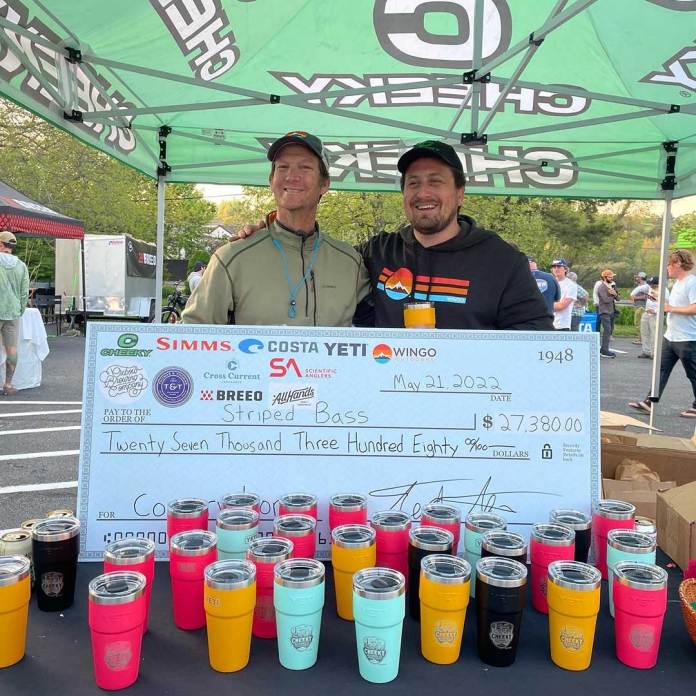
The Cheeky Schoolie Tournament raised over $27,000 supporting striped bass conservation!

During a typical year, the tournament after party is traditionally the event where competitors loudly share the stories they collected during their day on the beaches, rivers, and flats of the Cape. This year was no different, throughout the evening, Cheeky held their hotly anticipated Virtual Tournament Raffle with the proceeds going to further support striped bass conservation on the Atlantic Coast.

Leaderboard

1 – Playing Hookie – 116 inches
2 – Team Jones – 112.5 inches 
3 – The Harpoon Willies – 112.5 inches
4 – Lansing Brothers – 110.75 inches
5 – My Fishing Cape Cod – 110 inches

See the full 2022 Tournament Leaderboard, here!

You can learn more about the Cheeky Schoolie Tournament, here!

Court Orders Hatchery Release Smolts into North Umpqua

On May 19th, a Circuit Court Judge ordered the Rock Creek Hatchery, on Oregon’s famed North Umpqua River, to “voluntarily release” 70,000 hatchery summer steelhead smolts. The North Umpqua is one of those famed wild steelhead rivers that you’ve likely heard lots about. Its runs of wild winter steelhead–when no stocking occurs–have held fairly consistent in recent years, whereas last year the North Umpqua’s summer run was so low that the Oregon Department of Fish and Wildlife closed the North Umpqua summer steelhead fishing season for the first time in history. Earlier this spring, the ODFW , announced it would terminate its summer steelhead hatchery program on the North Umpqua River.

Then a Legal Challenge

  • The decision to terminate the hatchery program was challenged by Douglas County, Umpqua Fishery Enhancement Derby, Inc., and fishing guide Scott Worsley.
  • The Circuit Court Judge granted injunctive relief for the petitioners–the Court ordered the hatchery to voluntarily release the smolts, while the case continues.
  • “The timing of this release is critically bad given the hatchery fish are now on top of the offspring of the lowest NU Summer run in history,” said Dave Moskowitz, Executive Director for The Conservation Angler.
  • According to steelhead scientists, this voluntary release is likely to negatively affect wild steelhead rearing on the North Umpqua. Also, because of the release’s timing, survival of the smolts is likely to be very poor and increase competition with wild steelhead smolts.
  • When asked for comment, ODFW added, “The court order requires smolts that don’t migrate to be transported outside the range of summer steelhead rearing habitat to minimize risk of the smolts competing with wild juvenile summer steelhead in the river.”

Time will tell what the effect of this decision is. But again, the North Umpqua is one of the most productive wild steelhead rivers, yet it required an emergency angling closure last season. Hatcheries have their place, but when they have negative effects on dwindling populations of wild stocks, controversial decisions will be necessary.

Reel of the Week: 5 Seconds into the Backing with Alexandra Spring

In this week’s section of our Reel of the Week, we take a deeper look into a video that was posted by Alexandra Spring (@alexandra.spring).

A note from @alexandra.spring

“For the past five months @cjpeppe, @ed_walker_sportfishing, and myself have been chasing records on a fly rod targeting offshore species. On our way to another spot, we came across a large school of Amberjacks. After sizing the school up we played around with a few and @cjpeppe was lucky enough to hook what would soon become the all tackle fly length world record Amberjack. The Amberjack’s initial run was incredible and got everyone’s blood pumping. After a ten minute plus fight, we were able to capture everything we needed for the International Game Fish Association (IGFA), submission process and CJ released his record fish at 36 inches completely unharmed.”

@alexandra.spring

Into the backing in under 5 seconds! 😂 #fishing #flyfishing #amberjacks #catchandrelease #flytying #ajs #fyp #offshorefishing

♬ original sound – alexandra.spring

To check out CJ’s record Amberjack, click here.

For more information about Amberjack fly fishing and yellowtail fishing check out the article below.

Winter Yellowtail on the Fly

Costa Behind the Guides: Jeff Feczko

Jeff Feczko is a Renaissance man. He can repair outboards, has a USCG 100T captains license, is working on a pilots license, seafood cook extraordinaire, freediver, fishes for sustenance, award-winning fly tyer (IFTD best saltwater pattern 2022), and built like a miniature Roman sculpture, and the list goes on.

And then there are roosterfish. Jeff’s mom once said to him referring to roosterfish: “I think you have an internal sense for those things. I don’t think you just see them. You feel them.” On top of that, revered Montana guide, Dan “Rooster” Leavens, said of Jeff, “If you split Jeff’s head open with an ax, no doubt roosterfish would come spilling out.” We are excited to add Jeff to our ongoing blog series “Behind the Guides” presented by Costa Sunglasses. Check out the full interview with Jeff below. 

Flylords: At what point in your life did fishing start to play a greater role? 

Feczko: I’ve fished my entire life but the severity of the issue intensified around the age of 21 when travel became an easier reality.

Flylords: Where is home now and where in the world are you guiding over the course of a year? Where else have you guided?  

Feczko: Home now is La Ribera, BCS where I spend my winter to early summer. I have a Mexican work permit as an independent fishing and dive guide and guide here. I then head to Bristol Bay, Alaska to guide with Intricate Bay Lodge in July. In late October I will guide with Los Locos Mag Bay of San Carlos, BCS. I’m planning to check out Colombia soon to explore filling up my slower winter months here in Baja with hosted travel to Columbia. 

I started guiding Alaska in Southeast, Ketchikan & Sitka. Then it was Cook Inlet, Bristol Bay and out on the Alaska Peninsula. I spent a few years out in the Seychelles guiding for Alphonse fishing Co at St Francois, Astove & Cosmoledo. 

Flylords: Where was your first guide job and how did that materialize? 

Feczko: My first guide job was at Silver Salmon creek lodge with the help of the Sweetwater guide school in Livingston, MT. It was a cool experience, much heavier on bear viewing – wasn’t really what I was looking for. Shortly thereafter I got my USCG 100T captains license and started working in Southeast, which I fell in love with for quite a few years.

Flylords: When did you start getting into fly tying? 

Feczko: I started tying flies around the age of 11 when I got my first fly rod. I’d basically just thief my Mom’s sewing equipment and make all sorts of hilarious panfish flies and poppers. I became much more proficient with it upon moving to Alaska when I was 22 – whooping up Clousers, bunny leeches, big bait fish etc.

Flylords: What should your ideal client’s expectations be for Baja?  

Feczko: To learn!  And enjoy becoming a better angler in the most beautiful, relaxing place in the world. It’s a very challenging fishery that requires you to be patient and persistent – helps a lot if you come with a good strong cast, line management skills, and the ability to stay calm under pressure. When targeting roosterfish from the beach – you are testing everything you’ve got.

Flylords: Favorite 3 fish to target and why. 

Feczko: Roosterfish: They’re exotically beautiful, rare, strong, extremely selective, and will break you. In my opinion, a Rooster from the beach is the highest accomplishment in fishing. 

Jack Crevalle: They are more often than not ferocious and will do exactly what you want. They’ll take just about anything you put in front of them and will do their best to make sure you don’t get it back. To me they are a symbol of strength and resilience, plus they won’t break your heart if you lose one. There is nothing like seeing a pack of 100 or more 20#+ Jacks charging a teaser.

Pargo or Yellowtail: Both are very difficult to catch on fly without added encouragement (chum) They’re both incredibly strong and if structure is present, they will find it if you let them. Easily up there with my favorite fish to eat. Vertical jigging is extremely fun and effective for them.

Flylords: Living in Baja just based on geography alone puts you in a position to have a predominantly fish diet. Do you fish for food? Freedive?  

Feczko: Absolutely. My diet is predominantly fish, shellfish, vegetables, and fruit. I usually fish the first light with my surfcasting rigs for food or I suit up and go shoot them with my spear gun :). 

There was about a 3 week period this spring where I ate sashimi basically every night.

Flylords: Why Baja? 

Feczko: Baja is filled with mystery and still is the wild, wild west. There are still plenty of spots to be discovered and there is a serious element of risk in finding them, which is exciting to me. The topographical diversity and fish species is unparalleled – for example in Mag Bay, we have multiple options of fishing the surf, rocks, mangroves, and or blue water.  

The people, culture, language, food, and climate are just as impressive and rewarding. It’s easily my favorite place in all of my travels.

Flylords: Hardest aspects of guiding in Baja? 

Feczko: Shrinking access, pressure, and the overall difficulty of the attaining target species. 

Flylords: Many American Ex-Pat fly fishing guides in Baja haven’t had the friendliest reputations. What sets you apart?  

Feczko: I just mind my own business! I just want to provide people with positive experiences. Life is much more enjoyable when people are respectful to each other – in my opinion, it’s an easy choice to make. We’re all out here doing similar things, with similar goals. Why not coexist peacefully?

Flylords: What question do you want someone to ask you? What’s your response? 

Feczko: Why is it that over the past 6 years you’ve gotten more into fishing conventional? Well, it’s frickin rapidly effective and efficient. Certain conditions really call for the spin casting rig. If I’m hungry I’m fishing gear or a spear. It’s not as easy as people seem to think. Can you accurately and consistently throw a 12’ surf rod 150 yds in front of a fast-moving fish? Can you hold your breath for a minute or more at depth and wait for the right moment to make the shot? All super fun and makes you a better fisherman.

Flylords: You seem to be keenly promoting through your own day-to-day life that the entire experience is far greater than the sum of just catching fish. Through freediving, fly tying, crazy good cooking using local ingredients, etc. Is this mindset something that’s new to you?  

Feczko: It really is all about the experience and I’ve been on that program for a while – before I started working with fish, I cooked in restaurants – totally makes me happy to cook and it’s even better when it’s something you’ve caught/hunted. I get similar satisfaction from catching fish with flies I tie. I try not to get too tunnel vision with fish goals, when you do it usually works against you.

Flylords: Favorite pair of Costa’s and why?  

Feczko: I love the Blackout Fantail, they fit my face well and block a ton of sun. I prefer the Green Mirror Lens because it creates an amazing contrast with the water/substrate color here.

Thank you to Feczko for taking the time for the interview, be sure to check him out on Instagram at @tothegills.

Interview and photos by Nick Price, check out more of Nick’s work out here www.nickpricephotography.com.

Costa Behind the Guides: Lael Paul Johnson

Costa Behind the Guides: Jako Lucas

Fishing Tips: Wet Flies & Nymphs

Check out this video from The New Fly Fisher for all the information you need on wet flies and nymphs. Considering the well-known statistics of trout eating 90% of their food under water, this is a must watch.