Home Blog Page 60

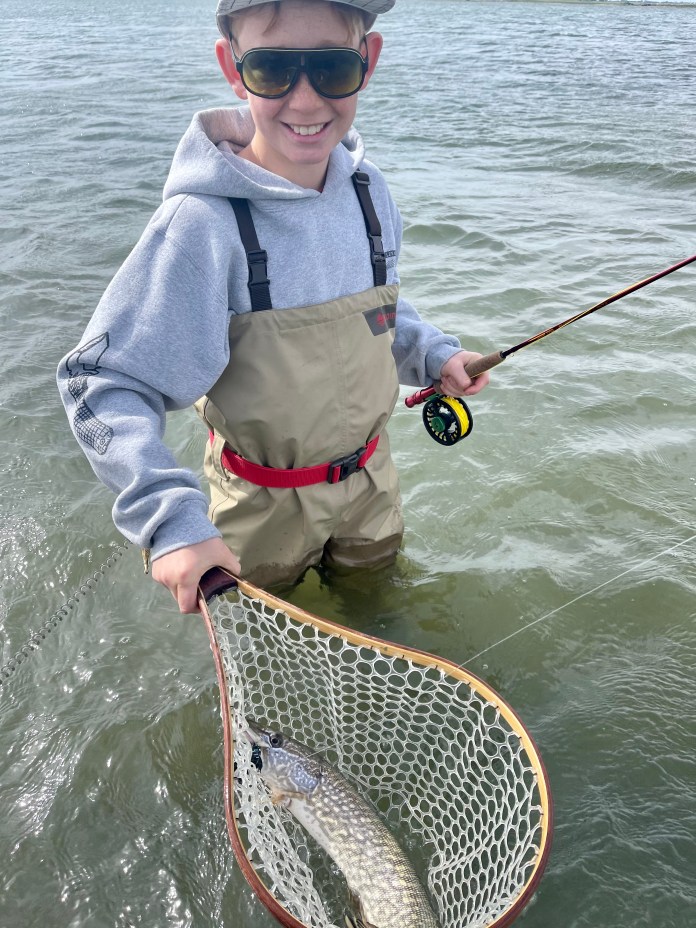
Reel of the Week: Kids Catching Pike on the Fly Rod

A note from Brandy Hasselback:

“What started as a social night discussing Pike fishing at a local fly shop ended with Owen winning the biggest Pike in the kid’s category. Typical Trout anglers, we had never targeted Pike, but we couldn’t turn down a contest and two curious boys.

We picked up a few new tools and flies and headed out on the water. Given my lack of experience, imagine my surprise with my son’s first cast yelling for a net! I ended up running back and forth between the two boys!

What was solely excitement for them ended up being a combination of excitement and angst for me. I watched a few YouTube videos on removing hooks from Pike, and we pretty much went unscathed, but it wasn’t easy. 15 fish later, I coaxed them away with the promise of treats.

Keeping your children interested in fly fishing can be a challenge; fishing can be slow, or sometimes fishing can be hot. A few tips for any parent when your kids are interested in fly fishing is to invest in the right equipment. Having good rods, proper wading boots, and waders is a must. Be flexible, one day, they may fish for hours, and the next, they’ll be more interested in rocks. Lastly, you can never have too many snacks when fly fishing with your kids. Be patient, teach them something new, and have fun while out on the water!”

Reel of the Week from Brandy Hasselback, follow her and her boys’ fly fishing endeavors on Instagram @raising_gingers. Here at Flylords we inspire the next generation to get out on the water and to protect the water that we all love. If you have an avid fly fishing child, feel free to send content to our team at content@theflylords.com and nelson@theflylords.com.

Check out the articles below:

5 Tips: Getting Kids Hooked on Fly Fishing

The Tiny Angler

Fly Fishing The Gaula River in Norway

The Gaula River

In the distance, deep in the forest that covers the hills, I hear the bellow of a moose, louder than the sound of the running water, only disturbed by the whistle of my rod in the dark. I swing my flies in this magnificent pool in the darkness of a Norwegian night in July. On every drift, I play with the line between the fingers of my left hand, searching for the feeling my eyes don’t have in this darkness.

“Have faith”

I repeat that repeatedly in my head, trying to connect myself with nature, keeping it away from all the questions that any salmon angler has when fish are not active.

“Have faith”

I have to recognize that sometimes it is not easy. However, at dawn, our brain seems to be less rational, and it perceives things around us in a different way. That is why I love fishing at night; the sounds, temperature, water, light, and my rod becomes a mantra that keeps me awake and focused on my goal. Step by step, cast by cast, waiting with faith.

It is as if I were hypnotized, and everything ran with the pace of a symphony in which the tug would be the dissonant note. Higher, louder, and deeper, it goes through all the neurons of your nervous system.

After that, everything turns into the dark chaos of the fight. Sometimes, the Gaula lets you touch the sky with the tip of your fingers.

The Golden River

Every salmon angler in the world has read about it. It has its legend. Its name is synonymous with greatness, wild, invincible… one of the only few rivers still undamed, with its pure golden waters running free. And, of course, Gaula means giant salmon. Thousands of stories about huge Atlantic salmon have been told by the banks of this river.

Not in vain, the number of 20 pounders caught every year here is outstanding, but the amount of 30 or even 40 pounders shows that we are in one of the best rivers in the world when it comes to landing the fish of our lifetime.

Possibly, that was what the British bourgeoisie searched for when they came here during the summers of the XIX century, more than 150 years ago. That was the beginning of the fishing tourism industry that nowadays we find along the banks of the Gaula, with world-class waters like the Norwegian Flyfishers Club, where I am fishing tonight. Fishing tourism has evolved during the last two centuries; lodges like this support a sustainable business based on catch and release.

As I said, the Gaula river is entirely wild, without dams or hydroelectric stations, one of the few big ones left in Norway and Europe. With more than 150 km, its golden waters run through deep valleys covered by lush coniferous forest in its high reaches. The forest turns to meadows and traditional Norwegian farmlands in its middle and lower reaches till the Gaula reaches the Trondheim fjord.

The Gaula is a river with a strong personality. Its pools are deep and stable, with its bottom covered by small-medium boulders, offering the perfect scenario for the fly fisher who loves long casts and good tension during the drift.

As the natural river it is, the Gaula tends to suffer from pronounced flow variations caused by the unpredictable Norwegian summer weather. In the middle of Norway, close to the arctic circle, the summer is short but excellent. It’s like spring and summer were mixed and concentrated into three months, getting the best of each. Although sometimes you have to be ready for the unexpected.

A River to Graduate

Peak time on the Gaula goes from the beginning of June till mid-July, depending on the conditions. This time is when you find the big fish and an endless number of them. And, of course, the unpredictable but fantastic late August, when the amount of fish in the river reaches its peak and salmon start to feel the spawn, turning more aggressive and prone to take our flies.

During those first weeks of the season, we fish long rods in the 14-15 foot range with heavy sinking lines and big flies. It is a challenging but rewarding job.

Later during July and August, we change to something lighter and shorter. Floating lines with sinking tips and smaller flies are the setup of choice. Under these low water conditions, anglers who enjoy tactical fishing, accurate swings, and smaller flies will get their perfect playground.

Despite the healthy population of salmon that runs into Gaula, we should manage our expectations. The Gaula is a challenging river; it is capricious and demands excellent technique, tactical knowledge, and good physical and mental shape. We can not forget that we are in Norway, the land of the midnight sun. When fishing the Gaula, you will deal with long fishing if you want to catch your dream fish. You might be rewarded if you put in the hours, fish hard, and try your best.

There are only a few things more frustrating than casting over and over into a pool full of fish, rolling every minute while your brain struggles to get the correct answer. These extraordinary fish will always have the last word though.

We are not in Iceland, and this is not where you catch ten fish per day. We are in the Gaula; you have to visualize the fish, see your fish, and go for it on every cast. Trust me. Nothing can beat that feeling of getting hooked up.

The challenge is there. The Gaula is a river where you can touch the sky. The best canvas to paint your dreams. The river where many anglers could fight with the fish of their lifetime, some won, others did not. In the meantime, I will keep searching for it. While it arrives, we share experiences, laugh, and share unique moments with our fishing buddies because, overall, salmon fishing is what you experience between every fish landed.

Article from Focus on the Fly Media, Alvaro Santillán. Find him on Instagram at @focusontheflymedia. Special mentions to @brodie_jordan, @bergues.fabrice, @the_purest_mischief, and @roar113.

Check out the articles below:

A Dream Called New Zealand

Why You Need to Fly Fish Norway

Video of the Week: Why you need to go Backpacking by TightLoops

Happy Holidays everyone! With this polar vortex swirling around the country we hope everyone stays safe and warm. To combat some of these negative temps sit down with a nice warm drink of choice and watch as Chase & Aimee of Tight Loops and Mak & Owen of Bound for Nowhere packraft on an amazing summer backpacking adventure. “We fielded the idea of hiking in and packrafting out to @tightloopsfly who took little to no convincing to come along for the trip. Under the heaviest packs we’ve ever carried (ultralight backpacking quickly becomes anything but light when you add a boat into the mix) we left the rigs behind for three days in the backcountry. As we hiked upriver, we scouted our river run the best we could from the trail…” (Words from @Bound.for.nowhere)

With this short video leaving us with a want for more don’t forget to check out the full video of their trip here: Packrafting trip.

Check out these other rad articles as well!

Video of the Week: In Search of America’s First Trout “For Wild’s Sake” Episode 5

Video of the Week: “El Toro” A Montana Bull Trout Story

Far From Home: Ep. 5 Patagonia

OUTLIE Launches The First Tent Designed For Your Flats Skiff

From OUTLIE: 

OUTLIE gear announces the launch of the first tent specifically designed for flats skiffs. Designed for both planned and unplanned overnight stays, OUTLIE tents are pushing the boundaries of what’s possible for modern anglers.

OUTLIE started as an idea when owner and designer Doug Henderson started fishing a chain of uninhabited barrier islands, located in the easternmost point of the state of Louisiana.

With a 30 to 50 mile run from the nearest boat ramp, making the trip can take up to 2 hours. With this level of exposure; storms, swell, and wind can create a challenge or make it impossible to get back home. This possible issue is always on the back of your mind. Why not have the ability to overnight in case of bad weather? This became a problem that was worth finding the solution for and OUTLIE tents was born – the world’s first tent specially designed for flats skiffs.

Spec’d out for 4 seasons use; these expedition-weight tents are built to stand up to anything. It could be a winter overnight in Louisiana with temps around 32 degrees or a spring night in the glades where the dew falls and soaks everything without a roof, or even a high & dry situation with the no-see-ums in South Carolina. Being completely waterproof, windproof, and bug-proof ensures your OUTLIE tent will keep you comfortable regardless of which element you’re trying to manage.

During the development process, the team at OUTLIE continued to think of the possibilities this product would bring to the skiff owner. Just like the composite skiff in your garage changed the saltwater fly fishing game, the OUTLIE tent will once again push the envelope of what is possible for the modern-day angler.

A key feature of the OUTLIE tent is that no permanently mounted hardware is needed. OUTLIE tents are secured in place by a series of lightweight clamps and hooks and are compatible with all major skiff brands. When stowed, your skiff is returned to the low-profile fishing machine it was designed to be.

With an OUTLIE tent, skiff anglers have access to an adventure lifestyle previously untapped in saltwater fly fishing. Follow the striper migration in the northeast, camp in the South Carolina Low Country and the Louisiana Marsh, or hang out on the Sandbar on a Saturday afternoon.

And of course, no tarpon is out of reach.

OUTLIE and our team have designed this product to be long-lasting.

  1. The nylon used for the tent is nylon and the treatment is Silicone outside with good water repellency and PU Coated inside for waterproofness.
  2. The seams are seam taped, repelling water from all possible entry
  3. The PU coating on the inside accompanied by taped seams creates a 100% waterproof
  4. The thread used for the tent is SP thread with size of 30/3. This is a common thread size used for expedition weight tents.

Flysheet: 70D 190T NY Taffeta, Silicone/PU1500mm, FR Mesh: 15D NY No-See-Um mesh.

OUTLIE has launched a Kickstarter campaign where you can pre-order comfort, safety, and adventure for the skiff owner in your life – even if that’s you!

Follow OUTLIE’s adventures on Instagram @outliegear and visit their website HERE for more information.

Fishing Etiquette: Flats Fishing

Small Business Spotlight: NOMAD Grills


NOAA Announces $105 Million in New Funding for Fish Passage Projects

Just last week, the National Oceanic and Atmospheric Administration announced a suite of fish passage projects that would be receiving funding under the ‘transformative‘ infrastructure package signed into law last year. NOAA highlighted 36 priority projects that would be receiving nearly $105 million in funding. We’ll detail some specific projects below, but this is quite the year-end gift for strong fisheries and healthy habitats around the country.

  • Nearly $10 million for California Trout to remove a rockfall barrier and obsolete fishway in Big Chico Creek, a tributary of the Sacramento River. The project will reconnect high-quality habitat for Central Valley Spring Run Chinook and Central Valley steelhead, including cold water habitat that is critical for climate resilience.
  • Up to $14.8 million for The Maine Department of Marine Resources to design and implement a fish lift at Woodland Dam on the St. Croix River in Northern Maine near the US-Canada border. This project would open up access to 600 miles for all migratory fish and 60,000 acres of habitat for alewife (a critical forage fish species for saltwater fisheries).
  • American Rivers will receive $15 million to design, permit, and begin construction activities for the removal of Kellogg Creek Dam. The dam currently blocks access to 15 miles of high quality habitat in Kellogg Creek, a tributary of the Willamette River. Removing the dam will provide habitat for threatened Lower Columbia River coho, Chinook, and steelhead. ($7,513,180 in first year; up to $15,000,000 total over 3 years)
  • $7 million dollars will go to Trout Unlimited to replace eight fish passage barriers as part of the Coldwater Connection Campaign, a partnership to reconnect 125 miles of high quality salmon and steelhead streams along Washington’s coast. The project will open more than 7 miles of spawning and rearing habitat for salmon and will increase Hoh tribal community capacity focused on salmon restoration.
  • $10 million for the The Wild Salmon Center to  remove nine culverts as part of the Coldwater Connection Campaign. The culvert removals will improve access for migratory salmon and improve the durability of public infrastructure. The project was developed with the Quileute and Quinault Tribes and will increase tribal capacity for fish passage restoration. ($10,396,280)
  • NOAA also opened up opportunities for tribes to propose projects. $1.2 million will fund the Skagit River System Cooperative to reopen habitat that has been blocked by poorly designed culverts. Work will focus on three sites of interest to the Swinomish Indian Tribal Community and Sauk-Suiattle Tribes: Martin Slough, Hatchery Creek, and Everett Creek. The project will also expand a collaborative process aimed at identifying and repairing barriers in the Skagit River watershed.
  • Click HERE for a full list of projects. And, click HERE for a list of the tribal projects.


View this post on Instagram


A post shared by Trout Unlimited (@troutunlimited)

What we’re hearing from Non-Profit Partners:

“Trout Unlimited’s ongoing partnership with NOAA is helping us recover critical populations of salmon, steelhead, and trout and building resilience against the growing impacts of climate change for fish and communities. The new investments from the Bipartisan Infrastructure Law only accelerate this crucial work,” said Chris Wood, President and CEO of Trout Unlimited. “This work is improving fish passage, but also helping rural communities by providing family-wage jobs, improving water quality, and helping prevent road failures and flood damage. We are grateful to NOAA and our congressional allies for their hard work to make this critical funding a reality.”

“We thank the entire Pacific Northwest delegation for securing generational federal investments that can change the trajectory of salmon and orca recovery,” said Guido Rahr, Wild Salmon Center CEO. “We’re at a critical juncture for these species and the Tribes, economies, ecosystems, and local communities that depend on them. This investment builds resilience in our communities and our watersheds, ensuring that wild salmon and steelhead can access cold water needed to thrive in a changing climate.”

These projects will have amazing impacts for our fisheries, as connected, quality habitat is so, so important for abundant, sustainable fish populations. Keep up the good work NOAA and all the organizations carrying out these great fish passage projects!

Striped Bass Management Updates–Stock Assessment, Commercial Quota, Rebuilding?

Well, the fall run has come and gone. Based on reports, some regions had stellar fall fishing, while other regions felt the bass just passed them over and/or vanished overnight. For example, parts of NY and NJ had flat-out epic striper fishing, partly due to the abundance of inshore menhaden. Based on this, some might think that things with striped bass are A-OK, and the stock has recovered from its overfished and subject to overfishing status. Fortunately, it’s progressing in that direction, which is good, but there remains room for caution.

Much of this fall and late summer, striped bass advocates waited for the release of a new stock assessment, which would have big implications on rebuilding and potentially trigger additional reductions for the fishery. At a November striped bass management meeting, the new stock assessment was unveiled, producing a response of cautious optimism. The assessment found that actions taken two years ago to end overfishing (the management change to a 28-35″ slot limit) were proving effective at reducing fishing mortality, and the stock’s biomass (how many spawning sized fish) was increasing. However, biomass is not at the target level, but projections indicated a 76% of successfully rebuilding by 2029 under the current fishing morality rates.

The cause for concern, however, is that that low fishing mortality rate may not be realistic. The current rate is lower (killing less fish) than the target and threshold set by management. So, the chances of successfully rebuilding decreases as fishing mortality increases.

According to a blog by the American Saltwater Guides Association, “If F increases to the threshold (F=0.20), we have less than a 50% chance of reaching the target SSB in any year. If the history of the striped bass fishery and its management has told us anything it’s this: when there are more fish out there, more people go fishing. How effort and F might change with increasing availability of slot-sized fish is something we need to watch very carefully.”

At the November meeting, striped bass managers acknowledged caution about fishing mortality and recruitment, but chose to not take immediate action. In stead, they will look at catches in 2023 to see if they are tracking with projections and rely on upcoming stock assessments ahead of the 2029 rebuilding deadline.

Then the Striped Bass Board moved forward on an addendum to consider commercial quota transfers. The idea behind this action was that some states’ commercial fisheries do not catch all of their allotted striped bass, so this surplus should be transferred to those that do catch all of their quota. The striped bass fishery is a predominantly recreational fishery (87% according to the 2022 assessment); the commercial sector accounts for 13% of total removals.

However, even though the commercial sector accounts for a far lesser portion of removals, this effort should be opposed, contends ASGA. “Now is just not the time to increase commercial landings, which would increase total removals,” said ASGA Policy Director and VP, Tony Friedrich. “We need to focus on rebuilding the striped bass stock by 2029, not injecting more uncertainty into that process by maximizing commercial harvests.” ASGA is supporting Option A, no commercial transfers for this Addendum.

The Atlantic States Marine Fisheries Commission is accepting public comment on this draft Addendum until January 16th, 2023. If you want to provide a written or online webinar comment be sure to check out ASGA’s comment guide blog.

Fishing Tips: 5 Quick Redfish Tips

0

Check out the 5 quick redfish tips you need to know. When it comes to fishing for redfish, there are endless variables that you can consider, but there’s a few key tips that everyone should hold close. Thanks to Huge Fly Fisherman for breaking it down!

The Beauty of a Fishless Day

Over the years, I have used a litany of excuses to get some, “me,” time. I’ve done the obvious one of calling in sick for work. I’ve told girlfriends that I have to help a friend so I couldn’t make dinner plans, or have even said a loved one was in the hospital. I’ve used them all so I could grab my fly rod and just go fishing. All so I can have uninterrupted casts out onto blue ribbon trout streams, in the middle of the workweek.

The reason for the excuse this particular day, was because of the weather. The air was warm, the wind was forecasted to becalm, the sun was shining, and the river, of course was devoid of humans. Nothing but the sound of water, without a drift boat in sight. Just the birds dipping and chirping like they always do. Even the drive out to the spot was a surreal experience. Painting the picture of what my local river was like maybe ten or 20 years ago on a weekend. Quietly, my rod was rigged with my favorite terrestrial pattern, with the sound of nothing but the river in the background. Bank after bank, I probed the grasses in search of the large rainbow or brown trout waiting to ambush my grasshopper. But cast after cast, nothing showed interest.

As the day progressed, the sun warmed and the shadows of the towering mountain peaks faded. The grasshoppers began rubbing their legs and clicking their wings as they took flight. Witnessing fish annihilate grasshopper after grasshopper without any interest in the one I seemed to be casting. Again, I continue to cast and one take presents itself, but I failed to set the hook.

The rest of the day, that drumbeat continued while not a single trout came to hand. The depression of breaking down the rod and stowing for the weekend was realized and the drive home was frustrating knowing I had to head right back to work the next day. Head back to work in a bad mood from a fishless day and pretend I was sick or sad or lie about whatever it was I made an excuse about.

“Maybe it was Karma.” I thought to myself as the universe clearly didn’t like that I had made far too many excuses to have a day on the river to myself. Perhaps it was selfish of me to lie to my girlfriends over the years to have some, “river,” time. Perhaps it was awful that I said grandpa was in the hospital, and I needed to be that drastic with my excuse making because my boss is this soul sucking leech that can’t grasp why employees don’t like him. Or just maybe perhaps, it’ simply part of the sport we all love and pursue. To on occasion, not catch any fish.

Trout anglers have it somewhat lucky as out of all the possible game fish an angler can target, trout are arguably the easiest to catch. But I’m sure if I interviewed a bass angler, for example, those fishless days also do exist. Casting and popping that fly next to reeds, logs, or lily pads with nothing to show for it.

Or how about the flats angler in the Seychelles targeting permit or bonefish or GT’s? The same to be said in the Bahamas, or any flats fishery, constantly searching for shadows, fins, or studying tidal changes in hopes of even casting to a fish, let alone getting a strike.

What about the blue water anglers? Imagine cruising the wide-open ocean, chumming the water, ringing that dinner bell, but being reminded with each hour of fishless presentation that the open ocean is actually a vast desert. Thousands of dollars from boat maintenance to gasoline, to a guide or even tackle, all for a day on the ocean without a fish in sight. After all, ask any boat owner about what it stands for. “Bust Out Another Thousand.” All so no fish come on deck. Talk about depression.

Lastly, don’t even get a steelheader started on a fishless day. How many casts, mends, steps, and snaps have been made, all with the perfect swing through the perfect run to have nothing to show for it? It took me five years alone to even get a glimpse of one of these fish. And still never landed it with no photo for proof other than the mental capture before it snapped its head and sent my line in a different direction. Five years for that moment.

But what all of these anglers have in common and all these fish that we chase share, are locations, up there, with the most beautiful on the planet. The snow capped peaks towering above the trout stream with alpine glow painting them orange. The pastel colors of a sunrise on a cloudless day with turquoise water reflecting the calm lagoon of a flat. Frogs groaning and sunlight reflecting the bass pond, and the deep blue rolling of the ocean and gentle lap of water along the bow of the boat.

An angler devotes themselves to the fish. We go extremely out of our own way to purchase the gear, the plane tickets, gas, and even alarm clocks for a chance at catching a fish at our desired location. If that’s not the case, not the main drive, then cut the hook off your fly and tell me otherwise. But without question, the most common reason people fly fish, after catching fish, is for the location that the fish live in. The stunningly beautiful and just as uniquely diverse locations as the fish themselves.

Because of that, because of that realization, I was able to head home after my fishless and excuse driven day, and was able to put my head down on my pillow and be happy. Be happy about the day I spent casting beneath snowcapped mountain peaks, feeling the water rub up against my leg, and admire the birds chirping and the wind causing the trees to sway. Grateful at even the opportunity to set the hook on a fish interested in my presentation, despite my hook set. And after that realization, I was honestly prepared to head back to work, making the countdown until the weekend easier.

I could say the fish aren’t going anywhere, but sadly and miraculously, many are. So that is a conundrum some anglers will have to face. But anyone who said creativity isn’t required to be a fly fisherman clearly hasn’t ever picked up a rod. But that creativity isn’t just in the art of the cast, the beauty of the presentation or in the tie of the fly, but it also comes with how you create time to fish at all.

Another day will come, another run will happen, another tide will change, and another excuse will be made. The sun will rise again, and set, all with the opportunity to head back out and try my luck again. So much effort and emphasis is put towards the moment that the hook is set, the fight and pull of the fish, and the landing via net or wet handed. But there is so much time before any of that process happens that is often over looked in our sport. And that is the emphasis of this story and the reminder I needed when I got home from my fishless day. But until then, I lie in bed and simply remember and remind myself, that the sport is called fishing after all, not catching.

Article written by Sean Jansen @jansen_journals. Sean Jansen is a freelance writer for Flylords Magazine, and spends his time in Bozeman, Montana where he guides tours through Yellowstone National Park.

Check out the articles below:

The Solitude of Swinging Streamers in the Snow

How To Fly Fish Yellowstone National Park

Abel ROVE Now Includes Engraved Drag Plate Options

0

From durability to design, the Abel ROVE has quickly become a favorite for anglers and it’s not hard to see why. This workhorse of a reel has the capacity to fish two-hand rods, saltwater, and trout and trout spey. It’s your ultra-tough, ultra-reliable, high-capacity, beat-me-up adventure reel that will go where you want to go without feeling a need to have a backup reel in your limited carry-on space. But how can a reel this great get any better? Well, it’s all in the details.

From Abel:

ROVE: /rōv/ – to travel constantly without a fixed destination; wander.

Our ROVE reel has been an outstanding addition to our lineup since its introduction in the spring of 2022. We’ve been proud to see it win the IFTD Best of Show Saltwater Fly Reel Award, Gears Guide’s Best New Reel Award, and the overall Best of Show Consumer’s Choice Award at The Fly Fishing Show. Not too shabby of a collection this year.

The one constructive comment we received was that some of our customers love our original concept of several freshwater/saltwater flies engraved on the drag plate of all sizes of reels, and some of them don’t. A few anglers actually prefer to not have anything engraved. Our answer is to now offer multiple engraving options to our customers. Why not? We’re Abel.

Abel ROVE Drag Plate Options

Get your custom drag plate here! 


5 O’Clock on the Water: How to Make the ‘Liquid Smoke’ Cocktail With Lael Paul Johnson

You’ve heard the phrase, “It’s 5 O’Clock somewhere”, but as we as anglers know, it’s always 5 O’clock on the water. Whether you’re celebrating the catch of a lifetime or drowning your sorrows after losing one, there’s nothing quite as satisfying as kicking your feet up and enjoying a refreshing cocktail after a long day on the water.

drink in hand

For this series, we’ve teamed up with YETI to sit down with some of our mutual fishing friends and get the lowdown on their go-to celebratory beverage. In this installment, we met up with legendary PNW guide: Lael Paul Johnson, or LPJ, as some might know him as, to see how he makes his signature original, “Liquid Smoke” Cocktail.

Who is Lael Paul Johnson? 

Whether you’ve only spent a few hours behind the cork of a 2-handed rod, or regularly spend your weekend wading up to your chest in ice-cold, ripping currents, it’s not hard to deduce that this faction of fly-fishing is one of the most difficult pursuits out there. Not to mention, when you take into consideration that the species you’re targeting is basically a living, breathing, equivalent of a military-grade Mark 48 torpedo, and has about as much desire to eat your fly as you do; the act of fishing for anadromous fish in the PNW seems like an almost impossible feat to pull of all-together.

lael on the river

Yet, with all factors considered, there are some folks who are crazy enough to do it. Furthermore, there are a few brave individuals who’ve dedicated their lives to not only studying the art of this kind of fishing down to a science but are patient enough to teach it, and make a living as a guide. This is where Lael comes in.

salmon in hand
Flylords’ Pat Perry and Lael after landing an impressive Coho Salmon.

Lael Paul Johnson is a fly-fishing guide who’s based out of the state of Washington, and for over a decade now, primarily focuses his efforts on targeting ocean-run fish, such as Steelhead and Salmon, as well as resident trout, on the fly. Unlike many other guides in his area, LPJ primarily focuses on getting his clients on fish via the traditional manner of fly-fishing for steelhead and salmon, which involves casting a 2-handed rod and enticing a fish to eat your fly on a downstream swing. In case it wasn’t conveyed in the previous paragraphs, this is an extremely difficult endeavor.

lael using a 2-handed rod

When it comes to fishing, Lael is the definition of dedicated. Spending 200+ days on the water every year: Lael is the embodiment of a steelhead fisherman. When Lael isn’t rowing down one of his local rivers, he can be found on bone-covered banks of faraway lands, leading hosted trips for Salmon and Steelhead in fly-fishing destinations such as Alaska, BC, and Patagonia. In an interview with Lael last year, we asked him what his motivation for getting on the water was. His response: “Finding a fish that is going to change my or someone else’s life”. A Guide like that is hard to find.

How to Make Lael’s “Liquid Smoke” Cocktail:

Ingredients:

  • Echinacea powder
  • Aromatic Bitters
  • Ginger Beer
  • Ice
  • Pineapple Juice
  • Irish Whiskey
  • Rosemary

ingredients for the cocktail

Step 1: Add a Dash of Echinacea Powder

We know – right about now, you may be asking yourself, what is Echinacea Powder? Commonly known for its ability to strengthen the immune system, Echinacea powder, obtained from grinding Echinacea flowers, is a common herbal remedy for cold and flu symptoms. In this drink, the powder is going to be used to substitute out gun powder (yes, gun powder), which is used in the drink that inspired Lael’s “Liquid Smoke”; which is appropriately named, “Gun Powder Punch”. Obtaining this powder is pretty easy, and can be found anywhere wholistic medicine is sold, or on Amazon.

Once you’ve got your Echinacea powder, add a teaspoon to the bottom of your cup.

 echinacea powder

Step 2: Add in your Bitters

Next, you’re going to add some aromatic bitters on top of the Echinacea. If you commonly use bitters, feel free to add to taste, but for those with less drink-making experience, 5 or 6 shakes of the bottle should do.

adding in bitters

Step 3: Add Some Ginger Beer and Stir

Now it’s time to add your liquid base. For this, we’ll use ginger beer. As the ginger beer is added to the powdery mix, the concoction will begin to foam, so pay attention while you’re pouring. For the best results, go ahead and give a 2-3-second pour. Now, take a whisk or a spoon and give your ingredients a stir until the foam has settled.

pouring in some ginger beer

Step 4: Add in Your Ice

Now that you have your main flavor additives set, it’s time to add in your ice. It’s best to wait until this step to add the ice so that the powder and bitters can mix together properly. Adding in your ice first can overcrowd your ingredients in the cup and cause the powder and bitters to clump together.

scooping ice

Step 5: Pour in Some Pineapple Juice

For this step, we recommend using fresh pineapple juice if you have the means and time to do so. However, if not, canned is totally fine. For this step, go ahead and add about 3 or 4 tablespoons of pineapple juice. If you want to adjust for sweetness, you can always add more. Once you’ve poured your desired amount, go ahead and give your mix another stir.

pouring pinapple juice

Step 6: Add Your Whiskey

Now, it’s time to add the crown jewel. For this recipe, we are using Limavady single-barrel Irish whiskey. The barrel-aged nature of the whiskey adds that desired smokey profile that gives the cocktail its name. For you scotch fans, some low-budget scotch will also do the trick.

Once you’ve selected your desired whiskey, go ahead and give a healthy pour of your spirit into the mix. Depending on how much you want to accomplish with the rest of your evening, feel free to add a lot, or a little…

pouring pineapple juice
The best way to enjoy a refreshing cocktail: is out of a YETI Lowball. Click HERE, to get yours.

Step 7: Garnish with Rosemary

For the final step, garnish your cocktail with a stem of Rosemary. You won’t necessarily taste it in the cocktail, but it will add a strong aroma which will add an extra level of sensory stimulation when you’re enjoying your drink.

springling rosemary

Once you’ve given your mixture one final stir, it’s time to enjoy! The Liquid Smoke cocktail pairs best with friends and the aroma of fish slime still on your fingers from a long day spent on the mighty waters of the Pacific Northwest.

enjoying drinks with friends

Thank you to Lael for sharing his afternoon with us and showing us a few new tricks on the water and behind the mini-bar. You can find him on Instagram HERE. Also, thank you to YETI for keeping our cups full and our cocktails cold. If you enjoyed this piece, be on the lookout for more just like it down the line. As always: drink responsibly. Cheers!

cocktail cheers

This article was published as part of a paid campaign between Flylords LLC and YETI Coolers, LLC. All opinions presented in this article are genuine and solely reflect the opinions of Flylords LLC. 

5 O’Clock on the Water: Making a Cold Brew Cocktail with Landon Mayer

5 O’Clock on the Water: Making a Dark and Stormy with Brandon Cyr