Welcome to the bucket-dome where two buckets will enter, and one will leave victorious. In the left corner, we have the $40 Yeti Loadout bucket, and in the other, you’re average 5-gallon paint bucket. The hilarious team over at You Betcha put together the final word in the argument we’ve all had: is the $40 Yeti bucket worth the cash?
We had the opportunity to sit down with iconic angler, Jeff Currier. His notoriety as an angler came from public speaking seminars, writings, travels, and other fishing-related art. Fly fishing for over 40 years has taken Jeff to more than sixty countries on six continents with more than 400 fly caught species and counting… Wherever he goes, Jeff brings a sense of humor, enthusiasm, approachability, and plenty of experience. Check out his website for more of his artwork and seminars!
Flylords: Who’s Jeff Currier?
Jeff: Am I old enough to answer this one yet? Seems like we’re always trying to figure out who we are. It’s part of the journey and hopefully, I have a way to go. But what I’ve learned so far is that I’m an incredibly lucky guy… I have an amazing wife, I enjoy my family and friends, and I’m passionate about the outdoors and all that it comes with. I’m serious about conservation and absolutely berserk about travel and fly fishing.
Flylords: Can you recall your most epic fish battle?
Jeff: Man, there’s certainly been a few, but years ago my wife, Granny, and I were camped on the beach in Oman. We were there for almost three weeks. It was spectacular, to say the least.
The morning routine was that I’d get up at the crack of dawn and walk searching for Indo Permit and Five Spot Pompanos. There was another fish called the Southern Pompano there too. This species is well known to saltwater fly fishing enthusiasts as the “Africanusâ€. The Africanus is considered to be virtually impossible to catch on the fly from shore because he lives in jagged rocks lined with mussels and oysters.
Each time casting for them I ended up getting knocked down by the crashing waves and lose my fly in a snag. I was sick of losing my crab flies and had pretty much given up trying for them…
Towards the end of my walk that particular morning, I saw Granny already up watching me and the sunrise from the rocks behind me. Right when I spotted her, she started yelling and pointing. “Hurry up! Come on! A bunch of Africanus!â€
I shook my head saying, “I’m good, maybe after a cup of coffee.†The problem was I was without my flat boots and barefooting the sand; however, she was imperative… I climbed up to where she was and sure enough, there were fifty tailing Africanus.
Now that I saw all the tails, I couldn’t resist and went for it. Carefully, step by step I eased my way to casting range doing all I could to not get leveled by a wave or slice my foot on a mussel. I managed to get in position and make my cast. To my disbelief, an Africanus took my crab!
Next thing I knew I was knocked down getting by a powerful wave. I was in a froth of whitewater getting my skin ripped off from the mussels and rocks. When the wave receded, it was a struggle to get up, but I managed and dashed for shore with rod in hand and fish on.
After making it to a better position, the Africanus was already deep in my backing. I looked like a fell in a blender and had blood leaking everywhere. Naturally, I didn’t care… Before nearly running out of backing, the Africanus stopped. I then began the intense battle to bring him back.
To avoid the danger of getting cut on rocks, it was time for an advanced move – get out past the rocks so I could pull him back. We were now 45 minutes in with the fish exhausted. I was literally dragging him up to the beach. Then the nightmare happened. The fly just plain popped out as I attempted to surf him up on the beach. The exhausted Africanus uprighted and swam away. That hurt more than the loss of any other fish in my life. I believe that would have been the first big Africanus caught off the beach on a fly ever.
Flylords: What’s fishing like in your home waters compared to other places?
Jeff: I live in Idaho for the amazing trout fishing. It’s truly some of the best in the world, but after more than 30 years on my home waters, they have gotten less challenging. So, for me, despite my home water fishing still being great, I mostly enjoy chasing the crazy different species I find all over the world both in salt and freshwater.
Flylords: What are the top 2 fishing accounts you follow on Instagram?
Jeff: I got my first smartphone earlier this year and still trying to figure it out. I do all I can to get my own post up let alone follow another’s. So, I have no favorites but rather when I have a rare free minute just check out the ones that pop up. Untamed Angling, Yellow Dog, and Built for the Wild stand out the most.
Flylords: Having caught over 400 species in 60 different countries, what 3 were most memorable?
Jeff: As of 2003, no American had ever won a medal in the World Championships of Fly Fishing. I was going into the last session for a Competition in Spain and was on my way to being the first. However, I had the lake my final session and my particular beat hadn’t produced a fish all-tourney and it had been fished by some of the best anglers on the planet. All I needed was A FISH to medal, but the odds were more than against me. Amazingly, thirteen minutes into my three-hour session I caught a 9†brown trout. The brown was small but just enough to put me on the podium. When they played the National Anthem and raised our flag for me in front of hundreds of people, it was the proudest moment of my life.
The other was a 22lb Atlantic salmon in Iceland and a Catch and Release World Record golden mahseer in India. Both have great stories to go with as well but I’ll save it for next time you see me in the bar!
Flylords: How do species differ as you fish from country to country? Do brown trout in the US contain small unique traits that fish in Europe don’t have?
Jeff: The brown trout in Europe are the same ones we stocked here in the USA. The main difference I see is that the ones in Europe are spookier and harder to catch despite being smaller. I’m guessing it’s a gene pool thing, Europeans aren’t as big on catch and release as we are and the ones that have survived are the wisest.
When you wander north and south in this world you rarely get the same species. For instance, here in the USA, we have bass, but when you drop down into South America you get the cichlids. That’s when there are big differences based on them being able to live in hot vs cold water.
Flylords: What country should all die-hard fishermen attempt to visit?
Jeff: If we’re talking die-hard fishermen that like all species, then hands down it’s the Amazon of Brazil. The Amazon region has the top gamefish of the world, the peacock bass, but also so many other kinds that are super fun to catch. Toss in the remoteness, the impeccable rainforest, birds, and animals – it is simply an experience every die-hard needs to do.
If you’re a die-hard trout angler and don’t care about the crazy fish, then you need to go to New Zealand. And if you’re a saltwater flats nut, don’t miss Seychelles.
Flylords: Who did you look up to when you were younger?
Jeff: No doubt it was my father along with both grandfathers. They all fished and mostly with the fly. My dad was an amazing fly fisherman and didn’t hold back on kicking my ass by catching way more fish than me even when I was like 8! It made me better faster. I finally out fished him on the Madison River when I was 16. I left him in the dust from that day on and I’m certain he was proud.
As for other pros in the sport, I was lucky to meet most of them. I was doing the big shows way back when I was only in my 20’s. I had the opportunity to be at the dinner table with many and I soaked it up. Guys like Mel Krieger, Dave Whitlock, Billy Pate, Lefty Kreh, Gary Lafontaine, Gary Borger, and Flip Pallot to name a few. Out of all of the fly fishing legends, Mike Lawson was the best. We became great friends at those shows and I still get together with Mike continuing to ask him questions and his advice on all kinds of matters.
Flylords: What does fly fishing do for you?Â
Jeff: Its more than a hobby, fly fishing is my life. It keeps life interesting. There’re always areas of the sport I can improve upon and learn to catch more fish. I love that challenge even when I need to raise the bar and hunt down a fish on the fly that nobody’s ever caught before.
There are benefits of fly fishing. First and foremost the sport gets people outside and on the water. Then, once folks see the fun fishing and the beauty in their surroundings, they want to protect it. Fly fishing creates awareness of the outdoors and leads to many fantastic conservation projects.
Flylords: Tell us about your art.
Jeff: I was the kid that did detention three times a week because of my desk art. Yea, when you arrived at your class and saw a desk covered in some crazy pencil drawing, that was me. I may as well have signed the art because I got busted every time. Needless to say, I loved art class and it was always my guaranteed A+ on every report card.
At college, I ventured away from the art. It wasn’t on purpose but I had other things going on. I studied biology and outdoor education. So, between studying and fishing the art slipped away.
Right after college, I found myself working in Jackson Hole, WY at the Jack Dennis Fly Shop. I’d work there for 23 years daily. The owner, Jack Dennis, wrote a few books and somehow, he found out I was pretty good with art. He offered me $3000 to illustrate his latest book. I was broke and jumped on the project. I’ve illustrated several more books including my own, had T-shirt lines with major fly fishing companies, and currently have my own line of fish on coffee mugs, beer steins, and shirts. Who knows where this will end up, but I’m glad to be using my art skills.
Flylords: Was it the fly rod or paintbrush that came first?
Jeff: I was born to be both. No doubt about it. My mom still has finger paintings I did in preschool… All were of fish. Then, my dad had me fishing with the bobber and worm set up before I was five. I started copying his fly cast with my first fly rod at 7. I loved both and still do!
Flylords: Tell us about your goal of painting every species you catch. How has the progress been going?
Jeff: Yes, I do have a goal of painting every fish species I’ve caught. I’ve presently caught 408 species and only painted about 75 of them. So, I’m a bit behind. The issue is I’ve been adding types of fish to my species list at a rapid pace. I never imagined I’d be fishing this much and it’s definitely cut into my art, but it’s a good problem to have. I figure there will always be time for my art. Art is something I’m certain I’ll enjoy when I’m old. The crazy world-traveling I do these days won’t be so easy when I’m old.
Flylords: What’s next for you?
Jeff: The great thing about my life is I’m not entirely sure. I think this is healthy and invigorating this way. What I know though is that I’m not ready to slow down. Though in my 50’s, I’m fortunate that my body still feels good. So, standing in the bow in wild seas, long hikes in foreign lands, and yanking on big fish are definitely on the “what’s next†agenda!
In this artist spotlight, Flylords had the chance to sit down with Piper Nunn, a talented artist and fly fisherwoman based out of Fort Collins, CO.
Flylords: Tell us a little bit about yourself?
Piper: I was born and raised in Fort Collins, Colorado, and grew up in the mountains. As I got older, fly fishing came into my life and gave me a new way to connect myself to the environment. It quickly became one of the most important parts of my life. I became so passionate about fishing and aquatic ecosystems that I began to pursue a degree in Fisheries Biology, and plan to graduate next spring.
Flylords: You’re an artist, can you tell us a little more?
Piper: I’ve always been into art, and have been painting since I was little. My art always seemed to revolve around nature, and when I got into fly fishing my art naturally became inspired by it as well. The majority of my paintings are done with acrylic paint or gouache, and recently I have been focusing on painting fish, mostly because I think their beauty should live outside of the water.
Flylords: Do you have any recent work you would like to share with us?
Piper: Yes, I do! Recently I worked with Yakoda Supply to design a sticker for their project supporting those whose workload and work-life have been effected by COVID-19. The sticker I created is a Salmon and is inspired by my passion for salmon and the way they are fundamentally connected to the ecosystems they live in.
Flylords: If you had to choose three flies to fish for the rest of your life, which would you choose?
Piper: An extended body Parachute Adams, because its perfect for pretty much any mayfly hatch. A Gold Ribbed Hare’s Ear since its super versatile, and the classic RS2.
Flylords: Do you have a favorite piece of artwork?
Piper: One of the pieces I’m most proud of is the Redfish I recently painted on a 3 foot piece of reclaimed pine beetle kill wood. It took me about 30 hours to completely finish and I’m really proud of it!
Flylords:Â Where are you going fishing the next chance you get?
Piper:  I currently have a Redfish trip to Louisiana planned for the end of Fall, given everything works out with the Coronavirus. Redfish will be a new species for me, and I’m excited to experience the Salt!
Flylords: Is there a way people can support or purchase your artwork?
Piper: I sell originals, prints, and commission pieces on my website: https://www.pipernunn.art/ or people can check me out on Instagram @piper_nunn
Article and photos from Ameen Hosain; content creator and fly fishing guide based out of Boulder, CO. Follow him on Instagram @thefishboulder.
In this week’s Fly Fishing Destination Video of the Week, UNTAMED ANGLING brings us to the remote fly fishing paradise that is the Kenjam River in search of a fly fishing adventure not had by few anglers before.
This film will show you the wonders of Kendjam in Brazil. Kendjam features a unique fly-fishing adventure deep in the Amazon Forest on rivers running through a wildland protected by Kayapo Warriors. Join anglers Jeff Currier and Ben Furimsky in this first-ever film about fly fishing on the previously forbidden Kayapo rivers.
The crystal clear waters are full of aggressive fish species all eager to take a fly. Kendjam is located on the Iriri River, some three hours flight time South-East of Manaus, Brazil. The Iriri is a clear river flowing largely over granite bedrock. Kendjam is a hidden treasure protected from despoliation by the last guardians of the Amazon jungle: the Kayapó warriors. This environment offers the first multi-variety Amazon fly fishing destination where an angler can target over ten different species in crystal clear fast waters; peacock bass, three different pacu species each with their own feeding habits, vampire fish (payara), wolf-fish (trairao), yatorana/matrincha, piranha, bicuda (freshwater barracuda).
Tune in every Saturday for a new installment of Fly Fishing Destination Videos and make sure to sign up for our newsletter below in order to keep up with new content published daily.
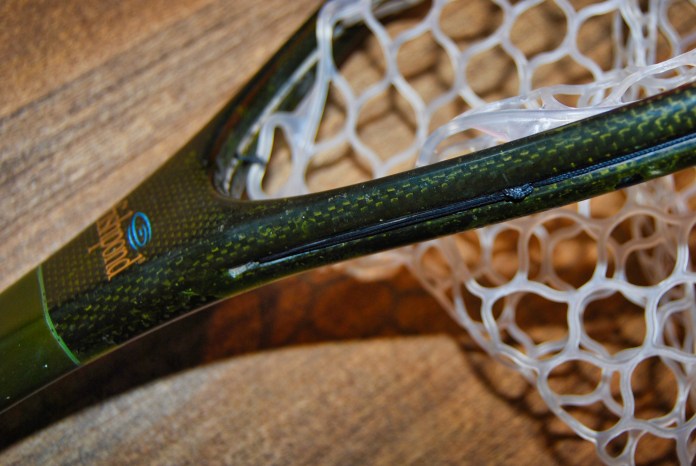
I’ve seen many nets on the water, Instagram, and online that are lashed together with zip ties, string, and even duct tape. Some of these nets should have been retired 15 years ago. Fortunately, for about $20 you can replace your net bag and have it working and looking like new. As we detailed in a previous post, choosing the right net is key but maintaining your net is equally as important. This simple guide will walk you through the various steps required to replace the net bag on most standard nets (think Fishpond and Brodin).
A weathered Fishpond Nomad net discovered by the editor streamside in need of some TLC.
Why Choose Rubber?
Landing nets are a valuable resource on the water. Not only do they help you land more fish, but they also help lessen the effects of catch & release fly fishing on the fish that we pursue. Many modern scientists and anglers alike believe that rubber net bags are less likely to damage the protective film on the skin of fish. For that reason, I recommend replacing any nylon nets that you may have with rubberized net bags. Many net manufacturers sell replacement bags sized/shaped specifically for their products.
Rubberized nets help reduce the impact of catch & release fishing on the species we target.
Remove the Net Â
The first step in repairing your net is to remove your discolored, torn & tattered net bag. You can either cut the net bag or the backing that was used to lash it to the frame. Keep in mind, you will need to completely remove any of the string/backing left on the frame at some point.
Cleaning the Frame
Once you have removed your net bag, you will likely notice dirt, algae, and scum that has built up around the frame. Simply scrub your frame with a firm bristled plastic brush and warm soapy water to remove any buildup. Not only will this make your net look new, but it will also keep you from transporting unnecessary debris in your vehicle.
Choose Your Replacement
Manufacturers like Fishpond sell a variety of replacement net bags in different sizes and even different colors (clear and black) to fit their offerings. While not all manufacturers make replacement bags, you should be able to find a net bag that roughly fits your net frame. (Note: Ensure that the diameter of the replacement bag is at least as big as the size of the frame) Fishpond’s series of replacement net bags can be had for around ~$20 and come with everything you need for installation (net bag, backing, and needle).
Re-stringing and attaching the replacement net bag to your freshly cleaned frame is an easy process once you get going! There are only a handful of materials required to complete this process: net frame, replacement net bag, ~4ft backing/string, and a large needle or bobbin threader.
Re-Stringing Process
To Start, attach your backing to any loop in the open end of the rubber net bag with an improved clinch knot.
Thread the other end of your backing/needle through one of the holes nearest to the handle (either side will work).
Next, pull your needle and remaining backing should through the first hole with your clinch knot pulled tight to the inside of the frame.
Tie a clinch knot around a loop in the bag before threading the backing through the frame.
4. Now your needle and remaining backing should be on the outside of the frame. The next step is to thread the backing around the perimeter of your frame and through each of the remaining holes.
Move around the frame threading the needle through each hole.
5. Next, with your needle and backing threaded through the inside of the following hole, wrap your needle around the next loop on the net bag. To finish lashing the loop to the frame, thread your need back through the same hole that it entered.
Thread the needle around the net bag loop and back through the frame.
6. Repeat the above steps, threading the needle and backing through each hole around the frame of the net. Be sure to pull the backing and net bag loop tight to the frame as you work your way around.
Work your way around the frame, threading your needle through each loop in the net bag.
7. Once you have attached each loop on the net bag to the corresponding hole on the frame, thread your needle back through the last hole (opposite of where you started). Your needle and backing should be on the outside of the frame again.
8. At this point, you have completely re-strung your net frame with a new net bag. You are now ready to tie off your backing. While you can tie several overhand knots in your backing and call it a day, the optional process outlined in Steps 9-11 leaves a much cleaner end result.
Optional Finishing Steps
9. Next, take your needle and thread it above and around the thread entering the second to last hole. We will use this point as the foundation of our uni knot.
10. Next, thread your needle under the doubled over backing created by looping around the second to last hole. Next, wrap your needle around the doubled over backing 3-5 times before completing a standard uni knot. Lastly, pull the needle and knot snug.
Tie a uni knot around the backing entering the second to last hole.
11. Finally, snip the remaining backing off once you have completed your uni knot. Applying a small amount of super glue to your knot will help ensure that it outlasts the rubber net basket.
The finished product after tying a uni knot and applying super glue.
Video Instructions
If you would like further instruction or wish to view a detailed video on replacing a net bag, check out the video below!
In conclusion, time, extreme temperatures, UV rays, and brush all wreck havoc on landing net bags. A tattered net could cost you the fish of a lifetime. Consider purchasing a replacement net bag and following the simple steps above for installation. A little time and effort can go a long way to have your net looking and functioning like new.
Article by Evan Garda, he is on the Content Team here at Fly Lords. He can be found chasing trout throughout the west with his trusty fly rod. Check out his adventures at @evangarda.
Spring is here, and for many of us on the East Coast, that means striped bass. Every spring stripers storm into coastal rivers to spawn and sustain their population. After spawning, stripers exit these coastal tributaries and begin their annual migration north, giving coastal anglers great recreational opportunities. If you are lucky enough to live close to the colder waters where these stripers spend their summers, you will enjoy action all summer long. However, with the current overfished and subject to overfishing status of the stock, this spring will most likely be a different story.
Sure, fishermen will find stripers, and some will even find pockets of big fish. But the aggregate success among striped bass fishermen this spring will continue trending downwards. It’s a simple yet unfortunate calculation: less fish in the ocean translates to less catching, which in turn affects many other sectors within coastal economies.
Photo courtesy of Flylords Team Member, Nate Holmes. Nice striped bass sightline bracelet, Nate!
Last year, around this time, the striped bass stock was declared overfished and subject to overfishing. This finding resulted in the management authority–The Atlantic States Marine Fisheries Commission (ASMFC)–moving to constrain the amount of striped bass killed. Certain states, however, are taking advantage of ASMFC’s rules and preventing the swift rebuilding of the striped bass stock. States can opt out of ASMFC’s recommended regulations and implement their own, if the regulations achieve the same conservation goals. This is called conservation equivalency and has consistently been abused. Striped bass are in poor shape due to ASMFC’s unaccountability, states’ shortsightedness, years of high harvests by the recreational sector, and environmental factors. All of this threatens one of United States’ most special and participated-in fishery.
Follow along to learn more about the complexities of striped bass management, this season’s regulations, and what all this means for anglers and the economic sectors that depend on striped bass.
Striped Bass Management Background
Striped bass are currently managed by Amendment 6, which was adopted in 2003, “to allow commercial and recreational fisheries consistent with the long-term maintenance of a broad age structure, a self-sustaining spawning stock; and also to provide for the restoration and maintenance of their essential habitat.†Amendment 6 contains triggers to address overfishing and an overfished stock. To be clear, an overfished stock is when the female spawning stock biomass (SSB) falls below the threshold (202 million pounds). The stock is experiencing overfishing when fishing mortality exceeds the threshold (0.240).
Striped bass have been overfished since 2013 and experiencing overfishing for 13 of the last 15 years, according to ASMFC. According to Amendment 6, “if fishing mortality exceeds the threshold and biomass (SSB) is below the threshold level, the Management Board must act to reduce fishing mortality to the desired target level or lower†and ‘rebuild the SSB to the target level’ within 10 years.
The striped bass Management Board (Board) adopted Addendum VI to Amendment 6 this past October (2019), to reduce fishing mortality back to the target level in 2020. However, Addendum VI does not directly address the issue of declining SSB.
Technically, according to ASMFC rules, the Board has to rebuild the SSB to the target level (252.5 million pounds) by 2029. The Board, however, has repeatedly neglected directly addressing this responsibility. To make matters worse, the current reductions of Addendum VI will restore the SSB back to the target level in 2033 with a 50 percent chance of success, which does not even take into account conservation equivalency proposals. Measures to address SSB are expected to be discussed at the upcoming May ASMFC meeting. But with the effects of COVID-19, what will happen is anyone’s guess.
The goal of Addendum VI is to achieve an 18 percent reduction of fishing mortality relative to 2017 levels for both commercial and recreational fisheries. Consequently, if you are a striped bass angler, you probably noticed a change to your respective state’s striped bass regulations.
2020 Regulations
Addendum VI sets new regulations for 2020. Commercial fishing quotas saw an 18 percent reduction. The recreational sector faced an 18 percent reduction as well: one fish per day @ 28-35†for the ocean and one fish per day larger than 18†for the Chesapeake Bay. States have the right, however, to implement different regulations through conservation equivalency. This is a mechanism to grant states a degree of flexibility to address “socioeconomic considerations within their own states while achieving conservation targets.†Conservation equivalency has been used by states positively, but more often than not it is abused by states to allow more harvests. Let’s see which Atlantic states adopted the ASMFC recommended regulations and which ones broke away and implemented their own regulations.
Maine, New Hampshire, Massachusetts, Rhode Island, Connecticut, New York, Delaware, Maryland (OCEAN, not for the Chesapeake Bay fishery), and North Carolina adopted ASMFC’s recommended regulation for coastal recreational fisheries: one fish per day @ 28-35â€. Virginia adopted a very similar regulation for its coastal recreational fishery: one fish per day @ 28-36â€.
The New Jersey Issue
The 2020 regulations get complicated—and ugly for the fishery—in the states that formulated their own regulations using data that is difficult to verify and unenforceable measures, specifically New Jersey and MD’s portion of the Chesapeake Bay. New Jersey and Maryland have more or less become the quintessential poster-children of misusing conservation equivalency.
Each year, New Jersey is one of the states with the highest fishing mortality. According to ASMFC data, New Jersey accounted for 20.1 percent of coast-wide recreational striped bass harvests from 2004 to 2018. Additionally, the state is an important staging area for striped bass, as they prepare to spawn in New York’s Hudson River. In what has become standard form, New Jersey broke away from the bulk of states and devised its own regulations. Its conservation equivalency proposal was approved and is now in effect: one fish per day @ 28-38†year round and a bonus program where tag holding anglers can harvest another fish per day @ 24-28†(applications for a bonus tag are currently suspended, due to COVID-19). Whereas New York has put in place protections for spawning fish, New Jersey allows the harvesting of breeding-size fish year round.
New Jersey does not have a commercial striped bass fishery but still is allocated a commercial quota of 177,048 pounds. So, New Jersey reallocates its commercial quota to the recreational sector with a bonus tag program using conservation equivalency. On paper this seems fair and equitable, but in reality the lack of reporting, enforcement, and accurate recreational fishing data puts the efficacy of this plan in question. The American Saltwater Guides Association put it like this: “About 5,000 [bonus tags] were applied for in 2018 and only 1,100 were returned. Are you honestly trying to tell us that from September to December 31st, only 1,100 fish [out of 5,000] were harvested between 24-28″ in the entire state of New Jersey?â€
New Jersey’s 2020 regulations will not achieve the much-needed reduction in fishing mortality that Addendum VI seeks.  The ASMFC Technical Committee approved this proposal while noting, “the [conservation equivalency] measures would achieve less reduction than the Addendum VI measure would.”
The Chesapeake Bay Dynamic
The Chesapeake Bay is the most important area for striped bass; it supports 70 percent of the entire striped bass population. This amazing estuary, however, succumbs to political and external pressures that often negate the best interests of the striped bass stock. Past attempts to reduce fishing mortality in the Bay failed, as Bay-wide harvests consistently exceeded Maryland Department of Natural Resources and ASMFC targets.
Recreational and commercial harvests in the Chesapeake Bay form the majority of coast-wide harvests. “The majority of commercial striped bass landings come from Chesapeake Bay; roughly 60% by weight annually since 1990, and 80% in numbers of fish,†according to Addendum VI.
The Bay is a unique fishery. In years’ past, the year-round fishery in the Bay had a diverse age structure of resident striped bass—yes, even in the summer months. Sustained fishing pressure, ineffective management measures (conservation equivalency), and various environmental conditions have severely strained the Bay’s resident population and migratory visitors. Addendum IV states, “from 2015-2018, that percentage [recreational harvests coming from the Chesapeake Bay] increased to 45%, likely as a result of the strong 2011, 2014, and 2015 year classes moving through the fishery.†So, the most important habitat for striped bass removes the highest percentages of the entire stock.
The hopeful conception of rebuilding the stock by relying on the strong year classes was squandered by the Chesapeake Bay’s commercial and recreational fishermen and Maryland’s irresponsible regulatory schemes. One of the reasons for the Bay’s year-in and year-out resistance to instituting conservative regulatory measures comes from the Bay’s commercial and for-hire sector.
These sectors form a relatively small yet very loud constituency and enjoy disproportionate influence in Maryland’s state politics. With this political influence, the Chesapeake Bay’s charter/for-hire and commercial fleets have maintained a tight grip on their allocations. For example, Maryland’s 2020 conservation equivalency proposal reduced the commercial quota by 1.8 percent and placed the vast majority of the recreational reductions on the private-recreational sector, to the blatant benefit of the charter/for-hire fleet. Wasn’t everyone supposed to take an 18 percent reduction because of Addendum VI, you may ask. The short answer is yes as long as conservation equivalency is around though, states can do what they want (more or less).
Maryland’s 2020 regulations game ASMFC’s conservation equivalency program, again. Chesapeake Bay recreational anglers will be subject to these regulations:
MD Spring Trophy Season
May 1-15
One fish per day larger than 35â€
MD Season (PROPOSED)
May16-August 15 and September 1-December 10 (no targeting from August 16-31)
One fish per day larger than 19â€; two fish per day for Charter/For Hire boats
VA Spring Trophy Season
CANCELED
N/A
VA
May 16-June 15 and October 4-December 31
One fish per day @ 20-28†in the spring. One fish per day @ 20-36″ in the fall.
Virginia managers understood the precarious state of striped bass last year and made the difficult decision to cancel the 2019 trophy season. In a show of support for the entire stock of striped bass and conservation principles, Virginia will not have a spring trophy season in 2020, and its Chesapeake Bay recreational regulations go beyond ASMFC’s 18 percent reduction (that’s a good thing). Maryland, on the other hand, refuses to adopt similar conservation-principles.
Maryland deployed another devious conservation equivalency proposal for the Chesapeake Bay’s 2020 recreational fishing season—the regs are still being finalized, but the proposal should represent the finalized regulations. MD is proposing a complex series of regulations that, according to their data, will result in a 20.8 percent reduction in removals. Maryland used questionable data and relied on unenforceable measures to get ASMFC Technical Committee’s approval for this proposal (currently awaiting ASMFC Board approval). For example, Maryland calculates that 46 days of no ‘targeting’ striped bass would correlate to a 5.67 percent reduction in removals.
Anyone who knows stripers, knows that they’ll show up when you least expect; I remember hearing a story of a young angler who was fishing frozen squid for scup off a pier in Oak Bluffs, Martha’s Vineyard landing a cow striper. When stripers are present in an area you cannot prevent anglers from catching them. How Maryland expects to effectively enforce this is anyone’s guess. Granted, COVID-19 and the actions Maryland took to slow the spread of the virus—prohibiting all forms of recreational fishing and boating—made enforcing the April no targeting provision much simpler. Regardless, however, the fact remains Maryland is clearly favoring the politically-powerful charter fleet and continue to impede striped bass conservation with these regulations.
After reviewing all the conservation equivalency proposals, the Technical Committee is unsure whether the suite of proposals will achieve the required reductions. “The predicted coastwide reduction in total removals may be different than 18% after accounting for conservation equivalency measures.” Infuriating, yes.
Post-Release Mortality
Maryland’s head-scratching conservation equivalency proposal seeks reductions in removals by relying on convoluted post-release mortality data. Currently, ASMFC calculates the post-release mortality figure using Marine Recreational Information Program (MRIP) data and an assumption that nine percent of all striped bass caught and released will die. In 2018, for example, ASMFC estimated the recreational sector accounted for 2,826,667 dead fish due to post-release mortality. I don’t want to spend too much time on this, but let’s just leave post-release mortality at an arbitrary number that—especially in the Chesapeake Bay—is HEAVILY influenced by environmental conditions, such as water temperature, salinity, pollution, oxygen content, and disease.
Coast-Wide Impacts
Striped bass are arguably the most important recreational marine fishery on the East Coast. According to NOAA’s 2018 Fisheries of the United States report, striped bass were the most commonly caught non-baitfish species and the had the highest harvests along the Atlantic Coast. Additionally, recreational anglers harvested and released more than 36 million striped bass, placing the fish third on NOAA’s Total Recreational Catch (harvest and released) list.
MRIP data also shows that the recreational striped bass fishery enjoys some of the highest participation rates on the Atlantic Coast and country-wide. Back in 2007, when the SSB was over 200 million pounds and there was an exceptionally large 2004 recruitment class, recreational anglers took more than 24 million trips to catch striped bass. Because of the quality and abundance of striped bass, recreational anglers came out in numbers, producing massive economic impacts along the coast. Good fishing directly correlates to high participation and positive economic impacts. Think about the all the marinas, tackle stores, guides, towns, restaurants, etc. that profited from the additional business—it’s a massive impact.
In 2019, when ASMFC declared striped bass overfished and experiencing overfishing, trips fell to roughly 15.8 million—that’s a 35 percent decline in directed trips and is attributable to the decline in striped bass. Think about the business, profits, local tax revenues, conservation excise tax revenues, booked trips, you name it, that was lost as a result. We need to rebuild this fishery not only to share it with future generations but also to support the thousands of businesses and communities that benefit from a healthy and abundant striped bass population.
The above considerations have not even discussed the effects of COVID-19, specifically. The effect of COVID-19 and social distancing rules on the striped bass population remains to be seen. In localities that allow various forms of fishing, it’s safe to expect an increase in participation and pressure on the stock. On the other hand, some states have places prohibitions on forms of fishing, so that should have a positive effect. Maryland, for example, has banned most forms of recreational fishing and boating, so there may be some rays of hope coming out of the Chesapeake Bay. Additionally, Massachusetts just prohibited fishing guides/charters from taking clients out. So how much this actually impacts striped bass is really a crapshoot, and any benefit could be nullified by a different consequence of COVID-19.
COVID-19 poses a serious threat to our fisheries management systems. The potential impact on data collection from social distancing orders may leave a black hole for 2020’s fisheries data. Additionally, due to the economic hardships affecting communities all along the Atlantic Coast, there will almost definitely be calls to liberalize regulations. In our recent interview with ASGA, Vice President and Policy Director Tony Friedrich had this to say: “Our number one fear is that there will be an outcry to roll back marine fisheries regulations to compensate for the recent economic losses. We are working at the highest levels of government to stop that effort.†Hopefully, fishery managers can see the long-term benefits of sustainable and abundant fisheries and resist the urge to give resource stakeholders a short-term free pass to further harm fish stocks.
Thoughts from Guides
I reached out to some well-known fly fishing and light tackle guides to see what they had to say. As you can guess, they want what’s best for the fishery, because that means more and better business for them.
Blitzing bass are a sure way to get your heart pumping. Photo courtesy of Matt Rissell, Buzzards Bay Outfitters
Captain Kyle Schaefer of Soul Fly Outfitters, who guides in Maine and hosts foreign trips, left me with: “Watching the striped bass stock fall to its current level and know that our managers still haven’t remedied the situation is heartbreaking. Striped bass are a way of life for Atlantic anglers and businesses. I continue to guide for these fish but in the back of my head I know that if we don’t rabidly stand up for stripers they will continue to be mismanaged and overfished into oblivion.”
Captain Jamie Simmons of Buzzards Bay Outfitters had this to say: “We are at a critical point right now with the state of the Striped Bass population. Regarded one of the most successful fishery management stories for years due to the effective management results in the 80’s and 90’s we unfortunately find ourselves in the same place again with declining numbers. Without effective management now the Striped Bass face a tough road ahead.”
Captain John McMurray of One More Cast Charters said:”Science aside, there’s been very noticeable decline since 2012.  My striper bookings are down for sure, and that’s clearly due to availability. I wouldn’t say the fishing is terrible, but it certainly isn’t what it used to be. If it gets worse, the saltwater guide industry in the northeast could be in real trouble.” John is also the President of the American Saltwater Guides Association.
Captain Chris Newsome of Bay Fly Fishing said, “Striped bass are the heart of my guide business. The decline in striper numbers has resulted in my guide season being shortened by one third over the past decade. Conservation of the fish stock has been needed for a long time. Hopefully, new regulations will aid in the return of striped bass abundance.”
2020 Spring Run Outlook
We’ve painted a very grim picture, but it’s not all despair. The strong 2015 year class should be 24-25†this season and available to anglers up and down the coast; I know I am looking forward to chasing these fish once all this craziness blows over. However, as was true in Chesapeake Bay in 2011, we cannot allow the 2015 year class to be decimated. That means all us recreational anglers must act in the best interest of the stock. Fortunately, the stock is not close to the levels in the 1980’s. But why wait–the time to preserve striped bass is now.
I’m not saying don’t go out and fish or don’t take home a striped bass for dinner. I am, however, hoping anglers are cognizant of where the population is right now. Think twice before you drag that schoolie up the sand or harvest that breeder-size striper. Do you have access to fresh, locally caught striped bass? If so, get your fish from your local fishermen—they’ll surely need the business after COVID-19, and the commercial striped bass fishery represents 10 percent of total removals and is actually accountable. Also, I know it’s been repeated many times, but help your guides out; book a trip for the upcoming fall run or next year. You get the point…be stewards of this special fishery, and hopefully managers can carry out their end of the bargain.
In closing, I’ll leave you with a quote from Peter Jenkins. Peter owns Saltwater Edge, one of New England’s premier tackle shops, and had this to say: “Striped bass are every man and woman’s fish. They can be caught on bait, lures, or flies on a boat or from shore March to December. They are the premier fish of the Northeast. The passion that is shared by all generations of fly fishermen, surf-casters, and light tackle fishermen is fueled by striped bass. All of that is threatened by the decline of striper stocks, and that is a direct result of the lack of accountability at the Atlantic States Marine Fisheries Commission.”
This week we’re throwing it back to one of the first viral GT videos out there. This video features 4 raw GT fights that will get any angler’s blood pumping. These are the kind of days that we all dream about.
In the video Peter Collingsworth catches 4 GT’s that take him on some crazy runs. Be sure to watch the full video as he talks you through his fishing techniques, and raw emotion as he catches some trophy GT’s on the fly.
The video of the week is selected and written by FlyLords team member Conner Grimes (@doublehaulmedia).
According to a press conference on April 27th, Washington State Governor Inslee announced that on the 5th of May, the state would begin partially re-opening its outdoor recreation areas. Washington will be reopening a number of state parks, public lands, boat launches, and reopen the state’s recreational fishing and hunting.
The reopening of public access outdoor recreation areas is a part of Gov. Inslee’s plan to reopen the state in phases as opposed to all at once. He stated in a press conference that this reopening is a part of his second phase.
“This is not a return to normal today,†Inslee said. “The virus is too rampant to allow that.â€
When targeting elusive species on fly, it can be tough getting used to long periods of time with no action at all. I know that the longer I go without a grab, the more I will appreciate it when it finally happens. Some fish have eluded me for days, others for weeks, but when it came to the most challenging freshwater game fish in Central Texas, it was years.
With a perry poke (a type of Spey cast), I set my anchor. Sweeping my rod, my line rips off the water to form a D-loop behind me, inches from the rock wall at my back. Keeping the line in constant tension, I come forward and stop high. The rig is airborne. Monofilament line shoots through my guides as the head, sink tip, leader, and fly unfold one after another, until stopping tight to the reel and falling at 90 degrees to the bank. I mend upstream to position the rig for a deep, healthy swing. I am fully present in this moment, focused on controlling every variable required to present my streamer at the right depth and speed.
Cast. Swing. Step. Repeat.
Soon I was lost in the rhythm. I imagined myself surrounded again by the evergreens of a coastal steelhead stream. A few decades earlier, on the nearby Skagit River, a group of line-splicing steelheaders were beginning to develop the very techniques I use today. Thanks to them, I’m Skagit casting, which is a sub-genre of Spey casting that allows for the effortless delivery of heavy sink tips and large, weighted flies at long distances, all with minimal casting space. It’s definitely a sleeper move around here, but in these conditions, the single-hand Skagit-swing is my tactic of choice.
Blake and I had anchored the canoe and waded along a conveniently shallow shelf, about 4 feet across, situated in a bankside eddy of the Colorado River in Central Texas. Towering above our heads into the dark, grey sky stands a bluff that makes a back cast impossible. Perfect. Beyond the eddy, in the main channel, landlocked striped bass make their home among the enormous boulders that have rested immoveable for nobody knows how long. Having held their ground through the near-biblical floods of 2018, these structures are worthy of the stripers whose Latin name, Morone Saxatilis, translates to “dwelling among the rocks.â€
A few hours passed, and neither of us had gotten a tug, but in this game, optimism is key. It doesn’t matter what happened in the last hour, week, or month. The past has no bearing on what might happen on the next cast. I laid out another one, angled slightly upriver. After plunging towards the bottom on a slack line, I felt my fly go tight downstream as it reached the end of its leash. I visualized my white marabou streamer pulsating as it hovered through the depths of the pocketed river bottom. Mid-swing, I felt a thump. Immediately, I lost my breath.
I kept my rod low, pointed directly at the fish until my drag gave up its first inch of line. Quickly, I jammed a sweeping hookset towards the inside bank. The fish answered without hesitation, violently turning to initiate its downstream escape. With my 8-weight held high and jaw dropped, I watched as the fish put hundreds of feet between us. We jumped back in the canoe, and from the stern, Blake shoved us out of the eddy and into the main channel. Thanks to a boost provided by the swift current, we began closing the gap on the distant striper that had yet to turn from its bulldozing run. I kept the pressure on and after many slow lifts, I brought all 37 inches of the mammal-sized striper to the surface.
After a lengthy battle that took us at over 200 yards downstream, I finally gripped the monster by its jaw. Over the past few years, we had put in countless days on this stretch, catching largemouth bass that rarely broke 6 pounds. Though extremely rare, we had seen some large stripers around since they were brought down from the upstream reservoir during the 2018 flood. We didn’t know of anyone that had ever fooled one. Laughing, Blake asked, “So did you wake up this morning and think, ‘I guess I’ll go catch a striper today’?â€
It definitely felt like a freak accident at first, but I was set on finding out if another one might fall victim to the swing. The forecast showed that the cold, rainy conditions were here for the week, so I was feeling hopeful. Two days later, I returned solo. After seven hours, I swung up another one, 28 inches long, proving to myself that the first fish was no fluke. Consecutive swing grabs from two solid stripers in a 3-day period had me unable to think about anything else. I had to come back for more.
The next day, with my friend Noah, I was utterly shocked when another striped bass ate a 3-inch white streamer down low. This one got the better of me quickly though and snapped my tippet fifty yards into its initial run. I didn’t get a look at it but based on its fight, it must have been the biggest of the three I hooked that week. Two for three in four days, and my streak came to an end.
The week’s perfect weather pattern moved on, and I’ve come up empty-handed on my two attempts since. There’s no telling how long it could be before I connect with another one, but there’s a lot of other fish to keep me busy until then. I won’t always target river stripers, but when I do, I’ll swing.
Article and photos from John Coffman, follow along with his adventures @jcoffman214.
Chances are you have heard about Washington’s Elwha River. Back in 2011, the largest dam removal project in United States’ history began with Elwha Dam. Three years later, the Elwha River’s second dam came down–the Glines Canyon Dam. Today the Elwha flows free, and the wild summer-steelhead are returning to the once inaccessible upper-reaches of the river, in a true feat of nature.
Before the dam removals became a reality, the Elwha’s wild summer steelhead were nearly extirpated. Additionally, the Elwha and Glines Canyon Dams blocked access for other species of fish and flooded culturally-important lands of the Lower Elwha Klallam Tribe.
The free-flowing and healthy Elwha River
Rising from the Ashes tells the unlikely story of wild summer steelhead returning to the newly-restored Elwha river in surprising numbers. John McMillan, science director for TU’s Wild Steelhead Initiative said, “there is one life history of fish in the Elwha that
really is a remarkable story, and that is summer run steelhead. They’re like the Phoenix, rising from the ashes.â€
“I’ve spent time on the Elwha my entire life, making this comeback story really hit home for me and gives me a tremendous amount of hope during very challenging times for our fish, rivers and environment,” said the film’s director, Shane Anderson.
Shane is right. The fact that the Elwha’s recovery has been so effective in this short time period, only helps elevate the prospect of continued watershed restoration projects all over the country. Now we have conclusive evidence that wild, native fish–whether it be summer or winter steelhead, salmon, bull trout, you name it–will return to previously inaccessible reaches of water.
Be sure to give Rising from the Ashes a watch–it tells a great story that you won’t want to miss!




 and also to provide for the restoration and maintenance of their essential habitat.†Amendment 6 contains triggers to address overfishing and an overfished stock. To be clear, an overfished stock is when the female spawning stock biomass (SSB) falls below the threshold (202 million pounds). The stock is experiencing overfishing when fishing mortality exceeds the threshold (0.240).


