In this week’s How to Tie video feature, Tim Cammisa of Trout and Feather teaches us how to tie Cammisa’s Sneak Attack
Learn About This Fly
Difficulty: Novice
This fly is an original creation by popular fly-tier, and youtube personality, Tim Cammisa and is an extremely simple, yet effective asset for the average Euro-nymphing angler.
Along with the adoption of Jig hooks and mono leaders, Euro-nymphing has erupted in popularity in the fly fishing space within the last 5 years. With it, so has the introduction of thousands of newly specialized nymph flies, all ranging drastically in weight and construction. Like many other euro-nymphing flies, this fly capitalizes on its simple design and sleek profile. By understanding that sometimes less is more, this fly floats easily through freshwater currents, only to be noticed by hungry trout at the last second. What makes this fly so effective is its ability to capitalize on its drastic contrast between the black bead and body, and the orange dubbing hotspot. By triggering a last-second reactionary strike, this fly focuses less on matching the hatch, and more on playing on aggressive trout instinct.
This fly is incredibly easy to tie, and makes a great practice fly for beginners in the fly tying space. However, considering its effectiveness, even the most season fly tier should never dismiss it as an unenthusiastic tie, as the fish it’ll yield will certainly compensate for any lack of complexity.
Ingredients:
Hook: Hanak H 450 BL; #16 Bead: Tungsten slotted 3.0mm; matte black
Learn to cast form one of the true, living legends of fly casting, Joan Wulff. Winston’s new 10-part series walks anglers through basic principles and wraps up with more technical casting instructions like “drift, false casting, double hauling, shooting line, and mastering the wind.” We’d be lying if we said our casts couldn’t use tune-ups, and we’ll be watching these and following along with the IGFA Hall of Famer herself, Joan Wulff.
Celebrating the 7-year anniversary of “One on One with Joan Wulff†we believe there is no better time for anglers to brush up on their casting mechanics and techniques.
Progressing from important basic principles to advanced casting techniques, this 10-part streaming series was made for all anglers from beginners to experts. It is available free on the Winston website (click here).
Joan shares her secrets to becoming a successful fly caster for life. Movies 1-5 focus on basic casting techniques, including, roll casting, loop formation, timing, and other variables. Movies 6-10, focus on more advanced techniques like drift, false casting, double hauling, shooting line, and mastering the wind.
While you’re waiting to hit the water, take some time and brush up on your casting techniques – Joan’s instruction will make you a better caster, which, in turn, will provide more successful days on the water.”
It’s the first summer fishing trip, the crew was able to get away from everyday life and take the week off. Caddis, Hoppers, even salmonflies, who knows. But what you do know is that it’s your turn to plan out the meals and food situation. So, burritos, eggs, bacon, burgers, pasta? All of a sudden there’s a lot more to prep and pack than just your waders, rods, and a sleeping bag. In this article, We’ll go over how to prep for a trip like this and provide tips and tricks to ensure that your meals are talked about for future trips.
To start, I can’t stress enough how much a classic 10 gallon plastic bin helps keep your “kitchen” supplies separate and relatively organized. A dual burner stove, cutting boards, kitchen utensils, rolls of paper towels, and all of your pans can all fit if organized right.
Minimize your trash. Beer cans, food packages, and whatever else tend to fill up trash bags very easily. So, I try to bring a set of metal utensils, reusable metal cups, and lastly, enamel plates and mugs. They are super easy to clean and it eliminates the need to use a ton of paper plates that fill up the trash bag. I know having the trash bag fill up is a small problem, but every bit of space saved helps.
Yes weird highlight, but nothing is worse than having a soggy wet egg carton and you drop half of the eggs for the trip. Or even worse they get crushed in the cooler. Then, your wiping eggs off of your bacon and beer. They are game changers and you can actually stack items on top of them instead of designating an egg corner in the cooler.
In my opinion, this is one of the most useful items in the kitchen kit. They can be used as a mixing bowl, makeshift cups and bowls, and an effective means for keeping ingredients separate. They make for easy leftovers and are once again, super easy to clean. The best thing I’ve found is that after a big morning breakfast of bacon & eggs, you are left with a ton of bacon grease in the pan. Let that cool enough and throw it in some Tupperware. Boom you’ve got a butter and oil replacement for another meal or meals. Another huge benefactor of Tupperware is the ability to meal prep. Sauces, sides, rice, whatever it is if it saves time by doing it at home it leaves more time to sit down and have a drink.
I know this probably self-explanatory, or at least I hope it is, but a foldable table is a game-changer. So instead of cooking on the tailgate, crouching and cooking on a cooler or a stump. I’ve done it all, but a few basics like a chair and a foldable table really do make a world of difference. After a long day of fishing in the sun, having to crouch or stand in an uncomfortable position to make food is a task that can be avoided. But if you’re in a pinch the tailgate is always a great option.
I cannot stress the versatility of a cast iron pan. Yes, they may be a little heavy, but if you wanted to you could cook anything on embers or even make a cast iron pizza. I highly recommend giving that a try next time! The biggest thing about cast iron and non-stick pans is that you use rubber or wooden cooking utensils, because if you use a metal spatula or metal tongs you end up scraping the bottom of your pans, therefore, getting bits of cast iron or non-stick coating into your food. It’s a Small problem again, but an avoidable problem.
Biodegradable soap and a sponge or scrub. The last thing you want your trip to be known for is, the trip that you got somebody sick because you didn’t clean the utensils well enough or there was still raw chicken on the cutting board. It happens, it happened to me. Not a fun time. Takes 5 minutes and keeps everything clean and organized.
Staying on the cleaning side of things, a portable sink is a huge addition to the kitchen set up. Now I know your first thought is what is a portable sink? Literally any container can be a sink. I use a little foldable plastic basket but it makes cleaning and just cooking so much easier.
Depending on how big your cooler is, utilize the organization racks. I know some coolers have them and some don’t but they are perfect for keeping things off ice yet still cold.
They are game changers and are so quick. If you want to make coffee, tea, or pasta don’t waste space with trying to boil water on the stove top. Save that for your sauce pan. A good majority of us on the team swear by them and never go on a trip without them!
Leftovers, cooking, even plates! Foil comes in handy more times than not. I think of it as the duck tape of the cooking world. Oh and don’t forget to mention foil dinners. If you haven’t tried one out you have too! A simple foil dinner that I use is ground beef, sliced bell peppers, spinach, garlic powder, taco seasoning, and mushrooms. Wrap that all in foil, and cook on embers for about 15-20 mins. So easy and so versatile!
Image Courtesy: Foodiecrush.com
I hope these tips are able to help on your next big trip!
Cheers to cold drinks, good friends, and tight lines.
As COVID-19 restrictions begin to ease worldwide, fly fishing businesses are beginning to reopen and public event companies are eager to reschedule their 2020 programs, the latest is the International Fly Fishing Film Festival (IF4) who optimistically announced that they will be rescheduling their 2020 tour, and we’re looking forward to seeing what the hardworking filmmakers behind this year’s tour entries created! Check out the press release below:
“As quarantine restrictions relent across the world, the International Fly Fishing Film Festival (IF4) will reschedule screenings that were postponed due to the novel coronavirus.
IF4, the outdoor industry’s premier fly-fishing film event, kicks off annually in early Jan. and runs throughout the year, with screenings throughout Canada, the United States, and other international destinations including Europe, and South America. As COVID-19 spread and large gatherings were prohibited, many of these events were postponed indefinitely and their futures remained uncertain.
As restrictions lift worldwide, the IF4 hopes to help rebuild and strengthen the fly-fishing community with rescheduled screenings.
“We want to highlight our commitment to our screening partners, both businesses and non-profits, who use these events to build community support and create opportunities for fundraising,†said Jennifer Bird, Executive Publisher of the Bird Marketing Group. “We believe both these functions will be that much more important in the months to come.â€
Rescheduled screenings will be updated on the IF4 website, https://www.flyfilmfest.com/ Tickets will be available online and through screening partners worldwide.”
Setting up your fly reel can be an intimidating task. Don’t sweat, Mad River Outfitters presents an in depth how-to tutorial on how to effectively set up your fly reel.
Simple Steps:
Determine your retrieval style (left hand reel or right hand reel)
Thread your fly line backing through your reel arbor
Create a UNI-Knot and cinch the backing tight to the reel arbor
Load on the appropriate amount of fly line backing to your reel
Attach your fly line to the backing with a simple nail-knot (variety of tools available for tying nail knots)
Attach your leader to the end of your fly lineÂ
Tie on a fly and hit the river!
For more information on fly line and backing, click here.
Washington and Oregon fishery managers, on Friday, announced the closure of spring Chinook fisheries on the Columbia River. This year’s forecast for Chinook salmon returns on the Columbia was the lowest in 21 years at 72,000 fish. Wild Chinook salmon in the Columbia River are threatened under the Endangered Species Act. Initially, managers wanted to shorten the season. When the data became more clear, however, closing the season was the only logical response.
Washington’s Department of Fish and Wildlife, in a press-release, said, “we would have liked to offer some additional opportunity for spring Chinook this year, but it was clear that the run wouldn’t support it.â€
There have been many abrupt closures like this one in the past. But what made this closure special was that commercial and recreational anglers agreed and advocated for the closure.
For more on the closure, check out Washington and Oregon’s press-releases.
It’s quite a popular destination for the tourist but not really known in fly fishers circles. Around Christmas, it is quite busy, but otherwise not so many tourists. A good place to take your better half for a vacation. Nice beaches, good food, markets and some of the best rum in the Caribbean.
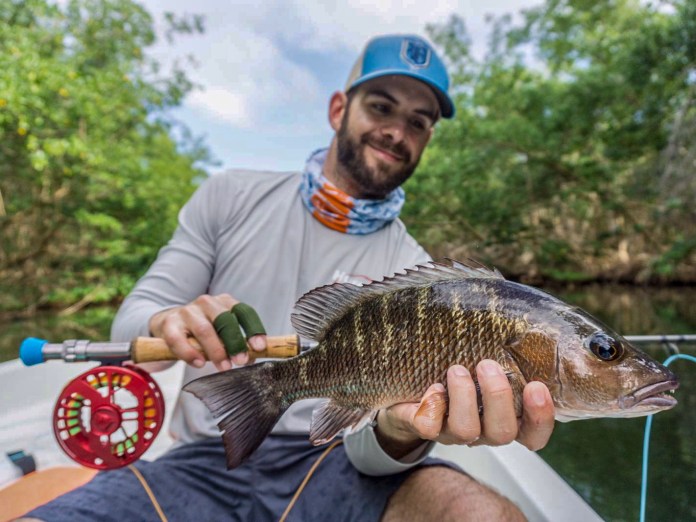
You can find different environments and species. Mangroves with tarpons, snooks and snappers. Flats covered by turtle grass and bonefish and permits swimming in the surf line. Tarpons are also present in the open ocean. There are jacks, cudas, needlefish and many smaller coral fish.
I’ve been planing a saltwater fly trip with my best fishing buddy Jan for a couple of years. Finally, in the fall of 2019 everything came together and we booked flights and accommodation for our first trip. Weeks of studying and preparation, tying flies and collecting gear. On the 7th of December we…. I don’t want to bore you with details of the traveling but I have to say one thing. If you’re going thru France and you will do in most cases, make sure you have about 5 hours for transfer from Charles de Gaule airport to Orly airport. It’s a terrible transport.
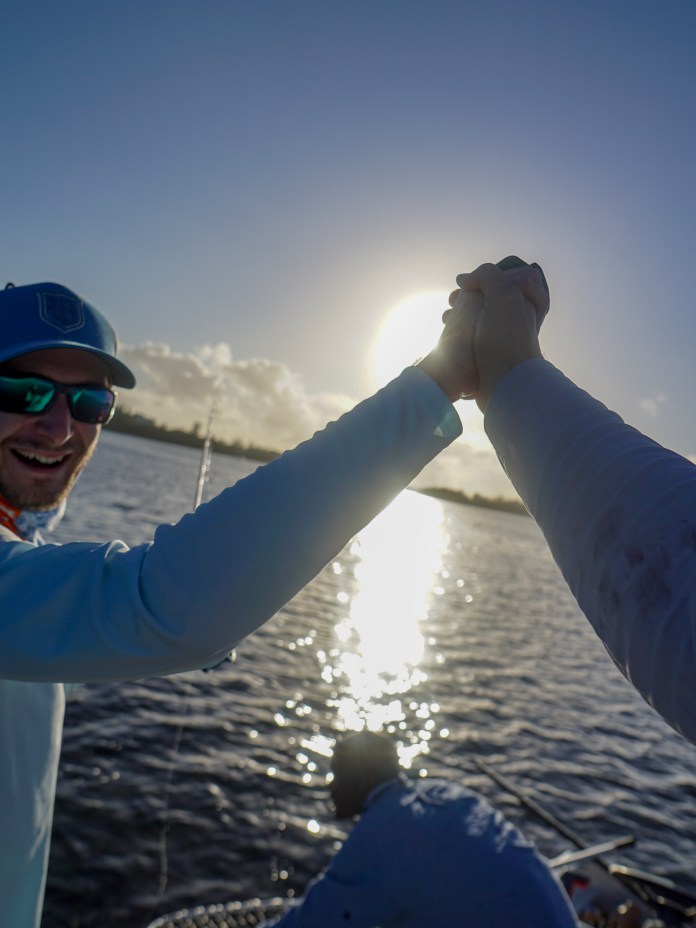
Finally in the Caribbean. It is nice to escape freezing Europe. But, while the first and last days were sunny the rest was not your typical Caribbean weather. Dark skies, wind, waves and lot of rain. Pretty bad conditions for sight fishing. So we did a lot of mangrove fishing, fishing in channels and also some blind casting. We hooked many new species and had fun with baby tarpons. In calm mornings we managed to find and catch some nice bones. We saw a bunch of big permits in surfs but didn’t manage to catch them.
Also on our last day with guide, we saw many big bonefish. Each of us got about 10 shots. For some reason, the fish just followed our flies and never took it. Some of them were monsters over 70cm and we saw 2 fish excess 80 cm. Need to say, our guide Cyril did his best to put us on some fish. I would like to say big thanks to him!! See ya next year.
I can see a big potential in this place. It is not an easy place to fish with big numbers of fish but the bones and permits are huge. A big challenge to trick, so we will definitely come again and again…….
The Environmental Protection Agency on Tuesday released a long-awaited report on water temperatures in the Columbia and Lower Snake Rivers. Warm water temperatures in rivers–specifically, over 68 degrees Fahrenheit–are particularly harmful for salmon and steelhead. The federal report validated what conservation groups and advocates have been saying for years: dams are playing a major role in rivers warming, adding to the lengthy list of their negative impacts on wild salmonids.
Climate change and warm-water discharges also contribute to warming water temperatures. The report, however, noted “that the dam impoundments have a greater temperature impact than point sources and tributaries” (page 43).
The negative impacts of dams are numerous, wide-ranging, and well-documented. Whether it is the physical barring of upstream or downstream migrations, predation, destruction of habitat, affecting water quality, or mortality-inducing warm water temperatures, dams are the primary culprit for the precipitous declines of wild salmon and steelhead.
For more on this report, read this Lewiston Tribune article, as the report is immensely complex.
In this week’s Fly Fishing Destination Video, Trippin on Trout takes us back to the meandering rivers of New Zealand’s abundant wilderness in search of monsterous trout and the adventure of a lifetime.
In this adventure, we get to travel along a guided trip to see the South Island and do a multi-day trip, way out into the wilderness. A four-day mission, that involved helicopters, kayaks, lots and lots of walking, climbing, scrambling, and fishing some of the most spectacular trout water New Zealand has to offer! If you like hard takes, huge brown trout, and a healthy fill of little flightless birds, check out the first part of Trout Hunting in the Wilderness (and be sure to come back next week for part 2).
Tune in every Saturday for a new installment of Fly Fishing Destination Videos and make sure to sign up for our newsletter below in order to keep up with new content published daily.
Flylords caught up with Michael Salomone, a longtime fly fishing guide and writer based outside of Vail, Colorado. We discuss why he prefers to fish Ross Reels, why he thinks the Gunnison Reel might be the most reliable and iconic reel around and he shares a few late spring-early summer fishing tips in the Colorado Rockies. Check out the full interview below.
Flylords: How long have you been fishing Ross Reels?
Sal: At the Denver Sportsman’s Show in 2001, I purchased some raffle tickets. One of them was from a Denver area Trout Unlimited. I won the Grand Prize. It contained everything a fly angler could need–waders, boots, jacket, vest, flies, boxes, tools, float tube, rod, reel, and more–kinda crazy. The reel was a Ross Reels, Canyon II. Fell in love with it. Since then I have acquired multiple Ross Reels from the entry-level Flystart and Rapid to the lightweight Colorado LT, the large arbor Evolution LTX and the ever-reliable Gunnison. Still use the Canyon but have developed a regular relationship with the Ross Reels Gunnison. My best suggestion is to buy a couple of raffle tickets when the opportunity presents. Somebody has to win.
Sal: The Gunnison is a restored classic. The analogy I use is that the Gunnison is like a classic automobile that has been taken into the garage and restored to new. Like a classic driver, a car meant for the road, the Gunnison is meant for the river. It is a reel equally at home on your favorite dry fly rod pursuing Colorado high country cutts, on your spey outfit chasing Great Lakes steelhead or walking the beach searching for summertime snook.
Flylords: People claim the Gunnison Reel is the most reliable reel around, do you agree?
Sal: Smooth drag, classic design, attractive porting and with a user friendly handle that gets better when wet, the Gunnison has become a “go-to†reel for my fly fishing. Anglers get a very high value per dollar when purchasing a Gunnison from Ross Reels. With a tippet-protecting drag the Gunnison helps anglers fight and land challenging fish.
The reel takes care of itself. A thorough rinse and maybe wipe of the spindle is all an angler ever needs to do. The deep anodization protects the reel from harsh conditions like saltwater or Pyramid Lake making it an extremely versatile reel for multiple environments. The Gunnison is just badass.
Flylords: One word that comes to mind when you think of the Ross Gunnison?
Sal: Classic.
Flylords: What rod and line do you have paired with your Gunnison? Type of fishing you do with it?
Sal: I have found the matte surface on the Gunnison matches perfectly with the same soft finish found on the new Echo Trout model rods. The look, feel, and performance of these two matched up with an Airflo Elite fly line creates a high-class outfit that doesn’t cost as much as a used car. But I have to admit I find myself tightening down the reel seat on an old Abel 5wt rod that pairs so well with the Gunnison.
The stacked disc drag found on the Gunnison is the same reliable drag used on the Evolution LTX. With a low start-up and consistent pressure the Gunnison is a perfect pairing for the dry fly fishing a large majority of my clients prefer. The light tippets many anglers use for small dry flies can break if you look at them harshly. But the Gunnison protects a light tippet when a 20†trout sips your Parachute Adams off the surface and bolts for the closest cut bank. I can count on the Gunnison reel to help my clients stop powerful fish before they’re lost.
Flylords: Any maintenance tips for your Ross Reels?
Sal: The fly reels from Ross like the Gunnison Reel have a self-lubricating bushing that eliminates the necessity for added lubrication. If a Ross Reel develops a “squeaking†noise, a window cleaner such as Windex is all that is recommended. Not oil. To clean, use a rag on the spindle and wipe inside the spool with a Q-tip. Allow the frame and spool to air dry separately before reassembly. Sealed drag reels like the Evolution R require even less maintenance. Any of the Ross Reels that are exposed to harsh environments like saltwater or Pyramid Lake should be soaked in distilled water, preferably, and then allowed to air dry before reassembling.
Flylords: As a veteran fly fishing guide what are three tips you would say to a novice angler getting into the sport?
Sal: Read. Magazines, books, online content–they all can teach you something off the water or teach you a technique to attempt on your next outing. Flylords is an excellent source with its massive amount of content. Books like Lefty Kreh’s Presenting the Fly and anything Gary LaFontaine wrote really helped me out when I was first starting.
Watch when you get to the river–other anglers, how they fish, cast, land fish, what bugs can you see and look for signs of trout that give their location away. Once located those fish are easier to catch. Slowing down and observing are skills anglers need.
Develop a relationship with your local fly shop. They have a wealth of knowledge and are willing to share it. Fly shops provide how-to-information, stock necessities like tippet, leaders and flies and carry new gear like the latest fly rods, new reels and updated waders. Most fly shops have tying nights too where fly anglers can learn to create flies with the help of an experienced tyer.
Flylords: Any springtime trout fishing secrets you want to share?
Sal: Look forward to what hatches are coming up and begin to fish the nymph phase of those bugs early. Knowing there is a big Salmonfly hatch on the Colorado River in June has me using large Pat’s rubber legs stonefly nymphs beginning in May. The well-known Mother’s Day Caddis Hatch on the Eagle River makes fishing caddis nymphs starting in April a good idea for the same reason.
Flylords: What else are you doing to pass the time during Quarantine?
Sal: With my home on the bank of the Eagle River, I don’t have a backyard. The river is my backyard. So under direction from my Dad, who suggests I get out every day, I have been fly fishing at my place. I am able to wader up on my deck and have a well-worn path down to the river’s edge. I’ve been mixing it up a little each outing–nymphing one day, dry flies the next and streamers when the water gets off-color from mud. Artwork (see recent work above) and writing about fly fishing have helped occupy the quarantine time too.
Flylords: Anything else you want to add?
Sal: With the Coronavirus keeping everyone apart these are trying times that can be hard to wrap your head around for some anglers. The disconnect I receive from fly fishing eases the anxiety surrounding the current situation. Organizing fly boxes, exploring local fishing opportunities on internet maps or wading through online content are all positive incentives for keeping anglers connected to the fly fishing world at home. Whether it is casting on the grass, rigging up your fly rod on the water or just sitting on the riverbank, fly fishing creates a productive distraction that eases your soul and clears your mind. Keep your head straight.
Mike “Sal†Salomone is a veteran fishing guide and writer based in Vail, Colorado. Be sure to check him out on Instagram at @mikesalomone88 or online at www.michaelsalomone.com. He can be reached at adventuresal@yahoo.com or by calling Vail Valley Anglers at 970-926-0900.