Flying and fishing are just part of Alaskan life. In order to get to remote fishing spots, an airplane is a necessity. Jeremy Pepperd and his family live the Alaskan dream in their SQ12, flying to incredible locations and catching some beautiful fish. The @xploringalaska Instagram page captures their amazing adventures. I got the chance to chat with Jeremy and his daughter Lainie about their Alaskan escapades. Below our interview with the father-daughter duo, along with some of their spectacular imagery!
Who is Xploring Alaska?
Jeremy: Our Instagram page was initially started by Lainie, but I manage it now. My son races amateur motocross down in the states, and we wanted to share our Alaskan adventures with people down there. It has been a fun way to share our flying, fishing, and hunting adventures with people all over.
When did you begin fly fishing?
Jeremy: As a kid growing up in Alaska we always were fishing, hunting, and exploring. I must have been about 14 or 15 when I really got into fly fishing. There weren’t very many people fly fishing back then. After the movie A River Runs Through It came out, I saw a lot more people on the local streams. Originally I had a cataraft and would float nearby streams, but as I got older I saw the need to get away from the crowds, so I bought my own bush plane. I grew up flying with my dad, and always knew I wanted my own plane.
Lainie: Dad has been bringing me fly fishing since I was super young, he used to put us kids in a backpack and take us out on the river.
What’s your favorite part about flying and fishing in Alaska?
Jeremy: My favorite part of flying and fishing in Alaska is just getting out and exploring new country away from the crowds. This airplane opens up some opportunities that other planes can’t necessarily offer due to its short landing and takeoff capabilities. I love finding new spots to land and fish, and it’s great to watch the kids catch fish.
Can you explain the culture of general aviation in Alaska (and the adventures that come with it)?
Jeremy: I think there are over 10,000 planes registered in Alaska. Bush flying is definitely a staple for Alaska, it seems like almost everyone has a plane. Alaska also has 33% of all Super Cubs registered in the USA. Just as a River Runs Through It brought a new crowd of fly fishers, right now it seems like a new crowd of bush pilots is coming up due to social media and YouTube videos. As far as general aviation in Alaska, I think it’s a part of life. A lot of people grew up doing it, and those that didn’t want to do it. It opens up so many opportunities for hunting, fishing, and exploring Alaska.
Do you have any crazy stories of fly-out fishing?
Jeremy: As a pilot, you try and limit crazy as far as mistakes and such go. We do have some good stories though. In the spring we’ve flown out and broke off big chunks of ice and floated down the river on them and fish off of them.
Last summer on the 4th of July my friend called and said they were halibut fishing in the Prince William Sound and I flew down and landed on the beach. I pulled my plane up into the grass and went out on their boat. When we came back the plane was sitting on a little island of dirt and was surrounded by water because the tide had come in. We stayed there all night long to wait for the tide to retreat so I could fly out.
Lanie: There’re too many trips and adventures to think about! We’re out doing something almost every weekend, so we’re always creating good stories.
What is your youngest child named?
Jeremy: Landin Trout is my youngest son’s name. Below is a picture of Landin Trout with a rainbow trout, how appropriate!
What is your favorite target species?
Jeremy: I love fishing in general, my passion for fly fishing started with Rainbow Trout fishing. There was a time when I was obsessed with fly fishing, it was right around when I got married. My wonderful wife worked at a local fly shop for a while so I could afford my fly fishing addiction. Although rainbow fishing is where my love for fly fishing started, there is nothing like catching a king salmon or doing saltwater fishing.
Lainie: I love rainbow trout fishing, I have never caught a brown trout but I really want to.
Do you have any exciting future fishing trips planned?
Jeremy: We are always doing something, but I really want to fly up to the Brooks range and fish for Sheefish (the tarpon of the north). I also have some steelhead spots I want to go explore. Next summer I want to put a raft in the plane and fly down to Prince William Sound and go halibut fishing off the beach.
Check out @xploringalaska on Instagram to see more of the Pepperd family adventures across Alaska!
Flylords got the chance to meet Rachel Lubarski, an Indiana native whose skill on the water shines through in her angling and her artistry. Her driftwood sculptures capture the movement of the fish species she loves, and are realistic enough to transport her viewers to their favorite rivers and lakes. Check out Rachel’s comments and creations below!
Photo Courtesy of Rachel Lubarski
Tell us about your artistic background – how did you become interested in art?
I had the privilege of growing up in a family of artists. My parents and both of my brothers are artistically inclined. We were always encouraged by our parents to channel those gifts and to make them our own, so we all did exactly that. My family owns an art gallery, Promise You Art House, in Northwest Indiana that showcases artwork from many local artists, so there is a lot of support for the art world in our family. I personally have always had a deep love for and connection with animals, and from an early age I showed interest in drawing them. I loved the way they looked, and I wanted to be able to recreate them in my own way. I would draw dogs on everything I owned, spending hours upon hours refining my skills, until I eventually became adept at drawing animals. I took a few art classes in school, but for the most part, I am self-taught and still learning every day.
Photo Courtesy of Rachel Lubarski
How has fishing played a role in your life so far?
Fishing has also always been a part of my life in some way. My brothers and I grew up fishing with our dad during summer vacations in Michigan. Five years ago I found a love for fly fishing. At that time I met my boyfriend, Aaron, who was guiding for massive steelhead out of small Indiana creeks. I didn’t even know what a steelhead was at the time, or that Indiana had them within half an hour of me, but I fell in love with them fast. These fish are so tough, but it is so rewarding when you hook one. I fished for months before I caught my first one. Fly fishing Indiana creeks for steelhead during cold winter months is not for the faint of heart, but I stuck with it and it paid off.
Photo Courtesy of Rachel Lubarski
A few years ago, the opportunity arose for us to spend a summer season up in Alaska on the Kenai Peninsula. It was tough because I had to leave two of my three pets behind with my family for six months, but I learned a lot that season—mostly about fishing. We did some steelhead fishing on our way out of Alaska, and I decided I wanted to challenge myself and catch one on a two-handed rod, swinging flies. I had never spey casted prior to this, but I was determined. I was either going to leave Alaska saying I caught one swinging or not at all. On the final day of fishing, we walked a little further up river, I made two casts, my line went tight and at the end of it was a dime-bright, wild Alaskan steelhead with my leech in her mouth. That was the moment I became hooked on spey casting.
Photo Courtesy of Rachel Lubarski
The following year we headed back to Alaska with two dogs and a cat in tow. We rented a little cabin in Cooper Landing, bought a drift boat and spent the fall, winter, and following spring and summer fishing the Kenai River. The Kenai is an intimidating river to learn to row a drift boat on, but I did it. The next fishing goal I set for myself was catching an Alaskan King Salmon swinging flies and, boy, did I put my hours in. It wasn’t until early summer of 2019 when I achieved that goal and landed a King Salmon on the Kenai River. It was an incredible experience, and I am still on cloud nine when I think about that day. I can’t even imagine what my life would be like without these fishing opportunities. It has become a part of who I am and has led me on many great adventures. It has also connected me with the love of my life and it’s an activity that we can enjoy together for many years to come.
Have you always been interested in three-dimensional art?
I was putzing around a small little craft shop in my hometown with my mom, and there was a small basket of unique pieces of driftwood found along the shores of Lake Michigan. One of those pieces caught my eye, and I envisioned an alligator’s eye when I saw it. I just started using those pieces of driftwood from the basket to build an alligator face right there in the store, snapped a quick photo so I could remember how I put it together, purchased the driftwood for a few dollars, went home, and built and painted an alligator head for myself. That was my first driftwood piece, and it still hangs in my home. I originally started building them for myself, just to keep myself busy and try something new that would keep my interest. I never anticipated selling them someday, but here I am several years later with over 100 of them under my artistic belt. I would love to keep them all and hang them throughout my house, but I always make sure to take good photographs of them before I send them off.
Photo Courtesy of Rachel Lubarski
Do you have any favorite fish to construct? Why is it your favorite?
I love making all fish, but I would definitely have to say that my favorite species to recreate is the brown trout. It was the first fish sculpture I ever made, as a gift for Aaron in 2015. I just love everything about them—their colors, their aggressive takes, the places they live. After I caught my first steelhead, the next fish I wanted to catch was a brown trout. They are few and far between in Indiana, so we invested a lot of time driving up to Michigan and Wisconsin to target them. I have so many good memories of those trips and rivers, so I get super excited when I get a brown trout order.
Photo Courtesy of Rachel LubarskiPhoto Courtesy of Rachel Lubarski
The way you paint the driftwood brings the pieces to life—have you always been a painter as well?
I haven’t always been a painter. I dabbled in painting growing up, but never really got super into it because drawing was my forte. It wasn’t until I started painting my sculptures when I really developed a huge love and appreciation for painting. It took some growth as a person to influence that move. I wanted to reinvent my art style by creating lifelike pieces of art using pieces of driftwood, which is essentially an art form in itself. I paint with the groove of the driftwood’s organic shape and texture because the driftwood is part of the beauty behind my work.
Photo Courtesy of Rachel Lubarski
Do you work from photos when you paint the fish’s features, or just let them take shape organically?
When building a new piece, I almost always use reference photographs. I’m a bit of a perfectionist, and I like my proportions to be accurate from the start. If a customer sends me a photograph of a fish they caught that they want replicated, I will reference that photo throughout my painting process, making sure to capture the likeness of the fish to the best of my ability. I also use reference photographs when making a new fish species. If it is a fish that I have made several times and I have creative control of the piece, then I will just paint whatever feels good and let my imagination do the work.
Photo Courtesy of Rachel Lubarski
Why is your work important to you?
My work is important to me because making art is my way of expressing myself without having to say much. I am definitely an introvert, and it can be difficult for me to be social or put myself out there sometimes. I struggle with mental health issues, and my artwork has helped me come out of my shell. It has helped me cope with difficult times or feelings because I can immerse myself in my artwork and it gives me purpose. Animals have always been the inspiration behind my art, and to be able to connect that passion with fishing has been life-changing for me. I like to think that my artwork speaks for itself but shows that I respect and care about the fish that I’m creating.
Photo Courtesy of Rachel Lubarski
How do you hope those viewing your art react? Do you have a specific message you are trying to send to your viewers?
I would love for people to see my artwork and appreciate the time and energy that I have put into each sculpture, from collecting the wood, to building, to painting. Each one is unique and tells a story. I have made them in Indiana and Alaska, and I have been sent driftwood from Florida to make them as well. One of the last orders I was commissioned to do while we were still in Alaska was for a largemouth bass. I built it with driftwood off the Kenai water system and started painting it while I was up there. I traveled back to Indiana with it, working on it along the drive home, and finished it up when I got back to Indiana. That piece made a 4,200-mile journey through Canada and the states to get to its final destination in Indiana. These sculptures are very special to me, so I hope people can treasure them the way that I do. The fact that people want to purchase my art and hang it as decor in their homes speaks volumes to me as an artist.
Photo Courtesy of Rachel Lubarski
Do you have a favorite fly to tie or fish with?
I got my own vise and tools to start tying flies a couple of years ago, but I don’t spend as much time tying flies as I would like to since I spend most of my free time making art. When I do make time to sit down at the vise, I typically tie streamers and intruder style flies. I have a dog, Edam, who is a Keeshond and very furry. I have tied flies with his fur before, but have yet to try them out myself. We did have friends come visit us in Alaska and one of the guys tied a fly with Edam’s fur and caught a steelhead with it! Most often I will borrow and use flies that Aaron ties because they seem to always catch me big fish.
Photo Courtesy of Rachel Lubarski
What advice would you give to someone who is thinking about picking up a fly rod or starting a creative hobby for the first time?
I have learned over the years that it is super important to have hobbies or activities to keep busy and keep the mind right. I would encourage anyone who is just starting out in a hobby, such as fly fishing, or starting a creative venture to just find something you enjoy doing, stick with it, and keep working at it! Hard work and consistency pay off in the end. It is so worth the effort to be able to find something you are passionate about and can continue to excel in with enough time invested!
Photo Courtesy of Rachel Lubarski
Is there anything else you would like for readers to know about?
Had I never met Aaron, I probably would not be where I am today in regard to fishing and my art. He has been my number one fan since day one. He has taught me everything I know about fly fishing, been patient with me throughout the learning process, and continues to encourage me to push myself daily. He’s a hard-working guide and goes above and beyond to make sure his clients have good fishing trips in Indiana, Michigan, and Alaska. Check him out on his website www.swingafly.com. Most of my artwork is custom commissioned orders, but I do have platforms where my work can be viewed. My website is www.catchmydriftart.com and my Instagram is @catchmydriftart. If interested in purchasing a piece, the best way to contact me to discuss order details would be my email, rlubarski@gmail.com or through Instagram direct messages.
Recap: A few South Carolina boys packed up and headed to the Pacific Northwest, setting up our base camp at The South Fork Lodge, which is built directly on a dramatic bend of the world-famous Snake River in scenic Swan Valley, Idaho.
These redfish guys had no idea what was in store, but drift boats, trout, and cooler temps sounded like just what the doctor ordered after a long hot summer. The new fall Marsh Wear line was about to drop, and we could not think of a better way to test some of the new fly-fishing apparel than a trip down the Snake with variable weather conditions.
From the time the boats were launched with guides Ryan and Jordan, it was on. A few mending lessons for us saltwater boys, and we were rocking and rolling downstream.
The new Rutledge Jacket was a trip favorite, with conditions switching back and forth from sunny and brisk, to cloudy and cold.
With the guides explaining that the rain made for a great topwater bite, we didn’t let the downpour on day-two stop us either. The Eclipse Jacket held up to its 10K waterproof rating and kept us dry all day.
All in all, fish were caught, sights were seen, beers were drank, and friendships were made. The new fall fishing apparel held its own in the elements of the Northwest, and we hope to be back soon!
Something is brewing on the Hells Bay Boatworks manufacturing floors. For those paying attention, Orvis President Simon Perkins and Hells Bay have both teased a mysterious skiff collaboration that fanatics of both manufacturers will love. So far we’ve only seen the hull and an Orvis Helios 3 logo embossed on the gunwale. Check out our investigation into the upcoming project, below!
After doing some slight internet sleuthing we found a hidden page on the Hells Bay website showing that an Orvis Edition Package Skiff has been created as a part of Captains for Clean Water’s “World’s Finest Skiff Raffle“. The raffle kicked off on the 1st of October officially, and you can learn more about it and enter, here, and proceeds will support the great work Captains for Cleanwater does around the nation.
The collaboration is built around a 2020 Hells Bay Professional and has been outfitted by Captain’s for Cleanwater with “a Mercury Racing 60R motor, a Raymarine Axiom 9, custom SeaDek flooring, Power-Pole shallow water anchor, Boatmaster aluminum trailer, extras from YETI and Traeger, plus a few more special additions.”
Searching for Salmon or Steelhead can be achieved in many different locations. The differences in the watershed can range from small to large, rural, or wild and can also be defined by the fish they hold. Some streams either have a hatchery or wild fish population, with some having a combination of both. Knowing the difference between the two can provide fresh fish for dinner or something you’ve had tucked in your backpack for 6 months.
A Wild Chinook Salmon (See adipose fin)
Some, but not all fisheries have hatchery fish clearly marked. Fish typically available for retention have the adipose fin-clipped when at the juvenile stage which then heals as an adult to identify it as a hatchery fish.
Hatchery Chinook Salmon (No Adipose Fin)
Washington’s Olympic Peninsula presents a hatchery and a wild fish population and a period when they are both abundant in the river at the same time. As the season progresses, in the area I am often found I can fish out of range where hatchery fish travel, but when guiding or fishing for myself early in the season, I am lower in the system targeting fresh fish coming into the river off the tidal push. In these areas, I’m typically below a small tributary of the main river that allows hatchery fish to travel up through once they have moved out of the main stem, but they must pass me first.
Fly fishers are not often targeting hatchery fish and are only looking to come in contact with nature for a brief moment, but if fishing an area where hatchery fish are present, you may come into contact with one. If this happens, having a hatchery fish in your net is a great surprise when dinner plans are not set. Before you return this fish to the river if planning to catch and release, make sure it does not have mandatory hatchery fish retention, which requires you to take the fish out of the system. What do you do when this tasty situation presents itself?
Step 1. Bleed your fish by cutting out the gills, which will allow your fillets or steaks to have a better taste. Quickly removing blood from your fish is essential to help preserve the quality of the meat if you are not able to put the fish on ice immediately.
Step 2. Steaks or Fillets? Determining how you will portion your catch decides which option is best for your home or a riverside campfire. Fillets are best suited for home when things are a bit more controlled. Steaks are better for a campfire, a sixer, and some fishing buddies fresh out of waders staring down at sleeping bags as the comfiest place on earth after dinner. Next up is the fun part, the cooking!!
DRY RUB MARINATED BBQ SALMON OR STEELHEAD RECIPE:
An easy way to step up your salmon or steelhead fillets or steaks taste is a flavor-enhancing rub that stores well in your cabinet, boat, backpack, or truck without the worry of it spoiling. Brown Sugar is the main ingredient, followed by Paprika, Thyme, Rosemary, and freshly ground Salt & Pepper. What you’ll need to prepare the rub is a small metal or glass mixing bowl, measuring cups, and a whisk.
Guide Tip: If utensils are not available, you can mix ingredients in a plastic Nalgene bottle or Ball Sealable Canning Jar by shaking.
1 Tablespoon Large Granule or Freshly Ground Salt1/2 Teaspoon Freshly Ground Pepper2 Heaping Tablespoons Paprika1 Teaspoon Fresh Thyme1 Teaspoon Fresh Rosemary1 Cup Brown SugarMix ingredients with a whisk or by shaking your container until all parts are distributed evenly.
Cooking Instructions:
When preparing on the river, layout the freshly caught fish on aluminum foil. If doing from home after your fish has thawed in the refrigerator, cut into 1/2 or 1/3 pound pieces and lay down in the same manner inside a rectangular baking dish. Get ready to use your bare hands riverside or if at home wear rubber gloves to press the rub into the meat after evenly distributed over the fish until absorbed.
Let fish sit for 15 minutes before grilling and during this time, preheat your grill or stoke your campfire to high heat and then down to medium-high coals for cooking. Your fish will need to go for no longer than 10 minutes on the grill – remember your fish will continue to cook after removed from the heat!
Place fish on the rack and cook for 4-6 minutes on each side over medium heat or very red coals with no flame until meat separates from the skin easily with a fork/stick. As your fish cooks, the brown sugar has been caramelizing on the grill, creating a sweet herb glaze. Remove from heat or place on the edge of the grill if plates are not available, crack a brew, and enjoy your catch. If vegetables are available, this rub will work as an excellent side dish seasoning for added flavor.
Enjoy!
Recipe Summary:
1 cup brown sugar
2 heaping tablespoons Paprika
1 teaspoon Thyme
1 teaspoon Rosemary
1 tablespoon large granule Kosher Salt
1/2 teaspoon pepper
Mix all ingredients with a whisk until all parts are distributed evenly in the bowl. Massage dry rub onto fish. Let stand for 15 minutes. Cook on medium heat for 4-6 minutes on each side. Let stand for 1-2 minutes.
This article was written by “LPJ†Lael Paul Johnson (@flygyde), a steelhead guide based just outside of Seattle, Washington. He guides The Olympic National Park, the Queets River, Skagit, Hoh, Humptulips, Clearwater, Satsop, Wynoochee, Skykomish, Kalama, Cascade and Stillaguamish River.
Check him out on Instagram @flygyde. If you’re looking for steelhead guidance on Washington’s Olympic Peninsula, Alaska, British Columbia or Patagonia visit www.flygyde.com
After decades of negotiations, the Klamath River is set to flow free in a short time. A Memorandum of Understanding on restoring the Klamath and dam removal was agreed to and signed today, Tuesday, November 17th, by the Governors of California and Oregon, leaders of the Yurok and Karuk Tribes, PacifiCorp, and the Klamath River Renewal Corporation. This would be the largest dam removal project ever undertaken in the United States, and “the project, when completed, will address declines in fish populations, improve river health and renew Tribal communities and cultures,” per the press release.
Photo by Ben Moon
Granted this will not happen overnight, but this agreement is the biggest step toward recovering the Klamath River and its fisheries in decades. The signing parties, “committed to the removal of the JC Boyle, Copco 1, Copco 2, and Iron Gate dams in order to achieve a free-flowing Klamath River with volitional fish passage.”
Copco No. 1 dam, USFWS
“The science on dam removal is rock solid – it’s one of the most effective ways to improve the health and resilience of wild fish and rivers. This latest agreement puts this proven solution into action on an unprecedented scale,” said Native Fish Society’s Executive Director, Mark Sherwood.
If you’ve been hunting for a rooftop tent that won’t take up all the precious space on your roof rack, the new Tepui Foothill is here. The new compact design comfortably sleeps two and leaves plenty of space for your other gear. Check out the press release below from Thule for more information!
From Thule:
The first compact rooftop tent that saves valuable mounting space for all the gear you love.
Leave nothing behind with the newest rooftop tent from Thule. At just half of the width of traditional models, the Thule Tepui Foothill’s innovative design is spacious enough to comfortably sleep two adults, while preserving enough room to carry a rod rack, kayak, bikes, surfboards, and other cargo next to it on the roof.
The new Thule Tepui Foothill gives adventure seekers the freedom to camp comfortably and leaves nothing behind. At just 24†wide, the Thule Tepui Foothill is half the width of most rooftop tents on the market, yet spacious enough to sleep up to two adults.
Image courtesy of Thule
When folded, the low profile design sits just 9.5†above the roof rack allowing owners to easily drive under low clearance instances like garages or parking structures.
Setting up camp in the Thule Tepui Foothill is quick and easy. A single person can deploy and break down the tent with its intuitive internal telescoping frame poles. And once deployed, the spacious interior features a wide entry, oversized panoramic windows, and dual skylights for plenty of breathability and an expansive view of the stars.
The newly designed base reduces tent weight while delivering premium strength and stability. To improve durability in shipping and simplify the initial installation process, pre-installed mounting rails have been added to save time and add strength.
Image courtesy of Thule
Rooftop tents are made for outdoor adventures – but even explorers like to sleep comfortably. The included high-density foam mattress offers at-home comfort. You can also customize your tent with a vast portfolio of accessories such as 310 thread count Thule Fitted Sheets or a Thule Tepui Insulator for those colder nights (both sold separately).
Like all Thule Tepui rooftop tents, the canopy fabric is both UV and mold resistant to withstand the elements of year-round use. And during inclement weather, the included rainfly easily attaches to the tent to provide a dry camping experience, but can quickly fold down and away when not needed.
Camping and outdoor activities go hand in hand for Thule users. The Thule Tepui Foothill is a game-changing rooftop tent with premium comfort that makes it possible to bring all the gear needed to fulfill your very own perfect adventure – whatever and wherever that may be.
Pricing – US Retail: $1,699.95
Available at Thule.com, REI, and other retailers where Thule products are sold in Feb. 2021.
If you’re an outdoor enthusiast, there’s a good chance you’ve seen one of these speakers pop up in the background of your social media feed, or, more likely, in the foreground of your most recent fishing trip. This sudden surge of speaker emergence comes as no surprise to us; especially after finally getting our hands on one ourselves. In our latest gear review, we’ll be going over the outdoor speaker that delivers Texas-sized sound, and is as tough as the Lone Star State itself. Below, see what we had to say about the Turtlebox Outdoor Speaker.
Upon Opening:
When the cardboard box with the Turtlebox logo finally landed at Flylords HQ, we were ecstatic to say the least. The clutch of winter had just begun to creep in from the Rocky Mountain Range, and consistent snowfall was becoming a weekly regularity in our little valley. At the same time, however, we weren’t ready to trade in our streamers for nymphs just yet, and wanted to capitalize on the last of the carnivorous tenacity of pre-spawn browns. More often than not, our days floating down our local rivers were met with snowfall, rain, or sometimes a wonderful mixture of the two. Add strong gusts of wind and an inexperienced drift boat captain behind the oars (me.), and you’re not exactly looking at the safest environment for a Bluetooth speaker (so we thought…).
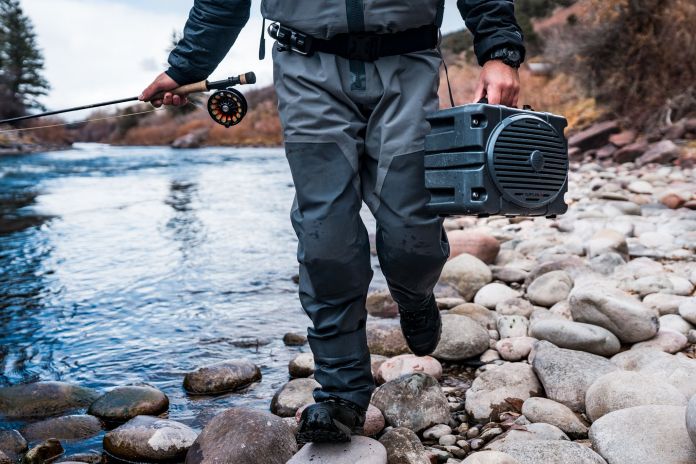
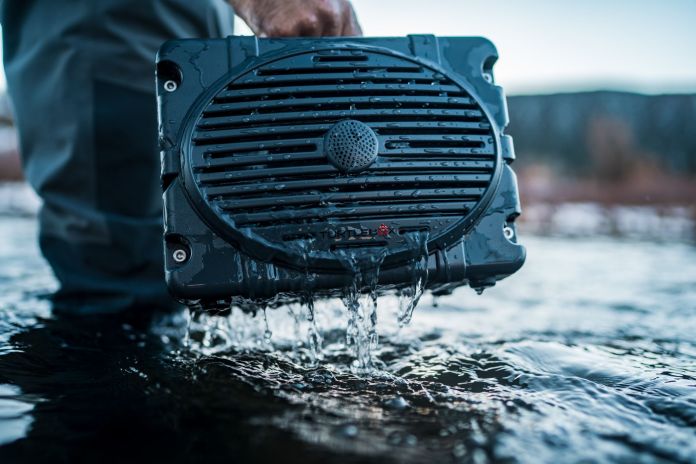
Upon opening up the packaging, we dug out a charger, an instruction manual (which we read through thoroughly), an aux cord, and of-course, one Turtlebox speaker. Immediately, the structural soundness of the box itself was noticeable. The frame itself is IP67, which means it’s 100% sand proof, dustproof, and most importantly waterproof. The box also had an enforced rubberized handle, as well as 4 rubberized feet to keep it firmly stationed wherever you choose to put it. There was pretty much no set up required for the box besides connecting a phone via Bluetooth, and figuring out which Billy Strings jam we were going to break in the new speaker with. Immediately, the office was flooded with ripping banjo and the sweet delight of some fast grass. Out of this, even at wall-shaking volume, the sound was crystal clear and totally distortion-free.
Field Testing:
While it was nice having an in-house concert speaker, it was time to put the product claims to the test. So, we rigged up our 6-weights, packed the cooler full of frothy bevs, and dropped our new Turtlebox into a custom low-sided dory from Boulder Boatworks — a chariot worthy of a king. Immediately on pulling up to the boat ramp, we got down to business. Before even slipping off our boots, we walked over to the nearest eddy, said a prayer, and tossed the box into the water. The sweet melodies being emitted from the speaker were immediately silenced as it was plunged towards Davie Jones’ locker. Immediately, the box surfaced again, still bellowing a crystal clear guitar solo from our friend Mr. Garcia.
After a couple more submersions, including a few where we held the box to the bottom in a semi-sadistic fashion, we gave up in trying to best the box. This thing was sealed tight. With that test out of the way, we were ready to hit the water. As we floated down the river, we were incredibly impressed by not only the sound distribution, as the boat could be used as an echo chamber, thus creating a surround sound effect, but the battery life. Not once did we have to worry about the battery giving out, and at a few knocks below max volume, this thing was really chugging along for a full day on the water. Thank the fish Gods too, especially considering the blizzard to follow.
With what started as a few flakes received on extended tongues and cheery cheeks, turned into a full-frontal onslaught of snow and wind and whatever else the good heavens could muster up. Thankfully, we didn’t have to worry about the integrity of our speaker, and as “Wait so Long” by Trampled by Turtles crawled into the front of the Spotify queue, we were more than grateful to have the proper background music to fuel the blind mad-dash to the finish line that ensued behind the oars. We’re not saying that anything bad would’ve happened had we not had the speaker to fuel our drive, but then again, there’s nothing to prove it wouldn’t have.
One additional feature that we consider an essential mention would be the co-speaker Bluetooth pairing capability to create a true right and left surround-sound speaker experience. If you don’t have a boat stadium like we did, or are just looking for a true concert experience, you and a buddy can link the two speakers seamlessly and get to blasting your favorite tunes how they were meant to be experienced.
Final Review:
Element Proofness:Â
Volume:
Audio Clarity:
Portability:
Battery Life:
User Friendliness:
Price:
Looks:
Conclusion:
Overall, we had a blast testing this product. In short, the Turtlebox speaker is one of the most well put together, best performing pieces of outdoor equipment we’ve ever had the chance of testing. It’s a product that speaks to what why we love the outdoor industry, in that by putting the bells and whistles aside, it’s engineered to perform to the pinnacle of the consumers expectation, and not get caught up in the other nonesense. If you’re looking for a speaker that’ll last a lifetime no matter what you put it through, we definitely recommend heading over to Turtlebox and trying one of their speakers yourself.
My friend Bobby Harrison and I, Kameron Brown, launched out of Dana Harbor in search of some inshore pelagics. Searching, drifting, casting, and stripping every paddy in eyesight. We pulled up to a really lovely kelp paddy that had some trashcan size chunks dispersed around it. We drifted and fished that one several times and came up empty-handed. We put the boat in gear and putted over to a smaller piece just 100′ away. As we approached the paddy(a chunk of floating kelp), we saw a huge black blob.
Whale? Mola? What is that? I just about fainted when I saw what we thought to be a 1000 lb Mako Shark, swimming 3 feet under our boat. I didn’t even think twice and set my rod down, grabbed the GoPro, and started filming. I had never seen a Mako Shark this big in my life and never thought I’d ever have the chance to see something of this size, especially being about 10 miles off of my daily surf spot, San Onofre.
Bobby and I were freaking out, unsure of what to do. We put the boat in gear and moved away from the fish and just as we started moving, my fly line starts zipping through the guides and finally stops at the reel. I picked up the rod in fear of me hooking the kelp paddy that would inhibit us from fleeing this beast until all of a sudden my reel started screaming. Absolutely screaming…… We couldn’t help but think that the fish would do an ariel jump and land in our 15′ boat and sink us/eat us!
The fish was burning drag for the next five minutes until the 20lb fluorocarbon finally broke…
We came home and checked the footage and to our surprise, the 1000 lb Mako Shark, that scared the crap out of us, was actually a 1500 lb Great White Shark…..
Huge thanks to Howler Bros, Socco Socks, SPY Optics, 81 Wetsuits, Shaper Studios, and Almond Surfboards for making my life a living dream. Make sure to check out Kameron and Bobby on Instagram!
We are mid-way through the month of November which means many of us are transitioning out of fall and into winter. Days become shorter and colder which means it is time to transition our mindsets to maximizing the opportunities we have on the water before the dark of the night creeps in. Although nymphs tend to work year-round, winter is when trout tend to key in on the abundance river beds have to offer. Hatches will tend to slow and trout lean towards saving energy rather than exerting it while the water temps are colder. You know what that means right? Time to bring out the flash! In this tips and tricks video of the week, Tanner Smith of Trouts Fly Fishing breaks down 5 effective nymph patterns for the month of November.
5 Flies to Get Your Through the Month of November:
1. Flashback Pheasant Tail (Size 16-20)
2. Zebra Midge (Size 18-20)
3. Massacre Midge (Size 18-20)
4. Purple Copper John (Size 16-18)
5. Extra Heavy Rainbow Warrior (Size 16-18)
Although this time of year may be more difficult than others, you can be sure if you have these flies in your box you will also find the fish. These flies can be tied in multiple varieties with many different materials. One thing is for sure in November, a little bit of flash goes a long way. Don’t hesitate to fish something a little out of your comfort zone because it might just lead you to the fish of a lifetime. Winter months can often be very rewarding for trout if you are willing to brave the frozen toes and finger tips. Best of luck on the water during the month of November!