Home Blog Page 182

Fishing Etiquette: Spot Burning

Sharing information about fishing is always a balance. A balance between 1) inspiring and informing people to get out and have a successful day on the water, and 2) sharing too much information and “burning” a fishing spot. This is a guide on how to successfully navigate the fishing world without spot burning.

What is “spot burning?”

Spot burning is the act of publicizing information that brings attention to specific fishing opportunities— usually resulting in excessive fishing pressure.

Why is spot burning bad?

As many of us know, being a successful angler is the result of many years of trial and error, researching, and a general collection of intellectual capital. It’s this knowledge that allows us to be successful on the water, and to eventually develop spots that you can continually count on to catch fish. 

When people spot burn they are bypassing this entire process. They are providing the general public with specific information about fishing spots that result in massive exposure to the resource.

Angler standing with Fishpond sling
Courtesy of @ericbraker

Social Media

Social media has been a blessing and a curse for the fishing world. On one hand, it provides a social network for anglers to connect with each other and to share experiences. On the other hand, social media has promoted the sharing of excessively specific information that leads to spot burning.

Geotagging

One way to improve your social media impact, and to decrease spot burning activity, is to monitor how you geotag your posts. The worst thing you can do is to be too specific with your tagging. For example, rather than geotagging a specific stream or local area, choose a more broad tag like a state or a region.

Some areas have even developed “Tag Responsible” geotagging options. For example, the “Tag Responsibly, Keep Jackson Hole Wild” is a popular geotag that allows Jackson Hole visitors to tag where they are without giving overly specific information about locations.  

Tag Responsibly, Keep Jackson Hole Wild
Courtesy of @andybrake

Background Context

Another way to avoid spot burning is to monitor what you include in the background of photos and videos. Do you want people to know the spot you fished, the tackle you used, the species you caught?… Different fishing scenarios warrant different degrees of secrecy. It’s up to you to be mindful of the information you include in the picture and whether or not this could lead to spot burning. 

What Can I share?

The main takeaway is to limit specificity when talking about your fishing experiences. It is okay to share methods and techniques, but you should refrain from sharing overly specific locations with the public.

Angler holding a Montana brown trout at night
Courtesy of @ericbraker

What do I do without spot burning?

Everyone struggles to figure out fishing spots and methods; yet, the struggle is what makes fishing so special. This sport is the constant pursuit of becoming more knowledgable of the environment you’re fishing in, and the species you’re pursuing. The satisfaction you receive when you carry out this process and figure out a fishery for yourself is incredibly rewarding.

With that being said, you are not alone. There are tons of tools and resources to help you achieve all of your fishing dreams in an ethical way. Fly shops and guides are one of the greatest resources. Visit a shop (and spend some money), and hire a guide for invaluable local knowledge. Additionally, check out reputable online fishing forums, spend some time on YouTube, and use Google Maps to navigate potential fishing spots.

And when you do figure it out, be careful with that information. You’ve worked hard for it.

Stay tuned for more installments of Fishing Etiquette!

Best Entry Level, Intermediate, and Advanced Euro Nymphing Rods

3

Originating in Europe, “Euro-Nymphing” or “Czech-Nymphing” has grown in popularity stateside and throughout the world. This effective approach gives weighted nymphs the chance to reach depths in which suspension rigs have a harder time reaching. Pair a tungsten bead with fluorocarbon tippet and your nymphs will cut through water columns. You may be asking yourself, “what makes this style so popular?”. While it may be hard to come up with a singular answer, Euro Nymphing gives anglers the chance to piece out sections of water, covering every inch of river or stream. Nymphing rods come in a variety of lengths and weights, but generally are no less than 10 foot in length. Typically, these rods will come in 2-4 weights with 3 being the popular choice amongst euro nymphing anglers. With a soft and sensitive tip, these longer than normal fly rods give anglers the opportunity to reach farther out while keeping a desirable distance from the fish which will likely improve your hook up ratio. Below, we highlight the best introductory, intermediate, and advanced euro nymphing rods on the market.

Introductory Euro Nymphing Rods

Echo Carbon XL 10′ 3-Weight – $189.99

Image Credit to Trident Fly Fishing

If you are new to euro nymphing and just want to dip your toe into the aspect of euro nymphing, the Echo Carbon XL is an excellent rod designed for anglers of all skill levels. This rod stems off of Echo’s Carbon XL series adding a new dimension to this line-up. The Carbon XL Euro Nymph is capable of casting dry flies, nymphing, or launching lightweight streamers. Versatility is the name of the game when it comes to fly fishing and the Carbon XL Euro Nymph offers just that.

Specs:
  • Four Piece Travel Design
  • Medium Fast Action
  • Lightweight ceramic stripping guides
  • Two styles of grips available
  • Warranty available
  • Available in 3 and 4 weight options

Orvis Clearwater 10′ 3-Weight – $198.00

Image Credit to Trident Fly Fishing

Orvis is arguably one of the most well-known companies in the fly fishing industry known for producing premium quality rods, reels, and gear. The Clearwater was tactfully designed to enhance the style of European nymphing for the novice all the way to advanced anglers. This rod is lightweight with a very sensitive tip which makes detecting strikes much easier. The new Clearwater line received a complete facelift where everything has changed except the value. This is by far one of the best rods you can buy for the price due to the significant upgrades in performance and looks. Whether you are new to the euro-nymphing game or a seasoned veteran, the Clearwater should not be overlooked!

Specs:
  • 10′ 3-weight
  • Blanks are black chrome with white accents
  • Quick rod identifier on the blank
  • Chrome snake and stripping guide with a ceramic insert
  • Full black nickel aluminum reel seats
  • Rods with fighting butts have composite tips for durability
  • Two-handed rods have composite on the tip of the foregrip
  • Comes with gray rod tube
  • 25-Year Guarantee
  • Designed in Vermont
  • Imported

Intermediate/Advanced Euro Nymphing Rods

Moonshine Epiphany 10’6″ 3-Weight – $225.00

Image Credit to Moonshine Rod Company

If you haven’t picked up on it already, European-style nymphing is a very tactical form of fly fishing. That being said, weight distribution is a feature often on the nymphing guru’s radar. Moonshine took this desire into consideration during the creation of the Epiphany giving anglers control over the balance of their rod. Anglers have the choice between an uplocking Epiphany with a removable fighting butt or a down locking Epiphany. Whether you are an everyday angler or in the competitive scene, the Epiphany is ultimately one of the most versatile nymphing rods on the market.

Specs:
  • High-Performance Graphite with a sensitive tip and a strong backbone. The Epiphany 3wt is equivalent to approximately a 5 or 6wt butt section.
  • Downlocking Reel Seat helps balance the length of the rod by shifting the weight of the reel to the furthest point back on the rod
  • 3.8oz without Fighting Butt. 4.2oz with Fighting Butt
  • Matte Black to keep the glare down when the fish are spooking easily.
  • Black wraps, with high-quality Titanium anodized hardware from reel seat to tip.
  • Hard 5 compartment embroidered rod case
  • Hand Turned Spalted Burl that has been dyed to reveal the exceptional graining in the burl.
  • Two tips, Lifetime Warranty

Syndicate P2 Pipeline Pro Series 10′ 3-Weight – $324.99

Image Credit to Precision Fly Fishing

As the sport of fly fishing continues to grow, we are seeing a rise in competition style nymphing. Competition fly fishing leagues are popping up all over the US ranging from colleges to local angling clubs. That being said, Syndicate has upped the ante with their P2 Pipeline. This rod is renowned for its lightweight and sensitive design and has become one of the most popular competition rods on the market. The P2 Pipeline not only protects tippets, but it also has the backbone to handle larger fish in those nail-biting situations. Anglers can fish the P2 Pipeline with confidence as Syndicate offers a lifetime limited warranty. If you are looking for a sensitive yet sturdy nymphing rod, the P2 Pipeline is a great option.

Specs:
  • Helical Carbon Fiber Construction
  • Mid Flex, Fast Recovery Blank
  • 4A Cork Half Wells Grip
  • Hardwood Reel Seat Insert
  • Aircraft Grade Aluminum Reel Seat Components
  • Matte Finish Olive Blank
  • TiCH Single Foot Guides
  • Ceramic Insert Rings

Advanced Euro Nymphing Rods

Thomas & Thomas Contact II 10′ 3-Weight – $825.00

Image Credit to Trident Fly Fishing

Thomas & Thomas hold their own when it comes to their constant production of premium quality rods suitable for any style of fishing. They have taken the same craftmanship into the production of the new Contact II Euro-Nymphing rod. The Contact II utilizes 5 different types of carbon and fiberglass fibers bound tightly together by their proprietary aerospace resin system. This rod features an improved guide spacing technology which decreases line sag from the angler’s hand to the first guide. Coming in at a higher price point, this rod is for the avid angler seeking reliable quality and usability in their tools of the trade.

Specs:
  • Optimized guide spacing with lowered stripping guides to decrease line sag between the hand and first guide
  • Increased backbone power to improve hook sets and assist in landing larger fish
  • Extra dense premium Flor grade cork grips increases feel and bite transmission
  • Black RECoil single foot snake guides
  • Black hook keeper and winding check
  • Black “Low Rider” style stripping guide keeps line tighter to blank for improved strike transmission and accuracy
  • New low-profile rounded fighting butt for balance and comfort
  • Stealthy brown and olive thread wraps.
  • Downlocking reel seat standard on 2wt to 4wt models
  • Uplocking reel seat available on 2wt-4wt rods at an additional $25 charge
  • Uplocking, all-metal reel seat, and full wells grip standard on 1086 model

G Loomis NRX + 10′ 4-Weight – $825.00

Image Credit to Trident Fly Fishing

G Loomis has been a mainstay in the fishing industry since 1982, known for its versatility and quality placed in each rod manufactured. The NRX 10′ 4 wt nymphing rod is no exception. This rod features an advanced compound taper providing power, line speed, and loop stability throughout each cast. The extensive construction process and premium materials provide rapid recovery rates and enhanced durability. With all of these features taken into account, it is safe to say that this rod has everything a well-versed angler is looking for.

Specs:

• Single-foot recoil guides
• Titanium SiC stripper guides
• Hook keeper (Line #: 4-6)
• Micro full wells, AAA grade cork grip
• Custom aluminum reel seat with walnut hardwood insert (Models: 490-4, 590-4, & 595-4)
• Custom aluminum reel seat with a fighting butt (4100-4, 5100-4, 690-4, & 6100-4)
• Aluminum rod tube with cloth rod bag
• Handcrafted in Woodland, Washington

Whether you are new to euro-nymphing or you consider yourself an expert, there is definitely a rod out there for you. Each rod on this list is well worth the money and consideration and will surely improve your fishing ability on the water. Ultimately picking the rod that fits your needs is what is most important at the end of the day. Take your time, and learn this style of fishing. You won’t be disappointed with your success! Tight lines!

An Angler Doesn’t Want to Catch Any Fish?

One man’s hookless fly fishing obsession has left us scratching our heads. This gentleman has been fly fishing without hooks on his flies for over 20 years. Is this the level of fishing you graduate to once you’ve reached the highest level of fly fishing enlightenment, or just another angler flexing on the rest of us because he’s only out there to play with fish and cast? Either way, this video had us in stitches.

Is this guy crazy, or do you also fish without hooks? Let us know in the comments!

Featured Fly Tyer: Eric Hurst

Nearly every time I head to #FlyTying on Instagram in search of some inspiration for my time in front of my vise, I find myself drawn to one page in particular at the moment, @EricHurst. Eric is a guide and fly tyer out of the American Southeast, and he ties up some of the more creative, and well-photographed streamers we’ve seen recently. Eric blends natural and synthetic materials creating imaginative and effective patterns. We caught up with Eric to chat about his tying style and process, and what keeps his creative tying juices flowing. Check it out below!

Flylords: Tell us a little bit about yourself, Eric.

Eric: My name is Eric Hurst. I’m a full-time fly tyer and fly fishing guide in Georgia. Always on the hunt for a good time and a couple of fish.

Flylords: When did you tie your first fly? What pattern was it?

Eric: I’ve been around fishing lures and flies a lot in my growing up. I was always fascinated with shiny baitfish patterns and lures in my dad’s tackle boxes. I use to play in his tackle boxes and try to create my own takes on patterns so I guess you could say that’s where it all began. I began to hone my skills on the classics like Clouser minnows and wooly buggers. I just love the art of fly tying and creating something to catch things we have no control over with natural and synthetic materials.

Flylords: What was the first fish you caught on your own tie?

Eric: First fish for me on my own fly would have to be the lean mean fighting machine: bream (sunfish).

Flylords: What is your favorite pattern to tie these days?

Eric: My favorite fly to tie is a loaded question. There are so many that come to mind depending on the situation. Kelly’s Sex Dungeon and Boogie Man always get it done. I’m really inspired by Andreas Anderson’s pattern designs also. The list can go on forever. Really just depends on what I’m hunting for. Basically, anything big and articulated is my go too. I like to throw and strip the fun stuff that looks like it came from Toys-R-Us.

Flylords: What draws you to fly tying and fly design?

Eric: The things that draw me to fly tying and design are: definitely the art of it. I’ve always been into drawing and creating things out of found objects. It’s so exciting taking random fly tying materials and manipulating them on a hook and finding the balance of the materials and how they swim and hold water to create something that gets aggressive strikes from wild creatures. When I’m not on the water I’m always on the vise turning out flies to test. I really enjoy the process of trial and error with fly tying. There’s so much involved to get the right action and that intrigues me. Fly fishing and tying have taught me so much about patience.

Flylords: What is your process while designing and testing a new pattern?

Eric: My process with fly design and testing is mainly a lot of trial and error.  Sometimes I know what I’m going to tie before I sit down at the vise and sometimes I like to challenge myself with picking certain materials that I don’t use often and try and make something happen. Win, lose or draw. For every good fly, there are multiple bad ones, never give up and keep grinding. The fish will let you know when you’ve got it dialed-in.

Flylords: How do you select materials to get different movement in your patterns?

Eric: I select materials to get the most movement by looking for material that don’t hold a lot of water when casting. A lot of getting the right movement is using less and balancing the materials in the right way instead of over tying a fly. The fewer materials you can use and still get a good profile, the better. Lighter hooks and materials on the rear hook combined with heavier and thicker materials on the front hooks always get the fly dancing more in the water. There are so many materials on the market and more coming out all the time. I always look back at the classics and mix in the new materials as best I can.

Flylords: What do you think is the most important aspect of a trout streamer?

Eric: The most important aspect of a trout streamer to me is: Color, action, and profile. I always want my trout streamers to dance like dirty dancing, fight like the last boss in a video game and walk the runway in fashion week. You’re trying to make it like appetizing or piss something off so it’s just finding the right balance of both worlds to me.

Flylords: Do you have any advice for anglers looking to get into fly tying?

Eric: My advice for people wanting to get into tying is to start basic and really study the materials and patterns. A lot of the big-name tyers put in a lot of work and have it dialed. We are lucky to live in a world with the Internet and books about different methods of fishing and tying. If you can get stoked from reading and looking at patterns, then it’s time to get into tying.

The most intimidating thing for me when I got into tying was all the material you need to tie different patterns. So the best thing is to start with simple patterns that only need maybe three materials and then the next thing you know you have a whole arsenal and can tie almost any pattern. Also, don’t be afraid to use other materials when your tying or trying to learn other people’s flies. There’s a lot of materials that have the same motion in water just play around and have fun.

Flylords: What’s next for Eric Hurst in 2021?

Eric: For me, the future is always more traveling and fishing/tying with new homies. I’ve learned so much from just getting out and meeting people doing the same thing. Sharing knowledge and growing with people doing the same thing. Guiding has also brought new exciting people into my life so I’ll keep grinding and learning.

Flylords: Where can people find your work and flies?

Eric: As of right now Instagram is the best place to find my work and communicate with me. Hopefully, in the future, I’ll get into some more tying videos and maybe link up with some companies and try to get my patterns in stores. 

How to Effectively Fish Woolly Buggers in Rivers

1

If you are new to fly fishing, odds are you will start with a 9′ 5 wt rod with a weight forward floating line and a 4x tapered leader. You will most likely start with a selection of the tried and true staple flies known for catching trout. One of those staple flies is the woolly bugger. This is a world renowned pattern and should be in every fly-anglers fly box. You may be asking yourself, how should I fish a woolly bugger? Buggers are universal in that they can be dead drifted, swung, or stripped like a streamer. They represent a lot of different things in fly fishing such as minnows, bait fish, leeches, stone fly nymphs, crayfish, dragonfly nymphs, and so much more. In this tips and tricks video of the week, Dave Jensen of Jensen Fly Fishing and the Orvis Company will break down the basic set-up and tactics on how to fish woolly buggers.

How to Rig a Woolly Bugger Set Up

  1. You will want to start out by tying a crane swivel to the end of your leader with a clinch knot.
  2. On the bottom portion of the swivel, tie 24 inches of 3x tippet off of that and leave 6 inches off the tag end of the clinch knot.
  3. Attach your first woolly bugger to the 6 inches of tag from your tippet addition.
  4. Attach your second woolly bugger to the bottom portion of your tippet addition.

Different Ways to Fish Woolly Buggers

  • The first option is to cast upstream, let the buggers sink for 2 seconds, then strip them back quickly. This will pick up the aggressive feeders.
  • Another option is to cast across the current, let the flies sink and swing in the downstream current. Then pulse your rod to provide movement to the buggers.
  • A very effective option would be to attach an indicator and dead drift the buggers. Adjust the indicator depending on the depth of the run. Dead drifting is essentially nymphing the woolly buggers to imitate dead bait fish.

Tips for Fishing Buggers

  • Apply movement to your flies. Avoid using short and small strips. Use fast and hard strips with pauses in between.
  • Use the current to your advantage. Allow your flies to swing in the current which can entice an eat.
  • When using an indicator, be sure to adjust the indicator based on the depth of the run you are fishing.
  • Remember, buggers are also streamers. It is okay to apply movement to a dead drift.
  • Pay attention to which fly the fish eats. It gives you an idea of how deep you need to be and what color the fish are targeting.

As mentioned previously, woolly buggers are world famous and have been known to catch fish for years. Having an arsenal of these in your fly box is essential needless to say. Take these tips and tricks to the river and test what you have learned on your home waters. Use versatility. If you notice something working better than others, try that method in various ways to try to dial in even more on the trout. Best of luck on the water and tight lines!

Most Useful Fly Tying Accessories

As anglers enter the world of fly fishing, picking up flies from a local fly shop or online is usually the norm. Many of those same anglers will eventually end up behind a vise and begin tying their favorite patterns. Over the course of the past several years, I’ve hardly purchased more than a few dozen flies from a shop. I’ve found that I get far more enjoyment out of catching fish on a fly that I have hand tied. There are certainly essentials when it comes to fly tying such as a vise, bobbin, and scissors but I’ve found a few other items to make fly tying a bit easier and more enjoyable than it already is. These are some tools and accessories that I have found to really enhance not only my time spent behind the vise but also the flies coming off of it. 

Tying Mats

Tying mats serve several purposes from protecting your desk or tying surface to also helping to keep your materials from bouncing and rolling onto the floor. The two options below from Hairline and Timber and Fins are at the top of my wish list and are sure to meet the needs of the beginner tyer and also someone who has spent countless hours behind a well worn vise.

The Hareline Mega Tying Pad is designed to keep beads from rolling around.

The Hareline Mega Tying Pad is a favorite amongst many fly tyers. This oversized mat is made of a dimpled, soft silicone material that prevents materials from bouncing and rolling off of your tying surface. I can’t tell you how many beads and hooks have fallen into the abyss below my tying desk that this mat would have prevented. In addition to keeping your materials where you want them, this mat also serves to protect your desk, table, or tying surface.

The leather tying mats and goods from Timber & Fins are sure to class up any tying desk.

If you have a dedicated fly tying room or maybe you just really like the finer things, check out the beautiful leather fly tying mats and goods from Timber and Fins. These mats have a hook size and bead chart along with dry hackle, and wet hackle charts to help ensure the most accurate proportions while tying. While they may be a bit pricey, they’re sure to class up any tying desk. 

Tying Light

After beginning my tying in a poorly lit area, I can’t say enough about the importance of proper lighting. Having a properly lit vise and work area will help reduce the strain on your eyes as you tie flies. It will also help ensure your flies are of the highest quality. While there are fly tying specific lights out there, you can find great desk light options for a fraction of the price. I have been using an adjustable desk lamp with several different light settings that has really improved my tying overall. 

Magnets

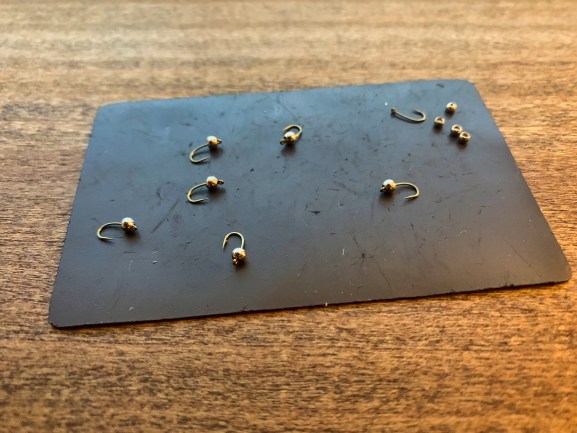
Magnets are an incredibly useful tool in fly tying. If I’m sitting down to tie some bead-head nymphs, I will typically arrange 12 or so hooks that are threaded through a bead on a flat magnet. Doing this prep work ahead of time really helps me get into a groove as I begin to tie. Magnets are also great for picking up tiny hooks and beads on your workstation and probably off of the floor at some point.

You can also use a magnet to orient the hole on tungsten beads prior to putting them on a hook. There are a number of applications for magnets in fly tying so do yourself a favor and grab one off of the fridge or pick up a few different sizes from a local hardware store. 

Storage

As you progress through your fly tying journey, acquiring more and more materials is almost a guarantee. I have found that keeping my tying desk and materials neatly organized makes me far more likely to twist up a few of my favorite patterns.

Storing materials like dubbing, beads, hooks, thread, assortments of hackle, tools and more can get overwhelming quickly. I have dedicated two drawers in a nightstand next to my tying desk to store my materials but I consider having that space a luxury. Many people use plastic bins to keep different materials organized. Plastic bins also eliminate the chance that any bugs can access and potentially ruin your hackle capes.

The Loon Outdoors Bench Rings are perfect for organizing materials like dubbing and packs of hooks.

Loon Outdoors, known for innovative fly tying tools, released their Bench Rings as a simple and cost-effective solution for storing a number of packs of dubbing or hooks in their original packing. These rings are available in 3 different sizes for all your materials.  I’d recommend picking up a few to keep your materials organized in a low profile way. 

The Renzetti Soft Foam Tool Caddy keeps me organized while tying.

My desk tends to get disorganized while I’m tying so I try to stop every couple of flies to tidy up a bit. That process includes returning my most used tools to my Renzetti Soft Foam Tool Caddy. This organizer helps keep all of my tools at the ready and has made my time behind the vise far more productive. It may seem like an unnecessary purchase but trust me, you won’t regret it. 

Inspiration

Inspiration for tying flies comes from many different places, maybe it was a natural insect that you were observing that sparks an idea or maybe you want to make a modification to a tried and true pattern. Regardless, I have found that thinking out of the box from time to time can lead to some really interesting flies that produce fish. 

Books Like Colorado Guide Flies from Pat Dorsey are places to find inspiration at the vise.

Another great source for inspiration would be guide books, fly fishing magazines, blogs, and fly tying books. Living in Colorado, I have leaned heavily on the hardback book Colorado Guide Flies from Pat Dorsey but the patterns found within could be applied just about anywhere that trout live. In addition to numerous patterns, Pat Dorsey provides great entomology information in a digestible way. I’d highly recommend picking up a copy of this book or doing a bit of research to find out some notable fly tyers from your region.

One last form of inspiration would be the beer! A cold one on the tying desk can really get the creative juices flowing. So be sure to check out The 12 Best Beers to Pack For Your Next Fishing Trip for some of our favorites!

fly fishing beer

How many flies will you tie this winter?

With winter in full swing in many places throughout the country, it’s a great time to take inventory of your fly boxes and twist up some of your favorite patterns. While none of these items are necessary to tie flies, they are sure to make your time doing so far more enjoyable. These are just a few of the items that I have found to really make a difference and hope they help you along your journey as well. I’m always curious to hear tips and tricks from other anglers so be sure to leave a comment below.

Article by Evan Garda, he is on the Content Team here at Fly Lords. He can be found chasing trout throughout the west with his trusty fly rod. Check out his adventures at @evangarda.

5 Essential Tools to Jumpstart Your Fly Tying Journey

DIY Fly Fishing Organization Ideas

The 12 Best Beers to Pack For Your Next Fishing Trip


Great Lakes Steelhead Magic

“Hey Julia, I’ll be at your house at 4:30 am to pick you up!”

 Julia: “Dude, are you serious?”

3:30 a.m. wake up calls come fast, especially the day after Halloween. Julia explained to me that she had other plans the night before and wanted to stay out late. I promised her she could sleep on the car ride and that it would be totally worth waking up early and being the first on the water to possibly catch her first lake run steelhead.

The Pennsylvania steelhead streams are notoriously busy during the fall season, so getting to your spot early can greatly improve your odds for the day.

I managed to convince Julia to come, and we made it to our destination by 6 a.m. While she did start the morning off by throwing up in the bushes, she was a trooper after that. Puke and rally! That’s a good omen, right?

We met up with Josh Trammell – a guide for Steelhead Alley Outfitters and Naknek River Camp in King Salmon, AK – at Elk Creek in Pennsylvania. Elk Creek is a 30 mile tributary of Lake Erie in Erie County, Pennsylvania. The creek is part of the Lake Erie Watershed. Elk Creek is a particularly popular spot, as it is well stocked with brown trout and steelhead by the Pennsylvania Fish and Boat Commission.

We tugged on our waders over our cold gear and put on our wading boots, got our fishing bags packed up, made sure we had some pocket beers and it was game on. We trudged through the creek in the dark with our headlamps and phone lights lighting our way to find that perfect spot. When we got to a spot that looked like it would hold steelhead, Josh helped us rig up our rods in the dark while waiting until some light trickled into the creek to start fishing. 

Last year was Julia’s first season steelheading, and she didn’t have much luck. The first year fishing for lake run steelhead can be quite the learning curve. This year she was determined for things to be different. Keeping a positive attitude, learning as much as possible from Josh, and not worrying too much about hooking and landing one were all important elements; the defeated and frustrated demeanor that crept up on her and overtook her last year evolved into a confident and optimistic disposition.

It just so happened that she was the first one to land a steelhead that day – a young chromed out male, who put up one heck of a battle. After that, the air around us was electric and intoxicating, energy-filled us (it was definitely the energy; definitely not the beer).

Julia and I took turns in different holes while Josh, a big smile stretching across his face, netted our fish. Conditions were absolutely perfect, and we definitely didn’t mind the steady rain while each wearing our favorite jackets: Orvis Ultralight Wading Jacket (Jessica) and Simms ProDry Jacket (Josh). 

The best moment was when Julia landed the biggest fish of the day. She recalls the experience: “I finally had the opportunity as a novice angler to put everything I had learned together and brought in the fish I had been dreaming about for years. I nearly cried when we netted him, and I couldn’t stop smiling for the rest of the day. I had been waiting for my first special fish for so long and I’ll never forget the way that steelhead made me feel”.

The rods we used during this trip were 10ft 7wt rods for nymphing and streamer fishing. You could also use a 9ft 8wt if you want more backbone to your rod. Julia used Josh’s G Loomis IMX-Pro 10ft 7wt with a Hatch 7 plus Gen 2 Finatic Reel, and I used the Orvis Helios 10ft 7wt with the Orvis Mirage Reel. The leader was 9ft 0x-2x; tippet 1x-3x. The water in Elk is usually clear, so using a lighter leader/tippet will help you hook into more fish.

The flies we used were sucker spawns (size 12 and 14), nuke eggs (size 12 and 14), Hare’s Ear Nymphs (size 10-16), Black Stonefly Nymphs (size 10-16), Pheasant Tail Nymphs (size 10-16), Crystal Buggers (size 6-8), Egg Sucking Leech (size 6-8), Zonkers (Size 6-8), Caddis Larva (size 12-14), and trout beads steelhead selection (various sizes) – all of which are great for lake run steelhead. Check out steelhead flies here! For hooks, we used Daichi #1640 size 8. 

We also used indicators. Josh personally likes the Airlock Biodegradable strike indicators. You can also use Orvis CorQ’s strike indicators, which are biodegradable, or Raven Float, which was specifically developed for river Steelhead and Salmon fishing.

You’ll also want to make sure you have plenty of BB split shots which makes your fly pattern sink faster into the strike zone. Micro swivels are also great to use. Tapered leaders are expensive, extend the life of your leader by tying a micro swivel at the end of your leader and connect your tippet to the other side. If you break off, the tippet will fail well before the micro swivel, saving the life of your leader. Micro swivels also help prevent line twist when throwing streamers and other large flies.

It was truly a magical day of catching lake run steelhead, drinking beers, ambling down the lush Pennsylvania creek, swapping stories, enjoying the beauty around us and the company of friends. This day will definitely be kept in the memory bank. 

Thanks to Josh Trammell and Steelhead Alley Outfitters for one of the best-guided trips!

If you are interested here is a list of the gear used on this trip.

Josh Trammell’s Steelhead Outfit

Rod/Reel

Waders/Gear

Fly Box/Bead Box/Leader/Tippet

Jessica Suvak-Tran’s Steelhead Outfit

Rod/Reel

Waders/Gear

Julias Steelhead Outfit

Waders/Gear

Article and photos from Jessica Suvak-Tran, give her a follow at @jessicasuvaktran. Additional photos from Julia Westermann.

Basic Tips to Catching Great Lakes Steelhead

How to Peg and Fish Beads for Great Lakes Steelhead

5 Effective Fly Patterns for Great Lakes Steelhead

Video of the Week: Catch Me Fly Fishing’s Golden Dorado Adventure

In this Video of the Week, we catch up with Michal Vavro of the Catch Me FlyFishing crew and discuss his expedition to the Bolivian jungle in pursuit of the Jaguar of the river. The Golden Dorado. I big-headed gold creature that lays waste to its prey and is not afraid to pull acrobatics. Michal and the Catch Me FlyFishing crew adventure from their familiar homes in Slovakia to the very foreign Jungle of Bolivia all in search of unfished water and an untouched Dorado fishery.


We had the opportunity to sit down with Michal and go over some quick questions about the trip and how the idea to trek into the Bolivian jungle was created.

Flylords: Who is Catch Me FlyFishing? Who does this group consist of? 
Michal: “We are basically a family. Catch me fly fishing is basically me, my uncle, and my brother. Of course, we often take cameraman RasÅ¥o and other friends with us.”
Image Courtesy: Michal Vavro


Flylords: How did Catch me FlyFishing start? Was it a group of buddies who love to fly fish and decided to take it to the next level?  
Michal: “Yes, basically it created itself after we made our first film in Mongolia. We needed to name our “crew” somehow so the name kinda just came up. But before that, our party went fishing for many years, only this was a step that together moved us somewhere else.”
Image Courtesy: Michal Vavro
Flylords: Why Bolivia? That’s a long way away from Slovakia. Was it the mountains of the Andes or the ever mystical Golden Dorado of the high mountain jungle streams?
Michal: “Bolivia was our long-term dream. After seeing a few photos and videos, we were convinced that we must experience this. Beautiful fish in untouched nature. Jungla and everything that belongs to it. This is simply every fisherman’s dream.”
Image Courtesy: Michal Vavro
Flylords: What do you typically fish for in Slovenia? How did fishing for Dorado differ from that?  
Michal: “In Slovakia, we fish mainly for brown trout, rainbow trout grayling, and huchos. Fishing was very similar to hucho hucho or aka Danubian salmon. We fished with 7/8 + rods and large streamers.”
Image Courtesy: Michal Vavro


Flylords: How special of a feeling was it knowing that you were the first “white fisherman” that far up that creek? Did it feel like you were in a different world, something far older and special than you’ve fished before?  
Michal: “Man it was a special feeling. Fishing a river that you know no one has ever fished before is magical. If you ever try it you will understand. It is indescribable by words. I wish every fisherman could experience that feeling at least once in a lifetime.”
Image Courtesy: Michal Vavro


Flylords: What gear did you guys bring? 7wts? were you using a steel leader similar to that of pike? Did you purely fish streamers for dorado?  
Michal: “We used fiberglass 7/8 wts rods from Epic. Very cool rods. The gear was basically very similar to pike or hucho fishing. Big flies and heavy lines. Big game fishing. We also fished some poppers but very rarely. A black streamer is the deadliest fly for golden dorado in my opinion.”


Image Courtesy: Michal Vavro
Flylords: What was the drink of choice on the trip? Did the crew find a favorite cocktail or beer that you now miss in Slovakia?  
Michal: “Bolivian rum was definitely the drink of the trip. All-day all night. Yes, we miss Bolivian rum a lot.” 😀
Image Courtesy: Michal Vavro


Flylords: Lastly, what’s the next trip planned for Catch Me FlyFishing? Argentina? Iceland? The states? How are you guys dealing with Covid? Are you guys able to travel locally and fish?  

Michal: “Well, we were supposed to go to Sweden for a pike, char, trout, grayling, and salmon fishing trip. But we had to cancel it, of course, due to the Covid-19 situation. Yes, we changed our fishing plans from broad to local fishing, finding new rivers, lakes, and visiting places that we wanted to fish for years but didn’t find time to visit.”

“So now we had some time, so we started hunting these local places. It was a lot of fun this summer. I highly advise fly fishers to go and try to fish small creeks that you know for years and know that must hold some fish. Now is the time for exploring your local waters. Well, our bucket list is very long but I would say the places we want to visit in the upcoming next 10 years are: Patagonia, Iceland, Russia, USA, Maldives, Nicaragua, Mongolia, Colombia, Canada, Norway.”

Image Courtesy: Michal Vavro

Huge thank you to Michal and the rest of the crew at Catch me FlyFishing. Be sure to follow Michal here @Michal.Vavro to follow along with his adventures!


Be sure to check out these other articles as well!

Video of The Week: A Journey Upstream

10 Tips for Catching Golden Dorado in the Marshes

What to Expect? – Fly Fishing Argentina and Chile


Striped Bass Management: A Call to Action

2021 is going to be a big year for striped bass. Changes are coming to the Atlantic States Marine Fisheries Commission and the folks at ASGA are hard at work to ensure the future of these fish, and the livelihoods of those who spend their careers guiding anglers like you and me.

In this short video, ASGA President Capt. John McMurray and Vice President/Policy Director Tony Friedrich explain the current status of striped bass and set the stage for upcoming changes to management by the Atlantic States Marine Fisheries Commission. Stay tuned for more details on these potential changes and how you can get involved in early 2021.

Learn more about the American Saltwater Guide Association and their current initiatives on their webpage, here, and check out our interview with them at the link below!

Fishing Etiquette: Trout Handling Best Practices

When practicing catch and release fishing it’s important to note that different species require different handling practices. Compared to other game fish, trout are more fragile. Because of this, handling these fish requires a slightly different approach. These are 7 techniques to ensure your catches return safely to their feeding lanes. 

1) Wet Your Hands

Wetting your hands before handling the fish is extremely important. Since trout have a protective slime coating that can be whipped off with dry hands, this is an integral step before touching a trout. 

Rainbow trout held in the water
Courtesy of @nativerelease

2) Use Barbless Hooks

It is best to use barbless hooks because it makes for easier unhooking— decreasing the handling time and physical injury to the fish. 

3) Keep Your Hands Out of the Mouth and Gills

Do NOT put your fingers in the fish’s mouth or gills. While it’s fine to lip some species of fish like bass, it is best to keep your fingers out of a trout’s mouth because it puts unnecessary stress on the fish, and because they have small teeth. Keep those hands on the body of the fish!

Brown trout held in the water
Courtesy of @dan.zaz

4) No Squeezing

Since trout have that slimy coating, they can be difficult to handle. Rather than squeezing the fish in order to get control of it, slide your hand underneath the fish and handle it by cradling it. This is something you’ll get better at with time. 

5) Keep Them Wet

Between the time the fish is taken out of the water, and the time when the fish is released, the fish should be wet during the entire process. If you can, it is best to keep the fish in the water the entire time. But, if you need to take the fish out for a quick picture, make sure to keep it quick! For more information on this check out Keep Fish Wet.

Brown trout held in the water
Courtesy of @dan.zaz

6) Don’t Play the Fish

Fighting a fish can be a lot of fun, but prolonging the fight adds unnecessary stress on the fish. To help avoid this, we can use stronger tippet, and try to decrease the amount of time it takes to get the fish to the net.

7) Use Fish Friendly Nets

Netting the fish is super important for keeping the fish in the water during the handling process, but some nets are better for the fish than others. It’s best to use a net with a rubber basket rather than a net with rope or other abrasive materials. Similar to wetting your hands before handling a fish, using a rubber net removes less of the fish’s protective slime, resulting in healthier released fish.

Brook trout handling
Courtesy of @ericbraker

This is a shortlist of some of the most important trout handling practices. If you have others that should be included on this list let us know in the comment section below. As anglers, we are always striving to improve our negative impact on fisheries and the greater world!

Stay tuned for more installments of “Fishing Etiquette.”