Home Blog Page 144

Canada Announces Large Cuts to Commercial Wild Salmon Fishing

0

This summer, Canada has been taking big strides to protect its wild salmon stocks. Whether it’s via cutting harvest quotas, closing fisheries outright, or large-scale commercial license buy-backs, the nation is going to war against the rapid decline in wild salmon stocks on its Pacific coast.

In June, Bernadette Jordan, the Minister of Fisheries, Oceans, and the Canadian Coast Guard, formally announced that many of the county’s wild salmon stocks are on the verge of total collapse. Stating, “We are pulling the emergency brake to give these salmon populations the best chance at survival,” Jordan said in a prepared statement. “The decisions to implement new long-term closures and permanently remove fishing effort from the commercial salmon fishery were not easy … But with fewer and fewer (salmon) returning every year — disappearing before our eyes — we have to act now.”

According to the Seattle Times, “The cutbacks are part of a broader $647 million initiative to save wild salmon, including habitat improvements and a reconsideration of Canada’s aquaculture industry in B.C. waters.”

While Canada is ahead of the US in regulating these fisheries, there are options on the table to restrict wild salmon harvest on the coasts of Washington State and Oregon to protect the region’s southern resident Orca population, which relies heavily on the annual runs of salmon for food.

While these new restrictions are unpopular with the commercial fishing communities, drastic changes like these are clearly necessary if we want to ever see a thriving population of wild Pacific salmon.

You can read more about this issue in this article by Lynda Mapes in the Seattle Times.

Gear Review: Sea Run Travel Case

In this gear review, we will be taking a look at the Sea Run Travel Case from Sea Run Cases. This travel case, made by the same people who brought the firearms/ hunting world: Negrini cases, is designed to offer a top-of-the-line user experience when traveling to some of the most exciting fly-fishing destinations in the world. As we are finally able to head back to some of our most beloved international fisheries, we decided to pack our gear into one of these Sea Run Travel cases and see just how well it could hold up to its award-winning reputation.

sea run case on a boat

Click Here to check out the final review stats.

Upon Opening:

Even before the case first hit the steps of HQ, we had high expectations. Between the mixture of having won the Strung Magazine Blue Ribbon Selection, and the 2021 Fly Fisherman Magazine’s Best Rod Carrier Award – it seemed that these cases were making a splash in the industry, even in the brand’s infancy. Not to mention, Sea Run Cases are manufactured purely in Italy, and if the Benelli in my safe and the Lamborghini in my dreams provides any testament to the quality that comes from the boot – it’s safe to assume that Sea Run would have a high standard to uphold.

reaching for a case

Upon actually releasing the case from its cardboard sarcophagus, any reservations we had were quickly dismissed. The case was protected by a fitted canvas protective cover, which even by itself was a sight to behold. The case itself boasted a sleek rigged ABS shell, lined with a high-tech synthetic canvas. Holding the case tightly shut were 3-stainless steel (TSA compliant) combination locks. To check out the internals, each lock release slides outwards and pops open with a deeply satisfying click (for reference, think: opening a briefcase full of money in a 90’s mafia movie… yeah, pretty nice).

sea run case lock

Inside, the case is cut into two compartments, each lined with the same supportive synthetic canvas as the outside. The top section is one open bay, perfect for storing sleeved rods, and the bottom is divided into several different compartments of varying sizes to accommodate reels, lines, tippet spools, knives, or whatever else your fly fishing expedition may require.

Field Testing:

Our team has had the opportunity to bring the Sea Run case across the globe to put it through the test. From the flats of Belize to the high mountain lakes of Sweden – we’ve put this case through every element imaginable to see how it’s held up.

Sea Run Case in Belize

Last Spring, our own Jesse Packwood had the chance to travel down to Belize with Katka Švagrová to hunt the tropical flats for elusive permit. Alongside them, they trusted the Sea Run to assure their most important tools got to their destination in one piece.

katka with a sea run case

Not having to carry rod tubes through an airport is a blessing – plain and simple. As the anglers made their way onto their first of many flights, their Sea Run case was loaded onto the checked bag conveyor belt and sent off into the black vortex that is the cargo hold for connecting flights. However, what is normally a death sentence for fragile gear, proved to be nothing but an afterthought many hours later when the case showed up right where it was supposed to without one bump or bruise.

As they navigated the unforgiving salt, they were able to keep their gear neat and organized, so that they could focus on the mission at hand. Waves, wind, and water were no match for the ABS shell encasing their gear as these two navigated the vastly diverse fisheries of Belize with ease of mind.

Sea Run Case in Sweden

A few weeks ago, our HQ team set out on a 2-week trip to the Swedish Laplands to explore all this tranquil part of the world had to offer. Between sour cups of coffee mixed with unrecalled corpses of mosquitos and caribou moss, and marvelous hikes through relentless midnight sun; we moved throughout several testing fisheries in pursuit of some of the famous species that haunt the dreams of anglers who’ve dared hunt those waters.

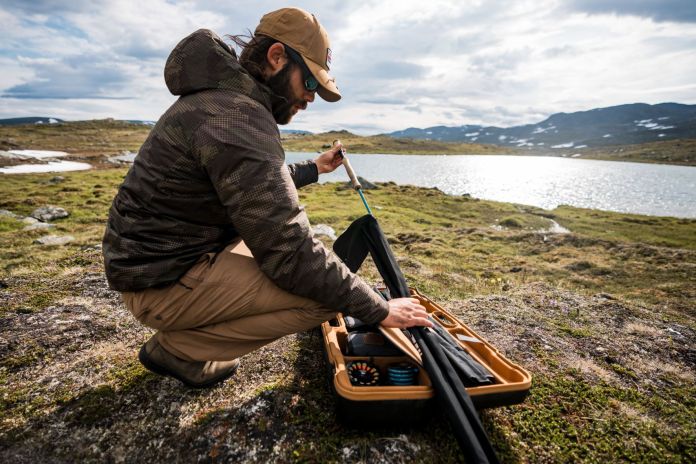
rod in sweden

On the last leg of our adventure, our team, accompanied by our local guide, Jacob Eliason, piled into a Swedish chopper and began to make our way deep into the mountains in pursuit of arctic char. For this journey, we had packed a few 5, 6, and 7 weight rods into our Sea Run case, alongside some extra lines and reels. As we drifted between the mountain peaks towards the arctic tundra where we would make camp, our gear bounced around in a small metal cage attached to the side of the helicopter. This was not the first time the case’s integrity was put to the test. However, watching the most important gear we had get tossed around as if it was in a washing machine was unsettling, to say the least.

sea run helicopter

Upon landing at our top-secret, remote campsite the case was immediately inspected. Not only was the tough shell left unscathed, but all of the internal contents sat snug, still nestled exactly where it had been placed.

sea run case and bags

It wasn’t long after unpacking the Whirley bird that the famous highland weather rolled in. From over the hills, strong winds and sideways rain began to pound our little campsite. As we scrambled to get the last of our tent stakes planted into the earth, our gear took the brunt of the onslaught of precipitation. It was about an hour before it all settled and we poked our heads out of our little tent. There, amongst a pile of waterproof duffle bags was the lone Sea run case, holding strong. Upon yet another internal assessment, all of the contents proved to still be dry, intact, and organized. It was there, in glorious victory, that the rods were finally removed from their sheaths, lined up, and carried down to our nearest lake for a few days of fishing none of us would soon forget.

unforgettable char

Final Review:

Portability:

4 star rating

Protection:

5 star rating

Storage:

4 star rating

Accessibility:

5 star rating

Security:

5 star rating

Waterproofness:

3 stars

Look:

4 star rating

Price:

3 stars

Conclusion:

travel case

In short – the Sea Run Travel Case is far from some novelty item. What could be easily written off as “just another piece of equipment to spend your money on” should be hastily reconsidered as an essential tool for any traveling angler. The physical appearance of the case on its own may tempt some to draw their wallets, but it’s the functionality that packs the real bang for your buck. When it comes to packing up what is ultimately thousands of dollars of equipment, you won’t don’t want to leave anything to chance. While on the more pricey side of $500 MSRP, with consideration to the items you’ll be protecting, you may be paying double that just to replace one broken rod or lost reel. The Sea Run case keeps your essential gear organized and protected better than any other case could – cut and dry.

We could not be happier with this case, and it will certainly be a staple to our travel kit for many many years to come.

Click HERE to check out the Sea Run Travel Case

Gear Review: Backcountry x SIMMS Flyweight Z Sling Pack

Ross Evolution R Salt Gear Review


How to Tie: The Surf Candy

In this week’s “How to Tie” video feature, Trident Fly Fishing gives us a great tutorial on how to tie the Surf Candy.

Learn About This Fly:

Difficulty: Intermediate

This week, saltwater junkies can finally rejoice as we take a step back from trout rivers and streams. The Surf Candy is an infamous saltwater streamer pattern that takes intermediate skill to tie but is worth the time to perfect. The combination of synthetic materials and UV Epoxy creates an extremely durable, yet effective, pattern that can be used in a wide range of fishing situations.

From tuna to striped bass, the versatility of this fly is extensive. The Surf Candy can be tied in many different sizes/colors to match different baitfish that your target species preys upon. Depending on the quantity of polar flash, this fly can become as bulky or sparse as is desired. With this simple change, you can imitate a diverse spectrum of baitfish, while keeping the same durable body.

Profile for many predator species is the key to getting them to eat your fly. The Surf Candy can maintain that profile even after several fish due to its hard setting epoxy. The most difficult part of this fly is building this profile with the epoxy but taking your time and using layers will make this much easier to control. Tying patterns that require more attention to detail will ultimately increase your skill level while on the vise. Although the Surf Candy is more laborious to tie than other flies in the How to Tie series, no angler should be without it in their saltwater box.

Ingredients:

  • Hook: Ahrex NS172 – Size 6
  • Thread: Monofilament
  • Polar Flash: Pearl & Grey
  • Epoxy: Loon UV Epoxy
  • Eyes: Fish Skull Living Eyes – 3mm – Ice

Now you know how to tie the Surf Candy. 

Video and ingredients courtesy of Trident Fly Fishing.

Concrete Spill Causes Large Fish Kill in Utah’s Mill Creek

On July 30th, an unknown amount of concrete slurry washed into Utah’s Mill Creek, killing countless trout downstream of the spill, and prompting authorities to warn people and pets to stay out of the water as the pH levels spiked.

Patrick Fink, a local angler, was one of the first to report the spill which happened below a construction project near Skyline High School. In an Instagram post, Patrick remarked that the creek turned “chalk white” and had already killed most, if not all, of the fish in the creek.

According to the Utah Department of Environmental Quality, the spill occurred when “Concrete was released from a catch basin that was part of a freeway construction project, due to a failure to block an inlet when they were filling the basin,” the report said. “Storm drains that were no longer needed were being filled up with concrete and the storm drain outflows were not blocked, which allowed the concrete to flow into Mill Creek.”

“We have heard reports, but we haven’t yet confirmed any fish kills below 2000 East,” a Utah Division of Wildlife Resources representative said. ”The fish can’t tolerate any significant changes in pH level, especially when it happens that quickly. It didn’t help there’s lower water this year and it’s warmer because of drought. That was another stressor on top of those previous stressors.”

The Utah Division of Wildlife  Resources plans to restock the creek with Bonneville Cutthroat as soon as the environmental conditions allow.

You can read more about the spill, here.

Ridiculously Easy Poached Fish with Green Goddess Dressing Recipe

If there is an easier fish cooking recipe on this green planet (or its blue oceans) I have yet to hear of it. I make salmon this way, striper, redfish, lake trout, halibut, but most of all, cod. Ned Baldwin showed me the secret when we were writing our cookbook “How To Dress An Egg.” It’s his version of a poached cod that a friend made for him in Norway when he was traveling around trying to figure out what to do with his life. This was before he opened the restaurant, Houseman, where he was “discovered” by the New York Times. Food critics think of him as a chef who fishes a lot, but I think of him as a fisherman who chefs for a living and is not half-bad at it.

Photo: Kirk Marks (@kirkymarks)

Although it’s not absolutely necessary, this recipe calls for Kombu, available online and in many markets. It’s dried kelp, a form of seaweed. Japanese chefs have used it for centuries to enhance the flavor of cooked food. It is the most concentrated source of the mysterious flavor called umami. What is umami, you ask? There are volumes written about the science of it, but the best explanation is the translation of umami into English—deliciousness.

Photo: Kirk Marks (@kirkymarks)

Poached Fish Recipe:

Serves 4

Ingredients:

  • 1½ pounds fish fillet, about 1-1 ½” thick divided into 8 pieces
  • 1 teaspoon kosher salt
  • 2 6” squares of kombu (optional)

Salt the cod for at least an hour before cooking (even longer is better). This tightens the flesh a bit, so it holds together better when you cook it.

Bring 2 quarts of water and the kombu to a simmer. It’s important that you use this much water so that the water will retain enough heat when you add the fish. Bear in mind, poaching water doesn’t bubble, while a simmer does. Add the fish. When the fish hits the water, the temperature will drop, likely to around 160°F—an ideal poaching temperature. I find that the fish is done after about 5 minutes. You can gauge doneness by trying to flake a piece with a fork. If it flakes, it’s cooked. Take the fish from the water using a slotted spoon, or any utensil that will allow the water to drain off. You’re done.

Sprinkle some flaky salt and a drizzle of olive oil and serve….or…try it with Green Goddess Dressing.

Green Goddess Dressing Recipe:

Photo: Kirk Marks (@kirkymarks)

I like this dressing on just about any white-fleshed fish. In the spring on the East Coast, I do it with poached shad filets. It’s also terrific with any salad with sturdy greens such as romaine lettuce, endives, Savoy cabbage. Use it as a coleslaw dressing for a fish sandwich. It is said to have been invented in the 1920s in San Francisco in honor of the play, The Green Goddess, about a beautiful English woman who enchanted a cruel rajah and thereby saved three of her fellow Englishmen from being beheaded. Maybe true, or at least it’s one of those stories that journalists call “too good to check.”

Photo: Kirk Marks (@kirkymarks)

Ingredients:

  • ½ cup scallion tops
  • ¼ cup watercress
  • ¼ cup fresh herb leaves—parsley, chervil, tarragon, cilantro, dill—singly or any mixture you have in the garden or fridge
  • 2 tablespoons mayonnaise
  • 2 tablespoons sour cream
  • 2 anchovy fillets
  • Juice of ½ lemon
Photo: Kirk Marks (@kirkymarks)

Put all the ingredients in a blender with 1 tablespoon water and run at high speed for about 30 seconds.

Recipe by Peter Kaminsky a long-time fly fisherman and author. His Outdoors column appeared in the New York Times for more than 30 years. He was a contributing editor to Field & Stream. Among his fishing books, the classic The Moon Pulled Up An Acre of Bass. He fishes New York Harbor a lot. Be sure to check out his most recent book, Fly Fishing for Dummies below.

Photos by Kirk Marks, an angler, photographer, and culinary aficionado based in Kent Island, Maryland. Give him a follow at @kirkymarks. 

Flavor on the Fly: Grilled Snakehead & Fried Wild Turkey with Caprese Skewers

5 Destinations in the United States You Should Fly Fish [2021 Edition]

If there is one thing that the COVID-19 pandemic has taught us, it is that we have some pretty incredible fly fishing opportunities just outside our backdoor. The continental United States is home to some of the best and most diverse fly fishing in the world, ranging from flats fishing for 100 pound plus tarpon, throwing dry flies to large brown trout, to aggressive bass takes on topwater. Below, we detail a list of 5 fly fishing destinations to add to your bucket list this year.

Destination #1: Florida Keys, Florida:

Florida Keys
Photo credit: Captain Brandon Cyr

One of the epicenters of saltwater fly fishing in the United States, the Florida Keys offers the opportunity for all anglers to play some of the biggest names in fly fishing. From tarpon to bonefish, the fly fishing in the Florida Keys is unmatched anywhere in the United States.

Target species:

  • Tarpon
  • Permit
  • Bonefish

Tarpon:

The Silver King. Photo credit: Captain Brandon Cyr
Best Time of Year to Catch a Tarpon:
  • Starting in February and March tarpon line up around basins, banks, and flats in the backcountry. These fish have not been cast at in months and will eat whatever you throw at them with enthusiasm. 
  • In mid-April, the tarpon migration begins as the fish move from east to west. This continues through May and June. 
  • September is a great time to fish for resident tarpon as there is very little angling pressure, and the fish are feeding on baitfish on the beaches. 
Fly Fishing Tips for Tarpon Fishing:
  • Tarpon have hard mouths, setting the hook hard is crucial to keeping the fish on.
  • After landing a tarpon, do your best to keep the fish in the water, oftentimes this means getting into the water yourself. This will help to ensure that the fish will continue to live after its release. 
  • My gear recommendation is:
    • 11 weight outfit 

Permit:

Photo credit: Captain Brandon Cyr

Best Time of Year to Catch A Permit:

  • In March, permit gather on the flats in large numbers, and eat enthusiastically as they prepare to spawn. 
  • In June, the fish have finished spawning and in combination with the crab flushes, you are set up for success. 
  • In October the water starts to cool down, and there are fewer anglers. Permit often stay active all day, making this time of year great for fishing. 

Fly Fishing Tips for Permit Fishing in the Florida Keys:

  • Before leaving to fish for Permit, practice casting accurately in the wind. Set up a hula hoop and practice casting from 40, or more, feet. 
    • Make sure that you are able to double haul effectively
    • Practice with a weighted fly
  • When casting at the fish, aim for their head, don’t lead them on like while tarpon fishing. 
  • Permit are spooky and hard to hook, let alone land. Going days without catching one is okay, the longer that you are out there trying, the more likely it is to happen. Persistence is your best friend.

Bonefish:

Photo credit: Captain Brandon Cyr
Best Time of Year to Catch a Bonefish:
  • You can fish for bonefish between March and November
  • In April the water is starting to warm up and the fish are feeding aggressively. In addition, because of the incredible nature of tarpon fishing at this time, the bonefish flats get very little pressure.  
  • In the summer months, bonefish can be found tailing on outgoing tides.
  • In October the water temperatures are falling and there is very little pressure for anglers, resulting in great fishing. 
  • Fishing for bonefish is also very good in November as the fish can be found everywhere. 
Fly Fishing Tips for Bonefish:
  • Bonefish in the Florida Keys tend to eat pretty big flies, so a size 1 or 2 hook comes highly recommended. 
  • Similar to permit fishing, it is important that you are able to cast accurately in the wind for 40 feet or.
  • My gear recommendation is:
    • 9 weight outfit (because of perennial wind and many wade fishing opportunities are in slightly deeper flats than are found elsewhere)

Destination #2: Telluride, Colorado:

Telluride destination
Photo credit: John Duncan

With a river running right through town, everything about this idyllic town high in the mountains of Colorado screams fish. Whether you are interested in fishing for small cutthroats high in the mountains, or rainbows in the valley, there is terrain, and fish, for everyone. Telluride offers a diverse range of rivers, small creeks, and high alpine lakes for anglers of all ability levels. As John Duncan, the owner of Telluride Outside and long-time Telluride resident would put it, “I love fly fishing in and around Telluride because every local knows a secret trout. There is something for everybody, and the terrain available is unmatched in this part of the world”.  

Photo credit: Telluride Outside

Target species:

  • Trout (Brown, Rainbow, Cutthroat, and Brook Trout)

Best Time of Year to Fly Fish Telluride:

  • Generally, the best time of the year to fish in this area is between April and October. In the spring and fall, you can find fish eating both sub-surface and on top. The water is cold during this time of the year, but as long as you are properly dressed, wading is your best bet. 
  • In the summer, dry fly fishing is hard to beat, and the water temperatures have warmed up enough to wet wade. In addition to wading, great float fishing is available as well. 
  • The peak of high alpine trout fishing is in the summer as well and can be truly something special. For more information on high alpine trout fishing in Colorado, check out our article here.

    Photo credit: John Duncan

Fly Fishing Tips for Telluride:

  • Be aware of where others are, oftentimes you will have to get off of the beaten path in order to find the best fishing.
  • “Match the hatch” is often a great way to go, especially in the warmer months. Don’t be afraid to turn over a few rocks or take a second to look above the water to determine what exactly the fish are eating! 
  • Make sure that you are comfortable with making short and precise casts as well as mending your fly line.
  • My gear recommendation is:
    • 3-5 weight outfit 

Destination #3 Martha’s Vineyard:

Accessible only by air or water, Martha’s Vineyard is an island unlike any other. Offering a plethora of fish and terrain, this island is a must-visit for any and all anglers interested in fishing for striped bass, among other species. In the words of Abbie Schuster, the owner and founder of Kismet Outfitters, “Martha’s Vineyard is literally my favorite fishery in the world. From the sandy flats where we stalk stripers like bonefish to the powerful rips where there is so much life, it is impossible to get bored. Our fishery changes throughout the season as well making each day different than the last. We start with schoolies and end with false albacore and Bonito. There is also amazing wade fishing which makes it accessible for everyone. You don’t need a boat. I have guided many other places and have been ‘burnt out’ by the end of the season. That has yet to happen with this fishery, and I know it never will!”

Target species:

  • Striped bass
  • Albacore and Bonito
  • Bluefish

Best Time of Year to Fly Marthas Vineyard:

  • The best time of year to fish for striped bass is between April and October. 
  • Striped bass can be found in April, but they tend to be smaller in size and are found less consistently. 
  • Bluefish can be found during the same months, and bonito and false albacore can be found between July or August and October.

    Photo credit: Nate Holmes

Fly Fishing Tips for Marthas Vineyard: 

  • You can wade fish around the island, and this is a great way to get your bearings and catch some sweet fish. 
  • Stripers tend to sit on the flats in 2-15 feet of water in addition to more structured areas. For more information regarding fishing for stripers on flats, check out our article here.
  • Fast sinking lines will help your fly get to the fish’s level fast and is usually the way to go unless the fish are feeding on the surface. 
  • Before you go, practice your double-haul to ensure that you are able to present the fish with the best-looking fly possible.
  • Be mindful of the tide to prevent getting stuck on a sand bar. 
  • My gear recommendation is:
    • 9 or 10 weight outfit 

Destination #4 Missoula, Montana:

Photo credit: Missoula River Lodge

You have heard it before and you will hear it again, Missoula is one of, if not the best, trout fisheries in the United States. The sheer quality of the rivers in this area is unmatched anywhere else, making it a fly fishing metropolis. Whether you are interested in fishing the area with the help of a guide or doing some DIY fishing, there is something for every angler. As Matthew Breuer, a Missoula River Lodge guide, puts it, “Fly fishing in Missoula, Montana means that I am at the epicenter of western trout fishing…unmatched due to the breadth and diversity of wild trout rivers here on the west-side of our continental divide. Montana is a special place, it will always be home.”

Photo credit: Missoula River Lodge

Target species:

  • Trout (Brown, Rainbow, Cutthroat, and Brook Trout).

Best Time of Year to Fly Fish Missoula:

  • Mid-March through October is generally the best time to plan a trip to Missoula, although there is often fishing available in the winter months. 
  • Beginning in mid-March, Skwala stoneflies hatch, offering some of the best dry fly fishing all year. This will continue through April. In the later months of April, BWOs, among other bugs, will start to hatch as well. 
  • In June, after the runoff, several different bugs, including Salmonflies and Golden stones, hatch. In late June Green Drakes and Caddis start to show up, and in July PMDs and Yellow Sallies start to hatch. Spice Moths light up the water in Late July, and as the water levels fall in August, terrestrials such as beetles and hoppers are the way to go.
  • Match the hatch, technical dry fly fishing can be found during the months of September and October. In addition to dry fly fishing, the fall is a great time to pull streamers.

Fly Fishing Tips for Missoula, Montana: 

  • Pay attention to your timing. When the water is low and the air temperatures are hot (ie. in August), it is best to avoid fishing in the middle of the day when the water temperatures are hot. Making these types of observations will enable you to make the most of your time fishing, as well as help improve your odds of catching fish.
  • Make note of the natural bugs that are in the air and on the water. Use these observations to choose the fly, specifically the type, color, and size, that you tie on. 
  • Move around…if you have spent several days in one spot with no luck, try a different spot or a different river entirely. There are lots to choose from!
  • My gear recommendation is:
    • 4-6 weight outfit

Destination #5 Austin, Texas:

Photo credit: Chris Johnson

Austin, Texas, yep, that’s right, the city with several million occupants is an amazing place to get into some bass on the fly. With quick and easy access to the Colorado River, both Guadelupe and largemouth bass can be caught while fly fishing. Despite the river’s proximity to Austin, it receives relatively little pressure and is the ideal location for anyone interested in doing some bass fishing. As Chris Johnson, owner of Living Waters Fly Fishing would say, “The waters of the Texas Hill Country are my home. The same rivers and streams that I began guiding on are now where I take my kids to play. Fly fishing is a way of life and the livelihood of my family and my staff. Without our local water, we would not have the growing community of local fly anglers we see now. From warm-water pursuits to tailwater trout, our publicly accessible waterways are fishable year-round. One could easily spend a lifetime pursuing the fish, birds, and wildlife that can be found all within a short drive from downtown!”

Photo credit: Chris Johnson

Target species:

  • Guadalupe bass
  • Largemouth bass

Best Time of Year to Fly Fishing Austin:

  • The best times of the year to go bass fishing in Austin are spring, early summer, and fall. 
  • The Colorado River gets very little pressure, and as a result, offers great fishing most months of the year. 

    Photo credit: Chris Johnson

Fly Fishing Tips for Austin, Texas:

  • Generally, the fish will hang out around structure in the river, and therefore, focus your efforts on these areas. 
  • The flows of the Colorado below Austin are controlled by the Longhorn Dam. Make sure to check the previous water releases prior to leaving, and use these to guide you in your decision as to when you are fishing.
  • The banks off protection and structure, fish them!
  • My gear recommendations:
    • 6 or 7 weight outfit 

With these recommendations in mind, we hope that you will go out and explore some more of the incredible fly fishing that the United States has to offer. Whether you opt for small-stream trout or the Silver Kings, there is something for everyone and even more for those open to trying a little something different.

Urban Fly Fishing & The World’s 9 Best Cities to Fly Fish

Belizean Bliss, from the Jungle to the Flats


Fishing Tips: Indicator Fishing

People often ask questions about rigging nymphs with indicators and dry droppers. But, people don’t tend to ask about where and how to fish these rigs… Here’s some tips on where and how to indicator fish.

Fish a Broken Current

Choosing what type of water to fish is key! Moderately fast, broken currents are one of the best places to fish with an indicator. This type of water provides movement for your flies at a speed that’s appealing to the fish, and manageable for the angler.

Fish a Uniform Current

It’s hard to get a good drift and follow the indicator in a swirly current. Trout may hide in these swirly currents, but when they feed, they prefer to hang out in a uniform current. This is because it’s easier for them to hold their position and capture their prey. Remember, the goal is to cast your flies, indicator, and line in the same current lane.

Start in Faster Water

Since fish have to make quicker reactions for meals in faster water, they can be easier to catch. Prioritizing faster water will get quicker reactions out of those fish. Just make sure you have enough weight to get down to where those trout are feeding.

Find Optimal Depth

When your flies hit the water they begin to sink. Over time the nymphs drift down until they are hanging directly below the indicator (if everything goes to plan). This is the place where you are most likely to get a trout to eat; however, trout can eat at any moment over the course of the drift. Sometimes they’ll even eat the nymph as soon as it hits the water. It’s up to you to test out the waters and figure out what depth to fish.

Don’t Be Afraid To Add Extra Weight

It can be helpful to add more weight to your setup for two main reasons. The primary reason being that weight can help your flies get deeper in order to catch fish that are deeper in the water column. Adding weight can also help create a more drag-free drift if the nymphs and the indicator are moving in different current speeds. The addition of the weight can counteract the pull of an indicator if it’s moving at a different speed.

High-Stick When Possible

Whenever you’re close enough to the indicator that you don’t have to mend it’s best to “high-stick.” High-sticking is when you use the length of your rod to hover the fly line above the water. In this situation there is virtually no drag because the only line on the water is your leader and tippet.

Watch the Indicator Carefully

When watching the indicator you can tell if flies are “dragging” or “lagging.” A dragging indicator is when the indicator slides across currents when the line tightens. A lagging indicator is one that is in line with the flies but the surface current is traveling faster than the bottom current. Make sure to adjust your presentation to achieve a drift where the entire rig can travel at the same speed.

Open Up Your Loop When Your Casting

In order to do this you want the fly line to travel in a straight path. Instead of stopping at  eye-level with your forward casting, end your cast a little bit lower to the water. This additional movement will open up your loop and help prevent tangles.

Give these tips a try and see if you can improve your indicator fishing. If you have any additional tips, comment below. Stay tuned for more Fishing Tips articles.

Video of the Week: Brad Leone Goes Fly Fishing in Montana Part 1

In this Video of the Week, we catch up with some epic guys who need little introduction in pursuit of everyone’s favorite, Whitefish. Meateater’s Steve Rinella and Bon Appetit‘s Brad Leone set out to break the stigma around these native fish. Whether they may be brined, smoked, or served on top of a pizza the boys have a fantastic time cracking one-liners, exploring the greater Bozeman area, and even catch a few fish. So sit down and enjoy as Brad misses a few fish and Steve tells stories about their cameraman “Dirt Myth”.

Brad Leone is a Professional Chef and all-around good guy. Commonly referred to as a Golden Retriever in Human form. Brad has his own series with Bon Appetit called It’s Alive and It’s Alive: Goin Places. Brad’s cooking is focused on locally sourced quality ingredients with a funky flair that is uniquely Brad. Make sure to check out his page to follow along with his adventures and unique dishes here:@Brad_Leone. Also, keep an eye out for his first Cook Book: “Field Notes for Food Adventure: Recipes and Stories from the Woods to the Ocean.

Check out these other rad articles as well!

Video of the Week: MeatEater’s Cal in the Field: Rewards for Rainbows

MeatEater Premieres Das Boat Season 2

Video of the Week: Fishing the Salmonfly Hatch with MRFC

Orvis Unveils the New Helios ‘Blackout’ Rod Series

0

Today, after weeks of teasing a new rod release, Orvis has unveiled the release of the new Helios ‘Blackout’ Rod series. The 3 rods will come in a 9’5″ #5, an 8’5″ #8, and an 11′ #3, and are all designed to meet the growing market demand for specialty tools on the water. 

The Flylords team recently had the chance to put the Helios Blackout series to the test. Stay tuned for more exclusive Blackout action!

From Orvis This Morning: 

MANCHESTER, Vt. (July 28, 2021) — Orvis, the family-owned and operated outdoor retailer that specializes in fly fishing gear, announces the launch of the Helios Blackout Rod collection. The fly rod collection is hand-built at the Orvis Rod Shop in Manchester, Vermont, and is a high-concept series of premium fly rods that will provide users with scenario-specific equipment that matches an angler’s intended use.

“The research and development team at the Orvis Rod Shop is always curious and looking for ways to push the envelope of fly rod design to create new advantages for the angler,” says Shawn Combs, director of product design and development at Orvis. “With the new Helios Blackout models, our team developed new construction techniques to take the existing Helios 3 series to the next level with a focus on specific use-cases. This is exhibited through three models that are designed for improved line control on big rivers, quick shots from a skiff, and unheard-of nymphing sensitivity without compromising accuracy.”

Offering accuracy, long-range mending abilities, and an ultralight swing weight, the 9-foot 5-inch, 5-weight trout rod offers anglers the reach and added lift on a back cast of a 10-foot rod with the feel of a 9-foot rod. Taking quick-turn, one-shot fly placement to a new level, the 8-foot 5-inch, 8-weight rod provides the angler with the ability to quickly change directions with precision and deliver the high-speed line delivery required to stay ahead of fast-moving fish. With the growing popularity of the Euro nymphing technique in the U.S., the 11-foot, 3-weight freshwater nymphing rod combines high-sensitivity and accuracy for improved strike indication, added length for intuitive drift control in complex currents and a softer tip to protect ultra-fine tippet material. All of these details add up to providing anglers with an improved experience with specialized tools to aid in landing more fish on the water.

“At Orvis, we’ve always approached our fly rod development with a playful attitude and willingness to keep testing and refining until we achieve the desired result,” says Tom Rosenbauer, chief enthusiast for Orvis. Shawn and the team at the rod shop have really embraced this purpose-built and experience-driven philosophy while creating the Blackout rods and that shines through when fishing them. For their given purpose, each rod is destined to be best-in-class.”

The Helios Blackout Rod collection (MSRP $998 per rod) is available today, 7/28, at independent fly shops, select Orvis retail stores and online HERE.

Make sure to stay tuned to Flylords for more coverage and exclusive content around the new Blackout line.

What is Orvis Cooking Up for July 28th?

Orvis Announces 2021 Orvis Endorsed Award Winners

Fishing An 18-Hour Day in Yellowstone National Park

The alarm went off echoing throughout the rain fly of my tent, like the thunder that rattled overnight. Despite my restless sleep from Yellowstone’s choir of storms, coffee was poured, fly rods were set up, and the odometer on the car was set. The goal was simple: to fish every major body of water in Yellowstone National Park in a single day. Following six rivers, one creek, and one massive lake. To fish and document, the journey during a 18-hour day was a challenge I had not foreseen any other angler attempt. But with the six o’clock departure from my campsite at Indian Creek Campground, heading south to the Gibbon River along the Grand Loop Road, was sure to be an adventure nonetheless.

Fog boasted the morning sunrise. Inhibiting the views of anything beyond a quarter mile. Though there was an orange glow to the fog, the earth darkened in color bringing out the most vivid colors from the greens of the grasses, the browns of the tree trunks, and the wild descriptive shades of the various wildflowers in full bloom. The distraction of colors and the solitude of the road led me to believe in the reasoning for the screeching stop to witness a bison cross the first river of casts on the Gibbon. The only catch, however, was a photo taken of the bison doing what its been doing for most of its life, disturbed only by the swarms of tourists. Not of a hooked trout, the main target focus of the day for both my fly rod and camera.

The fog began to clear with the rising of the sun and arrival of further people in route to Madison Junction. Here the creation of the Madison River is formed via the Gibbon the Firehole Rivers. The river I had followed down to create the Madison and river I will follow shortly after a few casts into the reed thickened and elk bugled Madison. The caddis pupa got the rise on the first fish of the trip with a beautifully stunned brown trout, hiding in a deep bucket behind the riffles. A quick release into the cooled river and the odometer kept clocking as I made my way over to the Firehole River.

I mostly chose the route to start where I did and go counter clockwise along the park for the impact I new I was to have on the fish. The Gibbon and Firehole Rivers flow near geyser basins, making the water very warm in summer months. So I wanted to be sure to hit these rivers first thing in the morning when the water was still cool from the overnight temperatures and not at peak sunlight. Hooking into these fish could be deadly at the water temperatures the rivers hit in the afternoon. Much like going for a summer run in the desert. All the while craving a piping hot cup of coffee. Just doesn’t make sense.

So by 11 am, I had receded my casts on the Firehole after landing a few mistaken brown trout with a beaded stonefly in the slow water near Old Faithful. Then began making my way up and over the Continental Divide. The divide is simply a mountain range that splits our nation and continent into two. Waters that flow of the western side of the divide will eventuate into the Pacific Ocean. Waters off the east, into the Atlantic.

Yellowstone sits cradled atop and on either side of this divide boasting fisheries a plenty. With fishing on the western side of it to start the day, I slithered my way up and over to the eastern side and into the caldera of the Yellowstone super volcano.

The traffic led me to believe why I didn’t make it to Yellowstone Lake until 1 in the afternoon, but the mother grizzly bear and cub right off the side of the road created a traffic jam making the freeways of Los Angeles look like a breeze to get through. But with a cold beverage and a sandwich, I sat on the lakeshore and just listened and watched the waves slap the shore, keeping me company on this special day.

Another inspiration for the trip was my 31st birthday. I always try and do something outrageous for each trip around the sun, and figured a trip around Yellowstone was just the fit. But with any birthday, you always hope that something spectacular happens, and this day was sure to surprise with the next few casts.

Finishing up my lunch, my eyes wandered beyond the last bite of my sandwich to see a very large tail, cruising its way near the lakeshore like a bonefish on a salt flat. I stopped chewing and watched the 20-inch cutthroat continue searching the shallows in the crystal clear, sand bottomed Yellowstone Lake. I tied on a tan and red streamer and made my casts in a fan like motion from the lakeshore. Cast out, count to ten, then slowly strip in.

I lost sight of that tailing trout but knew there had to be more in the area. My hopes were beginning to diminish with what I thought was to be another fishless body of water for the day. Time was winding down and I had three more rivers to hit to finish out the day and a couple hours of driving as well. Made one more cast and let it sink for 15 seconds this time. Once 15 struck, I made two strips when the lightning bolt hit. The fish bent my 5-weight to the handle and the line screamed out of the reel as if a marlin fell for a cedar plug. The body torquing, head shaking of the large cutthroat came to a close and the gorgeously spotted fish came to hand for a few brief seconds before its release.

Yellowstone Lake is the headwaters of the most genetically pure Yellowstone cutthroat trout. With fish numbers once at unfathomable levels, the species are now threatened. In the 90’s, a fisherman discovered an introduced species in the lake, a lake trout. At first they didn’t pose any threat to the native species, but after a little time, it was apparent that the lake trout were not only a direct threat to the cutthroat but were also predating on them.

Yellowstone’s cutthroat trout are considered a keystone species. Meaning that all life in the park depends on them for their own survival. So while the park service has declared that all cutthroat trout be released after hooking and all lake trout be killed, any encounter with these incredible fish should be cherished and handled appropriately.

With a newly inspired agenda, I made my way to the park’s namesake river, the Yellowstone. I had mapped out a section I wanted to hit where the Lamar and Yellowstone Rivers meet, but not after watching the river continue its life out of the Lake and slowly meandering its way through the slow non-fishable sections through to the Grand Canyon of Yellowstone and the falls.

It was a bit of a hike and a good striking distance away from the last river I wanted to hit for the day. I arrived at the spot, opened my car door, took three steps towards the back of my Subaru when, smack! Right into the back of my neck, a large salmonfly had made its landing. Before long I had salmonflies crawling all over my car and eventually a pattern had made it onto the end of my 3X tippet.

The fishing on the Yellowstone didn’t start off great with a slip on a rock led to an embarrassing face plant. An hour or so of casts into the roaring Yellowstone River without a single rise to the large salmonfly, elk hair caddis dropper, I needed to once again abandon the scene like the Gibbon and move onto the next river in order to at least achieve the goal of fishing the bodies of water intended for the day.

With what many anglers consider to be the crown jewel of the park, the Lamar River and its valley reminds me of something out of Jurassic Park. This wide valley littered with Bison and just a few large cottonwoods lining the river in certain spots making most of this river to be seemingly untouched. The bison control the river much like trying to cross the demilitarized zone separating the republics of Korea. You can walk to its riverbanks, only if the 2000-pound bison will allow.

Meaning the fishing is superb and trout healthy. With the sun finally beginning to lower on the horizon, peaking itself in and out of a looming thunderhead, I daintily tippy toed my way through the maze of bison to my own bend of the Lamar and began making casts with the grey drake and caddis dropper combo.

The fish count took the cake for the day so far with a rise nearly every ten casts or so. Some of the takes were frustrating with the sippable notient of a fine wine, while others were an explosive gesture more like taking a whiskey shot on your birthday. Each one well over the ruler stick and safely released back into the slightly mudded Lamar River.

With the sun setting and clouds turning their colors, a final sip of a cold beverage warmed the stomach on what seemed like an impossible day on paper. Fly rod in hand, I made my way dodging bison patties the size of trash can lids, and let the grasses brush up against my waders with the stunned grasshoppers jumping out of the way onto other blades of grass.

The goal was to hit Soda Butte Creek and the Gardner River back near camp where the night previous I had hooked into dozens of small brook trout, but the fact that in a single day I had fished the Gibbon, Madison, Firehole, Yellowstone, and Lamar Rivers with the incredible gift of the large cutthroat from Yellowstone Lake is a mention on the checklist well deserved marking off.

Leaning up against my car, watching the sun set and the darkness creep in, the orange glow on the horizon and large outlines of the bison grunting and foraging there way through the valley polished off the incredible birthday of mine driving 172.1 miles and fishing five rivers and one lake in Yellowstone National Park. A rainbow, brown, and Yellowstone cutthroat trout; grizzly bear and cub, osprey, eagle, bison, elk, white-tailed deer, pronghorn, and black bear all joined me on this incredible day in the park on my 31st spin around this planet.

Article and photos from Sean Jansen, an avid angler and writer based in Bozeman, Montana. Follow along with his adventures at @jansen_journals.

Stand Up Paddle Boarding Yellowstone Lake