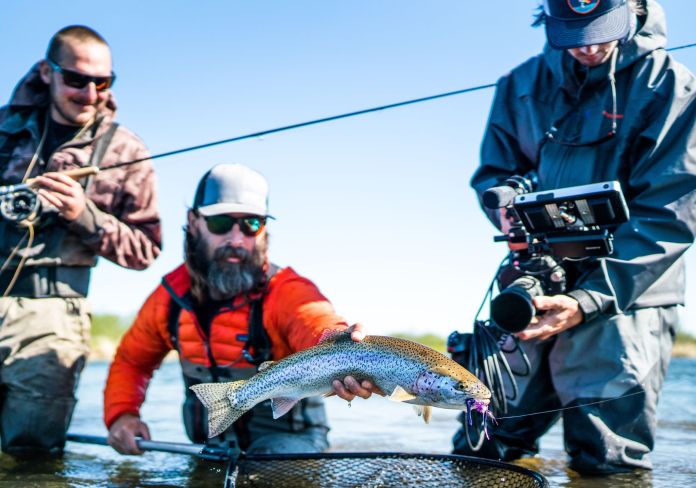
Trout Unlimited found its beginnings in the place you would fully expect it to, the bank of a river. As they were dropping their skiffs into the water on the Au Sable River in Michigan, George Mason and George Griffith shared their concerns for the river and the fish they held so dear. From that boat launch, the seed was planted to start an organization to protect our wild and native fish populations. As we celebrate the fish they dreamed to save over 60 years later we are able to take a look back at the timeline of the big wins, people, and places that brought us to this moment.Â
“If we take care of the fish, the fishing will take care of itself”
– Art Neumann
Graphic by Ryan Michaelis
While Trout Unlimited has been going strong for over 60 years now, this is just the beginning of the story. We must continue to join in the fight to protect our coldwater fisheries. If you are interested in joining this fight go check out your local chapter and become a member here.
Trout and coldwater conservation come in many forms and from all over the country. Jamie Vaughan is Trout Unlimited’s Rogue River Home Rivers Initiative Project Coordinator. Michigan’s Rogue River is a special river and fishery, but like so many others stressed by increasing pressure and development. Follow along to learn about Jamie and how she’s working to protect the Rogue long into the future.
Jamie, shovel in hand, restoring the Rogue River
Flylords: Hey Jamie, tell us a little about yourself and how you began with Trout Unlimited.
Jamie: I’m a Chicago native and while I had little access to nature growing up, I always had a care for the environment engrained in me. I knew early on that I wanted to work in the environmental field. After studying environmental science at the University of Michigan (Go blue!), I was lucky enough to get an internship with Trout Unlimited working on Michigan’s Rogue River. I knew almost nothing about fly fishing, but I quickly came to appreciate the mission focused on this almost mystical fish and the amazing community of anglers that revere it. I was warmly accepted into the TU family and still feel lucky every day to have such a rewarding career.
Flylords: You’ve been the Project Coordinator for TU’s Rogue River for seven years now. How has the river changed? What are its biggest threats?
Jamie: The Rogue River is special because it is situated so close to a large urban center – Grand Rapids. That means many people have easy access to the river and don’t have to travel too far to reach a robust trout fishery. Of course with the population center comes its own stressors on the river. The Rogue River watershed has seen a lot of development over the years and the loss of natural areas like forests and wetlands has meant higher temperatures and more sediment for the Rogue River. Climate change is compounding those threats and definitely makes trout populations in the Rogue River vulnerable.
Rogue River tree planting
Flylords:Â What is being done to mitigate those issues? Do you have any interesting projects in the works?
Jamie:Â In the Rogue River, we know that our groundwater-fed tributaries are bringing in really cold water to the river, making it suitable for trout especially in the hot summer months. Our efforts focus on those priority tributaries and work to restore natural areas where possible which helps the ecological function of the watershed and makes rivers cooler and healthier. Those projects could be small scale projects like encouraging homeowners to convert their lawn to native plants, or it could be large scale wetland restorations.
One project that’s got me really excited right now is our Rogue River Tree Army. We started doing large scale tree plantings along critical areas on the Rogue River and its tributaries to combat climate change and the loss of healthy riparian forests. In the last 3 years we planted 25,000 trees and will be planting another 15,000 this fall!
Flylords:Â Similarly, how is science informing these efforts?
Jamie:Â Science informs all that we do at TU. I work closely with Jake Lemon, our Monitoring and Community Science Manager, to use innovative methods to guide our restoration projects. Right now, Jake is honing a technique using drones to collect thermal maps of the watershed which show us exactly where coldwater seeps are coming into the river. This knowledge can help us strategically plan projects to protect those critical areas that trout depend on, and target restoration for areas lacking shade from trees.
Making science and trout fun!
Flylords: You were telling me about your fly fishing summer camp for girls—care to share any details/success stories?
Jamie: TU’s STREAM Girls program gets girls outside to explore their local stream. Not only do they get hands on experience in watershed science, but they also learn from local women anglers how to tie a fly, cast a fly rod, and go fly fishing. It’s an amazing way to build girls’ confidence in STEM fields and fly fishing – two areas where women are currently underrepresented. If there’s something I learned from these camps, it’s that girls have the makings to be inimitable anglers and conservationists. Their favorite part of camp is almost always tying colorful woolly buggers – their patience allows them to pick it up so quickly – and they are in awe when they see the awesome Flygirls of Michigan (who regularly volunteer for the camp) artfully casting a fly rod. It’s especially cool when we can get girls from cities like Grand Rapids and Detroit getting outside and comfortable in the outdoors. I know if I had these opportunities when I was young, I’d have discovered my love for wild rivers and coldwater conservation a lot sooner!
We had the privilege of catching up with Trout Unlimited Biologist, John McMillan, to talk about his work in the Pacific Northwest. While he is typically diving deep into steelhead research, he also has an immense amount of knowledge on trout populations. In addition to this amazing interview, tune into the Flylords Instagram for an Instagram live with John, tonight at 5:00 PM MT.
FL: How are climate change and warming ocean conditions impacting anadromous fish populations?
John: Great question, and given the poor returns of steelhead across much of the West Coast this year – from BC down through much of Oregon – it is also timely. There are several ways climate change can and has impacted anadromous fish.
Salmon, trout, and char (here on referred to as “salmonidsâ€) all have a range of temperatures they can live in before things become highly stressful and eventually, lethal, which means that the spatial distribution of fish is likely to change depending on the species-specific tolerances for water temperature. Generally, climate change is predicted to increase water temperatures both in freshwater and the oceans, and if the temperatures get too warm, a fish must move or die. Â
Juvenile Chinook – Photo Courtesy of Jon McMillan
In freshwater, this could eventually push the distribution of salmonids further north in latitude and/or higher up in elevation. For example, salmonid species that are partly or wholly resident, such as inland cutthroat and rainbow trout, may need to spend larger portions of their life in higher elevation habitats to avoid warmer water temperatures in lower elevation locations. They could also alter their life history by only utilizing the lower elevation habitats during the coolest periods of the year, and then relying on the higher elevation, cooler habitats during the hottest times of year. In both cases, fish will have to adapt to keep pace with a changing climate.Â
If the ocean does become too warm and/or we continue to experience warm “blobs†of water holding in the North Pacific, the impacts will likely depend on the species. A warming ocean could eliminate some species that do not have a freshwater life history, such as pink salmon and chum Salmon. On the other hand, steelhead and rainbow trout are the same species and can give rise to one another, and there is evidence that declines in survival of steelhead can lead to increases in resident rainbow trout. It is therefore possible that the anadromous steelhead life history could be dramatically reduced or extirpated, but the species as a whole could persist as resident rainbow trout if freshwater conditions are sufficient. The same is true for coastal cutthroat trout.
“As my dad loves to say, Nature will bat last.”
These are very general answers, of course, because it is very difficult to predict how quickly and broadly temperatures may become unsuitable for salmonids. From a process perspective, there is some interesting science on the strength of the ocean currents that circulate water from north to south. These ocean currents are also critical to creating upwelling, which provides cool water and rich sources of food for juvenile salmonids entering the ocean. If the circulation system continues to weaken and eventually break down, it could be devastating for salmonids. That said, if things get that bad, some models predict the warming phase will be relatively short-lived and we could revert back into another ice age, which would be very challenging for humans, but awesome for salmonids. In other words, just because things are heating up now, doesn’t mean our climate will continue to warm without an equal reaction back the other way at some point in time. As my dad loves to say, Nature will bat last.Â
FL: With steelhead numbers on the decline in most places, how is this impacting local trout populations in some of these rivers?Â
John: Oncorhynchus mykiss, the scientific name for steelhead/rainbow trout, are my favorite species, both as scientists and anglers. I love them for their remarkable diversity. O. mykiss occupies the broadest range of habitats across the Pacific Coast, from Baja California up to the Aleutian Islands. One reason they do so is because of their ability to withstand warmer and cooler temperatures and because they have both resident and anadromous life histories in their evolutionary tool-belt. Therefore, it is possible, as I mentioned earlier, that as steelhead declines, resident rainbow trout could become more prevalent. Â
The data I am familiar with suggests it will take a longer period of poor ocean survival to dramatically shift the population away from anadromy and more towards residency. In Russia for instance, it took at least a few generations of poor steelhead returns before rainbow became more prevalent. The latest period of poor ocean survival started around 2016. If this continues for another 5-years, there could be some measurable changes. Unfortunately, though, very little data exists on rainbow trout compared to steelhead, and in many rivers, the number of steelheads returning each year is not monitored. For instance, I live on the Olympic Peninsula, and we have data on the abundance and distribution of returning steelhead, but we don’t have any data on rainbow trout. The same is true for most of the steelhead populations from Alaska down to California and inland to Idaho. Unless we begin collecting that type of information, it will be difficult to track how populations change.
Spawning Steelhead – Photo Courtesy of John McMillan
FL: Can you talk about the work that has been done on the Elwha River?Â
The Elwha River has been front and center for a tremendous amount of monitoring. I would be remiss then not to mention that a great deal of work has and is done by Lower Elwha Tribe, NOAA/NMFS, Olympic National Park, USGS, USFWS, WDFW, and many other agencies. Basically, a lot of really cool work has been done so far, and that work, though it has slowed a bit, continues to track various aspects of dam removal.
I’ll try to nail it down to a few major points.
First, dam removal had a clear impact on the river, fish, and insects. The main-stem Elwha below the dams became choked with fine sediment during and following dam removal, though sediment loads are now at what scientists consider to be fairly normative levels. That is good for the fish and the other types of life in the river. Nonetheless, research indicated that the high levels of sediment dramatically reduced the abundance of fish and insects in the river below the dams, up to as much as 95% depending on the year and location. Now, 10-years after dam removal started, we are seeing a sharp resurgence in many salmonids and a big increase in insect production. Essentially, the river is back to looking like a normal river, and the fish and insects are taking advantage of the more stable environment. Â
Elwha Bull Trout – Photo Courtesy of John McMillan
Second, among species, bull trout and summer steelhead have shown a remarkable increase in abundance since dam removal. Not only are bull trout more abundant, but they are also larger, and many fish are now migrating to the ocean and then back up above both dams into the headwaters where they spawn. Summer steelhead nearly became extinct prior to dam removal. Each year, I counted only 1-3 adult summer runs below the dams. Some were stray hatchery fish, others were unclipped, but we were unsure of whether they were originally from the Elwha or from somewhere else. The cool part is that the summer run population in the Elwha is now the largest population of summer runs on the Olympic Peninsula and is likely the largest population along the entire Washington Coast. Pretty amazing for that to happen within a few years of dam removal, and that is one reason that Trout Unlimited partnered with film-maker Shane Anderson to produce a short movie on Elwha summer steelhead, which can be found HERE. The response of both species underscores that dam removal can be a critical strategy for increasing the survival and resilience of formerly depleted stocks of fish.Â
Third, much of dam removal was focused on restoring the fabled runs of large-bodied Elwha River Chinook Salmon. The fish were rumored to exceed 100lbs, and discussions with members of the Elwha Tribe indeed suggest the river once supported a very large Chinook. Since dam removal, they have produced very few natural offspring, presumably because they mostly spawn in the main-stem Elwha below the dams, and their redds and juveniles experienced very difficult conditions. Recently, however, the fish have started to turn things around. The abundance of naturally produced Chinook smolts has sharply increased, and we are starting to see more diverse juvenile life histories than we did prior to dam removal.Â
Last, while the river conditions and fish are generally improving, the fish are still not out of the woods yet, so to say. Some species, such as chum salmon, pink salmon, and sockeye salmon have not responded with similar gusto, likely for a variety of reasons. This is not surprising. That said, the Elwha provides a beacon of hope in an otherwise challenging climate. Â
FL: What were the steelhead counts when the dam was there and what are they are today?
John: Before the dams were removed there was about 100-300 wild winter steelhead below the dams, though the population may have occasionally reached larger numbers in years when ocean survival was good. We only documented 1-3 summer runs a year. Â
Since dam removal, the number of winter runs, which includes a hatchery broodstock program (a program where wild fish are used as broodstock) run by the Lower Elwha Tribe, has increased up to 1,500-1,600 fish in the best years. The summer run population, for which hatchery fish are not released, has ramped up to as many as 900 fish in a year. It’s great to see this kind of trajectory, though I believe there is still room for many more winter and summer-run steelhead in the Elwha. This is just the beginning.Â
FL: Why are dams so bad for fish species?
John: Dams have a number of bad effects, but I tend to think there are two major ones.
First, dams without fish passage block migration within rivers and to and from the ocean. There is nothing worse than blocking the pathway of migratory species like salmon and steelhead. It essentially eliminates the fish that were formerly produced above the dams.
Second, dams dramatically change streamflow and temperature regimes. For example, both dams on the Elwha blocked the downstream transport of sediment, so the main-stem Elwha contained a higher frequency of larger boulders and cobbles below the dams. This limited the amount of spawning-size gravel for salmon and steelhead, and almost eliminated the potential for smaller-bodied fish that use even smaller-sized gravel when spawning. In places like the Snake and Klamath Rivers, water temperatures tend to get warmer in the long, stagnant pools formed behind the dams. The combination of slower water and warmer water temperatures can also lead to greater productivity of invasive warm-water species, such as small-mouth bass and catfish, both of which are known to prey on juvenile salmon and steelhead. Essentially, salmon and steelhead have evolved to live in free-flowing rivers, and while they also take advantage of lakes and beaver ponds, free-flowing rivers create a myriad of diverse habitats and niches that favor different species in different locations of the river. Dam construction homogenizes the habitat, usually worsening conditions for salmon while simultaneously improving conditions for invasive competitors.
Chinook Carcasses Above Dams – Photo Courtesy of John McMillan
Further, there is an interaction between fish migration and the lakes formed behind dams. For instance, juvenile salmon and steelhead tend to use the river’s current to help them migrate downstream to the ocean. With dams in place, they are forced to swim without any assistance, sometimes for hundreds of miles, resulting in reduced survival. And even if passage is available for adults, as we see in the Columbia and Snake Rivers, the stagnant, warm impoundments that form behind the dams can result in stressful and lethal temperatures for upstream migrating adults, leading to high mortality rates in warm years. Â
FL: A unique species that you study is coastal cutthroats, how are they different than your normal resident cutthroat trout?
John: I do love cutthroat. Like steelhead, they display a lot of life history diversity, and they also love the rainforest rivers that I call home. The main difference with coastal cutthroat is that some of them go to the ocean, while our inland sub-species, such as Westlope and Yellowstone cutthroat, do not because they can’t access the ocean. That said, Yellowstone cutthroat can attain larger sizes than our coastal cutthroat, even the anadromous ones because they also undertake migrations to and from lakes. In those situations, the lake basically acts like an ocean.
Coastal Cutthroat – Photo Courtesy of John McMillan
The Elwha is somewhat unique among our coastal watersheds in that it doesn’t have many coastal cutthroat trout. The Elwha is predominantly a rainbow trout/steelhead stream. There is however one small creek in the Elwha that is home to a very cool population of cutthroat.Â
Both fall and spring spawning fish have persisted through and after dam removal, and we are collecting DNA to evaluate the genetics of fish in different locations. I’ll try to provide you an update on that once the research is suitable for publication.
FL: What can someone who doesn’t live in the PNW do to make a difference for these fisheries?Â
John: Absolutely, there are many ways that people can get involved and try to help the fish and the fisheries they support. One way is to join a group or organization that is focused on conservation, like Trout Unlimited. We have a presence in every state where there are salmonids in the USA, and we have a large number of local chapters where people can get to know their watersheds and learn about ways to help conserve the fish and their habitat. We also have a series of blog posts that people can read to learn more about fish and conservation, and there are a lot of ways for members to learn from TU staff and scientists.
I would also recommend getting to know one’s own favorite fish and watershed, especially local ones. Improving knowledge about local fish and science is critical because more informed people make better advocates. If you have a favorite fish or river, look for opportunities to learn more about those places. Additionally, it’s important for anglers to keep abreast of fish runs because as we see this summer, many populations of steelhead are struggling. One way to be conservative is to try and reduce our impacts individually, either by catching fewer fish or by using more difficult methods. Essentially, don’t focus on fishing as a numbers game, try to enjoy the whole experience, our fish populations are under a lot of stress trying to keep pace with climate change, and if we want the next generation of anglers to have a chance at these fish, we will have to make some sacrifices in our life.
Steelhead Parr – Photo Courtesy of John McMillan
Last, but not least, I suggest reaching out to local biologists that work in a person’s home watersheds. TU has many local biologists working across the USA, but so do agencies and other groups. Biologists can help anglers better understand the fish, their habitat, and their challenges, and it is fun because anglers often learn new things to help them become more effective stewards.
FL: Are their takeaways from the Elwha we can apply to other struggling river systems?Â
John: I think so. The project underscores how valuable dam removal is. I understand that some dams are unlikely to be removed to breached. But there are also dams that, like the Elwha, are aging, outdated, and if not unsafe, they simply aren’t providing the services they once did. Further, given the effects of climate change and the depleted status of salmonids, dam removal may be more critical than ever.
Dam removal or breaching can restore natural river processes, including thermal and flow regimes, transport of sediment, and formation of habitats – like riffles, pools, and side-channels. That is something that should happen in almost all rivers where dams are removed. In the Elwha, the former lake beds have become some of the most important habitats for spawning and rearing salmon, steelhead, trout, and char. They have extensive floodplains, which are low gradient reaches where the river can spread over and across the terrain as the river flow increases. This helps disperse energy and store sediment, and it establishes the types of lower energy habitats that fish need during floods. And it has helped increase the diversity of gravel and cobble in areas below the dams, dramatically increasing the amount of spawning habitat.
“Breaching dams is the only way to improve the migration corridor sufficiently to ensure that fish remain healthy enough to get in and out of those high-quality upstream habitats.”
There are floodplain habitats underneath the reservoirs behind the four dams in the lower Snake River, and if the dams were breached, the floodplains and side-channels could offer similar benefits to fish as we have observed in the Elwha River. Such habitats will likely help expand the distribution of spawning and rearing salmon and steelhead, and they could provide pitstops for juveniles and adults that are migrating through the system, either downstream to the ocean or upstream to their spawning grounds.Â
Dam removal in the Elwha also renewed access to high-quality, protected habitat in the Olympic National Park. There is also an abundance of high-quality habitat in the upper Snake River basin, and while the four lower dams have passage, an abundance of salmon and steelhead reaching those habitats has declined since the dams were constructed. In the Snake, getting to and from that habitat requires one of the longest salmon migrations in the world, and it is made all the more difficult by the long series of stagnant impoundments. Breaching dams is the only way to improve the migration corridor sufficiently to ensure that fish remain healthy enough to get in and out of those high-quality upstream habitats.Â
In this week’s “How to Tie†video feature, AvidMax gives us a tutorial on how to tie a true guide fly, the Euro Style Guide’s Choice Hare’s Ear.
Difficulty: Easy
The hare’s ear nymph is one that all fly anglers should know and cherish. For many anglers including myself, this fly is one that carries confidence and almost always in my nymph rig. Now, this legendary fly has been modified through the addition of a jig hook, allowing it to ride hook point up and adopt a European style. The Euro Style Guide’s Choice Hare’s Ear is a small redesign on a fly that has stood the test of time and should always be in your box.
This fly has a relatively simple design that is buggy and can be fished dead drifted, swung, and even stripped in at the end of a drift. The Euro Style Guide’s Choice Hare’s Ear is as versatile as nymphs come. Its ability to be used in a multitude of rigs and potentially year-round make it a necessity on the river. Using red thread adds a hot spot on the collar of the fly, letting this primarily natural fly have some attractor style properties and productivity on those slower days.
The Euro Style Guide’s Choice Hare’s Ear imitates the general buggy profile a wide variety of subsurface insects fit into. Partridge soft hackle creates a mottled look and movement in the fly even while simply being dead drifted, while the peacock herl thorax adds natural flash, creating the perfect all-purpose nymph. Confidence is a word that can be used when fishing the Euro Style Guide’s Choice Hare’s Ear, and once you fish this fly it may never leave your rigs.
An uncontrolled fire is normally viewed as destructive, harmful, and dangerous. However, wildfires have critical regenerative properties that certain ecosystems count on. But their increasing frequency, scope, and size threaten unadapted systems and the species that rely on them.
The effects of a wildfire on a watershed are both numerous and complex. A wildfire may compromise the watershed during active burning until years after the fire is contained and smolders out. The immediate five-year period following a wildfire is one of immense transition and rebalancing.
Wildland firefighters on the Caldor Fire Complex in California. Photograph: Noah Berger/AP
Short-Term Effects
Increased Sedimentation
Without vegetation, trees, or a solid soil structure, massive amounts of debris and ash can wash through a watershed after a wildfire. Excess fine sediment, from the increased erosion, can clog or wear down a fish’s gills and suffocate eggs. It may also occupy small spaces between cobbles where eggs would be laid.
John Moody, USGS Researcher, points out that not all erosion has a negative effect. Course grain sediment, critical to fish habitats, is replenished back into the system.
Nutrient & Temperature Variations
In the first year after a burn, in-stream nutrient levels may increase dramatically. Nutrient variations are due to the heightened amounts of debris being welcomed into the system through run-off or ash. Increased amounts of nitrogen, phosphorous, and potassium are often found. These nutrients are needed for algal and plankton growth- critical as fish food sources. An excess amount of the nutrients, however, can cause algae blooms. When alive, the blooms decrease light penetration and, when dead, decrease amounts of dissolved oxygen.
The ability of water to hold oxygen depends on its temperature. An increase in water temperature, even slightly, decreases the capacity of oxygen that may be held. Many aquatic species, especially trout, can tolerate only a small variation in temperature change. Any shift within the minimum and maximum water warmth can dramatically change the species composition in a wildfire-affected region.
Long-Term Effects
River Reorganization
One of the longest-lasting threats to fish in a watershed post-wildfire is the fragmentation of habitat. Erosion and tree fall may cause reorganization and loss of connectivity in river channels. This means the fish are unable to move freely throughout the watershed. They are unable to migrate to more habitable areas of a river or stream to find food or escape warming waters. Rebecca Flitcroft, U.S. Forest Service fish biologist, says that the survival of a fish species affected by wildfire largely depends on the availability of safe refugees up or downstream.
Ashley Rush, a researcher and fisheries biologist who specializes in the long-term impacts of wildfire, can’t highlight enough the importance of eliminating nuisance blockages in the water system in her interview with Trout Unlimited.
“The best thing we can do is keep our waters connected [by getting rid of unnecessary dams, diversions and other impediments],†she said. “There’s no mitigation that needs to happen after [fires]—we don’t need to restock or be more aggressive on that. We need to acknowledge that we need to clear fish passages, give it time, and recognize that some spots are going to be muddy for a couple years after the fire when it rains.â€
Population Density
A study by Rosenberger et al. (2015)Â suggests that moderate warming associated with wildfire and channel disturbance history leads to faster individual trout growth. This exacerbates competition for food resulting in an overall decrease in trout populations due to the fish’s quick maturity.
It’s important to note that many species in fire-prone regions are adapted to withstand these natural phenomenons. Rust says that it’s crucial to make sure that these systems become and stay resilient. This includes not intervening in too much habitat recovery to allow the landscape to adapt as it needs.
“In the long term, it’s good to recognize that [fire is] part of the landscape, that we’ve all evolved with it, and at some point it won’t be such a scary-looking burnt-out landscape,†says Rust. “So far I’m seeing that the insects and fish actually bounce back faster than the vegetation or the land does. So, you look around a burnt landscape that might look devoid of life, but the water might be just fine.â€
Scorched riverbank landscape after a wildfire. Photograph: USDA Forest Service
Wildfire plays a critical role in the general balance of an ecosystem. However, their increased occurrence and growing vastness pose both short and long-term effects that may threaten the species that rely on these landscapes. The good news? Research is showing that fish populations are able to bounce back after a decade (or sooner), and even flourish, after the short stint of bad luck.
Learning how to fly fish for trout can be hard enough between practicing casting techniques, researching entomology, and understanding how to read the water. By the time you actually catch a fish, you’ve put in an incredible amount of work. But, there’s one very important part of the trout fishing equation that all anglers need to consider … how to be an ethical angler. These are some of the key ways that we can be better stewards on the water.
1) Respect Other People On The Water
In many fishing situations, you will find yourself in an area that is also being used by other anglers. One of the most noteworthy ways to show respect when sharing these areas is to keep proper spacing between you and others around you. Depending on the scenario this spacing will be different. For example, in a popular tailwater fishery anglers might be standing as close as 20 yards from each other, while in a backcountry creek anglers may prefer hundreds of yards, or even miles, of space. It all depends on the situation at hand and the preferences of the anglers.
If you do come in close contact with another angler, it’s always best to practice good communication skills and talk with them about their plan of action. Figuring out whether they’re moving downstream, upstream, or spending the day at the honey hole will help you plan your approach in a way that will be beneficial for both of you.
This is an important tip because without the proper care of trout, we won’t be able to continue trout fishing for years to come. The biggest piece of advice about trout is that they are incredibly fragile. Unlike other common freshwater sport fish, they require meticulous care in order to avoid mortality after catching them. A few ways to help limit the mortality rate of trout are wetting your hands before handling them, pinching the barbs on your hooks, and not sticking your fingers in their gills when you’re handling them. When it’s time to release the fish, point the fish upstream and hold it in the water until it’s ready to swim off on its own.
For more information on proper trout handling check out this article.
3) Pack It In, Pack It Out
Many of you may have heard the term “Leave No Trace.” This is the concept of participating in outdoor recreation activities while limiting your negative impact. One easy way of achieving this is to leave with everything you came with (aka no littering). It’s pretty self explanatory why it’s important not to leave beer cans and food wrappers on the banks of a trout stream, but one item that not many anglers tend to think about is tippet and leader material.
Monofilament line can take up to 600 years to decompose in the wild. And if you think that’s bad, fluorocarbon can last up to 4,000 years in the wild! That means that every piece of line that has ever been left out on the river is still out there!
This is a big one! Before you hit the river it’s always important to take a quick look at the regulations for the zone you’re traveling to. This is a great time to grab a fishing license/stamp online, and an opportunity to take a look at other rules pertaining to hoot-owl restrictions, keeping fish, de-barbing hooks, and cleaning wading materials.
Image courtesy of Real Deal Anglers
5) Watch Where You Wade
When it comes to wading through trout streams, it’s a good idea to tread lightly. During spawning seasons anglers should be hyperaware of areas where trout are spawning. These areas are called “redds.” A redd is an oval-shaped section of gravel located near shallow riffles and other well-oxygenated areas in the river. A redd is going to be lighter in color than the surrounding rocks because trout physically clean out a “nest” area where they do their business. Anglers should avoid wading in these areas at all costs because these redds are where the future generations of trout are being incubated. For more information on this tip check out this article.
There ya have it! Those are five of the most important tips for trout ethics. You are well on your way to being a steward of our waters.
Sarah Landstrom is a skilled painter hailing from North Muskegon, Michigan. The 27 year-old artist currently lives between San Francisco and her cabin in Northern Michigan, and this combination of rural and urban living inspires her artwork. Recently, Sarah has teamed up with Flylords and painted a custom cooler to support Trout Unlimited’s Trout Week. Working with Sarah for Trout Week, we have learned about her artistic development and love of fishing. Check out her work and her story below!
Photo available at sarahlandstrom.com
How did you first experience fishing? What has kept you interested?
My first experience fishing was fishing off of my grandpa’s dock back in Michigan. It wasn’t until I was living in Montana that I discovered fly fishing. I think what has really kept me interested is the fact that there is always more to explore—that and seeing others develop a love for the sport.
When did you first engage with art?
When I was a kid I always felt like art was the only thing that I was accomplished at. I wasn’t much of an athlete, was awful at subjects like math, and was very shy. Art was a special space where I could create my own world through doodles. It wasn’t until I was in college, though, that I began to take it seriously and consider myself to be an “artist.”Â
Photo available at sarahlandstrom.com
Are you exclusively a painter, or do you have experience with other types of visual art?
Weaving, paper making, and knitting are all types of art that I love and find therapeutic. I think fiber art can be empowering, especially as a woman. There is a connection to the work women have done for thousands of years and the development of intricate techniques that combine beauty with practicality.
What draws you to fish and their environments as your subject matter?
When I was going to school at School of the Art Institute of Chicago (SAIC), I was cut off from fishing for months at a time. One day I decided to paint “Missouri River Brown†and it gave me the same feeling I would get on a river. Now, I have the opportunity to fish whenever I like and reflect on that experience in the studio. I love it.Â
“Missouri River Brown” photo available at sarahlandstrom.com
What is your favorite type of paint?
I almost always use Golden acrylic paint. The quality reminds me of the effect of oil paint. It has a heavier body and they also have high quality mediums that you can explore. I highly recommend Golden paints—they are worth the price tag.
Have you always used vibrant colors? What draws you to them?
The colors represent how I remember certain fish. It reflects the intensity I feel and it just sort of happens. I used to fight it and force myself to paint in more neutral colors, but now I understand that it’s better to just follow my instincts.
Photo available at sarahlandstrom.com
Do your personal passions find their way into your artwork?
Absolutely. I’m very thankful to be involved in certain projects such as [Trout Week]. When you’re alone so much of the time painting, it’s nice to know that the art will help make a difference. And it’s always a treat to have the opportunity to speak with groups like Trout Unlimited and their efforts. [Those conversations] usually end up inspiring the piece. In this case, I painted a brook trout, which is the state fish of Michigan, where Trout Unlimited began.
How have your mentors shaped your development as an artist?
When I was at SAIC and began painting fish, many students were confused and thought of it as “kitsch.” I had a professor named Paola Cabal who was always encouraging, and having that encouragement come from such a great artist was all I needed to keep going.Â
Navigating how to begin working with the fly fishing industry was the next big step I had to take. Derek DeYoung was incredibly helpful. I met him up in Traverse City, and he thoughtfully shared his experiences and provided invaluable advice. He is a very kind man.
Photo available at sarahlandstrom.com
In your experience so far, how has your artwork impacted people who see it?
In my experience, [my artwork] brings people back to memories of their own, and I love that. Children are usually mesmerized by the colors even if they don’t have fishing memories of their own yet.
Why do you think art is important?
I believe art is important for the same reason I think design, music, theatre, writing, etc. are important. It’s an expression and a way to communicate with people on a level where all interpretations are unique to that person.Â
Photo Courtesy of Sarah Landstrom
What made you want to participate in Trout Week?
When I heard that this [project] involved Trout Unlimited, I said yes right away. It is such an impressive and important group of conservationists. I grew up seeing the work they were doing in my home state, and I feel honored to be partnering with them for Trout Week!
Photo Courtesy of Sarah Landstrom
What fishing destinations are on your bucket list?
They are countless, but Scotland for Atlantics, Mongolia for Tamen, and Columbia for Peacock Bass are all up there. I’ve been trying to fish more locally this past year and a half. I’m looking forward to when it becomes safe to travel internationally again.
What is your best fishing story?
I would have to say the first time I went to British Columbia. All of my Steelhead fishing had been in Michigan, so it was my first chance to catch a sea-run Steelhead. After camping along the river, I started making my first couple of casts. Along this tiny seam, all of a sudden, my line blew up. The Steelhead immediately jumped and thrashed. I was so shocked by the power that I lost it within seconds. Excited, I ran down to tell my friend. He didn’t believe it when he saw where I said it had been sitting, so I took another swing. The fish crushed the fly a second time and I was mind-blown by the sheer aggression. The trip also included some sketchy night hikes, a dozen or so bear sightings, and nearly missing a flight home after losing track of time. But it was the power of the fish up there that really made the trip.
In honor of a day respecting trout in the arts, we had the privelidge to sit down with legendary author, John Gierach. John can be considered one of the most legendary, award-winning, fly-fishing authors of the 21st century. With over 21 published titles such as iconic staple of fly-fishing literature: “Trout Bum”, and “All Fisherman are Liars”, John has managed to capture the very spirit of fly-fishing and deliver it back to his readers within the casing of two covers. Whether you’re a reader, writer, or you just love the idea of working a small stream with a bamboo fly rod – there’s something for you in the words below…
FL: Who is John Gierach?
John: I’ll keep this quick. AÂ writer, fly fisherman, old guy, traveler.
FL: When did you start fly fishing?Â
John: Let’s see, I moved to Colorado after college in ’68 (John graduated from Findlay College in Ohio with a degree in philosophy), and it would’ve been soon thereafter. I fished all my life with a break during college. And I got out here and it was the first time I’d actually seen people fly fishing. I think I might’ve seen someone fly fish once in the Midwest. It wasn’t a thing. They’re all over the place now. But, then it was all bait casters and stuff. And I saw people fly fishing and I just thought it was pretty. So, I got a rod; not a good one, but a rod I could afford and went out and figured out how to catch fish. I thought the fish were pretty. I just thought everything about it was pretty. I liked the creeks and I just fell into it.
I liked the looks of it. I thought it was cool. I thought it was what fishing should’ve been, but never was until I figured out you can fly cast, and then it started to make sense, started to feel like that’s the way it should be.
FL: How was it you first got into writing?
John: I think it was just that I had always been a reader. As I said, my mother used to read to me before I could read myself, which doesn’t mean I was a good student, but I just always liked to read. I thought maybe it would be fun to do. The way you put language together just interested me.
By high school and into college, I was trying to be a writer and I stumbled into writing about fly fishing. I was out here. I’d been fly fishing for a while, reading fly fishing magazines. I think at the time I was driving a garbage truck for a living, which is nice because it left the afternoons to fish. I was reading the fishing magazines and one day it just occurred to me, well, they pay for this stuff, and it’s not War and Peace. It can be done. I sold the first fishing story I wrote and for what amounted to a month’s pay [around $75 at the time].
FL: Was that your first published writing work?
John: No. It was the first published work I was paid for in a magazine. I’d published before, mostly not for pay, although I had a book of poetry in print that I actually… I mean, that paid me royalties. I found an old royalty statement for six months and it was $4 or something. It was nothing. But it was the first significant amount of money I made writing.
I remember thinking, “Well, this is great because I can pick up some money on fly fishing writing and pursue my real serious literary career.†[But] that didn’t last long…
FL: What made caused you to make the transition into focusing mainly on fly-fishing literature?
John: That came from reading guys like Jim Harrison and Tom McGuane, and thinking actually: “You can do this just as well as you can do anything else.”
I realized that it doesn’t have to be dumb shit, hook-and-bullet, ‘me and Joe went fishing’ stuff. I mean, this CAN be literary. [Fly-Fishing writing] could be as good as writing gets. And so I owe it to that first bunch of counterculture guys that came up writing about fly fishing and taking huge amounts of drugs.
FL: Do you think that new perspective in fly fishing and literature is what brought you over to the fly fishing side, and kept you there?
John: No, no. It might’ve kept me there. No, what brought me to fly fishing writing was fly fishing itself. I’d see people wading in streams catching trout on a fly rod and I just thought what a cool way to fish. But that’s probably what kept me into writing about fishing. [It] was just the idea that this can be literature. It’s literature when Tom McGuane does it, maybe it can be literature when I do it.
FL: Let talk about your creative process. When you’re out fishing, you carry the notebook. Do you have something that you can sum up as when inspiration usually hits?
John: Not a moment in time that I can put a finger on, but I’ll just get an idea. We were talking about Norman Maclean before, and I’m reading “A River Runs Through It and Other Stories“, and the other stories get short shrift, but they’re wonderful. He says in one, “There’s a moment when you realize you’re part of a story and things aren’t just happening...”, and I think that’s maybe just because I just read it and it was said well, but that’s kind of what it is. There’s a moment when you think, “Yeah, there’s a story in this.â€
What keeps the notebook in my pocket is the fact that I’ll think of something that I think is brilliant, and if I don’t write it down I’ll forget it. It doesn’t always happen fishing. You could be at the grocery store and see a can of Dinty Moore beef stew and remember Dinty Moore beef stew from camping 30 years ago, and it will set something off. I’ll think, “Yeah, right. I’ll remember that.†But I don’t…
The vast majority of things I write down are useless. You go back and look at them later and you go, “What the hell is that?†But every once in a while there’s something there.
Here, we have a page from one of John’s many hundreds of notebooks he has stacked beside his writing desk.
FL: Can you recall a specific time you’ve been on the river and pulled out your notebook to write something special down?
John: Not really, but it does happen and it’s not terribly rare. A lot of times, also, it isn’t to capture so much the moment of inspiration as I’ll be working on something, and when I’m working on something, it’s always rattling around in my head somehow. Sometimes, I’ll just all of a sudden, out of absolutely nowhere, think; “Okay, I’ve been wrestling with that paragraph and now I know what to do with it. The middle part has to go and the beginning, and then what becomes the middle has to be deleted, and the end is already there.†Editing is almost always a matter of making things shorter, more concise.
FL: Aside from the notebook, can you walk us through what the rest of your writing process generally looks like?
John: When an idea begins, I will usually just kick it around in my head for a while. Might take some notes. If it’s just a brainstorming idea in the course of things, maybe I’ll write down a few notes and think about it. If it’s a trip I’m on… and almost any fishing trip is a story, because it’s got this narrative arc that begins in your driveway and ends in your driveway and what happens in between.
If you go to Alaska, you fly to some podunk little town, you get in a boat, and it’s just step by step from there. I’ll have notes for a trip like that and I’ll usually transcribe the notes, because, you were just fooling around with my notebook, you can see you can’t read it. And that’s true of me after a month, I can’t read what I wrote either, or it’s really hard.
As I’m transcribing it, I’ll think of other things that I’m reminded of, write those down. And then I’ll just live with it for a while. And at some point, the lead is really important, and there’s just a point where I’ll go, “Okay, I’m going to start there.†And it could be the end, it could be the middle, it could be anywhere. But, just someplace where it seems like that’s the door, that’s the way I take in. And just tell it like I was writing a letter. And that was always really helpful. It’s just forgetting the pretense, forgetting that it’s literature. You’re just you’re writing to a friend. “Here’s what happened today.†And so a lot of times it’s just as simple as that.
And then, I don’t know, I just write. I don’t think too much about what I’m saying or why I’m saying it, I just go ahead and write as if I’m telling the story to somebody.
FL: And what does your editing process look like?
John: There’s a huge amount of editing. And a lot of it’s technical. A lot of it’s just making sentences shorter, more concise, finding the right words. A lot of times I won’t so much stop and figure out, “Okay, what’s the right word here?†I’ll just use, “Very big.†This is not good writing because anytime you have to modify a word, you’re using the wrong word. But it’s like shorthand. I know I need to go back and change that to “humongous” or “as big as a house”, or whatever it is.
Sometimes it’s the whole bone structure of the thing. You’ll start in the middle and go to the end and stop and there’s the beginning. So, sometimes I have to totally restructure it, and as I said, every once in a while I’ll wrestle with one for a while and I’ll just go, “This is no good. There’s no story here. I was fooling myself to think there was a story here.â€
And I’ll abandon it.
Tying flies can be a great outlet to break through some writers block.
FL: For the ones that get finished: how do you know a story is done?
John: I don’t know. It’s a feeling. It’s almost like you’ll hit a point and it’ll just take that one last breath and it’s done. And it’s one way I know a story isn’t right is I’ll read it all through and I’ll go, “Yeah, this is fine, but I don’t it didn’t land, it didn’t land right.†You ever been on an airplane that lands just right? It’s just all of a sudden you’re on the runway, or on the lake, or whatever it is. That’s how I like stories to end.
It can have that feeling, even if it takes a real angle at the end. But it just has that, “This is exactly what I meant.†And I just keep fooling around with it until I’ve got it.
FL: From your own personal collection, your own repertoire, do you have a piece that you’re the fondest of, in terms of the process that went into it? Perhaps surrounding a meaningful time in your life that it was written?
John: Yeah, there’s a story. I think it’s in mymost recent book. [It took place] up in Michigan, and it’s about my friend Paul who died. It was interesting because he was a really fascinating, truly strange guy. An Unapologetically strange guy – he got cancer and died. He and I fished together the last time he went fishing. I knew I wanted to write about it, but I started it half a dozen times, and I just couldn’t do it. I just couldn’t figure it out.
However, eventually, I remembered, in fact, this happened while I was fishing on the Frying Pan, but I remember thinking, “That story isn’t about you, it’s about him, so get the fuck out of it and just tell the story. Just tell his story.†And when I got back and sat down, I think I wrote it in, there’s always editing, but I think I wrote a really good first draft in one sitting. And people loved it.
I think Kirk Deeter said it was the best thing I’d ever written. My editor at Simon & Schuster, Bob, said it was the best thing I’d ever written. And then, I got mail about it. When you hear something like that your first thought is, “Thank you.†And your second thought is, “Okay, have I now set the bar so high I’ll never get over it again.â€
FL: What do you think is encapsulated in literature that’s unique to literature alone – that can’t be transcribed into film or painting?
John: I think it’s just a version of conversation. You’re one person reading what one other person has to say. And it seems very personal. I’m reading Norman Maclean right now, and he’s dead, but I feel like Norman’s telling you this story. And that’s not true of all writers. I mean, sometimes you read writers, we were talking about philosophers earlier, sometimes you read writers and it feels like they’re talking to an audience of thousands. To me, that isn’t what I think of as good writing.
FL: If somebody has never read any of your work, is there one book that you’d recommend for them to check out?
John: Probably the most recent: “Dumb Luck and the Kindness of Strangers”. Mainly because, and I don’t know if I’m fooling myself or not, but I just feel like I’m a better writer now than I was when I wrote Trout Bum. I’m 40 years older and I’ve been doing it continuously. I sure hope I’m better.
FL: Who are the writers that you sought inspiration from when first starting out?
John: I think Hemingway. The first story that I can remember that really blew my socks off, was one I read in my early teens, it was: “Big Two-Hearted River”, and I thought, “Okay, that’s it, that’s it. That’s the best thing anyone’s ever written.†And, jeez, I’ve gone back to that now I don’t know how many times. Every couple of years I read that and I haven’t changed my mind. It’s still just fucking brilliant.
[It’s]the best short story ever written, maybe. I mean, it’s not like the Olympics where you ran so far in such a time. It’s totally subjective. And there’s a lot of people now who don’t like Hemingway because he was a macho creep. Which he was.
In terms of my favorite fly-fishing author, it has to be Tom McGuane. He’s not a fly-fishing author, but he wrote the best fly fishing book ever written, which is “The Longest Silence”. [It’s] hands down the best fly fishing book. Followed by Jim Harrison, who actually didn’t write a whole hell of lot about fly fishing. But he wrote a lot about bird hunting. Harrison and Chatham both… Chatham was a surprisingly good writer, considering he was a great painter. And both those guys were influences. I like Chatham slightly better as a painter than a writer, but I liked him a lot as a writer.
John’s ‘Toy Room’, sitting adjacent to his office would certainly make Hemingway proud.
FL: When you sit down to read for fun, what do you usually gravitate towards?
John: I read a lot of short stories. I read a lot of novels. I read a lot of essays. Margaret Atwood is a great short story writer, and I don’t think she’s ever published a book of short stories, but she’s had a couple in the New Yorker in recent years that were just forehead-slapping good.
And I read a lot of John McPhee, who’s a fantastic writer. And I mean, he can write about things that don’t interest me but I can still read them because just the way they’re written. It’s like a short course in writing. And he’s got a book called “Draft No. 4: On Writing”. It’s invaluable. Although you can skip the whole long section about his computer program you can skip. But the rest of it is really excellent.
And he used to do a thing, he does it on a computer now, but way back when, he used to do a thing where I transcribe my notes, he would sit down and he would write every element that he had in his notes, he’d write it on a four by six card, or a three by five card, file card, like one of these. And he would put them in a stack and he’d shuffle through them until he found one and went, “Okay, that’s the beginning.â€
FL: When you sit down and you’re writing, is it the same as when you’re on the river trying to find what you’re going to put in the book. How do you separate those? How do you enjoy something that you do for a living?
John: Oh, I don’t separate them. I mean, I do it for a living because I enjoy it. I could’ve actually made money. I mean, I could’ve gotten a real job and made money. I could’ve taught college, or… I don’t know. It’s not an easy way to make a living. But the lifestyle is… Jack Gartside said, “It’s not much of living but it’s a great life.†So I go fishing and I’m working and I work and I’m working and I… Some rock and roll critic years ago said… somebody asked him why people were so crazy about rock and roll and he said, “It’s because musicians work when they play and play when they work.†There’s no difference. It’s all work and it’s all play, and it’s just what they want to do.
FL: What’s some advice that you’d give for aspiring writers in the fly fishing space and in the outdoor space in general that you wish you had had?
John: Yeah. I think the one piece of advice I wished I had was to be aware of my rights. I mean, my copyright, my ownership of the material. And I think that’s especially true on the internet. I mean, you put that stuff out there and it’s just out there. And you’re always reading stuff where it’s all you can do to find an author, and sometimes you can’t find an author. People leave that out when they forward it.
[In terms of techniques…] there are endless techniques. The best technique is to find and read the best writing you can get your hands on, and what that is is up to you, and learn from that. Most people are too wordy. Most people say, rather than say something succinctly once, they’ll say it three times not very clearly. And I still do that, but then I go back and fix it.
If I go back to edit a story and I go, “Well, wait a minute. This paragraph says about the same as this one. And then this third paragraph says roughly the same as the first two. So let’s make it one paragraph and say it really briefly and succinctly.†And I’ve had three paragraphs turn into a sentence. And you just need time and distance to see that.
I mean, there are people, God bless them, there are people who see it right away, and I often don’t because I’ve got the whole shape of the whole thing in my head. But I’ve come to recognize the feeling when I’m just typing along and typing. I actually did it this morning while I was waiting for you guys to come up. I went through this story and I went, “No, I don’t need all that. I don’t need all that at all.â€
And things make a much greater impact the fewer words you use, and I don’t know why that is. It’s maybe just that slogan, “I like Ike”.
FL: What’s a specific part of other people’s writing you often take notice of most?
John: I take note of the shape and sound of the language. Actually having tried to be a poet for a while, I’m really sensitive to the shape and sound of the language, because I mean, you can say something that’s really clear, really crystal clear, but isn’t very pretty. It doesn’t scan right. An example I remember from college. We were reading Robert Burns, who wrote: “My Love is Like a Red, Red Rose”. And the professor said, “Why did he use a simile instead of a metaphor?†And I remember this, talk about the burst of inspiration, I said, “Because, if he said love is like a red, red, red rose, he’d lose the syllable he needs for the line to scan.†And he said, “You’re right, that’s right.â€
FL: What is next for John Gierach?Â
John: Well. Hopefully, more of the same…
A note from the Interviewer:Â
It was the summer of 2015 when I first cracked into one of John’s most iconic books: “Trout Bum”. As I sat on the side of an unnamed lake in the middle of Ontario, my legs still quivering from a short portage that had brought me there, I spun through the pages of the novel, fully encapsulated in John’s wordsmithing. His way of describing trout fishing was of such simplicity, yet didn’t miss a beat when capturing the emotions associated with fly-fishing and the sensory stimulation that a cup of camp coffee encites. There, I sat on that lichen covered rock enjoying my conversation with the author, hoping to one day to engage in a true back and forth.
Fast forward to thelast days of August of 2021, and there I sit in the passenger seat of John’s truck – disecting possible redundancies in Tolstoy’s work only to have John smother any points I might make with patiently practiced retort. John is a man who’s words have deeply affected many. For some, his work inspires. However, for many John’s work aids in reigniting a love for the simple aspects of fly-fishing. By painting the details often missed by our actively searching eyes, Gierachs work reminds us of the evening hatches we often drift back to during a long day at work – or more importantly, reminds us of the importance of humility on the water.
Whatever your purpose for reading fly-fishing literature, there’s something to be found inbetween the pages of the works of arguably one of the most accomplished fly-fishing authors, John Gierach.
-Wills
Thank you to John Gierach for taking the time to sit down with us. Click HERE to check out his newest book, “Dumb Luck and the Kindness of Strangers”. Also, thank you to Trout Unlimited for making this interview possible. Click HERE to learn how you can win an autographed copy of “A Fly Rod of Your Own” as part of TU and Flylords’ Trout Week!
What does fly fishing mean to you? Is it the pursuit, the feeling, the opportunity to get away, or is it something a little more? For most of us, I’d say fly fishing is a combination of these things. Maybe for some, it’s a job, for some, it could be their “church”, and for most of us, it’s a connection to the fish we target. For our first rendition of Trout Week in partnership with Trout Unlimited, we are rolling out just what makes Trout so special. A whole damn week dedicated to the fish that goes hand in hand with the very sport we love.
In this Trout Week article, we are listing the top 5 conservation films to bring light to the ever-evolving change within our watersheds and what we need to do to help preserve our favorite species ecosystems. Whether it’s the Everglades, Alaska, or your backyard this week is about inspiring change and shedding light on some of our favorite ecosystems.
1. Everyone in Between
Starting the list out we Join Captain John Landry in the Captains for Clean Water’s film Everyone in Between. This film focuses on the battle we are fighting to protect and preserve Florida’s Everglades and Alaska’s Bristol Bay ecosystems. A moving film that puts our challenges and fights into perspective, “The battles are complex and arduous, but united, we move mountains.”Â
2. The Return
The Return is a film by KGB Productions about Dave Sweet and his relentless pursuit to save one of the west’s great native species, The Yellowstone Cutthroat Trout. In 1993 they realized they would have a major ecological problem when the first Lake Trout was reported in Yellowstone Lake. From that point on, Dave Sweet has spent over a decade helping to bring back the Yellowstone Cutthroat from the brink of extinction. Along with his daughter, Diana, a fisheries biologist, he will travel into the infamous Thorofare area of Yellowstone, the most remote wilderness in the lower 48, to see if his efforts have been successful and if the trout have returned to their native spawning grounds.
3. DamNation
“A couple of decades ago it was Radical in terms of thinking you can take a Dam out.” Imagine taking a Dam out and opening up a watershed to reconnect the fish to that were there originally for hundreds of thousands of years, I mean it gives you; Hope.” DamNation needs little introduction to the outdoor community but even from its release in 2014 dams in our rivers still seem to be one of the main topics of conversation. Whether they may be deadbeat dams that no longer produce electricity or the 4 Lower Snake River Dams who have had devastating outcomes for our lower 48 Salmon and Steelhead populations. DamNation gives you eye-opening statistics to Inspire what needs to happen next. #FreetheSnake
4. Big Land
Big Land by Tight Loops Fly is about finding one of the last great Brook Trout strongholds in North America. Driven by a 15-year-old rumor of an untouched and forgotten Brook Trout nirvana. 4 friends embark on the adventure of a lifetime in search of a wildness seldom found in the urban sprawl of the Anthropocene. In an effort to better understand America’s first sport fish, and the eastern seaboard’s only native trout, filmmakers Chase and Aimee Bartee lead a canoe expedition into North America’s last great and unexplored frontier; Labrador.
5. Artifishal
Artifishal is a film by Patagonia and Josh ‘bones” Murphy on the fight for the future of our Wild Fish. While there are many factors to include in the decline of our wild fish populations Artifishal focuses on the threats posed by fish hatcheries and fish farms. These issues include altering the gene pool and causing nutrition issues in the greater ecosystem surrounding wild salmon. “How far can we go to manufacture wildness.”
Our Two Hands by Asher Koles is a deeper look into the adversity and problems we face with our Wild Salmon and Steelhead. This film is an examination of the underlying cause of this decline, as well as the innovative voices in the angling community and general public fighting for a wild fish future in the Pacific Northwest. “Animals don’t go extinct because we shoot the last one or a bulldozer scrapes away the last of the habitat, they go extinct because the web of relationships that sustain them unravels.” We know this is only a teaser for the full film but the full film can be rented or bought on Vimeo to help support Asher make more fantastic cinematography and continue to spread the word for wild salmonids.
All in all, Trout Week means a lot more than just shining a light on one of our favorite species it’s a call to action. A call to act as a steward, friend, or just to maybe open your eyes a bit more while you are on the water. Whether your home water may be the marsh, mangrove creeks, or a meandering mountain river it’s all Home Water worth protecting.
So you want to film trout? Whether it be for posting on Instagram, showing family, or making a fly fishing film — capturing trout on film isn’t a walk in the park. That being said, I know that videography can be an intimidating endeavor, but as long as you follow these three tips for capturing trout on film, you should be one step closer to those epic, beautiful, and captivating shots.
1. Pick up a Camera, Know It, and Always be Recording.
You can’t catch a fish without bringing a fly rod and casting, capturing trout on film is the same — the best way to capture trout on film is to pick up a camera and start shooting. Becoming familiar with your camera and its settings and pushing yourself to always bring your camera with you on every outing will prime you for success. In those stressful moments when you are shaking because you see the most beautiful trout in existence, having a great understanding of your camera will ensure that you don’t mess anything up. Even more important, always be recording — the trout won’t wait for you to push the button at the perfect time.
Flylords Director of Photography, Max Erickson, dialing in his settings. Whether you’re shooting on a camera like this, or simply a DSLR – It’s extremely important to know your tools.
2. Have the Proper Camera Settings.
Disclaimer: these settings are not the “best,†they are what I recommend and what I use myself. For those camera nerds out there, if you are interested in capturing those cinematic, smooth, slow-motion shots of trout sipping a bug or crushing a fly, these camera settings are a great starting point.
F-stop: Ideally you want to have a low f-stop (around 2.8) to get a nice depth of field to separate your rising fish from its surroundings.
Frame Rate/Shutter Speed: Lots of prosumer cameras these days have amazing slow motion frame rate capabilities. Anything from 60 frames per second (fps) to 120 fps to 240 fps will guarantee you see every moment of a fish rising. Just make sure you follow the rule that your shutter speed should be double your frame rate for the smoothest quality footage (i.e. if shooting in 120 fps your shutter speed should be at or around 1/240th).
3. Don’t Be Afraid to Get Your Butt Wet…
You heard me right. You have to force yourself to get to the level of the trout. Sure, trout live in beautiful places, but they also live in inconvenient places. Don’t always shoot from standing up because it’s easier. I’ve stood waist-deep in glacial lakes to get underwater footage of alpine trout, I’ve climbed trees to get a great downstream shot of fish rising and I’ve laid prone in tall grass on the bank for 30 mins waiting to capture just the right moment. If you want a special shot, sometimes you have to do special things. So, don’t be afraid to get down and dirty: get those knees in the mud, sacrifice comfort and let those thighs feel the burn from crouching for minutes on end.
In Conclusion…
At the end of the day, you get out what you put in. There are lots of nuances — long lenses, different settings, special techniques — but these are the three main guiding principles that have helped me capture trout on film. It doesn’t need to be complicated, just know your equipment, put yourself in the right place (no matter the discomfort), and always be recording. Leave the rest to the trout, and a little bit of luck.