This fly sits high on every anglers list, and low on every line of tippet. This week, Tim Flager from Tightline video is back with another fly tying video to teach us how to tie the Copper John.
Learn About This Fly
First introduced to the world of fly fishing in 1993 by John Barr, the Copper John has made quite a name for itself amongst anglers and tyers alike. This fly is meant to resemble a Mayfly nymph, and is commonly praised for its ability to sink fast.
Because of its copper wire construction, this fly has extra weight to it that isn’t normally found in common Mayfly imitations. Because of this, it is a great fly to fish on the top of a two fly dropper rig, as it will act as an anchor, and keep your flies low and in front of trout that are holding out in deeper feeing lanes/behind rocks.
This fly utilizes certain tying aspects that may intimidate the novice fly tyer. However, once you collect the proper tools and materials, this fly makes for great practice for those looking to get into more advanced ties. For those who are more antiquated with the craft, alterations can be added such as rubber legs or new colors.
Ingredients:
2X-heavy, 2X-long nymph or streamer hook (size 10-20)
They say tarpon fishing is hard but I don’t think I ever really truly believed anyone until this tournament. It was about 5 past 8 in the AM, June 13th, 2019 – day 3 of the competition. Salty, stinging sweat seeped into both eyes with every blink. The sun had just risen about an hour prior and was getting to that angle where you just start to feel the power of UV physically cooking your face.
I had no concept of just how hard you could pull on 16lb test until this very moment. I have climbed Mt. Rainier, run ½ marathons, hiked 45 miles with a 40+ lb backpack in tow and subjected myself to 100 degree weather with mosquitos that covered you from head to toe for days on end in hopes of that perfect take, but never before had I pushed my body to this point physically. I was at that moment fighting a fish that was well over twice the size of any fish I had ever fought and that had surpassed the longest fight two times over. 2 hours and 7 minutes into the fight my rod makes a noise similar to when an F-18 breaks the sound barrier… on a smaller scale of course.
I looked down to find the majority of my rod dangling on the fly line like a cheerio necklace and bloodstains on my right bicep where the broken rod had spontaneously combusted with direct impact into my arm. Five, maybe 10 max seconds later using just the reel to apply pressure without the help of the rod to distribute forces I heard the saddest pop ever. Breaking right in the middle of the class tippet… she was gone, swimming into the abyss almost completely unphased by what she had just experienced. That made 1 of us.
First thought was, “damn Mike, are you captain knots!?†2nd thought, they didn’t show any of this in Silver Kings (my main “practice†tarpon fishing resource since I live in the PNW) which looking back makes sense because the episodes would be 4 times as long. But it wasn’t until I dropped to the bow of the boat in complete and utter exhaustion, every muscle in my body still trembling from a combination of being flexed for two hours and adrenalin cruising my bloodstream faster than the diameter of my veins would normally allow. Unable to really make complete sentences I stopped my regular chatterbox talk fest while trying to regain my breath. I starred a solid 10 silent seconds into the blue morning sky and thought to myself, “DAMN. THESE WOMEN ARE BAD.â€
Each year since the beginning of time starting in spring to early summer tarpon have migrated up the coasts of Florida and each year since 1977 female anglers from around the world have migrated to Islamorada, FL. With a passion for the sport of saltwater fly fishing and the patience, diligence, and dedication it takes to land one of these magnificent creatures they come to compete in The Ladies Tarpon Fly Tournament (@ladiestarponflytournament). June 10th -13th, 2019 marked the tournament’s 42nd anniversary and every year the tournament attracts a diverse, yet like-minded group of female anglers from seasoned to novice.
The awards vary from Grand Champion to Best New Angler providing a wide range of categories that anyone one competitor can aim for. The tournament is a 3 day event that begins with an opening ceremony where each and every tournament rules is clearly stated and if needed elaborated on. One can view a full list of tournament rules here. Essentially, points for the 2019 tournament could be achieved in 3 ways. First, a Release Fish described as 4 feet or longer is worth 200 points. The points are attained when the nail knot at the junction of the fly line and the leader passes through the 1st eye of an angler’s rod. Second, is a Caught Fish. A Caught Fish is described as a tarpon also measuring 4 feet or longer in length that is fought to the boat where the hook is disengaged by the guide amounting to 300 points. And finally a Weight Fish is one that you fight to the boat and estimate to be 70 lbs or greater. In this instance you would take length and girth measurements such that length x girth x girth (all in inches)/800 = weight in pounds, and points = pounds x 10. For example a weight fish that is 60†long by 30.5†in girth is equal to (60 x 30.5 x 30.5)/800=72.1 x 10 = 721 points.
I sat down and had a conversation with Shandra Rummel (@islandrummel) of Islamorada, FL who lead this year’s tournament. After a series of questions I had more detailed knowledge on just how much organization it takes to hold a tournament of this nature as well as a bit of the history behind it.
Ruth: Where does the Ladies Tarpon on Fly Tournament occur in the lineup of Florida Keys tarpon season fly fishing tournaments?
Shandra: Late April through June is the pinnacle of the tarpon migration and tournament season in the Florida Keys. The first of the “big three†tarpon tournaments kicks off the last week of May with the Golden Fly Invitational Tarpon Tournament which celebrated its 25th anniversary in 2019. The first week of June has seen the Don Hawley Invitational Tarpon Tournament take place for 45 years. It is a 12lb test, release only tournament which started in protest of tournaments which historically killed tarpon to tally the scores. Points are now earned when the nail knot passes through the top eyelet of an angler’s rod. As time went on the tournaments all eventually leaned towards non-kill points. The 2nd week of June was chosen as the week of the Ladies Tarpon on Fly Tournament back in 1977. For 42 years, this tournament has been so proud to continue to occupy such a prime week on the tarpon calendar. Finally the 3rd week of June is traditionally reserved for the Gold Cup which started in 1964 and is seen as the tournament of tournaments in the tarpon fly fishing community of the Florida Keys and beyond.
Ruth: How long have you been a part of the Ladies Tarpon Fly Tournament?
Shandra: In 2014, Shandra served as the tournament scorekeeper in hopes of gaining the confidence to compete the following year. She has been a competitor each year since, and served as the tournament chairman and an angler in 2019. In 2010 Heidi Nute (@heidinute) who has competed in both the Don Hawley and the Golden Fly and who currently holds the world record for tarpon on fly using 16lb class tippet with a fish weighing 152.8lbs, began running the tournament. Heidi was instrumental in resurrecting the tournament, following several years of declining numbers. She continued to run it until 2018 when she moved out of state. And in 2019 Shandra accepted the chairmanship, deciding she had gained enough familiarity, experience and contacts within the fishing community of Islamorada, that taking on the duties and responsibilities of the tournament would be supported by the locals and those who participated in it before her. This was important to her to be in a position within the community to feel as though she could provide such a historically prestigious tournament proper justice and be supported by all involved. Heidi was able to grow the tournament to 18 anglers in 2018 from none only 7 years before. Building on this momentum, Shandra assembled 26 anglers in 2019! Remembering when the tournament was first at its prime in the late 70’s and 80’s, often registering 30-40 female fly anglers, this is quite the accomplishment and an honor to be able to bring a tournament so rich in history roaring back to life!
Ruth: When did you take it over?
Shandra: Officially she took it over for the 42nd anniversary of the event which occurred June 11th -13th, 2019, meaning she began with the organizing a year prior. At this time she had “put in her time†aka established relationships with the founders of the event, the guide community, and the sponsors crucial to create a successful tournament. She even put in her time at the local fly shop and title sponsor, Florida Keys Outfitters. Most who knew her could sense that her stepping up to take on this role would happen with her heart and vision in the right place, an authentic place. Â
Ruth: What sets this apart from other tournaments?
Shandra: It is the only all women’s tarpon fly fishing tournament in existence. Although women do participate in the other historically all-male fly tournaments (i.e Diana Ruldolf who was the first female to win the prestigious Don Hawley Invitational Tarpon Tournament in 2004, and also one of Shandra’s inspirations!) generally these tournaments have long waitlists and are reserved for anglers (mostly men) who have competed in them time and time again. So here we have a tournament that only women are allowed to compete in, and thus even newcomers have a chance at placing.Â
Ruth: What were some of the challenging parts of organizing this event?
Shandra: Shandra says, “It takes year-round planning. It is 100% about the contacts and relationships one establishes. It is also about balancing the work of the tournament with your day to day occupation.†Shandra, a former buyer, who currently works as a property manager, and has a long history of side gigs in the hospitality and restaurant industry, is able to take on the responsibilities and duties of organizing the tournament to be honest because her heart is in the right place, as mentioned before. But also because she is already in a position career-wise where the tasks and details of such an event by now come second nature to her. All it takes is one interaction with Shandra to see the excitement and aspirations in her voice when she speaks of the event to know she truly wants this tournament to be a premier event in the world of salt water fly fishing.Â
Ruth: I heard there is a scholarship component to this event? What/who does this benefit?
Shandra: In 1977 the ladies who created the tournament added a scholarship. It has sort of become a norm for the tournaments of Islamorada to raise money for a specific cause. One example: some tournaments contribute to what is known as the Guides Trust. This trust essentially comes to the aid of a local guide say for instance breaks his/her leg or anything occurs that would keep a guide unable to work and could thus benefit from community support. The Ladies Tarpon Fly Tournament from early stages was registered as a 501(c)(3) and in 1977 when they first began introduced this educational scholarship component. This scholarship supported a female student in the local community studying marine sciences (As a fellow STEM lady hell yea I approve!) During the duration of when the tournament as a whole fizzled out, the 501 (c)(3) unfortunately also died and it has been Shandra’s goal to regain that organization status. This is currently one of the many things on Sandra’s plate that she is working diligently to achieve alongside other women involved in the organization. As part of the tournament there is also a silent auction and vendor donation. The tournament has at this point attained a board and all have been working to reestablish the scholarship trust based on the IWSA’s (International Women’s Fishing Association) model. The plan is that when school begins session in the fall, the marine science scholarship application will be circulated and collected, at which point the board will collaborate and make a decision for the aid to be distributed in spring of 2020.
Traditionally, most of the tournaments in town have a philanthropic component to them. Raising money for a whole host of causes including conservation and research efforts, and funding organizations like the Guides Trust Foundation.This trust essentially comes to the aid of a local guide say for instance breaks his/her leg or anything occurs that would keep a guide unable to work and could thus benefit from community support. The Ladies Tarpon Fly Tournament reestablished its 501(c)(3) status in 2019 and re introduced the idea a scholarship trust originally started by the founding tournament anglers. This scholarship will support a female student in the local community studying marine sciences (As a fellow STEM lady hell yea I commend!) As part of the tournament, there is also a silent auction. All proceeds benefit the scholarship trust. The scholarship application will be circulated and collected in the fall of 2019, at which point the board will collaborate and make a decision for the aid to be distributed in spring of 2020. The scholarship applications can be found on the tournaments webpage: Scholarship Trust
Ruth: How can you be invited to participate?
Shandra: The tournament ranges widely in skill level such that all skill levels are encouraged to participate. As mentioned in the above article, there are many categories with which to aim for. As part of the placements there even exists a Best New Angler category which provides attainable goals for the novice angler. At the moment with the tournament’s growing popularity the board is deciding between 25-30 participants + a waiting list. However if you are interested in participating in the tournament the best way is to fill out the “Contact Us†form at the bottom of the tournament’s home webpage: https://ladiestarponfly.org
Coming into this competition I had no idea until 4 days before the tournament that an IGFA class tippet of 16 lb test is to be used and will be provided to each angler/guide pair. To be honest I was simply shocked, and thought how on earth am I going to land a 100+ pound fish on 16lbs test? It was not until I actually fought a 120lb fish on it, where at times I was pulling as hard as I physically could until my rod snapped that I realized the class tippet while it is “sporty†is equally a safety measure. Through talking with anglers and captains the week I was there, I heard horror stories of anglers getting limbs severed back in the day for using 60lb plus straight nylon as a leader on a flyrod.
You see, one of the most critical moments is the moment you get a take, it is the moment where the difficult part begins. You have mere seconds to get that fish on the reel while making sure your line isn’t wrapped around anywhere it shouldn’t be including your body parts. Fish eats. You strip set. Arms apart. Look down at your feet. This is the drill as learned from my guide Captain Mike Alfano @captain_mike_alfano of Islamorada, Fl.
All of this can happen in nanoseconds with the first strip or even more difficult, the last strip when the fish gets right up to the boat and during the entire fly presentation/follow the line had been piling up God knows where! The most interesting thing with tarpon fishing as with most species is that when you are learning them, you think if you could just learn to do this one thing better then everything is gravy. Wrong. Lol.
For example, I went a day early to practice with Mike and after that day what I realized is that I needed to be better at seeing them. Ok, so I have a confession: I usually don’t pray for things for myself especially not for things as silly as being able to better see fish but I’ll admit I did pray just that for the next two nights! (I know, sounds ridiculous to pray to be able to see the fish). And hey, not trying to get all religion-ey up in here but yo that shit worked! I straight up could see fish coming from all directions starting day 1 of the competition. Hooray for me I thought! But again I thought wrong. Seeing them soon became the easy part, feeding them became feasible as well (most likely the fish Gods lining up hella stars).
The difficult part soon became how to get them on the reel without having tangled line or breaking them off right away. 16 lbs test has a lot of meaning. You have to set them hard enough for it to stick but not hard enough for the initial impact to cause the tippet to break. Through frankly unfortunate trial and error aka many fish breaking off, I began to learn how to set them. Again another check on the list of landing a tarpon.Â
Ok, so recall: See them. CHECK. Feed them. CHECK. Set the hook without class tippet breaking. CHECK. And then comes the fight. This is truly what it comes down to. Do you encompass the physical strength (and I mean every muscle in your body) and mental endurance to fight an adult tarpon to the boat? Everyone has their own idea of what is the difficult part of landing a tarpon and it may also be an evolving answer. To me at this point post-tournament, I can easily say I had better go hard on the bicep curls before my next tarpon encounter. While fighting this particular fish I learned my new challenge. Technique. Mike explained that there were anglers he knew who could bring a 100+ lb adult tarpon to hand in 25 mins all based on the technique that is learned over time.
As an angler from the PNW having only ever previously landed 3 tarpon with largest one weighing maybe 20lbs at most I had no knowledge of these techniques, but I now at this point intent to learn them. I think that’s one of the most intriguing things about fly fishing, is that there is always something new to learn and thus a new goal to achieve.Â
In this 3rd and final day, I gained more points than the previous two days. Day 1 was 200 points with a solid nail knot release, which ended in the fish chewing through my 40lb bite tippet moments later like it was soggy redvine. The second day I zeroed as we had few shots throughout the day and day 3… well day 3 was a day not soon forgotten. There was the tarpon that completely kicked my ass starting in the morning. In fact, we had the massive being to the boat and for the life of him, my guide Mike tried his best to get her to open her mouth so that he could land her by holding on to the lower jaw. As fate would have it this was most likely not her first rodeo and she stayed determined with lock jaw game strong.
We know how this story ended…still the experience gained me 200 points and most likely the hardest fight I will ever have with a fish (or at least I hope so!) We determined that in this fight I was defeated for several reasons. 1.) No prior experience fighting a fish of that caliber thus zero and I mean ZERO techniques applied lol. 2.) She never once jumped. This is not the normal scene envisioned when catching tarpon but she was mad intelligent and saved all of her energy for the pull. She basically towed us around for two hours. And 3.) And this is totally my personal opinion, I was using a 10wt rod when I had no right to whatsoever! Hahaha I know it should have been fine but as a novice tarpon angler I definitely should have chosen a heavier weight rod, I just liked casting (nothing like a good cast!) that 10wt intermediate line so much and it was working quite well for the water depth we were fishing that morning.Â
After a mind-altering and epiphany filled morning, we went on to an eventful afternoon, to say the least. Landing 2 more tarpon that were inches from making the 4 feet requirements and thus 0 points the universe ended things with a bang. And I kind of literally mean that. It was about 2 hours from the 3 PM cut off time and we found ourselves dead center in the middle of a shrimp hatch. Ok, what?! A shrimp hatch!? I had never even heard of such a thing… What was about to unfold could only be described as damn near supernatural.
We were way out in the backcountry and all around us, 2†shrimp were literally popping out of the water in parabolic trajectories landing 3-4 feet onto the surface from where they emerged in every direction that you looked. Mike switched me to a shrimp pattern faster than I’d ever seen anyone tie on a fly. And are you ready? We were literally in a SEA OF TARPON. For two straight hours hundreds, and I mean HUNDREDS of adult tarpon burst from beneath the surface going absolutely nuts biting at anything and everything in their path.
All caution completely out the window. Subtle takes? No such thing!! What is a follow? These fish did not give a damn! As soon as your fly hit the water, BOOM! Hahahaa it was literally one of the scariest yet simultaneously riveting fly fishing experiences for me to date. In my home waters, it’s a damn good day if you get a bite on the swing after putting in 10 hours in the middle of freeze your butt of February. But this!? THIS WAS BANANAS!! I had about 10 eats, 4 that instantly either broke off or spit the hook and one that took every last ounce of energy I had. 45 minutes later, dragged into the deep blue and sweating profusely under the mid-day sun, a Caught Fish adding 300 points to the scoreboard. As soon as we released the fish Mike said, “Ok are you ready for another one, we have about an hour left.†I said absolutely not. Lol I’m completely toast!
With tarpon still full body breaching the surface creating an unsynchronized wake in the distant background Mike carefully cruised us back into place. My casting ability was beginning to fade. My arms like noodles did the best they could, but I was beat. In a daze of lethargic casts and possible level 2 heat stroke lookin like I woke up in a ditch on Jan 1st I heard the most beautiful noise!! Beep beep. Beep beep… Mike’s alarm went off signaling the 3PM the cut off time. Thank the Lords in heaven!!!Â
The next morning I woke up sore from head to toe. I really do not think that I had ever been that sore in my life and I came to this conclusion when I went into the kitchen and reached for a blueberry in a bowl on the counter. I think the word, “ouch†actually slipped from my mouth lol. Was it all worth it? HAAAAIL YEA! I had the chance to meet 25 like-minded, incredibly talented female fly anglers all of who I send serious props out to for chasing tarpon period. I learned more about fly fishing in 3 days than I could have ever imagined and I ended up setting new goals for myself. I have visited quite a few places and caught 71 different species on fly. I don’t know how many times I’ve heard people say the species of their particular region is the hardest to catch and I have not caught all this fish in the world, but I can for damn sure say that tarpon in my book are the HARDEST fish to catch for a plethora of reasons.
I have heard of situations with saltwater guides making a trip more of an unpleasant experience than anything else but I really lucked out with Mike. I 100% could not have left this trip with such a full heart and amazing stories had it not been for him. His methods of communication, patience and supportive and encouraging dialogue enabled me to hook, release, catch and fight the fish I did in this tournament and for that I am thankful. I’d also like to thank all of the ladies past and present who participated, supported, took part in making this event a reality especially Shandra Rummel and her support team, y’all straight rock a party!! Long live the Ladies Tarpon Fly Tournament! See you guys next year!
Article by Ruth Sims, an avid angler based in Seattle, Washington. To follow along with her adventures be sure to check her out at @navajoflyfisher on Instagram. For more information on the Ladies Tarpon Fly Tournament, be sure to check them out online here. Photos shot for Flylords by Austin Coit.Â
The Fonz just keeps getting cooler with age. And no one has ever looked happier than Henry looks while holding his latest catch. Check out the latest interview Conan.
Colorado is one of the best fly fishing destinations in the country. With the seemingly endless mountains of the Rocky’s that provide waterflow to the productive waters on either side of the continental divide, the fishing is both beautiful, and plentiful.
This article aims to point out each of the best fly fishing rivers in the state, and also tips to land fish in those waters. Below we will break down these rivers by area of Colorado, to help you better find the rivers nearest to you or your destination. Do keep in mind that several of these rivers are in more than one quadrant of Colorado. But beyond this list, there is much more. Also, don’t forget the endless high country native trout opportunities. Find just about any stream in the rockies, and you’ll be able to land smaller and beautiful native trout.
The Colorado River is pretty much a legendary river known everywhere. In this case, we are talking about the upper stretch that starts in Rocky Mountain National Park and extends to the Fraser River. Much of this is designated Gold Metal water, where anglers can not only catch ample fish, but big fish.
Gore Canyon is a great location to test out. With native fish abundant, and the canyon walls around setting a beautiful scenery, this a must fish destination. This 3 ish mile section of river is great for wading when water levels are low enough. Pretty much all of the Colorado River is an outstanding fishery.
The Colorado begins in the northeastern quadrant part of Colorado, but travels southwest through the state making this river cover a large portion of the state.
Season: Year Round
Tip for the Upper Colorado: During high water, bring the sink tip line for fishing streamers a little deeper. Midges will produce year round.
Blue River
@jahspriggs showing off a healthy brown on his home river the Blue.
Another designated Gold Water river, this tributary of the Colorado River is both accessible, and highly productive. If you are into small stream fishing, this river is for you. The designated Gold Water stretch is located downstream of the Dillon Reservoir. Here you will find large rainbows, and lots of fish.
This river is located almost in the center of the state of Colorado, so, we could put this in just about any section of this article.
Season: Year Round
Tip for the Blue River: This river is one of the few Colorado rivers with Mysis shrimp. The rainbow trout gorge on these…take advantage.
South Platte River
South Platte River Rainbow Trout
This river is densly populated with fish estimated at 3,000 fish per mile of river. With ample sight fishing opportunities, the upper South Platte is heavily fished. The Cheeseman canyon area holds a lot of larger fish, but it can be pretty difficult due to the heavy pressure they get from other anglers.
The most popular stretch of river is the upper 3 miles or so in Cheeseman Canyon, but the next 15 miles or so before the river connects with the North Fork still contain tons of fish, that are quite a bit less picky. The below map is showing the upper (most popular) stretch into Cheeseman Canyon. If you are looking for a full map of the South Platte, we recommend this Nat Geo Map.
The South Platte is slightly above the northern half of Colorado, putting this river in our northeast section.
Pretty much any stretch of the South Platte is filled with fish, you should hit all of it.
Season: Year Round (With some regulations near dams)
South Platte River Fishing Tip: This river gets busy…because it is amazing. Want to avoid the crowds? Hit the river in the winter. Ice build up can make things difficult, but you can find a lot of awesome water without a soul in sight.
North Platte River
Hard Fighting Rainbow’s of the North
This wild trout river, and Gold Medal water is renown for some of the best wading fishing in all of the country. The headwaters are locate in North Park, where various creeks flow into the North Platte.
From Routt National Forest to the Wyoming border the water is designated as Gold Medal waters. Parking at Northgate Canyon will give anglers great access to lots of water if willing to hike a bit.
We also highly recommend heading over the border into Wyoming and checking out the highly productive waters there.
Season: Year Round
Tip for the North Platte River: Spring and early summer often brings high water. THe most success during these high water times is from a float trip rather than wading.
Southeastern Colorado
Arkansas River
Fishing the Arkansas River in March
The Arkansas River is loaded with fish, and flows over 150 miles from the headwaters in Leadville, through the towns of Buena Vista & Salida, and all the way to the Colorado plains.
We put this river in the southeastern section as it begins in central Colorado, and flows southeast through Pueblo and eventually into Kansas.
The upper stretches feature fantastic wading opportunities, but many choose to float down the river, where it becomes far easier to have a productive day. The river flows through Royal Gorge, one of the deepest canyons in Colorado, which provides stunning scenery. While this river doesn’t tend to produce the state record sized fish, the populations are plentiful.
In the spring, the Arkansas is most productive. Due to the unique environment, and high elevation snowpack, the flows stay really nice for a couple of months in spring, making the fishery really productive.
Season: Year Round
Arkansas River Fishing Tip: The most productive way to fish this river is via boat. Wading can be successful, but you’ll likely see a lot more success floating down hitting a larger portion of the river.
Northwestern Colorado
Yampa River
Beautiful scenery and low pressure from anglers
The Yampa is not only extremely gorgeous but also houses an incredible fishery. There is tons of public access near the town of Yampa, and this fishery has become a destination for trophy-sized rainbow trout.
The headwaters in White River National Forest, Stagecoach State Park, Cross Mountain, and even in the town of Steamboat Springs are all extremely productive areas. Basically, you are good fishing any stretch of this river year round.
Season: Year Round
Tip for the Yampa River: Tricos and midges work best early season, and golden stonefly patterns tend to perform really well.
The Fryingpan River
The Frying pan river is Gold Medal water that is productive year round. Located in White River National Forest, you’ll find lots of wild trout, and beautiful scenery.
The most productive section (the gold medal water) flows from the Ruedi Reservoir to the Roaring Fork in Basalt. There is around 9 miles of public access waters here in the White River National Forest. In winter, midge hatches lead to extremely productive fishing, including a lot of the larger catches.
Fryingpan River Fishing Tip: Summer = Green Drakes, Spring = Winged Olives, Winter = Midges
Roaring Fork River
Photo: Nolan Dahlberg
The Roaring Fork begins flowing just southeast of Aspen in the Hunter-Fryingpan Wilderness. Much of the river has public access, making it easily fishable. In even better news, the Roaring Fork features two sections deemed as Gold Medal waters (that means there is a lot of fish here).
One Gold Medal section is between Aspen and Basalt, Colorado. The Rio Grande trail runs along the river, providing great access to these waters. The other Gold Medal section is located where the Roaring fork meets the Crystal River near Carbondale, and continues to the confluence of where the Roaring Fork flows into the Colorado River (near Glenwood Springs). Here the water is deeper and larger, making float fishing the most productive method.
This river is really in central Colorado, but stays in the northwestern quadrant of the state.
Season: Year Round
Roaring Fork Fishing Tip: If you are looking to wade, we recommend the stretch of river accessed from the Rio Grande Trail.
Southwestern Colorado
Gunnison River
The Gunnison River (The Gunny) is one of the top fisheries in the United States. Year round, anglers can land very large brown trout and rainbow trout. Anglers can also even land Kokanee salmon.
The Gunnison River is Colorado’s second largest river. The upper sections of the Gunnison River are designated as Gold Medal Water, and a native trout water. It also happens to be some of the most beautiful land and water in the world. The section going through Gunnison National Park features 2,000 foot cliffs towering over the river, beautiful water, and loads of mule deer and elk.
At 78 miles long (including lakes) this river has a ton of water to fish. We recommend doing additional research on the Gunnison depending upon the area you will be fishing in. A drift boat is recommended for this river due to the size, however wading can perform extremely well.
Season: Year Round
Gunnison River Fishing Tip: After the Kokanee fry release, streamers tend to work really well. Also, as most rivers, when nymphing, it is extremely important to get deep on the Gunnison.
Animas River
126 miles of water, yet again designated as Gold Metal Fishing. This river begins in the San Juan Mountains, flows through Silverton, past Durango, into into New Mexico where it merges with the San Juan River.
There is a lot of river to fish, but the most popular areas are surrounding Durango, where there is a 7 mile stretch of river easily accessible to the public. There are plenty of wading spots, as well as a boat launch.
Outside of Durango, accessing the river without a boat can be difficult. Much of the river isn’t accessible by car, making hiking in essential. In addition, south of Durango, the river flows through the Ute Reservation. The fishing is fantastic here, but anglers need to obtain a special permit.
All in all, this is a highly productive year round river that holds really big browns. Easy access in Durango.
Season: Year Round
Tip for Animas River: Winter months, the midges are by far the most successful. During the summer, caddis tend to do well, but midges as a backup in summer months.
Rio Grande River
Photo: Ben Kraushaar
The Rio Grande is yet another famous river in Southwestern, Colorado. The upper sections feature ample wading opportunities year round. Lots of fish, and lots of big fish are available.
More southern sections are fished more heavily due to the easy public access, but still very productive. This section of river is close to highways, making the area less scenic, and even noisy in places. This section is along I-60.
Heading even further south, towards Del Norte, the river gets larger, and float fishing becomes the best way to catch trout. This area is considered Gold Medal water and holds trophy sized fish.
Season: Year Round
Rio Grande Fishing Tip: Taking advantage of the caddis fly hatches can yield some really awesome days on the water.
The article was written by Fly Lords team member Max DesMarais of hikingandfishing.com.
An Australian man is under investigation after using a homemade drone to hoist himself above the water and then use it to fish the lake below him. As you can see in the video below, the man is raised quite a few feet in the air, with a beer in hand, and manages to hook and land a fish while he floats above the water.
Australian authorities are concerned with the safety of using homemade drones but are still unsure if the man broke any laws while field testing his new fishing invention. Either way, this might be one of the most Australian things we have ever seen. But we’re waiting to see if a model that works for fly casting will be available…
This month’s Photographer Spotlight is more than just a brilliant picture-taker… He is also the co-host of History Channel’s new series, Face the Beast. We had the opportunity to sit down with Brian Grossenbacher and catch up with his recent projects. Some of you may have seen his work in the Orvis Magazines, but if not, you’re in for a real treat. Read on to see how a pro photographer operates!
Brian: I would rather make people laugh than making money…I’ve lived a life with purpose but without much direction. I strive for success in whatever I put my mind to, and firmly believe that anything worth doing is worth overdoing.
Flylords: Is photography like an equation or are there times that you just have to wait for the right opportunity?
Brian: Definitely have to wait sometimes…especially in fishing.  There are times when you wait until the angler/model is comfortable and other times when you are waiting on the fish, the light, the action…that being said, some of my favorite images don’t have a fish in them. They are the in between moments that capture that anticipation, excitement, grace, and tradition our sport offers.  Anglers hunkered down waiting out a storm, popping beers at the end of the day, long into a fruitless day of searching for Permit, scanning a stream for the next cast or even being lost and looking at maps…It’s all part of the game…and sometimes you have to wait for it.
Flylords: Where is the craziest place photography has taken you?
Brian: I was very fortunate to fish the Rio Pluma in Bolivia before the lodge was built (Tsamine). We were the second group ever to fish it and the experience was unbelievable.  We didn’t have a Sat phone, rescue beacon or even a GPS…still not sure why…we just had the pilot coming back to get us in 10 days. A broken arm would have been a big deal.  Fortunately, no injuries. Just amazing fishing, great friends and a lifetime of memories.
Brian: Face the Beast is a History Channel show that examines animal/human interactions throughout history that have gone horribly wrong. The first episode we filmed in Myanmar explored the Ramree Island Massacre where 1000 Japanese Soldiers were pinned down in a swamp during WWII. After nearly a month of the 1000 soldiers that entered the swamp, only 15 walked out. Saltwater Crocs killed the majority.
Flylords: Tell us how you contribute to this History Channel segment.Â
Brian: I am a co-host of the show with Andrew Ucles, an Australian wild man who specializes in catching things with his bare hands.  He has over 500,000 YouTube subscribers for good reason… he is f***ing crazy and does not have a fear gene in his body. I provide a historical perspective to the storyline and try to keep Andrew Ucles from harming himself or others. The Ramree experience was truly frightening as we hunted crocs daily from a 9-foot FlyCraft raft. Often times we were out from 11pm-3am in the truly remote jungle trying to get close enough to a croc and get a noose around its neck. We ended up catching the croc that we were after…one that had killed a woman 6 weeks prior to our arrival and brutally attacked a young man while we were there. Without a doubt the scariest thing I have ever done in my life but at 51 years old it was a great feeling to try something totally different and challenging and come away knowing that I gave everything I had.
In the second episode, we swam with sharks on and I ended up hand lining a 10’ Bull Shark which was an entirely different experience.
Flylords: Has this opened any doors for your career?
Brian: Only time will tell…we have just filmed the first two episodes.
Flylords: Seems like you are in a little bit of shooting everything… what other projects are you most proud of?
Brian: I really enjoy shooting Bird Hunting as there are many parallels to fishing … rich tradition, beautiful scenery, cool gear and when the action happens it goes from zero to 60 really fast. And then you add great bird dogs to the mix and the photography element is really exciting.
I also did a long shoot for Yeti (10 weeks) and we covered everything from Bull Riding and Barbecue to Snorkeling and Shark fishing and was able to photograph truly amazing people like Conrad Anker, Steven Rinella, Tuffy Stone, Douglas Duncan, Camille Egdorf, and Rob Fordyce.
Flylords: What is the best picture you’ve taken?
Brian: Not sure I have taken it yet.
Flylords: What is your favorite shot featured in Orvis Magazine?
Brian: It was an image of a jumping tarpon that I took in Campeche Mexico. Â The mangroves were still in the shadows and I was able to adjust the exposure so that they were almost black, bringing the attention to the fish and the water spray. Baby tarpons are such a fun and dynamic fish. In this shot, you can still see the rings from where it took the fly and a separate set of rings where it made its first jump. It all happened in a matter of milliseconds and you can see the fly line curving all the way back to the rod.
Flylords: Is it tough to standby while others catch mouthwatering fish? Or would you rather take the pictures?
Brian: I definitely cannot do both. With fishing, I am like an alcoholic who says he’s only going to have one drink…if I pick up a rod, I have a very hard time setting it back down.  I can’t just make a few casts and then go back to photography. It is usually better if I just stick to shooting. I have been in some truly spectacular fishing locations and have never made a cast.
Flylords: Any advice for upcoming photographers out there that are pursuing their dream contract?
Brian: Value your work. Don’t give away your photos for the promise of “exposure,†and try not to trade for gear. Gear doesn’t pay the bills and it undercuts everyone else out there trying to make a living selling photo. Be patient, persistent, and flexible and never be afraid to make a U-turn to get a photo.
In our latest video of the week, we travel all the way to Sweden for a film by Carpe Diem. In the video, we see a short story of a man and his quest to catch an elusive brown trout. This film also shows off the amazing scenery that Sweden has to offer.
One of my favorite things about this film is the attention to detail, especially with sound. There are hardly any words in this video, but the sound design tells a story in itself that really takes the film to the next level.
This video was created by Carpe Diem. Be sure to check them out on YouTube.
The video of the week is selected and written by Fly Lords team member Conner Grimes (@doublehaulfishing).
Earlier this week, the Danish Government officially ended the development of any new pen salmon fishing in their waters. They will no longer allow any new farms from being developed as well as blocking any further expansion of the current 19 active farms. The future, according to the Danish, will be land-based fish farming.
The move is in response to an international appeal to end Atlantic salmon farming after farm conditions and several accidents, have shown what can happen when farming is done poorly. Denmark’s Environment Minister Lea Wermelin, officially said the end of farming is for, “the sake of the marine environment and pointed out that the coastal areas and inland waters are overloaded with nitrogen.”
“We have major challenges with oxygen deficiencies, and we can see that nitrogen emissions are not falling as expected. Therefore, it is the government’s position that there is no room for more or larger facilities in Denmark,†said Wermelin.
We hope more governments follow the Danish’s lead and work to move saltwater fish farming operations in-land where they cannot affect the delicate balance of our marine ecosystems.
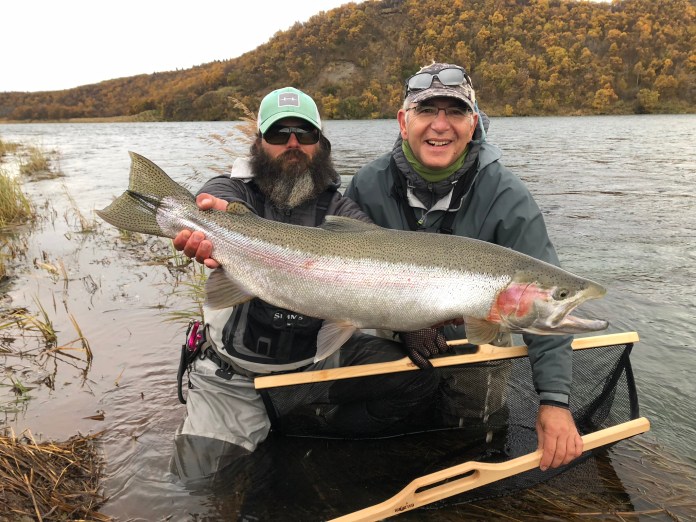
There are so many destinations for the avid Spey fisherman from Steelhead to Atlantic Salmon but nowhere on earth offers a chance to swing up the rainbow trout of a lifetime like the Naknek River in King Salmon, Alaska.
I’ve had steelhead fisherman that connect with these Naknek rainbows and are not prepared for the ensuing battle. They bring click and pawl reels and realize these late-season rainbows are a different class of fish. Heavy and very strong, these fish use the mighty Naknek to their favor. Very much a challenge on the traditional setup. Of course, the modern reel certainly offers many advantages but man those old school reels scream!
If anyone is looking for a real challenge on a two-handed rod then look no further than Katmai Trophy Lodge. The last week of September through October and into November offers the best chance at a true trophy rainbow.
For more Alaska rainbow trout content, be sure to check out Captain John McCloskey at @dryflyjohn or +1.678.873.6079.
A recent study conducted by the Theodore Roosevelt Conservation Partnership (TRCP) and hunting company onX, has discovered that 6.35 million acres of Public Land are “landlocked” by private land, which chokes off public access almost completely.
“onX and TRCP release a groundbreaking analysis of state land access across 11 Western states
This week, onX and the Theodore Roosevelt Conservation Partnership revealed the stunning results of a collaboration to quantify how many acres of state lands across the West are entirely landlocked by private land and, therefore, inaccessible to hunters, anglers, and other outdoor recreationists.
This is the anticipated follow-up to last year’s study of federally managed public lands, which showed that more than 9.52 million federal acres have no permanent legal access because they are isolated by private lands.
“Based on the success of last year’s landlocked report, we decided to turn our attention to the West’s 49 million acres of state lands, which are important to sportsmen and women just like national forests, refuges, and BLM lands,†says Joel Webster, Western lands director with the Theodore Roosevelt Conservation Partnership. “State trust lands, parks, and wildlife management areas often provide excellent hunting and fishing, yet 6.35 million acres of them are currently landlocked and inaccessible to the public. Together with our previous findings, the TRCP and onX have produced the most comprehensive picture of this access challenge across the West.â€
The new report and companion website break down landlocked acre totals for each of 11 states. Montana, Arizona, New Mexico, and Wyoming each have more than one million acres of landlocked state lands, creating existing barriers and future opportunities for public access.
“Handheld GPS technologies have revolutionized how the recreating public finds and uses state and federal lands, making millions of acres of small tracts of public lands easy to discover and explore, both safely and legally†says onX founder Eric Siegfried. “GPS technologies have also helped the recreating public become personally aware that inaccessible public lands are scattered across the Western landscape, and onX is eager to help identify the extent of the landlocked challenge and showcase the collaborative tools to fix it.â€
While the analysis looked at various types of state-administered land, such as state parks and wildlife management areas, the vast majority—about 95 percent—of the landlocked areas identified are state trust lands. Trust lands were long ago granted by the federal government to individual states and are generally open to public recreation in all Western states except Colorado.
“Each year, hunters and anglers across the West enjoy some of their best days outdoors utilizing state land access,†adds Siegfried. “If we can work together to unlock state lands for the public, many more sportsmen and women will have those experiences in the years ahead.â€
The Solutions
The report also highlights the various ways in which states are and can be addressing this issue, so that effective solutions can be more widely adopted across the West. Several states have made significant progress with dedicated staff and programs for improving access, and by utilizing walk-in private land hunting access programs to open up state land. Additionally, state-side grants made possible by the Land and Water Conservation Fund, which was permanently reauthorized earlier this year, offer another promising tool to address the landlocked problem.
“Many states have embraced the opportunity to open these lands to recreational access, and it is our hope that this report will help decision-makers find ways to tackle the challenge more completely,†says TRCP’s Webster. “This includes Congress doing its part by passing legislation that would establish full and dedicated annual funding for the Land and Water Conservation Fund, which must direct 40 percent of all dollars towards state and local projects.â€
The TRCP is encouraging hunters and anglers to support full, permanent funding of the LWCF through its online action tools here.
The mission behind onX is to always know where you stand: to give outdoor enthusiasts more information about their surroundings than they ever thought possible. onX strives to create the most complete, current, and accurate mapping information available, including landownership, roads, trails, and other access-related data. By providing people the best and most up-to-date data and GPS technology in the palm of their hand, onX seeks to help people have the best outdoor experiences possible.
Inspired by the legacy of Theodore Roosevelt, the TRCP is a coalition of organizations and grassroots partners working together to preserve the traditions of hunting and fishing. By ensuring access to quality fish and wildlife habitat, we’re also safeguarding the $887 billion that sportsmen and women help contribute to the American economy.”


 As an angler from the PNW having only ever previously landed 3 tarpon with largest one weighing maybe 20lbs at most I had no knowledge of these techniques, but I now at this point intent to learn them. I think that’s one of the most intriguing things about fly fishing, is that there is always something new to learn and thus a new goal to achieve.Â
As an angler from the PNW having only ever previously landed 3 tarpon with largest one weighing maybe 20lbs at most I had no knowledge of these techniques, but I now at this point intent to learn them. I think that’s one of the most intriguing things about fly fishing, is that there is always something new to learn and thus a new goal to achieve. 


![11 Best Fly Fishing Rivers In Colorado [Pro Tips For Each]](https://i0.wp.com/theflylords.com/wp-content/uploads/2019/07/untitled-5-of-70.jpg?fit=696%2C464&ssl=1 "11 Best Fly Fishing Rivers In Colorado [Pro Tips For Each]")


 Flylords: Where is the craziest place photography has taken you?
 In the second episode, we swam with sharks on and I ended up hand lining a 10’ Bull Shark which was an entirely different experience.


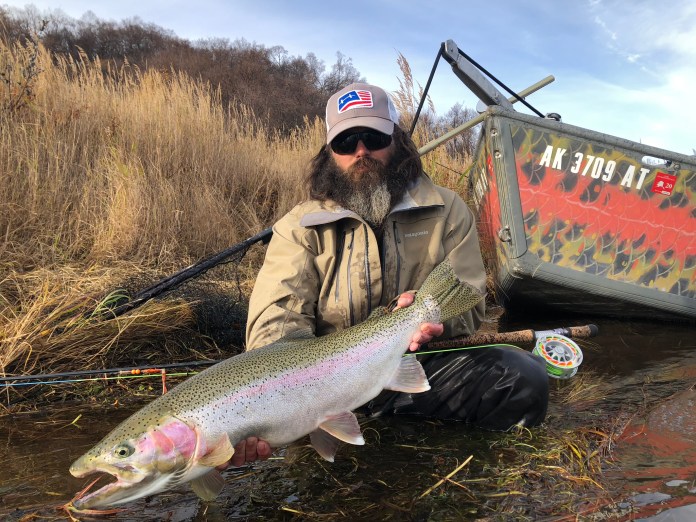 I’ve had steelhead fisherman that connect with these Naknek rainbows and are not prepared for the ensuing battle. They bring click and pawl reels and realize these late-season rainbows are a different class of fish. Heavy and very strong, these fish use the mighty Naknek to their favor. Very much a challenge on the traditional setup. Of course, the modern reel certainly offers many advantages but man those old school reels scream!
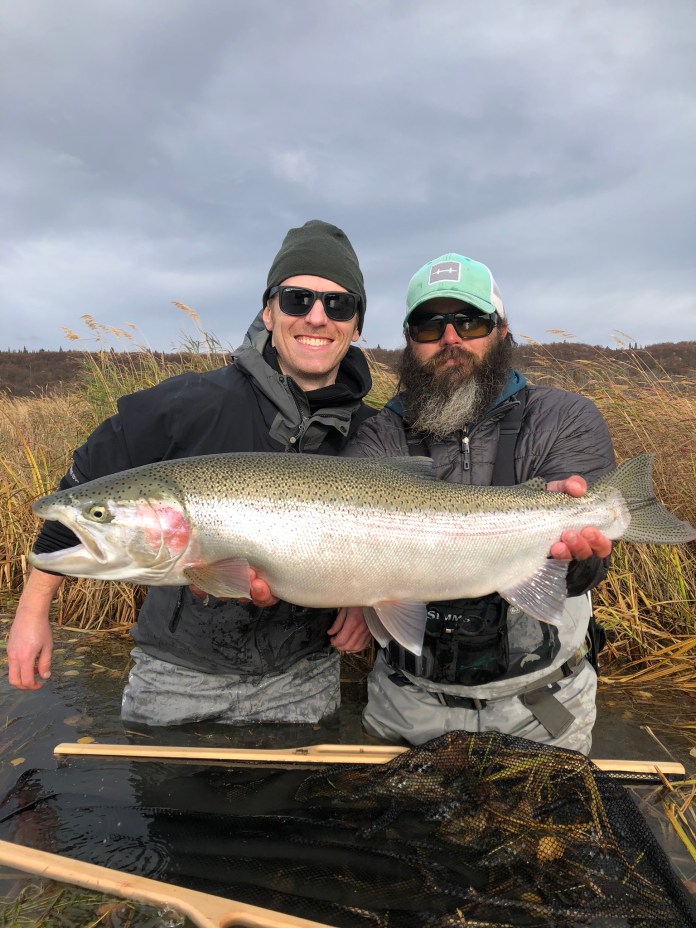 If anyone is looking for a real challenge on a two-handed rod then look no further than Katmai Trophy Lodge. The last week of September through October and into November offers the best chance at a true trophy rainbow.
 For more Alaska rainbow trout content, be sure to check out Captain John McCloskey at