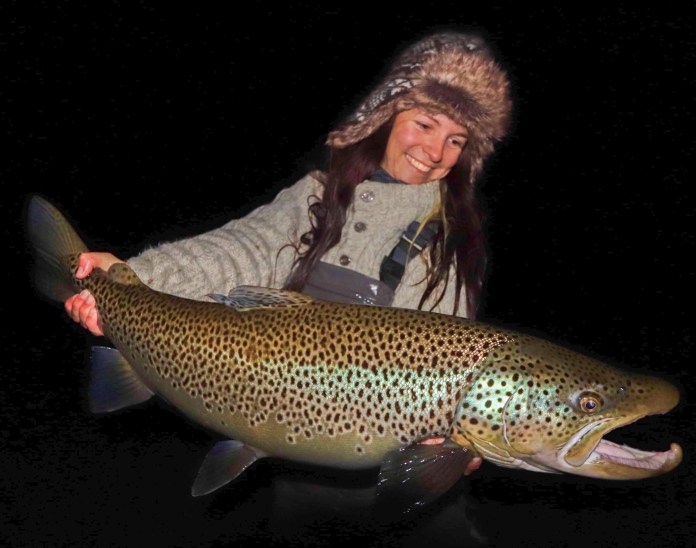
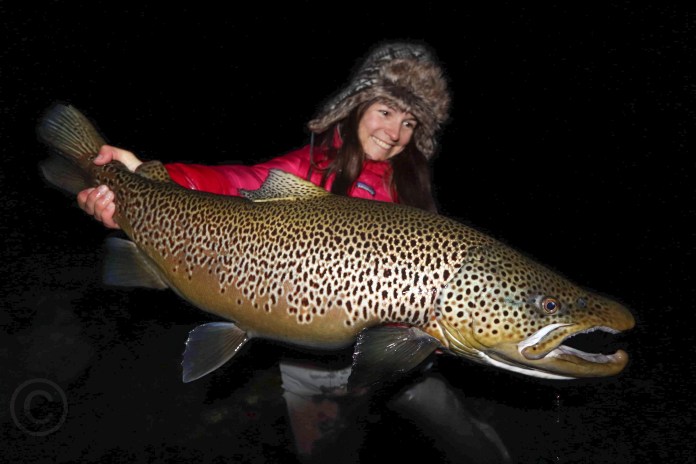
Officials with the U.S. Bureau of Reclamation, Fish and Wildlife Service and Pyramid Lake Paiute Tribe started construction Tuesday for a $23.5 million fish-passage project to aid Lahontan cutthroat trout move past the Truckee River’s Derby Dam, which has been in place since 1905. The construction of the dam, located 20 miles from Reno, Nevada has been blocking the passage of the Lahontan’s upstream to their traditional spawning grounds near Lake Tahoe.
The Lahontan Trout were thought to be extinct from the 1940s-1970s until a rancher found a small population that had been previously stocked, and subsequently forgotten. In 2006, broodstock from that population was used to restock Pyramid Lake, and in 2014 the first Lahontans successfully spawned in the short stretch of river between the lake and Derby Dam.
The fish passage project is expected to be functional for fish traffic as early as next Fall and will open up miles of river above Derby Dam to spawning access for the recovering Lahontan Trout.
Sometimes the simple films can be some of the best ones. This video features a few epic shots of a really cool tarpon fight. Tarpon are known as one of the craziest fish to catch on the fly, and this video gives you a good glimpse of that.
Thanks to the crystal clear water, you can see some amazing drone action as well as some really epic jumps. Check out the video to see if they were able to land the fish!
This video was created by Aelian Media, be sure to check them out on Vimeo!
The video of the week is selected and written by Fly Lords team member Conner Grimes (@doublehaulfishing).
We’ve heard rumors about the fabled Wessel islands for a few years now… Watching films like Glorious Bastards make the place seem fake, with endless sand flats full of permit and blue bastards… So preparing for this trip definitely gave us some goosebumps. After a killer first few days in the Snowy Mountains and Sydney Harbour, we were ready to head north.
We packed our bags and headed to Sydney’s domestic airport, our first flight took us through Cairns, considered the gateway to Australia’s Great Barrier Reef, is a city in tropical Far North Queensland.
We had an overnight stay in Cairns, so just a few hours to re-organize our gear and relax before heading further north. The people, food, and overall culture in these small cities are some of the best parts of the trip. Coming from a city like New York it’s so refreshing to spend time in a place like Cairns. I still remember how great the breakfast was at the Cafe down the street from our hotel, and No Tips! That was a wild concept…
Our next flight left early the following morning, we flew into the small town of Gove, located on the northeastern corner of Arnhem Land in the Northern Territory of Australia. Walking out of the small airport was when I finally realized how “Out There†we truly were. If you give Gove Airport a quick google on your phone you’ll understand just how remote this place really is… And we hadn’t hit our final destination yet…
We met the Waterline Charters team outside the airport and loaded our gear into a bus to head across Gove. It was about a 30 minute drive through some interesting terrain until we finally had the Waterline Charters Boat in sit.
We loaded into a smaller skiff to head out to the main boat. The next hour was pretty surreal, being greeted by a professional well-dressed crew with glasses of Champaign and hors-d’oeuvre as we settled into our rooms. Me and Max (Flylords DP) were splitting a bed with a small divider in between, but no complaints here.
Before starting our journey even further north, we had a briefing from the captian. He brought out a big map and gave us a run through on the schedule for the next 6 days at sea. He gave us a safety briefing and emphasized the importance of watching out for Saltwater Crocs. Stories of them stalking the boat, and close friends losing lives were the last thoughts going through my head on that first night out at sea. Though the next morning those thoughts quickly dissipated as we pulled into our first fishing spot.
Barramundi was on the schedule first. We were targeting this big silvery oddly shaped creatures with 9 weight rods and big streamers and poppers. Our first few days we battled for light through what felt like never-ending rain storms. We would push our skiffs into narrow canals to search for these fish in clearer shallower water. As we pushed into some of these smaller systems we would be surrounded by Giant Fruit bats, lizards, crocs, you name it – it was truly a wild untouched place.
We worked our asses off to find these fish, but when we did it was so rewarding. Hard fighting creatures that love to crush flies and jump into the air mid-fight. I’d describe these fish as a cross between a Tarpon and a Snook. Technical fishing at times having to pull fish out of sticks and snags, and sight casting to big shadows with very little room for a backcast. Josh explained the importance of his famed Bow and Arrow cast off the front of the skiff. I laughed at him for a while until he actually caught a fish on one of those casts…
After a long day on the water, we were greeted by some cold Australian beers and 5-star dining. Did we need 5-star dining? No, the fishing and experience were enough, but this operation tries to make this a true experience of a lifetime. Although 99% of the time we are catch and release fishermen, there are circumstances when we harvest our catch for food. I will say the Barramundi was one of the best-tasting fish I have ever had.
After a few wet days of Barra fishing, we pulled up the Anchor and headed even further north, to the end of the Wessel Islands. It was an overnight steam with the occasional wave waking you up. But I was most likely sleeping with a shit-eating grin on my face thinking about how lucky I was to be in this situation. We pulled into our port AKA in between to cliff faces and a sand flat the next morning and loaded into the skiffs.
The clouds decided to follow us, so we would be battling for vision on these flats for the first day and a half. The second the sun came out we would spot fish all over the place. Queenfish, Permit, Bastards, you name it, the place was littered with fish. It’s moments like these when you realize what an untouched fishery can really be like. Is this what the florida keys were like 100 years ago?
My first catch of the trip was the Blue Bastard, and boy was that a wild ride. You are site fishing to this massive blue blob mooching around in the water. The cast needs to land in front of the fish, where the crab pattern can settle in the sand and fall into the feeding line of the fish. A slow smooth retrieval is required to entice one of these bastards to jump on a fly. When you finally trick one into taking a fly it’s one of the oddest battles, the fish will rise up to the surface and flail around not really knowing what is going on, and after about 15 seconds of slowly shaking its head back and forth BOOM it takes off, straight into your backing.
This is right about when you need to have your shit together, the line needs to clear, drag needs to be tight, and you need to steer the fish away from sharp coral. Two times I managed to get my line tangled on my reel, and ended up jumping into the croc-infested waters to try and keep my fish on… I ended up receiving the nickname “Jumping Jarodd” after the second incident, but landed both fish! The yellow eyes and transient blue colors of these fish are truly spectacular, they will go down as my favorite fish I’ve ever targeted on the fly.
The following two days we watched josh pull two Permit to the boat, amongst a number of other species. Max even had a chance to put down the camera and catch a few bastards. schools of Permit 500 deep would swim by our boat, it was truly remarkable. At night we would have a cocktail and reminisce about the incredible day with the rest of the boat. We even had a chance to stream the season finale of Game of Thrones while we were out at sea… (Please don’t judge me for that, it was a great show).
On our way back to Gove, we spent a day doing some off-shore fishing. We thew on the sinking lines and big streamers and headed into some deep rips. Monster Mackeral, Trevally and Queenfish all day long. This was quite the finale to an incredible trip, and my arm was literally sore heading to sleep that night… Once again with a shit-eating grin on my face.
This was truly a trip to remember and should be on every anglers bucket list. What a finale to an incredible Australian adventure.
Big shoutout to Tourism Australia for having us down, to Aussie Fly Fisher for organizing this incredible journey, and to Waterline Charters for hosting us on this wild finale in the Wessel Islands.
If you haven’t checked out episode 1 or 2, give them a watch!
On September 26th, US Secretary of Commerce Wilbur Ross announced that Alabama and 6 other states have been included in a Fishing Disaster Declaration.
According to AL.com, “Secretary of Commerce Wilbur Ross said commercial fishery failures occurred between 2017 and 2019 in Alaska, California, Georgia, and South Carolina. During the same time, catastrophic regional fishery disasters also occurred in Louisiana, Mississippi and Alabama due to extreme flooding events in the Gulf of Mexico.”
The recent declaration came after Alabama Governor, Kay Ivey wrote to Sec. Ross informing him of “tremendous and unprecedented amounts of freshwater that have inundated the bays, bayous and estuaries†in the central Gulf Coast. Rivers in the state have experienced record flooding which has resulted in many coastal marshes and brackish rivers losing their salinity which is imperative in maintaining healthy coastal fish populations.
“The declaration makes fisheries in these states eligible for NOAA disaster assistance. The process of determining which fisheries are eligible is currently underway.”
Ready for a new fly to add to the nymph arsenal? In this week’s “How to Tie” feature: Tim Flager with Tightline Video is here to show us how to tie Crane Fly Larva.
Learn About This Fly:
Difficulty: Novice
Inspired by a mix of several varieties of the “Killer bug” pattern, as well as the “Walt’s Worm” pattern, the Crane Fly Larva imitation is a deadly weapon on a dropper rig. Modeled after the subsurface larvae of the infamous crane fly, these buggers can be found in streams and lakes across the world.
Because of their size and commonality, these flies can be fished wherever there are fish to be found; as trout or grayling will gobble them up whenever they’re nearby. When fished on a dropper, usually below a heavier weighted fly (Such as a copper john or weighted caddis larvae), you’re bound to attract the attention of fish from all sizes and species.
This fly uses only a few materials and is a relatively easy job for tyers of all levels of proficiency. However, with the use of materials like Wool yarn, it also offers a chance for tyers to add something new to their repetiteur and entices some new originality. Note, if you don’t have yarn available, grey or tan dubbing can also be used as a supplement until you can make it to your local sewing store.
There’s just something special about watching trout feed on the surface. But these trout in Marfield Nature Reserve in Yorkshire, England, taking to the air trying to snatch big dragonflies as they fly just above the water’s surface, is something truly special to witness. The video below was captured by Yorkshire Dales Rivers Trust project manager David Higgins, who was joined by Solent News videographer Gary Lawson, and the two captured some incredible action.
Iceland, the land of fire and ice situated just below the Arctic Circle and above the Mid-Atlantic Ridge. It’s home to active volcanoes, spouting geysers, thermal springs, thunderous waterfalls, vast inland glaciers and one of the cleanest environments you can experience. Although it is a remote island with a small population and little impact on global politics and economics It’s one of the most beautiful countries I have ever seen. I’m fortunate to call Iceland my second home. I have been spending the past two unforgettable summers as a fly fishing guide under @hreggnasianglingclub, guiding people from all over the world for Atlantic Salmon and Laxa à Kjos the famous searun ghosts!Â
Photo: Edward Smith
The last two nights before my season was over I was invited to go fishing with my friend @cezary_fijalkowski who is one of the most skilled guides at Thingvellir Lake. The lake is one of the most mystical places in Iceland. Biologists believe that it also holds the biggest brown trout on Earth! The prime time for the ice age chrome brown trout runs are during April and May, occasionally you can catch some nice fish there during the summer months and Thingvellir Lake is officially closed in September.
Cezary picked me up at Kjos Lodge after my guiding session around 21:30. Our chef Sveni prepared me a nice sandwich to take away, I took some extra wool clothes and jumped in the car. The lodge where I’m guiding is just 30 minutes drive to the lake so after 22:00 I already made my first cast. Cezary was almost sure from the start I will manage to get my 90cm+ brown trout tonight! We fished pretty long fluorescent streamers from Cezary’s fly collection. I was surprised because my last trips to Thingvellir I was always advised to fish small trout streamers, but you know the saying “Big fly=Big fish“. Well, it rang true, in a few hours I landed 8 fish between 75- 83 cm but nothing close to the magical border 90 cm (35.5 inches).Â
80 CM Fish (32 Inches)
It was close to 3 a.m and I was supposed to be guiding the next afternoon shift. As we were walking back to the car around the water, Cezary stopped me and said “Make one last cást right here please“. I made the first cast somewhere into the dark, took a few strips and felt the hit. Basically the fly line just stopped and the “bus” started to pull. The important thing here at Thingvellir is to let the fish go as long as the fish wants, just be sure you have enough backing on your reel (200-300m should be enough). It took another 30 minutes of fighting before I managed to see the biggest brown trout of my life. Even now when I’m writing about this experience I still feel the adrenaline in my body. But even after I held him in my hands the drama was not over. The trout escaped from my hands and was slowly swimming away. I did not wait for any single second and jump on the fish right into the water. Its nothing you want in -2 C even you are wearing wool clothes. Water slowly swelled into my waders, all clothes, my hair were wet, but the good thing was that I was holding the trout tight under my body. Cezary was just staring at me frightened before he started to laugh. Everything ended up well. We measured this fish on exact 90 cm of length and took some quick shots before release. When I returned back to the lodge it began to dawn. Well, the next guiding day was quite hard but I felt as obsessed by these Thingvellir browns and next night after my guiding shift we were heading back to the lake!Â
First 90 CM Fish!
The second night prediction for northern light was on the highest level, the temperature was attacking 0 Degrees C and Cezary was pretty confident about another brown trout beast! His Pike Terror fluorescent fly was on fire again! The fishing was a bit slower than last night when all of a sudden I had been gifted to fight a fish while the lady aurora was dancing in the sky! What a surprise! This trout was insane, 95 cm long male, probably the fattest fish I have ever seen too! Thanks to my friend and excellent guide Cezary, these two nights will never be forgotten! I can’t wait to be back in Iceland again next summer and try to get a brown trout over 1m!
a 95 CM Beauty
If you consider Iceland as a destination to go you should. Chasing silver Atlantic Salmon on single-handed 7wt rods on surface hitch flies, trying to 80+ get Searun ghost on a little dry fly or catch your biggest brown trout ever on Thingvellir lake and as a bonus be surrounded by pure clean Icelandic nature and if you lucky watching lady aurora on the sky while fighting your fish! Everything is possible in Iceland!
We are always inspired when we hear of good people using their talents to help and honor others. Harold Watters, a disabled veteran and volunteer with Project Healing Waters, has taken to his vise, tying up 1,000 “Purple Heart Flies” to honor American veterans who were injured while serving their nation.
“We’re honored to share a very special story from our Spokane, WA Program. Harold Watters, a disabled veteran participant and volunteer, has made it his mission to pay it forward by tying campaign ribbon flies, specifically the Purple Heart fly, for those who have been wounded in their service to our Nation.
The Purple Heart Fly was designed and created by John Gort of the Olympic Peninsula Fly Fishers and the original fly is a part of the Project Healing Waters Campaign Ribbon Fly Plate.  John recruited and trained tiers from the 90-member club to design and create the plate, and each fly, to compliment a military campaign theme. Sixteen one-of-a-kind flies were designed, tied and mounted with the companion Campaign Ribbon. Because each fly is an original design using many hard-to-find materials, the project took hundreds of man-hours and nearly a year to complete. This incredible tribute and work of art now resides at the American Museum of Fly Fishing in Manchester, VT.
Courtesy of PHWFF
Sylvia Bach, Rocky Mountain Northwest Regional Coordinator, Project Healing Waters Fly Fishing, Inc. notes: “I am proud to share this on behalf of Harold Watters! Harold is a participant/volunteer in the Spokane program. Here is his story…â€
I’ve been a participant of Project Healing Waters Fly Fishing for 8 years. My first involvement was when I was in the Seattle VA Hospital. When I returned to Spokane, I joined because I found that tying flies would temporally take me out of my head and I had to focus on tying.
To give back or pay it forward, I started tying campaign ribbon flies, as I had seen a poster that the group located on the Washington coast where they tied a fly for each campaign ribbon. But they also had a Purple Heart fly… I tracked down the man responsible for it and ask if I could buy one. I was told they don’t sell them but if I was awarded the Purple Heart they would send me one. About a year later my tying skills were better and asked if I could tie them and give them to veterans.
I was sent the instructions and showed them what I could do and was given the go ahead to tie. Last year the Spokane Purple Heart Association asked if I could tie a few that they could use for their convention. I said sure, then they said “we need 400â€. I worked on them thru the holidays and delivered them in late January.
Courtesy of PHWFF
I kept tying, and I have just tied my 1000th Purple Heart fly.
I have also modified the fly to give to Gold Star families, as my feeling is that their son, daughter, husband or wife gave their all for their country. Of 1000, 100 are Gold Star flies.
To me, it is my way to give back to the program and share my tying with others that have been wounded for their country.”
Images and text courtesy of Daniel Morgan at Project Healing Waters Fly Fishing. To get involved with PHWFF, check out their website!
I was lucky to get this shot when we were sight fishing for some northern pike at my favorite hard-to-access lake. To get there, you need to drive about 300km from Whitehorse, Canada (the Yukon’s capital and largest town), then paddle about 20km down a swift river, and then portage about 1km in the forest to reach your destination. As you can see, it really pays off!
Every year we go there and have the same success, which makes you forget about the hard portage really quickly. This specific pike in the video was just short of a meter, but it had an 8″ half-digested pike in its stomach as well as a mouse…see the photo below.
They are so aggressive that even with barbless hooks it is very challenging. They tend to swallow flies really deep, so usually after catching what we can eat while we’re there (1 or 2 fish) we simply stop fishing to keep the lake healthy for many more years to come!
The article, video, and photos from Gabriel Rivest. Check him out on Instagram at @gabe_rivest or his Vimeo channel here.
The 50/50 On the Water movement was launched by Orvis with the goal of celebrating women in the fly fishing world and inspire others to join in on this wonderful sport. The tour will be hosted by Orvis retail and nonprofit partners.
“MANCHESTER, Vermont – Outdoor retailer Orvis has launched a film tour as part of their 50/50 On the Water campaign aimed to inspire more women to get out on the water and discover the joys of fly fishing.
The family-friendly film tour features 90-plus minutes of storytelling, highlighting anglers and fisheries from around the world. Films include Orvis’s latest 50/50 On the Water film, as well as stories of connection, recovery, and conservation that take the audience from the Smith River to Glacier National Park to Greenland and French Polynesia. Events and showings are hosted by retail and nonprofit partners and proceeds will be donated to the local nonprofit partner of their choice. A full list of the featured films can be found on the Orvis blog.
The tour is part of the 50/50 On the Water movement, initiated by Orvis to inspire and celebrate women in the sport. It includes women-specific gear development, education, adventure experiences, nonprofit partnerships and storytelling.
“This initiative is an industry-wide endeavor,†says Jackie Kutzer, one of the catalysts behind the 50/50 movement. “Brands across the industry came together to thoughtfully curate a collection of films that celebrate women and conservation within the sport. We wanted to make it easy for folks to create and host their own event. This will hopefully be the first of many women-centric events to keep building on our momentum of reaching gender parity in the world of fly fishing.â€
Retail and nonprofit organizations interested in hosting a stop on the tour and supporting the cause can click here to sign up. Hosts receive a full event package including films, raffle prizes and marketing materials. The tour is limited to 100 events, first come, first served. Questions should be directed to 5050@orvis.com.”


 We had an overnight stay in Cairns, so just a few hours to re-organize our gear and relax before heading further north. The people, food, and overall culture in these small cities are some of the best parts of the trip. Coming from a city like New York it’s so refreshing to spend time in a place like Cairns. I still remember how great the breakfast was at the Cafe down the street from our hotel, and No Tips! That was a wild concept…
 Our next flight left early the following morning, we flew into the small town of Gove, located on the northeastern corner of Arnhem Land in the Northern Territory of Australia. Walking out of the small airport was when I finally realized how “Out There†we truly were. If you give Gove Airport a quick google on your phone you’ll understand just how remote this place really is… And we hadn’t hit our final destination yet…
 We loaded into a smaller skiff to head out to the main boat. The next hour was pretty surreal, being greeted by a professional well-dressed crew with glasses of Champaign and hors-d’oeuvre as we settled into our rooms. Me and Max (Flylords DP) were splitting a bed with a small divider in between, but no complaints here.


 After a long day on the water, we were greeted by some cold Australian beers and 5-star dining. Did we need 5-star dining? No, the fishing and experience were enough, but this operation tries to make this a true experience of a lifetime. Although 99% of the time we are catch and release fishermen, there are circumstances when we harvest our catch for food. I will say the Barramundi was one of the best-tasting fish I have ever had.
 After a few wet days of Barra fishing, we pulled up the Anchor and headed even further north, to the end of the Wessel Islands. It was an overnight steam with the occasional wave waking you up. But I was most likely sleeping with a shit-eating grin on my face thinking about how lucky I was to be in this situation. We pulled into our port AKA in between to cliff faces and a sand flat the next morning and loaded into the skiffs.
 The clouds decided to follow us, so we would be battling for vision on these flats for the first day and a half. The second the sun came out we would spot fish all over the place. Queenfish, Permit, Bastards, you name it, the place was littered with fish. It’s moments like these when you realize what an untouched fishery can really be like. Is this what the florida keys were like 100 years ago?
 This is right about when you need to have your shit together, the line needs to clear, drag needs to be tight, and you need to steer the fish away from sharp coral. Two times I managed to get my line tangled on my reel, and ended up jumping into the croc-infested waters to try and keep my fish on… I ended up receiving the nickname “Jumping Jarodd” after the second incident, but landed both fish! The yellow eyes and transient blue colors of these fish are truly spectacular, they will go down as my favorite fish I’ve ever targeted on the fly.
 On our way back to Gove, we spent a day doing some off-shore fishing. We thew on the sinking lines and big streamers and headed into some deep rips. Monster Mackeral, Trevally and Queenfish all day long. This was quite the finale to an incredible trip, and my arm was literally sore heading to sleep that night… Once again with a shit-eating grin on my face.
 This was truly a trip to remember and should be on every anglers bucket list. What a finale to an incredible Australian adventure.