We want to help you experience some of our favorite fly fishing adventures. If you are looking to plan a fly fishing adventure shoot us an email:Â travel@theflylords.com.
The moment your feet step off the panga and onto the landing dock of the breathtaking Thatch Caye Island Resort you are greeted by a fresh glass of ice cold watermelon juice prepared specifically for your private arrival. Pearly white smiles of the hospitality crew surround you. From that moment until you return back to the mainland, every wish and desire you have is accommodated at the all-inclusive island resort. The entire island only takes you 20 minutes to walk from one end to the other, it is complete with 15 rooms and can sleep up to 32 guests.
The resort attracts honeymooners from all over the world as it is complete with oceanfront penthouses and overwater bungalows, so there will be no shortage of drunken happy go lucky couples to laugh the evenings away with. The advantage to this is that while yes you will mostly come across a plethora of vacationing couples, you will be all alone in your fly-fishing quest for one of the most challenging sport fish of all time. Trachinotus falcatus. Otherwise known as the Permit.
Thatch Caye is centered in the heart of permit country. Surrounded by the world’s largest living reef, the Belize Barrier Reef you can literally cast to schools of tailing permit and not see another soul for miles past the horizon. One morning we just hopped on a couple of the community bicycles and peddled down to the north end of the island.
Stealthy as we could peering through openings in the hanging palms we spotted bonefish tailing just a rod lengths from the shore. Someone wake me up, it can’t be this easy… All along the west side and close to the overwater tiki bar thrashing takes and baitfish raining just above the surface for their lives echo throughout the night.
The water is alive with hunting barracuda, reef fish brilliantly strutting every color of the spectrum, and of course your game fish: bones, tarpon and permit.
Say for example not every person in your party wants to fly fish every day. No worries, your experience is completely designed by the interests of you and those who accompany you. Snorkeling, diving, lobster/conch hunting, basket weaving, kayaking, stand up paddle boarding, river boat tours, island crawl via a floating bar, body treatments, spa massage are all on the table. Evenings if you so desire can end with popping bottles on a stargazer’s cruise under the Belizean Night Sky. And again if all you came for is the fly fishing then you can literally fish till your heart’s content.
While we were there we had the incredible opportunity of fishing with the Permit Master himself. When you meet Lincoln Westby you have immediate innate respect for this man. A legendary Belizean fly fishing guide he was fishing for permit with a fly rod before the rest of the world knew what a permit was.
At 78 years of age, he was polling us around the flats as if he had just reached his prime, telling us fish stories from 40-50 years ago while slipping in life lessons of forgiveness, humility and well-being.
Lincoln is simply an immense wealth of knowledge that no video, book or article could ever fully convey. His kindness, patience and direction deemed him an absolute pleasure to spend the days fly fishing with and the words and stories he shared with us will not soon be forgotten. (Lincoln is the lead guide for Blue Horizon Belize, an Orvis Endorsed fly fishing outfitter that operates out of Thatch Caye Island Resort).
The island resort is well aware of the jewel of a location in which they are located when it comes to destination fly fishing so they have cleverly designed several of their cabanas to accommodate the visiting angler. At the end of a long day on the salt, all you want to do is shower and be cold right? Well, you just mosey yourself on down to your private quarters, hang your rods on the fly rod holders built right onto your cabanas deck, step inside and blast the AC.
You must, however, be very cautious of the beds in the angler cabanas…. I kid you not, the first night I slept there I awoke the next morning feeling as though I had slept for a week and subtracted 10 years of aging. A nap could turn into missing dinner and dinner at Thatch Caye is not something you can forgive yourself for if you miss.
The first night prepared by the Island’s private chef we had lobster that was caught that day from a rocks throw away. The food is thoughtfully and artistically prepared as the chef has the support of a crew of 5-6 servers, sous chefs and line cooks all with one goal which is to make sure that every bite is an invigorating experience.
I think that in itself is exactly what this Muy’Ono Resort envisioned when they designed this paradise destination. They pictured a glistening sunset and you walking barefoot, past the breezy palms on your way to a hammock, pina colada in hand and a smile from ear to ear reminiscing on a day of fly fishing that you won’t ever forget.
Article by Ruth Simms (@navajoflyfisher) on a recent Team Flylords trip down to Thatch Caye Island Resort while fishing with Blue Horizon Belize in the famed Permit Alley region of Southern Belize.
If you are looking to plan a fly fishing adventure down to Thatch Caye shoot us an email at travel@theflylords.com. For more information on Lincoln Westby and Blue Horizon Belize check them out online here.
Four dams on the Klamath River in California have been scheduled for removal in 2022, but there’s still plenty of work ahead for the researchers who are doing their best to study as much of the system before the unprecedented dam removals begin.
The Klamath has been hurting the past few decades as salmon stocks continue to dwindle and water quality is becoming a concern. Now the dam removal will help a solve many of the challenges, but there are plenty more looming in the foggy mountains. Researchers are most focused on identifying and tracking the changes the river system undergoes once the four dams are removed, so the data can be used to aid other dam removal projects around the world.
Currently, researchers are in a rush to log as much “base-line” data as possible, to have something to base research on once the dams have been removed.
“It’s a huge opportunity to learn about what dams do to rivers and what taking them out can also do,†says Laura Genzoli, a University of Montana ecology doctoral student.
This week we’re throwing it back to one of the most popular fly fishing videos on YouTube from over 10 years ago. This film features some epic topwater eats and a unique style of targeting massive trout.
In the film, trout are targeted by using mouse flies. Obviously the fish need to be pretty large to take on an animal such as a mouse, and you can see a variety of heavy rainbows and browns taking advantage during this film. It really shows how aggressive these fish can be. Check out the video to see all of the action for yourself!
This video was created by Bumcast. Check them out on YouTube for some other films!
The video of the week is selected and written by FlyLords team member Conner Grimes (@doublehaulfishing).
The Payara, one of the ultimate jungle predators, are mainly known for their sizable teeth and aggressive behavior. For many years, Untamed Angling sought to find waters where fly anglers could target these remarkable fish and find true trophy payara.
Untamed Angling is pleased to announce Xingu Lodge — a new destination for jungle fly fishing. Located on the Rio Xingu in the Brazilian Amazon, Xingu Lodge will focus primarily on fly fishing for giant payara.
Payara, one of the ultimate jungle predators, are mainly known for their sizable teeth and aggressive behavior. For many years, Untamed Angling sought to find waters where fly anglers could target these remarkable fish and find true trophy payara.
“We searched tirelessly for the ultimate destination for payara,†states Rodrigo Salles, partner, and CEO of Brazil Destinations for Untamed Angling. “It turned out that the best location we could find was on the Rio Xingu — a river completely protected on indigenous land by the Kayapo people and very close to Kendjam. It was an exciting secret they were holding, and we are thrilled that they are sharing this special place with us and our guests. It is an exclusive destination with world-class fishing.â€
Untamed Angling has exclusive access to these protected waters, where payara are known to reach more than 20 pounds. Additionally, Rio Xingu’s clear waters are ideal for fly anglers who want to target payara with a range of fly fishing techniques and also target additional species such as peacock bass, wolffish, and more.
Untamed Angling is currently undergoing an exploratory season and working on a new lodge in preparation for their 2020 season. Xingu Lodge has easy travel logistics, and accommodations will include comfortable double occupancy wood cabins with box spring beds, en suite bathrooms, hot water, electricity, satellite WIFI, and delicious food. The camp is located on the banks of the Rio Xingu and looks out over a gorgeous rapid and pool.
Capitanas log stardate 20190815. The date is August 15th, 2019 and I’m a nerd. I’m actually a fly fishing nerd, and yes I use to watch star trek but that’s beside the point. On the 19th I will take a red-eye down to Atlanta, GA for a connection flight to BZE (Belize City) on the 20th. Being 4 days away from departure a rolodex of items not to forget flip through my mind. I keep thinking of my passport… I know it’s in that one drawer but I had better make sure today after I get home from work. Fishing wise I keep thinking to myself, “Ok the list of equipment on the Blue Horizon Belize at Thatch Caye Island Resort website says for tarpon a 30lb 9ft leader with 12-18 inches of 60, 80 pound shock tippet.†This suggestion has been whirling around in my head for the past 2 weeks.
You see I have been on a couple destination trips now and have had knots that I tied fail on large fish, hooks bend out and swivels be pried open just above the popper. I feel I have solved the swivel problem with an extensive swivel haul at my local outdoor store. Seems like a random issue but if you never have cast a very large popper you may not know that after a few casts unless you have a swivel that rotates inline with your fly, your fly line will start to twist. I learned this the hard way, aka first hand. The absence of a swivel in this kind of setup is not ideal because A.) it frustrates you to no ends and B.) over time if you don’t tend to it, it will cause your line to split or crack and poof you’re down another $100.Â
So back to this tarpon leader…I pretty much have two options. One is what Capt. Buddy Kirkhart once referred to as a “homeboy†leader. It is essentially 50, or 60 or whatever lb test you’d like of STRAIGHT flouro. I know this works because I once used a 60 lb test 10’ piece of flouro with a perfection loop on one end (loop to loop connection to the line) as well as a perfection loop to the fly. I used this 60lb test “homeboy†leader to land a 50lb GT on the flats of Kiribati. In that situation, it really didn’t matter because the only obstacles between the fish and I were deep blue water on the edge of a flat and maybe some coral that I was hoping my 60lb flouro would withstand. Also in these shallow flats the GT was the apex predator and only had to fear human anglers (this statement will make sense later). At that time all I knew was that building a leader was not my specialty.
A month prior I had gone to Columbia and lost 3 huge Peacock Bass on class tippets that I tied. I was using improved Albright knots that I learned from videos online. Theoretically, they should have worked just fine, but with a rushed learning period and no one to provide feedback except for my comparisons to images on Youtube I really had no idea what I was doing. The only other time I had to care about leaders for that large of a fish or greater was when fishing for tarpon in Islamorada, FL this past June 2019. And on this trip is where I learned the benefits of using a class tippet.
Should your rod break or your reel come loose or any other kind of equipment failure occurs and you have a 100+ lb fish on the line, ideally, you want that reel back and you want those rod pieces back. In this situation, a class tippet will protect your gear if your 11 or 12wt tropical line has a 50lb core, or theoretically anything with a greater pound test than your class tippet.
a. PAUSE. I just realized that some might not be familiar with the term class tippet leader. Essentially this type of leader is comprised of 3 main sections (sometimes even just 2). The first section (the part closest to the fly line or butt secion) is something hard to break, like 40 to 60lb test. It is something with a substantial diameter such that a smoother transfer of energy can occur from fly like to leader during a cast. Connected to that you have a smaller lb test piece of line: the Class Tippet is usually 20-16lb way down to even 2lbs in some cases. And depending on the species in many cases the 3rd section is a bite tippet. This piece of line is something with a little thickness to it like 40-80lb test so that the targeted species cannot chew through the part of the line that comes in contact with its mouth. This 3rd section is connected to the fly. Ok, back to the benefits of using a class tippet…
2. Say you are fishing and stripping in line on a boat… doot doot de doo just enjoying the scenery then BOOM huge hit! Your line starts ripping out of the boat from the pile that you’ve made down near your feet. Where is it wrapped around?? Feet? Toes? Fingers? A wrist?? One morning in the keys this happened and the line was flying out of the boat so fast that it caught one of my fingers…pop! Guess what? I lost the fish but I got to keep my finger!! Amen.
3. Lastly, say you have the biggest permit you have ever seen on, or the most hydrodynamic bonefish known to woman, OR a tarpon so shiny you are blinded when the sun glistens off its mirrored body jumps. And then all of a sudden! Out of nowhere! Dun dun. Dun dun. Oh hi Jaws. Oh you wanna eat my disadvantaged fish? Not on my watch. With a class tippet you have the choice to selflessly point your rod tip directly at your prized (almost landed) fish and perform a sad but HERORIC long distance release. And then you sleep well at night.Â
Ok so what is my dilemma? Well… I’m embarrassed to say but I do not feel confident in being able to tie a leader with class tippet inline. Who’s with me here!? Believe me, I have tried to learn. I learned all about improved Albright knots but after those leaders, I made failed me I don’t trust them. Actually, really I should say I don’t trust my ability to tie that specific knot correctly. What do I trust? At home, I have leader that Capt. Mike Alfano tied. It has a 16lb class tippet that was broken right in the middle of the class portion after a 2 hour fight with a 120lb tarpon. (my rod snapped on this fish so actually had that not have happened I highly suspect the leader would have stayed intact.) So what does that tell me? This leader is drool face emoji GOLD. I’m going to do some research tonight and report back tomorrow.Â
I’m back! After a little DM-ing I got the skinny a couple of leader options. The first is from Capt. Mike Alfano of Islamorada, Florida. Mike is a guide who has spent immense amounts of time understanding tarpon behavior, migration patterns and feeding habits and will be sure to put you in the right spot at the right time. He has a variety of leaders he uses for adult tarpon and was kind enough to send me this recipe.Â
If your fly line comes with a pre welded loopÂ
Perfection loop on 6ft of 60 lb
Loop to loop connection
If you fly line does not come with a pre welded loop
Nail knot with 6 feet of 60lb (butt section)
Blood knot
4 feet of 40lb
Improved blood knot
Just less than 18 inches of 20-16lb class tippet
Improved blood knot
Just less than 12 inches of 50lb “shock†or “bite†tippet
Fly is attached using improved homer roads loop knot
Mike has been fishing for tarpon since he was a child and if you’d like to see the kind of tarpon he or his clients catch using leaders like these check him out @captain_mike_alfano Mike notes also that if using a clear fly line you can shorten the overall length of the leader a tad. And alternatively if using a colored fly line lengthening the leader a tad won’t hurt either. He further notes that lubricating the blood knots using chapstick can really make a difference. As a final check make sure that there are not any burn marks in the 16lb class after clinching them down.Â
I was also able to track down a leader recipe designed for more inshore fishing using a 7-9wt rod for tarpon up to 40 lbs. This one comes from a guide I fished with last June Capt. Buddy Kirkhart @night_heron_light_tackle. By the way, if you are ever in the Stuart, FL region of FL (2 hrs north of Miami) do not hesitate to book him. He is one of the most hilarious and kind guides I have ever fished with and you are guaranteed a trip to remember. Ok back to the leader!
Buddy’s recipe:Â
Assuming your fly line has a welded loop
Perfection loop
3.5 feet of 40 lb mono
2.5 feet of 30lb
18 inches of 20lb.
18 inches of 15lb
12 inches of 30 lb for the bite tippet
All connections are a simple uni to uni knot
From bite tippet to fly Buddy uses a Mirro-lure loop knot.
Only substitute is a piece of 40lb bite tippet instead of that 30lb if the tarpon are on the plus side of 30lbs.
He notes that this basic leader works in 90% of all his situations and turns over well.Â
Further, he notes that he ties his “traditional†tarpon leaders complete with a bimini twist and blood knots for his 10-12wt rods and/or poons over 50lbs. For this type of leader I won’t go into detail but if you’re interested in learning more about that kind of leaders and are in the Islamorada area swing by the Florida Keys Outfitters and hit up Jill Tisdale @jill_bird who ties them day in and day out at her local fly shop, for tournaments, visiting anglers, etc.Â
For all of these knots, I was able to look up Youtube videos sent by Mike Alfano or with a simple Youtube search. I know a lot of us get comfortable with the luxury depending on our guides to make the leaders but I feel it’s important for myself to have a basic back up plan in the case that I’m traveling to a destination where class tippet leaders aren’t the norm and I just feel more humane and safe using one. Also, no judgment on “homeboy†leaders as I’m all about that life given a specific situation. With leaders packed, may the good lord fill Thatch Caye Island with massive tarpon, permit, bonefish or another goliath. Amen.
Craig Dickmann was out on a solo fly fishing trip on the beach of Cape York, Queensland, Australia, when an 8 ft saltwater croc thought the off-duty park ranger would make a tasty snack.
But, the croc bit off more than it could chew. After grabbing Craig by the arm and legs, the croc attempted to drag Craig down into the water. The ranger then “scuffled” with the animal and managed to gouge into its eye, prompting the reptile to release its grasp on his limbs.
Bleeding and injured in both legs, Dickmann managed to drive himself over an hour out of the wilderness area to his home, where a neighbor saw to his wounds until a Med-Evac chopper carried him to a hospital in Cairns, Queensland.
Dickmann is now stable in the hospital after an intensive surgery to repair the croc damage.
According to CNN, “There have been several other crocodile attacks in Queensland this year. In March, two fishermen were stranded in a tree above crocodile-infested waters for two days, and just last month a crocodile ate a pet dog playing in a river.”
In this How to Tie video feature, Tim Flager from Tightline Video shows us how to tie the Conehead Bunny Leech
Learn About This Fly
Difficulty: Intermediate
The conehead bunny leech is a fantastic fly for fishing big fish with big appetites. Given its name from the iconic cone-shaped head, along with its rabbit hyde body, this fly moves through the water with dangerous tenacity.
A perfect snack for hungry bass or trout, this fly can be fished in rivers, ponds, and lakes in pursuit of all water-dwelling beasts. An extremely effective style of fishing this fly is with a strip-and-pause retrieve that instills life into the free-flowing streamer body. By allowing small pauses between the flys drift, the submerged leech performs an attractive dance, which combined with the shiny torpedo-shaped head, is overwhelmingly enticing for any surveying fish.
While this fly is only made up of a few components, it may still provide a bit of a challenge to those less experienced on the vice. However, by using the helpful tips Tim provides, as well as running through a few practice rounds, you’ll be cranking these flies out within no-time. Also note, the coneheaded bunny can be produced in a plethora of colors, so get creative and have some fun!
Ingredients:Â Â Â Â Â
2X-long streamer hook (here, a Lightning Strike SN1), sizes 2-10.
Yeti is once again pushing the envelope of hard-sided cooler technology. While vacuum insulation was once reserved for smaller drinkware because of its cost, the Austin-based cooler-maker has created the first, vacuum-sealed cooler. Looking like something Don Draper would have tossed in the back of his station wagon in 1965, these coolers combine a retro look with breakthrough technology.
“There’s only one way to say it: this cooler offers the best thermal performance that science allows. Using vacuum insulation with the support of our proprietary PermaFrost™ Insulation, The YETI V Series™ Hard Cooler is a testament to first-of-its-kind innovation and offers unprecedented ice retention in a cooler. Stylistically, it’s a nod to the past but built with downright futuristic technology.
“Featuring a kitchen-grade stainless steel body, the YETI V Series is vacuum insulated, offering the best thermal insulation that science allows. Additional highlights include a single-center stainless steel loop latch, providing a durable and easy-to-use closure, as well as a leakproof, deep seal drain plug.”
As the line twitches in their fingers, the angler is careful in keeping his count. With each jerk of the fly line, the cork popper makes another theatric lap across the surface of the pond. Behind it, a peculiar ripple boils up to the water’s surface. With one more gentle strip, an explosion of water engulfs the fly and the angler rips their rod back. The line goes completely tight as the rod tip plunges downward. It feels as if there’s a bowling ball attached to the leader. suddenly, there is another explosion and out from the pond flies a tenacious, yet beautiful largemouth bass, its skin glowing in the setting sun’s light.Â
Fishing for freshwater Bass (specifically smallmouth and largemouth) can be one of the most intense and rewarding experiences on a fly rod. Between their geographical abundance, hyper-aggressive nature, and the power they can impose against a taught line, bass are a great opportunity for anglers to diversify their regularly targeted species, as well as have a great fight.
In this guide, we will break down everything you need to know about targeting American freshwater bass such as smallmouth and largemouth. We’ll cover where to find bass, how to catch em, and what gear you’ll need. This being said, saltwater bass, including the popular striped bass, as well as sea bass, will not be covered, however, keep an eye out for a guide in the near future. If you would like to move around the page, just click on any of the titles in the contents below.
The Difference Between Largemouth and Smallmouth Bass
No, It’s not a stupid question. Many anglers spend years in unknowing silence because they’re shamed into believing that the difference between the two fish is simply the name. However, this could not be further from the truth. Here is a quick glance at how these fish differ.
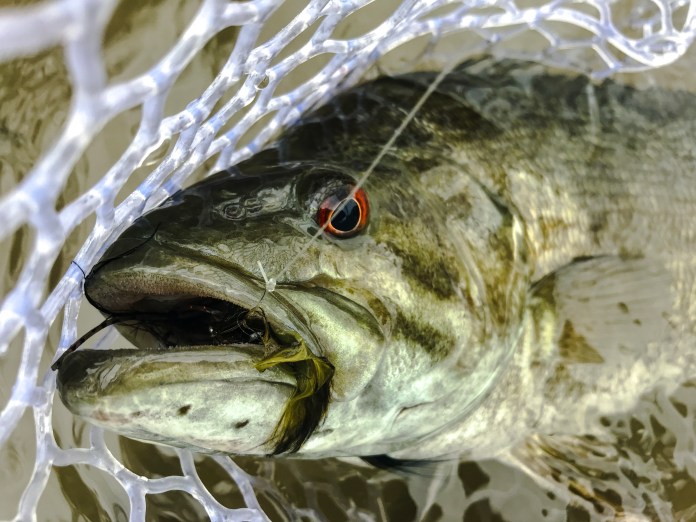
Mouth Size: While this is the most obvious distinction, not all anglers know how to identify it. Largemouth bass’ upper jaw will extend past their eye, while smallmouth bass’ upper jaws will stop in line with their eye.
Striping:Â Another easy way to identify between the two is the striping of the fish. Smallmouth bass possess vertical strips that line their bodies, while largemouths have horizontal stripes located around their bellies.
Dorsal fins:Â Another easily identifiable detail that separates smallies and largemouth bass is the break between a largemouth bass’ dorsal fin. Smallmouths do not have these breaks.
Location:Â Largemouth Bass are generally considered the lazier of the two. They prefer hanging out in calm water, specifically in ponds and lakes, and waiting for their food to come to them. When targeting smallmouth, remember that they tend to hunker down in faster moving current, and can often be found chasing minnows in streams and rivers. Smallmouth also prefer colder water, and will retreat to deeper pockets of rivers and lakes once the water temperature begins to rise.
Fight:Â When you hook onto a largemouth bass, it oftentimes feels as if you’ve hooked onto a bowling ball. Once these fish realize they’ve been hooked, they will often take off towards the depths, only to come up and jump out of the water. However, they will usually only jump once or twice. Smallmouth, on the other hand, are more unpredictable. Once hooked, smallmouth will attempt an array of gymnastic feats in order to try to shake your hook free. So, make sure to keep your eyes peeled for submerged obstructions where they could break you off, as well as watch out for their leaps.
Left: Largemouth bass. Right: smallmouth bass. Image courtesy of dovetailgames
What to Expect when Fishing for Bass
Fishing for Bass on the fly is oftentimes an angler’s secret addiction. The entire process is great fun and can be a more than satisfying relief from targeting finicky trout or non-existent musky. So, when prepping to land some of these underwater bullies, there are a few things to remember off the bat.
Bass (usually) hit HARD. like an ornery brown defending its territory, the bass often attack flies with tenacity. If unprepared, a hungry largemouth will make light work of your fly. Now, we noted usually because like any other factor, there are exceptions to behaviors. Often times, when they spot a gently floating fly, they will simply inhale it. So, stay alert.
Thick skin means a hard set. If you’ve never fished for bass or other thick-skinned relatives, make sure to understand your sets. Once you feel a bass has grabbed your fly, give the hook a strong set. You’ll often see professional Bass Fisherman send their entire body in their hook set, and while this isn’t entirely necessary, Bass have much thicker skin than trout. Because of this, hooking them securely requires a slightly more powerful set than just an upwards flick of the wrist.
Expect an airborne attempt. As mentioned before, Bass (Smallmouth especially) will oftentimes take to the skies when they realized they’ve been hooked. Don’t let their size fool you, these monsters can fly. In preparation, once the hook is set, keep some line available and let it loose if the fish jumps. By giving it a small amount of momentary slack, the fly will be much less likely to shake from the fish’s mouth.
Expect a good long fight. Once you’re hooked up on a Bass, know that the battle has only just begun. Bass are meaner than trout, and do not wear out as quickly. Because of their lack of dependency on specific water temperature and oxygen levels, bringing in a Bass will often be a more rigorous and lengthy procedure. By capitalizing on their robust, thick skin designs, bass will often mix in a variety of maneuvers in an attempt to break you off, or toss your hook, only to settle for an instant then try it all again. Remain patient with Bass, put in the time and understand that you’ll be bringing them in on their time, not yours.
Where to look for Bass
Bass are warm-water fish. This means, unlike cold-water fish such as trout, Bass have the ability to thrive in most areas of the United States. With this in mind, ideal ecosystems for bass will be areas that provide an abundance of food, space, and shelter. Due to their aggressive habits, bass do better in large ponds and lakes where they have the ability to move around and grow with minimal harassment, as well as minimal dietary interference.
Ponds and Lakes)
When fishing for bass, ponds and lakes are where you’re going to find a majority of large-mouth, as well as some decent small-mouth. In order to properly target these fish, check which techniques to use based on the season HERE.
Whether you’re casting from the shore or a boat, aim to land your fly around any large submerged structures. Drainage basins, downed trees, and even patches of weeds or lilly pads make a great target area. Bass, like many fish, spend most of their time around these submerged structures in order to stay protected from predators, out of the sun, and hidden from oncoming prey. By placing your fly, around these areas, you greatly increase your chance of hooking up an unsuspecting fish looking for an easy lunch.
When fishing in bodies of water with substantial depth, pay close attention to the topography of the area, and look for submerged ledges and drop-offs. For Bass, Drop-offs are an instant food delivery service where they can sit cool and out of sight awaiting an unsuspecting minnow or crayfish to wander too close to the ledge. When it comes to fishing these zones, don’t be afraid to let a lot of line out in order to get near the bottom of the dropoff. By getting your fly down deep, you’ll be able to cover the entirety of the drop off zone and hopefully entice anything that’s hunkered down there.
During the hot summer months, smallmouth and largemouth will head to the deeper sections of the pond in order to avoid the increasing heat. As mentioned before, smallmouth have a greater sensitivity to temperature change, but both species like to stay cool. Note, both species will most likely not cohabitate, so you’ll be able to figure out which fish your targeting pretty quick after your first catch.
When fishing for bass in moving water, you’ll primarily be targeting small-mouth. Smallies prefer slightly colder water and running current compared to their largemouth counterpart, and therefore will oftentimes thrive in streams and rivers. Lots of the time during the warmer summer months, anglers will begin to target smallmouth bass in their local rivers in order to compensate for unenthusiastic trout.
While the fish couldn’t be less alike, fishing for Bass in rivers is fairly similar to trout fishing. By utilizing current and keeping to riverbanks and deep holes, anglers will find great success in their pursuits. However, something to keep in mind is that while smallmouth Bass love strong, oxygen-rich current, they also love still water. Bass can often be found near the end of tributaries, in eddies, and in low current pockets culminating and chasing around smaller baitfish. If you see a glass water hole with a few submerged trees, you’d be a fool not to send a few casts in that direction.
When to fish for Bass
Time of Year
When it comes to Bass, warm water is the way to go. However, this is not to say Bass can’t be found during the winter, but in the spring and summer is the best time to target these fish.
In the spring, Bass will begin their spawning season. Before that, they will be in pre-spawn (April-May depending on the region). During this time, Bass will be feeding rampantly in preparation for spawn. This is an excellent time to target bass on large, shiny streamers.
Once the water heats to approximately 55-65 degrees Fahrenheit, bass will seek out deeper, more sheltered water to begin spawning. In areas such as lakes, it is important to remember that the water does not all reach the same temperature at once, so there will be hot spots where bass will be located, as well as dead zones.
Once spawning has concluded, near the end of spring, bass will be rather apathetic as they’ll be recuperating. However, within a few weeks, they’ll be back to their normal feeding habits. As the summer sun heats up the water to the high 80’s, largemouth bass especially will be targetable throughout all levels of ponds. During this time, smallmouth will be spending much of their time in fast-moving current in order to maintain their preferred temperature.
Bass are never really reluctant to feed, but like many other freshwater fish, they prefer to do their feeding in the early hours of the morning, and dusk. As temperatures rise and fall, fish activity usually possesses a negative correlation to temperature. On hotter days, larger fish will swim deeper in order to combat the heat (smallies especially).
The best times to shoot for would be 5am-9am, and then (depending on the time of year), 6pm-8/9pm. During these times, not only is the heat comfortable, but many animals that bass like to feed on make their way near or onto the water this time (mice, frogs, and certain insects).
What Rig to Use for Bass
When fishing for bass, whether it be shallow creek smallies, or deep pond Largemouth, it’s important to have the right rig. The most important thing to remember, is that bass spook less easily than trout, and tend to fight harder. With this in mind, it never hurts to pack heavy.
Rod:Â
A 5-6 will almost always do the job. However, as previously stated, it’s better to overcompensate rather than underestimate. You never know when you’re going to hook onto the fish of a lifetime. If you want to be really safe, especially when fishing big lakes or rivers, pack an 8 weight. The extra durability will most likely benefit you in the long run.
When choosing a reel, just try to match it to whichever rod you’re using (weight wise). Using a large arbor is never a bad call, as sometimes monster bass can take you deep into your backing. Another factor to take into consideration is the drag on the reel. For bigger fish, we recommend using a “disk” drag over a traditional “click and pawl” system. While there’s nothing necessarily wrong with the click and pawl system, the disk drag accommodates for more gradual resistance as line is pulled from the reel.
While your fly line requires less subtlety than with trout, it’s always important to have line that you can depend on, and can turn over heavy flies. some folks prefer sinking fly line, but when it comes to fishing ponds, a sinking leader will usually do the trick. As always, make sure to replace your line regularly, and to always let line dry after a long day on the water.
This is all dependant on what kind of fly you’re fishing. Most likely, you’ll be using some sort of wet fly like a streamer. In this case, any leader between 4-2x should do the job. Make adjustments based on the average size of the water, as well as fish caught in it. For fishing poppers and dries, aim for no larger than 4x. Also, feel free to tie on some tippet to allow for a more gentle presentation. Total leader size (tippet can be included if used), should be around 7ft. by finding a solid middle between 9ft. and 5ft., you can improve presentation without making casting awkward.
Like many other elements of bass fishing, it’s not about the specific flies, but instead about their presentation. Below are a few guidelines that will help you to find the perfect fly for catching that pond monster.
Flies (primarily streamers), that implement a shiny or colorful element are a great way to catch bass’ attention. By utilizing flies with sparkly, shiny, or otherwise attractive elements is a great way to draw bass out from hiding. In murky pond water, bright flies are the difference between getting skunked and landing a PR.
POP POP
Using poppers is not only an extremely enjoyable method for catching bass, but an extremely effective one. Popper flies, or just poppers are built to replicate the movement of a large topwater animal (usually a frog). Unsuspecting frogs as a perfect snack for a sneaky bass, and are commonly a large part of their diet. By stripping these flies in with small, abrupt strips, the commotion of the fly is sure to bring a hungry lurker your way.
Get Low
By using weighted flies, you greatly increase your chances of getting a fly down to a big bass’ feeding lane. These flies are especially useful in the late summer as fish are hunkered down in deeper water in attempts to stay cool. Using heavy flies is also an important aspect when fishing big moving water, as it assures you that your fly will spend less time sinking, and more time looking delicious.
Movement is Key
Flies with moving parts is just another way to get the attention of apathetic fish. By using zonkers, rubber legs, or articulation, bass are more likely to fall into the hypnotic daze an easy meal presents. Without overdoing it, the more going on with your fly, the more likely it is to stand out to a fish.
Mouse MeatÂ
If fishing for bass at night, all other rules apply. However, also feel free to break out that large mouse/rat pattern that’s been burning a hole in your flybox. While mice can be fished effectively at most points of the day, it’s at night when the monster fish make their rounds, preying on clumsy nocturnal rodents distracted by dangers above.
Get Creative
Can’t seem to get the attention of a fish with your olive woolly bugger? Try getting creative! in areas where food is in abundance, bass can sometimes grow content in their ability to find food, and will become less inclined to feed. If this seems to be the case, throw on something new. Perhaps it’s time for that pretty pink streamer you got as a gag gift to shine.
In closing, by following the tips in this guide you should be ready to get yourself on some serious bass. However, something to remember is there are techniques that work for some that don’t for others. Depending on factors far out of anyone’s control, sometimes certain methods work better than others. With that in mind, get on the water and experiment! Implement new techniques and get creative in order to find out what works best for you.
Most importantly, just enjoy your time on the water. Whether you’re catching bass, trout, perch, or trees, one of the best parts of fly fishing is being outside and living life. That being said, catching the bass of a lifetime never hurts either.
If all you have today, and all you’ll ever have in life is the companionship of a loving dog, and the patience of a long slow stretch of river, you have been blessed with a beautiful life.
In a chronic search for fulfillment, we often pull away from the simple and abandon what could possibly bring us the most joy in return for a promise that we become successful. But what is that success, where does it begin, where does it end, and what is its cost.
As fisherman success is perhaps defined more plainly; and while it can become about the number of fat river trout in a net or the girth of such fish, maybe success as a fisherman is even more simplistic. Did you enjoy it? If the answer is yes, you were successful.
Let competitive desires play elsewhere, and be on the river in that precious moment. Be grateful for nature’s patience; that as many times as we humans pull away from its grace to fulfill other commitments, we can always return to it, just as amazed as the first time.
Article and photos from Brierley McCubbin, check her out on Instagram @brierley_grace.