Home Blog Page 228

Technical Rigging Tips with Colorado Fly Fishing Guide Matt McCannel

Flylords caught up with Matt McCannel a full-time year-round fly fishing guide in Southern Colorado to learn a little more about how he rigs for success on Colorado trout streams. Check out the interview below with Matt to learn how to rig like a pro as Matt’s shows us his recipe for rigging for Colorado rivers.

*Tune in on Monday May 4th at 6:00 PM MST as we go live with Matt to discuss technical rigging and guiding in Southern Colorado.*

Flylords: Who is Matt McCannel?

Matt: I guide in the Gunnison Gorge and on the Uncompaghre River tailwater section “Paco” for RIGS Fly Shop in Ridgway, CO.  I have been guiding full time now for the past 15 years.  I have had my share of ups and downs in this game for sure, but guiding is what keeps me focused and pushing the envelope.  There is nothing I love more than spending hours pursuing double-digit trout with my great clients.

Flylords: How has COVID impacted you?

Matt: These past few months have hit all guides very hard. I have been very fortunate to have projects to keep my mind from completely going crazy.  With that said I have not taken a guide trip for almost two months.  The amount of income that I have lost is very scary. Clients that have had trips on the books for more than a year are now looking at dates for 2021, which is great but that will make this year a bit leaner.  My greatest fear moving forward is that -are people going to be traveling this summer?

Flylords: What are some of the river systems you fish?

Matt: I am fortunate to guide in the Gunnison Gorge. This place is wild and should be at the top of any angler’s list for an amazing multi-day adventure in the lower 48.  Yes, the Gorge is a great experience, but my passion is sight fishing to very large fish at Paco.  I absolutely love the game that is played out every day on the water there.  A client and I may sit down and watch a fish for hours making a plan before a cast is attempted.  This is a very intense game that really makes me think and it is hard as hell.  That is what makes is so fun for me personally.

Flylords: Number one rigging mistake new anglers make?

Matt: I would say that most anglers are very inconsistent with there rigging. Anglers need to be consistent when rigging say a multi fly nymphing rig.  I will always have my flies 14 inches apart most of the time.  By doing this and having my weight always 12 inches from my first fly I will always have a consistent sink rate.  If my weight is 14 inches from my first fly the flies won’t be where I need them.

Flylords: One rigging tip for anglers?

Matt: When it comes to rigging don’t be lazy. Check those knots and if something in the system is wrong, fix it.  The worst thing in our world is knowing you had a small knot in your tippet and the next cast you hook that monster but snap it off do to that one little saps of judgment.

Flylords: Can you share with us some of your rigging setups?

TailwatersTop to Bottom Extract: 

Tailwaters Top to Bottom Extract
SA Absolute Hard Monofilament, SA Micro Swivel, SA Absolute Fluorocarbon, SA Tippet Ring, SA Absolute Fluorocarbon.

Large Dry Fly Rigging Setup:

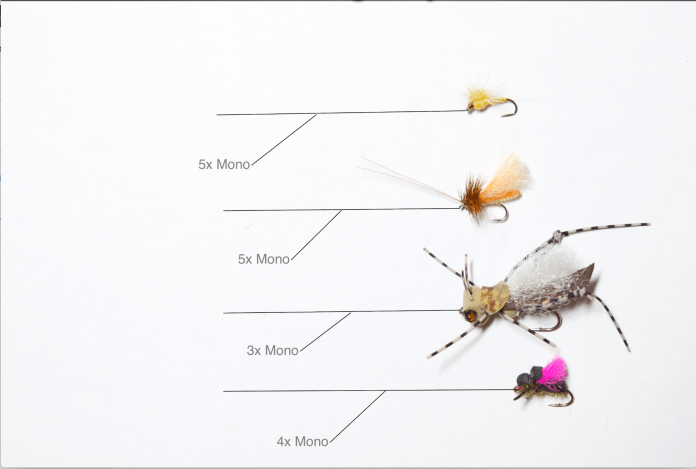
SA Absolute Mono Leader, SA Tippet Ring, SA Absolute Monofilament.
Large Dry Fly Rigging
SA Absolute Monofilament

Flylords: If you could only bring one spool of tippet on the water with you year-round what would it be?

Matt: Scientific Anglers Absolute Fluorocarbon in 5X.

If you are interested in booking a trip with Matt be sure to reach out to RIGS Fly Shop, which is the shop he guides out of in Ridgway, Colorado. Or go to his website, which is www.mattmccannelflyfishing.com. Be sure to check him out on Instagram at @mattmccannelflyfishing.

Midge Fly Fishing – Tips to Catch Trout All Day

Your Complete Guide to Czech Nymphing (Tips, Flies, Rigs, and More)

Fly Fishing Basics: How to Set Up Rigs for Nymphs, Streamers, Dries, and Dry-Droppers

Salmon Cannon to Aid Threatened Fraser River Salmon

It’s time for the Whooshh Salmon Cannon to shine.

After the Big Bar rockslide blocked a large portion of British Columbia’s Fraser River in 2018, Canadian officials have been hard at work constructing a fish passage around the slide’s rocky debris. The passage is to be a 2-stage process, with a fish ladder bringing the fish up to a holding pool where they will then get a free trip up and over the rock slide via the Whooshh Salmon Cannon.

The Salmon Cannon is a pneumatic tube that quickly “shoots” fish up over obstacles, be they dams, or natural impoundments like the Frase River’s rockslide. The passage takes less time for fish to move through than a fish ladder.

The 2-phase system is in place to help the salmon move upriver as officials from the Canadian Department of Fisheries and Oceans work to clear the slide’s debris and free the river back to its original flows.

The salmon cannon and fish ladder are only a temporary solution, as project leader Gwil Roberts aims to have natural fish passage through the section impeded by the slide by the next salmon migration.

“The intention is to have different systems that can work at different flow volumes,”  Roberts said.

To read more about the work being done to protect the salmon species of the Fraser after the Big Bar slide, check out this article from CBC!

Quarantine Fishing with the Kids by John Sherman

*Be sure to tune in tomorrow Thursday evening for a live session with Flylords and John Sherman.*

Those of us with kids are all struggling to keep them occupied while we are under a Shelter In Place order. Few, if any activities are better for both father and sons than fishing.

With the coronavirus shutting down almost every golf course I thought it was a good idea to take my little man @kasixsherman to my old golf course stomping grounds. Although unlike when I was a kid we didn’t have to sneak on.(Disclaimer, most golf courses don’t allow fishing even when closed). 

Golf courses offer some great fishing opportunities because 1) they usually don’t see much pressure 2) The fish are used to seeing golfers, so they tend to not be scared of anglers 3) the water is often clear and sight fishing can be the norm with the right light.  

Keeping a young angler captivated is often the biggest challenge for us as parents, so after a full meal (a hungry kid doesn’t stay focused) we were off.   

We kept the fishing sessions limited to a few hours and threw in driving the golf cart and we had the makings of a fun session destined to stoke his angling 🔥.

Article by John Sherman, a West Coast Sales Rep for Simms Fishing Products, Solitude Flies, Waterworks Lamson & Hatch Outdoors. Outdoor Photographer. Husband and Father! Be sure to check him out on Instagram here.

What to do with your Kids During Quarantine?

CEO Chris Wood Extends Free TU Memberships to Essential Employees

From Trout Unlimited:

“TU President and CEO Chris Wood offered free Trout Unlimited memberships to every essential employee in America last week as a “thank you” for putting themselves in harm’s way during the coronavirus outbreak.

In addition to offering free one-year memberships to essential workers, TU is also giving memberships to emergency personnel, first responders, and those in the health care community that might benefit from becoming a member of the TU community.

On behalf of Trout Unlimited, thanks to all essential workers who continue to report to work, perform their duties, and make life easier for the rest of us. If you’re an essential worker, please reach out directly to Chris, and he’ll hook you up with a complimentary membership.”

How to Tie: The 2nd Worm

0

In this week’s How to Tie video feature, Nordic Anglers is here to show us how to tie the 2nd Worm.

Learn About This Fly:

Difficulty: Intermediate 

The 2nd worm is an articulated version of a Ragworm imitation. The Ragworm is a pattern that has gained immense popularity in Europe, but can be effective in almost any setting. The ragworm, also known as the clam worm or the mussel worm is a member of the group of mostly marine or shore worms of the class Polychaeta, or put in more common terms: the class of animals to make you lose your lunch. This worm can be found cruising around oceanic habitats, but as stated earlier, it can be effective anywhere.

As the weather gets warmer and water temperatures rise, the springtime hatch of these worms comes into full swing. Whether you’re fishing for sea trout, tarpon, freshwater trout, bass, or anything in between, they’ll be searching for something as tasty looking as a ragworm. Because this fly is mostly just an articulate mix of dubbing, maribou extract, and hook, its underwater presentation is full of temptatious jubilance.

When tying this fly, take special note of what our friend from Nordic recommends and make sure to get out any sneezes or close any windows before you start making your dubbing mix. The slightest airflow is enough to send all your materials flying. On a similar note, get creative with your dubbing mix. There are no rules stopping you from exploring new colors and even new materials.

Ingredients:

(courtesy of Nordic Anglers)

Now you know how to tie the 2nd Worm!

Video courtesy of Nordic Anglers

How to Tie: The Pine Squirrel Trout Spey Streamer

How to Tie: Mayer’s Mini Jig Leech

How to Tie: The Redfish Minnow

Massachusetts Suspends All Guided Fishing Due to COVID-19

On April 27th, Massachusetts Gov. Baker issued further restrictions to the state’s March 23rd emergency order. This time the regs target charter captains and charter boats, stating that “During the duration of Governor Baker’s stay at home advisory and essential services order, all for-hire fishing operations shall be suspended and it shall be unlawful for you to conduct any for-hire fishing activities.”

We, like many of our Massachusetts guide colleagues and friends, hope these new rules are shortlived, especially with the arrival of the spring run of striped bass coming in the next few tides.

Read the full announcement from Gov. Baker, below:

“On March 23, 2020, Governor Baker issued an emergency order closing certain businesses and advising citizens of the Commonwealth to limit activity outside of the home. This order was issued in response to the COVID-19 pandemic and remains in effect. Further guidance regarding boating and marine-related activities was provided on April 27, 2020. This included prohibiting all for-hire boating operations while the current emergency order remains in effect. Consistent with this emergency order and subsequent guidance, the Division of Marine Fisheries is issuing you this Statement of Permit Conditions.

1. During the duration of Governor Baker’s stay at home advisory and essential services order, all for-hire fishing operations shall be suspended and it shall be unlawful for you to conduct any for-hire fishing activities.

2. This shall not restrict your ability to fish as a private recreational angler or conduct any commercial fishing activity for which you are permitted.”

5 Pieces of Gear You Need to Catch Stripers on the Fly

Due to their aggressive and hard-fighting nature, Striped Bass are known as one of the most fun game fish to catch on the fly. What makes these fish so fun is that they live in very diverse ocean habitats, and they can be caught on the flats, estuaries, or in deeper water. These fish are very accessible from shore, and they can be a very forgiving fish that provide a fun challenge for beginners. While these fish can be found all around the East coast (from Canada to the Gulf Coast), New England is the premier location to target them. Every spring anglers anxiously wait in excitement as the Stripers migrate back to the New England coast in droves. Here, we’ve compiled a list of gear items we believe you will need to catch these trophy fish.

Top 5 Pieces of Gear for Stripers:

1. 9 Weight Fly Rod and Reel

Image courtesy of Orvis

Due to the size of the fish and the pain of casting large flies in the wind, a 9 weight rod is the go-to rod for catching stripers. While stripers do run, unless you’ve got a very impressive fish at the end of your line, they typically don’t take you into your backing, so having a good drag system isn’t as important as other saltwater species such as bonefish or permit. For a rod we recommend the Orvis Recon 9 Weight due to its versatility and affordability, coming in at around $549. The Orvis clearwater pairs perfectly with the Recon rod and is very affordable coming in at $98. Due to the clearwater’s large arbor, it is very effective at fighting and helping you to land large fish.

2. Intermediate sinking fly line

Image courtesy of Scientific Anglers

When starting out striper fishing, an intermediate sink like is the perfect line due to its versatility. This fly line allows you to fish in various water columns using one line. This means you can fish anywhere from the beach to off of deeper rocks without changing your reel setup. While there are many lines that do a great job of this, the Scientific Anglers Sonar Titan Full Intermediate Sinking Line is by far one of the best, and gives you the most bang for your buck coming in at $89.95.

3. Stripping Basket

striper with basket

Whether you are fishing from the shore or are on the rocks, a stripping basket is essential in fishing for stripers. Stripping baskets allow you to keep your line organized and out of the water or rocks, so you are easily able to pick up and change the direction of your cast. There are many stripping baskets out there that are very effective and do very similar things. One I like is the Linekruv stripping basket, which comes in at $59.95.

4. Clouser Minnow

Image courtesy of Orvis

This epic fly pattern was developed by Bob Clouser and is a mainstay in all saltwater anglers fly boxes. What makes this fly so effective is its ability to imitate a variety of baitfish and other saltwater food sources. An assortment of this fly in various colors and sizes is essential for catching stripers on the fly. This was the very first fly that I learned how to tie and it was very easy, a link to a video on how to tie them will be attached.

5. Pliers

Image courtesy of Amazon

A pair of pliers is a must-have and can be very helpful when saltwater fly fishing whether it’s to tighten knots, get hooks out or cut tag ends. Dr. Slick makes an awesome very affordable plier called the Squall plier that comes in at $65.

Finally, now that you have all the gear you will need, get out there and catch some stripers. Make sure to remember to experiment with the flies you are using and how fast you’re stripping until you find the perfect combination.

Fly Fishing On a College Budget


https://theflylords.com/5-fly-fishing-podcasts-you-should-be-listening-to/

“Dragon’s Gold” – A Golden Mahseer Story

The search for giant golden mahseer that led us down numerous Bhutanese rivers experiencing the most humbling generosity from the local villagers. Fast rivers and powerful fish made for exciting battles that were often lost. Golden mahseer are protected and it’s illegal to fish for them in Bhutan. We had been granted special permission from his Royal Highness’ Office for monitoring purposes and on a strict fly fishing, catch and release basis. The magnitude of this permission would only truly sink in as the trip progressed, but in the meantime, I was beaming at the fact that I was in Bhutan, where Buddhist prayer flags flutter in the wind, where spinning prayer wheels create music with the wind, where menacing beasts and fiery dragons adorn walls to ward off evil and where the Royal Family and government care more for the kingdom’s happiness than for its standing in wealth and modernization. In a world obsessed with consumption, we would do well to take a leaf or three out of their books.

Druk Yul, directly translated it means ‘the Land of the Thunder Dragon.’ Situated in a mountainous area of the Eastern Himalayas on part of the Ancient Silk Road between Tibet, India, and Southern East Asia, Bhutan or Druk Yul is one of few countries in the world that has never been colonized. Centuries passed by while Druk Yul remained isolated from the rest of the world, fiercely guarding its ancient traditions and national identity based on Buddhism. The people are called the Drukpa (Dragon people) and the royal family is the Druk Gyalpo (Thunder Dragon Kings), a title George R.R Martin would be proud of. The traditions, rituals, and cultures are strictly followed with pride with most men wearing a knee–high robe made from a locally colored fabric called a gho and woman dressing in the Kira, an ankle-length wrap dress. Pictures of the royal family adorn pretty much every hotel, shop, and restaurant. The Bhutanese truly love their King. Even if you have deep-seated reservations about monarchy in modern times, Bhutan will give you a glimpse of a responsible monarch who truly loves his people.

From Paro, an hour chopper flight took us from a 10-degree celsius climate into a 34-degree subtropical rainforest as we slowly worked our way down the escarpment in a South-South-Easterly direction to a specially erected tented camp on one of the local rivers. Over the next ten days, our hosts Ugyen and Kencho would be our window into the deeply guarded realm of the golden mahseer. That we had the permanent use of a Eurocopter for the duration of the trip, opened up possibilities to fish three different rivers all with numerous junctions that had been scouted and were being guarded for us. Under Ugyen and Kencho’s tutelage, we would learn to fish differently, slowly planning each spot, not as a leader but as a patient follower. We would be treated to the Bhutanese way of humility, enjoying everything on offer, which included bamboo mugs of potato beer and leaf cups of rice wine prepared by locals who were guarding the pools. It was as much an introduction to local culture, cuisine, and brewing skills as it was a fishing trip.

Mahseer have an exceptional sense of smell and their sensitivity to vibration and movement makes them a mountain too high at times. The one benefit we did have is that their eyesight didn’t seem to be too great, which could have been due to the murky blooms of dirty water mixed into the clear creeks. The scent thing I had heard of before and thought it might be a myth until I saw it with my own eyes. On arrival at basecamp, Ugyen and Kencho walked us up to the clear creek above the camp where a school of fish made up of chocolate and golden mahseer congregated with their noses facing into the flowing water. The reason for this isn’t clear but it could be because the clear water of the tributary was a much better habitat than the dirty mainstream or that the tributaries were warmer and would speed up digestion. Another suggestion would be pre-spawn, which only happens months later. It could be seasonal as the rivers run much cleaner in the winter allowing for the fish to spread out within the mainstream. Set aside their acute ability to reject a fly, these fish are definitely hunting when in the cleaner water.

As the days passed we settled into a rhythm and managed to catch fish most days. The chopper would land downstream from the spot we wanted to fish, decanting our team of Ilya, Uygen, Kencho, and myself. We would then walk up to a viewing point, debate the best way to target the fish if they were there, set up tackle and cameras, walk back downstream, wet the fly, wet the line and leader and wash our hands, all in an attempt to relinquish any scent that might spook the fish. We would then walk back up to the casting area and engage stealth mode, eventually making a cast, maybe a couple more and if there was no hook-up we would reel in, return to the chopper, and plan for the next spot.

There was one spot in particular where we saw massive fish in excess of 60lbs. They were way too big for us not to make numerous visits back to the same junction, with much deliberating, planning, and tackle and fly changes. Our hosts even went to the extent of building a bridge to allow us to fish from the other side of the tributary resulting in five hours of fishing frustration a few days later. The first visit to this spot saw Ilya hook a sizable fish on his first cast, which proceeded to head off into the middle of the river down through a set of rapids taking his fly line with it when it parted at the braided backing. On returning to the junction all the mahseer had retreated to the dirty main river and only skittishly returned into the clear junction for a short period before disappearing once again. Our second visit saw more fish and bigger with only a few fish following before retreating to the main river for a short period but returning to their lie and not bothering too much about the flies swinging past. The third visit saw the same amount of fish but not so much as the slightest attention to the fly, almost as if to say, “we know you are here, you not a threat and we not going to bother to react to your presence.” The urge to catch one of these really big fish was realized for a fraction of a second when I hooked one at a junction above a set of rapids. It proceeded to head downstream with me chasing after it as graciously as possible like a fluttering Bhutanese butterfly, running, stumbling, falling, crawling and boulder hopping, only to be spooled a few seconds later. I had to lick my wounds that night while lying in a traditional stone bath sucking on a can of Bhutan Glory, which is named after the Bhutan Glory butterfly I so graciously mimicked six hours earlier.

Often the issue wouldn’t be the lack of fish, but rather that there were too many fish in such close proximity that you couldn’t actively target the big fish without spooking the entire school and ending up with no takes at all. It was hard enough enticing any fish to eat that concentrating on only enticing bigger fish was risky. The rivers would also change on a daily basis with tributaries clearing or blowing out as the main rivers rose and dropped influenced by whatever was happening miles away in the Himalayas.

Eight days and 34 beautiful golden mahseer later – ten over 20lbs and the largest weighing 36lbs – the trip had already exceeded my wildest expectations. It was the last day and by then, in my opinion, we had paid our school fees. If we were going to catch a monster it was going to happen on that particular day. In the chopper, we hopped from spot to spot looking for truly big fish. We fished a pool that revealed some giants only to hook and lose a smaller fish. We moved to the next spot to have the river blow out on us with not a fish in sight. The weather was closing in so we moved to a river closer to basecamp. I’d like to think that it was our inner Zen that played a part in what happened next.

The cast went in and a small fish moved at the fly, spooking the school, yet surprisingly the big fish remained. Ilya made another cast trying to entice these fish. Two mammoth mahseer pushed each other to take the fly but both missed it. Ilya made a third cast into the dirtier water where the big fish had moved to and we watched in amazement as he was immediately hooked up to a freight train heading downstream towards a massive set of rapids. Ilya engaged mountain goat mode as he followed the fish hopping from boulder to boulder. The reel acted like a click and pawl reel, making a crazy noise with minimal drag even though it was on full. No stranger to big fish Ilya used his hands to hold tight and with the tackle creaking he managed to persuade the fish to pause at the top of the rapid. Holding on for minutes felt like hours, while the fish contemplated heading down into the huge rapid – a move that would most certainly end with Ilya being spooled in seconds. It made a move back down towards the rapid with Ilya locked and holding tight before unexpectedly the fish ran straight towards us into a back eddy, stopping a couple of meters away from us in the murky water. In disbelief, I traded my camera for the net and had an immediate swipe at the fish as it rose in the water column for a second. I’m not sure who was more surprised, us or the fish, as with only a third of the fish in the net, we gasped at its size. With two more lifts of the net, I managed to get this incredibly beautiful monster fully surrounded. On my first judgment, I thought it would weight way over 60lbs as it was huge. An Atlantic salmon or taimen of these proportions would weight in excess of 70lbs. After carefully placing it in a weigh sling and weighing it with two different scales it weighed in at 55 lbs plus-minus one pound, making it the biggest golden mahseer ever caught on fly in Bhutan and possibly in the world. What an end to a trip of mammoth proportions as that cast would be the last cast of the trip.

Staying Afloat: Juan Biott Tres Amigos Outfitters Patagonia

Introducing the Staying Afloat Series, where we take an inside look into the lives of many different fly fishing guides, shops, brands, and lodges across the world in hopes of finding out how the COVID is affecting them, what they are doing to help, and how we can do our part to help them.

Flylords: Who is Juan Manuel Biott and Tres Amigos Outfitters?

Juan: I’m a fishing guide and lodge owner. We are a Patagonian company located at the bottom of Santa Cruz province, very close to the mighty Gallegos river. We own Los Plateados Lodge at Santa Cruz river and a trout program called Route of the Spring Creeks which I run with my own family at our ranch, we also manage Solid Adventures Patagonian programs as Las Buitreras Fishing Lodge and Glacier King. We fish for steelhead, brook and brown trout, sea-run brown trout, and king salmon.

Flylords: How has the CO-VID outbreak impacted your business?

Juan: It impacted very hard on our own Steelhead program at Los Plateados (Santa Cruz River). We work very hard to operate 6 weeks in this place and we basically had to cancel the whole season. Just to mention that this program means a year of work (together with agents) to fill these spots. Also, we lost part of the other lodges weeks.

Flylords: Are you still operating?

Juan: On the 17th of March we basically finished the season and locate every single employee back home. The quarantine started right after. Our country did not allow for tourists to enter and all local flights were canceled. So basically we didn’t have an option and accepted the rules right away as we saw the effects and how contagious the virus was.

Even though we don’t know what will happen our first program to open is the Route of the Spring Creeks. November 2020 we open this program that runs till March. Before that, we always take our time to scout new waters and fisheries.

Flylords: Have you lost a lot of revenue?

Juan: Fortunately, working with professional travel agents like Fly Water Travel & partners help you work on a rebooking policy that is both fair for your client and that also helps you stay on your feet. But some others just choose to cancel the trip and get refunds, money that is always invested in the structure I spoke before, this is where the problem affects you deeply. We lost some and find ourselves working hard to keep clients traveling next season.

Flylords: How can your customers help support you through these hard times

Juan: Our message to the fly fishing travel industry and to every single client is that you can truly help us and many other locations by postponing your trip for the next season. We are the only lodge in 400km of water from Santa Cruz river, 5 families that make a living on this program, you have to adapt to survive, exactly like steelhead. We are lucky at the moment that we don’t need donations (other cases are much worse and will need them).

Flylords: What are you doing to pass the time?

Juan: First thing is enjoying family, we are at home after a long working season so in my particular case my kids and I are catching up with every single game you could imagine. Also using every channel to keep working with my partners on every aspect of the company. There are so many things to consider at the moment rather than just watching Netflix haha. And also at last, I’m training my rusty voice. I used to sing more frequently and had my band, but all the work and family kept me busy, so that is really cool for me.

Flylords: Can you tell us a little bit about the singing?

Singing is something that I’ve done since I was a kid. I love Queen but I’m also very keen on the 80’s and love some singers of the 70’s. I like all kinds of music but mainly before the 90’s except for some of the classic Grunge bands. While I was studying at University I had my own Glam band with long haired partners, dressed in leather and make up all over my face haha. Those were memorable days! Nowadays with all these social media stuff you can easily show what you do to anyone in the world and that is really cool. I’m planning to make my own record at some point during the next two years.

Flylords: Anything exciting in the works for Tres Amigos?

There is always something exciting going on in Tres Amigos. We are developing a new steelhead program that will operate downstream to where we are now (a few miles from the ocean). We fell in love with this boutique style ranch hotel and its waters located right in front of Monte Leon National Park. This place will give every single fishermen that travels to Jurassic Lake, Gallegos River or even Rio Grande from mid-March until the end of April the opportunity to chase some steelhead in our prime time with us and enjoy a very pleasant stay. It will be called Santa Cruz River Lodge.

Another exciting thing is that we are adding some really awesome creeks with the most picturesque scenery to our trout program and also building a new private room with a bathroom. This will give us the chance of having 4 guests the whole season. It’s a very exclusive program and we want to keep it that way.

Flylords:  Are you still going fishing, what’s it like right now in Patagonia?

At the moment not a single sport activity is allowed. The only activities that are permitted have to do with health and the food industry. So it’s hard to think that a massive school of steelhead is running at our location and we are here.

Flylords: Anything else?

We want to thank you for letting us tell the fishing community how they can collaborate with our companies, guides and everyone involved. We truly appreciate it.

Juan Biott is an experienced fly fishing guide down in Patagoina. Himself, Claudio Martin and Pollo make up @tresamigosoutfitters. Be sure to check them out.

Staying Alfoat Series

Cheers to Fat Tire and New Belgium Brewing for making this series possible. Throughout the “Staying Afloat Series,” we will be sending beer to people who are really in need of a “pick me up”. If you have a good story for someone who deserves some beer shoot us an email theflylords@gmail.com.

Staying Afloat #4: Guide Matt Ertzinger

Staying Afloat #1: Cutthroat Anglers Fly Shop

MeatEater Compiles Detailed Timeline of COVID-19 Impacts on Hunting & Fishing

From MeatEater.com:

As states scramble to slow the spread of COVID-19 and enact a wide range of regulations to enforce social distance, many hunters, anglers, and outdoor recreators are left wondering what they’re allowed to do. We want to help keep everyone informed, safe, legal, and, whenever possible, outside. Below you’ll find regular updates to regulations and rule changes that impact hunters, anglers, and public land recreators. While we can’t promise that this list will cover every single rule change around the country in real-time, we’ll do our best to keep it current and accurate. Please email us at meateater@themeateater.com if you know of a regulation change that we’re missing.

To see the full timeline, go check it out on MeatEater.com!