Looking to scratch that flats itch and escape the cold in 2021? A fly fishing trip to the Bahamas may be your best and safest option to travel this season. Just a short flight from the mainland US, the Bahamas has been able to maintain low COVID case numbers through the implementation of government subsidized testing and standard social distancing measures.
The Bahamas is recording an average of 9 cases a day across all the islands, and Abaco averages 0 cases per day with the occasional exception. It was recently named by endcoronavirus.org as one of the countries doing the best at stopping the spread of COVID.
In order to enter the country, visitors are required to submit a simple RT-PCR COVID test up to 5 days before arrival. We recommend the Pixel test, which is done by mail and typically gives you results within 3 or 4 days. After a negative test, visitors are issued a Bahamas Travel Health Visa for $60, which covers your cost for a rapid COVID test after 5 days in the Bahamas. This rapid test is issued on-site at the Delphi Club and is eligible for your legal return to the US under the new international travel policies if it is taken within 3 days of your departure from the Bahamas.
Trips between 5 and 8 days are recommended so you don’t have to pay for additional testing. All in all, it’s about 30 minutes of paperwork and a short nose probe before breakfast on your 5th day of fishing. For more information on getting to and from the Bahamas, click here.
Now that we’ve sorted that out, it’s on to the fishing. High season in the Bahamas is typically between February and May, when the water on the flats begins to warm up and the weather is more generous to the needs of sight fishermen. We see large – sometimes incredible – numbers of bonefish on the flats at this time of year as they are in full eating mode without the distractions of spawning or uncomfortable cold water.
Bonefish can be found on all corners of Abaco, but anglers often overlook some of the other species to be caught on fly in this incredible place. Triggerfish, barracuda, and permit can all be found in similar sight fishing scenarios. If the rain levels are right, there are even opportunities to hook up a few juvenile tarpon between 5 and 30 pounds.
Flylords recommends the Delphi Club in Abaco for travelers looking to be assured of utmost COVID safety alongside world-class accommodation and great fishing. We were lucky enough to spend some time at Delphi in 2019. Check out the video below for a taste of what your experience might be like.
Upcoming 2021 Availability:
March, 16 – 22 / 6 rooms
April, 4-13 / 4 rooms
April, 24-30 / 5 rooms
May, 7-15 / 3 rooms
May, 23 – 26 / 3 rooms
June, 3 – 9 / 3 rooms
There are also prime permit dates available in October and November of 2021.
For more information on booking a trip to the Delphi Club, shoot us an email at travel@theflylords.com. Detailed rates can be seen here.Â
In this episode of Video of the Week, we take a look back at Tight Loops Epic Van adventure “Northern Exposure.” After returning from their epic road trip west called “Journey On” the thought of the road couldn’t keep them sedentary for very long. Eventually, the whispers of monster brook trout in one of their last natural strongholds turned into a reality as Aimee and Chase took to the road headed north.
Learning more about the area Aimee and Chase find something more than just an alleged stronghold for one of America’s most iconic gamefish. They find a thriving population of incredibly resistant brook trout under the continued threat of human intervention. So sit down and enjoy the amazing cinematography and storytelling from Tight Loops.
Make sure to check out these other articles as well! Also, don’t forget to buy your Fly Fishing Film Festival Tickets!
Recently, the Columbia Insight, an independent journal focussed on environmental issues in the Columbia River Basin, interviewed Congressman Mike Simpson. You may recall that in early February, Rep. Simpson, a Republican from Idaho, released a comprehensive plan to save Snake River Salmon. That plan surprised just about everyone. No other Snake River salmon development has had so much potential. The endless lawsuits haven’t worked, and numbers of wild Snake River salmon and steelhead continue to decline. Something had to give. Simpson’s Energy and Salmon concept is the result of years and over 300 meetings between stakeholders to form the first collaborative opportunity to remove the dams and save the river’s migratory fish.
MS: What’s really been interesting is seeing that the people who are opposed to this proposal tend to focus on only one aspect of the plan: dam removal. That’s all they hear, and then they shut down.
My staff and I, we’ve been working on this plan for over three years and have had more than 300 different meetings about it, so we’ve heard a lot of different points of view. And we’ve had a lot of discussions and collaborative groups on these issues in the region over the past 25 to 30 years. Every collaborative group over that time has come up with nice ideas that everybody can agree on: increasing the numbers of salmon, clean renewable energy, better efficiency, improving habitats, etc. But when it comes down to breaching the dams themselves, the groups break apart and they just can’t go any further. Fundamentally, the people who are opposed to breaching the dams are used to doing things a certain way, and just don’t want to change what they’re doing.
“OK then,†I said, “if you don’t like breaching the dams and still want to save the salmon, then tell me what your plan is?†And then there’s nothing—because everything else we’ve tried for the past 25 to 30 years simply doesn’t work. We’ve already spent $17 billion on fish recovery and salmon and steelhead numbers here have only gotten worse, to the point where they’re on a clear path to extinction. Are we going to spend $20 billion more over the next 30 years just to have them go extinct anyway?
Congressman Mike Simpson
CI: Some environmental groups have been supportive of your plan—American Rivers in particular released a statement calling it “bold,†“groundbreaking†and “potentially transformational†for the Pacific Northwest. Others have been more cautious, surprised to hear an environmental issue supported by a conservative Republican. Is that unfair?
MS: Well, most people live in Idaho because we love our environment—and that’s really true all across the Pacific Northwest. Yes, I’m conservative, and I also value conservation.
The salmon are going extinct. There’s just no way around that. We have to do something about it. To me, this proposal isn’t about the impact that it has on us today. It’s what do we want the Pacific Northwest to look like in the next 30, 40, 50 years? The decisions we make today will have an enormous impact on the entire region 50 years from now.
I don’t want our grandchildren someday to say, “Why do you call it the Salmon River? There are no salmon here.â€
CI: Right now this plan is still a concept, as you call it. What are the next steps to get this hammered into actual legislation that can be put before committees and eventually onto the floor for a vote?
MS: Well, now that a lot of different people are looking at the concept and thinking about it, the next step is that we have to listen to their different perspectives. We have to talk with them about what the plan does and doesn’t do, answer their questions and take their concerns into consideration before drafting legislation. But that needs to happen now. We don’t have a lot of time. I’d like to see actual legislation happen later this year.
Any experienced flats angler will tell you that it’s best to keep your distance from sharks you see patrolling the flats. Not only do you risk something like the video below happening, but it’s also likely that there are no fish around because two apex predators are moving around in the shallow water. That being said the video below, from our good friend Josh Hutchins (@AussieFlyFisher), shows a lucky encounter with a fired-up shark on the flats that chased in the fish that he had hooked on the end of his line.
We’re glad Josh made it out of this encounter without any bloody ankles (or worse). But the fact remains, it’s best to take Hank Patterson’s wildlife viewing advice when you spot that telltale fin in the shallows and “stay the f**k away.”
In this Interview, we had a chance to chat with B.A Dallas, A Colorado based artist, about his work, and some creative inspiration behind his fly fishing focus art featured in the Silverthorne Art Project.
B.A. DALLAS is known for his graphic Sumi lines and impressionist knife work. Inspired by his grandfather, Tom Beecham’s pulp fiction illustrations, graffiti, and western culture. B.A. is in pursuit of stories to tell. With studios all over Colorado, he is creating studies of personalities and noir stories. B.A is most often found working on all types of art mediums with intentions of telling a story and sparking emotion. Releasing series for over twenty years B.A is currently working on a collection in his Dirty Modern West Style. The Dirty Modern West is an aesthetic based on the blend of cultures and lines, graffitied over tourist attractions. The Dirty Modern West is an amalgamation of international ideas repackaged and sold back to Americans as authentic. Beautiful decay, heartbreak and eras overlapping create a colorful texture for a modern vision of the west.
FL: How could you explain your path to becoming an artist? When did you first realize you wanted to pursue a career in the arts?
BA: I come from generations of professional artists and since I was a kid, always had to be engaging in creative art. So, to sum up a long story of becoming I never realized I wanted to pursue a career in the arts, it just came as a natural talent and state of being.
FL: What was it like growing up for you? Can you name any influential people that led you to where you are now?
BA: I found that growing up in New York, the graffiti in the city was as inspiring as the fine art in the museums, and those two backgrounds led to a very definable and unique style. Where I could blend two backgrounds that make me who I am as an artist.
FL: What was it that drew you to Fly Fishing?
BA: My grandfather was a master Fly Fisherman and watching him work expertly coerced fish into biting is much to behold. As an adult, I’ve been reinvigorated to fly fish through spending time with my friends at the Rolling Jay Ranch in Colorado.
FL: What have you found has been one of the most difficult barriers to conquer in your creative journey?
BA: In my particular artistic journey, art is a fickle mistress.
FL: When did you finally decide to mix your art with your fascination with fishing?
BA: A lot of my family is quite famous for their wildlife art and even though I do my work in my Dirty Modern style it is an homage to my roots.
FL: Can you name any moments on the water that have contributed to any specific fishing pieces you’ve worked on?
BA: I would say that by pulling little brook trout from a stream, you see the most spectacular colors and metallics nature has to offer.
FL: What is your favorite medium to express your art through? Is there a specific reason for this?
BA: My favorite medium currently is working in steel, using turn of the century metal shaping tools and I get to work on the grand scale I’ve always dreamt about.
FL: What is your process when you begin to work on a new piece for the first time?
BA: I get a complete vision of the piece I wish to create, then I create a detailed layered sketch of how to execute the piece, then I gather materials, turn on the tunes and check out.
FL: Do you have any sort of mission with your art? Are you aiming to accomplish something specific, or just want to create and share it with the world?
BA: Having watched incognito people experience my work, I get a kick out of their interpretation of the piece, and I never explain my work.
FL: What advice would you give someone who wants to pursue art in the outdoor/ fishing space?
BA: I would say that I’ve heard a million people talk about what they are going to do, just start doing it.
FL: Where can people learn more about your work?
BA: At badallas.com. I always respond to emails and phone calls.
FL: What’s next for BA?
BA: I am building an entire exhibition of giant sculptures, however, I have not yet found the venue that is large enough to host my exhibition.
Thank you to BA Dallas for taking the time to share some of his creative inspiration with us. To learn more about his art, check out his website here. Also, thank you to Colorado Tourism and the Town of Silverthorne for helping make this piece possible. For more information on visiting some of BA’s inspiration, click HERE.
F3T trailer season is upon us! With the shake-up that occurred with last year’s tour and COVID-19, we could not be more stoked for the 2021 Fly Fishing Film Tour. Featuring films from around the globe, this tour is going to be unique without a doubt! Of course, we’ll be releasing our “Behind the Lens” interviews presented by Costa Del Mar Sunglasses, but until those start dropping in February, here is a full list of 2021’s films and their accompanying trailers. Enjoy!
“Uncle Mac left a deep imprint on Tommy. Join us as we retrace Tommy’s steps – from farm ponds to tarpon flats – to understand why.”
Directed By: Ben Meadows
River Tigers
From F3T:
“Journeying to Russia’s Tugur River is a journey back in time, to massive roadless expanses of boreal forest and the kingdom of Siberian taimen, the world’s largest trout that reaches over 100 pounds.
“River Tigers†a new 14-minute doc from Wild Salmon Center, Maser Films and Yonder Content, puts you on the old MI-9 Soviet helicopter to the Tugur.
The film follows a trio of adventuring fishermen to the Tugur, which is under threat despite its remoteness. American conservationist Guido Rahr, explorer-scientist Mikhail Skopets, and Russian industrial magnate Alexander Abramov converge on the river, in an attempt to find the elusive fish, to unlock its mysteries, and figure out a way to protect the place among the harsh realities of life in the Wild West of the Russian Far East.
“River Tigers†is about the passions and the unlikely friendships that drive conservation in this last frontier. It’s a trip to one of the last truly wild places on Earth. And it’s about the thrill of the hunt.”
Produced By: Wild Salmon Center, Maser Films, and Yonder Content.
“This is the story of a small village in the heart of Guyana that conserves fish and wildlife of the Rewa River. Not only did their efforts bring a fish back from the brink of extinction but it created the finest arapaima fishery on the planet.”
Directed By and Produced By Johann Du Preez
A Journey UpstreamÂ
From F3T:
“‘A Journey Upstream’ is a personal overview and reflection of the Braker brothers’ love for their home watershed— the Chesapeake Bay. It’s a view into how things have changed over time and how two pivotal species can distinguish the health of this massive ecosystem.”
“Life isn’t about what happens to us, it’s how we react. Follow avid angler Ryan Kelly as he documents the management of a disease that requires him to move constantly to cope with the pain. Living in the Flaming Gorge National Recreation Area he logs over 1500 miles on the “heel-toe express†and another 1000+ on the sticks. Through the process, he finds a most extraordinary Escape.”
Every year, a migration of epic proportions takes place along the Eastern Seaboard of America. From the Carolinas to Canada, anglers flock to the rocky coastlines, estuaries, rivers, and inshore waters to target one of America’s most iconic gamefish- the Striped Bass. Despite its popularity and significance to the coastal communities in the Northeast, the fishery is once again in major jeopardy. The last time this happened, we witnessed one of the greatest conservation success stories of all time, restoring the stock to astronomical numbers. Today, the question on everyone’s mind- can we do it again?
Directed by Chris Kitchen
Produced by KGB Productions and Rex Messing
Leap Year — A Topo Films Production
On the surface, spey fishing for steelhead is a sporting pursuit steeped in tradition. Every year, these anglers and the wild fish they pursue both similarly migrate to the same rivers at the same time. Now, from issues like global pandemics to global warming, there are countless ways in which this tradition can be broken.
In-swinging flies for wild steelhead in British Columbia’s famed Bulkley-Skeena Valley, Leap Year explores the river and the colorful characters of this culture as it begs the question: who will carry on these traditions if the migrations come screeching to a halt?
Directed by Jordie Lepage and Chase White
Produced by Patrick Henry and Chase White
Edited by Jordie Lepage
Mighty Waters — A Cold Collaborative Production
In Bimini, an island in the Bahamas, Martin Luther King found a friend in Ansil Saunders. Four days before the assassination of MLK, they sat in Ansil’s boat, sharing psalms while Dr. King worked on his final speech – “I’ve Been to the Mountaintop.†In the newest Cold Collaborative film, “Mighty Waters,†Ansil visits the spot he had taken MLK as well as visits the global change he’s seen and hopes to see in the world.
Directed by Shannon Vandivier
Produced by Cold Collaborative
Tetiaroa — An Aussie Fly Fisher Production
Tetiaroa is a special place. Nestled among the Society Islands of French Polynesia, it offers a promised land of giant bonefish, GTs, and Triggerfish. 40 miles from Tahiti, owned by the Brando estate, Tetiaroa is an untapped yet vulnerable beauty, deserving of protection. Join Joshua Hutchins of Aussie Fly Fisher and the team from Fly Odyssey as they explore the endless flats and unbelievable fishing. Double figure bonefish and cruisy island vibes make this a once-in-a-lifetime trip.
Filmed & Edited by Kane Chenoweth
Additional Footage: Joshua Hutchins
Dropped In The Pacific — A Jessica Haydahl Photography Production
Seven women are on an adventure of a lifetime; dropped in the Pacific to fish the famous Christmas Island coral atoll. The women experience the remote nature and unforgiving weather that Christmas Island can be known for. Together as a group, they share their experiences, the difficulties, and joys they encountered, as well as what the sport of fly fishing brings to their lives.
This is the story of unknown legend Denny Waln. Waln is a master flytier and angler. He’s one of a kind. Cut from the cloth of a bygone era, his humble, no-nonsense nature leaves an indelible imprint on those he crosses paths with. Join us as we peek inside Denny’s fly box. From filmmaker Matt Devlin of PMD Productions in Missoula, MT. Featuring Denny Waln and Erin Noordermeer.
Directed and Produced by Matt Devlin
A Soul Cleansing Spot Burn
We were torn about this one. Is it acceptable to tell the world about an uncrowded river with big smallmouth that slurp topwater flies if a mine threatens to ruin the whole thing? We’re all sick of spot burning, but we’re more sick of sulfide mines threatening iconic fisheries. This is a soul-cleansing spot burn.
By Off The Grid Studios and Meateater
The 2021 Fly Fishing Film Tour Schedule
From F3T:Â
After months of planning and consulting with fly shops, conservation groups, sponsors, filmmakers, and fellow anglers, we are thrilled to announce the virtual release of the 15th annual Fly Fishing Film Tour. Because even amidst a time of unpredictability, the F3T is a constant you can rely on.
The 2021 Fly Fishing Film Tour is set to be released in mid-March, 2021. The streaming event will include everything our audience has come to expect from an F3T event, including unforgettable storytelling, camaraderie, and premium free giveaways, including free trips.
Arguably the most well-rounded collection of films we’ve ever showcased, the 15th annual F3T is rich with stories of conservation, adventure, and stunning cinematography. Follow along as a Russian Oligarch burns down poaching camps in order to clean up a remote river in the Russian far east to better protect the gigantic duck-eating taimen that lurk there, in “River Tigers.†And buckle up as Ryan Kelly takes you on a deeply personal ride in Wyoming as he navigates the Flaming Gorge after a diagnosis of a life-altering disease. Shift gears with the team from Meat Eater and Guide/shop owner Tim Landwehr as they rip lips in Wisconsin and highlight a world-class smallmouth bass fishery. Travel with us back in time with filmmaker Shannon Vandivier and Bahamian guide Ansil as they reflect on Martin Luther King Jr.’s lasting social impact and his passion for flats fishing in the Bahamas. These are just some of the stories in this year’s tour.”
Over the past week, you’ve likely seen a wave of posts using #AllForAldrich auctioning off everything from guided trips to dozens of flies, all in the name of helping out a beloved commercial fly tyer, Justin Aldrich. Justin has become a popular fly tyer and has the honor of calling it his full-time job, but after his wife lost her job due to the pandemic, and recent long-term hospitalization, Justin and the Aldrich family need the fly fishing community’s help.
2) Participate in one of the many auctions going on where the proceeds of each will be donated to said GoFundMe. You can find those by searching #AllForAldrich on Instagram.
A few examples of items currently up for auction:Â
This is the latest in a series of grassroots fundraising efforts the fly fishing community has launched. In 2019, #DozenForDorian raised thousands for the Bahamas, in early 2020, #DozenForDownUnder took off in response to the Australian bush fires, and right at the outbreak of COVID-19 just 12 short months ago, another popped up to help support guides through the first few uncertain months of the pandemic. Seeing these organic campaigns having such success is just a sign of how special the bonds between fly anglers around the world are.
In this week’s “How to Tie†video feature, Fly Fish Food gives us a great tutorial on how to tie the Pinecone Cicada.
Learn About This Fly:
Difficulty: IntermediateÂ
This week, we will be learning how to tie the Pinecone Cicada. A fitting fly for 2021 to say the least. This May we will be welcomed by the regions largest brood of Cicadas, an event fly-anglers and scientists drool over every 17 years. This ultra buoyant creation was dreamt up by Fly Fish Food’s very own, Cheech and has been coined the term “Brood X Killer.”
A pinecone, a beetle, and a Mormon cricket equals the Pinecone Cicada you say? The key to a good cicada imitation starts with the materials. You see the word Fettuccini and your stomach automatically rumbles. But in this case, its rumbling for a different purpose….rising trout. The use of fettuccini foam and other buoyant materials allows the pinecone cicada to ride high in the water column aka the strike zone for hungry rising trout. Structuring the foam strips in a staggered and edgy manner while mixing in flash and color presents a very life-like appeal to this winged singer. The shear volume encased in this fly will ensure buoyancy for a full day on the river.
Like most flies, there isn’t one particular way to go about this creation. This is a fly open for experimentation. Try various colors of foam, dubbing, thread, you name it. As long as it floats and looks edible, hungry trout won’t bat an eye. For your convenience, pre-cut foam strips are recommended with this tie. It will save you time and frustration in the long run. Don’t be afraid to use superglue to reinforce the strength of the foam strips, these flies WILL take a beating. As mentioned previously, 2021 is a special year in the fly fishing world with the cicada hatch. Put in time at the vise and take advantage of this periodic occurrence.
Ingredients:
Hook: Firehole Sticks 618 Foam & Nymph – 4
Body: Ice Dub – Peacock Black
Body: Chicone’s Fettuccine Foam – Black
Legs: Life-Flex Spandex Material – Orange
Head: Fly Tying Foam – 2mm – Black
Wing: EP Trigger Point Int’l Fibers – Pale Morning Dun
Over the weekend, MILLIONS of gallons of Acid Mine Drainage (AMD) were released into the Cheat River and Muddy Creek in West Virginia after a mine blow out from the T&T Mine Complex. Officials have also stated that the AMD released was 10 times the normal concentration. The outflows peaked at 6,200 gallons per minute but have since lowered to 3,500 gallons/minute according to the West Virginia Department of Environment Protection (WVDEP).
Friends of the Cheat, a non-profit organization focused on the watershed put out a press release about the event:
“It is with heavy hearts that we inform our river community that there has been another blowout related to the T&T mine system, and acidic and metal-laden water is again flowing through Muddy Creek. FOC staff noticed the disturbing hue of the water yesterday and found the pH reading 3.65. pH has dropped in the Canyon at “Decision Rapid†to 5.8 and has stained the river right extensively.
The WVDEP Muddy Creek Watershed Treatment Plant has not been able to handle the burden of the recent precipitation events. With precipitation projected to occur more often and with greater intensity over the next decade, we are left to wonder how often these events may occur. For the fish documented in Muddy Creek and the Canyon, this is a major ecological setback. This is ever more proof that our work is not done, and the risk these Abandoned Mine Lands pose to healthy ecosystems.
We will continue to push for restored water quality, innovation, and will not accept this as the status quo for Muddy Creek. Now more than ever, SMCRA AML reauthorization will be critical to address the longstanding ecological damage continually caused by abandoned mine lands. We’re not out of the weeds yet.â€
You can read more about the event, in an in-depth article from WBOY 12 News, here.Â
Mighty Waters, produced by Cold Collaborative, is an emotive, inspiring film focusing on Ansil Saunders, a man who has made a permanent impact on everything from bonefishing and boat building, to the civil rights and independence movement in the Bahamas in the 1960s and 1970s. Ansil’s story is one that needs to be seen and heard, especially by today’s audiences. He’s spent decades educating himself while guiding prominent figures of his time including famous foreign dignitaries and Ernest Hemingway, but by far the individual who had the most impact on Ansil’s worldview was Dr. Martin Luther King, Jr.
Dr. King sought out Ansil’s counsel and company when he needed to find solitude and peace on the island while leading the Civil Rights Movement in the states. However, this isn’t a film about MLK, but rather how Ansil took Dr. King’s example and fought for civil rights and independence in his own country.Â
We had the chance to sit down with the director of the film, Shannon Vandivier, to learn more about the film, Ansil himself, and the impacts he hopes his film will have on audiences.
FL: How did you first learn about Ansil’s story?
Shannon: Heather Harkavy. For over a year, she worked for me acting as a producer for Cold Collaborative and as director of operations for Fish for Change. That’s how I learned about Ansil’s story. We were in the studio one day, and she started telling a story about this gentleman who was friends with Dr. Martin Luther King, Jr., and was with Dr. King four days before he was to be assassinated, and how Ansil essentially single-handedly started the civil rights movement on the island of Bimini.
He was incredibly prominent in his community and well-respected and just a giant slayer. It’s my favorite bit of terminology, my favorite metaphor for Ansil. He’s a giant slayer.Â
I think I stopped her in the middle of our conversation and I was like, “Wait, can you put me on the phone with this guy. This guy has a story to tell and this is what would make a good film.â€Â
I remember, she was just like, “Oh yeah, Ansil? Uncle Ansil?”Â
Sure enough, maybe a week later, she got ahold of Ansil and asked his permission to tell his story.Â
I think he responded with, “Yeah, sure. Can you be here tomorrow?”
FL: What was the timeline like between the conception of the film and actual production?
Shannon: when the idea was first conceived, we were really jammed up with projects, and I didn’t just want to take this idea and half-ass it. I wanted to make sure that I gave it the time that it needed.Â
In time, I was able to really scope out the story, do the research, confirm the claims that Ansil was making were actually true (which they very much were) and start going down the process of writing a script. In this case, from the time of learning about it to the time that we went out there and shot, I would say really you’re looking at a year timeframe. I spent a lot of time just researching the civil rights movement as a whole and reading through all of Martin Luther King’s speeches and researching Ansil. Doing all that, I was able to construct a script, and we took that script to Bimini.
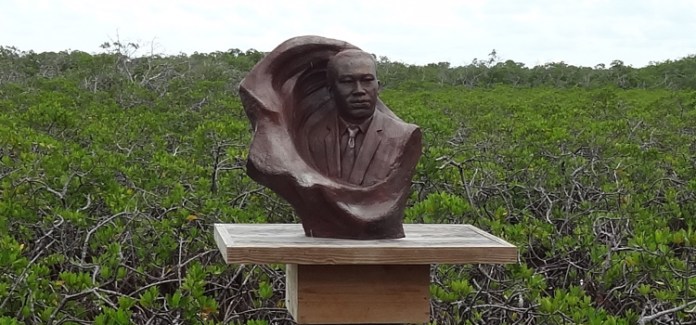
FL: Deep in the mangroves of Bimini, there’s a spot known as “the Healing Holeâ€, where Ansil took Dr. King and where a bust to MLK stands today. What was it like visiting the Healing Hole for the first time with Ansil?
What a question. The Healing Hole is this really interesting spot. Because the only things that have ever been put out there on Ansil are all pertaining to the Healing Hole and his psalm. So, when I went out there, I wanted the moment to be extraordinary, and I purposefully waited probably till the second-to-last day of our shoot to actually go out there. I wanted to learn and appreciate as much about Ansil as I could before that moment. I didn’t want it to be hindered by cameras and interruptions. I wanted it to be its own spiritual experience. Which is what we captured in the film.Â
Visiting the Healing Hole is transformational in the way you think about Dr. Martin Luther King, Jr. and how important he is. One of the goals I have with this film is to show Dr. King’s human side, the one that isn’t on a podium and giving very powerful and moving speeches. Here’s this person that laughs and loves, gets angry, and has faults and struggles.
Being out there, you can kind of just put yourself in the two men’s shoes. To me, the Healing Hole was this place that really I could get immersed within, where you can feel the energy of the place and Ansil’s passion.
Photo from US Embassy – Bahamas
Ansil’s passion is best comprehended in the words of a famous psalm he wrote and shared with Dr. King. Ansil’s psalm, which you will hear in the film, that he shared with Martin Luther King, impacted MLK so much. After hearing Ansil’s words, Dr. King gave him a commission:Â
He said, “Everybody needs to hear this at least once.”Â
While I was out there, listening to Ansil recite his own words, I was moved. It brought me emotionally to tears, it brought me emotionally to a place of appreciation and contemplation. It’s radically transformed my perspective on the Civil Rights Movement as a whole, as well as a deeper understanding of who Dr. Martin Luther King, Jr. was. I feel like through Ansil, I got to see this person in a different way than I’d ever before been able to appreciate.
Photo by Matt Jones
FL: Describe Ansil’s spirit. What has been his impact and legacy on Bimini?
Shannon: Well, first off, there’s not a person on the island that doesn’t know who he is. I think it starts with the idea that Saunders’ name goes back a long time. He was friends Ernest Hemingway and many other influential people.
Simply put, Ansil is a pioneer. I think he took personal offense that the blacks were second class in Bimini. Because to him, that meant his community, his friends, his family were somehow inferior, which is total crap. He wouldn’t stand for that. His spirit is too courageous. He illuminates the room.
You know that when you’re with him, you can do no wrong, in a way. He is the kindest, most accepting person I’ve ever been around. He’s incredibly intelligent for someone that didn’t go to college or high school. I think that is a really unique part about him and who he is and what he embodies.
It started with being born into a family that was respected and then living a life of action. Not one bit of his life has been about serving himself. It’s been about seeing injustice and seeing downfalls in his own community and wanting to do everything he could to make it right. When he was in his twenties he sat in protest, mostly by himself in the Bimini Big Game Club, which at the time was a “Whites Only†establishment. He tried to get other people in his community to help him, but they told him he was wasting his time.
Photo By: Matt Jones
He said, “I am going to go there every single day for lunch. I’m going to sit down and ask to be served.”Â
And, for 41 days straight he wasn’t, yet, he persevered, and on that forty-second day, they served him lunch, and they’ve been serving the black community on Bimini ever since.Â
He saw the movements in the United States that Martin Luther King and others were leading, and that gave him the courage, it gave him the inspiration he needed.
When everyone said, “You can’t and you shouldn’t,” he said, “I’m going to and I will.”
I think that that embodies every bit about who he is and what he stands for in those actions. He carried that through his life and it didn’t stop there. That event was just the spark, giving him the courage and the validation he knew he had within him. That’s what propelled him into the next phases of his life, which involved being the president of the PLP, the Progressive Liberal Party, and the right-hand man to Sir Lynden Pindling, the prime minister of Bahamas, writing his speeches and introducing him when he addressed the nation, and beyond.
Photo by: Matt Jones
FL: It’s very clear that Ansil values education and saw it as the way to lift up his people. But without traditional schooling, how did he educate himself?
Shannon: Fly fishing became his education because the people he had on the boat with him were educated people. They were doctors, lawyers, people like Dr. Martin Luther King, Jr., Muhammad Ali, a former president of the NFL, the list goes on and on and on.Â
One day, he was given this advice by a client, “Read the Miami Herald every single day for four years, you will get a college education.”Â
And that’s what Ansil did.
Photo by Matt Jones
“I read the Miami Herald every single day for four years,†Ansil said, “it was a college education. I learned everything I needed to know to carry the conversations and ask the right questions to the people that were on the boat with me.”
That propelled his education, into this place where he could carry intellectual conversations and he could see the problems and the injustice in Bimini and the Bahamas as a whole. That is what gave him the courage of a lion. I look at Ansil and I think of Aslan in the Narnia. I see him as the lion who can lay with the lamb because he’s as gentle as a lamb. Yet, he has the courage and the tenacity of a lion, to attack injustice and take it down. That’s Ansil. That’s his spirit.
Photo by: Matt Jones
FL: There are a lot of parallels to the important conversations about equity and equality that have been going on in the country in recent years. What piece of Ansil’s story do you hope gets conveyed for audiences to take into their communities?
Shannon: If you had to draw a parallel similarity between Martin Luther King and Ansil, it would be that of courage.Â
He didn’t see all of these opportunities to get educated as a way to better himself in a financial way, because that would involve a life where he spent his time serving himself. Ansil saw time as the most important resource that he had control of. In his case, something as little as 42 days had a very important and lasting impact. That happened before he met Martin Luther King and you better believe every single bit of Martin Luther King’s desire to want to be in the boat with Ansil had to do with hearing that story from Senator Clayton Powell and saying, “That guy sounds interesting. I’d like to be in the boat with him.”
I’d say that having the courage to stand up for what you believe in and being willing to invest the time into that. It’s easy to get caught up, spending all of our time chasing money. Why? So that we can take our money and reprioritize our time?Â
In the end, a guy like Ansil is a model who represents someone who just skipped the middleman, prioritizing his time to serve others.
Photo By: Matt Jones
FL: I noticed during the interview segments you tighten the frame, focusing on Ansil’s face and hands, cropping out other features in the process. What inspired that?
Shannon: That’s an important part of telling someone’s story, is being intimate. Really understanding somebody requires intimacy, you know? It’s something that only happens when you truly befriend somebody when you genuinely understand them, and you truly are able to empathize with their perspective.Â
That was a creative decision in how I directed, the way the film was shot, and how I operated the camera when I was filming. I just wanted to be close and I just wanted to be as tight as I possibly could, because there is so much character there. There’s so much to be said in his face. He has obviously spent a whole life smiling more than he’s been frowning.
Photo By: Matt Jones
FL: Who were your partners in the film?
Shannon: This film would not have been possible without the support of Rex Messing from Simms, Joe Gugino with Costa del Mar, and Woods King IV, and Sarah Foster from the American Museum of Fly Fishing. They all were all in, “Whatever you need, we’ll get you taken care of.” I think I only had to make three phone calls in a matter of two or three days, and the film was funded. It’s fantastic when you have sponsors that get it.