Kristine Dunker is an invasive species biologist with the Alaska Department of Fish and Game, Sport Fish Division. She has researched and worked on invasive species in southcentral Alaska for 14 years and her primary focus is on northern pike. Read below to learn about Kristine’s job as well as her research experiences in Alaska!
FL: What does an invasive species research biologist do?
Kristine: I coordinate the invasive species activities that occur in the Southcentral Alaska region. 90% of my work is northern pike-related. My job is very unique in that it’s both management and research-focused. A lot of my work now is office based so my team gets to do most of the fun fieldwork, but every now and then I am able to get out in the field with them too. Another big part of my job is that I help fund the invasive species programs through writing grants and such. I help design projects, and I write a lot of reports and manuscripts of our work on the pike program as well.
FL: What species are the most harmful to Alaskan ecosystems?
Kristine: In my opinion, pike and elodea are the two largest threats to Alaskan fisheries that are currently here. I along, with my ADF&G team, manage the pike whereas the Department of Natural Resources is in charge of elodea. Elodea is a plant that can dramatically alter fish habitats. For example, Alexander Lake was found to have elodea in 2014. About two years later it had gone from a small patch to covering almost the whole lake.
Elodea is a statewide issue, but pike are a southcentral problem (pike are native to northern and western Alaska). For more information regarding northern pike check out Kristine’s article about the differences between native and invasive pike in Alaska. Zebra mussels are another invasive species that we are looking out for. They are currently a problem in the lower 48 and we don’t want the same thing to happen up here. Right now, we do not have any known reproducing zebra mussels in the wild, and we want to keep it that way.
FL: What impact does your work have on Alaskan fisheries?
Kristine: Aquatic invasive species can have a huge impact on fisheries. As far as our pike work, we’re trying to benefit anglers and the sport fisheries that everyone loves. Everything that we do is situationally dependent, and certain places need more or less management than others. Our primary focus is trying to prevent our pike problems from getting any worse. From there, we are trying to chip away and remove populations where we can and restore native fisheries. Currently, that is not possible everywhere.
For example, on the Susitna drainage, we are not trying to eradicate pike (because that isn’t really a feasible goal at this point). Instead, we are trying to reduce those populations and, therefore, the amount of predation on juvenile salmon and trout. Of course, we want the pike populations eradicated, but we need to focus on thinning them so juvenile salmon and trout can survive. In other areas, like Alaska’s Kenai Peninsula, eradication of all pike was feasible to attain, and we’ve almost accomplished that goal. The best part is getting to restore native fisheries along the way.  If we can minimize the effects of pike now, future anglers will have the opportunity to enjoy Alaskan fisheries for years to come.
FL: How are Alaskan fisheries and invasive species different from the contiguous US?
Kristine: Alaska is in a unique situation because our invasive species problems are just starting. I went to graduate school in Florida and worked in the Everglades before starting my career in Alaska. Down there the ecosystem is so messed with many invasive species, and due to the expanse of the Everglades, little can be done to eradicate them. We actually have the ability to do something in Alaska and change the outcome of future fisheries, which is very exciting and rewarding.
FL: What is Environmental DNA?
Kristine: Environmental DNA is a technique where water samples are collected and they can contain DNA fragments from organisms in the water. When a fish excretes waste or loses a scale, its DNA ends up in the water. The exact same testing method as COVID is used in a laboratory to determine what species are living in a certain waterway. Environmental DNA is an effective form of research because it can detect invasive species without having to catch the actual fish themselves.
FL: What is the most interesting research you have had the opportunity to participate in?
Kristine: So many answers for this one. My team and I are currently collaborating with professors at the University of Alaska Fairbanks regarding the microchemistry of a fish’s ear bone (the otolith). Pike in other parts of the world use estuaries such as in the Baltic and Caspian seas. Here in Alaska, we have received reports of pike in the Cook Inlet from commercial fishermen and even had a commercially caught pike brought into us. More recently, we brought an otolith to Fairbanks from a newly discovered location on the Kenai Peninsula with a pike that has a Cook Inlet connection. UAF ran the isotope analysis, and it had a saltwater signature (meaning we could infer it spent time in the ocean and may have originated from the Susitna). It is crazy to think that a pike can travel so far in saltwater, and using microchemistry to research this is intriguing.
I have also really enjoyed research into using eDNA for pike in Alaska, and there are lots of questions on invasive northern pike ecology and genetics that have been really fun to explore with the university and other agencies. Really, all of the pike work I have been part of is interesting, and each new project brings lessons. We’ve got a very dedicated team of folks working on this problem in Alaska. To learn all about the pike research and management that has taken place in Alaska in the last 10 years, check out: Fishes | Free Full-Text | A Decade in Review: Alaska’s Adaptive Management of an Invasive Apex Predator | HTML (mdpi.com)
FL: If someone finds an invasive species while out on the water, what should they do?
Kristine: ADF&G has an online reporting website that you can access here: https://www.adfg.alaska.gov/index.cfm?adfg=invasive.report. Â Report the invasive species online or contact us at 1-877-INVASIV if you have any questions. As far as other parts of the USA are concerned, if you find an invasive species you should contact your local fisheries office and report it. In southcentral Alaska, you can do your part to minimize the pike population by harvesting all the pike you can. It is actually illegal in southcentral Alaska to release a live pike. If you are visiting Alaska, make sure any gear you are bringing with you is completely dry and free of any hitchhikers. The same is true for Alaskans visiting other states. We appreciate local and visitor help in keeping our amazing Alaskan fisheries healthy!
In what may be one of the most groundbreaking announcements to hit the fly fishing industry since the release of the squirmy wormy, Columbia Pictures has just dropped the first teaser poster for the sequel to the 1992 film, “A River Runs Through it”. The project is titled, “A River Runs Two It”, and will be set to hit theatres and streaming services as early as the Summer of 2021.
Little is known about the upcoming release besides the return of award-winning director, Robert Redford, who will be heading the project, as well as a new ensemble of cast members such as Zach Efron, Dave Franco, and Seth Rogan. According to our sources, the popular trio will be playing the characters of the unmentioned nephews of the late Paul McClean, who will be returning to their Uncle’s home river to pay homage to the originator of the shadow cast. Further character casting has been left up to speculation, but no additional talent has either been confirmed or denied by studios.
In a quote from Mr. Redford himself, who will be taking on a producer role alongside his directing credit, he stated the following:
“It was time to give this old movie a new coat of paint. The original film doesn’t even begin to scrape the surface of Euro-nymphing or the life of Fly-fishing influencers whatsoever, and quite frankly that strikes me as a problem. [A river Runs Two It] will be a movie for the people of today’s fly-fishing culture.”
-RR
While sources are still clamoring to dig up more information, the Rogan-Efron-Franco trio has released a small tease that the movie will have a similar “taste” to their 2014 release, “The neighbors”, and will serve as a “satirical, edgy take on the sport of fly-fishing”.
We are personally very excited to see what this new movie has in store for audiences, and will be scratching at the door to learn more of when we can finally get more details. According to sources, a trailer is scheduled to be dropping on June 31st, 2021. So, mark your calendars and stay tuned for more details as they come!
There are not many places in the world where you can catch a 20 lb Rainbow trout on foot. Jurassic lake is one of those places. Located in southern Patagonia, Jurassic Lake, also known as Lago Strobel, is home to some of the most consistent fishing for large rainbows found anywhere in the world. It’s windy, it’s desolate, and it’s remote. But, if you have the chance to spend a few days casting to these fish, they will undoubtedly haunt your dreams for years to come. We spent a week with Estancia Laguna Verde getting a taste for what these magical waters held. Check it out!
Feel free to shoot us a line if you want more info on a trip like this at travel@theflylords.com.
Be sure to check out episodes 1-3 of “Far From Home” and make sure to subscribe so you stay notified on future adventures.
The time to gear up and advocate for the long term protection of striped bass is here. This fish is the most important species on the East coast, bar none. Anglers of all skill levels, gear preference, and background enjoy this perfect fish. You see, what makes striped bass so perfect is the diversity of opportunity in the fishery–when they are abundant and healthy that is. You can catch them sight fishing on the flats, or blitzing on the beach, or in the inlet, or a mile offshore. You can catch a little schoolie and then a 30 pound fish an hour later on the same fly.
Today, however, striped bass are overfished and subject to overfishing–and have been for a couple years now. Last season, the authority that manages striped bass, the Atlantic States Marine Fisheries Commission (ASMFC), passed Addendum VI in an effort to reduce fishing mortality (dead fish) by 18 percent. Despite that effort (the impact of Addendum VI is currently unknown), the ASMFC initiated an amendment process, which will shape the future of striped bass management.
Economically, this fishery produces a greater impact than what you see with Alaska’s salmon fisheries. According to a 2016 report, striped bass had a nearly $8 billion economic impact in 2016 (when the stock had declined considerably). Bristol Bay’s salmon fishery is valued at over $1.5 billion. Think of what an abundant and sustainable stock could produce and how much it would benefit our coastal communities.
It may seem impossible now, but the striped bass recovery in the late 80s, early 90s is one of the greatest environmental success stories in history. But just because the fish was recovered 30 years ago, does not mean that it will happen again. It’s an unfortunate reality, and s very real possibility, that this amendment process could take a turn for the worse and fundamentally change striped bass.
This whole process is complex, drawn out, and will undoubtedly be contentious. For the next ten days the ASMFC is seeking comment on a Public Information Document (PID), which will ultimately guide what is in or out of the future draft amendment. Of the nine issues identified in the PID, there are several issues that deserve special attention: biological reference points, stock rebuilding, and conservation equivalency.
The striped bass population is at a 25-year low point.
Lowering the Goal Posts
Bar none, the Biological Reference Points issue stands to be the most devastating for striped bass and those who love to catch them and share that experience with others. Think of reference points as a measuring stick that managers use to judge the stock. The current reference points are based on 1995, when the stock was declared recovered and exhibited an abundant and diverse age structure. Lowering the reference points by using a different base year is a realistic outcome of this amendment. A healthy and abundant fishery benefits all of us, and it is possible. In the early 2000s, when the striped bass population was at its highest, fishing mortality was near or at overfishing levels. Therefore, if fishing mortality is responsibly controlled, the ‘target’ level is attainable. Maintaining the current reference points is paramount for restoring striped bass and future management.
Speaking of restoring stripers, the ASMFC is supposed to rebuild the stock by 2029, but a rebuilding plan does not currently exist. When stripers were declared overfished and subject to overfishing in 2019, a 10 year rebuilding timer started. The ASMFC is supposed to adhere to that timeframe and create a rebuilding plan per their own rules, but accountability is not a strong suit with the ASMFC. It is imperative that striped bass are rebuilt, and that starts with the ASMFC devising an effective plan.
Conservation Equivalency
As you probably know, striped bass are migratory and swim up and down the Mid-Atlantic coast. Managing stripers as a migratory stock under a standard set of coastal regulations promotes management effectiveness and uniformity. Conservation equivalency, however, can undermine even the best management programs, because it allows different regulations for implementing states without any accountability. And while every state does have different fisheries and priorities, they all share these fish. States that choose to implement conservation equivalency should not negatively impact the collective resource nor impede management efforts.
Conservation equivalency should be reined in, or at the least not be an option when the stock is overfished and/or subject to overfishing. Further, managers should require more accountability from states that chose to implement conservation equivalency and penalize those that fail to meet conservation objectives.
How to be an Advocate
If the reference points are lowered there will forever be less fish in the water. If rebuilding is not addressed and conservation equivalency continues to be abused, recovering striped bass is a pipe dream. This fish is too important to settle for subpar management and relative scarcity. You can submit an electronic comment to ASMFC up until Friday April 9th.
This is complex and time-consuming, and we aren’t even at the actual amendment stage. However, getting involved today and commenting on the PID will inform and guide the draft amendment, which will hopefully prioritize the long-term health and abundance of striped bass. The American Saltwater Guides Association is working to make this entire process understandable and provide motivated individuals with all the necessary resources to be effective and informed striped bass advocates. Click on the link below for the American Saltwater Guides Association’s one-stop shop for navigating the PID and how to submit a comment or attend a virtual hearing.
Think of the impact this community had on Pebble Mine and Bristol Bay. The highest levels of government realized that Pebble was the wrong mine in the wrong place, and Bristol Bay’s sustainable economy was more valuable. Those successes, while Pebble is still not completely dead, are attributable to public input and pressure. That energy and level of involvement will be needed to restore striped bass and protect the resource for generations to come.
In this week’s “How to Tie†video feature, Jerry French gives us a great tutorial on how to tie the Intruder.
Learn About This Fly:
Difficulty: Intermediate
The Intruder Fly was originally created by Jerry French and was a concept pattern with a streamer style body with a trailer hook off of the back of the fly. What is unique about this fly is that it is commonly tied with tubes for buoyancy. Jerry ties his with shanks instead which is a key take away with this pattern.
The Intruder is considered a Spey fly or a fly fished on the swing for steelhead and other migratory fish. Trailer hooks were commonly tied on larger hooks but these hooks tend to damage and hurt steelhead upon release. This is where this idea was born. A safe and effective way to imitate food such as shrimp or squid for these sea run steelhead, salmon, and brown trout.
Jerry’s Intruder is tied with custom made shanks with a reverse eye. The smaller shank eye reduces the amount of resistance when casting allowing for better turnovers. The trailer hook is tied using an aqua rig and is tied in just like wire off the back of the shank. Be sure to run the tag ends through the shank eye for added security and strength. This fly was designed to be light to make the fishing experience more enjoyable. Easy to cast and an excellent sink/rise rate, the Intruder is a no brainer for swinging to Pacific sea run migratory fish.
Alec Lackmann, a North Dakota State University researcher was out on the water conducting research examining often overlooked freshwater fish species in Otter Tail County’s Crystal Lake in Minnesota. As a part of the research, the team was sampling the fish’s “otoliths”, ringed growths located within the skull of many fish species. Without going into the true nitty-gritty of it, biologists can determine a fish’s age by reading the otolith under a microscope, similar to reading tree rings to age trees. What’s most remarkable is that of the multiple fish caught in the study, a couple of specimens were over a century old, and the oldest tipped the scales (no pun intended) at 112 years old, making it the oldest freshwater fish ever recorded.
When you think of the popular hunting and fishing brand:Meat Eater, you’re most likely picturing epic hunting, delicious game recipes, and just about anything besides catch and release fly-fishing. However, this year, the fishy crew over at Meat Eater holstered their treble hooks and took on a conservation project out of the pureness of their hearts, and maybe a free fishing trip (their words, not mine). In what is perhaps the most justified “spot burn” that the fly fishing industry has ever seen; Joe Cermele, Miles Nolte, and Off the Grid Studios brings us to Tight Lines Fly Shop and the waters of the Menomoniee River for some world-renowned smallmouth fishing all in the name of conservation.
We had a chance to sit down with Joe Cermele of Meat Eater’s “Bent” Podcast, as well as their installation in this year’s Fly Fishing Film Tour, to get a behind-the-scenes look at creating “Spot Burn”.
FL: Who is Joe Cermele, and what is your role with Meat Eater?
Tim (left) and Joe (right) hard at work on “Dos Boat”.
Joe: I head up MeatEater’s East Coast contingent, which makes me the lone full-time editorial staffer based on the Right Coast. I live in Eastern Pennsylvania now, but just across the river from Jersey, otherwise known as the Motherland. I joined the MeatEater team as the senior fishing editor in February of 2020, literally two weeks before the COVID hammer dropped. Prior to that, I was the fishing editor at Field & Stream for a decade, during which time I created a spin-off brand for them called Hook Shots that included a video series and podcast. I also served double duty as the fishing editor of Outdoor Life for a couple of years. I was initially attracted to MeatEater because personality-driven content, particularly podcasts and videos, is such a central part of their program. I’m a writer at heart, but really embraced new forms of media as they shaped the fishing scene and firmly believe modern outdoor media consumers identify with the who before the what. So, when I was offered the opportunity to help define and shape the fishing program at MeatEater, there was no way I wasn’t jumping on that. I was thrilled.
FL: In short, can you explain to us what “Spot Burn†is about?
Joe: “Spot Burn†was born from MeatEater’s Das Boat series. We focused an episode of season two on the Menominee River in Northeast Wisconsin and the threat it was facing from a Canadian Mining company’s proposed open-pit sulfide mine. The film you’re seeing in F3T is an expansion of that story with a fishier twist. “Spot Burn†centers around outfitter Tim Landwehr’s decision to expose the incredible smallmouth fishing on his home water to the masses in hopes that more people will help the locals fight the fight and derail the mine.
But, in a broader sense, I’d be lying if I said “Spot Burn†wasn’t also about poking a little fun at several topics that have become fishing media taboo. These days, you hear the term “spot burn†so often you just roll your eyes. Is it a real thing? Yup. Is it happening? Yup. Will it continue to happen? Absolutely, so why do we still let it suck so much enjoyment out of our sport? I know dudes that spend more time complaining about spot burning on the internet than they do fishing. I’ve been a burn victim, and I don’t like it, but I’m not going to lose sleep over it because what can you do? Those anglers have every right to be there. The spot is not mine. You either adapt and deal with it or quit fishing I guess. Second, there is this ethos in fishing that if you’re doing anything in the name of conservation your content should be automatically placed on a pedestal. Because you’re “doing it for the cause,†you’re nobler. There are loads of respectable anglers out there that have moved mountains for conservation. There’s a lot of people that damn-well should be on that pedestal. But there are also people that treat a cause like a tool to elevate themselves in the fishing scene and in doing so glaze right over the joy of fishing. With this film, we wanted to make something that was both entertaining and shed light on a conservation issue. Fishing is both fun and serious, so why does fishing media need to be one or the other? Why can’t it be both?
FL: Meat Eater is perceived by many to be focused on hunting, and fishing with conventional tackle for food. Can you tell us how you guys are aiming to subvert those understandings and deliver a message more geared towards the fly-fishing audience?
Joe: We’re trying to create a fishing environment that’s all-inclusive. No matter how you fish, why you fish, or what you get out of it, we’re all anglers. We have so much in common and we can learn a ton from each other. As it stands now, the vast majority of fishing media is stuck in these separate silos. Is that because every angler is only interested in his or her faction? Maybe. Or maybe it’s because fishing media lacks a quality home for the angler that fishes multiple methods, targets a wide variety of species, and is interested in a wide array of fishing topics. Quality fishing media tells interesting stories around the thing we all love to do: go fishing. Prior to joining the MeatEater team, I created a pretty successful brand that proved a generalist approach—where we’re flyfishing one week and trolling the next—works and attracts an audience. We’re confident we can do that even bigger and better at MeatEater. So, in regard to fly content, it’s important to us and will be one of the areas we focus on, but it’s just one piece of a larger puzzle. As you know, I’m a hardcore fly guy, but I’m not fly-only. To me, a fly rod is a tool within my broader arsenal, but it’s not a way of life. I’m a much better fly angler because I do a lot of conventional fishing and vise versa. You want to be a great streamer angler? Spend a season throwing swimbaits. You want to be really proficient at dunking worms? Learn about nymphs and how trout feed on them. A lot of what we want to do dives into these connective tissues that many anglers may not think about, but that speak to the fact that we’re all out there trying to get the same bite.
FL: As seen in the opening sequence of the film, there are so many different conservation efforts at the forefront of many anglers’ minds. What was it about this one that really stood out to you guys?
Joe: For me, it was a bit more of a David and Goliath scenario. Lots of people care about Bristol Bay. Lots of people care about the Boundary Waters. These are destinations and their plight is in our faces. But Tim and his crew have something very unique and special in the Menominee. Is that not worth saving because the area doesn’t generate the same money and the interest? We didn’t think so, and I could easily put myself in Tim’s shoes. What would I do if my home water, the Central Delaware River, was under this kind of threat? Matter of fact, it could be in the near future as a result of fracking initiatives. But the Central Delaware isn’t a destination. Few people get hot and bothered unless there’s an issue with the trout sections 200 miles upstream of me. The only people to fight the fight here would be a handful of local anglers. If I could potentially help thwart disaster by sharing more about my piece of the river than I was comfortable with, I’d do it.
FL: When prepping the boat for a warm-water fly fishing mission, what are some of the factors you guys took into consideration?
Joe: One of the things the Das Boat series proved was that contrary to popular opinion, you don’t need some souped-up, snazzy watercraft to fish effectively. In season two, we took an ancient, rickety aluminum Starcraft with a deep-V hull and adapted it to six very different fisheries, from big-lake trolling to floating a tight trout stream. Tim and I got pretty lucky. Our mission was to row this beater down a pretty wide river, albeit a relatively shallow one. So, while other duos in the Das Boat series had to fabricate casting decks, add downriggers, and wire electronics, we just had to strip the boat to bare bones. We needed to make it as light and maneuverable as possible. We tweaked the anchor system a bit and reinforced the oar locks, but other than that, everything—including the motor—came off. While I can’t say it was the easiest boat I’ve ever rowed, it also wasn’t terrible. It performed well and gave us a really spacious, stable platform to fish from. As long as you weren’t forward rowing, you almost forgot you weren’t on a drift boat.
FL: What was it like having the preliminary conversation with Tim when discussing “Blowing up his spot� Was he hesitant at first? What consequences did he expect?
Joe: Tim was certainly hesitant. In fact, in the very early stages of planning, there was some drama behind the scenes. We negotiated what we could and couldn’t show, but ultimately ironed out the details and got everybody on the same page. Once we all aligned on the same vision and Tim was committed, I don’t think his confidence about this being the right move waivered. He understood we were there to tell a story that needed to be told. That doesn’t mean he wasn’t nervous about how this would be received, but look what happened. As soon as the original Das Boat episode aired, support poured in for The Coalition to Save the Menominee River. While the mine isn’t dead by any means, that organization and the Menominee Tribe were able to win their first court battle and get one of the Environmental Quality Permits rescinded. I got a glorious drunk text from Tim when the news came through. His whole crew was celebrating. There are several more court battles that need to be funded and won, but it was a fantastic first step.
FL: Continuing on the topic of ‘spot burning’, what is your opinion on the matter? Are there other justifications besides saving a river from becoming a stagnant pool of toxic sludge? Should spot burning be chalked up to a militant act of evil, or is it simply a product of time on the water and word of mouth?
Joe: Spot burning is a complex subject because it has so many layers. I actually find it really fascinating from a psychological perspective. I once got a long, F-bomb-riddled email from a fan after posting a video that showed a bridge on a river. He said I was careless, and while he didn’t mind that I was filming on “his†river, there was no need to include a shot of the bridge. My response was, “If this was a bridge on a different river, one you didn’t fish, would you be ripping me apart for potentially burning someone else’s spot?†He didn’t reply, of course, because nobody cares until it’s their spot that’s burned. The fact is, there’s no such as thing as a secret spot anymore, at least not in the lower 48, and that’s only going to get worse. Thanks to the pandemic alone, there are more people out there than ever before trying to wet a line, and if you’re resourceful, you’re going to find places. Does it really matter if you find it through a poorly thought-out social media post that feeds it to you on a silver spoon or Google Maps and boots on the ground? The end result is the same.
In my opinion, spot burning is the most damaging on a local level. If you’re posting on a local forum geared to a local scene, giving detailed info on a spot or bite can create an almost real-time crowding issue. But people have it in their minds that if you share something on a national level to a large audience, every area motel will be booked next week. Ask the thousands of guides and captains that have been featured in magazines and videos and prayed for solid bookings as a result if that’s always how it played out. I’ve had people harass me for highlighting an entire river or giant lake, and that makes very little sense to me.
Just because I’ve shown you a vignette from somewhere doesn’t automatically load your brain Matrix-style with the years of trial and error it took me or a guide to figure the place out or give you a complete working knowledge of the system as a whole. People love to act like you’re giving away a secret simply by showing an audience that there’s a certain fish in a certain body of water, but I can’t think of anything I’ve ever done or anywhere I’ve ever fished where I revealed something completely unknown. It’s all public information. This film is a prime example. There’s nothing we’ve shown you that you couldn’t have figured out if, say, you’re a diehard smallie guy looking for a new place to road trip. You see some great fishing in the film, but to think you’re just going to step into the same conditions and replicate what you saw without time and effort is a fantasy. Real anglers know this, but there are tons of “I-want-it-now†fishermen out there these days. The silver lining I’ve discovered, however, is that while your post or video might prompt some these people to go somewhere new, if it’s not easy, lights-out fishing that provides Instagram fodder during their first visit, they often don’t go back.
FL: Having grown up around, and now residing in the state of PA, as well as having been able to fish for smallies on conventional tackle and on the fly; do you have a favorite method? Why?
Joe: If smallie fishing revolves around deep and slow, I’m not overly excited. I have the utmost respect for the dudes that can shake a hair jig in place in a deep hole in the winter looking for a little tap or crawl a tube in the early spring, it’s just not my jam. Truthfully, I don’t usually focus on bronze until May and I’ll stay after them into the fall, right up to when I have to work too deep and too slow to catch them. Where I live, there’s no shortage of other games in town late and early in the year, so I have other options. But in the perfect scenario, I’ll catch them on popper flies all day. There’s no doubt that’s my favorite method because I love the finesse aspect of it. You’re expecting this explosion but it’s often the gentlest sip, and you often have to earn it. Rare is the day that they’re just crushing a Boogle Bug on every cast, at least on my home waters.
FL: With missions such as these, there is a lot of chatter about what truly incentivizes someone to go and open up a fishing spot to the world. How do you guys go about finding the proper balance between using a cause to get a free fishing trip, and fishing for a cause?
Joe: “Spot Burn†was really the first time in my entire career I’ve been part of a project that was specifically aimed at exposing a major threat and conservation issue to the masses. I keep up with issues locally, nationally, and globally, and I’ve done my share of reporting on them through writing and podcasts, but I’m definitely not the guy seeking them out and using my position to fish cool places under the guise of being there for the cause. The closest I ever came prior to this was filming a web show on a Northeast Pennsylvania river that could use some more love and attention but wasn’t facing a major threat like the Menominee. And it was home water, so I was just burning my own spot and sleeping at home that night, not at a swank lodge. If more people know and care about a fishery that attention certainly can help protect it, look at Pebble Mine, but you also have to pick your battles. I do think “the cause†can easily be turned into a thin excuse to simply justify making content. If that’s your angle, you can find a cause within almost any fishery.
So, to make it effective and lead to action like it did with “Spot Burn,†you have to really study that cause, debate it, and weigh it, because our audience trusts that if we think they need to hear about it, it’s probably worth listening. MeatEater’s reputation is staked in conservation work, but if every other week we’re fishing or hunting somewhere with a half-assed cause and telling you to care, that can easily lead to our motivations being questioned or dilute the bigger, more important messages.
FL: What do you feel was one of the biggest take-aways from working on this project?
Joe: On a personal note, I learned a ton about fly-fishing for smallmouths from Tim and crew. The bugs they use, the kind of water they target, and the presentations were eye-opening. In a way, it almost made me feel dumb for not being tuned into their methods years ago, because nobody I know is doing what they do out East, and I’ve been able to bring that game to my home turf. But the bigger takeaway was that despite all the keyboard commandos that live to bitch and moan about spot burning, when you tell a story the right way with good intentions, it draws out the camaraderie in the greater angling community. After the initial Das Boat episode dropped, The Coalition to Save the Menominee received donations from all over the place, from fly and conventional guys, most of which will never even fish that river. But I think they see themselves and their friends in me, Tim, and his crew in this film. The Menominee can be a thousand different rivers. It can easily be your home river.
FL: How did you and your crew decide you wanted to make a film for F3T? Was it always the goal to have this piece in the film festival?
Joe: It wasn’t an initial goal. As it often goes when you’re filming anything, a lot of really great stuff ends up on the cutting room floor. In many ways, the Das Boat series focused more on the boat itself and the people in each episode than the actual fishing. But in our shoot on the Menominee, a lot of really good fish-porn got left out. We saw an opportunity to reshape the narrative around the mine issue with a more directly fishing-focused angle. We had so much footage that hadn’t been seen, and so many things we either didn’t say in Das Boat or that we felt could be expanded upon, we thought working something up for F3T was a no-brainer. It also helps our ongoing effort to show new audiences that not everything at MeatEater related to fishing ends with a fillet knife in hand.
FL: This film takes a much more comedic/light-hearted approach to address an otherwise serious concern. What was your goal with this?
Joe: Frankly, I never take anything to do with fishing too seriously. That’s always been kind of been my deal, and Miles Nolte, MeatEater’s director of fishing, and I try to bring that attitude to everything we do. That’s not to say we shy away from serious conservation issues and controversial topics, but too many anglers in the public eye fancy themselves crusaders. At the end of the day, it’s just fishing, man. We’re all just trying to fool something with a tiny brain, and at some point, all the crusaders and people that treat fishing like war started doing this because it was fun! I go fishing to have fun whether it’s a work trip or just the weekend, and once you lose that, once you’re only fishing for a cause or only fishing to let people know what an expert you are, you should just hang it up. I’ve always strived to avoid a contrived, on-camera persona. What you see is who I am. And yes, we were there to shed light on a very serious concern, and I think we did that effectively. But you know what? Tim and I weren’t floating down the river crying and moping about the mine. We were fishing, and laughing, and quoting “The Golden Child,†and high-fiving, and ribbing each other when we goofed a hook set. You’re trying to save something that provides fun and enjoyment, and if I’m the guy that gets to tell that story, the vibe I’m going with is NOFX not “Everybody Hurts.â€
FL: What is the best way to take action in aiding in the fight against the mining project covered in the film?
FL: Can the fly-fishing community expect more to come from Meat Eater in terms of fly-fishing-focused and catch and release content in the near future?
Joe: It sure can. I’ll personally be contributing a bunch of it. But I think it’s important to reiterate that our goal is to be welcoming to all anglers. We’re really trying to create conversations and perhaps get fishermen looking at things from other perspectives. So, I think what you’ll see is a bit more explanation and thought put into why we are—or are not—releasing a fish. I love eating fish, but food on the table is not the driver that gets me on the water, and I believe huge amounts of anglers fall into this category. However, the idea that killing a few fish is deplorable and barbaric is false. We certainly won’t be shying away from catch-and-release, because it’s very important to us as conservation-minded anglers, but you’re going to find out why we believe catch-and-release is the answer within the fishery at hand. And time to time, we’re going to tell you why it’s OK to eat one of those 36 stripers you caught in Montauk, or one of those trout you caught on that Insta-worthy Drunk & Disorderly you tied.
In honor of the Spring season, we have partnered with a bunch of our favorite brands to bring you one incredible Spring Giveaway. Two lucky winners will take home fly fishing packages worth $2320+ in gear! This package comes with all of the goods to outfit you for any of your upcoming spring fishing trips.
The Grand Prize Package ($1400)
Includes the first choice of two Redington Rods, Cheeky – Launch 350 Reel with 200 yards of backing & Cheeky 550 Pliers. A Yakoda Slim tin packed with 36 flies, Utility Pouch & Utility Wallet, Freestoned Water bottle, and LS shirt of your choice. A $300 gift card from Topo Designs and a $200 Gift Card from Flylords.
2nd Place Package ($920)
includes the remaining Redington Rod, Cheeky – Launch 350 Reel with 200 yards of backing. A Yakoda – Slim Tin packed with 30 flies, and a sticker pack of the winner’s choice. A $150 Gift Card from Topo Designs and a $100 Gift Card from Flylords.
Whether you’re a seasoned veteran or just starting out in the world of fly fishing, on the water gear storage is equally as important. Walk/wade anglers are presented with a few types of storage solutions including hip packs, sling packs, vests, and backpacks. Hip packs are the favorite of many anglers as they provide ample storage for a day on the water and can be kept on your back out of the way of fly lines and leaders. Below are some of the best new hip pack offerings to hit the market in recent months from Simms, Fishpond, and Orvis.Â
Simms
First, The Simms Flyweight Hip Hybrid System is the newest hip pack offering from the manufacturer. This hip pack was just released as part of their Flyweight collection of gear designed for anglers who push it to the limits and like to keep their gear light while covering miles in hopes of catching your favorite species in crowd-free waters.
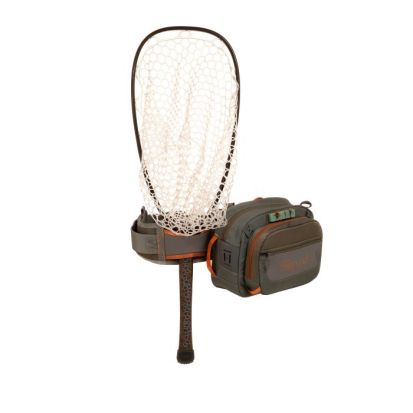
Similar to other packs and waders in the collection, the Tech Utility Belt features 5.11 Hexgrid Cordura webbing that allows you to attach and change out accessories at a moment’s notice. One of the primary accessories available for the Flyweight Hip Hybrid System is the Flyweight Net Holster. The complete Hip Hybrid System retails for $159.95 and is available in Tan or Cinder (light gray).Â
The new Switchback Pro Wading System from Fishpond is a modular fishing hip pack similar to the Simms Flyweight Hip Hybrid System. The main compartment has a zipper closure and 2 mesh pockets for organization. On the exterior, there’s an additional magnetic drop-down pocket with 2 mesh pockets and 1 zipper pocket for easy access.
Anglers can attach and remove accessories like the new Thunderhead Water Bottle Holder and Thunderhead Submersible Pouch to ensure all your gear is secured and at the ready. The Switchback Pro Wading System notably features an adjustable shoulder strap and fly pad attachments as well as an integrated net holster. This pack from Fishpond is designed to allow you to take as much or as little gear with you for a day wading your favorite waters.Â
The Orvis Guide Hip Pack is part of the newest line of packs and bags from the manufacturer. The guide hip pack is designed to provide maximum organization in its 9L of storage. This pack notably features an integrated tippet spool, fly patch, water bottle holder, and net holster.
 The main storage compartment of this pack features drop-in pockets and stretch mesh sorting pockets. There is an additional front pocket that features two mesh sorting pockets for quick and easy access. The Orvis Guide Hip Pack is perfect for anglers who place a priority on maximum organization.Â
Time for an Upgrade?Â
Customization is trending in fly fishing gear design and the Simms Hip Hybrid System and the Fishpond Switchback Pro Wading System are the latest and greatest in customization. Other anglers who place a priority on the maximum organization may find the Orvis Guide Hip Pack to be more appealing with so many integrated features. Regardless, if your pack or bag has seen better days and is ready for an upgrade or you’re looking for a quality pack to last for years, any of the options above are sure to meet your needs.Â
The Trout Unlimited Costa 5 Rivers Program is a community of over 140 College conservation–focused angling clubs around the country that seeks to engage the next generation of outdoor enthusiasts through recreational fishing and advocacy for the fisheries that unite us.Â
A past TU 5 Rivers participant makes a cast at the 2019 Northeast Rally.
Over the past year, clubs around the country have had to retool to not only keep members engaged while dealing with restrictions brought on by Covid-19. 5 Rivers is no different. Over the past year, we have pivoted to provide more online resources for young anglers across the country. Below you will find a few of the initiatives we are doing to engage younger anglers.Â
 Emerging, the official TU Costa 5 Rivers Podcast, presented by Simms Fishing Products premiered this past fall as a resource for anglers getting into the sport. Emerging seeks to give a voice to people and issues that shape the future of angling and waters that fish rely on. Episodes are published every other Friday during the school year on various platforms including Spotify and Apple podcasts.
Riffs and Riffles is an Instagram live webcast series that invites guests from the industry to share helpful tips and insights on various topics from steelhead to musky to saltwater fly-tying techniques. These episodes are published every other Thursday on the @tucosta5rivers Instagram and are available via IGTV to watch at your convenience. When tuning in live, you have an opportunity to win some great Costa Sunglasses gear!
River cleanup! Two students raise their trash from a 2019 5 Rivers Rally.
In addition, we have expanded our partnership with the Fly Fishing Film (F3T) for the coming years. TU Costa 5 Rivers affiliated clubs will now have access to a variety of perks to include exclusive on-campus premiere rights for F3T starting the fall of 2021! Â
For more information or to start your own TU Costa 5 Rivers college angling community on your campus, visit www.tu.org/5rivers or email andrew.loffredo@tu.org! Â