Spring fishing in Alaska begins around mid-April/May (depending on what part of AK you’re in) when the temperature starts to increase. Rainbow trout are ready to stuff themselves with food after the long and cold winter. Spring also brings hungry local anglers, that catch some beautiful trout after reminiscing on fall fishing all winter long. Below are ten flies that are a must-have for your spring fishing trip in Alaska.
Olive Sculpzilla
Photo Courtesy of Alaska Fly Fishing Goods
Alaskan trout eat sculpin all spring long, so it’s no surprise that the olive sculpzilla is a beloved spring fly. It imitates sculpin and gets deep enough for trout to snatch up. Any sculpin pattern does great for spring fishing in the last frontier, but a sculpzilla is like the queen of sculpin trout snacks.
Stoneflies
Photo Courtesy of Alaska Fly Fishing Goods
This is a necessary nymph for matching the stonefly hatches that occur in Alaska. Although the land of the midnight sun is known as a streamer fishing paradise, nymphs can be quite productive in spring and summer. We recommend trying the stonefly out in early spring for the best results.
Conehead Zuddler
Photo Courtesy of Alaska Fly Fishing Goods
Another large streamer, the conehead zuddler is made for large rainbow trout. If you’re looking to catch the big boys and girls, you will want to try tying this buddy to the end of your line. Although great for spring fishing, it is a solid year-round fly. The conehead zuddler comes in olive, black, and brown.
Small Fry
Photo Courtesy of Alaska Fly Fishing Goods
Salmon fry are a big part of Alaskan trout diets. This fly might not look like much but it does a great job of imitating salmon fry. The small fry is also quite simple to tie.
Wounded Smolt
Photo Courtesy of Alaska Fly Fishing Goods
Another realistic pattern, the wounded rainbow smolt will make large bows hungry. If you’re trying to weed out the big trout from the little bows, this is the fly to use. This wounded smolt is irresistible to those viciously hungry spring trout.
Beadhead Hare’s Ear
Photo Courtesy of Alaska Fly Fishing Goods
If you’re looking for a solid nymph for spring fishing, the bead-head hare’s ear is a good all-around fly. It is great for trout, char, and arctic grayling! Having a couple of beadhead hare’s ears in your fly box is always a good idea.
Dirty Hippie
Photo Courtesy of Alaska Fly Fishing Goods
Who doesn’t love a dirty hippy? Trout certainly love this smolt and sculpin patterned dirty hippy. This fly is made of peace, love, and a hidden conehead that will make it sink down right near trout faces. The dirty hippy is the perfect fly to add to your spring fly box.
Dolly Llama
Photo Courtesy of Alaska Fly Fishing Goods
A staple fly in Alaska, the black and white dolly llama works great on trout year-round. For spring trout fishing, we suggest using a black and olive dolly llama. You can purchase this fly online or at any Alaskan fly shop. It is also an incredibly simple fly-to-tie! This video explains the few materials you need and how to make a dolly llama.
Beadhead Flash-A-Bugger
Photo Courtesy of Alaska Fly Fishing Goods
Another tasty leech that Alaskan trout love, the flash-a-bugger is simple but effective. As the name says, it’s flashy but will sink well due to its bead-head! We recommend trying this fly in olive, white, and black.
Exasperator Sculpin
Photo Courtesy of Alaska Fly Fishing Goods
This sculpin is made for spring trout fishing. If you enjoy fishing big streamers for big fish, you need the Exasperator Sculpin. It is a very realistic-looking fly that moves great in Alaska’s rivers and creeks.
Regulations
Trout spawn during springtime, so it is very important to check regulations in Alaska. The Kenai River is closed from May 1 to June 10, and some other rivers have restrictions as well. To make sure you are current on the rules for spring rainbow fishing, check out the Alaska Department of Fish & Game’s sportfishing regulations.
In this week’s “How to Tie†video feature, Fly Fish Food gives us a great tutorial on how to tie the Butt Cheek Buzzer.
Learn About This Fly:
Difficulty: Novice
The Butt Cheek Buzzer, quite the funky name but is also known as a still-water Chironomid pattern. A Chironomid is also known as a midge or a lake fly and they are distributed throughout most waterways around the world. If you are a trout fisherman, you know this first hand. They go nuts for these things!
These little bugs are unique in that they come in many sizes and colors and quickly change from one lifestyle to another. That being said, it is important to know a little bit about them and keep a few in your fly box. This fly is tied with Glo-Brite Floss which acts as a breather. With that said, this fly should be fished as a pupa lower in the water column. It works very well as a lead fly to ensure that it rides a tad higher in the water column.
Typically a midge fly is either tied with wire ribbing or a feathered quill. The Butt Cheek Buzzer is tied using a synthetic style quill which works just as well as a real feather. Be creative with this fly. Tie it in different sizes and colors until you find what works. As mentioned previously, Chironomids vary in colors and so having a nice selection won’t hurt.
Last week, the Atlantic States Marine Fisheries Commission’s Striped Bass Board met to consider the public information document (PID) and move forward on Draft Amendment 7. Amid extensive and conservation-dominated public comment–not to mention intensifying public pressure–the Striped Bass Board voted overwhelmingly for the conservation and long-term abundance of striped bass. In recent years, the Atlantic States Marine Fisheries Commission (ASMFC) has both ignored conservation and substantial public input. The usual anti-conservation culprits (Chesapeake Bay states and New Jersey) pushed back against the rest of the Board and public comment. Thankfully, this go around resulted in a different outcome, one that focused on the long-term health of striped bass and will aid the recovery of striped bass, which are overfished, subject to overfishing, and at a 25-year low.
“The American Saltwater Guides Association was encouraged with the outcome of the striped bass hearing last week at ASMFC,” said Tony Friedrich, ASGA’s Vice President and Policy Director. “We were able to remove many of the bad aspects out of Amendment 7. Now is the time for even greater engagement as we move towards the formal comment period for Amendment 7. Striped bass won this round, but we have a long way to go. Your voices moved the needle, and we will need them once again in a few months.â€
This meeting’s welcomed outcome deserves applause, and commendations are in order for many of the Striped Bass Board’s members and the thousands of engaged anglers who submitted comment. There is hope for the Atlantic coast’s flagship species.
Meeting Background
Earlier this spring, you may recall seeing Calls to Action in regard to public comment for the future of striped bass management. The requests for public comment surrounded a host of issues to potentially include in Amendment 7. Those issues included: Fishery Goals and Objectives, Biological Reference Points, Management Triggers, Stock Rebuilding Targets and Schedule, Regional Management, Management Program Equivalency (Conservation Equivalency), Recreational Release Mortality, Recreational Accountability, Coastal Commercial Allocation, and any other issues concerning the management of Atlantic striped bass.
Looking at that daunting list and complex PID, it was easy for anyone to become overwhelmed and intimidated. Thankfully a host of diverse groups, such as The American Saltwater Guides Association, Backcountry Hunters & Anglers, Stripers Forever, and more advocated for conservation and the long-term abundance of striped bass–while there were differences of opinions on specifics. Notably, the PID contained several avenues to fundamentally change the striped bass fishery for the worse. It was no small feat to effectively digest this document and motivate anglers to submit nuanced and concise comments.
As alluded to above, the overwhelming majority of comments promoted the conservation of striped bass. “There has never been this level of consensus on a fisheries issue. Never, not even close and not by a long shot…Let’s review some of the top-level numbers. 1.31% of comments wanted to alter the Goals and Objectives. 0.651% wanted to change the BRPs. 5.7% wanted regional management. 1.22% wanted Conservation Equivalency to remain unchanged in the fisheries management plan,” reads a recent ASGA blog. The public’s comments were generally focused on one thing: striped bass conservation.
From February to April 9th, more than three thousand individuals shared their perspectives on how they’d like striped bass to be managed. The summation of those comments was both conservation-focused and overwhelming one-sided, a rare feat in today’s hyper-polarized society. Prior to the May Meeting, the ASMFC summarized the collection of public comments for Board Members’ consideration–many of whom took the blatantly obvious preference of the public to heart.
Meeting Summary
The ASMFC Chairman Pat Kelliher opened the meeting with an encouraging and ominous statement. He said, “a lot at stake not only for the striped bass but for the ASMFC as well…things are changing…the downward trend in the stock is evident in the assessment…Today, I ask this Board to consider what is best for the striped bass, but also for the future of the Commission.†In order for fisheries to be managed effectively, the public must both trust the managers to make correct decisions and then follow those management measures. After being involved in this process for several years now, it is not a stretch to say that public perception of the ASMFC is in the garbage. And one more bad outcome for the most important fish on the Atlantic coast–striped bass–would possibly mortally weaken the ASMFC.
In any event, the meeting got off on the right start and largely remained on a conservation-focused track–despite attempts by several states to derail the progress. Here is how the Board voted on each issue in the PID.
Issue 1: Fishery Goals and Objectives. The Board voted to leave the current goals and objectives unchanged and remove the issue from Draft Amendment 7.
Issue 2: Biological Reference Points. The Board voted to keep the reference points unchanged and remove the issue from Draft Amendment 7. Had this vote gone differently, the “goal posts” would have been lowered, fundamentally shrinking the striped bass population. This was by far the most consequential issue, and the outcome was a relief to say the least–a resounding victory for conservation.
Issue 3: Management Triggers. The Board voted to reconsider the management triggers for striped bass in Draft Amendment 7. This presents an opportunity for the technical committee to take a look at the management triggers and possibly make updates. In general, the management triggers appeared to be working–and arguably would have prevented the current overfished and subject to overfishing status of the stock, if they were adhered to. However, there was public comment that supported only revisiting the recruitment trigger, which had never been ‘tripped’ despite many below average juvenile abundance indices.
Issue 4: Stock Rebuilding Targets and Schedule. The Board voted to keep the current rebuilding targets and timeline (10 years after an overfished designation) in place. However, two interesting things happened during this deliberation. The Board voted to remove this issue from Draft Amendment 7, but they did vote–nearly unanimously–to “add options for measures to protect the 2015-year class [a relatively strong year class that will be entering the slot in the coming years] in the development of Draft Amendment 7.” This was a huge, and unexpected, victory for conservation. In addition, Dr. Justin Davis, a representative from Connecticut, highlighted that the ASMFC staff remained intent on rebuilding the striped bass stock by the 10-year deadline–i.e., by 2029. He said, “the public should be rest assured that this board is cognizant of [rebuilding the stock] and we [the Board] will be adopting measures necessary going forward to achieve stock rebuilding by 2029.” Another tally in the win column for conservation.
Issue 5: Regional Management. At this point, the science is not available to pursue multi-stock management of striped bass. As such, the Board voted to remove this issue from Draft Amendment 7.
Issue 6: Management Program Equivalency (Conservation Equivalency). If you follow striped bass management, you undoubtedly know about conservation equivalency and all the controversy and management failures surrounding it. In this instance, leaving conservation equivalency in Draft Amendment 7 could repair the abused management too. The public reasonably views conservation equivalency as the root of all evil within the striped bass fishery, where states can circumvent science-based and Board-approved regulations to kill more fish. Well, the public was laser-focused on sharing their dissatisfaction with conservation equivalency, and the Board acted accordingly. They voted to keep the issue in Draft Amendment 7, thus providing an avenue to overhaul and remedy this issue. Another win for conservation.
Issue 7: Recreational Release Mortality. As recreational anglers, we bare a great responsibility for the striped bass stock’s decline–as a whole, we account for the vast majority of total removals, much of which comes from catch and release mortality. However, it is important to note that there is inherent value associated with a fish that dies after being released. As such, the Board voted unanimously to keep Recreational Release Mortality in Draft Amendment 7.
Issue 8: Recreational Accountability. This issue will not be included in Draft Amendment 7.
Issue 9: Coastal Commercial Allocation. This issue will not be included in Draft Amendment 7. However, the issue will be examined by staff to seek an equitable remedy to allocating the commercial striped bass quota amongst the states.
All in all, this meeting went smoothly and promoted conservation to be the focus on Draft Amendment 7. However, much work remains to protect striped bass, every man’s fish, for future generations. There will be upcoming comment periods for the Draft Amendment and the subsequent final amendment. Thanks are due to both many of the Board Members who listened to the clear public mandate to protect and restore striped bass. Additionally, the public deserves a resounding round of applause because they undeniably influenced the Board’s decision making. A lot of work and outreach looms on the horizon, but the future of striped bass looks brighter today than it did two months ago.
While fishing for Striped Bass on the Caney Fork River in Tennessee two anglers, identified by the TN Wildlife Resources Agency only as Matt and Jason, hooked something that would put their gear to the test. Once hooked, the fish towed the pair’s boat over half a mile before they managed to land, photo, and quickly release the fish.
According to the U.S. Fish and Wildlife Service, American paddlefish are endangered or threatened in most states within their historic range. The fish, which are highly migratory, can live 50-plus years.
Leigh H. Perkins, who purchased The Orvis Company in 1965 and over the next three decades transformed it into one of the country’s most respected sporting, apparel, and dog brands, passed away at the age of 93 on May 7, 2021, in Monticello, Florida.
Although he built his reputation as a shrewd businessman and marketer, Leigh was most at home wading in a trout stream or walking behind a bird dog in the field. He was a lifelong outdoorsman who hunted or fished more than 250 days a year into his 90s, and his reverence for nature was at the heart of his drive to conserve land and water resources for future generations.
Born in Cleveland in 1927, Leigh was raised by a mother, Katharine Perkins, who was a dedicated angler and hunter at a time when there were few women who engaged in the outdoors. It was she who fostered his passion for nature and sporting pursuits, and these experiences shaped his desire to conserve woods and waters so that others could enjoy them. “She taught me to fish and hunt, and she was my principal sporting companion for the first 18 years of my life,†he wrote in his 1999 autobiography, A Sportsman’s Life: How I Built Orvis by Mixing Business and Sport. Together, they caught bluegills from farm ponds, cast to cutthroats in Montana, traveled to the Atlantic salmon rivers of the Gaspe Peninsula, and shot grouse, quail, and ducks.
Although he was born into a wealthy Midwestern family, Leigh chose to make his own way in the world after graduating from Williams College in 1950. He started as a rodman on a survey crew in the iron mines of northern Minnesota, working his way up to foreman before taking a job as a salesman for Cleveland’s Harris Calorific, which made gas welding and cutting equipment. It was during this time that he discovered the value of listening to the needs of customers, which would serve him well as he built Orvis. As Leigh once told his grandson, Simon, “You always learn more by listening than by talking.†Leigh often spent time taking phone calls and reading customer letters to ensure that he was serving their needs, a practice that continues at Orvis today.
The idea of mixing business and his sporting passions first occurred to Leigh when he began looking for a company of his own to build. He had been a customer of the Vermont-based Orvis since his college days in western Massachusetts. After a nine-month courtship with then-owner Dudley “Duckie†Corkran, Leigh closed the deal on the first day of 1965. He was a hands-on owner, serving as president, merchandiser, art director, product developer, and whatever else needed doing. His attention to detail was legendary, and he personally approved every item in the catalog.
Over the next 27 years, Leigh would grow the company—founded in 1856 by Charles F. Orvis—from a niche business with 20 employees and $500,000 in annual sales to a mail-order and retail powerhouse with more than 700 employees and sales topping $90 million. Along the way, he was a pioneer in both business and product development. Among the first to capitalize on changes in the direct-marketing world, Leigh made the Orvis catalog a household fixture from coast to coast and opened Orvis retail stores in cities around the country.
Leigh prioritized products that solved problems and enhanced a person’s time on the water or in the field. He introduced the first retractable zinger to hold fly-fishing tools and the first Gore-Tex rainwear. Orvis graphite fly rods were not the first on the market, but they were better-designed and more durable than competitors’. Leigh’s love for working dogs led to perhaps his biggest coup, the Orvis Dog Nest bed—the first of its kind sold in the U.S. in 1977—launching an entire category for the company.
In 1966, Leigh launched the world’s first fly-fishing school in Manchester, Vermont, teaching 150 students the basics. He added a wingshooting school several years later. “It was one of the first outdoor schools of its kind,†says Tom Rosenbauer, Orvis’s chief fly-fishing enthusiast and one of the sport’s best-known teachers, anglers, and authors. “Kids got that kind of stuff at summer camp, but it was groundbreaking for adults and the industry.†The company now offers free instruction to more than 15,000 would-be anglers per year. As his grandson, Simon explains, “His passion for education and sharing has grown over the years into an important Orvis legacy of increasing access and participation in the fly-fishing and wingshooting communities.â€
For Leigh, the importance of handing down family traditions—in life and in business—to the next generation was always on his mind. As his mother had done for him, Leigh passed on his passions to his children, who are all keen anglers, wingshooters, and conservationists. His sons—Leigh H. “Perk†Perkins, Jr. and David—made Orvis their lives’ work. When Leigh retired in 1992, Perk became president and CEO, with Dave working alongside him. Under their leadership, Orvis quadrupled in size. Today, the company is run by Perk’s son, Simon, while his brother, Charley, and his cousin, Hannah, also hold important positions in the business.
Leigh’s fervent belief that anglers and hunters must work to protect those resources that make time in the outdoors so fulfilling became a company ethos and business imperative. In the 1980s, he helped pioneer corporate conservation efforts by donating 5 percent of pre-tax profits to conserving fish and wildlife through organizations including Trout Unlimited, the Ruffed Grouse Society, the Nature Conservancy, and the Atlantic Salmon Federation. “I think this is his greatest and most lasting contribution to the outdoors and the industry,†says Rosenbauer. “It wasn’t a cynical business decision. Leigh did it because he wanted to be a steward of this world he loved. And if the company didn’t make enough profits in a year to support a project, he would reach into his own pocket, quietly, without telling a single customer or even his employees.â€
He also served on a variety of non-profit boards, and in 1985, he founded the Orvis-Perkins Foundation, which has donated millions of dollars to habitat and wildlife conservation efforts over the years. “It’s no exaggeration to say that Leigh Perkins was a friend to anglers everywhere,†says Johnny Morris, founder of Bass Pro Shops and long-time friend of Mr. Perkins. “Leigh was a lifelong conservationist. Through his generosity and clear-headed advocacy, he was an inspiration to all of us who care about the outdoors. He was one of our heroes.â€
Humble with a self-effacing sense of humor, Leigh once responded to an interviewer who asked what he’d like to be remembered for by saying, “my duck soup recipe.†However, for his dedication and impact on the outdoor world, Leigh received many accolades, including the 1992 Chevron Conservation Award. Nine years later, the University of Minnesota awarded Leigh an honorary Doctor of Laws degree, for “[helping] some of the most prominent and important conservation organizations in the world to modernize their practices, create scientific research programs and achieve their potential for service,†as well as for creating a permanent forest-wildlife research program at the university. In 2016, Bonefish and Tarpon Trust named Leigh Sportsman of Year, honoring his conservation work and dedication to the preservation of the fish and waters he so loved.
Despite all the good he did, Leigh didn’t think of himself as a do-gooder. “No one feels sorry for me,†he once said. “I’ve done exactly what I enjoy most all my life.†It is that example of pursuing the real joy in life that he will be remembered for by everyone with the good luck to have known him.
Leigh H. Perkins is survived by his wife, Anne; children Perk Perkins, David Perkins, Molly Perkins, and Melissa McAvoy; stepchildren Penny Mesic, Annie Ireland, and Jamie Ireland; grandchildren Simon Perkins, Charley Perkins, Hannah Perkins, Molly Perkins, Jake Perkins, Leigh Perkins, Spencer McAvoy, Emma McAvoy, Ralph McAvoy, Melissa Mesic Marshall, and James Mesic; three great-grandchildren; and a pack of four-legged family members.
I spend the winter months in Fairbanks, Alaska, tying mouse patterns and refilling fly boxes for the upcoming summer. When it is -40 outside, there is not much else to do. One of the issues that I have found with many of the commercially tied mouse patterns is their lack of durability. In order to solve this issue, I began to utilize heavy-duty materials which resulted in the use of superglue, UV resins, 210 denier thread, rabbit strips, and thick foam. To some, this might be considered overkill but there is nothing more annoying to me than having a fly disintegrate after only a few fish. After tying my mouse flies this way, I have found that I have to replace my trailer hook long before the fly is deemed unfishable due to missing pieces or being so saturated that they no longer float. In my opinion, there’s not much more you can ask for out of a fly. For the die-hard trout fisherman in Alaska, the months of May, June, and July can be considered a mousing season. Generally speaking, mousing is not the most effective way to fish for trout however, throughout the spring and early summer and if the conditions are just right, a simple mouse pattern has the potential to out fish all other typical Alaska trout files. The following trip caused me to rethink how I build my mouse patterns and they went from looking like actual mice to just a little more than some rabbit fur on a hook.
After a forty-three-mile hellish day float full of class 3 rapids, high wind, and rain, we were finally able to pull our waders off and climb into our tents to enjoy a quick four hours of sleep. I was woken up at 6 am by the sound of someone digging through gear bags to find a pot to boil water in for coffee. After breakfast, we tied on mouse patterns, hopped back into the rafts, and paddled across a deep slough where we slid the boats up onto a muddy bank and tied them off. We were careful to leave no traces of food behind for the bears and began hiking. During the entirety of our trip, A few bears were spotted but luckily spooked at the sight of five humans in their fishing holes. A lot of half-eaten salmon, moose bones, and fresh paw prints were found and we had an eerie feeling that we were being watched the entire time through the tall overgrown brush. All of this was worth it as leopard-spotted rainbow trout pounced on mouse patterns so hard that they ripped the ears and tails off of our flies, spit them out then came back to finish the job. I took note of this as I tossed another unfishable fly into my fishing pack and tied on another.
For the majority of the first day, all of us were skating mouse patterns to the overzealous fish. One may have thought they were starving to death by the way they were attacking our flies but most of those trout had probably never seen a mouse made of deer hair, rabbit fur, and foam. On the second day, we all decided to stop fishing the natural-looking mouse patterns that were working so well and try some different flies. I tied on a fly that I called the Disco Mouse, it was yellow, red, pink, orange, blue, and essentially an insult to every mouse pattern that had ever been invented but by the end of the second day, it had landed two trout. Those were by far the most rewarding fish for me as they came on a fly that I did not expect to work.
Trips like these are amazing but it is easy to get carried away and not realize how many fish you have actually caught. It is important to take a step back and not be greedy. It is a fantastic opportunity to try a new technique or new fly. Throughout all of the chaos, it is vital to remember that proper fish handling is still important so that Alaska’s wonderful fisheries like this one and many others can be preserved for future generations. Just because there is a lot of fish there now, does not mean that it is a resource that can be abused.
Five simple tying tips to improve your mouse pattern:
1) Use rabbit strip leather for your tail. Chenille (even if singed with a lighter on the ends) will fall apart after only a few fish leaving you with a short white string that does not resemble a mouse’s tail.
2) Use Foam. Deer hair is awesome too however, I hate nothing more than having to use an entire bottle of my favorite expensive dry fly floatant to keep my mouse swimming above water. Rabbit fur and foam can make a quick and easy two-material mouse.
3) Fish a short heavy leader. You will often be casting your mouse over logs, sticks, and branches. A short heavy leader will not only help you retrieve your fly without having to go stomping through your favorite trout hole but help you turn that big wind-resistant fly over when it comes time to cast.
4) Keep your hook sharp! I always carry a hook file and make sure my hook sharp so that it sticks inside the fish’s mouth when a trout takes a swipe.
5) Simple is best. Keeping your flies to two or three materials will save you a ton of time and effort and is all you need to tie a very productive mouse pattern. Also, you will not be quite so sad when you lose a 5-minute mouse pattern as opposed to a 20-minute mouse pattern.
Be sure to check out these awesome films from Fly Out Media:
When visiting Sudan and the Nubian Flats in 2019, it was my 40th tropical fishing trip. Sudan was something I kind of stumbled into by coincidence, after meeting an Italian in Oman who had fished there. He was immensely excited about the Sudanese fishery, and all that it had to offer. Of course, this was something that needed some looking into. After numerous trips to different flats fishing, and coast/beach fishing locations, I wanted something new, something different, I wanted to fly fish Sudan.
Now, 1.5 years and three trips later. Having fly fished Sudan for about forty days, walking a crazy amount of miles on the flats there, I feel like we have just barely scratched the surface.
Living on a ship for a couple of weeks, sailing from one great location to another every day, is at least to me, as good as it gets.
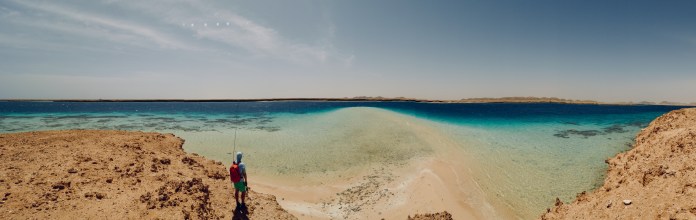
One day you’ll wade coastal flats, walking the seemingly endless shallows, all protected by a long barrier reef. Fishing both the actual flat, but also the reef, which is a bit more challenging. The reef can undoubtedly be extremely rewarding in terms of big fish.
The next day fishing off an island, with different habitats such as turtle grass, reef, coral, rock, with sandy areas in-between. Then onto another stretch of sandy flats, beaches, and rocky coast the following days.
We are always covering new interesting ground, teeming with marine life. Fishing in these ever-changing environments is hugely fascinating, and you often feel like you’re in an episode of Blue Planet, almost hearing sir David Attenborough narrating the scenes playing out.
The Fish Species of Sudan:
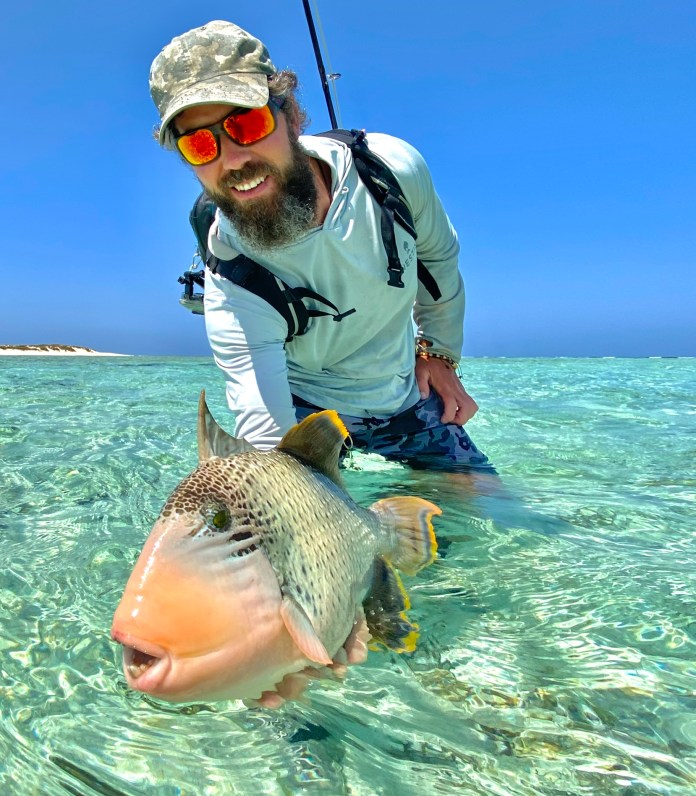
Most days you’ll find yourself casting at Titan and Yellow Margin Triggerfish, two fish that are guaranteed to make your brain boil.
Hardly any trigger is the same, and when you think you have figured them out, they will slap you in the face.
Of all fish I have targeted, I’d say the triggers are the ones that most often put me on an emotional rollercoaster. Lots of love and hate, all packed into a very compressed package.
The Bluefin Trevallies are also very much present on the shallow flats and are usually more than willing to eat anything that comes their way, be it a crab, shrimp, or a brushie. Greedy and fast as lightning, hard strikes, and even harder runs!
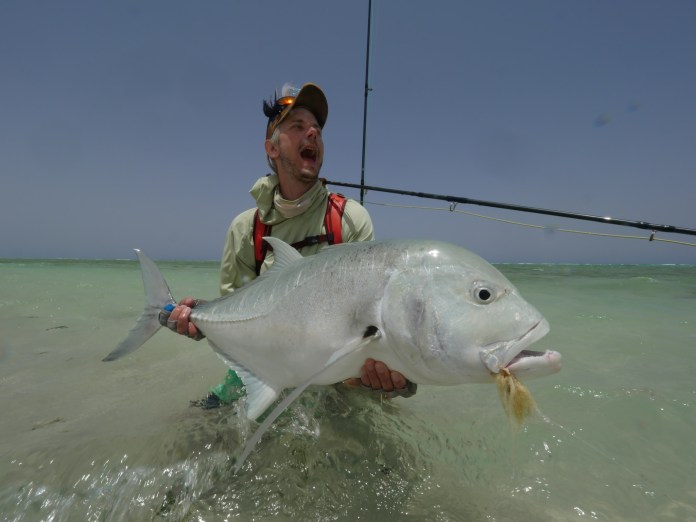
Then there’s, of course, the Giant Trevally and we always walk with a rod dedicated to the “gangsters of the flats”, usually armed with a 130lbs leader, and a fly tied on the strongest fly hook you can find. These fish will put both gear and the angler to the test! The stories of broken lines, broken hooks, broken rods, and broken men are endless.
I guess the craziest grand-slam of GT fuckups I’ve ever heard of, happened to a friend of mine on our March trip last year. When he pulled the spectacular stunt of breaking his rod, his line, and his hook, ALL on the same fish!
The GT has a reputation of being a mean bastard for good reason, making overpowering these brutes on a fly rod feel even greater.
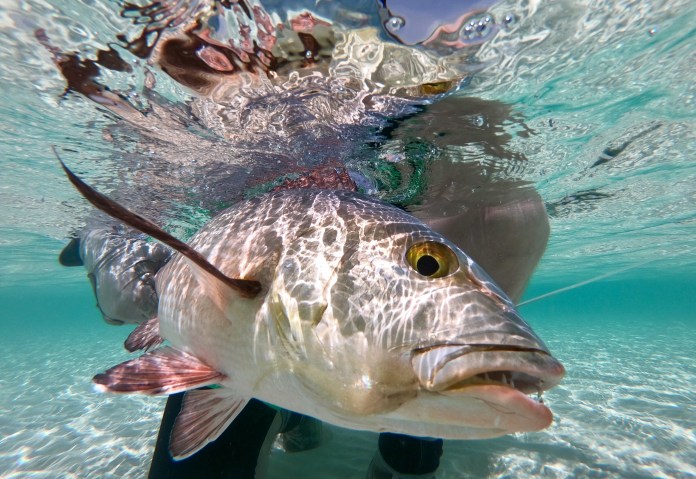
In addition to the “usual suspects,” the Nubian Flats also offers a multitude of other species such as Bonefish, Indo-Pacific Permit, Milkfish, Bumphead Parrotfish, Napoleon Wrasse, Bohar Snapper, Barracuda, and more species than you can shake a fly stick at.
For those feeling adventurous, there’s also the possibility of targeting Dogtooth Tuna with heavy sinking lines and dredging flies. The doggies are abundant near the reef drop-offs and will hit a fly with unmatched brutality.
History of Fly Fishing in Sudan:
Divers have been coming to this part of the Red Sea for a long time. But it wasn’t really explored by anglers until Nicola Vitali and Federico Castignoli, of Wild Sea Expedition, set their eyes on this untouched area in 2011. An area which still to this day is pristine.
Sudan is not really a fishing nation, and the only “commercial” fishing we ever see is a couple of guys in a panga, with hand-lines, or cast-nets. Something that is in stark contrast to the raping one, unfortunately, see many other places around the world. Since the Sudanese coast is full of reef and coral, it is not an easy place to be netting or long-lining. So nature’s natural “walls” of the reef is helping to keep it free from pesky intruders.
Travel to Sudan:
Traveling to Sudan has been very easy. And Sudan should not be confused with South Sudan, which is a different country, with kind of a bad ring to it.
There’s a direct flight from Cairo to Port Sudan. Visa and paperwork are taken care of by a Sudanese agent and it is handed out upon arrival in Port Sudan. Then, after a short mini-bus ride to the port, you’ll find yourself on the yacht, ready to sail off to the realm of the Giant Trevally.
Its hard to believe that we are in the month of May already. This year just seems to be flying by, therefore you should be taking advantage of the fishing to be had. Depending on where you live, the ice has melted off and lakes and rivers are in prime condition. In this tips and tricks video of the week, Tanner of Trouts Fly Fishing highlights the top 5 flies for the month of May.
Black or dark wooly buggers are an excellent pattern to jig through weed beds in lakes and rivers.
Works very well with a strip retrieve.
The heavy tungsten bead and jig hook allows this fly to get down quick which is great for fast moving water or deep still water lakes.
There you have it, 5 flies to get you through the month of May. Try different sizes and color combos until you find what works best for you. Honestly, it is a game of trial and error but the time trying will pay off when you find what works.
Ten years ago, RepYourWater was a hat and an idea in the minds of two people. Now, thanks to Corinne and Garrison Doctor, it is a widely known and impactful company in the fly fishing industry. Corinne helped build this company from the ground up, all while teaching high school Spanish full-time. Now, ten years later, she has moved on from teaching and is working full-time for the company that they started together; fishing, traveling, and doing what she loves each and every day. Check out the full Women on the Water interview below.
Flylords: Tell us a little bit about yourself, who are you both on and off of the water?Â
Corinne: I was born and raised in Boulder, Colorado, a very outdoorsy town. As a family, we did the typical camping and hiking adventures, but fishing and hunting weren’t part of our immediate family traditions. I started fishing when I was dating Garrison, who is now my husband and business partner, almost 15 years ago and never looked back. Together we started RepYourWater while we both were working other jobs. I was working as a high school Spanish teacher which I loved, but it became clear that my path was meant to be in the fly fishing world full time.
Flylords: Are there any fly fishing experiences or moments that have shaped you as an angler or as a person?
Corinne: Most of my early fly fishing experiences were just with Garrison, and like most novices, I was pretty self-conscious about what I couldn’t do. One of the first times we fished with one of our friends he offered me one simple little tip and I realized it’s not so scary, not so intimidating. Since then I have picked up new little tips and tricks almost every time I fish with new people because we all have different backgrounds, favorite flies, favorite techniques.
Flylords: Do you have any specific personal goals regarding fly fishing? Any bucket list fish or destinations?
Corinne: I have always loved traveling, especially to Latin America because of my background in studying Spanish, and when fly fishing and travel came together for me, it was hard to not think of that next trip. 2020 provided lots of time to think about that next trip, as we were not able to go anywhere because of COVID. We will be adventuring to Iceland early summer this year, back to the Bolivian Jungle in early fall, and who knows what will happen after that. As far as bucket list fish, I just want to keep tallying up new species. Certainly, the big names like GTs (Giant Trevallies) get me excited, but I caught my first Yellowstone Cutthroat recently and that made me pretty happy as well.
Flylords: What is the story behind RepYourWater? Where did the inspiration to start the company come from?
Corinne: We are about 10 years old now and it all started with one hat. My husband Garrison is an artist and designer and during the recession in 2008, he started doing some guiding on the side. As he spent more time in shops, he started noticing that there weren’t options for hats other than wader or sunglasses brands or the fly shop hats. There wasn’t anything in between that just said “I love to fish†or “I love to fish in Colorado.†Now we have a whole lot more than just one hat, but it is cool to think back on how one little idea can become a real job.
Flylords: In ten years, where do you imagine RepYourWater will be? What about you?
Corinne: Since we started with one hat 10 years ago and now we have a vast expanse of apparel and accessories, ten years from now I imagine things will much different. What likely won’t change is our focus on beautiful designs and supporting conservation for fish and fisheries.
Flylords: How has being a woman impacted your experiences in the fly fishing industry?
Corinne: Women, more so than men, innately doubt themselves. So when I described earlier that I only thought about what my skills were lacking, a man with my same skill set would probably focus on what he could do. That is how women have been trained. Also, because I have a place in the industry as more than a participant; I have been afforded some awesome opportunities to speak to groups about public lands, lobby on Capitol Hill in DC, and be elected to the board of the American Fly Fishing Trade Association. I am qualified for all of those things beyond my gender, but because I don’t look like stereotypical fly anglers, I stand out a little bit and as a result have been able to share my voice.
Flylords: As an industry and sport, what can we do to be more inclusive (race, gender, age, etc.)?
Corinne: The first thing is to recognize that historically, fly fishing has not been inclusive. I don’t believe anyone sought out to have walls up, but that was the result. The second step is to realize that there is room for a diverse group of participants, ideas, techniques, beliefs, conservation goals, and so much more. We already have one thing in common, a love of fly fishing; that can be the starting point for having conversations about how we all have a place in this sport.
Flylords: How can we use social media to create a more positive fly fishing culture?
Corinne: The number one thing I say about social media is that it needs to be authentic. Make sure what you post aligns with your story, the photo, your conservation ethic, etc. Some people will never be happy with social media, either on the side of the person posting or the person commenting or viewing. If you are posting a photo of a fish you are proud of or taught you something or just made you laugh, say that, do that, don’t make it anything that it isn’t.
Nothing like trout and fall colors. Photo credit: Josh Duplechian
Flylords: What advice would you give a woman or young girl who is just starting to fly fish?
Corinne: For anyone starting to fish, I would use the same advice I use for someone learning Spanish: just do it, use it, try it. There are bad apples everywhere, but in my experience, if you are trying (in an authentic way) to connect with something that someone else loves, they are going to be there to help you out. Like I learned 15 years ago, the people that love to fish love to do it because it relaxes them, challenges them, gets them outside. They will be there to help you, give you tips, and even hold your hand while you wade across the river to the next run.
Thanks so much to Corinne for the time, you can follow along with her at @csd817. Be sure to check RepYourWater online, and follow along with them on Instagram at @repyourwater.
My Evolution R Salt arrived right on time for a trip to Florida. I had no doubts that a reel with “salt†in the name would be able to handle everything I could throw at it whether on the boat or sight fishing from the beach. At the time this was the nicest reel I had ever purchased, the Evolution R Salt 7/8 retails for $595.00. I am a firm believer in “You get what you pay for!” and with the Evolution R Salt, you get quite a lot.Â
The build quality on this reel is an amazing accomplishment. It’s a large arbor reel and built like a tank but all the while it doesn’t feel heavy. One thing you will notice immediately is the drag knob is not your typical drag knob. You almost don’t even realize it’s there, it just looks like it’s part of the frame. For me, I love this design and I think it works very well. I really liked using my palm to adjust the drag and if you must it is just as easy to adjust using your fingers. One of my favorite features is the micarta handle, it is super grippy when wet. It is so much more durable than wood and has way more grip than metal.Â
One thing for certain, the drag on this one has some stopping power. It has a sealed 16 disc drag system that is more than adequate to put the brakes on a fish. I know from reading its specs it has a proprietary carbon disc and stainless steel drag system that is double the stack of the Evolution R. Simply put, the reel feels like it could stop a truck. I had a very large king mackerel take a Clouser minnow and had it not been for the exceptional drag system, I probably would have been spooled very quickly.
One of my favorite fish to sight fish from the beach is pompano, permit’s little brother. They are powerful fish and will put a nice bend in the rod and cramp in your forearm. Listening to the Evolution R Salt sing as the pompano peel off the line was like music to my ears, the reel has a great sound. The large arbor really picks up line quickly, which was super helpful when a couple of fish decided to u-turn and come back at me. I spent most of my mornings and late afternoons of that trip walking the beaches sight fishing along the sand bars. I was alone most of the time and while unhooking a fish or taking a break my rod and reel would end up in the sand. A quick dip and shake in the water would clear any sand and I never once had any issues. At the end of each day, I would simply give the reel a good rinse with some freshwater and hang my rod back up till the next morning. I find the Evolution R Salt to be very low maintenance which I right up my alley.
 I usually only get to the beach a couple of times a year and in between those times, I usually use this reel for carp, pickerel, pike, and steelhead. The drag on this reel has bested some rowdy carp and has a way more than enough power for pike and musky. For steelhead, I find this reel incredibly beneficial because of the sealed drag. When temps get as cold as they do in Steelhead country, a frozen up reel can end a day very quickly. If you do plan on fishing salt and freshwater this reel can meet all the demands. Â
If you plan on getting a new reel that can handle the demands of saltwater fishing make sure to do yourself a favor and check out the Ross Evolution R Salt.
Article and photos from Landon Brasseur, an avid angler based in upstate New York. He spends most of his time fly fishing the small creeks of the Catskills for trophy trout. Give him a follow on Instagram at @lbrasseur.