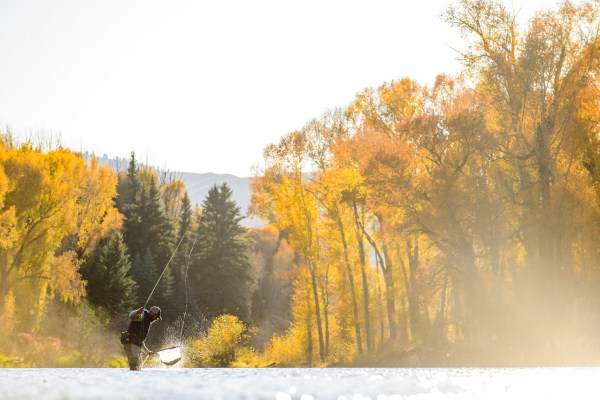
From a River Runs Through It, to fan-favorite cartoon, Rick and Morty, for an avid trout angler, it’s always fun to see fly fishing in mainstream media. Sometimes it’s tastefully executed, and other times it’s extremely awkward and can ruin a scene, commercial, or movie very quickly (although can be very funny). Here, we put together a list of some of our favorite TV shows, Movies, and Commercials where fly fishing and (trout) have made appearances.Â
Did we miss any you have seen, leave a comment below!
Rick and Morty
Fly Fishing Rick makes an appearance in the Oval Office, declaring to the president he is not hostile because he is wearing fly fishing garb.
Yellowstone
In this episode of my personal favorite TV series, John Dutton takes his grandson, Tate, fly fishing. Kevin Costner, who plays Dutton, drops an all-time quote, “Trout are like bankers, they don’t do a damn thing in the morning”.
A River Runs Through It
This list would not be complete without “A River Runs Through It”. It is the most quintessential fly fishing media to ever exist. We should have just provided the full movie as a link, but we exhibited self-control and only provided two clips.
Salmon Fishing In Yemen
You want to put salmon, where?
Boston Legal – Pacific Salmon
This clip from Boston Legal is spot on, and timely, especially with the current situation surrounding Pacific Salmon. Although this specific scene is not focused directly on trout, many of the points made directly reflect circumstances facing steelhead and trout around the world.
In addition to their features in TV and film, fly fishing and trout have made some interesting appearances in commercials as well.
In this week’s “How to Tie†video feature, Troutcastz gives us a tutorial on how to tie the Drunk and Disorderly streamer, one of the most infamous big trout magnets in fly boxes today.
Difficulty: Hard
The Drunk and Disorderly(D&D) streamer is a fly developed by Tommy Lynch out of Michigan. From the How to Tie series, this may be the most difficult yet. This fly incorporates a couple of key features that allow it to swim and attract big fish effectively. The Drunk and Disorderly includes two hooks, which allow the fly to bend and swim in the water as if hurt or distressed. Paired with a deer hair head, this fly slides, rolls, and dives through the water column.
Movement is what separates the Drunk and Disorderly streamer from others in its class. Different stripping retrieves when fishing this fly will allow you to key in on what those hungry trout want, and territorial trout loathe. The beauty of the Drunk and Disorderly is that its ingredients are where half of the movement comes from. Using a sinking line will get this streamer into the feeding zone and using the rod to influence movement in the fly while stripping back in will ensure erratic behavior on days when needed.
Using different colors is also a fantastic way to change tactics during the day. Traditionally, light on light days and dark on dark days is the color pattern scheme to follow, but do not be afraid to stray from this. It is important to remember that throwing streamers often results in a predatory response to kill as much as actual hunger. Take your time tying the Drunk and Disorderly. These flies are not the minute-fly nymphs that you can lose five in a day and not bat an eye. Profile while tying this streamer will ensure your time on the vise was not wasted and to make sure your Drunk and Disorderly produces those big fish that it is known for.
Ingredients:
Rear hook:
Hook: Ahrex NS122 #4
Thread: Textreme Powerthread Small
Flash tail: Flashabou – Bronze
Body: Textreme Long Hair Holo – Pearl White & Rabbit Zonker – White
Back: Flashabou – Bronze & Mallard – Wood Duck
Connection: NTS Wire & Fl Orange bead
Front hook:
Hook: Ahrex TP605 #1
Thread: UTC GSP 100D Black
Flash tail: Flashabou – Bronze
Body: Textreme Long Hair Holo – Pearl White & Rabbit Zonker – White
In honor of World Rivers Day, a celebration of the world’s waterways, we wanted to highlight 5 waterways in the Continental United States for multi-day float fishing trips. These trips are a great way to experience what a specific watershed has to offer and enjoy some quality time with your friends.
If you have ever fly-fished in Colorado, you have probably heard of the Upper Colorado River. The river’s headwaters begin at the Continental Divide of the Rocky Mountains just outside of Rocky Mountain National Park. The Upper Colorado River is a popular destination for recreation of all forms from rafters and kayakers to anglers. The Upper Colorado River’s fishery is world-class consistent fishing from the spring into the fall. Anglers can expect to catch rainbows and browns, with some rare brook and cutthroat trout mixed in.
Photo: Dan Zaz
Unlike many of the other rivers on this list, you do not need a permit to float the river or camp on the Upper Colorado River. Camping on the river is regulated under a first come first serve policy. With this in mind, the Upper Colorado River can be quite busy, especially on weekends in the summer. This river is great for less experienced multi-day floaters as you can do shorter trips like one night floats. For more information on the Colorado River check out the BLM website here.
Oregon’s Lower Deschutes River is famed for its summer steelhead, chinook salmon, and native redband rainbow trout. This federally designated Wild and Scenic River originates high in Central Oregon’s Cascade mountain range, where it flows 252 miles into the Columbia River.
The “Lower Deschutes River” begins below the Peloton Dam Complex and flows 100 miles long to where it converges with the mighty Columbia River. This section of the Deschutes River is most popular for anglers and multi-day floaters. It provides anglers with a tailwater fishery that offers year-round fly fishing opportunities. There are various different sections to float with many Class III and Class IV whitewater rapids as well as a mandatory portage at Shearers Falls. For floaters, you need to obtain a BLM permit in order to float the river. You cannot fish from the boat when floating the river, so anglers fish the river from the bank. The most popular times to float fish the Deschutes are in the late spring during the Salmon Fly Hatch and the fall when the steelhead are in the river. Another unique aspect of the Deschutes River is part of this section of river is on the Warm Springs Indian Reservation.
3. The Smith River
Montana’s Smith River is one of the most coveted multi-day float trips in the West. With only one put-in and one take-out along the 60 mile stretch of water, the Smith is renowned for its scenery and quality trout fishing. It is located in Central Montana, where it flows into the Missouri River.
Unfortunately, for anglers looking to experience the Smith, the lottery system can be tough to score a permit. But when you do draw the permit, it is a trip you will remember. The privacy and limited use of the river allow for an intimate experience. For more information on getting a permit to float the Smith River check out the link here.
2. The Rogue RiverÂ
This Southern Oregon River flows from Oregon’s Crater lake 215 miles to the Pacific Ocean near Gold Beach. The 84-mile long Wild and Scenic Lower Rogue River was one of the original rivers designated under the Wild and Scenic Rivers Act. The river is famed for its abundant steelhead and salmon runs and whitewater rapids. Anglers can float and camp along the river or stay at one of the historic lodges.
For anglers, the summer months are not the best time to float the Wild and Scenic section of the Rogue, as warm water temperatures and low flows are present, but in the fall and in the spring the steelhead fishing can be exceptional. To float the Wild and Scenic Section of the Rogue floaters must obtain a permit from May 15th-October 15th.
Central Idaho’s Middle Fork of the Snake River might be one of the most beautiful places on the earth. The 104-miles of crystal-clear water flows through the heart of the Frank Church-River of the No Return Wilderness. This Wild and Scenic River is popular among white-water enthusiasts for its Class III and Class IV rapids–not to mention the abundant fishery of cutthroat trout that will eat a dry on almost every cast.
Photo: Asa Menlove
A permit is required year-round to float the Middle Fork of the Salmon River, there are only seven permits a day are allowed, so again this river provides you with an intimate experience in an untouched wilderness area.
Welcome back to Trout Week. Today is World River’s Day, and we’ll be bringing you river-themed content all day. Speaking of rivers, Colorado’s Gold Medal waters are known by many. Quite simply, they are the most productive trout waters in the state–and some of the best in the country–that are accessible to the public. However, conserving and maintaining these waters for the future offers new challenges, which Trout Unlimited’s Colorado Gold Coalition seeks to overcome. TU’s Colorado Gold Coalition includes brands like NRS, Fishpond, Airflo, RepYourWater, and Abel and Ross Reels.
Colorado’s Gold Medal program is a state project, managed by the Colorado Parks and Wildlife (CPW). Currently, the program recognizes 11 bodies of water throughout the state, totaling 322 miles. These waters include: four miles on the Animas River, 27 on the Gunnison, and Gore Creek. While CPW has managed these waters effectively for decades, there’s no reason they should be the only voice for conservation, especially as Colorado’s population and tourism industry both face similar explosions.
RepYourWater on the Colorado River, Josh Duplechian, TU
“Colorado Parks and Wildlife does an incredible job of managing our fisheries,” said Trout Unlimited’s Colorado Coordinator, Scott Willoughby. “But our rivers, lakes, and fish are seeing more pressure than ever before and our Gold Medal trout waters are on the front lines, facing the cumulative impacts of climate change, development, dewatering and seasonal overcrowding.”
The Blue River in Summit County, CO, serves a perfect example. The Blue River between Dillon and Green Mountain Reservoirs is a storied high-elevation tailwater with close access to Colorado’s Front Range and is a significant contributor to the $36,000,000+ local fishing economy. The river, however, experienced a significant decline and lost its Gold Medal designation in 2016 due to a variety of factors. Development, increased pressures, and changing stream conditions appear to be the likely culprits. Currently, scientists and local patterns are working to better understand these issues, but they need support.
The Flylords’ crew on a shoot on the Blue River
The Blue to Gold Campaign is an offshoot of TU’s Gold Medal Program to restore the Blue River’s beauty and productivity. The campaign is a partnership between TU and The Blue River Watershed Group, which seeks “to promote, protect, and restore a healthy Blue River watershed through cooperative community education, stewardship, and resource management.”
Part of this program is to discover science-based explanations for the Blue River’s downfall. To that end, the Blue River Integrated Watershed Management Plan (IWMP) has already invested $250,000 during the first phase in 2019-2020. The groups are working to secure funding for the final stage of research needed to identify the problems with the fishery. They’re looking for $25,000 in independent contributions to fully leverage the $185,000 in state and local funding. Full funding will support essential studies, including seasonal macro-invertebrate and periphyton sampling, as well as an assessment of stream flow and channel morphology.
What’s happening on the Blue River is happening on other premier, Colorado rivers. Scott highlighted several others: “We’ve seen the impacts of abandoned mines and wildfire
on the Gold Medal waters of the Animas near Durango, watched portions of the upper
Colorado struggle for decades as we work to build a bypass around the Windy Gap reservoir and reconnect the river channel atop a Gold Medal reach, and see resort-town streams like Gore Creek in Vail listed as both “impaired†and “Gold Medal†by the state.”
Arguably, Colorado sports one of the strongest fly fishing pedigrees in the country. Unless the state, its anglers, and advocates protect and enhance that heritage, however, it may be lost. Strengthening protections for Gold Medal waters, restoring de-listed waters, and expanding quality trout habitat will help safeguard more Colorado fisheries while redistributing pressure on a currently limited resource.
“Gold Medal designations set the standard for high quality trout fisheries across Colorado,†said David Nickum, Executive Director of Colorado Trout Unlimited. “By strengthening the protections surrounding Gold Medal waters, bringing declining fisheries back up to capacity, and recognizing other deserving rivers and lakes among Colorado’s signature trout waters, we can help CPW broaden the scope and raise the standards for trout fisheries statewide.â€
The Colorado Gold Coalition is working to establish a direct connection between anglers and the waters they fish, embedding conservation ethics into the message. But they need your support. Head over to ColoradoGoldMedalWater.TU.org today to join the movement and learn more about Gold Medal waters.
A Great Way to Get InvolvedÂ
Go to an Angry James Brewery dealer and Pick up the Rain, Sleet, and Hail Pale Ale.
Photo Courtesy of Ben McCormick
Angry James Brewery and Cutthroat Anglers own Jacob Lutz created the Rain, Sleet, and Hail Pale Ale as an ode to the three mountain peaks in the Gore Range that feed into the Blue River Watershed. $1 from each beer sold will be donated to the Blue River Integrated Watershed Management Plan.
The science is clear: the Snake River’s wild salmon and steelhead are heading towards extinction–that is unless we enact meaningful change. Dams, water quality, ocean conditions, climate change, and anglers–yes, we do have an impact–contribute to the possibility of extinction. However, anglers, river advocates, and everyday individuals from the biggest cities or the smallest towns can help save the Snake River. They can also preserve the tradition, history, and importance wild salmon and steelhead represent for long into the future.
Wild salmon and steelhead in the Pacific Northwest are strong, resilient fish. Their genetic diversity and dispersed spawning timelines makes them remarkably resilient from poor conditions one year to another. However, both salmon and steelhead require quality habitat and rivers–and in times of alarm, left alone. A restored Snake River system provides wild salmon and steelhead with hundreds of miles of quality cold-water spawning and rearing habitats, but the dams need to go.
The 1,078 mile Snake is a wild, storied river. It originates in western Wyoming and flows through Idaho, Oregon, and Washington, before merging with the Columbia River and ending in the Pacific Ocean. The Snake was once considered a top salmon producing river in the world and accounted for half of all the Chinook salmon in the Columbia River Basin. Throughout that long, meandering river system, dozens of dams slow river flows, impede or flat-out prevent migrations, and create precarious warm-water caldrons for native species. Of the many dams, four federally managed dams have been most associated to the wild salmon and steelhead declines, and their removal represents the greatest chance at restoring these fish.
Ice Harbor Dam Construction, U.S. Army Corps of Engineers
The four lower Snake River dams–Ice Harbor, Lower Monumental, Little Goose, and Lower Granite–(LSRDs) are outdated, inefficient, and killing off wild salmon and steelhead. For one, their original intended use was for barge transportation, not power generation. Because the LSRDs don’t have large storage capacity, they are usually unable to operate at full generating capacity in late summer and winter, when power demand is the greatest. Additionally, while clean, reliable power alternatives may not be fully deployable today, that technology will be available soon and foreseeable by the time the dams come down (2031, in Congressman Simpson’s plan).
“It’s been 46 yrs, since the completion of Lower Granite dam, the last of the four lower Snake River dams, to get things right. The fact remains the same, steelhead, Chinook ,and sockeye remain on the Endangered Species list. We are no closer to delisting them today than the day these species were listed.â€
-Eric Crawford
Nancy Hirsh, the executive director for the NW Energy Coalition, said the best path forward is to breach the four lower Snake River dams. She said that while the technology perhaps isn’t yet ready for prime time, by the time breaching is a reality, it will be.
Removing the dams is essential, because they’re blocking nearly 140 miles of prime spawning and rearing habitat from salmon, steelhead, and other migratory species. The impact of the more than 50-year old dams cannot be ignored. “Since 1975 when the eight dams (four on the lower Columbia River and four on the lower Snake River) were completed, return rates have only rarely exceeded the 2 percent survival minimum.” The Snake’s wild Sockeye and Chinook salmon and steelhead are endangered or threatened under the Endangered Species Act. Further, the Snake River was listed as America’s Most Endangered River in 2021.
“For 50 years, we have tried barging fish, increasing spill over the dams, producing hatchery fish, and implementing dozens of other mitigation efforts,” said Greg McReynolds, TU’s Intermountain Regional Director. “But the fact is that since the construction of the dams, we have never been able to get enough adults to the Snake River’s high-quality spawning waters to keep these fish off an extinction trajectory.”
Salmon used to thrive in Idaho. As legend goes, salmon were the reason for the Snake River’s accidental naming convention. The river’s name came from an S-shaped hand sign made by members of the Shoshones tribe. European explorers misinterpreted this hand sign, which is now thought to have truly meant, “the people who live near the river with many fish.â€
Recovering these fish to their historic abundance will be difficult and expensive–it already is. Eric Crawford, TU’s North Idaho Field Coordinator, said “even with over $17 billion spent on mitigation for the impacts of the four lower Snake River dams and those on the Columbia, we are still seeing reduced opportunity and even closures.â€Â But Snake River salmon represent so much culture, history, and opportunity that their recovery may just be possible.
Wild Salmonids Struggling
While multiple factors contribute to declining salmon and steelhead, the dams have the largest impact. The obvious impact is on adult salmon and steelhead returning from the ocean to spawn hundreds of miles upriver. However, the impact on smolts–juvenile steelhead or salmon– is arguably greater. The few fish that do run the gauntlet and successfully spawn leave grim prospects for their offspring.
Pre-dam construction, smolts would swim downriver with the help of a strong current, thrusting them strong and healthy into the vast ocean. Today, however, they have to navigate a series of slow moving, torturously hot reservoirs created by the dams. In addition, the luke-warm reservoirs encourage non-native predators, such as smallmouth bass and walleye, adding another layer to the ever-growing field of threats for salmon and steelhead survival. In sum, the successful life cycle of Snake River smolt is far more difficult to complete today than 60 years ago, pre-dam construction.
Ice Harbor Dam, Army Corps of Engineers
Among scientists, salmon and steelhead are often measured by a smolts-to-adult return ratio (SAR). In order to sustain salmon and steelhead runs, a certain amount of adults need to return to their native runs and successfully spawn. Scientists agree that two percent of smolts need to return to sustain wild salmon and steelhead populations. In order to rebuild stocks, however, the SAR needs to be closer to six percent. In the past 25 years, “despite restrictions and closures, SARs have failed to reach even 2 percent.”
The Snake River Basin presently contains 50 percent of the coldwater habitat available to salmon and steelhead in their native range in the Lower 48 — much of it in protected public lands of high quality — and that is predicted to rise to 65 percent by 2080
The decline of wild salmon and steelhead has occurred despite more than $17 billion spent on efforts to recover the fish
It is our collective opinion, based on overwhelming scientific evidence, that restoration of a free-flowing lower Snake River is essential to recovering wild Pacific salmon and steelhead in the basin.
Similar calls for action are heard among the outdoor recreation and conservation communities. Patagonia got involved with its Free the Snake Campaign, back in 2015. NRS (Northwest River Supplies) Marketing Director Mark Deming, wrote, “We need to keep these rivers working for the people of the Pacific Northwest and utilize them to keep the people of the Northwest working. I believe that the best way to do that is to decommission the four increasingly costly dams on the Lower Snake,” in Paddling Life. TU and its many partners have engaged on the Snake River for years, but the situation and need for action has never been more dire.
Snake River steelhead, Josh Duplechian
Something has to give. Dean Finnerty, Of Wild Steelheaders United, wrote, “While a changing climate is a major factor in these declines, there are actions we can take to preserve stocks, most urgently by strengthening connections to pristine cold-water spawning habitat in the Snake Basin via the removal of the lower four Snake River dams.”
So, with scientific support for removing the LSRDs to save salmon and steelhead, why haven’t they come down yet? The dams support several key industries in the northwest–shipping, agriculture, and electricity generation. Much of the opposition to removing the dams stems from these industries, and has, for decades, fueled The Salmon Wars, a seemingly-never ending legal saga between salmon advocates and dam proponents.
American Rivers’ President, Tod Kiernan, lays it out simply: “We’re facing a critical choice on the Snake River. We can either stay with the status quo, which means failing salmon runs, more costly litigation, increasing energy insecurity and broken promises to tribes. Or we can choose to invest in salmon recovery and infrastructure solutions that create a future of abundance and prosperity for the region.” This shift took hold in the first few months of 2021.
Congressman Mike Simpson, a Republican from Idaho, unveiled a new approach to the Snake River dam discussion this past February. Rather than maintaining the status quo, which resulted in millions of dollars, countless court battles, polarization, and few signs of recovery, Simpson hopes to forge a lasting compromise. The Congressman’s Energy and Salmon Concept would remove the LSRDs and keep the affected industries whole. “Congressman Simpson’s proposal is bold and demonstrates the kind of leadership we hope for in our elected leaders,” wrote Chris Wood, President and CEO of TU. “[He] is proposing the single largest river restoration in the history of the nation, and doing so in a way that would leave behind none of the communities of place or interest that today depend on the dams.”
Idaho’s Salmon River, a Snake River tributary, Josh Duplechian
The plan for Simpson’s $33.5 billion concept was to fold it into a broader infrastructure legislative package. Unfortunately, the plan failed to gain much attention nor support from the region’s Members of Congress. “Rep. Mike Simpson has provided a once in a lifetime opportunity to recover salmon and steelhead in the Snake River basin,” Eric Crawford said. “And yet, we haven’t seen support from any other elected official other than Rep. Early Blumenauer (D-OR).â€
This summer proved to be a worst case scenario for wild salmon and steelhead in the Pacific Northwest. Ocean conditions weren’t ideal, drought took commanding hold through much of west, and record high temperatures on the lower Snake River compounded with an abysmal run of fish. Preliminary steelhead returns were the lowest on record and aren’t showing much sign of improving. So, what little fish made it out of the ocean had to beat the odds of safely passing numerous dams, angling pressure, and dangerously warm waters.
Washington, Oregon, and Idaho have all enacted emergency measures in response to the record-breaking low runs. We’re patching the leak, rather than fully addressing it. “These closures and short-term changes to how and when anglers can fish for summer steelhead are merely delaying the inevitable collapse of the species unless we address the primary limiting factors to recovery,” said Finnerty. Â “A longer-term solution is needed to rebuild these populations and achieving that will require collaboration between all angler user groups, fishing guides, agencies, and tribal co-managers. Anglers need to speak up and tell managers that we demand management decisions that favor caution in these times.”
Endangered Snake River sockeye salmon, NOAA Fisheries
The trends among wild Snake River sockeye and chinook salmon were similarly precipitous in recent years. The New Perce Tribe concluded that 42 percent of the Snake Basin spring/summer chinook populations are at quasi-extinction levels (less than 50 fish), and 77 percent of the populations are predicted to follow suit by 2025.
“We view restoring the Lower Snake River—a living being to us, and one that is currently injured—as urgent and overdue,” stated Mr. Shannon F. Wheeler, Nez Perce Tribe Vice-Chairman. “This is indeed an opportunity for diverse regional and political interests to come together for a better and stronger future for the Northwest: river restoration and salmon recovery; local and regional economic investment and infrastructure improvement; and long-term legal resolution and certainty.”
The record swings and dramatic headlines we’re seeing lend to one of the problems surrounding salmon and steelhead recovery: the shifting baseline. Most of the populations of wild salmon and steelhead in the lower 48 are mere fractions of their historic abundance–single digit percentages, in most instances. This fuels the shifting baseline issue, because current-day anglers have no conception of what it was actually like and celebrate a good year’s run or two. When in reality, that “Best run of steelhead in years,” which are often measured on a ten-year running average, is still minuscule in comparison to the pre-dam runs.
This is why sustained advocacy is so important for restoring these runs. “Anglers need to be engaged,” Eric Crawford said. “I’m not just talking about years when runs suck but all the time. If you want a future with abundant salmon and steelhead in the Snake River basin you better be engaged daily.â€
Fishing on the Salmon River, Josh Duplechian
Saving wild Snake River steelhead and salmon is not just about fly fishing. It’s about reconnecting a river to local communities and tribes, river rats, tourists from thousands of miles away, but mostly because it’s the right thing to do. All these fish need is a fighting chance, and they’ll storm back. Conditions for wild salmon and steelhead will likely remain challenging as marine and aquatic ecosystems face the impacts climate change. But to throw in the towel is asinine. In light of the challenging future for these fish, the logical response is to give them the best chances possible to return to their natal gravel beds, spawn, and send millions of smolts down-river to do it all over again.
Reconnecting the Snake River, will be a long process. But look at the fight to save Bristol Bay–it by no means happened overnight. But today, Pebble is essentially dead, and the Bristol Bay area is on the verge of securing Clean Water Act protections, because of sustained advocacy from concerned anglers like you. The Snake will require that level of involvement. So, tell Congress: “Time is running out for Snake River salmon and steelhead” today!
The United States has led the world in dam construction for the past 100 years. They are utilized for hydroelectricity, flood control, irrigation, and community water storage. While dams may help communities, they come with a steep price.
Not only do dams cost tens of thousands of dollars to maintain, but they also compromise water quality and connectivity. Fish are limited in their ability to search for food, ingress spawning habitats, or escape predation. Dams trap sediment which may smother redds and cause river flow to slow and water to heat up, leading to algal blooms. Continually, outdated and obsolete dams pose a safety threat to local communities. Yet, dam removal provides an opportunity for river ecosystems to flourish back to their natural state. Fish, birds, mammals, and community members alike all benefit from a healthy, connected watershed.
1. Elwha Dam – Elwha River, WA
After two decades of planning, the largest dam removal in the United States began in September 2011 and took 6 months to complete. Removal of the dam allowed for 45 miles of salmon species habitat to be connected, and the fish are storming back.
2. Clark Brothers Dam – Quinnipiac River, CT
Connecticut nonprofit, Save the Sound, spearheaded the removal of the Clark Brothers Dam in 2016. Over 16 miles of the river were opened to migratory fish such as striped bass, alewives, and American shad.
3. Noosak Middle Fork River Dam – Middle Fork River, WA
In 2020, approximately 16 miles of cool clean water were opened up for the Endangered Species listed Puget Sound salmon, steelhead, and bull trout.
4. Mill Dam & Powerhouse Dam – Cuyahoga Falls, OH
These two dams in Ohio were removed in 2013 due to their threat to public safety as well as water quality concerns. What was once considered one of the most polluted river systems in the U.S. is now the focus of regeneration and the establishment of free flow benefitting over 60 different species of fish.
5. Condit Dam – White Salmon River, WA
The removal of the Condit dam began in October 2011 and was completed in one year. After 100 years, 18 miles of river were made accessible to residential and migratory aquatic species.
Thankfully, today dams are being deconstructed faster than they are being designed and built. In locations where dams have been removed, the success of watershed restoration is extraordinary–just look at the Elwha River, where wild steelhead have made an extraordinary comeback. We hope to see an increase in removal across the country in the years to come. The introduction of the 21st Century Dams Act and publicity surrounding the four lower Snake River dams show that the fight has just begun.
It is no longer just an environmental issue but a movement that connects entire communities near and far to work together for something bigger than themselves. Countless successful removals show that we can all work together to fix the dam problem.
Another summer of record-breaking temperatures, river closures, mega-drought, and raging wildfires throughout the American West has come and gone. The impacts, however, remain perilous for trout and will require large-scale efforts to remediate and shore up watersheds. Scientists understand these complex and often interconnected impacts, but the frequency and intensity of recent droughts requires more questions, research, and solutions.
Drought’s Drivers
Drought is not some new phenomenon created by climate change. Ancient civilizations starved, and mass-extinction events occurred due to droughts. But that is no reason to shrug off what’s going on today—much to the contrary. We need to understand what’s causing droughts, how it may impact our lives and ecosystems, and develop plans to create resilient watersheds.
I know it feels like climate change may be the greatest scapegoat of all time. But think about how connected weather is to our daily lives. A storm that originated in the southern Gulf of Mexico, traveled north and brought record-breaking flooding to New York City and Philadelphia. Conversely, think about Lake Mead–the reservoir behind the Colorado River’s Hoover Dam. The lake is the largest reservoir in the country and supplies water for three states and some 20 million people. Due to the ongoing mega-drought and years of below average precipitation, the reservoir is at its lowest level in history. Our changing climate affects the planet in so many interconnected, complex ways, and drought is definitely one of them.
Drought can come in many shapes and forms, but our planet is changing, and droughts appear to be worsening. According to climate scientists, human-caused climate change causes, or exasperates, droughts for a variety of factors: hotter hots, longer and earlier summers, and shorter winters. A recent National Oceanic and Atmospheric Administration report on the 2020-2021 Southwestern U.S. Drought concluded that human-caused warming has made droughts more impactful.
Firefighters working along Dunraven Glade Rd, Cameron Peak Fire, October 17, Inciweb
A hotter planet encourages and intensifies droughts through more efficient evaporation and diminished snowfalls. According to the Yale Climate Center, “what might have otherwise been a mild or moderate drought in a cooler world will become, in a warmer world, more severe as a result of increased evaporation.†Snow has this one rule that it chemically has to follow—it has to be 32 degrees or colder to remain a solid. So, a warming planet, “increases the fraction of winter precipitation that falls as rain rather than snow and also shortens the cold season, so there’s less time for snow to even occur.â€
In a 2020 study in the journal Science, for example, researchers observed how human-caused climate change is contributing to the 21st-century mega-drought in the Western U.S. and Northern Mexico by evaluating trends in modeled temperature, relative humidity, and precipitation data between 1901 and 2018. According to the study’s findings, human-caused warming accounts for 46% of this drought’s severity.
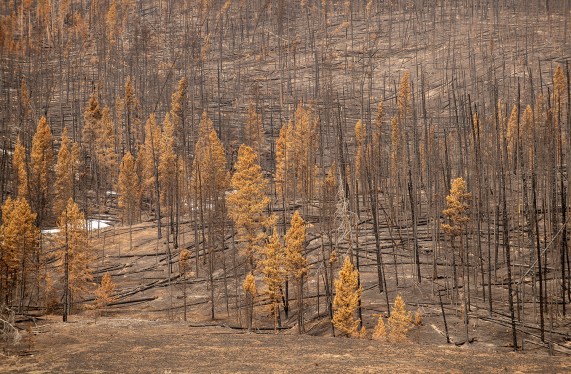
A burned hillside with scattered snow, Josh Duplechian
In the West, a primary indicator of drought is snowpack, which is also its main supply of water. Normal to above average snowfalls supply lower elevations with clean, cold water well into the summer. In Colorado, for example, snowpack provides 70 percent of the state’s water supply. TU’s Jay Chancellor, wrote about how climate change is impacting this: “Snow is melting between 15-30 days earlier than it was 25 years ago, which is leading to increased flooding and erosion and resulting in extended periods of summer drought.”
Colorado stands to lose six to seven miles of habitat on the Dolores River due to drought and poor snowfall; those stretches of river have literally dried up. The traditional slow, gradual replenishment from snowpack is crucial for watersheds and trout alike. Without strong snowpacks, watersheds and trout become increasingly vulnerable to mortality, disease, and climate change.
Ecological impacts
Over the past few years, some of the images of wildfires more closely resembled an apocalyptic video game rather than a planet that supports eight billion people. Wildfires increase and scale as droughts intensify. That’s part of the reason why we’re seeing amazingly destructive fires coincide with the West’s mega-drought. Visually, wildfires may seem the most destructive impact of drought—and they certainly are. But for trout, increased water temperatures, poor water quality, and low flows are a deadly trio that topple even the most resilient watersheds.
Temperature and water quality play an important role in trout lifecycles, and they’re heavily influenced by drought. We all know that trout need cold, clean water to survive and produce fishable populations. With an earlier and quicker snowpack melt off season, drought will encourage warmer water temperatures and lower flows, which does not fare well for trout nor the communities that depend on a strong fishing season.
Most species of trout begin perish or experience poor survival in waters warmer than 67 degrees, scientists have found. So, fishing in drought-stricken areas requires more attention to water temperatures, as temps may become hazardous for the fish. Additionally, as droughts increase and intensify, one can expect far more hoot owl restrictions or full-on closures.
A dry California riverbed, NOAA
The impact of drought on water quality is an evolving and complex field. Take for instance a dry, mud-caked hillside, A heavy rainfall in a drought year can produce intense erosion events and sedimentation, which have consequences for trout. Another consideration is how wildfire impacts a stream or river’s chemical composition. According, to the U.S. Geological Survey, wildfire can impact aquatic ecosystems by “changing in the magnitude and timing of snowmelt runoff and increased loading of streams with nutrients, dissolved organic carbon, major ions, and metals”
Additionally, droughts will put increased strain on existing water resources. This is especially true in the West, where water resources are over-allocated in normal years, let alone mega-drought years.
Is There Hope?
All this talk about mega-droughts, climate change, and withering trout is depressing, but important nonetheless. If we want to preserve trout species around the county and world, we need to understand these impacts and work together to discover ways to mitigate them. The current mega-drought will wane, as precipitation patterns change, but the drought drivers will persists and wait for the next period of low precipitation. That is why it is so essential to promote watershed resiliency efforts and responsible angling practices in drought.
“The best thing we can do is keep our waters connected [by getting rid of unnecessary dams, diversions and other impediments],†fisheries biologist and researcher Ashley Rust said. While climate change does appear to be playing a role, how we use water and alter watersheds plays a major role as well—and affects trout equally, if not more. It doesn’t take a rocket-scientist to understand that if we pump too much water from streams and rivers in normal climates, we’ll be in trouble come drought. Additionally, degraded or developed watersheds are far more susceptible to the impacts of drought. So, outside of the mammoth task of reversing climate change, creating resilient watersheds and reconnecting them will go a long way toward defending against the inevitable future droughts.
There is nothing better than fishing public waters, and the United States has a vast amount of public land and water. The federal government owns 640 million acres of land which is about 28 percent of the United States. Those acres make up some of the most beloved fishing spots in the world! Read below to learn more about the top six states for public land fishing access.
Alaska
It is no surprise that the last frontier has the most public land in the United States. Alaska is comprised of 223,803,098 acres of federally owned land. That is more acres than the entire state of Texas! A fun fact about Alaska is that all of the water, yes all, is public. There is no doubt that Alaska is the largest fishable state in the USA. Head up north for humongous rainbow trout, giant king salmon, and the biggest brown bears you’ll ever see!
2. Nevada
Nevada is the winner for the highest percentage of federally owned lands, coming in at a whopping 84.9%. Pyramid Lake is located in Nevada, and it is a world-class fishery that attracts thousands of anglers every year. Although Pyramid Lake is home to some gigantic Lahontan Cutthroat trout, there are also other great fisheries in Nevada. These rivers, lakes, and creeks are filled with all of the trout required for a Trout Royal Slam (Rainbow, Brown, Bull, Golden, Brook, Lahontan Cutthroat, and Mackinaw).
3. California
Almost half of California is federally owned, that is 45,864,800 acres. California is full of nature and there are nine national parks. Golden, rainbow, brown, and bull trout reside in many of California’s lakes and streams. The Smith River, Sacramento River, Hot Creek, and Mccloud River offer some of the best fly fishing. Winter Spey fishing on the Klamath and Smith for Steelhead is also an exhilarating way to use the public lands of California.
4. Utah
Utah has the second-highest percentage of federally owned lands, with 64.9% of the state under federal ownership. These lands are comprised of high alpine lakes, mountain streams, and roadside fishing spots. Utah offers a unique array of fishing locations for cutthroat trout, brown trout, muskie, kokanee salmon, and largemouth bass.
5. Idaho
The Gem State has 32,621,631 acres of federal land. Idaho is well known for its spectacular cutthroat and rainbow trout fishing. Rivers such as the South Fork Boise River, Henry’s Fork, and Snake River are amongst the best fishing rivers. Idaho is renowned for dry fly fishing, large trout commonly devour salmon flies and hoppers.
6. Oregon
The northwest state of Oregon is comprised of 52.9% federally owned land. This land is a place of love for Steelheaders. Fishing for steelhead in Oregon is no easy task, but those who layout a line can be rewarded with some beautiful fish. The public lands of Oregon offer more than just steelhead, there is also a healthy population of wild rainbows and bull trout.
The United States is comprised of millions of acres of federal land, and there is a multitude of public fisheries. Even if you don’t have a chance to fish in one of the top public-land access states, you should take advantage of the public lands in your own state. We encourage anglers to get out and support local public waters.
Coming this Trout Week, a redesigned, grassroots campaign will be at the forefront: Clean My Water. Clean My Water is an initiative designed to rally together all users of local waterways for the betterment of our backyards. Originally a brainchild of the North Georgia Trout Unlimited community, this movement has since caught the eye of Trout Unlimited folks across the nation. Join along as we make a difference in our local waterways.
Photo Courtesy of Winged Reel
Participation is easy and fun, aimed at getting you and your community outside doing what you love.
Go fishing on your favorite water body
Pick up trash on your way off the water
Snap a photo of your haul and slap #CleanMyWater and @cleanmywater on Instagram
Click the link for more information and be sure to follow along on Clean My Water’s Instagram because BIG prizes have your name on them!Â
Sad news coming out of the Vail Valley today. Over the weekend a large-scale fish kill hit two beloved tributaries in the valley, Gore Creek and Mill Creek. The kill’s suspected cause is a snowmaking solution holding tank that accidentally discharged into the two streams affecting 1,500 feet of both streams, leaving death in its wake.
After noticing the spill, Colorado Parks and Wildlife sent a team to investigate and they found a blue-grey tint to the water amongst the dozens of dead fish, some of which measured over 16-inches.
According to Vail Daily News, “Parks and Wildlife officials took water samples and recorded the totals of dead fish found, which included 85 mottled sculpins, one cut-bow, 16 rainbow trout, one brook trout, and 17 brown trout.”
Gore Creek has long been hailed as one of the Vail Valley’s most revered wild trout streams after many years of restoration efforts, and it’s a shame to see so much aquatic life lost in such a short window of time.
Holly Loff of the Eagle River Watershed Council remarked that the confluence of Mill Creek and Gore Creek was previously a very healthy piece of water.
She further remarked, “We don’t have all of the facts yet, so it is hard to know what happened. However, the report that I read said 85 mottled sculpin, one cuttbow, 16 rainbow trout, one brook trout and 17 brown trout were found dead. That diversity of fish, particularly with the high number of our native sculpin, which are food for the trout, is a sign that Mill Creek was pretty healthy in that stretch. This is really a shame and extremely disappointing after all of the restoration work and community education to improve the health of Gore Creek.â€
You can read more about the developing story, here.