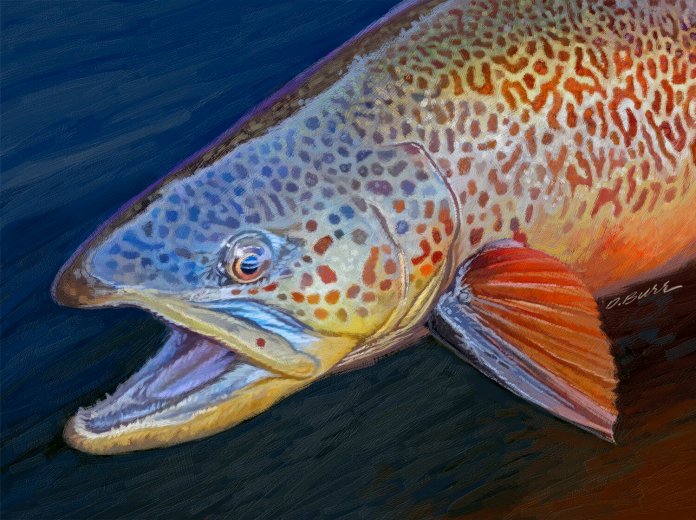
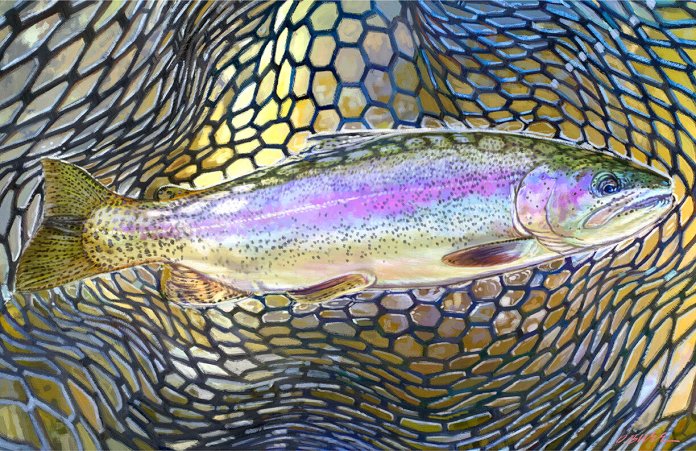
This month we met Dan Burr, a painter, illustrator, and fly fisherman located in Tetonia, Idaho. Thanks to his talent, experience, and training, Dan has built a successful career painting and illustrating all types of subject matter. His book illustrations and paintings portray everything from pirate ships to historical battles to Christmas mornings. Luckily for us, his work also features plenty of fins, flies, and fishing scenes. Read more about Dan and his work below.
Courtesy of Dan Burr
Flylords: Did you grow up with any artists in your family?
Dan: My father was an artist, and from my earliest memories I can remember watching him working on a painting or other project in our living room or garage. He encouraged me to draw and paint from an early age and set me on the path to pursue being an artist. He was also a fly fisherman, and he introduced my older brother and me to fishing. We had a wonderful childhood fishing the small streams near our home in northern Utah.
Courtesy of Dan Burr
Flylords: Have you always enjoyed painting subjects from the natural world?
Dan: I started painting when I was very young. My dad set me up with a pallet and canvas and gave me some basic lessons, then turned me loose. I’ve been drawing and painting for so many years that it’s just part of me—it’s what I do and how I see the world, especially the natural world. I guess because I grew up in a rural setting I’m drawn to the natural world more than the urban world. When I was young our parents moved us away from the city to the mountains, and before my father died I thanked him for doing that.
Courtesy of Dan Burr
Flylords: What drew you to study illustration in college and graduate school?
Dan: Because of my father’s encouragement to draw and paint I took art classes in junior high and high school. When it came time for a career choice I wasn’t really sure what I would do, but I knew it had to be something with art. I had married into a family of Doctors and well-educated people. At my wife’s insistence, I applied to Utah State University’s art department and was accepted, and it was there that I was exposed to illustration as a career.
Illustration made perfect sense to me. I love telling a story with my art, and Professor Glen Edwards was so well-rounded that we learned what we needed to know to start our careers. I received a BFA in 1989 with an emphasis in illustration and my wife and I left Utah to start my career in New York City.
Courtesy of Dan Burr
I started working for some of the big outdoor magazines and book publishers and never looked back. Fifteen years later I decided to go back to get a graduate degree because I started teaching illustration classes as a part-time instructor at a local college. Graduate school was terrific because I met new people in the industry and made some new, lifelong friends. It also broadened the direction of my career to illustrating children’s books, which I love.
Flylords: What has shaped your style as an artist?
Dan: Because of the places we lived and the things my family did, I was exposed to the natural world—fishing, hunting, camping, etc. I remember watching my dad paint on location on some of our camping trips. That influenced me more than I thought at the time. I don’t remember thinking, “I’m going to do that when I grow up,” but it was part of who he was and is now part of who I am.
Courtesy of Dan Burr
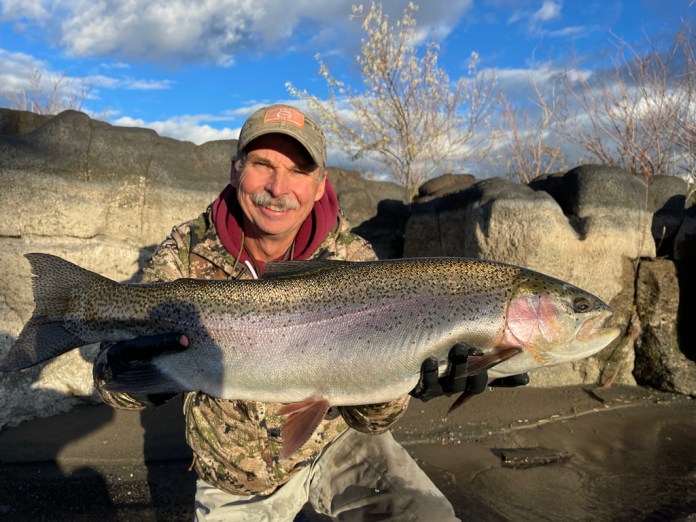
I’m a hunter and fisherman and the subjects of my pursuits are incredible to look at. I can’t help myself for wanting to try to capture what I love in my work. I love fishing with a fly rod and looking at the incredible variety of fish that I have been lucky enough to connect with. The other day I was fishing with my son in some new water and he landed a beautiful rainbow with huge spots on its head. I’m sure that fish will work its way into one of my paintings.
My education was a formal, traditional education. Our instructors demanded that we learn to observe and draw and paint, not only from life but using our imaginations as well. As an illustrator, you have to use your imagination to fill in the blanks when you can’t get the reference you need to complete a narrative. Over the years my style hasn’t changed much, and I’m still satisfied representing the subjects I paint in a representational way. I don’t wander too much from nature and sometimes simplify things, concentrating on shapes rather than details to describe what I’m doing. I love the process of making marks on a surface more than the details of the subject.
Courtesy of Dan Burr
Flylords: What do you hope viewers experience when they see your work?
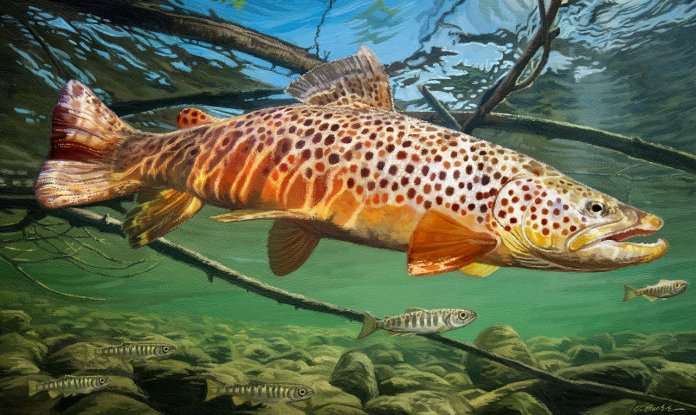
Dan: I hope those that see my work can connect with what I have done and my interpretation or representation of something that they love. Everybody wants to hear the story behind what you are doing. A good narrative tells that story, is complete, and has nothing missing or wanting. For instance, in my fishing paintings, I want to represent the fish naturally and in a setting with elements that would or should be in the scene. I make sure that light is beautifully represented, the surface of the water is believable, and that whatever is under the water makes sense. Composing any painting is a challenge because the design must work. It needs to feel right and today, with so many critics looking for mistakes, you have to get it right if you want to stay in the game.
Courtesy of Dan Burr
Flylords: Do you prefer digital or traditional painting and illustration?
Dan: I was trained to work as an illustrator with a pencil and paint, and the first fifteen years of my career I did just that. I love the feel of paint on a surface, but I don’t like making changes or adjustments on a traditionally painted illustration. I started working digitally in 2002 and had to learn the software that would allow me to draw and paint digitally, then how to duplicate my traditional work using a digital process.
It took a while, but now I love working digitally. I have so much freedom to edit the work and make the changes that improve the final outcome. It has allowed me to be more creative and willing to explore possibilities. On occasion, I still work with paint and love it, but because my work is mostly for the screen or printed page it makes sense to work digitally. When clients commission a painting, I paint it with paint and, for the most part, love doing the work. When I’m doing an illustration project, I paint it digitally and, for the most part, love doing the work.
Courtesy of Dan Burr
Flylords: What keeps you interested in outdoor subjects?
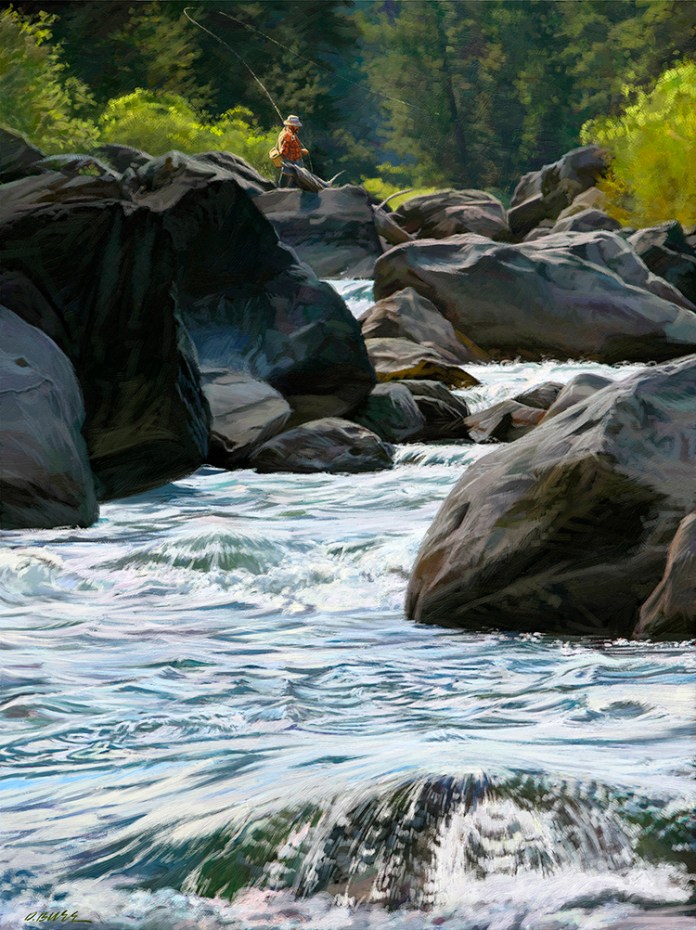
Dan: The other day, the same day my son caught that nice rainbow, we were wading up the river and suddenly a scene opened up that was truly incredible. I’m amazed almost every day by what I see. The world around us is incredible and the critters that live in the places we like to be are amazing. It just seems normal and natural for me to want to capture some of it in a painting or drawing—it’s what I do and I hope I never lose that need in my life.
Courtesy of Dan Burr
Flylords: What are the steps in your artistic process?
Dan: As an illustrator working for publishers, I’m usually working with a text or story of some sort. The editors or whoever I’m working with will suggest ideas for the image and we will discuss different solutions that would be best for the space in the layout and that would best help tell the story.
Sometimes the editor will send me a story and let me come up with the ideas for the illustrations. When I read something I see images in my head that fit with the words, then I do a sketch that attempts to capture what I think of. Sometimes I do a lot of sketches and sometimes I do one or two, then I gather references to help me create the finished sketch that I will send to the publisher for their approval.
Courtesy of Dan Burr
Once they approve the sketch I go to painting the finished art. Reference material helps me portray what is in my head. Because I’ve been painting for such a long time my brain can fill in a lot of gaps, but not in a way that is as good as nature can do it. So, I use as many photographic and observational references as I can get to help me fill in the blanks.
Flylords: What role has fishing played in your life?
Dan: I’ve been fishing with a fly rod almost as long as I’ve been drawing and painting, so having a favorite story or experience is like asking if I have a favorite painting. I probably do but then I’ll remember another one and think to myself, “maybe that one is the favorite.”
Courtesy of Dan Burr
I do have treasured memories of specific fish, takes, and places. For many years, I guided fly fishing trips part-time during the summers for a local lodge. There are so many stories from those trips, some funny and some not. I also have a specific memory with my wife and daughter when she was very young. We were on the South Fork in July, and the mayflies were everywhere. The fish were pounding them, and the boat was anchored on a shallow bar. I was trying to help my daughter hook one of the feeding cutthroat, and she finally did. I can still see that day with her curly blonde hair in the sunshine, her excitement at trying to cast the fly, and her mother taking photos of it all. Days on the river should all be like that.
Later our son came along and we have spent many days on the same river. One day, when he was still pretty young, he caught a beautiful cutty with a fly he had tied. I have a great photo of that day, but I don’t need the photo to remind me of it. He’s on that same river today fishing, even though it’s January and cold outside. Fishing has become his passion and I cherish the days I get to spend fishing with either or both of our kids.
Courtesy of Dan Burr
Flylords: What keeps you painting?
Dan: Sometimes it’s hard to believe that I’ve been able to make a living as an illustrator for all these years. This year makes 33 and it’s hard to imagine where the time has gone. Digging through my files and looking at dates on the work flashes me back to the day or days when I was doing the drawing or painting. I remember every one and most of the circumstances surrounding each.
There are days when I don’t want to paint, but I can honestly say that my work still brings me joy and fulfillment. I love finishing a project—it’s satisfying to paint the last stroke or sign my name to a painting. I guess that’s what keeps the ball rolling, oh, and the paycheck that goes with it. I get paid to paint pretty pictures, and money is a good motivator. I hope I never tire of wanting to go through the process of making a painting or telling a story.
Courtesy of Dan Burr
Flylords: How can folks learn more about you and your work?
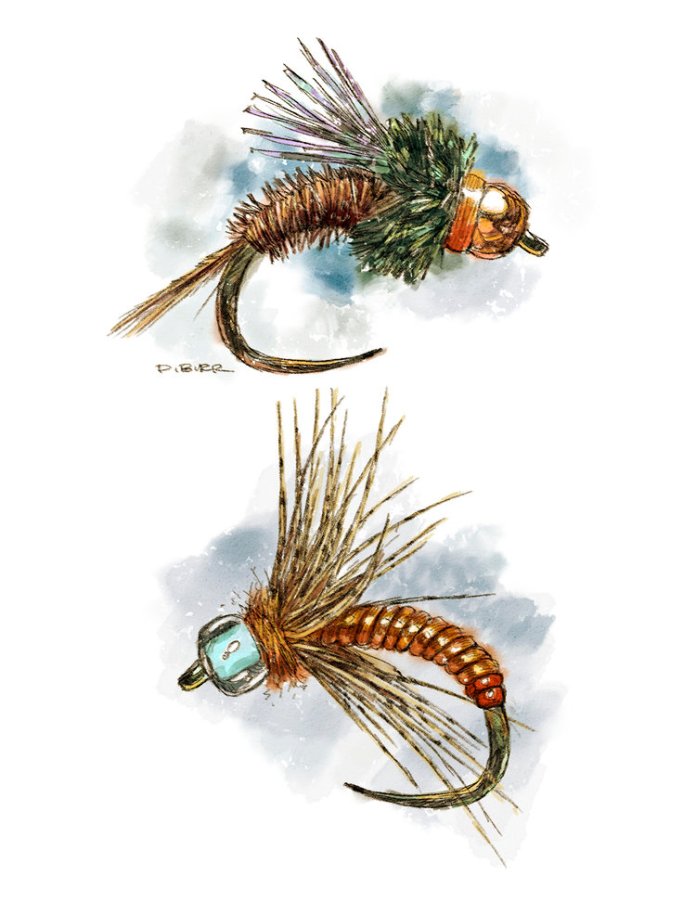
Dan: My website is a good place to see a broad range of my work. There are several videos of me working and talking about projects, a brief bio, and even a photo of me. You can follow me on Facebook or Instagram, and my studio is open to visitors by appointment.* If you like to fish and know how to row—I mean really know how to row—I’m open to a day on the river to discuss whatever you want, except my fly patterns.
Next up on the 2022 F3T Behind the Lens… “Cicada Hatch.†Every 17 years, there is an insect hatch of biblical proportions … Some call them red eyed cicadas, some call them periodical cicadas, and others call them 17-year locusts. No matter how you refer to these giant terrestrials, everyone only has a few opportunities to fish this hatch during their lifetimes. Join Matt Devlin of Western Pictures on this personal journey from Montana to Maryland.
Flylords: What drove you to capture this?
Matt Devlin: I learned to fly fish during the summer of the last emergence. I remember that I missed it by a matter of weeks or months. As I continued to become more involved in fly fishing, and more knowledgeable in insect entomology, I came to realize how awesome it would have been to trout fish during that cicada hatch. I continued to hear stories about how that influx in biomass during the 2004 cicada hatch created the glory years for Maryland trout fishing. People would always reference that hatch and the following years as a time when the fish grew faster and larger than any other year class. It’s always been a keen memory in the back of my mind that I had locked away until 17 years later. It’s amazing how quickly those years went by… 2021 was here before I knew it, and this time I was ready to do whatever it took to experience it.
Flylords: How did the hatch compare to your best hatch experiences?
Matt Devlin: I was a fly fishing guide in Missoula, Montana for 11 years, so I’ve experienced quite a few hatches in my life. With that being said, this cicada hatch was right there at the top of my list! I’ve never experienced anything like it before. It’s such a unique bug considering that it’s terrestrial, but it ends up in the river in mass quantities. And the fact that its emergence only happens every 17 years makes it extra special. Everything about it is weird and wonderful. The noise kinda gets under your skin. The sound, the visuals, the emergence. It’s intense.
Flylords: What is something unique to fishing the 17-year cicada hatch?
Matt Devlin: In fly fishing, time spent on the water, observations, and building on your knowledge base is how you get better. But, what’s unique about the 17-year cicada hatch is that nobody is an expert. The hatches are so far apart, that there is a lack of information about how to fish for them. It was a fun challenge to navigate the unknowns and make it happen on my own terms.
Flylords: What is a tip that you can provide to anglers looking to fish this hatch in the future?
Matt Devlin: One of the biggest things I learned while fishing this hatch is that you have to be patient. The peak of the hatch will be different across geographic zones. The time you want to be fishing is probably a little later than you expect because it takes time for the insects to hatch, then it takes more time for the fish to recognize what the food source is (remember, they haven’t tasted these bugs for 17 years, so usually, never). Additionally, the river corridor is on a different hatch schedule than the surrounding space. It could be going wild just off the river corridor, but until the hatch really gets going down by the river it’s not time yet.
Flylords: Are you planning on heading back for the next one?
Matt Devlin: I will certainly be returning to fish the hatch for as many years as I can. It’s become a very meaningful part of my life. It’s an interesting way to look at your life and check-in. It’s a chance to evaluate your life and think ‘this is where I was when that hatch happened,’ so on and so forth. I was one and half when it emerged in the late 80’s, I was of age in 2004, I was prime for this past hatch, and I’ll be in my early 50s for the next. It’s a way to keep a timeline of your life in general.
Flylords: What message are you hoping viewers walk away with?
Matt Devlin: More than anything, I hope that this film inspires people to live life now. This film certainly inspired me to do that… I was so close to not going back for a second shot at fishing the hatch, but I’m so glad I did. Experiences are priceless, and I thought ‘will I regret going or not going more?’ It was some of the most incredible and restorative fishing that I’ve ever experienced.
It likely comes at no surprise that stream access is a contentious topic wherever it is challenged. Anglers across the country commonly deal with whether or not a waterway is public, and more so if the streambed is public property. One such challenge, on the Arkansas River in Colorado, picked up momentum in the state’s court system when the Colorado Court of Appeals announced that the “Hill v. Warsewa” case will move forward into appellate court. Mark Squillace, a professor of natural resources law at UC Boulder, remarked that the court’s decision is a big development in taking a public waters access case to trial.
You can read Mr. Squillace’s full remarks on the case, below:Â
“The Colorado Court of Appeals has upheld our standing to bring this stream access case. The court denied our claim that the public enjoys an easement over the bed for which Hill could bring a quiet title action, but held nonetheless that Mr. Hill has standing to claim that the Arkansas River is navigable for title and subject to a trust on behalf of the public. Here’s the key language from pp. 16-17 of the opinion:
 If, as Hill alleges, the relevant segment of the river was navigable at statehood, then the Warsewa defendants do not own the riverbed and would have no right to exclude him from it by threats of physical violence or prosecution for trespass. In support of his claim, Hill proffers numerous factual allegations that the river was used for commerce at or near the time of statehood, including floating beaver pelts, logs, and railroad ties down the river. We certainly cannot, at this early stage, know whether Hill will be able to establish that the river segment was navigable at statehood. But we cannot say it is not plausible.
 Moreover, as noted, the question of whether, and to what extent, the public trust doctrine should apply to the bed of a navigable river has never been resolved — or, as far as we can tell, even addressed — in Colorado. Nor has Hill’s claim that he is entitled to access to the riverbed based on English common law been resolved or addressed. Thus, it cannot be said that the law as it stands now unequivocally bars Hill’s claim.”
Whether you’re a noob or a pro, all fly anglers need to know how to attach tippet. Check out this video from the Orvis Guide to Fly Fishing breaking down the basics of leaders and tippet, and best practices for attaching new tippet.
In this week’s “How to Tie†video feature, Tim Cammisa ties a highly productive nymph that any level fly tyer can tie with ease, Walt’s Worm.
Difficulty: Easy
The Walt’s Worm is one of the most versatile nymphs on the market today. It’s simplicity allows it to imitate a wide variety of bugs, while being very efficient to tie. This is a perfect pattern for beginners on the vise and those that may not want to spend countless hours tying flies. From crane flies, caddis nymphs, and scuds, this fly will be a strong imitation on nearly any trout stream.
Adding a hot spot bead or thread to this very simple fly is a way to turn this into an attractor pattern that stands out for fish. On some of the slowest days of fishing, adding a hot spot fly to your rig may just turn on the bite. You have the ability to change the color and size of the hot spot easily, which makes for short sessions on the vise with high productivity. The Walt’s Worm is one of those flies much like the Woolly Bugger, where the imitation is a wide variety, but the end result is production.
Picking out the body with a piece of Velcro is one way to give this simple fly a bit more life. This may imitate legs or other aspects of nymphs, and can only add to your chance of a hookup. Personally, the Walt’s Worm is one of my top selections when there is no visible hatch. Matched with a hotspot, this fly is as deadly as they come and hungry trout will not be able to pass up this meal ticket.
Last week, you may have seen news that US Army Corps of Engineers announced an historic $1.1 billion investment in Everglades restoration. The funds were allocated from the Bipartisan Infrastructure Bill that the President signed into law on November 15th, 2021. Before we take a look at where this money is going, it’s worth reinforcing the complexity and nuance surrounding Everglades restoration–this is not a simple topic. Thankfully, we’ve got groups like Captains for Clean Water, navigating these processes and translating all the minutia.
According to USACE’s accounting breakdown, five “South Florida Ecosystem Restoration” projects will receive funding.
Initiate and fully fund construction of the Broward County Water Preserve Area C-11 Impoundment feature.
Initiate and fully fund construction of the Indian River Lagoon- C23/24 North Reservoir feature.
Initiate and fully fund construction of Central Everglades Planning Project South – S-356 Pump Station feature.
Biscayne Bay & Southern Everglades Ecosystem Restoration (Complete PIR).
CERP Design – Western Everglades Restoration Project (Complete PIR).
Thousands of words would be needed to adequately explain these projects. So, en leu of that, just understand that the recently-funded “South Everglades Ecosystem Restoration” projects achieve varying levels of benefit and restoration for the Everglades and South Florida’s ecosystems. For example, some of the projects will capture and store rainfall runoff from suburban areas, and others have more to do with planning and review.
However, there’s a big caveat here, and one that has major implications for efficiently restoring the Everglades. While this investment in Everglades restoration is historic and federal involvement is always welcomed, it did nothing to advance the priority project that would have the most benefit for restoring the Everglades ecosystem and defending the harmful discharges to the east and west coasts of Florida. None of these federal dollars were allocated to continue construction on the Everglades Agricultural Area Reservoir.
You see, the EAA Reservoir will be composed of a 6,500 acre natural wetland project and 10,500 acre reservoir to capture discharge water from Lake Okeechobee. All of the projects under the Comprehensive Everglades Restoration Plan are important and will be needed, but the EAA is the most urgently needed component because it would provide immediate relief from the toxic discharges that have fueled harmful algal blooms, red tides, and fish kills during past summers. Daniel Andrews, Captains for Clean Water’s Executive Director, noted that “on one side this is awesome because it’s a ton of money for Everglades restoration, but the downside is that money is not being spent on projects that are going to have any significant benefit on our fisheries or estuaries.”
“This is a historic, monumental amount of money and we are extremely grateful to the bipartisan members of Florida’s delegation, the U.S. Army Corps of Engineers and to our supporters for making this necessary investment in Everglades Restoration.
However, while this investment is extremely important, it’s not going to do anything to stop the discharges. The project that will provide actual relief from the damaging discharges—the EAA Reservoir—has been further delayed and is still not fully funded.
The EAA Reservoir project is known as the “Heart of Everglades Restoration” and it will provide the greatest reduction in discharges to the estuaries, yet none of this federal funding was allocated to the EAA Reservoir.
As restoration is a marathon, not a sprint, we do look forward to additional significant funding in this year’s annual budget process to commit to this critical storage project south of Lake Okeechobee, but we still question why it received nothing from this record amount of money.”
Everglades restoration will continue, and hopefully the priority projects will continue to receive funding and progress, but this investment does not appear to be the best bang for the Corp’s buck. There are still opportunities for the EAA project to receive major federal contributions this year through the Federal Budget process. However, it may be more difficult to allocate additional federal funds to the EAA after $1.1 billion was earmarked for other Everglades restoration projects. Time will tell.
In this Video of the Week, we take a deep dive with Costa into the Indifly Organization and their Wind River Reservation project. Indifly is an organization that serves the Indigenous communities. Ultimately, Indifly helps develop sustainable local economies while empowering Indigenous communities to conserve natural resources. The Wind River Reservation is home to the Eastern Shoshone and Northern Arapaho Tribes. The Wind River Indian Reservation is one of the most spectacular wild and remote places in the lower 48. The 2.3 million-acre Reservation includes some of the best fishing in Wyoming with over 1,100 miles of streams and 265 lakes containing a variety of trout species and attracting visitors from across the country.
The residents of Wind River nonetheless face many challenges to protect their pristine resources, including barriers to youth engagement in the outdoors, limited management and enforcement resources, and an unemployment rate of over 70 percent. Indifly has partnered with the Eastern Shoshone & Northern Arapaho Tribes Fish and Game in an effort to develop a lodge on the Wind River Reservation that will be fully run and operated by the tribes. This project aims to create future stewards, utilize the unique natural resources of the Reservation to empower enrolled members, provide sustainable livelihoods, generate community-wide economic benefits, and create incentives for the protection of Indigenous homelands. Learn more about this project and others here: https://www.indifly.org/
On January 26th, we got word of some very good news out of the Boundary Waters. As of the 26th, the Department of the Interior has “canceled two hard rock mineral leases adjacent to the Boundary Waters Canoe Area Wilderness in northeastern Minnesota.” These mines and quarries posed direct threats to the wilderness area, and we’re stoked to see the DOI taking action on an issue so many outdoors people spoke out about!
Today the Department of the Interior canceled two hardrock mineral leases adjacent to the Boundary Waters Canoe Area Wilderness in northeastern Minnesota. The action comes after the Department’s legal determination that the leases, held by Twin Metals Minnesota, were improperly renewed by the Department in 2019.
“The Department of the Interior takes seriously our obligations to steward public lands and waters on behalf of all Americans. We must be consistent in how we apply lease terms to ensure that no lessee receives special treatment,†said Secretary Deb Haaland. “After a careful legal review, we found the leases were improperly renewed in violation of applicable statutes and regulations, and we are taking action to cancel them.â€
A new legal opinion from the Interior Department’s Office of Solicitor found significant legal deficiencies in the circumstances surrounding the 2019 renewal, including: the lease renewal forms contravened the Department’s regulations; the Department did not duly recognize the U.S. Forest Service’s consent authority; and the inadequate environmental analysis failed to include a no-renewal, no-action alternative. Subsequently, the Interior Department has canceled the two leases.
No mineral production has occurred on either lease since the original date of issuance in 1966.”
To learn more about the actions taken by the DOI, you can read this press release.
Penn State University is home to the country’s oldest fly fishing club and fly fishing education program. Over the decades, familiar faces like Joe Humphreys and George Daniel have taken the helm of the program in Happy Valley. Recently, the University announced a huge quarter of a million-dollar endowment that will ensure that Penn State Fly Fishing continues on for decades to come!
Wrestling fans flanked fly-fishing enthusiasts at the Penn State vs. Rutgers tournament on the night of Jan. 16, drawn together by a 93-year-old Penn State alumnus whose decades of achievements have spanned both sports. Before garnering fame as a world-renowned fly fishing icon, Joe Humphreys faced down foes on the wrestling mats of Rec Hall and demonstrated an athletic prowess that he would later parlay into acumen as a coach and instructor, culminating in his induction into the National Wrestling Hall of Fame in 2012 and the Fly Fishing Hall of Fame in 2013.
University officials chose the wrestling event as an apt backdrop to announce the receipt of an anonymous gift that will honor Humphreys’ legacy and provide substantial financial support to Penn State’s fly fishing program. The $250,000 endowment will help to secure the program’s status as a top-tier educational leader in the sport of angling.
You can learn more about the endowment and the Penn State Fly Fishing Program in this PSU press release!
Last summer 10-year-old Piper and her father PJ seemingly pulled off the impossible, Piper caught a Florida Keys Grand Slam at 10 years of age! Piper and her Father won a casting lesson with Nathan Linville from the Mill House Podcast and decided to get a day on the water with Simon Becker after the lesson. From there Piper went on to catch a permit, bonefish, and a tarpon in one day, in the Florida Keys! This is not at all an easy task for anyone who has fished down in the Keys, the fish are smart, selective, and stubborn at times. We caught up with Piper to learn more about her day on the water and what went into the success, check out the full interview below.
Flylords: Can you give us a background about where you were fishing and with whom?
Piper: We were fishing in August down in Key West with Captain Simon Becker. We were on a family trip before my sister left for college.
Captain Simon and 10 Year Old Piper.
Flylords: How did you prepare to catch a grand slam? Did you practice at all?
Piper: Yes, I did practice! I practiced in the front yard with my dad and I went to my dad’s work where there’s a pond to catch bluegill and bass. I was fishing a lot before the trip with my dad on his boat for redfish and tripletail. The day before I went to catch my Grand Slam I had a casting lesson with Nathaniel Linville from the Angling Company in Key West. We practiced in a park working on my distance and my backcast. I won the casting lesson and some cool stuff from the Mill House Podcast on Christmas last year!
Nathaniel Linville and Piper doing some casting practice.
Flylords: Which fish did you catch first? Can you walk us through how the day unfolded?
I caught my permit first! We woke up pretty early to take a cab to meet Simon. When we met him he said, “no matter what happens today we’re going to have fun!”. At the first spot we went we were looking for tarpon but we got rained on! I hid from the rain in Simon’s stripping basket. The next spot we went to I saw one tarpon but it spooked. Our guide saw fish pushing water and said they were permit. We idled to get ahead of them and started poling. Finally, we got close enough to them that I could see them and make a cast. I caught it on my first cast!
We went to another spot to look for tarpon and bonefish but didn’t see any. We took a break to eat snacks and Simon taught me what to do if a shark ever comes up while you’re fighting a fish. He taught me a lot that day! Then we went to another spot for bonefish and it got really cloudy. Simon said there were some bonefish at 11 o’clock and I casted but he said I was short. As I was stripping my fly it came tight and I said “I got one!”. It wasn’t the hardest fight I’ve ever had but it was still fun! That’s probably because I had just caught that big permit.
It was later in the day and my dad asked if we could go try and catch a tarpon. Simon said it was really hard because it was late in the day but he had a spot that he thought we could try. When we got to the spot we didn’t see any for a while. We got to a place where there was an area by the mangroves that we couldn’t get to but he said they were probably back there. He slapped the push pole on the water and said that makes them come out sometimes. A few seconds later some came out but they were spooked and swam away. While we were sitting there Simon said he saw some coming at us down the mangroves and told me to cast in front of the boat. I stripped the fly twice and a tarpon ate it. It jumped so many times! I got it all the way to the leader and the colors were very vivid and bright. Simon grabbed the leader and it came off at the boat.
Flylords: Can you talk us through the permit? Being an extremely hard fish to catch on the fly how did you catch it?
Piper: I have to keep Simon’s fly a secret but the fish were swimming high and I watched it eat the fly. It whirled around the fly several times and then ate it. I was nervous the whole time because my hook was barbless. I fought the fish for almost twenty minutes. It was the longest fight I’ve ever had with a fish!
Flylords: What went into the success of getting the grand slam?
Piper: We stayed determined and didn’t let things like the rain and messing up a cast get us down. I told my dad I wanted to catch a grand slam but he said it would be really hard for me to get a permit (he still hasn’t caught one). I stayed positive the whole time and Captain Simon was so nice and he wouldn’t yell at me when I made a mistake and get aggravated. I couldn’t have done it without Captain Simon Becker!
Flylords: What kind of gear were you using (size rod, line, flies)?
Piper: I used an older Orvis Helios 9′ 9wt that Captain Simon had to catch all of my fish. The permit was on Simon’s secret fly, the bonefish was on a small shrimp pattern, and the tarpon was on a purple toad.
Piper taking cover in the rain.
Flylords: Any tips for other young anglers?
Piper: Kids can get upset really easy so when something goes wrong don’t get discouraged. There’s always more opportunities to come! Being out there and seeing the pretty water and the animals is the gift, catching fish is just a reward we get sometimes from being out there.
Flylords: What’s next for your fishing adventures? Any species you would like to catch?
Piper: I want to catch a BIG tarpon and a bumphead parrotfish!
Thanks so much to Piper and her Dad PJ for sharing her story, be sure to follow along with Piper’s adventures at @pjohansen920.