Home Blog Page 137

Angler Lands Potential Redfish X Black Drum Hybrid

0

Hybrid – (n) – (reproductive biology) The offspring resulting from the cross between parents of different species or sub-species.

Hybridization is not a completely uncommon occurrence in the wild. In fact, wild Tiger Trout and Tiger Muskie do happen on occasion when the right conditions line up in the sweetwater. However, a hybrid Redfish and Black Drum has only ever been spoken of in hushed tones…until now.

“I caught what will most likely be the craziest fish of my entire life recently. While out fishing with my friend Billy we came across a small school of black drums. He pulled one out of the school and when it was my turn I hooked something that was a little different. Once the fish broke the surface and turn sideways we both knew what we had in our hands. We had a true Black Drum/Redfish hybrid. These have been bred in captivity but have never been documented in the wild before. We were beyond ecstatic to say the least. We released the fish and let FWC know about the capture. The photos are currently under review by the FWC.” – Kieran Hoffman (@KieranHoff)

How to Tie: BWO Soft Hackle

0

In this week’s “How to Tie” video feature, Trident Fly Fishing gives us a tutorial on how to tie the BWO Soft Hackle.

Difficulty: Easy

Fall is officially upon us. Colder weather will start replacing hot sunny days and terrestrials replaced by midges and blue winged olives. Morning and afternoon hatches will soon become mid-day hatches. The BWO Soft Hackle is a fantastic fly to imitate the small mayflies soon to be emerging to the surface. Swinging and dead drifting this fly will produce fish and undoubtedly make colder days on the water much more enjoyable.

The profile of the BWO Soft Hackle is extremely simple and buggy, making this an easy tie that will do the work for you underwater. The soft hackle allows for pulsations in the current, imitating the struggling bug trying to transition into a dun as it swims toward the surface. This style fly is very versatile as different body combinations can be created by changing the thread and dubbing. Picking an adult blue winged olive from the surface and looking at the color will help determine the right shade of green or even another color.

For beginners, this fly is incredible. Simple to tie and easy to fish, this emerger will pick up finicky fish on the toughest days. Sizes 14 to 22 for this fly are ideal, but usually you’ll find yourself on the smaller side of this range. Pairing this with an attractor style fly with weight is an efficient way to match the hatch, while using a pattern you may have more confidence with in that specific water. When colder days approach and small mayflies start popping off the water, tie on a BWO Soft Hackle and wait for the tug soon to come.

Ingredients:

Now you know how to tie the BWO Soft Hackle.

Video and ingredients courtesy of Trident Fly Fishing.

How To Build A Fly Rod And Reel Outfit

0

If you’re in search of a multipurpose fly rod for freshwater, this is the resource for you. In this video Joe from Red’s Fly Shop provides valuable tips to help you figure out the rod, reel, and line you need for an all-star setup.

5 Tips for Fly-Out Fishing

If you have access to an airplane or can rent out a charter plane, you need to try flyout fishing. Taking a plane out to a remote creek where the only competition is the wildlife is very exciting. Fishing untouched water is unmatched, and we want you to be prepared. Whether you have your own bush plane or are going on a chartered trip, this article will set you up for success. Read below to learn five awesome tips for flyout fishing!

1. Pack Light

Weight and balance is an essential part of flyout fishing. To get into remote airstrips, it’s important to be as light as possible (good thing fly fishing gear is lightweight). Bring a small backpack for your fly box, reel, and snacks. Pick out a fly box or two that you really want and don’t bring an entire bag on fly boxes. You might have to go for a short or long hike to get to the fishing spot, so bring a pack that is comfortable to walk in. We recommend the Simms Dry Creek Z waterproof backpack. If you’re bringing a net, use a lightweight one that takes up minimal space.

2. Do Your Research

Depending on where you live, there will be a variety of strips or a limited few. We recommend researching quality strips and locations for your fishing adventure. If you’re the pilot, start at a long strip, and slowly work your way up to short gravel bars. Likewise, if you’re on floats, start at a large lake with lots of creek outlets. There can also be some pretty amazing fishing right next to long airstrips or even airports.

3. Be Prepared

Mother nature can throw all sorts of things at you when out in the wild. It is important to have layers, a first aid kit, and extra food. Airplanes can take you to some incredible locations, but it is essential to be prepared for the elements and everything else. Using a Garmin Inreach or Spot can be very beneficial in remote locations without phone service. If you are spending a lot of time in the bush, you can invest in a satellite phone plan.

Are you going to be flying into bear country? If so, bring bear spray or a gun, you don’t want to be caught in the middle of nowhere with a bear between you and your plane!

4. Use a 4-Piece Rod

Although you might be able to fit a full rod in some planes, it is best to carry your rod in a tube. A 4 piece rod is quick and easy to put together, and it saves you lots of space in the plane. We recommend the G Loomis IMX Pro and the Orvis Helios 3F, which are both available from 4 to 8 weight. Whatever 4 piece rod you end up using will make flyout fishing easy and minimalistic.

5. Take Lots of Pictures

Flyout fishing is a surreal experience, and you are going to want to remember it forever. Take a variety of pictures, so you can share your experience with family and friends. You never know what you are going to see when flying, whether it be fish, glaciers, or rivers. If you’re looking for some flying and fishing inspiration, check out Flyout TV on youtube.

AFFTA Announces New IFTD Dates

0

After AFFTA announced the postponement of IFTD two weeks ago, many thought we’d be in store for another year without the perennial gathering of the fly fishing industry. However, in a recent press release, AFFTA announced that the show will in fact go on, just a few months late.

From AFFTA:

AFFTA is excited to let you know that we have new dates for IFTD! There will be new and exciting components to this show, your show! This is our industry’s gathering, our community’s opportunity to help each other’s businesses. As part of that business component we are having a Dealer Summit on Tuesday, March 29th, so make sure you come a day early, retailers! Dates for IFTD are March 30th – April 1st, 2022 in Salt Lake City, Utah!

We are excited about the fact that we are getting to have our show at a different time of the year and are only six months away from our original dates in October. This is just the start of the innovative ways we hope to change our industry gatherings moving forward. Together we can ensure that our industry remains strong in the face of the ever-changing landscapes of today and what better way to be together than at IFTD 2022!

Will you be attending the rescheduled show?

Fly Fishing Alpine Lakes; My First Experience in the High Country

Being from Cape Cod, which is essentially a giant sandbar, the idea of mountains, and just high elevation in general, was pretty foreign to me. I have spent some time in Colorado, so it wasn’t like I’d never seen mountains before, or experienced what life is like thousands of feet above my house in Massachusetts, but I still hadn’t really journeyed much deeper than the typical trout streams, and the occasional small creek. Looking at these mountains high above me, I always used to think, “I wonder what’s up there”, and my imagination would run wild. So, this summer when the opportunity arose to finally get up around treeline, and chase some beautiful, native Cutthroat Trout around for a day, I jumped on it as quickly as I could.

Our story starts on the evening of July 24 when I was coming home from a late-afternoon scouting mission. We were bouncing in and out of cell reception, which seems to be a given when I’m anywhere other than Massachusetts when a message pops up from Brooke Duncan, a fellow Flylords content team member and a good friend of mine. It said something along the lines of, “Do you want to hit up an alpine Cutthroat lake tomorrow morning?” I like it, straight to the point, no messing around. This was the type of message that you don’t say, “no, I’m busy” to, even if you are busy, you somehow have to find a way to figure it out; and by some miracle at 7 o’clock the next morning my family and I were following the Duncans up some steep, rocky switchbacks in our dusty rental Nissan Pathfinder.

While not all four wheels were touching the dirt at a given time, the Pathfinder stayed on the path, and we made it to the pull-off seemingly unscathed. As it turns out when you are chasing fish that live high up in the mountains, a car can only get you so far, so I guess this is where the “fun” part started. Before I could realize that I might have been sandbagged just a little, we were leaping over a creek and jumping headfirst into the steepest trail I’ve ever seen. In just over a mile, we gained around 1600 vertical feet, and my legs felt every single one. I consider myself to be fairly athletic, and in solid shape, but I will admit that the combination of the steep trail and thin, rocky mountain air got to me, and I was definitely huffing and puffing my way up.

Once we got through the steep, brushy, rock scramble of misery, the trail started to mellow out and we could see that we were getting close. We soon got to a small meadow that ended in a short, but steep hill. We moved as fast as our burning legs would alow up that hill because we knew our final destination was right on top, just out of view. Believe it or not, the lake indeed was right over that hill and it took about ten seconds to see a beautiful 18” Colorado River Cutthroat Trout cruising gracefully just below the surface. It was quickly apparent why trout bums across the Rockiess spend their days hiking up to these remote lakes. We quickly set up our rods, tied on our flies, and started fishing.

Brooke, my Dad, and I took off for the Northern bank of the lake because it had a nice dropoff and a path up above the shore that made for good spotting. I was up first so I was ready to go, walking as stealthy as I could along the bank, as my Dad and Brooke spotted from above. A few minutes into it, I hear “There’s one!” 

“Solid fish cruising on the dropoff right towards you.”

“Alright it’s in range, go” 

From where I was standing there was too much glare on the water to see the fish, so I put my fly right on the edge of the dropoff where the alleged fish was cruising. 

“Nice cast, you led him too much though. Just leave the fly there, it will see it if it keeps cruising straight. Also, don’t move.”

Luckily, the fish stuck to its pattern and cruised over, heading right to my fly. It gets within a yard and my heart is pounding. By this point, I can see the fish, and I watch as it slowly tilts its head up, and ever so slowly ascends upward toward my fly. It sounds cliche but everything around me did melt away and for just these few seconds the only thing that mattered in the world was this Cutthroat and my fly. As delicate and calculated as we all know trout can be, our little friend sipped my little black ant and my heart dropped. I waited what felt like forever but was probably less than a second, and then I lifted my rod and set the hook. (Yes my salty friends, I trout set, it had to be done) Somehow I didn’t choke the hookset and after a relatively short sequence of small runs and headshakes, my first alpine lake Cutthroat was sliding into my hands.

As the morning wound on, my dad and I each caught a few more of those amazing fish, and both Brooke and John went on to absolutely school us on those incredible waters they call home. Before I knew it, we were packing up our rods and heading off down the trail, back to civilization where there are other people and cars and opinions and problems. The thing about the high country is that those four things (along with a whole list of other bummers) don’t really exist, and I think that’s why there’s so much of a draw to come up to those lakes. That beautiful, alpine country really does leave you with a little something extra to take home. Hell, I’m back on the Cape right now, and as I’m finishing up this article after just having a day of Albie fishing that I dream about all year long, all I can think about are those big Cutthroat, sipping little ants up in the mountains of Colorado.

Greenie Weenie Season

0

Greenie weenie season is in full swing now. While the bright chartreuse fly is mainly imitating the green inchworms that hang from trees it can also imitate other caterpillars and occasionally caddis larvae.

The fly has been a staple in fly fishing for many years, it looks very similar to the ever so popular mop fly.

Do you like the greenie weenie or hate it? Do you prefer a mop fly or the greenie weenie?

Article and photos from Eric Harvey, give him a follow at @vatroutjunkie.

Learn how to tie the Greenie Weenie:

5 Trout Fly Patterns to Tie Under 2 Minutes

Suspected Pipe Bomb Found, and Detonated by Authorities at Jefferson River Fishing Access

0

According to Montana Fish, Wildlife, and Parks, a suspected pipe bomb was discovered in the Jefferson River south of Willow Creek last weekend and was detonated at the site. The device was found by the Gallatin County Sheriff’s Office Search and Rescue Team while they were training at the Williams’ Bridge Fishing Access.

“We’re grateful to Gallatin County and Malmstrom Air Force Base personnel for their collaborative response in this situation. Thanks to these efforts, we were able to safely reopen these sites to the public,” said FWP Warden Capt. Adam Pankratz in a Wednesday afternoon news release about the suspected bomb. “This is also a good reminder to use caution and carefully inspect items we would normally think of as litter before picking them up.”

The Gallatin County Sheriff’s Office is leading the investigation into the explosive device. People with information about the suspected pipe bomb found in the Jefferson River can share that information with the sheriff’s office by calling (406) 582-2100.

Learn more about the device and the quick response from authorities, in this article from the Bozeman Daily Chronicle.

BREAKING NEWS: EPA Resumes Process to Protect Bristol Bay

Today, the Environmental Protection Agency (EPA) took the first step to reinstate proposed protections for Bristol Bay. The decision deals another blow to Pebble Mine and its parent company. The announcement also comes after a recent Ninth Circuit Court of Appeals decision that ruled in favor of Trout Unlimited, finding Pebble would have an unacceptable adverse effect.

Pebble will probably continue to fester, but today’s decision makes it much more difficult for the mine to break ground. Further, the decision validates the cultural, ecological, and economical value of Bristol Bay, which has supported tribal communities for centuries and produces half the world’s sockeye salmon.

The EPA plans to reinstate proposed protections in the region through the Clean Water Act’s 404(c) process, which regulates the discharge of dredged or fill material into waters of the United States, a crucial activity for mining. Pebble failed to meet the EPA’s standard and now does not have the necessary permits. In technical terms, the EPA is initiating the process of withdrawing the 2019 determination that eliminated Bristol Bay’s protections and reinstating the 2014 determination and, thus, protections.

“The Bristol Bay Watershed is an Alaskan treasure that underscores the critical value of clean water in America,” said EPA Administrator Michael S. Regan. “Today’s announcement reinforces once again EPA’s commitment to making science-based decisions to protect our natural environment. What’s at stake is preventing pollution that would disproportionately impact Alaska Natives, and protecting a sustainable future for the most productive salmon fishery in North America.”

“This is a smart and significant step toward putting more durable safeguards in place for Bristol Bay’s fish, clean water, communities and businesses,” said Nelli Williams, Alaska director for Trout Unlimited. “This is an important layer of protection that makes it much more difficult for the Pebble Partnership, or any other companies in the future, to mine the Pebble ore deposit. Now is the time to get these much-needed protections across the finish line, and we look forward to working with EPA and Congress to get it done. Let’s put the Pebble mine proposal in the review mirror for good so we can focus on a bright, prosperous and fish-filled future for Bristol Bay.”

Durable protections are now needed to put a definitive end to Pebble Mine and protect Bristol Bay for the long haul. That ball is now in Congress’ court. Alaskan Senator Lisa Murkowski has floated “the idea of passing legislation to put Bristol Bay off limits to development, in exchange for compensation the federal government would provide Alaska for potentially lost revenue.” A bipartisan deal to permanently protect Bristol Bay, sure sounds great, and would fulfill the campaign promise of then-candidate Joe Biden to “listen to the scientists and experts to protect Bristol Bay–and all it offers to Alaska, our country, and the world.” Let’s hope permanent protections for Bristol Bay happen.

Cover picture courtesy of @FlyOutMedia

Costa Behind the Guides: Camille Egdorf McCormick

Meet Camille Egdorf McCormick, a fly fishing guide based currently in the Bozeman, Montana.  Camille has mostly guided in Alaska, but has hosted trips all over the world. The Flylords team was lucky enough to spend an evening on the water with Camille and her son Deke. It was amazing to watch her balance being an angler and a mother and hear about her fishing career. We are excited to add Camille to our ongoing blog series “Behind the Guides” presented by Costa Sunglasses.

Photo: Matt McCormick

Flylords: Tell me about your guiding history? What has been the most rewarding part?

Camille: Most of my guiding history takes place in Alaska where I guided at my parent’s lodge on the upper Nushagak. I started walk/wade guiding when I was 16 then when I turned 18 got my official guide license and started taking folks out in a jet boat. I guided up there for 7 years then started hosting some international trips when I was 23. There are many aspects that are very rewarding so it’s difficult to pick just one thing. The personal development in addition to sharing a fishery and watching others enjoy fly fishing is incredible.

Flylords: I recently watched your Yeti video, “Odd man out!” You talked about this in the video, but how has being a woman impacted your guiding career? Would you be willing to explain a bit about this?

Camille: When I started guiding, there were not many other women in the field so if anything, being a woman drew a lot of attention. Both good and bad. I didn’t experience much discrimination but what I did experience was the need to prove to myself and others I was just as capable as any guy. Through hard work, I did that and that’s something I’m very proud of.

Photo: Camille Egdorf

Flylords: What advice would you give to a woman hoping to get into fly fishing or guiding?

Camille: Just go for it! It’s no longer just a “guy” sport or career so don’t let that intimidate you. You’ll have to work hard but if you want it, can and will make it happen.

Flylords: You have fished across the globe! Tell us about one of your favorite fly fishing trips?

Camille: I think one of the most unique and adventurous trips I’ve done was when I went to Guyana to target Arapaima. I’ve never felt more immersed in a jungle and at the mercy of whatever creeps, swims, crawls and flys around than when I was there. The jungle is like being on another planet and it was awesome. The arapaima fishing was some of the most technical I’ve ever done. We were using 12wts with heavy-duty line and large wet flies that required a lot of effort to cast. An average cast was at least 60 feet since getting close to these fish was very difficult and the only time you really saw them was when they surfaced to breathe. The water was chocolate brown so sight fishing wasn’t an option. By far the most challenging fishing I have ever done but I’d absolutely do it again.

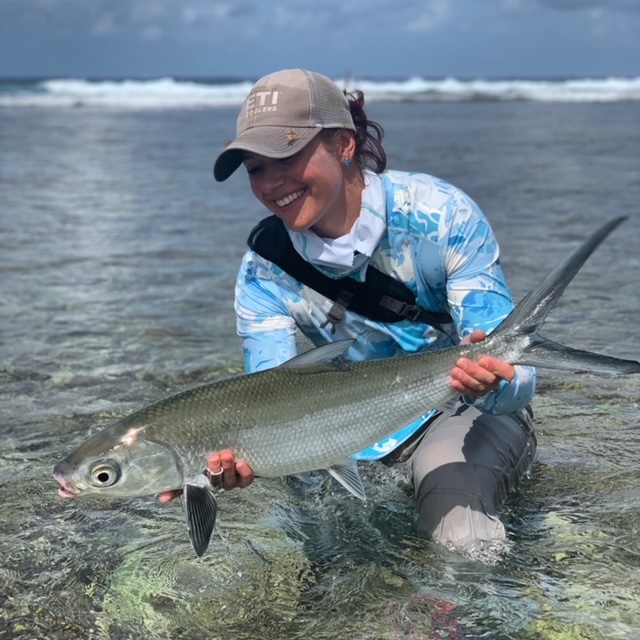
Not an Arapaima; but another fun trip in search of milkfish! Photo: Camille Egdorf

Flylords: You are a mother! What is it like being a mother?

Camille: Being a mom is incredible. So many emotions I never experienced before are now a daily occurrence. A combination of intense love, excitement, and worry all the time. I see the world through a much different lens now.

“Baby up in this B!#ch”

Flylords: What do you look forward to the most about motherhood? What is one life lesson you look forward to teaching Deke?

Camille: There are many life lessons I wish to teach Deke. However, I’m so excited to introduce him to the outdoors. I mentioned that “worry” is something I experience more now that I’m a mom so I find myself in this weird place of wanting him to get outside, skin up to his knees, get dirty and explore but also wanting to shelter him from it. It’s an odd place to be but I hope I can show him the world without sheltering him from it.

“I’m one fly baby”

Flylords: Changing gears, a bit, what sunglasses are you wearing today and why do you like them?

Costa’s Anaa frames with the Copper Lens

Camille: I was wearing the Anaa frames with the Copper Lens. They have great coverage on my face and fit well. Always been a fan of these frames!

Photo: Camille Egdorf

Flylords: What is next for you, Matt, and Deke?

Camille: Deke is only 5.5 months so for right now, focusing on him and family time at home. We plan to take him to Alaska next summer to visit the family lodge and river which I can’t wait for. We’re still figuring a lot out when it comes to being mobile with the little man but we’re slowly finding our new stride. It has been an amazing experience so far!

Thank you Camille for the time, be sure to check her out on Instagram at @camillegdorf. Also, thanks to Costa for supporting our guides, and making this series possible. Stay tuned for more “Behind the Guides” features.

Photos and interview from Gloria Goñi, @lapescadora.

Costa Behind the Guides: Brandon Soucie

Costa Behind the Guides: Nick LaBadie